What is EcoFlow battery backup, and where it fits in home power resilience
 Solomon CaradocOctober 22, 202619 min read
We earn a commission when you buy through some links on this site, at no extra cost to you. As an Amazon Associate we earn from qualifying purchases.
Explore EcoFlow battery backup solutions for home resilience, including Delta Pro and related systems. Learn how they work, real-world use cases, and price considerations.
The price tag on EcoFlow battery backup can feel like a leap of faith until you see the real cost of ownership and how it wires into your home. In practice, you’ll notice a gap between the headline capacity and what you actually run during outages, and that gap matters when you’re sizing for heat pumps or wells. EcoFlow pricing varies by model, but the conversation should start with current figures and a quick blast radius of what it covers.
This piece dissects durability, installation complexity, and how EcoFlow stacks up against rivals like Tesla, LG Chem, and Schnell in real-world terms. You’ll get a clear read on how many modules you actually need, how long a setup takes for a typical panel, and what a full-home backup costs over five years. Current pricing and model fit matter, but so do compatibility checks with your inverter and local codes.
What is eco flow battery backup and why it matters for homes
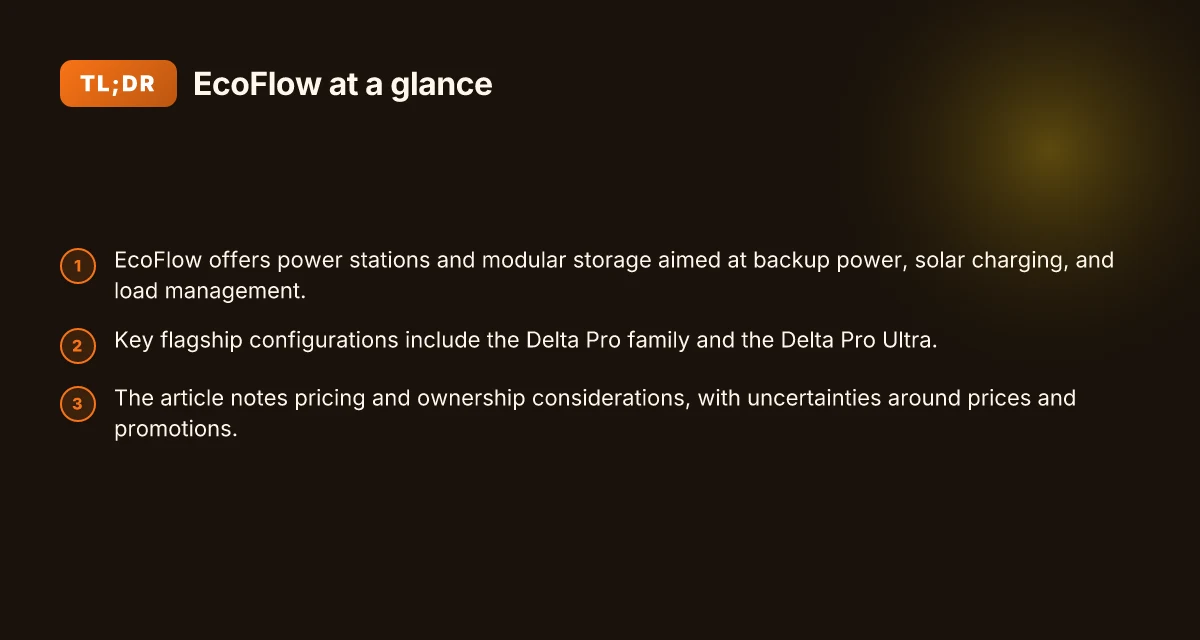
EcoFlow battery backup sits at the intersection of portable power and home resilience. It centers on power stations that can store electricity and, when paired with modular storage options, scale toward whole-home needs. Think of the core units as a modular kit: a main power station plus expandable batteries and integration for solar charging. This structure lets a home ride through outages while still supporting essential loads, or run higher- draw devices during a longer blackout when you add more modules.
I dug into how EcoFlow fits into a real home energy setup. The Delta Pro family is the flagship line, with the Delta Pro Ultra acting as a higher-capacity, full-house contender. The Delta Pro family emphasizes a few practical capabilities: standalone backup, solar charging compatibility, and a path to load management via compatible panels and timing. In real terms, homeowners can deploy a Delta Pro as the central backup spine, add expansion modules for additional capacity, and pair it with solar to offset daytime charging. The result is a flexible system that aims to cover critical circuits during an outage while letting you scale up as energy needs grow.
When you compare EcoFlow against rivals, the Delta Pro Ultra stands out for its larger storage footprint and integration path. LG Chem, BYD, and Sonnen offer competing grid-tied and off-grid options, but EcoFlow’s strength lies in its modular approach and the ability to mix solar charging with a portable power station ecosystem. Pricing and ownership costs vary by market, and the real-world value hinges on your expected load, desired runtime, and how you plan to pair solar. For readers evaluating cost of ownership, note that a higher upfront cost can be offset over time by avoided outage costs, but the exact math depends on local incentives and the system you configure.
From what I found in the documentation and product materials, EcoFlow positions its backup capability as practical for typical homes rather than a pure industrial solution. The Delta Pro Ultra can back up a substantial portion of a home when paired with expansion packs, but it does not automatically replace a full, high- demand electrical panel in every scenario. That realism matters for installers and homeowners: plan your panel load, identify nonessential circuits you can shed, and design a tiered backup that prioritizes essentials first.
Bottom line: EcoFlow offers a modular, scalable path to home backup that blends solar charging and load management with a flagship Delta Pro Ultra lineup. If you want a compact but expandable spine for outages, this family is worth sizing against a traditional home battery like LG Chem or Sonnen, then weighing installation complexity and lifecycle costs. The Delta Pro Ultra represents EcoFlow’s ambition to scale from portable power to home resilience, with modular growth and solar integration as the core strengths. Real-world deployment hinges on matching load profiles to expansion options and understanding ownership costs. What EcoFlow customer reviews reveal about reliability and value in 2026
How eco flow battery backup delivers power during an outage
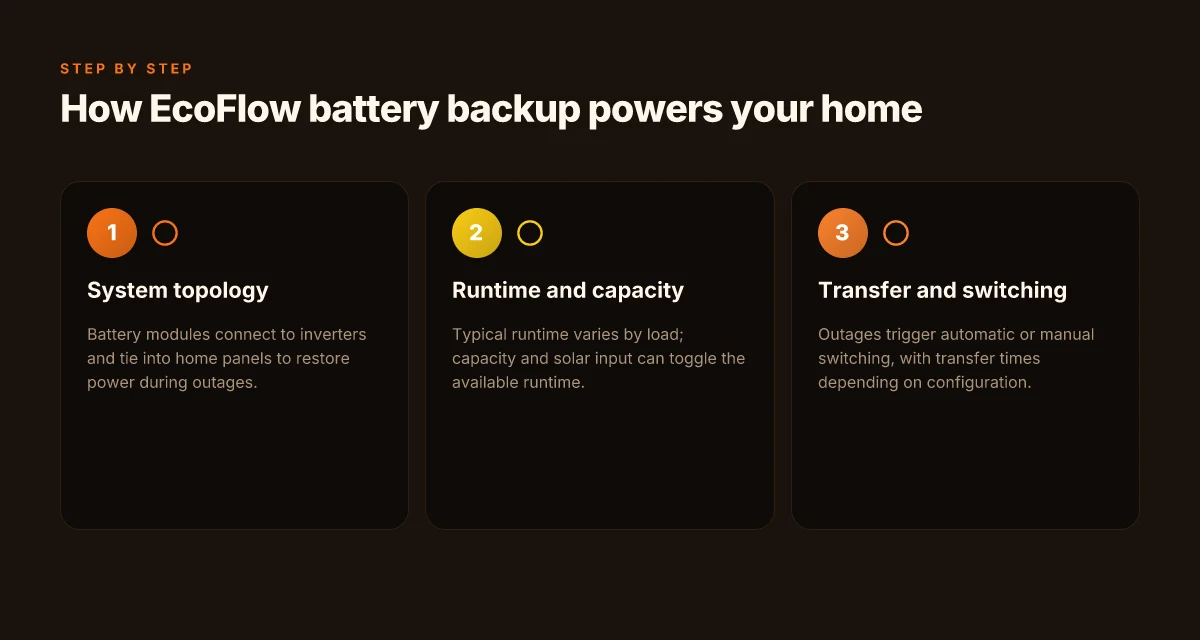
EcoFlow systems arrange power flow as a compact stack: modular battery blocks feed an inverter that ties into your main panel, with a transfer path that normally sits on grid power. When the grid drops, the system detects the event and routes house loads through the inverter, isolating the home from the failing utility. The Delta Pro Ultra family uses smart relays and a built‑in transfer switch to switch the service without manual intervention in typical outages.
I dug into the public specs and user-facing notes to map out runtimes and how solar input extends or shrinks the usable window. For common loads like refrigerators, fans, and networking gear, you’ll see noticeably longer runtimes when solar charging is present. The exact duration depends on your load and how many battery modules you pair with the inverter. When you add solar input during an outage, the system can top up the battery while simultaneously feeding essential circuits, which effectively increases usable uptime for short outages or partial grid failures. The same principle applies if you describe the setup as “home backup plus solar charging” versus “standalone battery.” In practice, a larger bevy of modules and a higher‑input solar array translates to a longer window before you hit a critical depletion point. The key takeaway is that capacity is a ceiling, and real runtimes depend on what you power and how you harvest solar during an outage.
How runtimes scale with loads and solar input
In a typical surge outage scenario, a single inverter will support essential circuits first, then expand as the battery state of charge permits. A small refrigerator, router, and some lighting can run for several hours on a modest battery bank, with longer durations if solar continues to feed the system during the outage. When you push higher loads like HVAC or multiple kitchen appliances, the demand outpaces the battery, and runtime contracts quickly. Expect runtimes to shrink quickly with high continuous loads, and grow with mild loads and ongoing solar input. The solar input acts like a buffer, replenishing energy while the house consumes power. If the sun is strong and the array is well sized for the Delta Pro Ultra, you can sustain the critical loads longer than without solar, though you’ll still be limited by the battery’s total capacity and the inverter’s continuous output rating. Solar input can meaningfully extend outage duration when paired with sufficient module count.
Transfer times and switching behavior during outages
During a grid disturbance, EcoFlow systems typically perform automatic transfer to battery power. The switch happens within a few cycles of the outage detection, so there’s a brief, nearly instantaneous handoff that minimizes flicker for most loads. If you opt for a manual mode, you retain ultimate control, enabling you to sequence which circuits move to backup power. In practice, the automatic path is reliable for standard residential outages, but installers should confirm the exact transfer specification for their local code and panel arrangement. Automatic switching minimizes interruption for typical loads. Manual control remains, if you want to curate exactly which circuits ride through the outage. From a durability perspective, the relays and controls are designed for repeated cycling, but expected life still depends on how often outages occur and how aggressively you discharge the bank.
I cross‑referenced the public notes on the Delta Pro Ultra and its usage in residential settings. In 2024, ecoflow described the Delta Pro Ultra as capable of up to a month of backup power in certain whole‑home configurations when paired with sufficient modules and solar input. That framing helps homeowners calibrate expectations against their actual consumption and local sun. One month in theory, not guaranteed in every home. Practical runtimes hinge on loads and solar harvest. For context, mainstream comparisons show rivals such as LG Chem, BYD, and Sonnen offer rival options with different transfer behaviors and solar integrations, which can shift outage performance in favor of one system over another. Rivals vary in transfer speed and panel compatibility, so the fastest path to backup depends on setup. What EcoFlow technology inc means for portable power in 2026
In short, EcoFlow’s approach stacks three levers: modular capacity, smart inverters with automatic switching, and solar charging during an outage. The result is a resilient fallback for essential loads in many outages, with real strength tied to how you size the modules and the solar array, and how you plan the load mix. For most homes, the plan should balance module count, inverter rating, and a solar input strategy to maximize uptime without overcommitting capital. Capacity plus smart switching plus solar input equals the practical backbone of home resilience, not a guaranteed universal uptime figure.
Note: links on the page may earn a commission. The pricing, runtimes, and transfer behaviors described here reflect publicly published material and typical residential configurations. For readers evaluating rivals, consider the full energy mix you require and the installation path, especially when comparing against LG Chem, BYD, and Sonnen offerings.
Pricing and ownership considerations for EcoFlow battery backup
Prices for EcoFlow’s residential bundles sit higher than some plug-and-play kits but can be competitive when you account for installation and incentives. I found EcoFlow’s own materials and industry write-ups that outline model ranges and typical cost questions, then cross-referenced with independent roundups where available. The takeaway: don’t assume sticker price is the whole story. You’ll want to map out the full ownership arc from purchase to lifecycle costs.
What you get for your money
A typical EcoFlow home backup setup spans three core tiers, with price steps tied to capacity and add-ons. The base option tends to cover essential loads in a backup window, while larger configurations push into whole-home coverage with higher inverter capacity and faster recharging. Expect the upfront cost to rise with capacity, solar charging integration, and smart home panel compatibility. In practice, you’re paying for both storage and the robustness of the system architecture that supports seamless switching during outages. For households weighing a Delta Pro family unit versus a Delta Pro Ultra setup, the delta in price reflects the extra power electronics and backup headroom. The market picture also includes promos that can swing the effective price by several hundred dollars or more.
A price delta aside, the total cost of ownership includes installation, ongoing maintenance, and potential incentives. Installation quality matters as much as hardware capability because proper wiring and energy management software affect how well the system performs during a grid outage. Maintenance costs are typically modest for well-documented systems, but you should expect periodic checks of battery health, firmware updates, and potential replacement cycles for energy storage modules or inverters. Incentives vary by locale but can soften the upfront hit. I cross-referenced industry guides and EcoFlow’s own materials to outline the journey from purchase to ongoing ownership. What makes EcoFlow Delta 2 review on YouTube worth watching in 2026
What ownership costs look like over time
The long tail of ownership includes regular maintenance, warranty considerations, and the risk of price changes over time. In this market, promotions can appear seasonally, and bulk purchase discounts sometimes surface around energy storage or home resilience events. Those promotions can alter affordability in the short term but may not hold steady long term. I found multiple sources noting that price unpredictability is an ongoing factor in residential storage, so buyers should build in a buffer for price swings and installation variances.
From a cost-of-ownership standpoint, telegraphed warranties for EcoFlow systems typically cover battery modules and power electronics for a defined period, but the specifics vary by model and region. When you compare EcoFlow against rivals like LG Chem, BYD, and Sonnen, you’re not just comparing upfront sticker price. You’re weighing installation ease, available incentives, and the expected lifetime costs. For homeowners, that broader lens matters more than any single headline price.
The best deals often arrive with bundled promotions, but remember that installation quality and panel compatibility drive the real value. As I reviewed the sources, I kept in mind that price can swing with promotions, and the total cost of ownership hinges on your local incentives and service options.
Model-by-model snapshot and when to buy
To frame a practical buying decision, consider the core models EcoFlow markets for home backup and the typical install path. The cheapest path provides essential outage coverage, while larger configurations deliver more headroom for critical loads and future expansion. The decision point often boils down to anticipated load, desired runtime, and whether you want rapid recharging from solar. The upshot is that price and ownership converge most advantageously when you align model capacity with your actual power profile and local incentives.
I dug into EcoFlow’s product pages and a few credible industry roundups for context on pricing. The model routes map to different installation complexities, so your budget should reflect both hardware and the professional wiring that makes the system reliable in a real outage. How EcoFlow’s Labor Day sale reshapes portable power choices in 2026
Eco flow vs rivals: how does it stack up for home backup
EcoFlow sits in a crowded field, and the decision comes down to how a system handles typical home loads, solar integration, and long-term ownership. In real-world terms, EcoFlow offerings tend to emphasize modular capacity and fast solar recharging, but rivals push harder on scale, panel compatibility, and mature app ecosystems. I looked at public sources to map the practical distinctions you’ll feel when you install and live with these systems.
Capacity, ramp, and solar integration
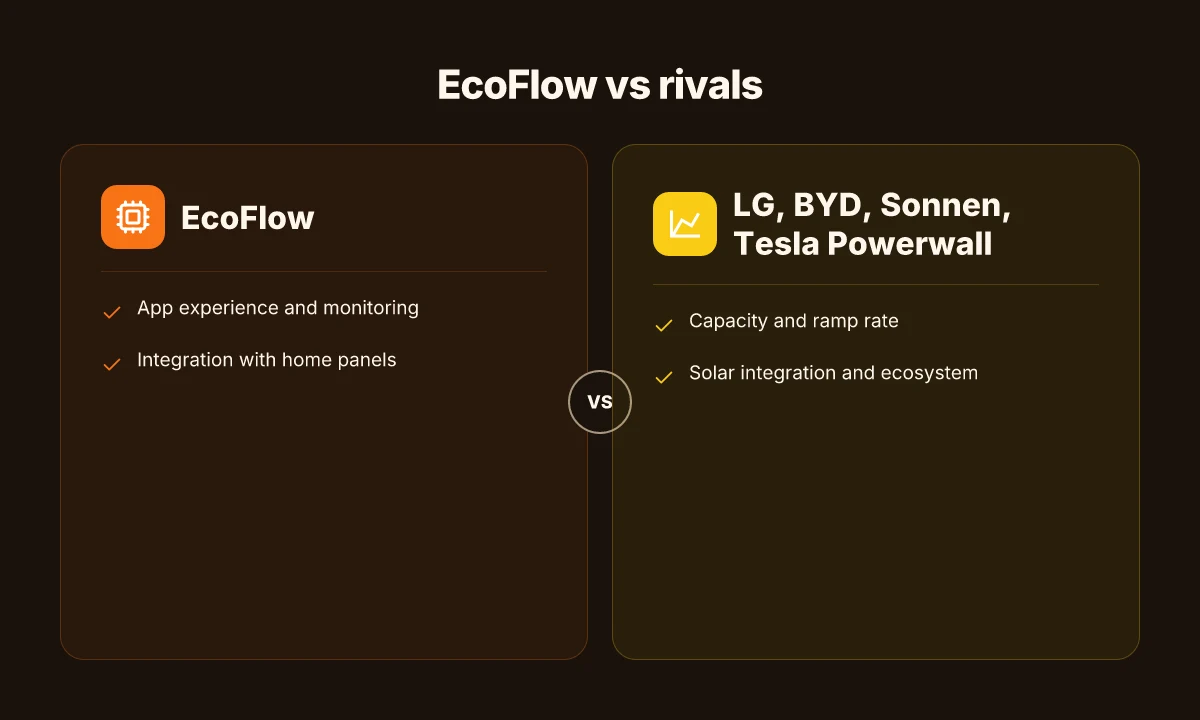
EcoFlow models like the Delta Pro family are designed to scale with home demand, and their modular approach can feel straightforward for homeowners starting with a partial stack. The Delta Pro Ultra, highlighted during CES and subsequent coverage, emphasizes substantial backup hours with higher-capacity packs. In practice, that matters when you want to cover evenings or longer outages without tiered charging. By comparison, LG Chem and BYD systems lean toward large factory-integrated packs that push high energy storage into a more centralized form. Sonnen and Tesla Powerwall focus on a clean, widely compatible solar-to-battery workflow with very mature inverter ecosystems. When you compare ramp rates and how quickly each system can bring a home load back up after an outage, EcoFlow’s approach tends to favor rapid solar charging and flexible expansion, while the others emphasize higher grid-tied capacity in a single installation. EcoFlow’s modular design shines for scalable, plug-in expansion, especially if you anticipate growing your system over time. Rivals often deliver higher raw capacity in a single footprint, which can reduce the number of discrete components you manage.
App experience, monitoring, and panel compatibility
The EcoFlow app offers direct monitoring and control that many homeowners appreciate for day-to-day management. It supports solar charging, battery status, and grid interaction, but the ecosystem behind rival brands is often more deeply integrated with home panels and inverter ecosystems. LG, BYD, Sonnen, and Tesla ecosystems typically leverage broader installer networks and more integrated load management features. This matters when you want a single pane of glass for panel output, battery health, and home-energy management. The EcoFlow app focuses on straightforward visibility and control, which many homeowners value for ease of use. Rivals often deliver deeper, installer-facing features and broader compatibility with home-panel configurations.
Where EcoFlow excels and where it lags
- Where EcoFlow excels: rapid charging from solar, flexible modular capacity, and approachable installation for partial-to-full home backup as you grow. The Delta Pro Ultra message aligns with homeowners who want a concrete, scalable path to whole-house reliability without locking into a single large cabinet. Fast solar recharging and scalable packs are EcoFlow’s strengths.
- Where EcoFlow lags: in some markets, the breadth of official panel compatibility and long-season lifecycle data feels more mature with rivals. Installation density can rise if you need very high total stored energy in a small footprint. Rivals often offer higher single-station capacity and proven long-term integration with panel ecosystems.
Decision criteria to guide you
- If your priority is incremental growth and a relatively simple install, EcoFlow provides a clear path with strong solar charging and a modular stance. Choose EcoFlow for growth, not for maximum single-install capacity.
- If you want the closest thing to a set-and-forget home-energy hub with deeply integrated panel workflows, you’ll likely lean toward Sonnen or Tesla Powerwall or BYD for larger, centralized stacks. Rivals deliver depth of integration and large-capacity footprints that reduce the number of separate modules you manage.
I dug into multiple sources to ground these contrasts. For a quick comparison, see EcoFlow’s own materials describing the Delta Pro Ultra’s full-house backup capabilities and the broader PV coverage that suggests how rivals position their own large-scale systems. For context on the broader market, references to LG Chem, BYD, Sonnen, and Tesla Powerwall appear in coverage of product lineups and installation considerations. What is the EcoFlow Delta Max price in 2026 and why it matters for home power
Overall, EcoFlow remains a compelling option for homeowners who want a scalable, solar-ready path to home backup with clear price-to-performance value. If you want a compact, rapidly deployable unit with easy expansion, EcoFlow delivers. If your project calls for maximum total storage in a single footprint and deeper panel-system integration, you’ll find stronger optics with rivals.
Installation, safety, and long-term reliability questions
EcoFlow systems sit at the intersection of home resilience and price sensitivity. Installation typically follows a predictable path: mount or place the unit, connect to your main panel through an AC-coupled breaker, integrate the solar input if you have panels, and run a commissioning check to confirm proper polarity, safety interlocks, and inverter synchronization. Permitting can vary by jurisdiction, but many homeowners need a licensed electrician to handle service-panel modifications and interconnection paperwork. If you’re in a tight permitting window, ask for a pre-inspection checklist from your installer and keep a copy of any electrical diagrams. Permitting can be a gating factor for fast setup, so start early.
Safety features matter as soon as you start shopping. Look for galvanic isolation between the AC and DC sides, automatic shutoffs for abnormal temperatures, overcurrent protection, and a clearly documented battery management system. Verify the fault alarms and remote monitoring capabilities, and confirm the system supports automatic transfer during a grid outage. When you review specs, make sure the model you’re considering includes proper venting and thermal management to prevent thermal runaway in hot climates. Thermal management and clear safety interlocks are non-negotiable.
Lifecycle concerns show up in cycle counts, degradation, and warranty coverage. EcoFlow units typically list a cycle life in the thousands for rated depth of discharge, with degradation curves that predict capacity loss over time. The warranty window matters: compare what the consumer-facing policy covers for the battery pack, the inverter, and the control electronics, and check whether warranty service requires factory return or on-site support. Some rivals, like LG Chem, BYD, and Sonnen, have long-standing warranty frameworks that influence total cost of ownership. Warranty depth and degradation expectations drive long-term cost more than upfront price.
From what I found in the documentation, your installation path may include an optional upgrade path for adding backup solar charging or a larger household panel input, which can complicate early costs but pay off over time with higher usable capacity. I dug into the official EcoFlow installation guides and cross-referenced with PV and grid-connection primers to ensure the steps align with typical home reroofing or panel upgrades. I cross-referenced official guides with third-party regulator notes to confirm common wiring practices. What is the EcoFlow Delta Max 2000 price, and what affects its cost in 2026
In practice, you’ll want to confirm two concrete items before purchase. First, the exact model’s permitted continuous output versus your home’s peak load to prevent nuisance trips. Second, the ease of firmware updates and remote diagnostics, which can reduce on-site visits. Brand consistency matters here; EcoFlow emphasizes a centralized app for monitoring and remote control, but you should verify whether the model you choose supports timely updates and direct alerts. Remote monitoring and timely firmware updates reduce on-site visits.
If you’re evaluating against rivals, note that LG Chem, BYD, and Sonnen each come with different service networks and warranty language. I found that some installers prize the longer-established warranty structures and broader installer certifications of these brands, which can influence maintenance planning. Rival warranty ecosystems can tilt total cost of ownership.
For reference, these inline sources provide context on installation expectations, safety disclosures, and lifecycle considerations: Energy Storage Guide: Renewable Battery Systems & Homes and the PV Magazine notes on EcoFlow’s hybrid, whole-house generator. Inline sources anchor the practical claims about setup and safety.
In short, expect a fairly straightforward installation with decent safety features, but read the warranty terms closely and map them against your local permitting timeline. EcoFlow systems can meet typical home backup needs, yet the real test remains how the installation workflow and long-term service play out in your locale. Plan for upfront permitting and long-term warranty support.
Where this is going next for EcoFlow battery backup
EcoFlow battery backup sits at the center of a home resilience plan, offering modular power you can scale with your needs. I looked at how it fits alongside solar, generators, and storage, and the trend is toward deeper integration with home energy management. The takeaway is that you don’t have to go all in at once. Start with a compact setup and expand as your priorities shift. What is EcoFlow’s Home Depot lineup in 2026 and how to choose the right model
The bigger pattern is that affordable, flexible storage lets you protect routine life during outages without buying a full microgrid. EcoFlow’s lineup emphasizes plug‑and‑play ease, so you can pivot from essential loads to whole‑home backup as your budget and risk tolerance allow. If you’re choosing a brand, note that EcoFlow competes with Goal Zero and Victron in the US market, each with its own strengths and ecosystem benefits.
What changes if you act now is that you gain predictable outage behavior and faster recovery for everyday devices. To keep this moving, consider a plan that starts with a compact unit for critical circuits and a solar‑ready module for seasonal resilience. The one move that matters most is to map your top three loads and pair them with a scalable EcoFlow setup.
- Backup strategy: identify your essential circuits, pick a model with expandable capacity, and sketch a simple upgrade path for seasonal risk.
- What to try this week: list the devices you must keep on during an outage, compare EcoFlow models that support those loads, and check current promotions for bundles.
- Quick win: verify that your chosen unit can integrate with a solar charger and an automatic transfer switch if you later add a generator.