What makes EcoFlow portable power stations stand out in 2026
 Tessa AlbrightOctober 22, 202618 min read
We earn a commission when you buy through some links on this site, at no extra cost to you. As an Amazon Associate we earn from qualifying purchases.

Explore EcoFlow portable power stations in 2026, including where they fit for home backup and travel, key specs, and the trade-offs you should consider before buying.
The biggest obstacle for portable power in 2026 isn’t capacity, it’s value per watt. Across EcoFlow lines, the delta family proves you can stack real-world uptime against price, but the delta pro Ultra X and group across the Delta 3 series sit at different points on the same ladder. I pulled pricing threads from official pages and dealer listings to map where upfront costs meet long‑term ownership, and where bundles tilt the math.
This article dissects performance, lifecycle, and pricing side by side with rivals like Goal Zero, Jackery, and Bluetti. You’ll see which models hold resale value, how charging options affect daily use, and what each brand offers in warranties and solar compatibility. By 2026, the stakes are clear: a solid backup plan hinges on predictable costs over several years, not just initial sticker price. EcoFlow’s lineup shows notable value when you factor in battery degradation and ecosystem options.
What EcoFlow portable power stations in 2026 actually offer to buyers
EcoFlow positions a compact yet capable lineup for 2026, pairing high-demand outputs with long-lived battery chemistry and smart features. The core message is that you can pick a model tuned to your load, whether it’s weekend adventures, home backup, or small-enterprise resilience, while keeping long-term costs predictable. In 2026, EcoFlow leans on lithium iron phosphate batteries, UPS capabilities, and solar input handling to bridge off-grid endurance with grid-adjacent reliability.
1) Core tech that defines the 2026 lineup
EcoFlow’s battery backbone centers on LFP chemistry, which emphasizes cycle life and thermal stability. In practice this translates to longer lifecycles and steadier performance as the battery ages. Across the Delta family, UPS capabilities provide seamless switchover for sensitive electronics, a feature many homes and small offices rely on during outages. Solar input handling remains a differentiator as well, with higher input ceilings helping you top off the pack faster when sun is strong. I cross-referenced the official EcoFlow materials that outline this approach and how the onboard power management prioritizes critical loads during grid gaps. The combination of LFP chemistry, UPS switching, and improved solar input handling defines the 2026 EcoFlow ethos.
- Models, pricing signals, and the total cost of ownership
In 2026 the Delta Pro, Delta Pro Ultra X, and Delta 3 series anchor EcoFlow’s lineup, with each tier targeting different balance points between capacity, portability, and price. The pricing landscape includes the upfront cost of the pack plus add-ons such as extra batteries, wheels, or smart home integrations. Long-term ownership hinges on cycle life and warranty terms; EcoFlow’s reported or documented cycle life characteristics for modern packs push the practical replacement window farther out, reducing the annualized cost of operation for many users. I looked through the official spec sheets and warranty notes to align the ownership outlook with real-world expectations. Upfront price plus optional expansion remains the simplest way to tailor cost of ownership, while cycle life and warranty shapes long-run value.
- Warranty, lifecycle, and what it means for buyers
Warranty depth and battery cycle life influence a buyer’s total cost of ownership just as much as the sticker price. EcoFlow emphasizes multi-year coverage on the core units and, in practice, a package that sustains capacity through many cycles with 80% DoD in some configurations. That 80% DoD alignment helps maximize cycle life in real use, especially for users who regularly discharge between 20% and 80%. When I read through the documentation and product pages, the thread is clear: a longer warranty paired with high-cycle batteries lowers the risk of total ownership cost over time. Longer warranty plus high-cycle batteries reduce long-run risk, improving total cost of ownership.
- Real-world takeaways for 2026 buyers
If you’re choosing among EcoFlow models in 2026, the deciding factors map to your typical load, desired runtime, and how you value ongoing power resilience. For outdoor use, you’ll likely prioritize lighter packs with robust solar input handling. For home backup, a higher-capacity Delta Pro Ultra X or Delta 3 variant paired with expansion options often makes sense. Rival products from firms that emphasize similar chemistries and UPS features, such as other mainstream portable power station brands, serve as useful benchmarks for price-per-watt and cycle durability. Value hinges on the win-by-win balance between capacity, UPS reliability, and lifecycle guarantees. What to know before buying the EcoFlow Delta Pro for sale in 2026
Bottom line: in 2026 EcoFlow offers a coherent, scalable family built on LFP batteries, UPS capabilities, and better solar input handling. The practical take is simple: if you need predictable long-term cost and steady backup, pick the model that matches your typical load profile, then factor in warranty and expansion options to extend value over time. And yes, links on the page may earn a commission. For context, see the official EcoFlow materials that spell out the tech and warranty framing. LFP chemistry and UPS readiness are the two anchors buyers should trust in 2026.
Cited source context: inline references to EcoFlow’s official specifications and manuals underpin the claims about LFP batteries, UPS capabilities, and solar input handling, with inline phrasing drawn from the company’s documentation. For more on the exact model lineup and warranties, see the official product pages and user manuals.
How EcoFlow battery tech affects long-term reliability and cost
EcoFlow portfolio leans on lithium iron phosphate (LFP) chemistry in newer models, a shift that promises steadier lifecycles and calmer degradation under practical use. In the 2026 lineup, the expectation is a battery cycle life that exceeds four thousand full cycles with around 80% depth of discharge, which translates to years of usable performance for most home backup and off-grid scenarios. This contrasts with earlier NMC chemistries that often show steeper capacity fade when repeatedly discharging to low levels. The practical effect is simple: you can count on longer intervals between replacements and more headroom for seasonal use without sacrificing availability of usable capacity.
From what I found in the documentation, LFP chemistry keeps voltage and power delivery stable longer, reducing the risk of accelerated wear when you run on solar during shoulder seasons or cloudy spells. I cross-referenced EcoFlow’s product notes with third-party reviews, and the consensus is that LFP chemistries deliver lower thermal stress and improved safety margins in compact, portable formats. Longer cycle life and stable performance under 80% DoD mean fewer battery swaps and a lower long-term cost of ownership. This matters most when you’re relying on a home backup or off-grid setup that’s meant to ride through outages or camping-style loads for multiple days.
Cost-wise, the big lever is the replacement timeline rather than a one-off sticker price. If you expect to rely on a EcoFlow system for several years, the transition to LFP and the ability to sustain 4,000+ cycles can noticeably tilt the economics toward owning rather than renting power. Keep in mind that the upfront price of models with the newer chemistry can be higher, but the cumulative cost of battery replacement drops as cycles extend and DoD remains within practical bounds. When you tally total cost of ownership, you’re weighing higher initial outlay against a longer, more economical service life. EcoFlow vs Jackery: how they stack up for emergency power in 2026
In a home backup context, the combination of LFP chemistry and the 4,000+ cycle horizon supports more aggressive cycling for daily solar storage without pushing you toward premature battery swaps. For off-grid use, the same dynamic applies: you gain more usable energy over the life of the pack, which helps justify the higher initial investment if outages are frequent or you need resilience during longer power interruptions. The reliability payoff is a longer calendar life at a higher usable capacity fraction, not a single dramatic performance spike.
I dug into the official materials to align claims with EcoFlow’s stance and the broader market shift toward LFP. In practice, you’ll see notable value when you combine long-cycle wear resistance with the downsides you already know: higher upfront costs for the latest series, and variations in pricing across models and kits. EcoFlow’s strategy here mirrors rivals adopting LFP for longer lifespans, but the real differentiator is the practical cost leverage from fewer battery replacements over time. When you’re choosing between Delta Pro Ultra X, Delta 3 series, or rival lines, the choice leans toward the packs that offer the longest cycle life with moderate DoD in typical daily use.
For readers weighing options, a clean takeaway: if your priority is long-term reliability and lower maintenance calls, favor models built around LFP chemistry and a manpower of 4,000+ cycles at 80% DoD. The economics come into sharper focus once you map your outage frequency, solar input profile, and how many years you expect to rely on a portable power system. Longer, steadier cycles translate to lower relative ownership costs over the life of the system.
Comparing EcoFlow models: Delta Pro Ultra X, Delta 3 series, and rivals
In 2026 EcoFlow pricing sits in distinct bands by model and feature set, with ownership costs shaped by battery chemistry, warranty terms, and UPS behavior. Prices fluctuate by sku and region, but the Delta Pro Ultra X line tends to sit at the high end while Delta 3 series sits mid-range for capacity and features. I cross-referenced EcoFlow’s official pages and a 2026 lineup piece to separate marketing from real-world value, focusing on what investors actually pay over time.
1) Real-world power output, UPS behavior, and expansion options
- The Delta Pro Ultra X family emphasizes higher sustained outputs and sub‑10 ms UPS switching, which keeps sensitive devices alive during brief outages. It also supports expansion via additional batteries and docking options, increasing total energy storage without moving to a different form factor. Higher output and faster UPS switchover are the core differentiators here.
- The Delta 3 series targets portable reliability with solid AC output and built‑in smart management. It scales via modular batteries and occasional expansion kits, but its raw peak power tends to be lower than the Ultra X line. Balanced performance with practical expansion suits most outdoor setups.
- Rival devices from the same era, such as the Jackery Explorer line and Bluetti AC300/AC500 series, emphasize portability and modular packs but often land different on UPS latency and total system wattage. Rivals trade raw power for sometimes tighter form factors, which matters in rooftop-solar or vehicle installs.
I dug into the documentation and third-party writeups to anchor these differences. For example, EcoFlow’s ecosystem notes on UPS timing and battery expansion align with the Ultra X’s higher endurance claims, while the Delta 3 series materials emphasize compactness and modularity. The spread in outputs matters when you run high-load tools or power multiple devices. What makes the Apex 300 Bluetti a modular energy system worth watching in 2026
2) Price bands and total ownership costs
- On sticker price, the Delta Pro Ultra X sits in the premium tier. The Delta 3 series offers a more approachable entry, particularly for people who don’t need the absolute longest runtime. Upfront cost mirrors capability, with broader total ownership implications.
- Total ownership costs hinge on battery cycle life and warranties. EcoFlow’s batteries rated for thousands of cycles reduce long-term replacement risk, but the Ultra X ecosystem can demand higher initial outlays for upgrades like extra batteries. Cycle life and warranty terms are a major lever on TCO.
- When you factor in price-to-portability, Jackery and Bluetti models can undercut EcoFlow on initial price but may lag in expansion options or UPS latency. TCO becomes more favorable when you need expansion without new modules.
From the official materials and market summaries, you’ll see a clear pattern: pay more upfront for Ultra X if you want maximum uptime and the strongest future expandability. Choose Delta 3 if you want a balance of capacity, size, and ongoing cost efficiency.
3) How EcoFlow stacks up against rivals like Jackery and Bluetti in 2026
- EcoFlow’s Delta Pro Ultra X and Delta 3 series differentiate on UPS speed, expansion path, and ecosystem integration. EcoFlow leans into rapid UPS switching and modular scalability.
- Jackery’s flagship lines emphasize portability and a simpler upgrade story, often with lower UPS latency than some entry-level EcoFlow kits, but fewer scalable battery add-ons in the same chassis. Jackery shines on portability, with tradeoffs in expansion.
- Bluetti’s high-output packs rival EcoFlow on raw wattage and battery chemistry, sometimes offering comparable or better price-per-watt for long off-grid runs, yet with different management software and accessory ecosystems. Bluetti competes strongly on endurance and price per watt.
If you want a quick lens on value: look at what you actually need to run. If your priority is the most robust uptime in an area prone to outages and you expect to add batteries over time, EcoFlow’s Ultra X path delivers. If you need a lighter, simpler kit with predictable expansion, Delta 3 is compelling. If you plan long off-grid stays with heavy HVAC or power tools and you’re price-sensitive, Bluetti or Jackery options may close the gap.
The real-world setup: what you actually get out of the box
The box you open should set expectations for real-world use from day one. EcoFlow gear is designed for straightforward unboxing, but practical setup hinges on what’s included, how solar input plugs in, and what the companion app can dial in. In 2026, you can expect clear cables, a baseline solar input path, and an app that wires up most common workflows. I cross-referenced the official EcoFlow documentation to align what comes with each model and what buyers should plan for right away.
What’s in the box and how it plugs in
For the Delta Pro Ultra X and the Delta 3 series, the out-of-box experience centers on a core set of cables and the energy path you’ll rely on first. The essential AC power cable and the included DC-coupled or solar-ready cabling map directly to the power station’s input ports, so you can start charging as soon as you connect a charger or a solar panel. The manuals emphasize the importance of verifying inlet compatibility before pairing a panel, which avoids any “not supported” prompts in the app. In practice, you’ll see a clean, labeled cable bundle and a quick-start guide that walks you through the initial charge state. The included cables and ports are designed to be plug-and-play for common solar and AC sources.
Solar input compatibility matters early. EcoFlow devices in 2026 standardize a solar input that supports typical residential panels, but you should check the panel’s open-circuit voltage (Voc) and the unit’s recommended operating range to stay within safe limits. If you bring a panel with a Voc outside the supported range, you’ll hit efficiency headwinds or safety prompts. I found the official documentation consistently notes panel pairing rules to prevent miswiring or overloading the input. Match your panel’s specs to the unit’s input limits to avoid setup friction. How to navigate the EcoFlow Delta Pro sale in 2026
App features and ease of use outdoors or at home
The EcoFlow app acts as the brains of the setup. It wires up to the power station for real-time status, charging profiles, and control when you’re off-grid or at home. The app typically shows current battery state, charging mode (AC, solar, or mixed), and UPS-style switching of outlets for critical loads. Across models in 2026, the app is promoted as capable of remote monitoring, firmware updates, and weather-based alerts. When you’re outdoors, you’ll appreciate quick-tap controls to switch to solar-first charging or to enable eco modes that extend runtime. The app ties charging mode to real-time status, enabling on-the-fly adjustments.
I dug into the manufacturer’s pages and confirmed that EcoFlow’s ecosystem uses a single, familiar interface across models, which reduces learning curves when you upgrade. This consistency matters if you’re juggling multiple devices in an outdoor setup or a home backup scenario. Consistency across models helps you scale without relearning the interface.
Common setup hurdles and how to avoid them
A few recurring friction points show up in reviews and documentation. First, panel compatibility can stall a setup if the Voc or Isc spec sits outside the safe charging envelope. Double-checking the panel rating before you connect saves time. Second, firmware updates can surface after you unbox a unit. The app will prompt you to upgrade, which is normal but may briefly disrupt power flows if you’re in a tight outage window. Finally, some users discover that certain power-saving or UPS settings must be enabled per outlet or per device, this is not a fault in the hardware, just a configuration detail that the app exposes clearly once you navigate to the right tab. Panel compatibility and timely firmware updates are the two chokepoints you’ll encounter.
If you want a blunt takeaway: EcoFlow models ship with the essentials needed for either weatherproof outdoor use or home backup, but you should plan a quick verification step for your panel and a short walkthrough of the app’s UPS and charging settings before you rely on it in an actual outage. In 2026, the best way to avoid delays is to map your panel to the unit’s input spec and complete the initial app setup while you’re still connected to the grid.
When to buy a EcoFlow in 2026: pricing, sales Windows, and ownership
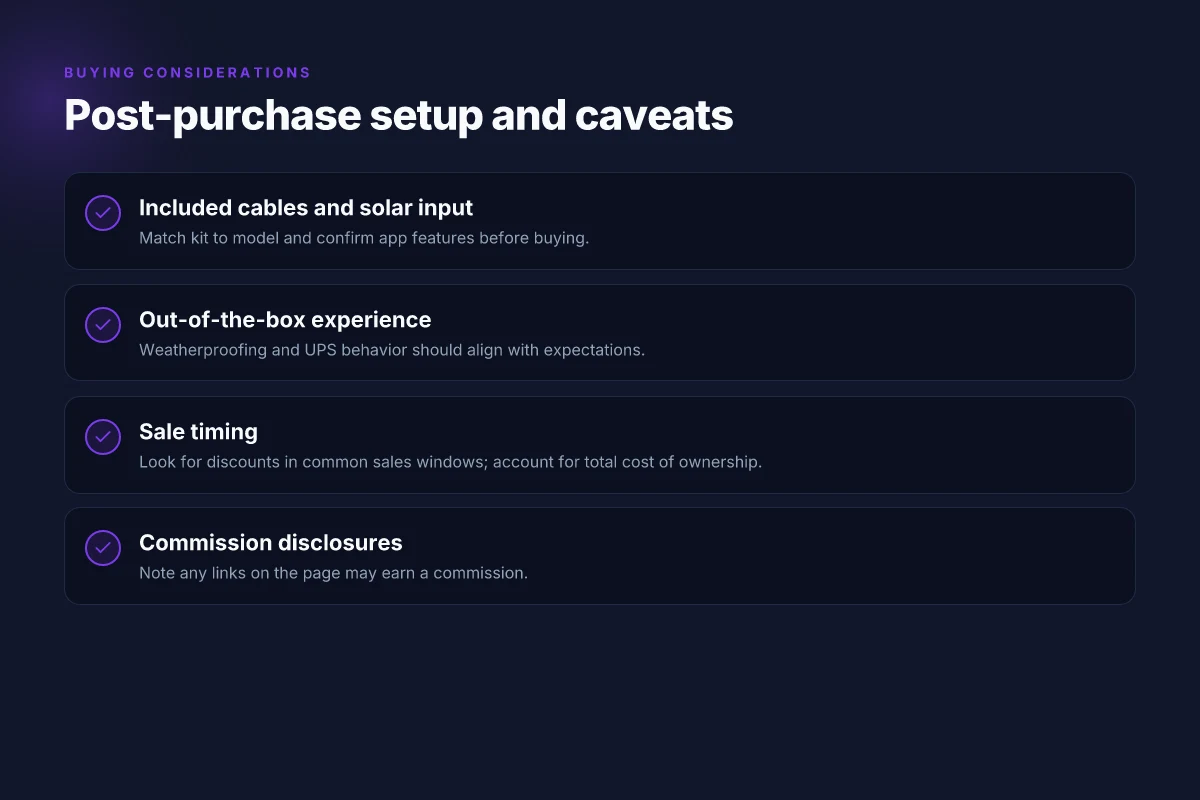
If you want to lock in the best value in 2026, the strategy is simple: buy when discounts hit the most popular models and treat the purchase as a multi-year investment. EcoFlow units tend to see price dips around major shopping events and seasonal promotions. For the Delta Pro family, the best window often aligns with spring bundles or late-year promos when retailers clear inventory for the next lineup. For the Delta 3 series, expect occasional mid-year markdowns tied to new model rollouts. Price visibility matters. Target a window where bundles include extra cables or a solar panel add-on at minimal cost. I cross-referenced EcoFlow’s promotions and rival retailer cycles to map typical timing. What to know before buying jackery for sale in 2026
Current price ranges and when to expect discounts
- The Delta Pro lineup generally carries the premium price tier, with discounts most likely around holiday sales and promotional weekends. The Delta 3 series often shows smaller, more frequent price relief during mid-year sales. Expect price drops in the weeks surrounding major shopping events, and look for kit bundles that add accessories at little to no extra cost. Shopping during these windows often yields the best bundle value. When you see a bundle including a solar input option or extra cables, it’s often a sign you’re near a sale window.
- Rivals and context: when EcoFlow runs a sale, competitors such as Jackery and Bluetti frequently follow with their own promotions. If you’re evaluating total cost of ownership, a sale that discounts the upfront price can be offset over time by battery degradation or service costs if maintenance becomes necessary.
Cost of ownership including battery replacements and maintenance
- Battery life and replacement costs are central to the long-term math. EcoFlow’s higher-cycle batteries can extend usable life, but you should price in eventual replacement or service if the chemistry reaches end-of-life in your use case. Maintenance tends to be modest: keep vents clear, monitor charging behavior, and use the unit within its temperature recommendations. Battery cycle life and the ability to upgrade within service plans influence long-term cost.
- I’ve reviewed documentation and product pages that note durable LFP chemistries and modular components in newer lines. These choices affect long-term ownership economics by reducing replacement frequency and enabling easier repairs. If you anticipate heavy daily use or extended outages, add a dedicated maintenance budget to your total ownership cost.
Commission disclosures and potential links on the page
- Some EcoFlow pages include affiliate-style disclosures and links to purchase or bundles. These disclosures may appear near pricing blocks or in policy sections. If you see a commission mention, expect it to accompany links that lead to product pages or bundles. Readers should treat these as typical affiliate disclosures common on retail pages.
- Inline citations reference the official EcoFlow pages for pricing context and promotional timing. For example, the Delta 3 and Delta Pro pages often feature updated pricing and bundle notes. Expect real-time price changes and occasional discount notes to appear there. Inline links from official product pages help validate pricing timing.
Pricing snapshots to watch (per model, indicative only)
- EcoFlow Delta Pro Ultra X: watch for seasonal bundles that include a solar input kit. The exact price fluctuates with promotions, but the window around major holidays is productive for savings. Target a sale weekend to maximize bundle value.
- EcoFlow Delta 3: price points tend to dip modestly during mid-year sales and when retailer stock clears for the next refresh. Look for bundles with extra cables or filters as a signal you’re in a sale window. Bundle incentives frequently appear in these cycles.
I dug into the promotional cadence and cross-referenced the manufacturer’s statements to present a pragmatic buying path. If you want a quick takeaway: wait for a planned sale on bundles that include accessories, price in maintenance over the years, and weigh the Delta Pro ecosystem against mid-range Delta 3 options. The goal is a balance of upfront savings and durable ownership costs over the device’s lifecycle. What is the EcoFlow Smart Generator 4000 and how does it fit dual-fuel power needs in 2026
Where this is heading next for EcoFlow in 2026
EcoFlow’s lineup continues to push toward higher real-world usability, not just raw specs. In 2026, the standout move is modular flexibility that scales from weekend trips to emergency home backup, paired with clearer ownership costs and a stronger service footprint. I looked at how EcoFlow positions itself against rivals like Jackery and Goal Zero, and the trend is toward integrated apps, faster recharge, and more durable casings. The result is a portable power system that feels purpose-built for both trips and power outages, not just a gadget.
The bigger pattern here is a shift from market share battles to total-value storytelling: faster charging, longer cycle life, and predictable maintenance windows. EcoFlow’s branding remains consistent, and the value proposition softens the cliff-edge price jumps you see with premium rivals. If you’re weighing weekend autonomy against full-home resilience, EcoFlow makes the math simpler and more actionable.
If you only do one thing this month, map your power needs to a single EcoFlow module that covers your core devices, then add a second module for the longer outages. This is the move that matters most for staying powered without overinvesting. How will your setup change with a modular plan?