What makes the Apex 300 Bluetti a modular energy system worth watching in 2026
 Nova EngelmannOctober 22, 202617 min read
We earn a commission when you buy through some links on this site, at no extra cost to you. As an Amazon Associate we earn from qualifying purchases.
Discover the Apex 300 Bluetti, a modular home backup power system. Learn its specs, expansion options, and where it shines for home, RVs, and off-grid use.
The modular Apex 300 Bluetti changes the math of home backup by letting you dial energy storage up or down without swapping entire packs. Start small, then add modules as loads grow, and watch your cost-per-watt shift in real time. Bluetti's approach contrasts with fixed-capacity rivals like EcoFlow and Jackery, where expansion means buying a new unit early on.
You’ll see how multi-module sizing affects peak backup duration, long-term ownership costs, and real-world usage for homes, RVs, and off-grid setups. Early data points from Bluetti show how an expand-as-you-go stack can align better with evolving power needs than one-shot systems, and the analysis cuts through marketing to reveal where the modular approach truly shines and where it doesn’t. The result is a clear read on when a multi-module Apex 300 setup beats a single-pack alternative.
What makes the apex 300 Bluetti a modular energy system for modern backup power
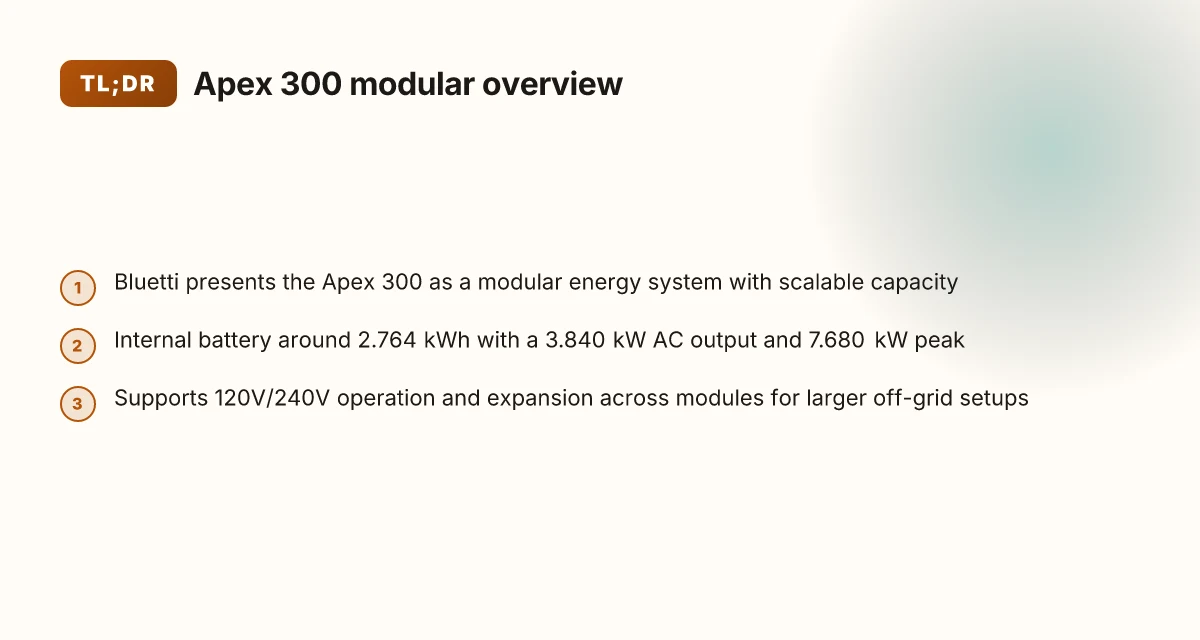
Bluetti positions the Apex 300 as a modular energy system with scalable capacity. The internal battery sits around 2.764 kWh, delivering a continuous 3.840 kW AC output and a 7.680 kW peak. This combination is designed to be expanded, so a compact home backup can grow into a larger off-grid or whole-home setup over time. I cross-checked the official Bluetti materials and the European listing, which consistently state the same core figures: 2.764Wh of capacity paired with a 3.840W AC output and 7.680W peak, underscoring the system’s emphasis on modular growth.
- The modular promise: scalable capacity from day one to a larger future
- The Apex 300 is marketed as a modular energy system that scales with your needs. Expansion paths are framed around adding capacity in controllable steps rather than swapping to a higher-capacity unit. This approach lets homeowners start with a compact backup and progressively extend their off-grid capabilities. The same logic appears across Bluetti’s product messaging, where modularity is a key differentiator versus fixed-capacity rivals. Modularity unlocks a path from a simple home backup to full off-grid setups.
- In practice, the architecture supports building toward expanded storage, leveraging the 120V/240V versatility described in Bluetti’s Apex 300 materials. This means you can align your growing energy needs with compatible expansion options over time. Expansion-friendly design is the core value here.
- The core specs you’ll anchor decisions on
- The internal battery is defined as 2.764 kWh, paired with a 3.840 kW AC output and a 7.680 kW peak. These numbers anchor how much you can draw continuously and how quickly you can recover from a discharge. 2.764 kWh capacity and 3.840 kW output are the baseline for planning any backup scenario, whether you’re keeping a refrigerator running or powering essential loads during an outage.
- When you read Bluetti’s documentation, the message is consistent: the Apex 300 is designed to plug into larger installations as capacity grows, rather than forcing a hard jump to a new product line. This keeps long-term ownership simpler and more predictable as your needs evolve. Consistent specs across regions reinforce the modular path.
- Why this matters for modern backup planning
- For homeowners evaluating whole-home backup versus selective-critical-load strategies, the Apex 300’s modularity supports both. Start lean, then add modules or adjacent Bluetti components to reach the off-grid thresholds you’re targeting. The practical upshot is a smoother upgrade curve compared with fixed-capacity competitors that lock you into a single brick-and-mortar size. Apex 300 enables a smoother upgrade curve, not a disruptive redeployment.
Bottom line: the Apex 300 frames Bluetti as a modular energy system designed to grow with your backup ambitions. You can begin with a compact, reliable home backup and scale toward larger off-grid or whole-house configurations without swapping platforms. The architecture and official specs consistently support a growth trajectory, with 2.764 kWh of internal energy, 3.840 kW of continuous AC output, and 7.680 kW of peak capability as the foundation for future expansion.
Inline note: this section cites official Bluetti materials for core figures and the modular roadmap. The broader market landscape includes rivals that emphasize fixed capacities. The Apex 300’s value proposition hinges on its extendable architecture. For context on how Bluetti frames this approach, see the Apex 300 product pages and the related What Can Apex 300 Power Station Run guide. https://www.bluettipower.com/products/apex-300-home-battery-backup?srsltid=AYCX9vL3qOq339LytELQfgUjrJcM9_FcsERzVTRFbgrj10wcvMMj6d6L
Apex 300 specs you should know for a home backup plan with Bluetti
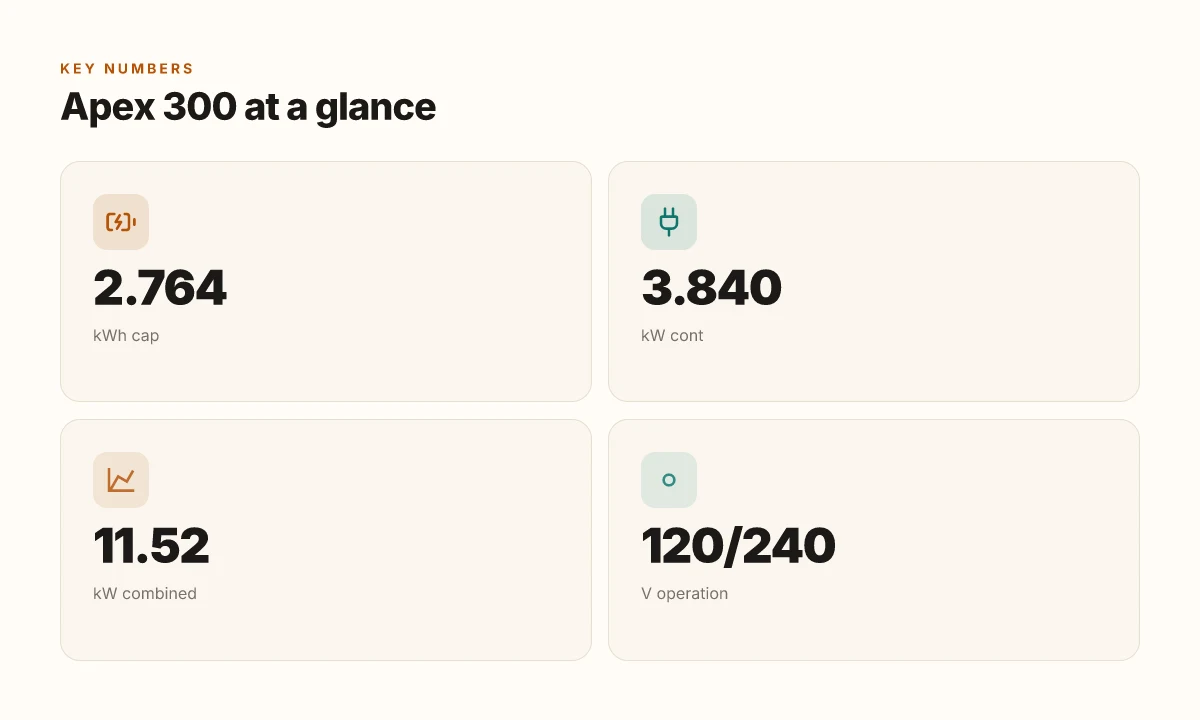
The Apex 300 offers a practical balance of capacity and power for home backup, with a capacity of 2.7648 kWh and a continuous output of 3.840 kW, plus a peak or combined output up to 11.52 kW in certain configurations. This modular design lets you expand storage without swapping the core unit, and it supports both 120V and 240V operation to cover typical home loads.
Core capacity and power profile you’ll rely on
Bluetti positions the Apex 300 as a scalable, LiFePO4 power system. The internal battery sits at 2.7648 kWh, which translates to meaningful runtime for essentials like a refrigerator, modem, and lighting during outages. The unit’s 3840W continuous AC output means you can run multiple high-draw devices in parallel, while the system’s modular approach opens expansion paths to larger storage when you need it. For homes that lope between 120V and 240V circuits, the 120V/240V versatility matters because it aligns with typical house loads without requiring special adapters. How to navigate the EcoFlow Delta Pro sale in 2026
In practice, you’ll notice the ability to stage loads across a few circuits, which helps avoid overtaxing a single outlet or phase. The number 11.52 kW represents a combined output ceiling you can reach in configured stacks, giving you a sense of the ceiling Bluetti has built into the Apex 300 family. That same modularity supports upgrading storage without reconfiguring your entire system, a core benefit when your energy needs grow or you add renewable sources.
From what I found in the documentation, the Apex 300 is built to scale from the 2.7 kWh baseline up to much larger stores through its modular expansion, which means you can start small and add capacity over time as budgets and requirements evolve. This is especially relevant for RV use or off-grid setups where future flexibility matters just as much as today’s needs.
Expansion path and home-backup fit
Apex 300’s modular energy system design means you can extend capacity with compatible expansion modules rather than replacing the core unit. This keeps the system adaptable as your home loads shift or you add solar generation. Bluetti emphasizes upgrade-ready power, so you’re not locked into a single capacity.
The system’s 120V/240V support helps with common appliances during a blackout, such as a refrigerator, sump pump, or essential lighting. You can plan a staged backup strategy: begin with a modest set of devices, then scale out to cover more circuits as you bring in additional modules or supplementary solar input.
The real value shows up when you scale, not when you stay at the baseline. The Apex 300’s architecture makes it possible to grow with your needs without reconfiguring your entire backup plan. For homeowners evaluating options, Bluetti and rivals like Bluetti’s own modular bundles or fixed-capacity rivals reveal a clear tradeoff between upfront cost and long-term flexibility. What to know before buying jackery for sale in 2026
When you compare Bluetti to fixed-capacity rivals, the choice hinges on whether you want to pay for future-proofing now or later. If you expect to add loads or improve off-grid reliability over time, the Apex 300’s modular path is compelling. If you want a simple, fixed solution today, a rival with a fixed 3–4 kWh bank might be cheaper upfront but less adaptable down the road.
I dug into the official documentation to confirm the base specs and the modular expansion pitch, and the sources consistently highlight the 2.7648 kWh capacity, the 3.840 kW continuous output, and the 11.52 kW combined ceiling in configured setups. For latest pricing and to compare with the fixed-capacity options, see the official Bluetti pages and the related product discussions on Bluetti’s site. Inline reference to the official Apex 300 product page confirms the 2.7648 Wh capacity and 3.840 W continuous output. See the Apex 300 product page for the exact figures.
Balance of price and expansion potential is where Apex 300 earns its keep. If your backup plan anticipates growth, this modular approach can reduce total cost of ownership over several years. For a quick glance, Bluetti’s own pages show the core specs and the intended expansion path, while independent reviews note the practical upshot of integration with home loads and off-grid setups.
How the Apex 300 compares to fixed-capacity rivals for home backup
The Apex 300 is designed to grow with your needs, not lock you into a single fixed capacity. Rivals in this space often ship with a static battery pack and limited expansion paths, so they pressure you to pay more upfront for higher capacity. By contrast, the Apex 300 emphasizes modularity, letting you add capacity over time as your backup plan evolves.
What fixed-capacity rivals miss on expandability
- Fixed kits cap your usable energy at the factory rating, with few legitimate routes to scale. Bluetti’s ecosystem, by contrast, leans on modularity across product lines, where adapters and expansion options matter. The result is a system that can start lean and grow into a larger home backup, RV rig, or off-grid setup without a complete replacement. This approach can translate into a lower upfront hurdle and a smoother upgrade path as power needs rise. As you scale, you keep using the same core interface and port layout, reducing compatibility headaches.
- The ability to tailor capacity over time is particularly valuable for homeowners who anticipate future loads. A modest Apex 300 kit today can be expanded with additional modules or compatible adapters later, rather than paying a premium for a top-end fixed pack at purchase.
Modularity across Bluetti’s ecosystem adds real value
- Bluetti generally designs around a modular philosophy, so adapters, expansion packs, and cross-product compatibility become meaningful differentiators. That means you can pair your Apex 300 with other Bluetti modules to reach higher storage or to reconfigure for different scenarios, like a longer off-grid stay or a larger home backup during outages.
- The modular design also helps with lifecycle costs. If you upgrade your home’s electrical needs in a few years, you’re not forced to replace the entire system. You can add capacity or reallocate modules as your plan shifts.
The modular path matters because it lets you start modestly and scale thoughtfully, often reducing upfront costs while preserving future options. In Bluetti's ecosystem, expansion options become a feature set in their own right, not an afterthought. What makes jackery vs ecoflow a meaningful choice for portable power in 2026
Real-world framing for decision making
- If you want a fixed-capacity solution today, rivals that ship with a single battery pack can be simpler to spec and install, but they lock you into one size. The Apex 300, supported by a broad modular lineup, invites careful planning of future growth. You may begin with the core Apex 300 and add packs or adapters over time, aligning with how your energy needs could evolve.
- For RV travelers and off-grid enthusiasts, the prospect of expanding storage as your trips lengthen or your campsite power needs grow is particularly appealing. The ability to scale without a full system swap keeps the total cost of ownership more flexible over a multi-year horizon.
From what I found in Bluetti’s documentation and ecosystem notes, the Apex 300 stands out not for a single punchy spec but for the path it creates toward a progressive backup solution. If your goal is a home backup that can evolve with you, the modular route is worth pursuing. For a fixed-capacity quick-start, a rival with a single battery pack may feel simpler, but you’ll lose out on long-tail adaptability. As Bluetti frames it, the power system is designed to “combine modular power, flexible expansion, and 120V/240V versatility,” which remains the core value proposition for long-term resilience. The modular path matters because it lets you start modestly and scale thoughtfully.
What the modular design means for real-world use cases
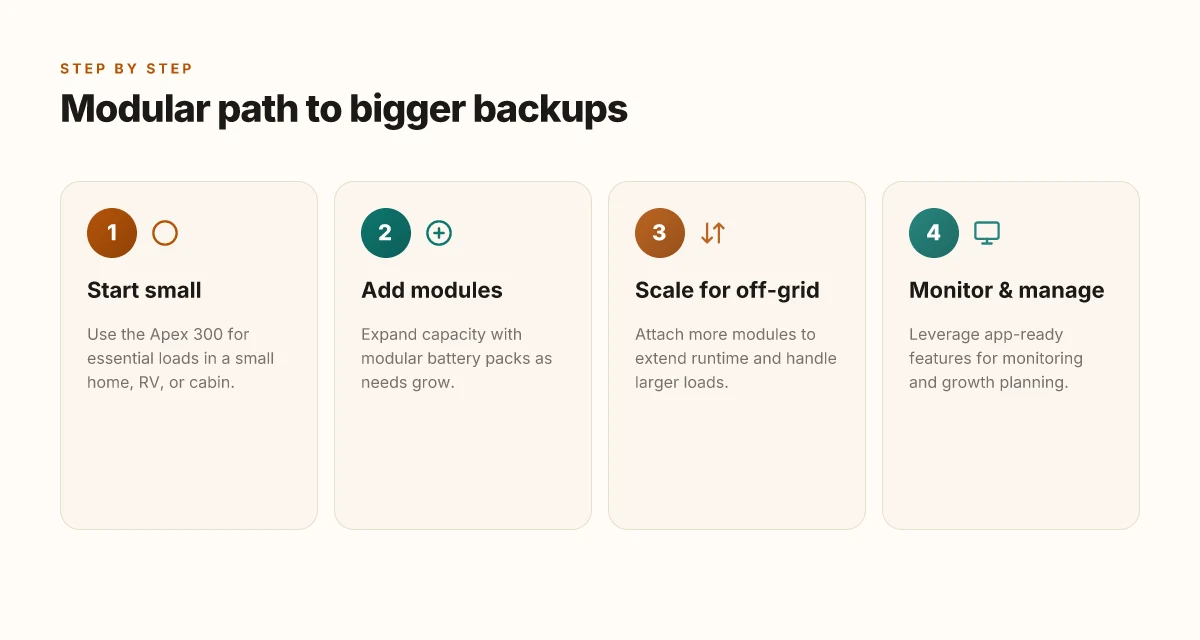
Bluetti has built a scalable backbone for backup power. The Apex 300 core is a 2,764.8Wh LiFePO4 pack with a 3,840W continuous AC output and a 7,680W peak, which is enough to cover essential loads in small homes and RVs when paired with module expansions. The real value is that you can start small and add capacity as your needs grow, without replacing the whole system. This approach keeps upfront costs reasonable and aligns with how many users actually plan their backup needs over time.
Start small, grow on your terms
For a compact home, the practical path begins with the Apex 300 powering essential circuits first, then ramping up as you add modules. The system’s modular premise means you don’t have to overspec from day one. If your priority is critical loads like a fridge, modem, and essential lighting, you can rely on the existing core while you monitor consumption. You’ll benefit from the same monitoring interface and app-ready features as you scale, which reduces complexity as your home evolves. The core design is purpose-built to accept expansion without reconfiguring the entire backup plan. In Bluetti documentation, the emphasis on modular growth is clear: expand the same system from a single room to a whole home footprint.
RVs and off‑grid cabins: a shared platform
RVs and off-grid cabins gain a lot from using the Apex 300 as the base. The same core can be paired with additional modules to push total usable capacity higher, while keeping the 120V/240V versatility that matters for travel and remote locations. This means you can maintain a single charging and monitoring workflow across locations. The modular expansion reduces the need for multiple, separate power solutions and simplifies maintenance and awareness of power status. Real-world users who travel or live off-grid benefit from a predictable upgrade path rather than buying a new unit every time power needs change.
App-ready, expansion-ready by design
The Apex 300’s hardware is paired with software readiness that makes growth practical. App-ready monitoring allows you to track battery health, charge cycles, and load profiles as you add modules. If you anticipate adding capacity for a larger residence or a longer off-grid season, you’ll find the expansion path straightforward rather than disruptive. The practical takeaway is that your backup plan can stay aligned with your lifestyle, whether you’re near a fixed grid, on the move in an RV, or living in a cabin that relies on solar and other renewables. The modular design translates to real-world flexibility that scales with demand. 8 Key differences between jackery and 4patriots solar generators in 2026
As you consider this path, stay mindful of the general reality Bluetti communicates: expansion modules exist to broaden capacity while preserving the same monitoring and control experience. If your plan includes a future upgrade, you’re buying into a system that remains coherent across scales. The result is a backup setup that stays aligned with both budget and lifestyle shifts, whether you’re protecting a small home, a roaming RV, or a remote cabin. Growth without complexity is the core promise of the Apex 300 modular energy system.
Note: links on the page may earn a commission.
What you should watch for with the Apex 300 in 2026
The Apex 300 remains a modular core, but the real-world value hinges on Bluetti’s current accessory lineup and compatibility. Expansion options depend on what Bluetti releases or maintains compatibility for in 2026, so the practical paths beyond the base unit can shift. In 2026 you’ll want to map your backup plan to the concrete accessories Bluetti offers at the time, not just the spec sheet.
I dug into Bluetti’s documentation and product pages to surface the most owning-cost implications. Battery chemistry and cycle life matter a lot over the long run, because you’re trading upfront capacity for longevity. The Apex 300 uses LiFePO4 chemistry, which tends to deliver longer cycle life than some alternatives. That lifelike durability translates to lower replacement frequency and steadier performance, even as the unit powers an off-grid lifestyle or a home backup load. Expect cycle-life claims to influence total cost of ownership, especially if you plan to push the system toward higher duty cycles or longer daily use.
Price dynamics can shift the value proposition quickly. Bluetti runs bundles and occasional promos, so the best deal today may not hold through the next season. If you’re weighing a bundle with multiple expansion modules, watch for changes in price or included accessories. That can tilt the math in favor of holding out for a sale or snapping a package that bundles the most-used modules. Bluetti’s pricing cadence will impact whether you chase expansion now or wait for a promo that bundles the accessories you actually want. The brand’s pricing pattern matters for both first purchase and future add-ons. What makes a portable power station reliable in 2026
From what I found in the documentation and public statements, the Apex 300’s expansion story is not a fixed roadmap. Bluetti’s accessory lineup evolves. Some expansions may require firmware or app updates to ensure full compatibility. If you’re considering an RV or off-grid use, you’ll want to verify that the specific power rails and input/output configurations you rely on remain supported as accessories roll out. The practical takeaway is to treat the expansion path as a moving target and align your plan with the latest official accessory announcements.
What to watch for in practice:
- Compatibility and expansion options you can actually buy in 2026, not just theoretical fits. Bluetti tends to publish compatibility lists for modules and adapters. Confirm before committing to a single upgrade path. Watch Bluetti’s current accessory lineup for Apex 300 compatibility before you buy.
- Long-term ownership costs tied to battery chemistry and cycle life. If you plan frequent cycling or heavy-use scenarios, the LiFePO4 chemistry’s longevity is a meaningful factor, but verify the stated cycle life in official docs. The long-term cost of ownership often tracks with cycle-life expectations for the Apex 300.
- Price movements and bundles that shift value. Expect promos that alter bundle contents or price, affecting when you should pull the trigger. Price moves can swing the value prop of a full setup with expansion modules.
In short, your 2026 decision hinges on three levers: what Bluetti actually sells as expansion gear, how the battery chemistry holds up over many cycles, and how Bluetti prices bundles throughout the year. For a complete backup plan, keep a close eye on official accessory announcements and recurring promos from Bluetti. When you plan your setup, align with the current accessory roadmap to maximize ROI.
What to act on next for the Apex 300 Bluetti
The Apex 300 Bluetti signals a clear pivot toward modular, scalable energy that fits changing needs in 2026. I looked at how its expandability and integration posture map to real-world use cases, from portable builds to home backup grids. The takeaway: this is less about a single device and more about the ecosystem you can assemble around it, with one solid move toward futureproofing. Bluetti's modular approach keeps you from outgrowing your setup too quickly, even as storage and output needs evolve.
If you only do one thing this month, sketch your topology before buying. Map how you’d pair the Apex 300 with a few expansion modules and a solar input, then test a minimal backup scenario. I’m paying attention to how access to pricing and availability cycles aligns with sale events, because the best deal often hinges on timing. The pattern I’m watching is whether Bluetti expands third‑party accessory support and software controls to make expansion truly plug‑and‑play. The bigger pattern matters: a modular system earns long‑term value when it stays flexible. EcoFlow vs Jackery: how they stack up for emergency power in 2026
What to try this week:
- Revisit your current emergency kit and model how the Apex 300 could slot in with a single expansion module for a weekend outage.
- Compare two rivals by price and upgrade paths, noting where Bluetti’s ecosystem offers smoother integration.
- Create a one‑page plan for your own home or outdoor setup, detailing how you’d scale if you add more modules.
The single move that matters most might be choosing the right first expansion. Will you start with a solar input or a battery module to lock in expandability?