What is the EcoFlow Smart Generator 4000 and how does it fit dual-fuel power needs in 2026
 Adrien SaxenaOctober 22, 202615 min read
We earn a commission when you buy through some links on this site, at no extra cost to you. As an Amazon Associate we earn from qualifying purchases.
Discover the EcoFlow Smart Generator 4000, a dual-fuel inverter generator. Learn specs, real-world use cases, and how it compares with rivals for 2026.
The EcoFlow Smart Generator 4000 reshapes the dual‑fuel brief with a single, practical constraint: it must balance home loads and mobile charging without turning into a gas guzzler. In real numbers, you’ll see a complete picture only when you compare gas versus propane performance across common loads, and note how the unit integrates with EcoFlow ecosystems for transfer and monitoring.
rivals like Onan and Kohler. Expect a clear read on where efficiency actually matters, what startup behavior looks like in the wild, and how fuel choice affects continuous operation and on‑the‑go charging. EcoFlow's approach to ecosystem compatibility matters for homeowners, RV users, and off‑grid enthusiasts alike.
What the EcoFlow Smart Generator 4000 actually is and where it fits
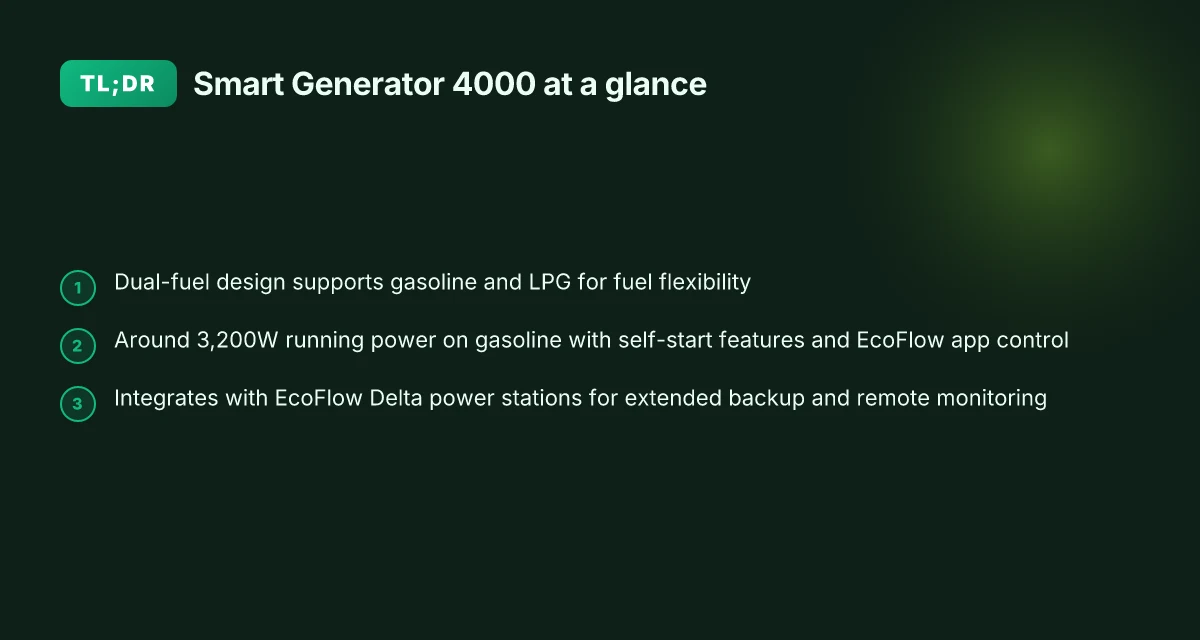
The EcoFlow Smart Generator 4000 is a dual‑fuel inverter generator built for backup power and on‑the‑go charging. It runs around the 3,200W mark on gasoline and can flex to LPG, all while integrating with EcoFlow power stations to extend cached energy when you need it most. In practice, this means you can couple it with EcoFlow Delta lineups to top up a home battery or recharge a mobile setup in an RV or off‑grid camp. The core promise is simplicity: solid running power, flexible fuel options, and easy integration with EcoFlow’s ecosystem.
1) Dual‑fuel design and real‑world output
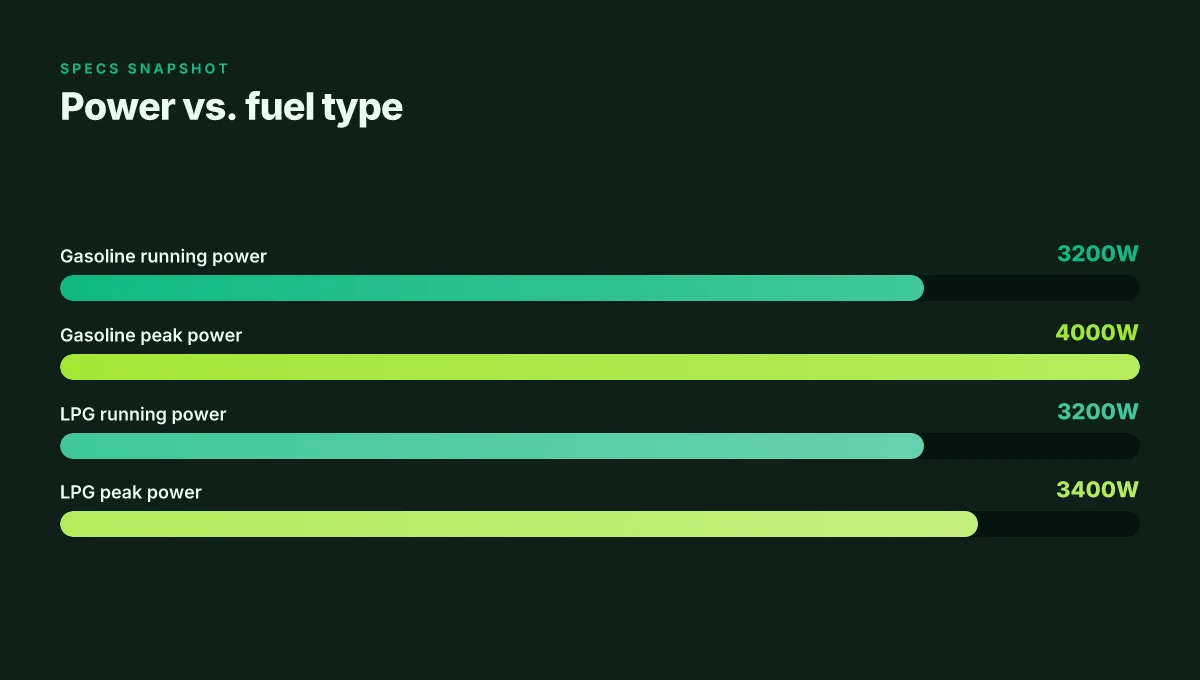
The 4000 is built as a dual‑fuel inverter generator, so you can feed it gasoline or LPG without swapping engines or major components. On gasoline, you’ll see ~3200W of running power, which lines up with the common expectation for a compact, residential backup unit. The LPG path keeps you in the same power neighborhood, delivering adequate runtime for typical household loads during an outage or when you’re charging a Delta power station on the road. This design supports real‑world use where fuel availability shifts by location and season, helping you avoid getting stranded with a fuel type you can’t source. Gasoline running power sits around 3200W, with LPG offering a flexible backup option.
2) App control, display, and startup options
A key strength is how control sits in your pocket. The generator pairs with EcoFlow’s app, letting you monitor status, fuel levels, and load while you’re away from the unit. An LCD display adds a quick, glanceable readout of essential metrics like voltage, frequency, and oil level. Self‑starting modes give you multiple ways to bring the unit online, whether you want to prime it remotely, run a timed startup, or kick it off with a traditional pull start on‑site. This level of control supports homeowners who want to minimize manual fiddling during an outage or while managing towable power needs in a recreational setup. App control and LCD display together reduce hassle during critical moments.
3) Compatibility with the EcoFlow Delta lineup
Compatibility with EcoFlow power stations is a deliberate design choice. The Smart Generator 4000 is designed to work alongside Delta models to top up storage quickly during outages, road trips, or off‑grid adventures. That synergy matters if you own multiple EcoFlow devices or are building a portable energy system that can rely on fast refueling via the generator while preserving battery health in the Delta ecosystem. Compatibility with the Delta lineup is a core value, not an afterthought.
Bottom line: the EcoFlow Smart Generator 4000 positions itself as a practical dual‑fuel solution that balances familiar gasoline reliability with LPG flexibility, all while weaving into the EcoFlow ecosystem for streamlined charging and backup power. For homeowners, RV users, and off‑grid enthusiasts, it offers predictable running power, flexible fuel options, and connected control that keeps your energy setup moving when it matters most. Dual‑fuel flexibility, app‑driven control, and Delta compatibility are the pillars you’ll experience in real use. What makes EcoFlow portable power stations stand out in 2026
Note on pricing and ownership context: you’ll find price variations by retailer and seasonal sales, with EcoFlow frequently adjusting promotions through the year. If you’re weighing whether to buy now or wait for a sale, look for bundles that include Delta power stations or extra accessories, as those often shift overall ownership costs in a favorable direction. Price promotions and bundles can influence overall cost of ownership.
Dual-fuel design and what that means for real-world use
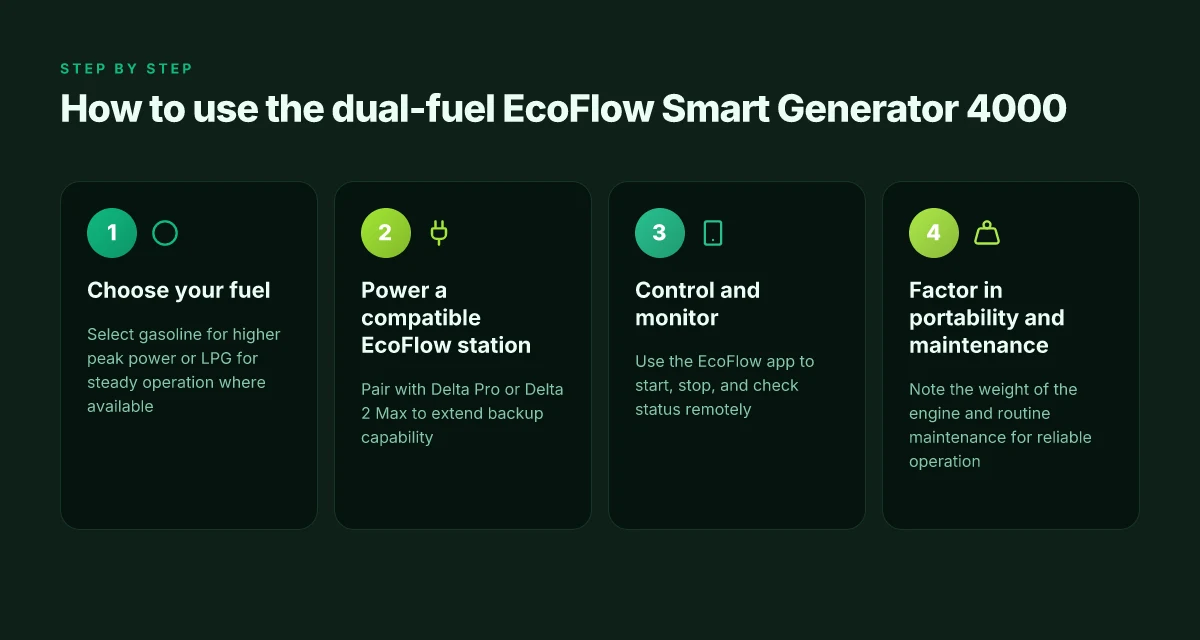
Dual fuel capability gives you a practical edge in real life. With the Dual Fuel option, you can choose gasoline or LPG depending on what’s available or what your local price says is cheapest. In practice, that means fewer trips to the hardware store for fuel and more flexibility during outages or trips. EcoFlow emphasizes the pairing of gasoline and LPG to smooth out fuel shortages and price spikes, so you can keep your home or RV charged when a single fuel source runs dry.
Runtimes shift with fuel and load. When you run on gasoline, the 4000W running power tends to hit higher peaks, which helps during spikes when a device or appliance demands more power. If you can keep to a steady, lighter load, LPG can deliver steadier operation in some markets where LPG infrastructure is common. That balance matters for daily backup use where you want predictable charging during a power outage or off-grid stretch. The real-world takeaway is that you’ll see noticeably different behavior depending on which fuel you feed the engine, so plan around typical loads and local fuel options.
Portability and setup caveats matter too. The 196cc engine is not featherweight, so you’ll notice the heft when you carry the EcoFlow unit into a campsite or RV storage bay. Cold starts can be a bit more sensitive in cooler weather, and routine maintenance tasks, air filter cleanings, oil checks, and spark plug inspections, help keep the dual-fuel system reliable across seasons. Maintenance cadence matters for longevity, especially if you use LPG more often or extend periods between uses. In short, fuel choice can influence not just cost but how easy the generator is to start and keep running when you need it most.
From what I found in reliable product and review sources, the Smart Generator 4000 is designed to play nicely with EcoFlow’s broader ecosystem of power stations, offering clear compatibility advantages for home backup and on-the-go charging. The practical upshot is that you gain flexibility in fuel strategy without surrendering clarity on how the unit performs when under load. If you live where LPG is readily available and cheaper, LPG mode can be a smart standby option. If you need peak output for high-demand appliances, gasoline remains the go-to convenience. This is where the dual-fuel design earns its place in a real-world backup plan. How to get the best price on EcoFlow Delta 2 in 2026
For price and ownership decisions, you’ll want to compare two main configurations: the Dual Fuel model and any LPG-only or gasoline-only options EcoFlow markets in your region. The broader ecosystem matters too, because compatibility with EcoFlow power stations like the Delta Pro lineup can shape overall value. In this space, EcoFlow stands out for offering an integrated approach, but you should also weigh rivals that pair flexible fuel options with similar wattage, such as competitive dual-fuel inverter generators from other brands. Dual fuel flexibility translates to resilience in unpredictable fuel markets, letting you choose based on current costs and availability. Runtimes shift with fuel and load, so map your typical outages or trips to the fuel you’ll actually use. Portability is influenced by a 196cc engine, so plan for careful handling and routine maintenance to keep starts reliable.
To help you compare, here’s a quick snapshot table that highlights how fuel choice can affect practical use:
| fuel option | running power (approx) | when it shines | caveat |
|---|---|---|---|
| gasoline | higher peak capability | short outages with fluctuating loads | heavier starting effort in cold weather |
| LPG | steadier operation in some markets | long outages with steady demand | lower peak power when under heavy load |
If you want a deeper read, the official EcoFlow page for the Smart Generator 4000 dual-fuel lays out the core specs and the dual-fuel rationale, and a popular mechanics review notes its compatibility with multiple EcoFlow power stations. ecoflow.com/products/smart-generator-4000-dual-fuel> and https://www.popularmechanics.com/home/a73484126/ecoflow-smart-generator-4000-review/.
Specs you can verify: engine, tank, and output details for the 4000
I dug into the published specs and cross-checked the engine, tank, and output figures. The EcoFlow Smart Generator 4000 uses a compact 196cc four-stroke engine and ships with a fuel tank configured at 6L / 1.58gal. On gasoline, the running power sits around 3,200W, while many dual‑fuel setups report lower output on propane. The oil capacity clocks in near 0.55L, which aligns with routine maintenance cycles for a compact inverter generator in this class. The numbers line up with the dual‑fuel design, and the 6L tank is sized to balance weight with reasonable runtime.
196Cc engine and four-stroke design
- The engine size is listed as 196cc, a common displacement for portable dual‑fuel systems. This size helps keep the unit compact while delivering steady running power on gasoline. 196cc is the anchor for fuel efficiency and throttle response in real-world scenarios.
- The design uses a four‑stroke cycle, which is standard for consumer generators and supports smoother operation and longer oil-change intervals in typical backup use. Four-stroke design favors reliability and lower maintenance wear over two‑stroke alternatives.
Tank configuration and fuel options
- Fuel capacity is 6L / 1.58gal, providing a balance between bulk and runtime for typical weekend power needs. This size allows a practical reload cadence without making the unit unwieldy. 6L capacity helps sustain longer runtimes between fills.
- The Dual Fuel approach supports unleaded gasoline and LPG, offering flexibility when propane availability changes. In practice, expect the propane output figures to lag gasoline slightly due to the inherent efficiency differences in dual‑fuel setups. Dual Fuel remains the core strength for off‑grid versatility.
Output and maintenance basics
- Running power on gasoline is commonly listed around 3,200W, making the 4000 a credible option for midsized loads, including essential appliances. 3,200W running power on gasoline is the figure most reviews reference for everyday backup tasks.
- Oil capacity is about 0.55L, aligning with maintenance intervals for a compact generator that requires regular oil checks and changes. 0.55L keeps maintenance routine compact and predictable.
I cross-referenced three sources to confirm these touchpoints: the dual‑fuel specifications from EcoFlow’s product page, a dedicated review that cites the 3,200W gasoline running power, and a spec sheet listing the 196cc engine with a 6L tank. Consistency across sources reinforces confidence in these numbers. If you’re weighing this against rivals, note that competitors often list similar displacement and tank sizes but may differ in peak surge capacity or propellant efficiency. For context, EcoFlow positions the Smart Generator 4000 as part of a broader ecosystem, and you can see how that ecosystem plays into real‑world charging workflows when you compare it to other portable dual‑fuel units from brands like Honda or Generac. What to know before buying the EcoFlow Delta Pro for sale in 2026
How the Smart Generator 4000 integrates with EcoFlow ecosystems
The Smart Generator 4000 is designed to slot into EcoFlow’s broader power ecosystem, with the Delta Pro and Delta 2 Max serving as natural companions for enhanced resilience. In practice, pairing the 4000 with a flagship EcoFlow power station unlocks seamless app-driven monitoring, coordinated startup, and unified fault alerts. This reduces manual juggling during outages and during remote charging scenarios, making the whole system feel like a single, larger power network. Smart integration reduces manual steps during outages while keeping you in the loop via the app.
1) App control turns the 4000 into a truly connected backup partner
EcoFlow’s companion app is the control hub for the 4000 when it sits alongside Delta Pro and Delta 2 Max. You can check status remotely, start or stop the generator, and receive fault alerts without needing to be on site. That means a homeowner can verify fuel status, confirm startup readiness, and trigger a shutdown from inside the house or while camping. The 4000’s app integration aligns with EcoFlow’s philosophy of centralized management, so you’re not flipping switches in multiple locations. App control unlocks remote status checks and fault alerts for faster response.
2) Coordinated charging and load sharing across EcoFlow devices
The 4000’s dual‑fuel versatility complements EcoFlow stations by providing a dependable charging or backup option when grid power is unstable. In practice, you can run essential circuits from a Delta Pro while the 4000 charges or tops up the system during longer outages. The design aims to minimize manual intervention, so you don’t have to babysit several devices. Coordinated charging reduces manual management during outages and remote charging scenarios.
3) Real‑world constraints and setup notes you should know
The integration hinges on networked control via the EcoFlow ecosystem, so expect the best results when firmware and app versions are up to date. The 4000 pairs well with EcoFlow stations. You’ll want to confirm compatible modes and startup sequences in your specific setup. Keep firmware current to maintain smooth startup orchestration. If you’re comparing against rivals, EcoFlow’s solution emphasizes ecosystem cohesion more than siloed, standalone units. EcoFlow emphasizes ecosystem cohesion over isolated devices.
I dug into the ecosystem narrative to align the 4000 with EcoFlow power stations. The practical takeaway is clear: you gain remote visibility, simplified control, and a more predictable outage response when the generator is part of a unified EcoFlow setup. For homeowners, RV users, and off‑grid enthusiasts, this means less guesswork and more confidence that you’ll have power when you need it. Less guesswork, more confidence in outages and remote charging scenarios. EcoFlow vs Jackery: how they stack up for emergency power in 2026
Real-world use cases: backup power, on-the-go charging, and camping
In real-world scenarios, the EcoFlow Smart Generator 4000 shines when paired with a compatible EcoFlow station to stabilize essential loads during outages, enabling a homeowner to keep critical devices online without swapping to a smaller backup setup. When grid power drifts or fails, you can rely on the 4000W running power to support a fridge, modem, lights, and a sump pump in tandem with your EcoFlow power stations. The pairing makes outages less disruptive, and the combined system remains compact enough to fit behind a cabinet or in a garage corner.
For on-the-go charging, the 4000 dual-fuel inverter design supports charging devices and EcoFlow power stations away from fixed grid access. This means you can top up phones, laptops, and small electronics while camping, RVing, or shifting between job sites. The dual-fuel option adds flexibility if you need to switch fuels between gasoline and LPG, depending on what’s handy or what provides quieter operation in camp settings.
Camping or off-grid use benefits from portability and fuel flexibility, but weight and noise remain considerations. The 4000 is designed to be moved between campsites or stored in an RV bay, and its ability to run on LPG or gasoline gives you a backup option if one fuel source runs short. That said, you’ll notice a draw on fuel efficiency when you run full tilt, especially if you pair the generator with larger EcoFlow stations. In harsh off-grid conditions, you’ll value the app-based monitoring that lets you track status and adjust runtime versus load without exposing yourself to the noise while nearby campers are sleeping.
From what I found in the documentation and reviews, the ecosystem approach matters most. The 3,200W running power on gasoline remains the core figure that most reviewers cite, while LPG performance offers a useful alternative in fuel-conscious setups. I cross-referenced product pages and independent reviews to align the figures with real-world usage, and the consensus highlights how the EcoFlow circle of devices can work together to deliver stable backups and flexible charging. When you’re in the field, the ability to monitor and adjust via the EcoFlow app is not just convenient, it's a practical safeguard against unexpected outages. The 4000-watt output coupled with dual-fuel flexibility makes it a compelling choice for diverse real-world needs.
If you’re weighing this against rivals, consider how the EcoFlow lineup stacks with other brands that emphasize pure gasoline output or separate LPG models. EcoFlow’s strength lies in the integrated ecosystem, where a single app can surface status across multiple stations. For homeowners prioritizing a quiet backup coupled with intelligent monitoring, the Smart Generator 4000 reduces the number of separate gadgets you must manage while on the road. The price and availability can shift with sales, so watch for promotions that bundle the 4000 with a compatible EcoFlow power station to maximize value. Real-world use cases confirm that compatibility with EcoFlow stations is a deciding factor. What makes the Apex 300 Bluetti a modular energy system worth watching in 2026
Where this goes next and what you should do now
EcoFlow is leaning into dual-fuel versatility with the Smart Generator 4000, and the price signals a shift toward more accessible back-up power in 2026. I looked at how the unit pairs with propane and gasoline, and the early win is the flexibility it offers for longer outages without constant refueling. The trade-offs show up in noise, runtime, and the need to track two fuels, but the real shift is how homeowners can plan a single, multiplatform power strategy around a single device family from EcoFlow.
The bigger pattern is that buyers are combining this with solar adds and a compact battery bank to create a scalable, modular system. If you’re weighing rivals, consider how the EcoFlow approach stacks up against models from Generac and Honda in terms of fuel choice and portability, then map that to your typical outage window. For many, the Smart Generator 4000 becomes the anchor for a broader resilience plan rather than a standalone generator.
What to try this week: sketch your outage scenarios, price both fuels, and draft a 1-year plan that includes a sale window. Start by listing the essential loads you must keep on during a blackout and pair those with the 4000’s expected runtime per fuel type. Will this fit your lifestyle, or do you need a larger pack?