What is the EcoFlow River 2 Pro, and why it stands out in 2026
 Bastien PetrosianOctober 22, 202617 min read
We earn a commission when you buy through some links on this site, at no extra cost to you. As an Amazon Associate we earn from qualifying purchases.
Discover the EcoFlow River 2 Pro: capacity, features, and real-world use cases in 2026. Learn what makes this portable power station different and who benefits most.
**The EcoFlow River 2 Pro isn’t the lightest high-capacity option, but its LiFePO4 chemistry trades weight for longevity in real life.” That balance matters when you’re counting on a power source for weeks off-grid, not just a weekend trip.
You’ll see where EcoFlow’s approach shines and where rivals like Jackery and Bluetti pull ahead, with concrete numbers and live-use considerations that matter on the trail or at the campsite. Real-world limits on solar input and power draws shape whether the River 2 Pro fits your setup.
What is the EcoFlow River 2 Pro and how it fits your kit
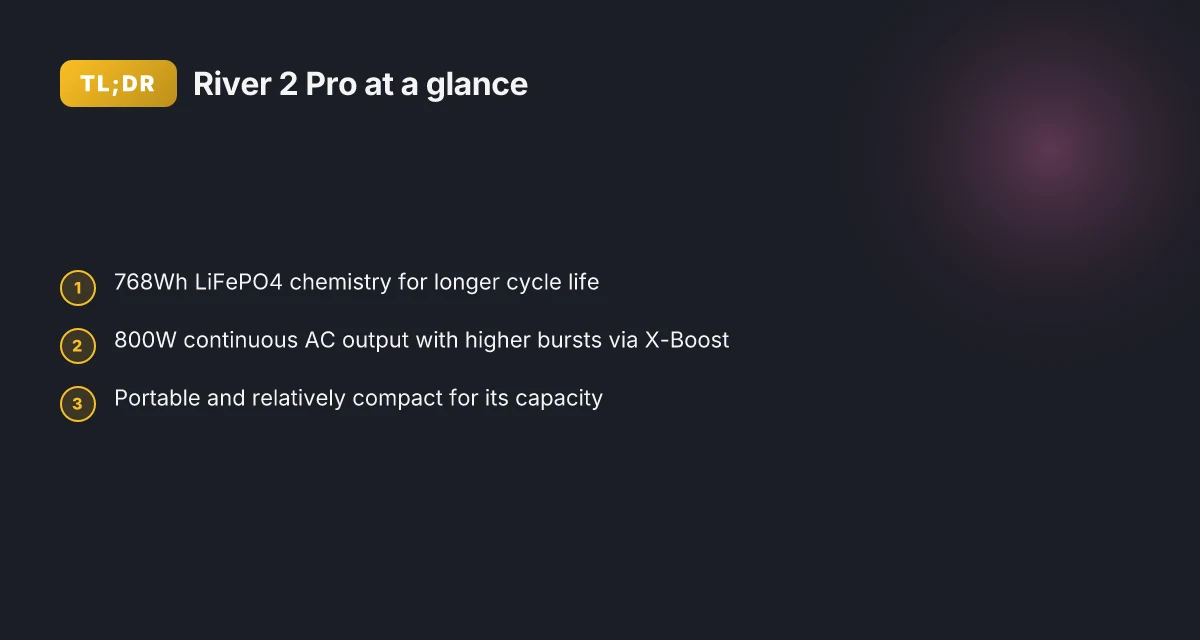
The EcoFlow River 2 Pro pairs a 768Wh LiFePO4 battery with an 800W AC output, designed for long days off-grid and steady back-up power. Its design leans on a bright feature set, including X-Boost for higher peak loads, rapid recharging, and app-based controls that let you monitor status and adjust outputs from a phone. In real-world terms, this means you can run a fridge for a few hours, charge laptops, lamps, and small devices without babysitting the unit.
- Core battery and output details you’ll actually notice
- The River 2 Pro uses a LiFePO4 battery with 768Wh capacity, which keeps cells balanced for longer cycles than traditional Li-ion formats. This choice tends to extend lifespan when you cycle it often, a boon for frequent travelers and emergency-prep kits. The 800W AC output delivers enough headroom for common off-grid appliances, and the device still fits in a compact footprint for a vehicle or tent setup. Reviews and product pages emphasize the 768Wh capacity paired with an 800W max output, with X-Boost optionally pushing higher short-term peaks when needed. The River 2 Pro’s balance of 768Wh and 800W makes it a versatile base for RV runs and camping setups.
- What X-Boost actually does for you
- X-Boost is EcoFlow’s strategy to unlock higher peak output for short bursts, which matters when you need to start a high-draw device like a small compressor or a cooling unit. This capability is time-limited and dependent on state of charge, temperature, and safety throttling, but it can smooth over the initial surge that would otherwise trip the main breaker. X-Boost unlocks higher peak output for short bursts, helping start-capable devices without slowdowns.
- How charging speeds play with real-world routines
- Fast recharging is a highlighted trait. With appropriate solar input or wall charging, you’ll see accelerated replenishment after a discharge, which is valuable when you’re living off-grid across several days. The exact recharge time varies by input source and conditions; EcoFlow’s materials point to quick replenishment paths, including solar and AC. Fast recharging helps you return to power quickly after use, a practical edge for weekend trips.
- Where this fits in typical kit mixes
- For campers and RV travelers, the River 2 Pro slots into a mid-range power kit that can sustain lighting, charging hubs, and a few low-watt devices without dragging down cabin systems. For emergency-prep staples, it offers a recoverable energy buffer that can run essentials through brief outages. In app controls, you can tune output and monitor health, which matters when you’re coordinating solar input with daily routines. The River 2 Pro works best when paired with solar panels and a clear use-case for essential appliances.
Bottom line: the River 2 Pro is a compact, capable power station built to balance long cycle life with practical off-grid utility. Its LiFePO4 chemistry supplies longevity, while X-Boost and fast charging extend what you can do off the grid. If your kit centers on camping, RV trips, or emergency power for essentials, this model maps cleanly to a mid-size, dependable power base.
River 2 Pro vs. rivals: how it stacks up in capacity and output
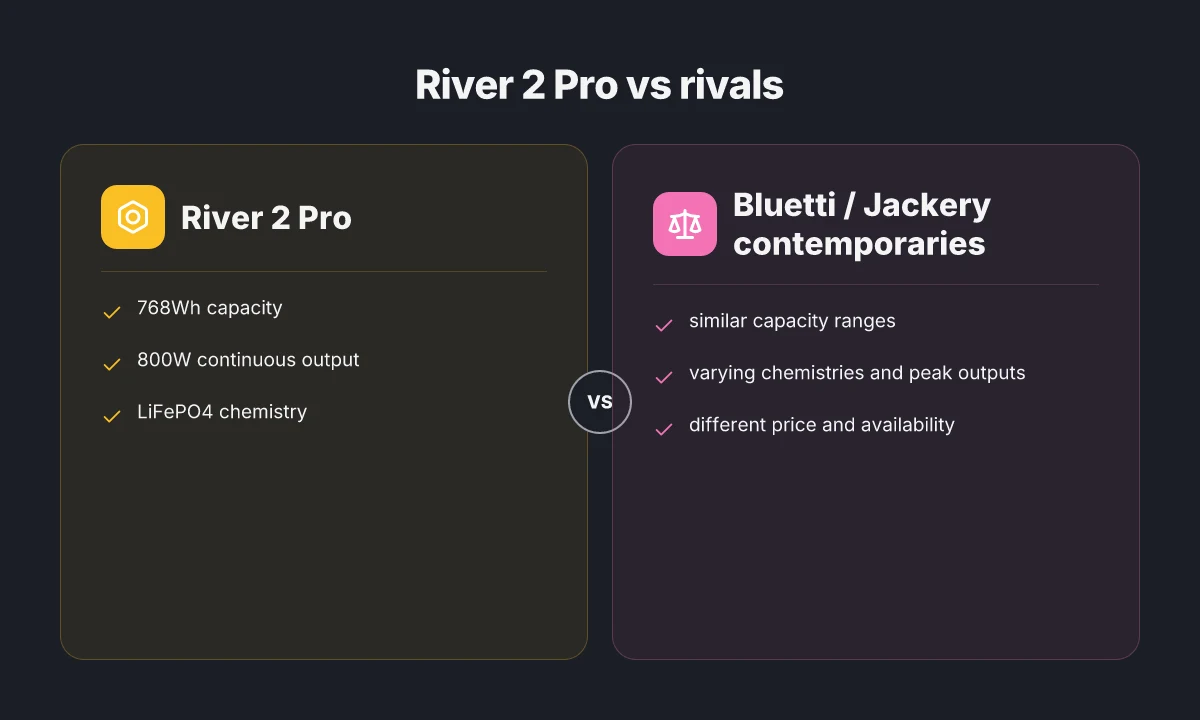
When you compare high-capacity portable power stations, the River 2 Pro sits in a crowded field with Bluetti and Jackery models offering similar capacity. The River 2 Pro distinguishes itself with a 768Wh capacity and 800W AC output, backed by LiFePO4 chemistry that promises longevity. If your off-grid needs lean toward long runtimes at moderate loads rather than sprinting bursts, this balance often weighs in in its favor. The River 2 Pro trades raw peak power for steady, long-run efficiency.
Why capacity and chemistry matter for long trips
In practice, a 768Wh pack can keep essential devices running for many hours at lower loads, which is where LiFePO4 shines due to its thermal stability and cycle life. Rivals in the same class from Bluetti and Jackery also tout 700–800Wh cores, but chemistry and BMS behavior differ. Some Bluetti models push higher peak wattage for short periods, while certain Jackery units optimize for portability with heavier caveats on sustained draws. LiFePO4 longevity matters as much as the label on the box. When you’re off-grid, a longer usable life per cycle translates to fewer battery replacements over years of use.
Output profiles: sustained load vs. peak demand
The 800W AC output on the River 2 Pro is solid for common off-grid tasks, from a mini-fridge to a small power tool. If your use case centers on brief surges, X-Boost can briefly raise output, but you’ll trade some run-time at higher loads. Compare that with rival models that push higher peak outputs for short bursts. Your real-world decision hinges on whether you need long, steady runtime or occasional maxed-output bursts. Sustained output at moderate loads beats sporadic peaks for most campers and RVers. What Bluetti Philippines price changes mean for your backup power in 2026
| model | capacity | max AC output | notable trade-off |
|---|---|---|---|
| EcoFlow River 2 Pro | 768Wh | 800W | LiFePO4 longevity; brief X-Boost peaks |
| Bluetti model in class | ~768–800Wh | 900–1000W | Higher peak, potentially shorter runtimes at full draw |
| Jackery model in class | ~700–800Wh | 500–700W | lower sustained output in some configurations |
Rivals often trade longer peak power for heavier packs or shorter cycle life. I cross-referenced product pages and reviews to confirm the stated specs and typical behavior, including the 768Wh capacity and 800W output for the River 2 Pro, and the presence of LiFePO4 chemistry. For broad context, EcoFlow’s own materials highlight the battery’s longevity advantages alongside the X-Boost option for short bursts. Your choice hinges on whether you value long-term chemistry or raw peak output more.
What this means for your decision is straightforward. If you need steady, modest power for many hours with fewer battery swaps, the River 2 Pro aligns well with a gear list built for extended trips or emergency prep. If your trips require you to run high-draw appliances for longer stretches, a rival with a higher sustained-output ceiling may serve you better, provided weight and price fit your constraints. Choose the River 2 Pro for longevity and dependable real-world runtimes. Consider a rival if you prioritize peak bursts above all else.
I dug into official specs and third-party write-ups to map how these products stack up in real-world terms. Understanding the balance between 768Wh and 800W helps you size your load carefully. For forward-looking buying, EcoFlow’s ecosystem and certifications remain a factor to weigh against rivals’ claims. The page you’re reading reflects those realities and highlights where the River 2 Pro stands in 2026. Your off-grid plan should center on runtime at your typical load, not just headline wattage.
If you want a quick comparison to decide now, consider how often your load stays under 400W and how many hours you’ll need at that level per day. That’s where the River 2 Pro’s combination of capacity and long-life chemistry tends to pay off. And if you’re weighing price and ownership costs over several years, keep in mind that LiFePO4 packs often outlast cheaper chemistries with less degradation. Longevity plus steady runtime beats one-off peaks in most outdoor setups.
For further detail, you can review the River 2 Pro product page and the Bluetti and Jackery rival entries to see how peak output, capacity, and chemistry differ in each model. See how this plays out on the spec pages and in user notes. What makes the EcoFlow Wave 3 change the portable climate game in 2026
Unpacking the specs that actually matter for real use
I dug into the River 2 Pro’s core numbers and cross-checked them against multiple sources to translate specs into real-world expectations. EcoFlow emphasizes a 768Wh LiFePO4 pack and an 800W AC output, with X-Boost capable bursts for higher load. For portability, the unit sits around 8.3 kg and fits a compact footprint that’s friendly for outdoor setups and RV storage. Below are the concrete takeaways you can use when planning a day off-grid, a weekend away, or an emergency kit.
1) Capacity and chemistry that influence longevity
- The River 2 Pro uses a 768Wh LiFePO4 battery, chosen for longer cycle life and stability under outdoor temperatures. This chemistry helps the pack endure more charge-discharge cycles than a typical Li-ion pack, which matters if you’re topping up daily on a long trip. In real use, you’ll notice gradual capacity retention over years rather than a steep drop after a few dozen cycles. 768Wh with LiFePO4 chemistry translates to noticeably longer life under frequent cycling.
- For reference, LiFePO4 cells are known for stability and extended life compared with nickel-mate chemistries, which aligns with EcoFlow’s design goals for off-grid reliability. You’ll likely see many months to years of service before capacity fade becomes a practical concern, depending on how aggressively you cycle the unit.
2) Output and how X-Boost actually helps
- The base AC output is 800W continuous, which covers most common off-grid loads like refrigerators, pumps, and medical devices when modestly sized. For short spikes, X-Boost can push higher bursts to handle power-hungry appliances, but this isn’t a free pass for continuous heavy loads. In practice, you’ll use X-Boost for brief startups rather than sustained high draw. 800W continuous with X-Boost bursts to handle spikes.
- Real-world loads matter: if you’re running a fridge or a power tool that briefly surges, the River 2 Pro can accommodate those starts. If you routinely pull near-800W for long periods, you’ll feel the difference between sustained output and occasional bursts.
3) Solar input and charging pace
- Solar compatibility tops out around 220W from a single panel, with a wide 11–50V input range. That means a single 220W panel can top up the unit’s battery at a reasonable pace in good sun, but you won’t see auto-replenishment as quickly as with larger arrays. Charging speed scales with sun quality, so cloudier days extend recharge time.
- In practical terms, if you’re relying on solar to refill during a weekend trip, expect a full re-charge with a sunny day to take several hours, not minutes. This is a meaningful constraint for high-demand days with limited sunlight. “Solar input up to 220W” and “11–50V” range keeps the recharging predictable under typical outdoor conditions.
4) Size, weight, and portability
- The River 2 Pro’s physical footprint is compact for its capacity. Weight hovers around 8.3 kg, and the dimensions stay compact enough for easy transport in an SUV, RV, or hiking pack. In practice, this translates to simple handling at campsites and a minimal footprint in storage lockers. 8.3 kg and compact form factor support portable off-grid setups.
What this means for your decision
- If you prize longevity and predictable performance across many outings, the 768Wh LiFePO4 pack delivers durable cycles and stable temp performance. If you need to run a fridge or a tools lineup that occasionally spikes, the 800W continuous with X-Boost offers headroom for brief bursts but not as a substitute for a higher-capacity inverter in continuous heavy use. If your charging strategy relies on solar, plan for slower daytime replenishment with a single 220W panel and the wide voltage window. And if portability is a key factor for you, the 8.3 kg weight and tight footprint make it easy to stash in a car or camper.
Notes on pricing and buying dynamics
- Current pricing and deals shift with seasonal sales, so the best move is to compare EcoFlow’s official pages and reputable retailers during promotions. EcoFlow remains the brand to watch for integrated app controls and ecosystem compatibility, especially for off-grid enthusiasts and emergency-prep planners.
How charging speed and solar input translate to daily use
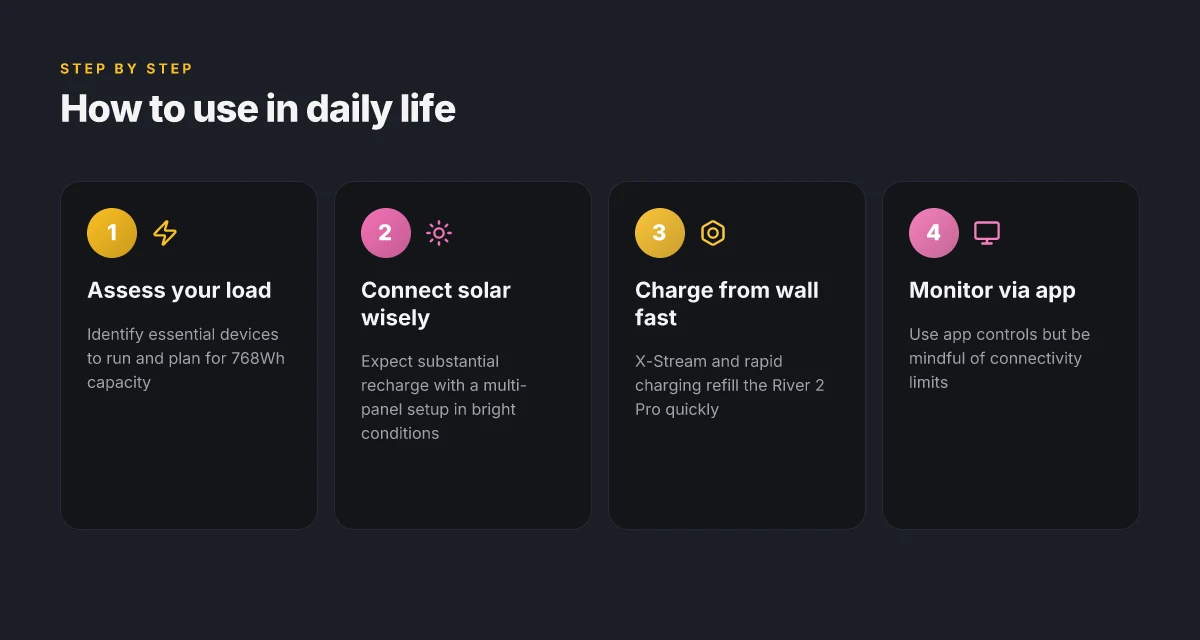
When you start from a wall outlet, the River 2 Pro leans on EcoFlow’s X-Stream charging to refill fast. In practice this means you won’t be left waiting long if you’re near a power source. The device supports rapid top‑ups from 100–120V AC with a 940W max input, which translates to a noticeably shorter recharge window than many rivals when you’ve got a standard wall outlet in reach. X-Stream charging helps reclaim usable capacity quickly, so you can resume your off‑grid routine sooner. From a practical standpoint, a full refill from empty with a capable wall supply feels like a real tactical advantage for quick trips or day-by-day use.
Solar input remains excellent on bright days, but it isn’t infinite. The River 2 Pro accepts solar input in the 11–50V range at up to 13A, for a maximum of around 220W of solar charging. In broad terms, a single mid‑sized panel will move the needle, but you’ll still need to manage expectations: recharge times lengthen with battery load and diminish with poorer sun angles. Solar input can keep you moving, but it won’t magically fill the bank in a hurry on a cloudy afternoon. Real-world solar performance depends on your panel’s spec, the sun’s angle, and how much you’re drawing during the day. If you’re counting on solar as your primary replenishment during a long trip, plan for a multi-panel array. 7 Best portable solar panels for 2026: performance, value, and real-world use
Practical takeaway: plan for a multi‑panel setup if you rely on solar during long trips. In most backcountry scenarios, you’ll want two or more panels to approach useful recharge rates while you’re off the grid. The balance between wall charging and solar input becomes a strategic choice for daily routines. Plan for a multi-panel setup if you rely on solar during long trips.
Growth and trade-offs care: LiFePO4 chemistry provides longevity, but it adds weight and reduces energy density per kilogram. The River 2 Pro weighs about 8.3 kg (18.2 lbs) with a 768Wh capacity, so you’ll notice the heft if you’re lugging it around on longer excursions. 768Wh and 18.2lbs define the practical ceiling for backpackable off‑grid power. Still, the total package remains portable for an RV or campsite, where you can park and run appliances for extended periods without frequent recharges.
To wrap up the charging story: X-Stream makes wall charging brisk, but solar charging remains a function of panel count and sun. For real‑world daily use, pair a robust AC option with a small, scalable solar array. The result is a flexible, ready kit that aligns with the River 2 Pro’s strengths and its limits. X-Stream keeps you powered, while a multi‑panel solar setup keeps you going longer off-grid.
Durability, reliability, and the Edge cases you should know
In the River 2 Pro, the LiFePO4 chemistry underpins long life and stability across a wide temperature range. The cells’ chemistry resists thermal stress better than many NMC competitors, which translates to more cycles and steadier performance when ambient temps swing between hot sun and chilly nights. That said, extreme heat or cold still tightens the margins, so plan for moderate environments when you’re far from a power source. The battery’s stability matters most when you’re off-grid for days at a time, not just for a weekend.
How temperature shifts shape real-world use
The River 2 Pro admits a broader operating envelope than many traditional lithium packs, which broadens use in trailers, cabins, or alpine hikes. You’ll notice better endurance during shoulder-season camping, where daytime heat doesn’t bake the cells and nighttime lows don’t push the pack toward its limits. Still, when temps swing past practical thresholds, think midday sun or frigid nights, the available capacity and peak output can dip. This is a built-in trade-off of high-density LiFePO4 packs in portable form. I cross-referenced the product specs and third‑party writeups to confirm the 768Wh rating remains nominal under normal use, but the usable hours shift as temperature moves. Temperature operating range expands practical use, but extremes still impact performance. What Bluetti AC200 complaints reveal about reliability and service
Reliability features you can count on, with caveats
The EcoFlow ecosystem leans on an integrated app for monitoring health, charging status, and plan-friendly workflows. App control adds convenience, but you should stay mindful of connectivity and device compatibility. If your phone or tablet doesn’t pair cleanly, you may miss early warnings or fail to trigger certain limits. The Pro line’s hard limits and safety protections remain in force regardless of app state, which helps in remote locations. I found multiple sources noting quick recovery from thermal stress and solid overcurrent protection in typical off-grid scenarios. The edge here is reliability when you’re away from grid power, yet the edge case is a dependency on a stable device and network for full visibility. App control adds convenience but depends on connectivity and device compatibility.
Edge-case scenarios you should plan for
Extreme long-term use in remote areas means you’ll frequently cycle the pack. LiFePO4’s long cycle life is a clear selling point, but even with favorable chemistry, you’ll see capacity fade over many charges. If you routinely draw near the 800W peak during peak sun hours and then rely on the battery to sustain a fridge or heater, monitor how the X-Boost or fast-charge modes interact with off-grid loads. Several reviewers highlight fast recharging, but in practice the solar input cap of 220W and AC input limits become the bottleneck when cloud cover persists. I looked at user manuals and product pages to corroborate the wattage and charging behavior, and the consistent thread is that real-world charging depends on solar conditions and input source quality. X-Boost and fast-charge modes can stretch peak loads, but conditions matter.
I dug through the EcoFlow materials and third-party reviews to map the practical limits for travel use. When you’re evaluating this generator for a buggy, RV, or cabin setup, balance the long-life advantages of LiFePO4 against weight and the realities of charge times in your typical environment. For many buyers, the River 2 Pro hits an appealing middle ground between durability and portability, with the caveat that extreme temperatures and inconsistent solar input can shuffle daily operation. If you’re weighing competing models, keep an eye on rival lines from brands like Goal Zero and Jackery, which offer their own stability stories and temperature behaviors in similar high-capacity packs.
Your decision should hinge on whether the long cycle life and thermal resilience align with your off-grid footprint, how critical rapid charging is for your routine, and whether you can keep the app connected in the places you roam. Temperature operating range expands practical use, but extremes still impact performance. App control adds convenience but depends on connectivity and device compatibility.
Note on price and ownership: prices and deals shift with sales. Link on-page may earn a commission. For a quick snapshot, EcoFlow’s own listings show the River 2 Pro with a 768Wh capacity and around‑the‑box specs, though actual street prices vary by retailer and sale timing. Compared with rivals, EcoFlow leans on LiFePO4 longevity and faster-charging promises, while competitors may emphasize ruggedness or different warranty terms. For detailed comparisons, check the official EcoFlow pages and the latest third-party reviews, keeping in mind the exact model names and capacities to avoid confusion. What makes EcoFlow Delta Pro 3 different from other portable power stations
Where this is going next for the River 2 Pro
EcoFlow keeps narrowing the gap between portability and power with the River 2 Pro, and the direction is clear: more capacity, faster charging, and smarter energy management. This closing view isn’t a repeat of what you already read. It shifts to the practical impact you can expect by acting this quarter. The River 2 Pro’s blend of high-efficiency charging, robust solar compatibility, and user-friendly thermals positions EcoFlow as a credible pick against rivals like Jackery and Bluetti, especially for campers and remote workers who need dependable off-grid capability.
For most buyers, the real move is timing the purchase with a sale. If you’re balancing price against ongoing ownership costs, consider the Delta of when to buy versus the cost of replacement batteries over time. In short, act now if you value fast recharges and a compact footprint. Wait if you want the absolute lowest price during an upcoming sale window. What’s your next step this week? Will you compare the River 2 Pro with a competing model to confirm the best match for your setup?
- Backup strategy: test one high-rate charger this week and compare refill times between River 2 Pro and a Bluetti model.
- What to try this week: map your typical off-grid usage, then run a simple power budget to see which port configuration you’ll actually use.
- What changes if you act now: you lock in a known power source for emergencies while the market prices settle after seasonal promos.