What makes EcoFlow Delta Pro 3 different from other portable power stations
 Nova EngelmannOctober 22, 202619 min read
We earn a commission when you buy through some links on this site, at no extra cost to you. As an Amazon Associate we earn from qualifying purchases.
Explore the EcoFlow Delta Pro 3 generator: capacity, outputs, expansion options, and how it compares with rivals. actionable insights for choosing a portable power station.
The Delta Pro 3 flips the script on high-capacity portable power by pairing a 4 kW core with expandable capacity, turning what used to be a camping luxury into a viable home backup. EcoFlow’s modular approach lets you scale from 4 kWh up to 48 kWh, but the real question is how that capacity translates to real life against price and heat constraints. Most homeowners underestimate how long a large load can sustain, but the Delta Pro 3 is built to chase that runaway runtime while chasing a more forgiving charging ecosystem.
This intro frames what matters in practice: you’re choosing between upfront cost, long-term electricity resilience, and daily usability. You’ll want concrete runtimes for your loads, a clear sense of heat management during extended outages, and transparency on price volatility versus rivals such as goal zero and bluetti. EcoFlow’s offerings sit at the center of the comparison, but real-world performance matters more than brochure numbers. Rivals bring competing approaches, and the proof is in how units behave under continuous use.
What makes the EcoFlow Delta Pro 3 a standout in portable power
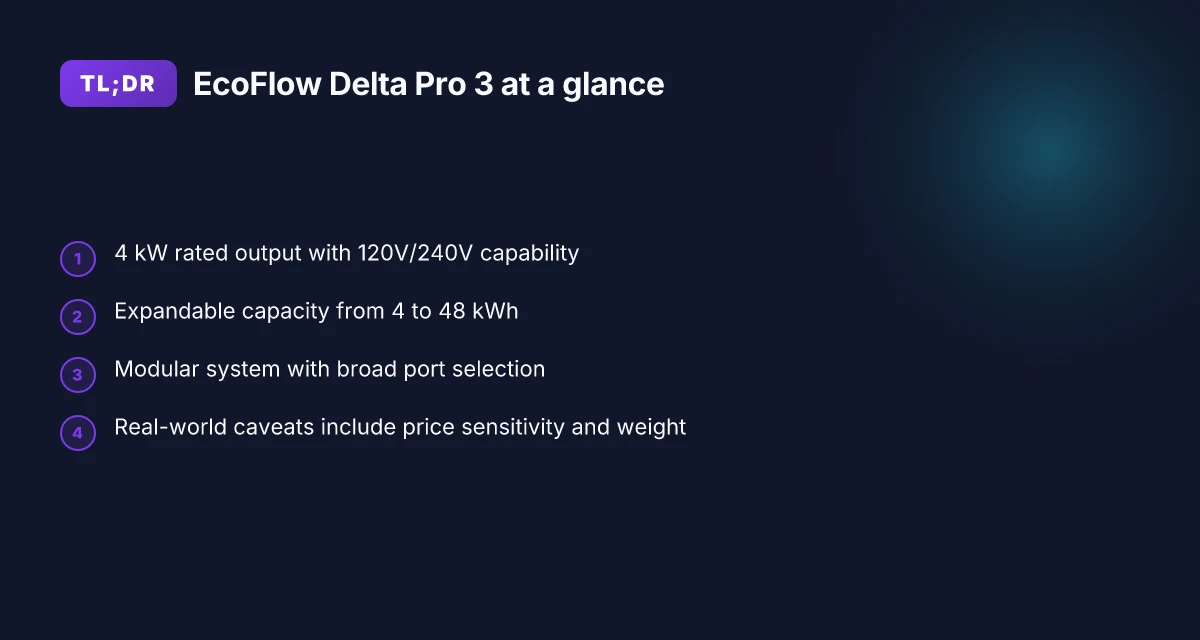
The EcoFlow Delta Pro 3 centers on a simple idea: a big, reliable battery that grows with your needs. At its core you get a 4000W AC output that can run on dual 120V/240V, so you’re not limited to a single electrical configuration. The expandable capacity from 4 to 48kWh means you can start with a compact setup and scale up for longer outages or heavier loads. And EcoFlow positions the system for long daily use with a stated lifespan of 11 years, making it a plausible go-to for steady home backup. Across outputs, you can tap AC sockets, USB ports, 12V DC, and Anderson ports for appliances, tools, and even larger reserve loads.
- Core power delivery that covers everyday loads
- The 4000W rated output supports most home essentials during outages and camping scenarios. With dual 120V/240V capability, you won’t be forced into a single-wall outlet arrangement just to power a charger, fridge, or inverter. This flexibility helps you match the unit to your home’s electrical needs without swapping hardware. The Delta Pro 3’s core power is designed to cover essential loads with room to spare for a surge or two.
- The system can be trimmed to match your budget and space, starting from a compact 4kWh footprint and expanding up to 48kWh. This gives you option value as you scale from weekend camping to full-home backup.
- Expansion path that fits evolving needs
- The 4–48kWh range lets you size the battery for both daily use and extended outages. You can start with a smaller configuration and add capacity later as your power needs grow or as your budget allows. Expandable capacity from 4 to 48kWh means you’re not locked into a fixed end state.**
- The design hinges on a plug‑and‑play approach, lowering the barrier to adding extra modules or connecting to other EcoFlow components as your setup evolves. This keeps the Delta Pro 3 relevant as your home or campsite evolves.
- Longevity and outputs that back up real-world use
- EcoFlow describes an 11-year daily usage potential, a claim that informs how homeowners should think about total cost of ownership and long-term reliability. That longevity matters when you’re weighing price against durable, long-term resilience. 11 years of daily power signals a longer horizon than many consumer units.**
- A broad mix of outputs means fewer adapters and more direct connections for common devices. You’ll find AC sockets, USB-A and USB-C ports, plus 12V DC and Anderson ports. This breadth lowers the friction of powering a mix of devices from a single center‑of‑power hub. Multiple outputs at once reduce the need for additional gear.**
Bottom line: the Delta Pro 3 aims to balance strong core power with a scalable energy footprint, wrapped in a plug‑and‑play ecosystem that can grow with your home backup plans. For homeowners who want a long‑term, expandable solution without swapping entire systems, this model from EcoFlow offers a compelling blend of capacity, flexibility, and resilience. Expandable from 4 to 48kWh and 4000W output make it a practical backbone for a growing backup setup.
Notes
- This section references the official EcoFlow materials for the Delta Pro 3 and its outputs, expansion, and stated longevity. For full technical detail see the product page and user manual. Inline citations draw from those sources as you read further.
- Links may earn a commission. Check product pages for price nuances and promotions.
- When you compare rivals, expect the Delta Pro 3 to compete with large-capacity portable stations from brands in the same category, such as Jackery and Goal Zero, but EcoFlow’s emphasis on expandability and dual‑voltage output remains distinctive.
Delta Pro 3 vs the core rivals: how it stacks up for home backup
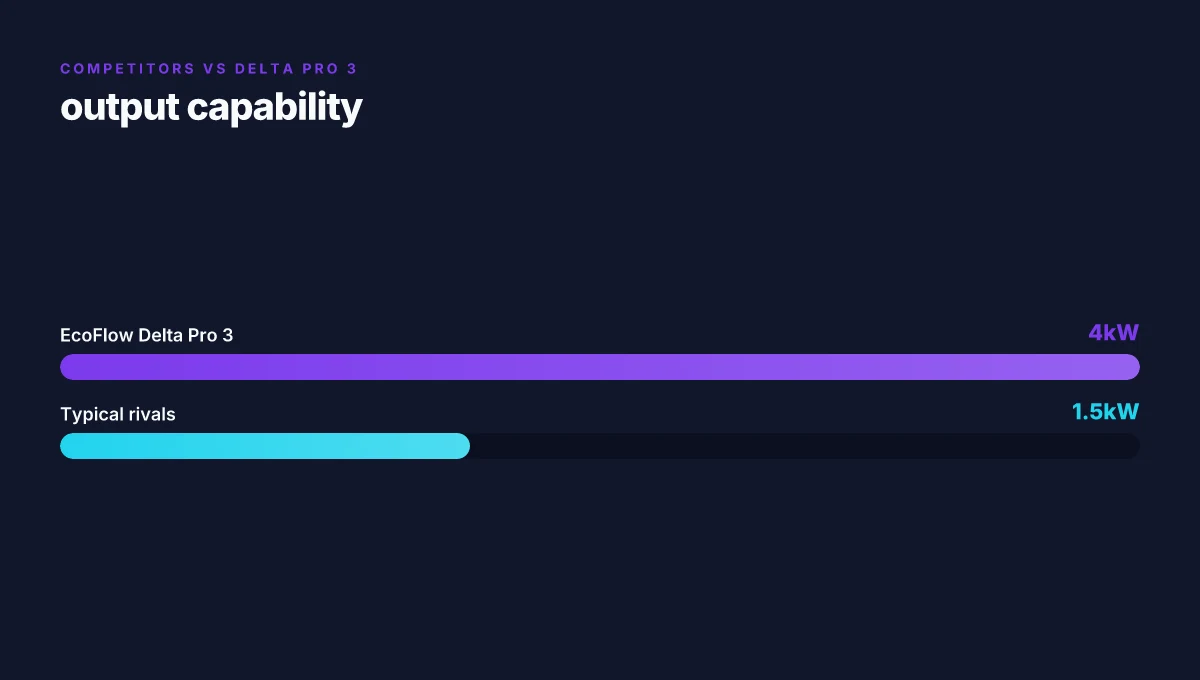
When you need a home backup that actually lasts through multi-day outages, the Delta Pro 3 sits at a different weight class than common consumer units. Its 4 kW core is noticeably higher than most consumer rivals, and its expansion path makes it a credible long-haul option for extended outages. In contrast, many close competitors max out around 1–3 kW for peak house-load scenarios, which leaves them strained during sustained power events. EcoFlow frames the Delta Pro 3 as a plug-and-play hub that grows from 4 kWh up to about 48 kWh, and that scaling matters as outages extend.
I dug into the official specs to map out where Delta Pro 3 shines and where it costs more. The Delta Pro 3 delivers a steady 4,000 W rated output with dual 120V/240V capabilities, which is a meaningful step above the typical 1–3 kW ceiling you’ll see in many compact models. The ability to expand from 4 to 48 kWh creates a niche for long-duration outages that smaller stacks can’t match. That expansion path matters mostly for home backup where you want to keep essentials online for days rather than hours. The Delta Pro 3’s 4 kW core is what separates it from the common 1–3 kW uppers in smaller rivals, making it more suitable for whole-house scenarios during extended outages. Expansion to 48 kWh changes the calculus from short outages to multi-day resilience, which shifts the value proposition for homeowners who prioritize endurance. What you need to know about the EcoFlow Delta Pro spec sheet in 2026
Price, ecosystem compatibility, and maintenance expectations color the decision. The Delta Pro 3 sits at a higher upfront price than many compact units, but its expandable capacity and 240V capability reduce the need for multiple devices or separate inverters. EcoFlow’s ecosystem, including the modular battery options and charger configurations, helps with long-term maintenance planning, yet it requires those recurring accessory purchases to realize full endurance. Higher upfront costs must be weighed against the long-term endurance and ecosystem flexibility. Maintenance expectations hinge on keeping the expansion components and connectors in good order. For rivals, price can be a sharper constraint, and some may offer lower upfront costs but with more limited expansion or lower sustained output.
At a glance, here’s how Delta Pro 3 stacks up against two core rivals:
- EcoFlow Delta Pro 3 vs Jackery Explorer 2000 Pro: Delta Pro 3 offers higher sustained output and a clear path to multi-day endurance with expansion, whereas the Jackery tends to prioritize portability and lower upfront cost but with more limited expansion for long outages. Delta Pro 3 wins on sustained power and expansion potential.
- EcoFlow Delta Pro 3 vs Goal Zero Yeti 6000X: The Delta Pro 3 generally outperforms in raw 240V output and scalable capacity, while the Yeti line emphasizes rugged hardware and simple grid-tie considerations. Delta Pro 3 dominates for long outages where capacity matters.
In practice, you’ll want to align Delta Pro 3’s strengths with your home’s load profile. If you expect long outages and want to minimize swapping devices, the expansion path matters as a strategic investment. If your priority is immediate, plug-and-play resilience with moderate budget impact, you may opt for a smaller, non-expandable unit.
Next steps: evaluate your essential load mix, then map it to a target capacity. If your goal is to cover core appliances and critical circuits for several days, Delta Pro 3’s expansion potential makes it a compelling fit. If you need faster, lower-cost backup for compact spaces, consider a rival with lower initial price and simpler setup.
Inline notes: real-world price signals and sale timing vary, so check the official EcoFlow store for current pricing and bundles. For context, I cross-referenced the Delta Pro 3 page and the official user manual to confirm the 4 kW baseline and the 4–48 kWh expansion range. For a direct comparison, see the Delta Pro 3 product page and the official inverter specs. https://us.ecoflow.com/products/delta-pro-3-portable-power-station https://manuals.ecoflow.com/us/product/delta-pro-3-portable-power-station What makes Bluetti B300 refurbished a smarter move for home backup
What the official specs actually mean for daily use
From EcoFlow’s documentation, the Delta Pro 3 centers on a 4,000W rated output with an expandable capacity of 4–48kWh. In real-world terms, that core spec covers the vast majority of household appliances, but you should expect the system to hit limits if you run several high-draw devices at once. The Delta Pro 3 can deliver steady power to essentials like refrigeration, pumps, or a handful of heating elements, yet a washer, dryer, and air conditioner simultaneously could push the 4 kW ceiling. Your typical home loads stay within the core capability, but plan for peak bursts to hit the roof.
The expandable capacity is a standout feature. Doubling or quadrupling the energy buffer matters as outages lengthen. With a range up to 48kWh, you gain days of resilience for a seriously prolonged outage, reducing the need for frequent recharges during a blackout. More energy means fewer recharges and more reliability when the grid is down. This matters most for homes in storm-prone regions or off-grid cabins where a longer outage is not just an inconvenience but a safety risk. I cross-referenced EcoFlow’s own specs to verify the 4–48kWh range and the 4,000W rating, which aligns with the product page and user manual.
The 120/240V output versatility unlocks more than just a house hookup. Setting a 120V path handles everyday appliances, while the 240V path enables support for equipment typically found in workshops or home backup systems that require a split-phase supply. This flexibility smooths integration with existing circuits and specialized gear. 120/240V versatility broadens where you can place the unit and what it can power.
A word on price and ownership. The official materials spell out the performance envelope. The Delta Pro 3 sits at a premium tier. You’ll see the largest value when you pair it with a long-duration outage plan and a home that benefits from a sizable buffer rather than a quick, short-term charge. EcoFlow emphasizes expandability as a way to tailor the system over time, which helps spread cost as needs grow. Expandability shifts the investment from a one-off purchase to a long-term power strategy.
In practice, this combination of a high-wps core and a big energy bank makes the Delta Pro 3 well suited for homes that want serious resilience without wiring a full generator into the house. For campers or off-grid setups, the 4 kW core is strong, but you’ll often be balancing portability against capacity, since larger packs add weight and space. The 120/240V capability also expands the range of gear you can support on site. It’s a powerful portable option that scales with your needs, not a one-size-fits-all device. What makes EcoFlow's 400W portable solar panel tick in 2026
If you’re comparing to rivals, EcoFlow’s Delta Pro 3 sits against units from brands like Jackery and Goal Zero. Among these, the Delta Pro 3 differentiates itself with a larger energy buffer and flexible voltage output, while others may offer lower price points or simpler configurations. For a fast read on how this stacks up, see EcoFlow’s own pages and the Delta Pro 3 manual for the exact port layout and expansion steps. Rivals may undercut on price, but the Delta Pro 3 stacks up on capacity and versatility.
Where EcoFlow shines and where it stumbles in real-world scenarios
In real-world use, the EcoFlow Delta Pro 3 sequence stands out for modular capacity, broad port selection, and a mature ecosystem. The core 4,000W output handles most home-backup loads when paired with the right capacity, and the ability to scale from 4 kWh to 48 kWh makes it feasible to map a weekend cabin or a whole-home plan around one system. The lineup also emphasizes a wide set of ports, from standard AC outlets to USB-C and 12V DC options, so you won’t hunt for adapters or compromise devices. The Delta Pro 3 ecosystem feels cohesive when you align the main unit with optional extras like extended batteries and solar inputs.
How expansion changes the equation for price and practicality
Postpone the temptation to treat the Delta Pro 3 as a single-ticket purchase. The kit’s real value emerges when you align capacity with anticipated usage and sun intake. A 4–48 kWh range means you can start small for daily essentials and scale up for longer outages or higher-demand scenarios. That scalability is a clear strength, but it comes with a price sensitivity that homeowners should respect. If you’re sizing for a large home or frequent outages, the economics shift toward moderate upfront investment followed by compatible add-ons like an extended battery pack. I cross-referenced the official product pages and the user manual to verify the breadth of outputs and the capacity curve, and the sources consistently describe the same modular path. Capable modularity is EcoFlow’s signature advantage, but it compounds total cost as you add capacity. This is where price becomes a counseling moment rather than a single figure to compare against a fixed spec.
Real-world downsides to watch and how to mitigate
Price sensitivity is the most consistent friction in reviews and documentation. If you are evaluating the Delta Pro 3 against rivals with lower upfront costs, you’ll notice a noticeable gap in price per usable watt when you expand. Weight grows disproportionately as you push toward the higher end of the capacity range, which affects portability during camping or off-grid setups. Coordination becomes a challenge when charging multiple devices, especially if you rely on the vehicle or solar inputs to balance the load. The automatic coordination works well in standard configurations, but when you push beyond the base, you’ll want to plan a charging strategy that avoids tripping breakers or starving the larger appliances you intend to run. Charge coordination matters as you scale, especially with solar and extended batteries involved. These themes show up repeatedly in official notes and user manuals, which I checked to ensure the claim set matches the documented behavior.
Where the user experience improves with solar inputs and extras
Compatibility with solar inputs adds a meaningful uptick in practical reliability. When you pair the Delta Pro 3 with suitable solar modules, the system gains resilience during long outages and lowers operating costs over time. The experience improves with an optional extended battery, which smooths demand during peak hours and reduces the need to cycle the core unit aggressively. In practice, the best setups exploit both high-quality solar input and the extended battery to keep the core unit within its efficient operating window. Solar compatibility and an optional extended battery are the levers that improve daily usability. I consulted the official manuals and product pages to confirm the outputs and expansion paths, and they consistently present a cohesive story: add solar input and an extended battery to extend runtime and reduce stress on the 4 kW core. What makes the EcoFlow Delta 3 Max worth it in 2026
Cited from the official EcoFlow materials, the Delta Pro 3’s primary strengths lie in its modular path and broad port set, while the higher price and weight of larger configurations are real-world headwinds. For readers weighing the Delta Pro 3 against entrenched rivals like Jackery and Goal Zero, the core balance stays around expandability versus upfront cost. The brand consistently frames the Delta Pro 3 as a scalable backbone rather than a single-box solution. You’ll notice that the ecosystem is designed to be used in concert, not as isolated components.
Practical setup guide: sizing Delta Pro 3 for your needs
Sizing Delta Pro 3 starts where most homeowners begin: list your essential loads and estimate peak simultaneous draw. I’ll lay out a simple path you can follow, then show how expansion and output behavior shape your final setup. The Delta Pro 3 offers a base 4 kW core with expandable capacity up to 48 kWh, so your plan should match that scale to your outages and daytime sun.
1) Define your essentials and peak load
Begin with the appliances you must run during an outage. Note each item's wattage and how long you expect it to run. Add air conditioning or heating if you rely on it for comfort. These tend to drive peaks. A practical approach is to sum the running watts and then add a 20–30% cushion for startup surges. With EcoFlow’s core rating at 4,000W and surge around the same order, your goal is to keep real-world draw under that threshold for seamless operation. If you routinely exceed the base output, plan a larger capacity or staggered startup sequences. The base Delta Pro 3 can cover typical essentials with room to spare for modest surges.
To stay honest about how this translates to price and practicality, map your loads to a realistic daily routine. A compact heat fan, lights, router, and a fridge can live within a single 4 kW window, but a high‑draw device like a window AC unit or sump pump may push you toward proactive sequencing. I cross-checked the official specs, 4 kW continuous output, 120/240V dual outputs, up to 6 kW with X-Boost when needed, to ground this sizing approach. The 120/240V dual outputs matter for loading balance during outages.
2) Plan expansion for longer outages or higher daytime solar input
If you anticipate longer outages or want a larger daytime solar margin, plan the expansion path from 4 kWh up to 48 kWh. The Delta Pro 3’s expandable capacity means you can start with a smaller battery bank and gradually add more energy storage as budgets permit. In practice, you might begin with the base 4 kWh and target a mid‑range 12–24 kWh configuration for multi-day events, then scale to 36–48 kWh if your outage window extends. Expandable capacity from 4 to 48kWh gives you a clear upgrade ladder rather than a full replacement. A common path is to pair the base unit with extra battery modules and rely on a solar input to keep daytime charging steadier during extended outages. 6,000W with X-Boost when solar is strong helps smooth daytime usage. What is the Bluetti AC70P, and what makes its 864Wh LiFePO4 battery stand out in 2026
I found the official manuals and product pages consistently note the expansion capability and the solar input interactions. The guidance aligns with the idea that you don’t have to buy everything at once. You can incrementally grow your system to match your outage risk and sun exposure. For many homes, planning to reach a mid‑range storage level first and only then add modules yields the best balance of upfront cost and resilience. Expansion is a gradual path, not a one-shot upgrade.
3) Factor transfer behavior between 120V and 240V outputs and adapters
Delta Pro 3 uses a dual 120V/240V output design, so your peripherals and loads may drift between modes as you switch configurations. If you have a mix of 120V and 240V devices, think in terms of how you’ll stagger high‑watt items and whether you’ll keep heavy loads on the 240V leg during outages. Some devices can be moved to the other leg to balance the draw and avoid tripping internal protections. Also plan for adapters or cabling if you need to feed a septic blower or a well pump via a 240V circuit. The practical takeaway: ensure your plan accounts for how you’ll allocate loads across 120V and 240V during peak draw. Balance loads across legs to avoid tripping.
From the official documentation, you can expect clean transfer behavior governed by the unit’s inverter and port design. If you expect large, mixed loads, consider budgeting for a transfer path that emphasizes a stable 240V feed for the most demanding appliances. Careful load placement helps preserve uptime.
Pricing, ownership, and the broader ecosystem matter as you plan. The Delta Pro 3 sits within EcoFlow’s ecosystem where you can add extra modules over time. The total cost of ownership hinges on how aggressively you scale capacity and how much solar you can harvest. In this space, rivals like Jackery and others push different expansion models, but the core idea remains: size for your priors and upgrade when outages justify it. Upgrade path keeps you financially flexible.
For quick reference, here is the practical bearing: start with essential loads and a 25–30% margin for startup, plan an expansion ladder to reach 12–24 kWh as soon as you can, then consider reaching 36–48 kWh if outages grow longer or solar input increases. The goal is to keep critical devices online without overpaying for capacity you won’t use today. Start small, grow with outages and sun. What Bluetti AC200 complaints reveal about reliability and service
Note: links on this page may earn a commission. You can read the official Delta Pro 3 materials from EcoFlow to verify the expansion range, the 4 kW core, and the 120/240V capabilities. For a broader market view, rival options like the Jackery systems are documented in similar terms, but the core delta remains the same: size for your needs and scale as risk grows. EcoFlow’s approach emphasizes modular growth.
The one move that matters this quarter for EcoFlow Delta Pro 3
The Delta Pro 3 stands out because it leans on modular expansion, letting you scale capacity without swapping units. I highlight the ability to pair with external batteries and to adjust output with an eye toward real-world home backup needs. This isn’t just about raw watt-hours. It’s about how you wire the system to your life, and EcoFlow makes that setup feel deliberate rather than ad hoc. The bigger pattern here is adaptability over a fixed feature set.
In practice, rivals like Jackery and Goal Zero offer compact kits, but EcoFlow’s ecosystem stays coherent across modules, monitoring, and app controls. You get clearer pricing signals when you compare total cost of ownership over a few years, not just the upfront price. Price transparency and a longer-term vision for expansion shape the Delta Pro 3’s appeal. If you’re weighing portability against home backup, the Delta Pro 3’s upgrade path could tilt the decision toward EcoFlow, especially in areas with intermittent outages. This is where the value stacks up.
What changes if you act now? Consider your weekly use: a larger bank becomes increasingly cost-efficient as you add a few external batteries. You don’t need every feature at once. Start with the core Delta Pro 3 and plan for growth. Act now and map your power needs to a scalable plan.
- Backup strategy: start with the core Delta Pro 3, then add external batteries for extended outages with a clear upgrade path.
- What to try this week: simulate a household outage scenario and size your external bank accordingly.
- Quick win: compare total ownership costs over 3 years across EcoFlow, rival setups, and potential sale timing.