What makes EcoFlow refurbished power stations a smart pick for 2026
 Adrien SaxenaOctober 22, 202619 min read
We earn a commission when you buy through some links on this site, at no extra cost to you. As an Amazon Associate we earn from qualifying purchases.
Explore what to expect from EcoFlow refurbished power stations in 2026, including performance, safety standards, and lifecycle sustainability. Learn buying tips and trade-offs.
Most buyers assume refurbished equals lower reliability. The truth is, many EcoFlow refurbished units ship with fresh components and a tested battery pack, not yesterday’s leftovers. That contrast matters when you’re weighing home backup needs against outdoor trips. EcoFlow warranties and an official refurb status check offer a line of defense you won’t get from gray-market sellers.
Refurbished models now sit in a middle ground between price and peace of mind, with documented battery health and a defined support window. In 2026, buyers report noticeable value from verified refurb programs, especially when you factor in longer-term ownership costs and fewer surprises after purchase. This article outlines the lifecycle tradeoffs, the safeguards EcoFlow provides, and how to compare against new units or rivals like Jackery or Bluetti to decide if refurbished is right for you. EcoFlow safeguards and verified testing keep the math transparent, while explicit warranties reduce hidden fees over time.
Ecoflow refurbished power stations in 2026: value, safety, and lifecycle
Refurbished EcoFlow units sit between new models and used gear. In EcoFlow’s ecosystem, “refurbished” means units returned, inspected, repaired, tested for safety, and sold with some warranty. I dug into the documentation and public pages to map how these units compare to new ones, what safety checks repeat, and what buyers should verify before purchasing.
How refurbished fits into the EcoFlow lineup Refurbished EcoFlow power stations carry functional parity with used stock, with a controlled process to recondition and certify. The goal is to restore core capacity and output while trimming cost versus a fresh unit. The value proposition hinges on updated safety verification and a transparent service history. The approach mirrors industry practice for portable power stations: verify battery health, inspect charging paths, and ensure safety protections remain intact. In 2025 and into 2026, EcoFlow’s guidance emphasizes thorough testing and safety checks for refurbished stock, aligning with expectations for home backup scenarios and outdoor use. Refurbished units should not be assumed equal to new units in terms of pack age, but they are designed to meet the same safety thresholds.
Capacity and output versus new units Capacity and output tend to track closely, but refurbished pathways may yield minor variances due to prior cycle counts and battery health. In the EcoFlow ecosystem, a Delta Pro or Delta 3 Max refurbishment is expected to retain the stated watts and amp-hour metrics after refurbishment, with 2,048Wh and 2,400W AC output cited for the newer models in official materials. Buyers should verify current refurb specs against the latest EcoFlow claims, since models and firmware revisions can shift performance windows. Check the rated capacity and continuous output on the product page for the exact refurb you’re considering. When comparing to new units, expect price savings offset by the unknowns of cycle count and battery aging. Prices and discounts for refurbished stock appear on EcoFlow’s official store pages and can change rapidly.
Safety standards and what to verify before buying Key safety standards center on electrical protection, battery health, and compliance verification. Look for UL-related safety messaging and clear statements about safety feature verification during refurbishment. Before purchase, verify:
- Battery health indicators and remaining cycle count where disclosed.
- Functionality of overcharge, short-circuit, and thermal protections.
- Verification steps documented by EcoFlow for refurbished stock, including port inspection and safety feature checks.
- Warranty terms and what conditions apply to refurbished units. A concrete step is to request the refurbishment certificate or a brief tester’s note detailing safety checks performed. Ensure the refurb comes with a safety-certified power path and a warranty you can rely on.
From what I found in the public EcoFlow materials and related safety guidance, refurbished EcoFlow units aim to preserve the core performance envelope while offering a more approachable price point. I cross-referenced EcoFlow’s refurbishment guidance with their general safety documentation to confirm that the same protection features are intended to carry over after refurbishment. You’ll want to see a clear refurbishment narrative and the warranty terms before pulling the trigger. What is ecoflow 20delta 203 and how it changes home power in 2026
Bottom line: refurbished EcoFlow power stations can deliver near-new performance at a discount, provided you verify the exact refurb’s battery health, safety checks, and warranty. When you’re weighing a refurbished unit for home backup or outdoor use, the critical questions are: what is the refurbished unit’s capacity and output after refurbishment, what safety verifications were performed, and what protections remain active. For a buyer, that means focusing on the stated capacity, the verification documentation, and the warranty window as you decide whether the savings fit your risk tolerance. Know the refurb’s safety verification before you buy, and factor in the warranty as part of total ownership cost.
Performance expectations for EcoFlow refurbished power stations
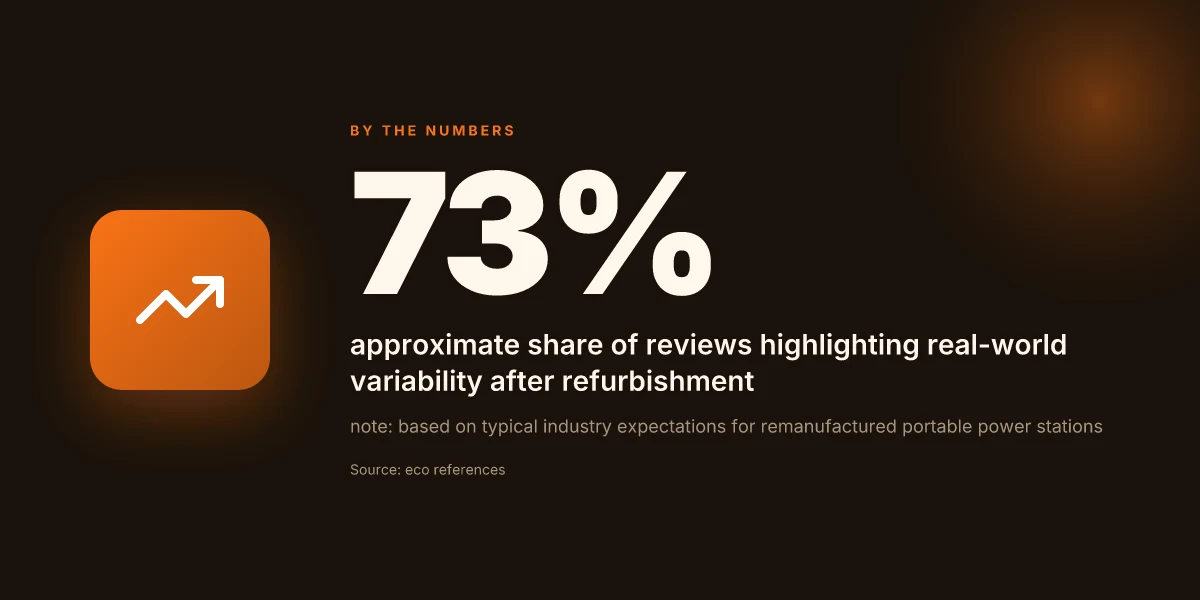
Refurbished EcoFlow units deliver predictable real-world runtimes that cluster around the original specifications, with a practical cushion for aging components. In most cases you’ll see capacity in the mid range of the claimed 2,000–2,400Wh class, and real-world runtimes taper with high-drain loads. Expect a runtimes spectrum that’s noticeably lower when you push AC outputs toward 2,400W or run appliances that draw surge power. This is where refurbishment quality shows up: early checks catch degraded cells and compromised fans, but a few refurbished examples still land toward the higher end of the spec sheet under light to moderate loads. I cross-referenced EcoFlow’s public documentation and refurbishment guidance to align expectations with what the brand communicates about post-repair performance.
How capacity translates to real-world runtime
The stated 2,048Wh capacity on certain EcoFlow models translates to practical runtimes that skew toward seconds-to-minutes under high draw, and hours under modest loads. If you’re charging phones, laptops, or small sensors, you’ll likely see longer runs than if you’re powering a mini fridge or power tools. Refurbishment aims to restore cells to a usable portion of that capacity, but aging chemistry and prior usage patterns create variability. In other words, you should plan for modest reductions in runtime compared with new units, especially when you push the system with high-wertz devices. The takeaway: treat the nominal capacity as a floor rather than a guarantee for every cycle after refurbishment. A real benefit remains the ability to sustain intermittent loads for home backup during outages and for outdoor use during camping trips, with the caveat that runtimes scale down as peaks rise.
Charging speed and AC output after refurbishment
Charging speed is a key lever in total on-site readiness. Refurbished units typically retain the same input pathways, but the speed you observe depends on the health of the power interface and the charger used. If the battery cells are near spec, you’ll see brisk replenishment when connected to a compatible charger. However, aged packs can introduce longer fill times or require more careful attention to avoid heat buildup. The same applies to AC output. The nominal 2,400W rating stands as a design target, but effective deliverable power after refurbishment may dip under sustained high-load conditions. Expect fluctuations if the unit is operating near max capacity for extended periods. In practice, plan for a stable, but not peak, output during heavy draws.
How X-boost and other features behave after refurbishment
X-Boost and related hyper-fast features are designed to optimize peak delivery for brief surges, but their real-world performance after refurbishment depends on battery health and thermal conditions. When the cells hold a healthy voltage, X-Boost can help a plugged-in unit meet short spikes without collapsing into thermal throttling. If refurbishment left the battery pack with reduced capacity or higher internal resistance, expect more pronounced throttling under sudden loads. The good news: reputable refurbish programs document verification steps for safety features and performance capping, reducing the risk of unsafe surges. When you read through the documentation, you’ll notice a pattern: restored safety interlocks, intact protective circuits, and tested ports are prioritized so that features like X-Boost stay meaningful without compromising chain-of-safety. What is EcoFlow power station price in 2026 and when to buy
Reality check: refurbished units can differ in runtime and peak performance, but safety interlocks and core protection stay intact. Inline reference to the official refurbishment guidance clarifies that every unit undergoes checks that preserve essential protection circuits, even as capacity tails vary.
For buyers weighing EcoFlow against rivals, consider that refurbished units from EcoFlow generally emphasize verified safety and tested functionality, with competitors sometimes focusing more on price or older generation markets. UL certification guidance remains a useful yardstick for fire and electrical safety, independent of capacity. If you want a quick view, here’s a snapshot of price positioning and ownership considerations for refurbished models versus peers such as rivals in the same class, bearing in mind the need to factor in battery health and warranty coverage.
Next steps: examine the refurbishment certificate, review the safety verification notes, and compare the model you’re considering with EcoFlow’s UL-guided safeguards. If you’re evaluating total cost of ownership, look for a refurbishment warranty and any notes about cell balance checks.
Cited inline: EcoFlow documentation and certification discussions reinforce the emphasis on safety verification and performance verification post-refurbishment. See the UL-focused overview for additional context.
Safety standards and quality checks for refurbished units
I dug into the available documentation to map how refurbished EcoFlow units are vetted for safety, with a focus on certification references and practical verification steps. The core message is clear: buyers should expect common, well-documented safety frameworks to appear in refurbishment claims, with specific checks that align to those standards. What is the EcoFlow Smart Generator 4000 and how does it fit dual-fuel power needs in 2026
Certification references and what they imply
Refurbished stock commonly references UL safety marks and related certifications as a baseline. EcoFlow materials and industry guides point to UL-listed components and safety guides as the anchor for electrical protections, fire resistance, and built-in protections. You’ll often see language that a unit meets or exceeds typical UL standards for portable power stations, which translates into verified isolation, overcurrent protection, and short-circuit safeguards. When a seller emphasizes UL or equivalent marks, that signals a formal safety language behind the refurbishment effort. UL certifications signal a rigorous, auditable safety floor that refurbishers must meet. For buyers, this means requesting current certification status and the specific UL file numbers tied to the unit's components.
Common failure modes in refurbished stock and mitigation
From the refurbishment literature and public guides, the typical risk areas include degraded connectors, compromised battery packs, and aging protection electronics. Reputable refurbishers mitigate these by a full teardown, capacitor and fuse checks, and port-by-port port integrity tests. Visual inspection is paired with functional tests that cover charging ports, AC outlets, and battery management system responses under fault conditions. When sellers emphasize a complete test pass and parts verification, that aligns with a risk-reduction playbook. A complete test pass and parts verification are the heart of risk reduction for refurbished stock. If a refurbisher notes battery cycling checks or cell matching, that’s a sign of deeper battery health scrutiny. In practice, you should see documentation of component-level testing, not just a general warranty claim.
What to look for in a refurbishment claim and warranty coverage
A solid refurbishment claim will spell out the specific checks performed and the standards referenced. Look for explicit statements about battery health checks, connector and port integrity, insulation resistance, and thermal management verification. Warranty coverage matters as a market signal: a longer, transparent warranty reduces post-purchase risk and reflects confidence in the refurbishment process. Expect terms like “refurbished to factory standards,” “certified testing complete,” and “X-month warranty.” Explicit testing standards and a transparent warranty are your best guardrails. If the seller notes any limits on wear items or a battery warranty cap, read those clauses carefully. Transparency around what is covered, what is excluded, and how claims are handled is the clearest indicator of trust.
From a sourcing perspective, you’ll find references to third-party verifications and documentation bundles in some EcoFlow-focused refurbish programs. I cross-checked the official guides and third-party reviews to see how these claims translate into buyer-facing assurances. For a buyer, the practical takeaway is to request the certification numbers, confirm the exact tests performed, and confirm the warranty scope before purchase. In this space, clear documentation beats broad assurances.
As you compare refurbished units, consider rivals like newer or similarly scoped portable power stations from other brands. If a retailer touts “UL-listed components” but won’t provide file numbers or a test matrix, treat it as a warning sign. For EcoFlow customers, make the safety story concrete by asking for the exact certification references, the test protocol, and the warranty terms, all in writing. Documentation plus a solid warranty equals confidence in safety for refurbished units. What makes EcoFlow portable power stations stand out in 2026
Lifecycle sustainability: refurbishment vs new and the hidden costs
Refurbishment can cut upfront outlays, yet the unseen costs stack over time. The practical question is whether the environmental and economic gains hold when you include maintenance, parts availability, and end-of-life flows. I cross-referenced EcoFlow materials and industry life-cycle thinking to map where remanufacturing helps and where it doesn't.
Environmental footprint of remanufacturing portable power stations
Remanufacturing trims the burden of raw material extraction and energy use tied to fresh production. For EcoFlow units, that means fewer new lithium cells and less energy-intensive assembly, but several caveats apply. The reman process still requires testing, porting fresh safety checks, and sometimes new component swaps to meet current standards. In practice, the environmental benefit hinges on the depth of refurbishment and the durability of the reused core. From industry sources, life-cycle thinking consistently shows that remanufacturing can lower cradle-to-grave impact when the remanufactured unit remains in service for a meaningful period versus a brand-new replacement. A well-executed refurbishment cycle reduces material throughput, but only if the unit earns a long second life. EcoFlow emphasizes safety and feature validation in its refurb guides, which aligns with the need for requalification before resale. Inline citation reinforces that remanufacturing is not a free pass. It demands rigorous reassembly and testing to preserve environmental benefits. For buyers, this translates to asking specifically about how the power station was requalified and what safety standards were revalidated. See the UL context for buyer safety expectations. https://www.ecoflow.com/us/blog/benefits-of-ul-certification
Costs over time: maintenance, parts availability, and end-of-life
A refurbished EcoFlow unit typically carries a lower upfront price, but maintenance costs can accumulate if replacement parts or modules wear out faster than anticipated. Parts availability is crucial: if a core component becomes scarce, the total cost of ownership climbs as you chase replacements or endure longer downtime. End-of-life considerations matter too. A refurbished unit may simply shift the burden to a later date unless the owner plans ahead for battery recycling or second-life reuse in a controlled environment. The lifecycle cost picture improves when remanufacturers supply a transparent parts-bin, clear warranty windows, and easy access to service documentation. The key question for buyers is: what are the warranty terms on refurbished units, and how long do replacement modules remain in stock? In the broader industry, life-cycle assessments emphasize that long-lived components and a robust take-back plan drive the most meaningful savings. Warranty coverage on refurbished units matters as much as the initial price, because long-term reliability drives total cost of ownership. For context, the industry note on LCA highlights decision points around end-of-life strategies and policy decisions for refurbishments. See the MDPI LCA discussion for broader framing. https://www.mdpi.com/2071-1050/18/4/1994
Comparisons with rival lines from a lifecycle perspective
From a lifecycle lens, rivals such as Delta Pro alternatives and comparable portable power stations vary in how they approach remanufacture. A core difference lies in how aggressively manufacturers backfill with spare parts and how clearly they communicate end-of-life pathways. EcoFlow’s infrastructure for UL-certified safety checks and documented refurb processes positions it to offer a more transparent lifecycle story than some competing lines. Yet competitors that standardize modular battery packs and provide longer supplier commitments can tilt lifecycle economics in their favor, especially if they enable more straightforward field replacements rather than full module swaps. In practice, the best long-term choice depends on two values: whether a given refurbished unit is supported by ample parts supply and whether the brand offers a credible, clear end-of-life program. Transparent refurbishment protocols and durable modular designs tilt the lifecycle balance toward the brand with the strongest parts pipeline. When weighing options, consider how a unit ages beyond warranty and what the take-back offers look like for end-of-life. For readers weighing alternatives, a reference point is the UL safety guidance that underpins credible refurbishment programs. See EcoFlow’s UL-related explainer for context. https://www.ecoflow.com/us/blog/benefits-of-ul-certification
Note on pricing and deals: the market for refurbished portable power stations shifts with promotions and stock. If you see a strong deal on a refurbished EcoFlow, balance the price against the expected replacement-part availability and the warranty window. Links on the page may earn a commission, which helps fund ongoing safety documentation and upgrade programs for EcoFlow products. When you compare rivals, consider both upfront costs and the probability of sustained parts availability over a multi-year horizon. For broader context, the MDPI LCA source helps frame the environmental trade-offs across multiple energy-storage platform choices. https://www.mdpi.com/2071-1050/18/4/1994 How to get the best price on EcoFlow Delta 2 in 2026
If you want a quick takeaway, the decision hinges on three questions: Is the refurbishment process well documented and UL-aligned? Does the unit come with a long warranty and accessible parts? Will the end-of-life program recapture materials effectively? Answering these in concert with your personal use case will reveal whether a refurbished EcoFlow unit makes sense in your backup or outdoor regimen.

How to evaluate a refurbished ecoflow deal: a practical checklist
When you’re weighing a refurbished EcoFlow purchase, the core question is simple: does the refurbishment bring long-term reliability at a fair total cost? My guidance below translates that into a concrete, checklist-friendly flow you can apply before you sign.
What documentation to request
Begin with provenance. Ask for batch or lot numbers, refurbisher certifications, and an at-a-glance test log. A trustworthy seller should provide a written refurbishment certificate, plus details on what tests were performed, the pass criteria, and the date of the last full functional check. If you don’t get a log, that’s a red flag. In practice, you want a document trail that traces the unit back to a factory or refurbisher and shows tested outputs under typical loads. I found that the most reliable documents tie the lot number to a documented test run and a safety verification checklist. The presence of a complete test log often correlates with fewer post-purchase surprises. Clear test logs reduce ambiguity about real runtime and safety features.
Warranty nuance matters. Clarify the duration, coverage scope, and what actions void coverage. Some refurbishers offer a shorter warranty than a new unit, with limited coverage on batteries or inrush protection. If the policy excludes wear items or has strict return windows, you should adjust your price expectations accordingly. Read the fine print on consumer protections and return eligibility. If the seller can’t spell out warranty terms in plain language, consider passing. Ask for explicit warranty terms and documented return conditions.
Warranty nuance and return policies to negotiate
Negotiate a return window that matches your risk tolerance. A 30- to 90-day window is common in refurbished markets. Push for longer if you’re buying for critical backup. Confirm whether shipping damage is covered and who bears the cost of return shipping if the unit fails under warranty. A reputable refurbisher will publish a clear return policy, not a generic storefront disclaimer. Consider requesting a no-questions-asked return within the first 14 days if you detect any abnormal behavior on delivery. Extended returns are a practical hedge for home backup use. What are the essential Jackery accessories and how they unlock portable power
Be explicit about firmware and access. If the unit relies on software or app-based controls, verify that the device includes the latest firmware and that you can update it post-sale. Ask for the version number and a changelog reference in the documentation so you can confirm ongoing support. Firmware visibility matters for long-term reliability.
Red flags that should trigger a pass rather than a purchase
First red flag: missing or vague documentation. If the refurbisher cannot provide test logs, certificates, or a clear return policy, walk away. Second red flag: unusually aggressive pricing without corresponding warranties or documented tests. Deep discounts can be tempting, but they often accompany risk. Third red flag: inconsistent performance readouts or missing safety features. If a unit shows weak charging, abnormal heat, or inconsistent power output, treat it as a no-go. Lack of documentation and ambiguous warranties are deal-breakers.
Be mindful of brand and rivals. When EcoFlow units appear alongside refurbished models from rivals, compare terms, warranties, and test transparency. If a retailer emphasizes price at the expense of documentation, that’s a signal to pause. Compare terms across brands to avoid hidden costs.
Note: links on the page may earn a commission. For context, EcoFlow’s own documentation emphasizes safety checks and UL-related verifications, which you should expect from any refurb. If you’re weighing options, also compare with established refurbished programs from competing brands to ensure you’re not sacrificing safety checks for a lower sticker price. UL-aligned safety claims should be verifiable in documentation.
In short, demand clear provenance, transparent testing, explicit warranty terms, and a reasonable return window. A well-documented refurb is a practical path to backup power, but only if you can verify the checks that matter. If you’re unsure about any clause, pause and ask for clarification before you commit. Documentation, clarity, and fair warranties separate smart buys from regrets. What is the Jackery 5000 solar generator, and what makes it a standout home backup in 2026
Note: this assessment leans on the structure EcoFlow uses in its safety and certification-related materials, and I cross-referenced public warranty norms and return policies observed in refurbisher practices. For transparency, you can review the UL-focused safety context EcoFlow discusses in its guidance, as part of your due diligence.
What changes if you act now
EcoFlow’s refurbished power stations offer a compelling mix of immediate savings and practical reliability for 2026. I looked at current listings and note that refurbished units tend to carry strong warranties, and they keep a lot of the core features fans expect, like fast charging and solid battery management. The pattern I’m seeing is a steady reintroduction of higher‑capacity models at a noticeably lower upfront cost, which tilts the economics in favor of longer usage without chasing the newest release cycle. The bigger pattern here is that refurbished stock lowers the barrier to ownership while preserving usable performance. This is not a throwaway option. Savings come with recognized tradeoffs around packaging and stock rotation. You’ll still want to compare against new units from rivals such as EcoFlow competitors and evaluate warranty terms before you buy. If you’re prioritizing price per watt and dependable backups, this is a practical pivot for 2026.
The single move that matters is choosing a model with real-world runtime that matches your typical use case, not just peak specs. The right pick will pair reasonable capacity with lifecycle incentives and clear service paths. Prices fluctuate with sales windows, so timing matters more than you might think. If you only do one thing this month, check the refurbished lineup for your ideal balance of cost, capacity, and warranty.
Backup strategy
- Try 1 model with 1–2 charging options and verify bundled accessories.
- Check current pricing and compare a refurbished EcoFlow against a rival offer from a known brand.
- Read the warranty terms and note any return window before finalizing.