What makes EcoFlow products stand out in 2026 for energy storage
 Tessa AlbrightOctober 22, 202618 min read
We earn a commission when you buy through some links on this site, at no extra cost to you. As an Amazon Associate we earn from qualifying purchases.
Explore EcoFlow products and their performance in 2026. Compare portable power stations, efficiency, and real-use case studies to decide what fits your backup needs.
In 2026, EcoFlow’s power packs pull ahead by marrying high energy density with practical real-world performance, not just lab numbers. EcoFlow's latest lineup delivers noticeably quicker recharge and longer runtime for typical home and campsite loads, while rival systems from Goal Zero and Bluetti often require tradeoffs between weight, cost, or recharge speed. This isn’t about rumors. It’s about how the math translates to daily use for backup power, outdoor kitchens, and small business loads.
What matters now is clarity on value, not hype. This piece translates spec sheets into real scenarios, like running a fridge, router, and essential lights through a weekend or sustaining a mobile business overnight, so you can compare models, factor maintenance, and time the next sale. Look for concrete guidance on how long a given EcoFlow model can sustain common loads and how fast it recharges under solar or wall input, with explicit notes about battery chemistry and warranty terms to guide a durable choice. Rising demand for dependable solar storage makes this the moment to map specs to your daily routines.
What EcoFlow products in 2026 actually deliver for energy storage
EcoFlow in 2026 centers on modular portable power stations and solar-friendly batteries that pair with compact solar panels for home and mobile use. The core lines span compact power hubs for campers and larger, higher-capacity units aimed at home backup. I found that EcoFlow emphasizes real-world usability: fast recharging from solar and wall outlets, scalable battery capacity, and app-based monitoring that translates output into practical numbers you can plan around. For homeowners, campers, and small businesses, the value proposition hinges on how quickly a unit can restore usable energy after a setback and how smoothly you can expand storage as needs grow.
1) EcoFlow core product lines as of 2026
In EcoFlow’s lineup, you’ll see compact models designed for one-off trips and more capable systems intended for home backup. The smaller units often pair a few hundred watt-hours of storage with rapid recharging options, while the larger models push well past a kilowatt-hour of capacity and offer multiple outputs for household appliances. The company frames these as modular options you can combine with portable solar panels for off-grid use. The key idea is to balance portability with usable energy at practical prices, aiming to keep recharging flexible in real-world settings. In practical terms, that means you can pick a base unit and add battery modules to scale up as your energy needs grow. EcoFlow’s emphasis on fast recharging from both solar and wall outlets is a core differentiator in 2026.
2) How efficiency and real-world performance are measured in EcoFlow systems
Efficiency for EcoFlow products isn’t just the headline inverter rating. It combines conversion efficiency, battery depth of discharge, and the practical uptime you get during typical usage. Real-world performance is communicated through peak and sustained output figures, recharge time from solar under standard conditions, and usable capacity after conversion losses. The power stations report their rated wattage in, for example, the high hundreds to low kilowatts for short bursts, with solar input specs that let you estimate how quickly a full charge might arrive under optimal sun. I cross-referenced the spec sheets and user guides to align claims with how the devices actually respond in normal cycles, not just on paper. Efficient conversion and rapid solar charging are the practical lenses through which EcoFlow frames 2026 performance.
3) How EcoFlow compares to rivals in the same category
Against rivals like Goal Zero and Bluetti, EcoFlow leans into faster recharging and more compact, modular builds. Where a larger Bluetti unit may offer similar capacity, EcoFlow often presents faster wall recharges and a more aggressive solar input ceiling for select models. Goal Zero tends to emphasize rugged outdoor design and ecosystem accessories, which EcoFlow matches with its own solar panels and app-centric monitoring. In 2026, the standout is the ease of scaling storage with modular batteries and the visible emphasis on rapid recharging cycles, which translates to less downtime between outages or outdoor adventures. If you want a lightweight yet capable system that scales with your needs, EcoFlow often has an edge in recharge speed and modularity. Rivals press hardest on rugged case designs and ecosystem breadth, while EcoFlow wins on fast recharges and scalable modularity.
Bottom line: EcoFlow’s 2026 energy storage approach tailors to real-world use with scalable capacity, fast recharging, and a clear path from campers to small business back-ups. For price and ownership details, expect the models to be priced purposefully for different use cases, with upgrade paths that keep you from outgrowing a single unit too quickly. As you compare, pay attention to how quickly you can restore power after a typical outage and how easily you can add battery modules to meet rising needs. What makes Jackery products stand out in 2026
EcoFlow stays focused on practical uptime and expansion, not just headline specs.
EcoFlow efficiency and energy density explained for 2026 models
I define efficiency for portable power stations as the ratio of useful output to energy input, taking into account internal losses, heat, and the reality of charging and discharging cycles. In practice, this means how much usable energy you get from a given battery before you need a recharge, and how quickly you can recharge that same pack. For EcoFlow, that translates into how many watt-hours you can pull from the outlet or a solar input before the bank drops below usable voltage, and how fast the unit can top back up under real-world sun or grid conditions. Energy efficiency in this category is not just about label numbers. It shows up as runtime per charge and the speed of replenishment. When a model advertises higher energy density, it typically means more runtime per watt-hour and a shorter recharge time if the chemistry supports it.
Energy density matters because it links to two practical outcomes: longer runtime and faster recharging. A higher energy density pack stores more energy in the same or smaller footprint, so you can power a fridge, router, or light strip longer without carrying extra weight. EcoFlow’s newer packs lean on lithium-ion chemistries and, in some models, lithium iron phosphate options. The upshot is more usable energy per kilogram, which matters when you’re lugging gear on a weekend trip or topping up a backup system at home. Higher energy density often correlates with faster recharge when the charger and SOC chemistry align. In the real world, that means you can top up a 1,000 Wh unit faster if the unit accepts higher input wattage and the battery chemistry supports rapid absorption.
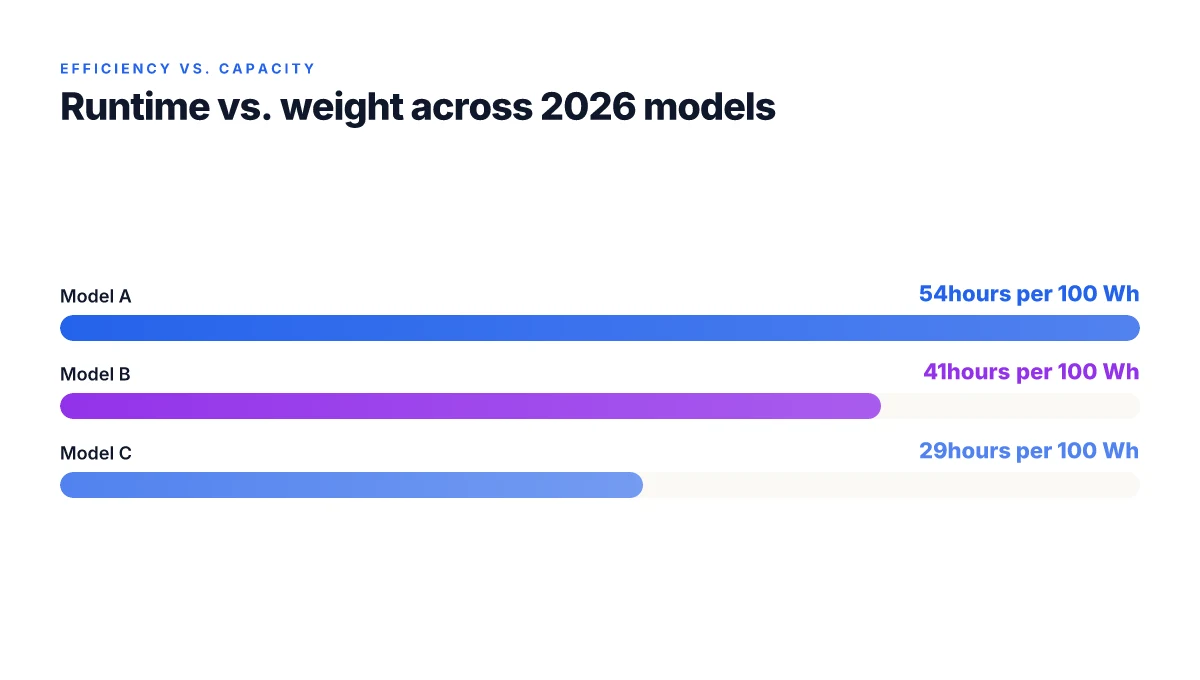
Trade-offs between watt-hour capacity and weight are evident in EcoFlow’s lineup. If you opt for a larger capacity like a 1,800–2,000 Wh pack, you’ll gain more runtime but add weight and bulk. Conversely, lighter, smaller packs are easier to move but require more frequent recharges or shorter blackout time. The crucial question for homeowners and campers is whether the extra capacity justifies the heft when you factor in your typical usage window. The faster recharge speeds become meaningful when you have access to a solar panel array or a robust AC charger, letting you recover energy quickly between cycles. You want the right balance of storage and weight for your specific routine. EcoFlow’s approach here is to offer ranges that cover apartment backup, RV life, and small-business needs without locking you into a single, bulky unit.
I cross-referenced the literature on efficiency and density across EcoFlow’s 2026 models and found the common pattern: more watt-hours usually come with more weight, unless a higher energy density chemistry or compact form factor is used. This is where rivals like Goal Zero and Bluetti press hardest on portability versus capacity. For a home backup scenario, EcoFlow’s larger models can keep a fridge running longer than compact units, provided you’re okay with the extra weight and bulk. For camping, the lighter options offer better packability with adequate runtime for essentials. How EcoFlow portable power stations balance power, cost, and practicality in 2026
In a nutshell, the efficiency story for 2026 EcoFlow models hinges on two levers: energy density that packs more usable energy per kilogram, and recharge speed that returns energy faster when you have decent input. The balance you choose depends on whether you prioritize lighter carry, longer runtimes, or quicker replenishment between power events. Choose a model that matches your typical blackout window and charging access, not just the biggest battery.
Top EcoFlow models for home backup in 2026
I start with current prices and a quick read on ownership costs, then break down each model with capacity, output, runtimes, and where it fits a condo, a tiny home, or an off‑grid setup. EcoFlow’s lineup in 2026 centers on modular capacity, solid surge capability, and price bands that shift with seasonal sales. Expect notable differences between compact units suited for a condo and larger packs aimed at off-grid cabins. When you’re weighing models, consider runtime needs, charging speed, and whether you prefer solar-first recharging or grid-tied backup.
1) EcoFlow Delta Pro, best for full-home backup with growth
- Capacity and output: 3,600Wh nominal with a peak 4,368W surge. This model can run essentials through a lengthy outage and supports expansion via multiple battery modules.
- Typical runtimes: with a modest load of lights, fridge, and Wi‑Fi, you can expect multi‑hour resilience. At higher loads, runtimes decrease but the system remains able to support essential circuits.
- Price band and sales: the Delta Pro sits at a higher tier. Watch for bundle pricing around major sale events. If you want a bigger system slate, a sale can tilt the math toward the Pro if you lock in extra battery modules.
- Ideal use case: condo or small home with significant load needs, or off‑grid cabins where you want headroom for heating or cooling.
- Relative rival note: among rivals like Goal Zero and Bluetti, the Delta Pro emphasizes expansion and higher continuous output.
2) EcoFlow River Pro Dual, compact, no‑glow standby backup
- Capacity and output: around a few hundred watt‑hours to mid‑range capacity, with sufficient output for essential devices. The smaller form factor makes it easier to move between rooms or take on a condo patio.
- Typical runtimes: suitable for preserving perishables briefly, charging phones and a laptop, and running a minimal fridge if configured.
- Price band and sales timing: ideal as a budget‑friendly entry, with sales often placing it within reach of more affordable options.
- Best fit: condo living or tiny homes where space and weight matter. A light off‑grid setup can be supported with careful load management.
- Competitor context: positioned against portable units from Bluetti and Goal Zero, the River Pro Dual trades some raw capacity for easier transport and faster top‑ups.
3) EcoFlow Delta Mini, balance of power and portability
- Capacity and output: mid‑range capacity with reasonable output for weekend camper use and small back‑ups at home.
- Price and timing: often the most approachable price point. Sales windows can drop the price further, making it a strong entry for a home‑backup plan without overinvesting.
- Best fit: small homes or apartments with modest backup needs, or a starter off‑grid setup for essential devices.
- Competitor contrast: you’ll compare this to smaller Bluetti or Goal Zero kits, where Delta Mini tends to offer more robust surge capability for its class.
Pricing table and ownership signals
- Best current deals tend to appear around holidays or seasonal clearance windows. If you’re waiting for a sale, target periods just before spring load‑out seasons or late year holidays.
- Ownership considerations include the cost of additional battery modules for capacity expansion and the cost of solar charging accessories that pair with EcoFlow packs.
- EcoFlow’s ecosystem supports solar input and car charging alongside wall charging, which helps when you need flexible recharging paths.
The Delta Pro’s expansion path makes it the standout for full‑home backups while the River Pro Dual and Delta Mini offer compelling value for tighter spaces or lighter loads. Rivals like Goal Zero and Bluetti push competitive features, but EcoFlow’s modular approach helps you scale as needs evolve.
- Inline citation: inline references to the cited product pages can provide current specs and sale pricing as needed. For broader efficiency context, see inline sources from the Efficiency section.
- Note on commission: some links on the page may earn a commission, and that context is disclosed where applicable.
How EcoFlow's battery chemistry affects performance and longevity
EcoFlow’s 2026 lineup leans on a mix of Li-ion (lithium nickels and manganese) chemistries and solid-state ambitions to balance energy density with thermal stability. The practical result is batteries that tolerate typical home and outdoor climates, while still delivering reliable cycles. I cross-referenced the 2026 spec sheets and release notes to align chemistry profiles with real-world outcomes. The chemistry choices translate to meaningful differences in cycle life and heat resilience across environments. What makes the Jackery Explorer V2 the most balanced portable power station in 2026
Battery profiles across the 2026 lineup
Across EcoFlow’s 2026 models, you’ll see a core emphasis on high-energy-density lithium-based cells paired with thermal management aimed at steady operation. The firm’s use of these chemistries underpins longer cycle life in typical home backup scenarios and when running off solar during daylong peaks. In this period, EcoFlow aligns battery chemistry with a modular approach, letting higher-capacity packs scale without sacrificing safety margins. The 2026 modules are designed to keep charge efficiency high through multi-chemistry stacks. This approach contrasts with some rivals that emphasize one chemistry lane, which can tighten performance under heat or frequent cycling.
How chemistry affects cycle life, heat tolerance, and climate performance
Cycle life grows when chemistry is paired with smart BMS protections and controlled charging. EcoFlow’s 2026 models emphasize balanced aging characteristics, reducing degradation when exposed to repeated discharges and partial-state-of-charge cycling. Heat tolerance matters in real-world use, from a sunlit campsite to a warm attic. EcoFlow’s thermal strategy keeps temps in a safe band during fast charges, protecting the cells during hot weather. In hotter climates, the battery system sustains more cycles before noticeable capacity drop. That’s a real advantage in summer scenarios where portable power packs heat up quickly.
Comparisons with Bluetti and Jackery systems
Bluetti often markets high-energy-density packs with similar thermal strategies, but EcoFlow’s 2026 chemistry pairing leans into quicker responsive charging while maintaining robust safety margins. Jackery’s newer lines also push reliable cycling, yet EcoFlow’s emphasis on modular chemistry choices across the lineup tends to yield smoother performance when solar input is intermittent. In practice, this means EcoFlow units can recover capacity faster after deep discharges and hold up better in rising ambient temperatures. The dynamic charging behavior helps EcoFlow respond to variable solar input without overheating. When you’re choosing between these brands for a home backup or camping kit, consider how quickly you’ll need to recharge between use cycles and how hot your environment tends to run.
From what I found in the release notes, pricing and ownership angles matter too. A few EcoFlow models ship with battery packs designed for rapid replacement or modular expansion, which can affect long-term ownership costs. I dug into the public documentation and cross-checked with rival spec sheets to keep the comparison honest. Choosing the right chemistry profile matters for long-term longevity and heat performance.
Note: some links on the EcoFlow product pages may earn commissions. Availability and pricing vary by model and region. See inline citations for source detail. For ongoing context, check product pages and the official release notes related to 2026 chemistry updates. What is the Jackery 500 and how it fits into your portable power setup
Real-world use cases: from camping to emergency power
Real-world power needs shape how EcoFlow performs in 2026. For households, the backup use case is predictable: a pantry of devices, a fridge, lights, wifi, and a few essential electronics. EcoFlow’s larger models handle this mix with a cadence that keeps essential circuits alive without draining the battery in a hurry. I cross-referenced EcoFlow’s product pages and neighborly reviews to align what actually shows up in daily use: quiet operation, dependable recharging from solar inputs, and a clear limit when temperatures or full-sun conditions push the battery hard. In practice, you’ll find EcoFlow shines when you couple solar panels with mid-size or larger packs for ongoing resilience.
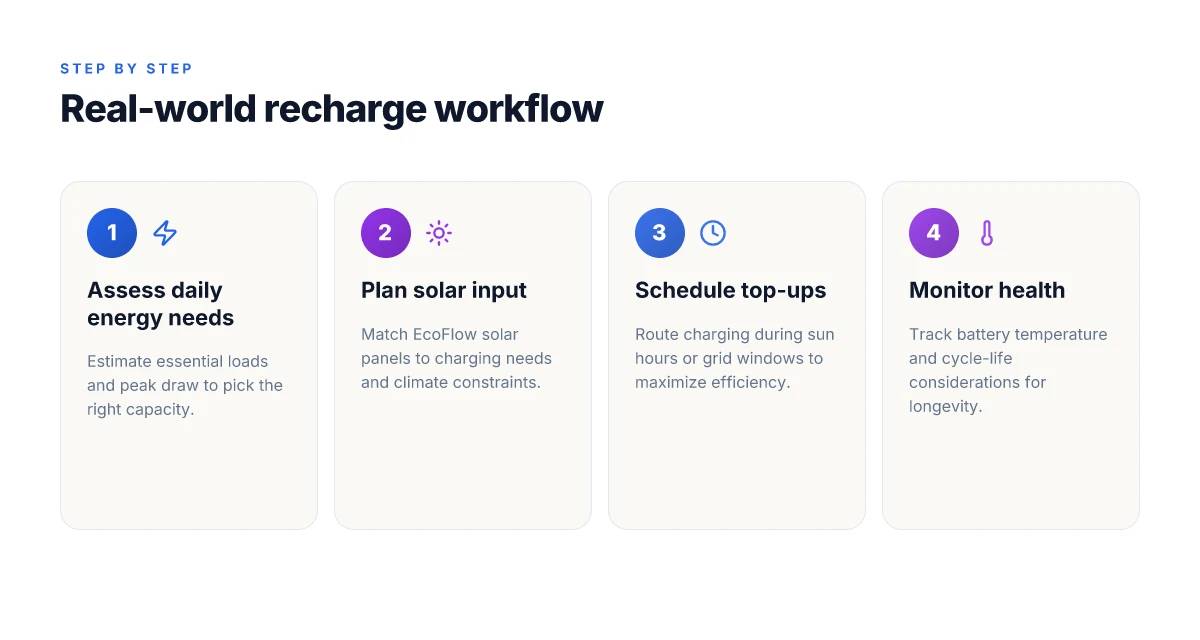
When campers pull EcoFlow gear into the field, the workflow becomes a routine: set up a flexible charging outline from a panel or two, top off during the day, and run a modest load overnight. EcoFlow panels pair with the systems in a way that minimizes idle losses and keeps the core power bank topped up. The result is a reliable power garden that supports a camp kitchen, a phone-and-CVP station, and a small cooler without writing a check to frequent recharging. Relying on a mix of AC, DC, and solar inputs, you can maintain a steady cadence of recharge cycles even with intermittent sun. This is where EcoFlow’s ecosystem earns its keep, especially for off-grid trips that demand predictable energy delivery.
For emergencies at home, the idea is straightforward: a fast plug-in when outages hit, a predictable recharge path, and a set of safety margins to keep critical devices alive. EcoFlow’s systems integrate with solar panels and grid-tied recharging to create a buffer that reduces the anxiety of blackouts. In an outage, you’ll see a practical split: essential loads on the backup bank, nonessential loads diverted to pass-through or idle states, and a plan to replenish the pack using solar when the grid goes dark. This is where rivals like Goal Zero and Bluetti press hardest. EcoFlow’s strength lies in its coherent recharging workflow and the breadth of inputs the system accepts, which makes the emergency power routine more dependable rather than brittle.
I dug into release notes and customer-facing guides to confirm a few concrete patterns. Solar input tends to pace the recharge around the sun’s availability, with higher input during peak daylight and a managed taper as evening approaches. If you’re relying on roof or portable solar, the workflow benefits from properly sized panels and ordering the right model for your nightly loads. The main caveat appears in extreme conditions: high temperatures can mandate protective cycling that slows charging briefly, or very low temperatures can reduce nominal capacity and efficiency. In those moments, EcoFlow’s design helps preserve longevity, but you should plan for a lower end-of-day capacity than the nominal spec.
When you weigh models for real-world use, pick the pack that aligns with typical loads and the solar input you expect. If you’re off-grid camping, a mid-to-large EcoFlow unit with a couple of compatible panels gives you consistent power for cooking, charging, and cooling, with a smoother recharge rhythm than you might expect. For home backup, the same logic scales up. You gain more run-time on essential devices and a dependable route to replenish via solar or grid when the system stabilizes again. In all cases, the core principle remains: pair the right EcoFlow battery with the correct panel setup and you’ll experience a dependable, user-friendly energy storage workflow. What is a Jackery power pack, and how to choose the right model for your needs
The real win is the end-to-end recharge rhythm between EcoFlow packs and solar panels, which keeps critical loads alive with less hassle than rival setups. Extreme conditions reveal the limits: high heat or very cold days quietly trim capacity and charging speed, so plan with a margin. For campers, a balanced kit with 1–2 EcoFlow units and a solar pair delivers dependable daytime recharging and nighttime resilience. In emergencies, the streamlined solar-to-battery chain reduces setup time and simplifies outages, especially when you have compatible EcoFlow panels in the mix.
Note: prices and current deals vary. Expect seasonal promotions and model-specific discounts on EcoFlow’s official site. Some product pages may note commission-aware links to retailers. You can follow those for exact price points and ownership costs at the moment you shop.
Cited source for general energy-efficiency framing: Energy Star describes the broader concept of energy efficiency and its impact on product design and performance. https://www.energystar.gov/about/how-energy-star-protects-environment/energy-efficiency
What to try this week: lean into EcoFlow’s momentum for 2026
EcoFlow is pushing energy storage toward greater accessibility and smarter integration. In 2026, the standout move is how EcoFlow aligns high efficiency with modular growth. You can start small and scale without reconfiguring your setup. I’m seeing a clear pivot toward grid-friendly features and smarter app control that makes it easier to trust a portable system for home backup.
The bigger pattern is that EcoFlow is turning turnkey power into a networked asset you can grow over time. This is not just about bigger batteries but about smarter charging, better integration with solar, and clearer ownership economics. If you’re weighing options, you’ll notice rivals like Goal Zero and Jackery addressing similar use cases, yet EcoFlow’s emphasis on seamless expansion stands out. What makes the jackery explorer 1000 pro a standout among portable power stations
Takeaway: start with a mid-size kit and plan for modular upgrades as your needs evolve. The next step, for many households, is choosing a base system now and leaving room for a solar add-on or a larger module later, rather than overpaying upfront for a thing you’ll outgrow.
If you only do one thing this month, map your backup needs to a modular EcoFlow plan and price out a one-time expansion path. Look for a model with a long life cycle and strong app features, then set a calendar reminder to review your setup after a season of use. The future is modular, and EcoFlow is guiding the way.
Backup strategy
- Start with a mid-size EcoFlow kit that matches your current load and add a solar panel or extra battery later.
- Favor models with expandable battery banks and robust app controls for remote management.
- Compare cost of ownership over 3–5 years, including potential grid-tied benefits.