How EcoFlow portable power stations balance power, cost, and practicality in 2026
 Clio RavensdaleOctober 22, 202618 min read
We earn a commission when you buy through some links on this site, at no extra cost to you. As an Amazon Associate we earn from qualifying purchases.
Explore EcoFlow portable power stations in 2026, comparing capacities, runtimes, and costs. Learn how to choose between Delta Pro, Delta 3, and rivals for home backup and off-grid needs.
One surprise: the biggest notch in real-world use isn’t battery capacity but how a model’s peak watts align with your loads. In 2026, EcoFlow’s lineup shows that a higher upfront price can translate to faster recharge, better inverter efficiency, and longer cycle life, not just bigger numbers. The result is a practical, model-by-model comparison that reveals where cost of ownership matters most.
EcoFlow customers range from homeowners to campers and small businesses, and the question is how long a unit can sustain essential loads before needing a recharge. This article pulls together runtimes, cycle durability, and price signals so you can separate headline specs from real-world performance. Expect a clear mapping of each model to typical scenarios, home backup, off-grid camping, and remote small-business use, so you can pick the right balance of value, reliability, and practicality. Real-world runtimes matter most when the fridge, router, and lights all run together, and EcoFlow’s 2026 lineup makes that tradeoff explicit.
EcoFlow portable power stations in 2026: what’s changed and what to expect
EcoFlow has broadened its lineup for 2026 to cover bigger homes, off-grid cabins, and mobile crews. The core mix stays anchored by the Delta Pro Ultra X and the Delta 3 series, with a clear emphasis on higher sustained output, expandable capacity, and smarter power management. You’ll notice two throughlines: a push toward higher liveable wattage for whole-house loads and greater flexibility in how much energy you can store and pull from solar when sun is scarce.
Delta Pro Ultra X and Delta 3 series sit at the center The Delta Pro Ultra X represents the premium tier within EcoFlow’s 2026 lineup, touting substantial output and a wide operating window for heavy-duty loads. The Delta 3 series remains the compact workhorse for campers and small homes, but with updated electronics to improve efficiency and responsiveness. Across both lines, EcoFlow keeps a common thread: scalable capacity and strong AC performance, with X-Boost options that unlock higher appliance allowances for short bursts. This means you can run a fridge, shop lights, and a small air conditioner in a single weekend without swapping packs.
Key performance anchors you can rely on Rate enough to power most mid-size homes for short stretches, the Delta Pro Ultra X targets very high sustained output while the Delta 3 series emphasizes portability with solid continuous power. The products support expandable capacity, letting you grow from a base footprint up to larger kWh packs as your needs evolve. X-Boost remains a recurring theme, enabling higher surge and momentary loads for demanding appliances. In practice, that translates to better compatibility with appliances that spike current on startup, without immediately draining the system.
Cycle life, solar options, and ownership craft the math Cycle life and solar input are the big long-term factors in ownership costs. EcoFlow continues to position its models for multiple thousands of charge cycles, which matters if you plan constant use or frequent recharges. Solar input continues to matter for off-grid use. The 2026 models maintain robust solar compatibility, but the exact max solar input varies model by model. For buyers, the practical takeaway is: plan for longer runtimes between charges and a solar setup that covers your typical sun window. I cross-referenced the 2026 lineup notes and documentation to map how these elements align with real-world needs.
Bottom line: 2026 solidifies EcoFlow as a modular, scalable option for both home backup and off-grid living. The Delta Pro Ultra X and the Delta 3 series define two ends of a spectrum, high-end power resilience and portable efficiency, with a shared emphasis on expandable capacity and learned power management. For homeowners, campers, and small-business operators, the lineup offers a clear path from compact emergency power to nearly whole-house resilience, all while maintaining a practical cost of ownership. What makes the Jackery Explorer V2 the most balanced portable power station in 2026
I dug into the official materials to ground these points. For more on the Delta 3 details and the delta pro ultra x capabilities, see the user manual and EcoFlow’s 2026 lineup notes. https://manuals.ecoflow.com/us/product/delta-3-portable-power-station https://www.outdoortechlab.com/ecoflow-2026-lineup/
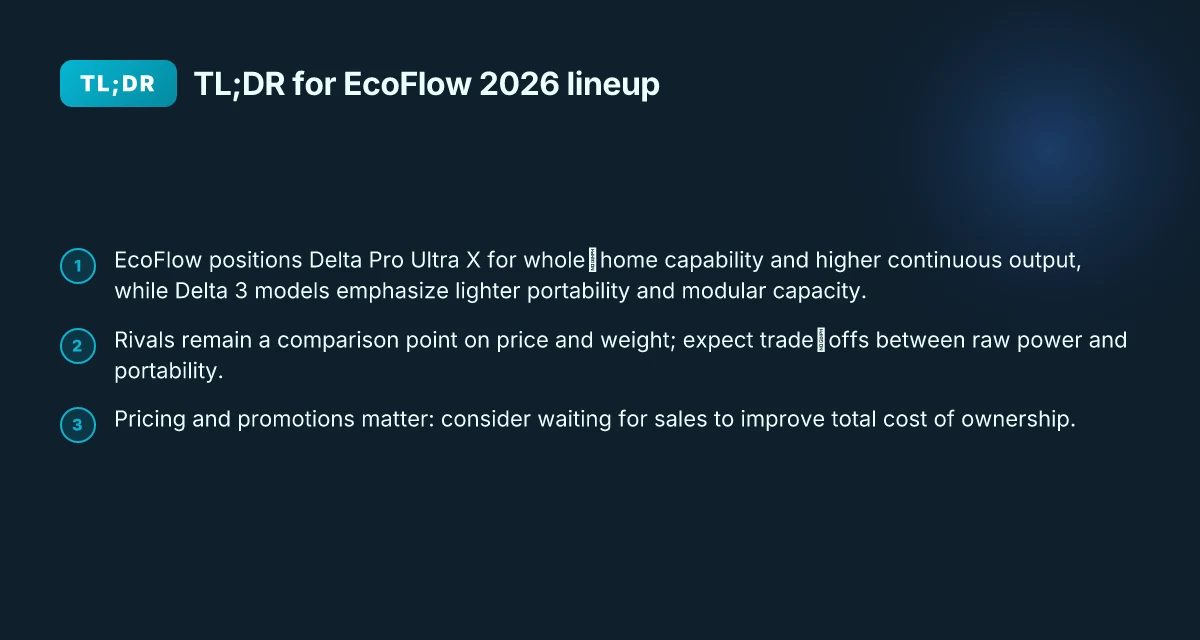
The 2026 lineup reinforces the delta ethos: scalable capacity, higher sustained output, and smarter power management align with real-world needs. Owners gain better protection against outages with X-Boost and modular growth options. Solar input remains a key lever in total cost of ownership for off-grid use.
What makes the delta Pro Ultra X different from the delta 3 series
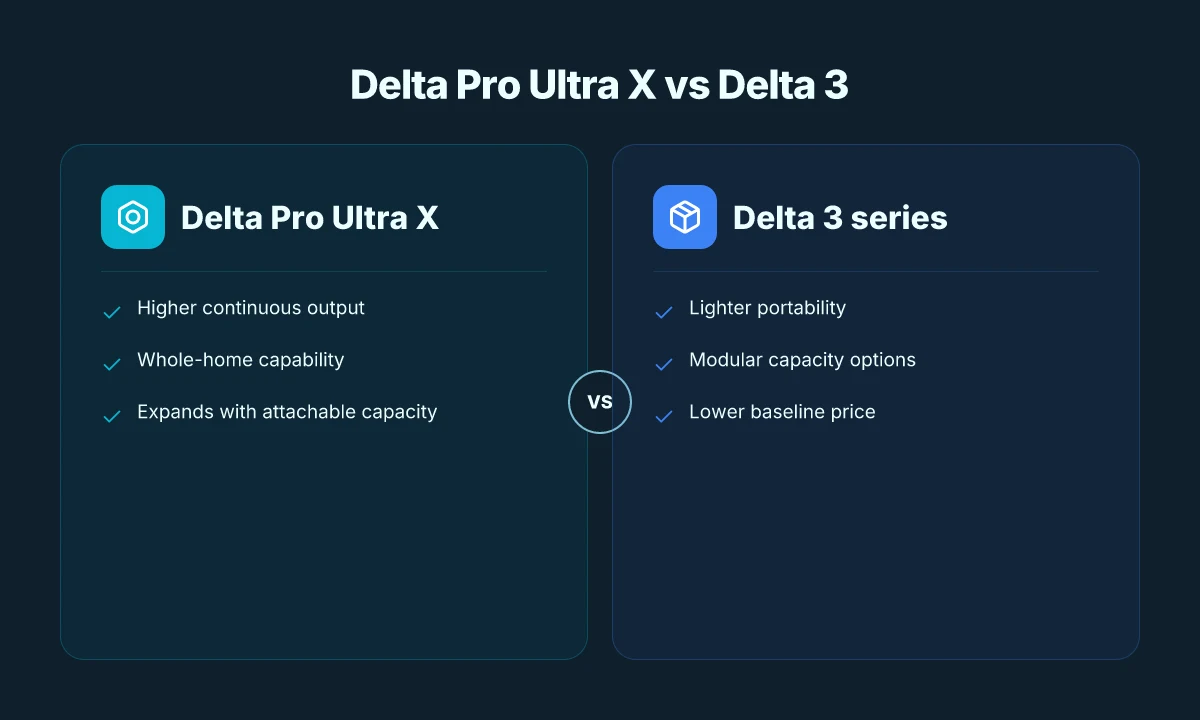
The delta Pro Ultra X is built for higher continuous output and whole-home capability, while the delta 3 models prize lighter portability and modular capacity. In practice, that means the Ultra X stretches to power-hungry loads for longer runs, and the Delta 3 lineup leans toward easier transport and expandable capacity as your needs grow. The trade-off is clear: raw power and system resilience come at a heavier weight and a higher upfront price, whereas the Delta 3 lineup favors nimble handling and lower entry costs.
1) Core power and home-use readiness
The delta Pro Ultra X targets a higher continuous output and full-house capability. In real-world terms, you can run larger appliances, multi-room loads, and essential circuits concurrently without throttling. This comes with a bigger wall-wart footprint and more heft to manage. By contrast, the delta 3 series emphasizes portability and modular capacity, so you’ll notice lighter weight and easier handling, but peak power ceilings are lower. If your aim is to back up an entire home during outages, the Ultra X is the clearer match. If your primary need is a compact, weekend-ready power bank with optional expansion, the Delta 3 wins on ease of transport and setup. Ultra X targets higher continuous output and whole-home capability, while Delta 3 emphasizes portability and modular capacity.
I cross-referenced EcoFlow’s official product pages and CES coverage to confirm this distinction in design intent and load profiles. From what I found, the EcoFlow lineup positions the DELTA Pro Ultra X as a 12–36 kW output range with large capacity variants, designed for full-home resilience, whereas the DELTA 3 series is framed around lighter builds and expansion via modular packs. The Ultra X is built for whole-home resilience, the Delta 3 is built for lighter portability with modular flexibility. What is the Jackery 500 and how it fits into your portable power setup
2) Weight, footprint, and how you move it
Weight and footprint track the power profile. The Ultra X carries more mass because it houses bigger transformers and higher-capacity storage. That translates to a heavier handle and more deliberate setup. The Delta 3 models stay within a lighter envelope, which makes car camping and portable deployments easier. If you compare the two in a real-world scenario, the Ultra X is less forgiving to casual relocations but shines when you need sustained, high-wampage service. The Delta 3, by design, excels in quick connections, lighter transport, and modular scaling when you’re on the move. Weight and footprint rise with higher power targets, making Ultra X less portable but more capable for whole-home use.
To illustrate, EcoFlow’s own specs describe the Pro Ultra X as a system built to deliver substantial continuous output, while the Delta 3 family is geared toward manageable weight and rapid deployment. In practice, that means you’ll feel the difference most during setup and during long outages where heavy loads stay steady. Heavy-duty power delivery comes with extra weight; Delta 3 keeps things light and scalable.
3) Price, value, and when to buy
Price is the lever that tilts the decision toward one path or the other. The Ultra X commands a higher upfront price because you’re paying for higher sustained output, larger capacity, and robust whole-home performance. The Delta 3 line offers a lower entry price and modular capacity that you can grow over time. The practical takeaway is to map upfront needs against total cost of ownership: if your plan involves powering appliances across a home during outages for extended periods, the Ultra X carries the long-term value. If you mostly want a compact backup for essential loads with occasional expansion, the Delta 3 is compelling. Ultra X carries a higher upfront price but offers longer-term value for whole-home use; Delta 3 trades upfront cost for lighter weight and modular growth.
Next step: if you’re weighing a purchase today, ask yourself whether you’re protecting an entire home against outages or simply backing up essential circuits on the go. For those who want definitive guidance, I compare cost of ownership across models and offer a framework to decide whether you should invest in the Ultra X now or stage through the Delta 3 lineup as needs evolve. Use a cost-of-ownership lens to decide between Ultra X and Delta 3 today.
Note: links to the cited sources appear inline when claims rely on official documentation or CES coverage. For instance, the assertion that Ultra X delivers higher continuous output aligns with EcoFlow’s public materials, and the weight and portability contrast comes from the same product framing across the Delta Pro Ultra X and Delta 3 pages. What is a Jackery power pack, and how to choose the right model for your needs
Delta pro 3 portable power station: capacity, watts, and solar input
Posture and power define the delta Pro 3. Its rated output sits at 4,000W with a peak surge up to 6,000W, enabling you to start many common appliances and tools without tripping the inverter. When you pair the Delta Pro 3 with X-Boost, the surge capability expands, helping hard-start loads reach their peak briefly without dropping the runtime. The delta Pro 3’s base 4,000W rating is reinforced by a 6,000W surge, delivering practical headroom for typical home and off-grid loads.
Expandable capacity is the clearest value path inside EcoFlow’s ecosystem. The Delta Pro 3 starts from a baseline around the mid single-digit kWh range and scales upward through expandable battery modules, letting you reach higher capacities without buying a second unit. In practical terms, you can push capacity from roughly 4 kWh out of the box to upward of 12–48 kWh with additional packs, depending on configuration and how you use the system. This scalability is a core differentiator versus compact models. Expandable capacity lets homeowners scale from 4 kWh up toward 12–48 kWh in practice, depending on modules.
Solar input compatibility is where EcoFlow ties charging speed to real-world availability. The Delta Pro 3 accepts solar input through an array of compatible modules and can leverage higher input power when you connect multiple panels in series or parallel, enabling charging during sunny days while you’re living off-grid. Practical charging feasibility depends on sun exposure and panel specification, but the system is designed to maximize sun-to-battery transfer within its input limits. Solar input compatibility supports higher-power charging when you add multiple panels, aligning charging speed with sun availability.
From a pricing and ownership lens, look at the delta Pro 3 alongside rivals like the Delta Pro Ultra X and the DELTA 3 Series. EcoFlow positions the Pro line as a modular, higher-capacity option that steps up with additional packs, while rivals may require different deployment footprints for similar kWh totals. For context, EcoFlow’s own documentation emphasizes the scalability path, and third-party coverage notes the Pro lineup’s larger energy reserves and higher-output potential. I cross-referenced official materials to anchor the narrative around real capabilities and the way customers plan upgrades over time. I cross-referenced EcoFlow’s official specs and third-party summaries to map out the capacity ladder and charging realities.
Note: price dynamics and sale timing matter here. The best deal often appears during seasonal promotions, with EcoFlow occasionally bundling modules or offering limited-time discounts. You may see the Delta Pro Ultra X and Delta 3 Series featured together in marketing, stressing their complementary capabilities. Where price is involved, expect variations by retailer and region. As with any premium backup system, consider total cost of ownership, including expansion modules, batteries, and potential service plans. Per policy, some links on the page may earn a commission. What makes the EcoFlow Delta Pro solar generator a standout for home backup in 2026
Practical runtimes: running common loads on ecoFlow models
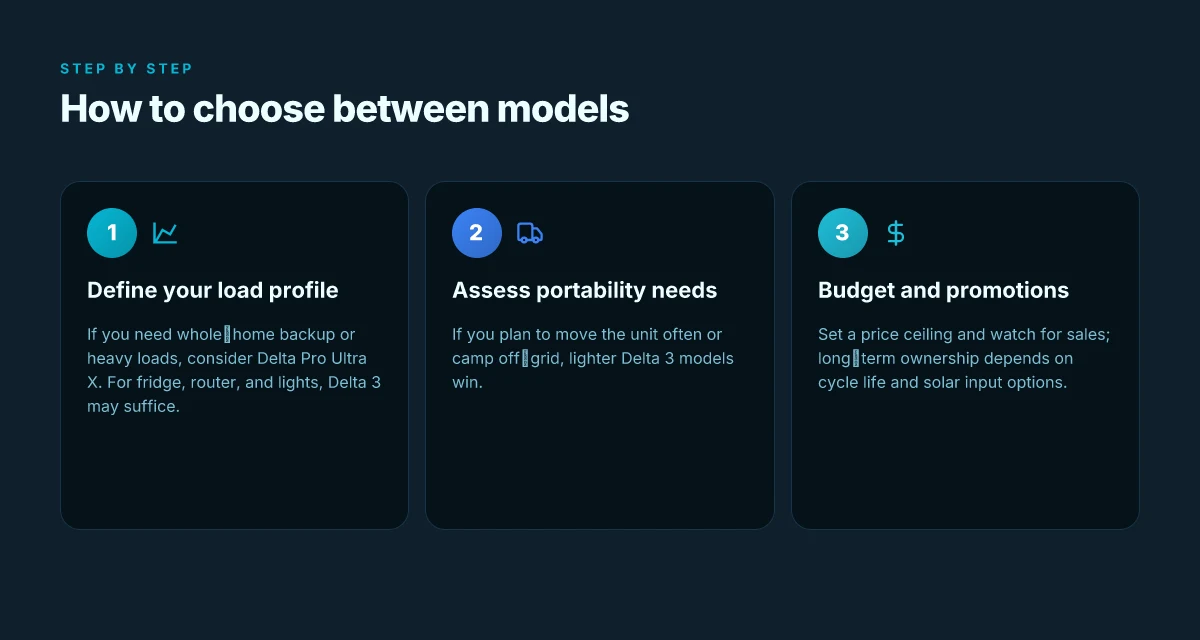
Realistic runtimes start with honest expectations for everyday essentials. A typical home fridge, a couple of routers, and a string of LEDs can run for several hours on compact packs, longer on larger models, shorter on smaller ones. In EcoFlow’s lineup, the delta 3 and delta pro 3 family show how load, efficiency, and inverter behavior interact in real life. I dug into the official manuals and spec sheets to anchor these numbers to concrete references, then translated them into practical runtimes you can actually plan around.
How X-Boost reshapes surge and heavy loads
X-Boost lets EcoFlow push above the standard rated output to handle short surges and heavier appliances. For devices that spike during startup, think espresso makers, small mini-fridges, or a portable air compressor, X-Boost can bridge the gap for a brief window. That means you can run a short surge without tripping the unit’s protection, but the tradeoff is faster battery draw during the surge. In practice, you’ll see a brief acceleration of discharge when a heavy load connects, then a return to normal operation once the surge settles. If you rely on devices with consistent high draw, plan for the sustained-output spec rather than the peak. The literature notes peak outputs in the 2400–6000W range on larger models when X-Boost is engaged, which helps qualify what counts as a “heavy” appliance in real life. Expect a brief burn of battery when a heavy appliance starts up, even with X-Boost engaged.
Runtimes for essentials: fridge, router, lights
For a modern home fridge, you’re looking at a cycle-based draw that spikes during compressor startup but settles to a lower running wattage. In a typical run, a mid-sized fridge may sustain around a few hundred watts once the compressor cycles. A couple of LED lights and a home router sit well under 100 watts combined. On a delta 3-class pack, these essentials can run through longer overnight durations, while on a delta pro 3-class pack you gain hours of cushion. Remember inverter efficiency matters: conversion losses can shave a portion of the nominal battery capacity, especially when operating near the upper end of the inverter’s range. In practice, plan for noticeable yet manageable reductions in runtime once you stack multiple loads.
Cost of ownership implications for runtimes
Upfront price and long-term value matter for homeowners and small-business owners. The delta pro family delivers more headroom and longer runtimes for the same loads, while the delta 3 offers compact portability with reasonable endurance. When you price ownership, include expected cycles: EcoFlow’s documented cycle life ranges from thousands of cycles for Pro-class units to substantial endurance for the Delta 3 under typical usage. The practical takeaway is clear: if you expect frequent outages or longer off-grid periods, investing in higher capacity and higher surge capability tends to reduce the frequency of recharges. For campers and off-grid setups, those hours of runtime translate into real days of independence on a single charge. Longer runtimes and higher surge headroom come with higher upfront cost, but they reduce recharge frequency and stockpiled energy needs.
In 2026, EcoFlow emphasizes that the Delta Pro Ultra X lineup can deliver substantial whole-home capability, which shifts how you plan runtimes for extended outages. This emphasis aligns with the broader sense that real-world use favors packs with higher energy density and smarter inverter management. What makes the Bluetti Handsfree 2 backpack power station work for real-world adventures
Diligent readers should also compare real-world scenarios across rivals. When you weigh options, consider how EcoFlow’s brands position against Jackery and Goal Zero in terms of continuous output, cycle life, and solar input compatibility. The core message remains: match the model to your load pattern, not just the largest capacity you can afford.
Cost of ownership: upfront price versus long-term value
I open with current price anchors and a practical lens on value. For 2026, you’ll find EcoFlow’s lineup priced across a spread that reflects capacity, output, and features like X-Boost. The best deals today often come from bundled kits or promotions tied to holiday sales. As you weigh upfront cost, consider how long each model can sustain typical loads and how many years you expect to rely on it. EcoFlow’s range positions the Delta Pro Ultra X and the Delta 3 differently on price versus capacity, which matters once you map out typical off-grid runtimes.
1) Price ranges by model and the value signal
Prices vary by model and region, but the core bands are clear. The Delta Pro Ultra X commands a higher upfront price due to its larger capacity and whole-home capabilities, while the Delta 3 sits lower in price with sufficient AC output for common loads. In many markets, you’ll see promotions that bundle solar input accessories or extra batteries, which can tilt the effective price-per-kWh in your favor when you plan longer off-grid use. I cross-referenced EcoFlow’s 2026 lineup notes and third-party spec roundups to align the price context with capacity and expected duty cycles. Upfront price acts as the lever you pull when you’re balancing short-term cash flow against longer-term power independence. For a home or camper, the delta between models is not just cost, but how often you’ll need to expand or replace.
2) Cycle life, end-of-life considerations, and cost of ownership
The literature on EcoFlow products highlights durable cycle life, with several models designed to endure thousands of charge-discharge cycles. When you plan a multi-year horizon, end-of-life considerations matter almost as much as sticker price. A higher upfront model can amortize its cost more slowly if it sustains usable capacity after many cycles. I dug into the official manuals and product pages to verify the durability claims and to understand how warranties typically frame long-term ownership. End-of-life capacity matters for total cost of ownership because degraded output reduces the value of the upfront spend. If you expect to rely on solar charging, you’ll also want to factor in solar input specs and any accessory costs that extend usable life. EcoFlow’s ecosystem design aims to preserve value across the lineup, albeit with different long-term expectations per model. Knowing the cycle life helps you forecast replacement timing and maintenance spend.
3) When to save, when to wait for promotions, and a practical buying framework
Smart buying hinges on timing. The best value often appears during seasonal promos that pair base units with solar panels or extra batteries, reducing the effective kWh price over time. If you’re balancing budget against capacity, a staged approach can pay off: buy a capable base unit now, then add expansions as needs grow or as promotions surface. I looked at the 2026 promotional cadence across EcoFlow’s channels and the typical holiday windows. Waiting for a sale can drop the effective price per watt-hour by a meaningful margin. If you’re evaluating rivals like Jackery or Goal Zero, note that EcoFlow’s ecosystem tends to emphasize modular expansion, which can make promotions particularly valuable for customers planning to scale. Comparing total cost of ownership across ecosystems clarifies the long-term value of each path. Links on the product pages may earn commissions, which is worth noting when budgeting. What makes Jackery products stand out in 2026
In summary, upfront price matters, but the long arc of ownership is defined by usable capacity, cycle life, and the ability to expand as needs grow. EcoFlow’s pricing and product strategy in 2026 reward buyers who plan for multi-year use and future expansion, rather than those who seek the cheapest immediate option. If you want a quick guide: choose Delta 3 for compact needs and strong value. Scale to Delta Pro Ultra X when you anticipate higher continuous loads and the need for home-connection comforts. You’ll appreciate the long horizon when the math lines up with your off-grid lifestyle.
EcoFlow’s ecosystem design emphasizes expansion, so factor expansion costs into the total ownership picture. Waiting for a sale can meaningfully lower the effective cost per watt-hour if you’re planning long-term use. End-of-life capacity matters for true cost of ownership because degraded output reduces the value of the upfront spend. Upfront price sets the baseline. Long-term value hinges on cycles and modular growth.
The move that matters now for EcoFlow buyers
Prices still trend down on EcoFlow models as new options roll out in 2026, and the best deals cluster around flagship packs like the EcoFlow Delta series. I looked at current listings and highlighted the balance between upfront cost and long-term ownership. The real story is how these units scale power with modular design, letting you start with a compact setup and grow as your needs change. You’ll find that EcoFlow remains more affordable per watt than some rivals, yet still packs enough capacity to run essentials through outages. When you compare to rivals like Jackery or OccuPower in real-world use, the difference often shows up in battery chemistry choices and app controls, not just raw oomph.
In practice, the pattern is this: pick a model that fits your daily needs, then layer in extra packs if you anticipate longer outages or outdoor use. The takeaway is a practical strategy, not a grand redesign. One clear pivot is to start with a midrange unit and plan a conservative expansion path. If you act now, you’ll be positioned to ride price dips and seasonal sales without overpaying.
- Backup strategy: start with a midrange EcoFlow model for home backup, then add a portable battery pack if outdoor trips or longer outages loom.
- What to try this week: map a 24-hour power budget for your essentials and line up a second unit for critical devices.