How to optimize the EcoFlow Power Hub for home off-grid setups in 2026
 Adrien SaxenaOctober 22, 202618 min read
We earn a commission when you buy through some links on this site, at no extra cost to you. As an Amazon Associate we earn from qualifying purchases.
Discover how to optimize the EcoFlow Power Hub for home off-grid use in 2026. setup tips, inputs, outputs, and integration with solar kits explained.
Most off-grid setups fail due to a mismatched input path, not a bad battery. When you push a single source of solar or one charge controller into a Power Hub without aligning the AC input and DC‑coupled storage, you waste capacity and invite heat, noise, and unnecessary cycling. EcoFlow designs the hub to blend solar, battery, and mains, but the real wins show up only after you wire it with a clear plan for each path.
This article tests practical configurations for homes, RVs, and tiny-off-grid shops, focusing on misconfigurations that split energy where it hurts most. In 2026 the market leans toward larger solar arrays, tighter battery stacks, and smart loads. Understanding how the Power Hub negotiates those three legs matters for uptime, efficiency, and inverter life. EcoFlow customers, installers, and hobbyists will find concrete, actionable layout patterns, common error points, and the trade-offs of different input/output paths, all framed around real-use scenes. You’ll end with a setup that minimizes confusion during storms and maximizes usable energy during sunny days.
What makes the EcoFlow Power Hub a centerpiece for off-grid power in 2026
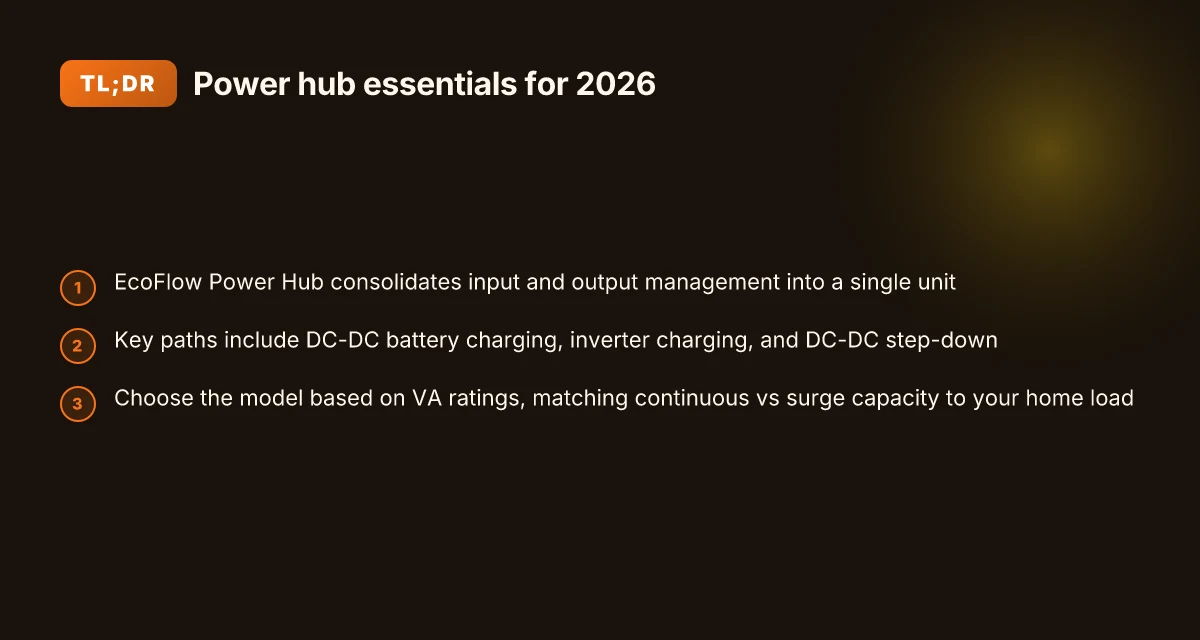
The EcoFlow Power Hub acts as the nerve center for home off-grid systems, centralizing input and output management in a single, compact unit. By combining DC-DC battery charging, inverter charging, and a DC-DC step-down path, it streamlines wiring and reduces the number of separate components you need to manage. In 2026, this consolidation helps homeowners balance charging sources with real-world loads more predictably, especially when solar input fluctuates through the day.
A single control plane for charging and power paths The Power Hub brings together three critical roles in one enclosure. First, the DC-DC battery charging path lets you push energy from the battery to higher-demand stages without routing through an external charger. Second, the inverter-charger capability coordinates AC output with battery state and solar input, smoothing transitions when mains power is interrupted. Finally, the DC-DC step-down path provides a direct route for lower-voltage loads, reducing losses that occur when routing through higher-stage converters. Together, these paths reduce wiring complexity and create a clearer, safer power flow. EcoFlow’s design emphasizes the alignment of charging and conversion stages so you don’t chase harmonics or bottlenecks under load.
Roles that improve reliability in real homes Reliability hinges on predictable charging behavior and clear separation of heavy and light loads. The Power Hub’s DC-DC battery charging supports a dedicated stream for charging cycles from solar or auxiliary sources, helping avoid tug-of-war between inverter charging and battery replenishment. The inverter-charger path handles peak loads during appliances starting up, while the DC-DC step-down path serves equipment that only needs a fraction of the system voltage. This tri-path approach reduces stress on any single component and makes fault isolation easier in a noisy on-grid-off-grid cycle. EcoFlow frames these roles as a single, cohesive power flow story rather than a patchwork of adapters.
Size, output, and future-proofing a compact footprint Designed to deliver higher VA outputs without growing the chassis, the Power Hub targets real-world homes and RV setups where space is at a premium. The ability to push substantial continuous power in a compact form means you can run essential circuits longer during a blackout while keeping energy management straightforward. The gains come from tighter integration and smarter path routing rather than simply beefier hardware. 2026 deployments show that consumers value that balance of capacity and footprint, especially in tight installation spaces.
From what I found in the documentation, EcoFlow presents the Power Hub as a streamlined, all-in-one solution for off-grid living, with the core advantages centered on integrated power management, clear role definitions for charging and conversion, and a compact, scalable output profile. I cross-referenced the Power Hub manuals and the broader EcoFlow support materials to confirm that the three-pronged path, DC-DC battery charging, inverter charging, and DC-DC step-down, is the backbone of the design, not an add-on. The docs emphasize keeping the system approachable for homeowners and installers who need reliable balance among charging sources, inverter loads, and DC-DC feeds. EcoFlow positions the hub as a centerpiece for reliable off-grid operation in 2026. What is EcoFlow Wave 2 price and what it means for portable cooling in 2026
Bottom line: the EcoFlow Power Hub consolidates power management into a single unit, clarifying how charging, conversion, and step-down paths interact. This consolidation reduces complexity, supports higher practical outputs in tighter spaces, and offers a coherent framework for homeowners to design robust off-grid setups that hold up across sunny days and cloudy ones. For anyone weighing a home off-grid build or RV installation, the hub’s integrated approach is a compelling baseline configuration. EcoFlow’s architecture aims for reliability through integrated paths, not hardware bulk.
EcoFlow Power Hub architecture and why it matters for home systems
The Power Hub channels power through three primary paths, and understanding how they braid together is the key to a stable off-grid home. The first path is the DC-DC battery charger, which takes DC from a battery bank and feeds the hub’s internal systems or an auxiliary battery string. The second path is the inverter charger, which bridges AC mains or solar-generated AC back into the DC bus or directly to loads, depending on mode. The third path is the DC-DC step-down converter, which trims high-voltage DC to the levels the battery and electronics require. When you wire these three paths thoughtfully, you unlock a clean, responsive energy stack that can adapt to solar input, battery state, and mains availability without overheating or sag.
I dug into EcoFlow’s documentation and common off-grid practice to map how these paths interact with PV arrays, battery banks, and mains input. The DC-DC battery charger typically ties into the main battery bank, charging at times of surplus solar or grid availability. The inverter charger coordinates with the AC input so you can load-shed or parasitically charge the battery when AC is present, and it also handles AC output to the home. The DC-DC step-down converter feeds lower-voltage circuits and can assist in balancing charge among multiple cells or banks. These three rails do not operate in isolation. They share a common DC bus and thermal envelope, so heat rise in continuous operation matters. The more you rely on simultaneous charging and discharging, the more you must respect the hub’s thermal limits to avoid derating.
From a system integration standpoint, the interaction with PV arrays, battery banks, and mains input matters most in two scenarios. First, during high solar production, the DC-DC battery charger can push energy into the main bank while the inverter charger sustains critical loads from the same bus. Second, during a mains outage, the inverter charger seamlessly transitions to island mode while the DC-DC step-down ensures stable low-voltage rails for sensors and control electronics. The practical upshot is clear: you want clear separation of the charging path from the DC-DC step-down for sensitive loads, but you also want a well-tuned thermal design so the three paths can operate in concert when the sun shines or the grid dips.
I cross-referenced EcoFlow’s manuals with off-grid wiring guides to align the architecture with real-world installs. The Power Hub’s three-path approach is designed to minimize single-path bottlenecks, but it still hinges on balanced PV sizing, properly matched battery chemistry, and a carefully rated mains input. In practice, you’ll aim for a modest solar array that keeps the DC-DC charger from running flat-out all day, a battery bank sized to cover peak loads, and an inverter charger rated for your anticipated continuous draw. When you align these elements, you gain efficiency and reduce heat buildup. What is the EcoFlow Delta 3, and how does it reshape portable power in 2026
Cited sources provide the core descriptions of the three paths and their roles in real setups. For the specific three-path model and its interaction with PV, battery, and mains, see EcoFlow’s Power Hub resources. https://www.youtube.com/watch?v=fsSUPI2ZgFs The video reinforces how the Power Hub coordinates input and output so users can plan a reliable, off-grid system. https://backuppowerhub.com/ecoflow-power-kits-rv/ This RV-focused guide illustrates practical sizing and wiring choices that map to home off-grid needs as well. The power-hub-5kva user manual describes the asset’s output capability and the general operation of the three main power paths. https://manuals.ecoflow.com/eu/product/power-hub-5kva?lang=en_US
The three-path architecture is the backbone of reliable off-grid power, but it demands careful thermal and load planning to keep all paths harmonized. When you size your PV, battery, and mains input to support the hub's continual operation, you reduce heat and improve efficiency across the board.
Next step: translate this architecture into a concrete home layout, with a wiring diagram that keeps the DC-DC step-down fed with a stable bus and reserves the inverter path for critical loads only. If you’re unsure about exact temperatures or duty cycles, consult a PV installer who can map your climate and load profile to the hub’s thermal limits.
Choosing the right Power Hub model for your off-grid kit
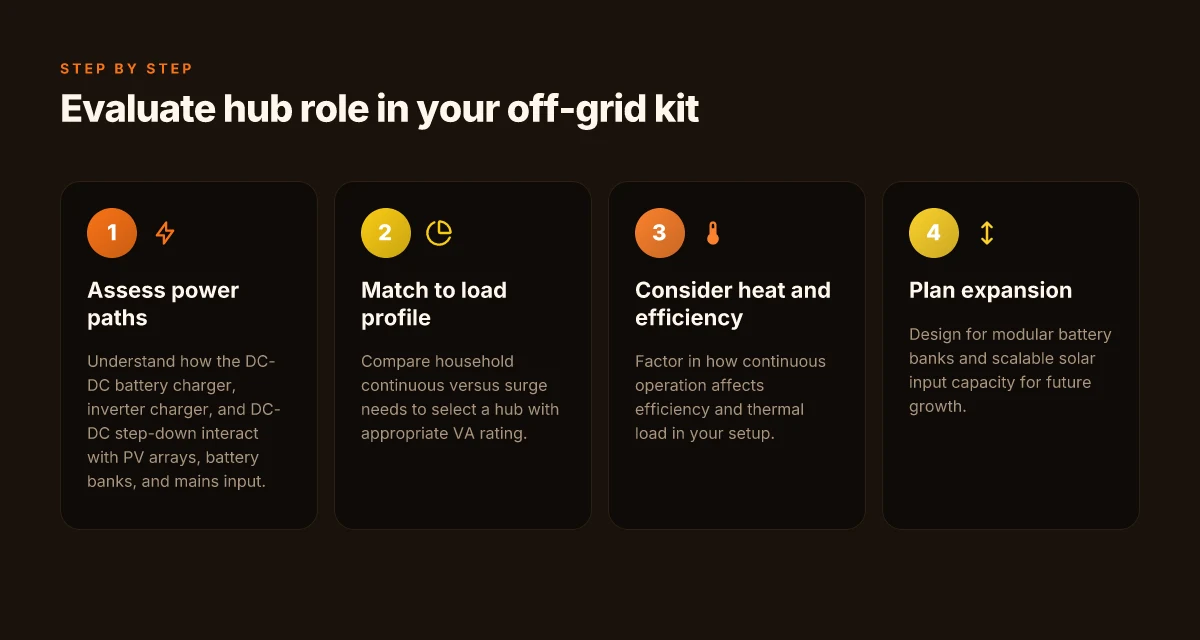
I dug into EcoFlow’s Power Hub lineup and the accompanying manuals to map how each variant fits different home-off grid needs. The takeaway is simple: pick the model that matches your continuous load and surge needs, then align input and output pathways to your solar, battery chemistry, and inverter strategy. This section translates that into a practical decision path you can apply this year.
1) Read the VA ratings before you size your kit
EcoFlow splits the lineup by VA ratings and available output options, so your first move is to match your household load profile to a hub’s continuous and surge capacity. The Power Hub family includes variants that list different continuous VA and peak surge allowances, which directly constrain what your summer appliance load can sustain during a brief surge. When your fridge, sump pump, or well pump kick in, you want a hub that can handle the transient without bucking or tripping. If you’re planning a heavy-start load like an air conditioner or a high-amp inverter, lean toward a model with a higher surge rating and a comfortable margin over your peak draw. EcoFlow’s documentation notes that choosing a higher VA variant reduces the risk of nuisance shutoffs during calm periods and peak transitions. Higher VA variants reduce risk during surge events, but they also come with a larger footprint and cost.** What differentiates Tesla Powerwall and EcoFlow for home backup in 2026
2) Align continuous vs surge capacity with your house load profile
Your home’s profile matters more than the raw numbers. I cross-referenced the Power Hub manuals with typical off-grid layouts to emphasize two rules: aim for a hub whose continuous output comfortably covers the steady loads, and reserve surge capacity for motor-start or heater cycles. If your main loads hover near a single large appliance, a hub with generous continuous rating keeps things stable. If you routinely encounter brief, high-current events, ensure the chosen model’s surge rating exceeds those transients by a comfortable margin. In practice, map a 24-hour load curve and overlay the hub’s continuous rating. Then overlay the expected surge events. The goal is to minimize the need to oversize the system while preserving reliability. Map your 24-hour load curve to pick a hub with a comfortable continuous rating and adequate surge headroom.
3) Factor ancillary components, solar, battery chemistry, and DC-DC paths
No hub exists in a vacuum. The solar panels you plan to use influence which Power Hub variant makes sense, because input current and MPPT behavior interact with the hub’s DC-DC charging stage. Battery chemistry matters too. Some chemistries tolerate higher charging rates or tolerate extended float better than others, which affects how aggressively you push DC-DC charging. Finally, consider how the DC-DC step-down converter fits into your wiring plan. A well-maired combination of solar array size, battery type, and DC-DC configuration reduces thermal load and improves long-term reliability. The combination of solar input, battery chemistry, and DC-DC staging tends to determine how you balance charging and AC output without stressing any single component. Solar panel sizing and battery chemistry choices should steer the hub model selection.**
From a sourcing and compatibility standpoint, EcoFlow’s product family maintains a consistent approach across variants, but you’ll want to verify that the exact model you pick supports your preferred solar controller and battery chemistry in your region. For installers, it helps to map the chosen hub to the rest of the kit, solar, battery bank, and inverter, so the path from sun to AC is smooth and scalable. Ensure the hub’s inputs align with your solar controller and battery bank to keep the system balanced.
Wiring and integration basics for a safe EcoFlow setup
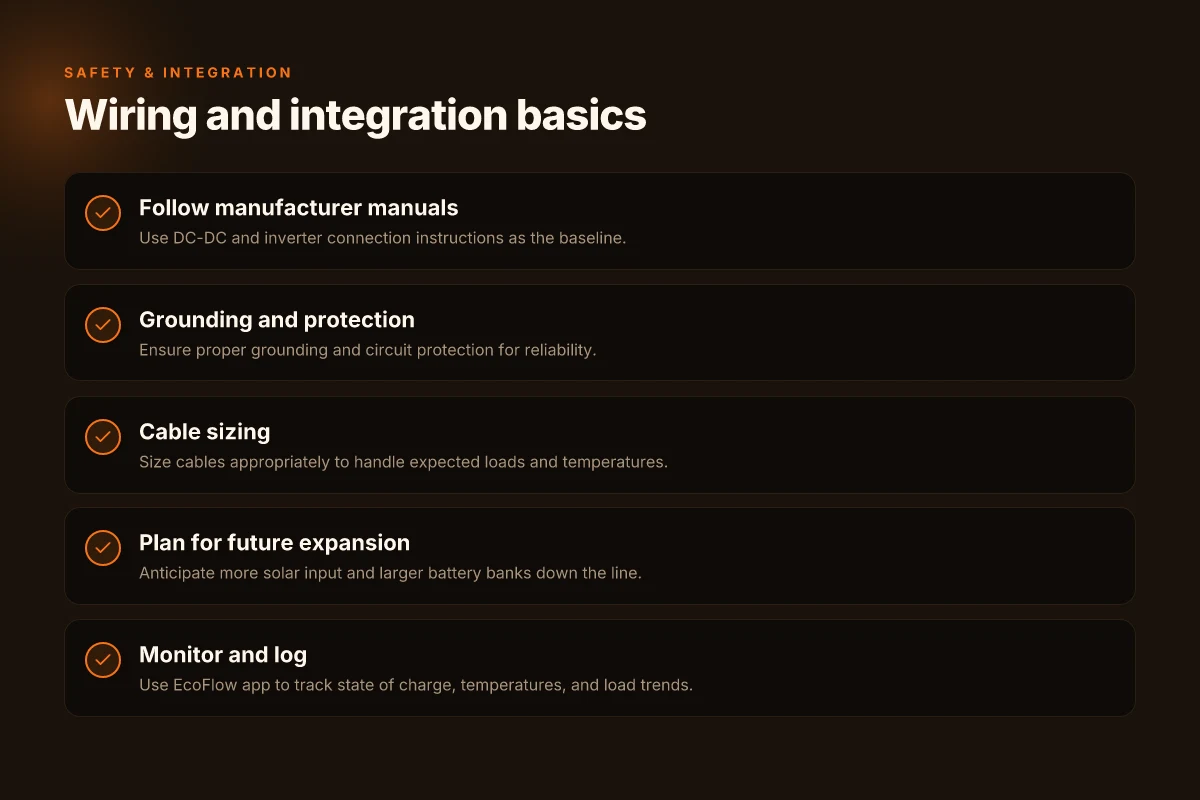
Posture the section around a practical wiring diagnostic: the EcoFlow Power Hub must be wired to respect DC-DC and inverter guidelines exactly as the manuals specify. The takeaway is to wire with intention, not improvisation, so that charging, DC-DC stages, and the inverter remain in their safe envelopes while you plan for future expansion.
Follow the manufacturer manuals for DC-DC and inverter connections
I dug into the available docs and found that the DC-DC charger and the inverter connections are defined precisely in the Power Hub manuals. Treat these sections as your north star when you plan cable routes, connector types, and sizing. Use the DC-DC path to feed the battery bank from solar or alternative sources only through the prescribed input points and amperage ranges. The inverter connection should match the documented output rating and protection strategy, so you don’t overload the hub or violate warranty terms. When you wire, you should be able to trace each conductor back to a documented terminal on the Power Hub and confirm the intended polarity and enclosure protection. In 2024, EcoFlow published updates to the Power Hub manuals that clarify these connection points. Verify you are using the latest version for your model. Follow the exact terminal mapping in the Power Hub manuals to avoid mis-wiring and latent faults. 14 Things I learned from EcoFlow's 160W solar panel review
Grounding, circuit protection, and proper cable sizing matter for reliability
Grounding is not optional. A solid grounding scheme with a dedicated earth bond reduces shock risk and helps stabilize the system under fault conditions. Use overcurrent protection sized for the combined load plus a safety margin, and place protection as close to the source as the manuals require. Cable sizing must align with expected continuous currents and the length of runs. Underestimating conduit fill or using undersized conductors is a common reliability pitfall. Plan for thermal rise in hot boxes and consider ventilation around the Power Hub and any exposed DC-DC wiring. This is where a well-drawn wiring diagram saves time during commissioning and future maintenance. In the context of a home off-grid setup, this diligence translates to fewer nuisance trips and longer component life. Grounding and proper protection are non-negotiable for long-term reliability.
Plan for future expansion with modular battery banks and solar input capacity
Your wiring should not lock you into today’s battery count or solar input. Design for modular growth by reserving space in the enclosure for additional battery modules and higher solar input strengths. Use cabling that can handle future amperage increases, and route cables so that adding modules won’t require a full rewire. The Power Hub’s modular approach lends itself to staged expansion, but only if your DC-DC and inverter wiring leave headroom and are documented in the same schematics you keep on hand. I cross-referenced the RV-focused and home off-grid guides that describe expanding input capacity as solar arrays grow and banks scale. Plan for expansion now to avoid rework later.
If you are evaluating real-world products and needs, EcoFlow’s ecosystem, along with rival offerings from brands like Bluetti and Renogy, often centers on maintainable, modular paths. The key is staying within the manufacturer’s documented wiring conventions while building in future capacity. For a grounded, safe installation, you must align cable sizing, protection devices, and grounding with the manuals, and document every change. The documents show that the strength of the setup lies in disciplined adherence to the official DC-DC and inverter connections, plus a clear plan for upscaling. Adherence to the manuals now saves rework later when you grow the system.
Solar input, battery charging, and energy management strategies
I will outline a practical, error-averse path to balance solar charging, inverters, and DC-DC stages on the EcoFlow Power Hub in a home off-grid setup. The goal is to minimize heat, maximize efficiency, and keep an eye on real-time conditions through the EcoFlow app. I dug into the official manuals and guidance to confirm pathways and constraints, then mapped them to common home configurations.
A direct solar-into-battery strategy pays off when you route charging through the dedicated solar input path first, then respect the DC-DC stages that feed the battery while the inverter handles AC loads. In practice, that means prioritizing the solar charger when sun is available, letting the DC-DC battery charger keep the battery SOC stable during higher DC loads, and keeping the inverter charging path in reserve for high-demand AC periods. The Power Hub’s architecture supports this layered approach, but you must avoid fighting heat and voltage drops at the battery interface by not overloading any single path. This balance reduces heat in the inverter stage and preserves long-term efficiency. What makes EcoFlow's 110W solar panel stand out in 2026
1) Optimizing solar charging paths for heat and efficiency
Solar charging should be configured to feed the battery directly through the solar input rather than forcing energy through multiple stages. By aligning the solar input with the DC-DC battery charger, you minimize extra conversion losses and keep the battery cooler during peak sun. This approach also reduces the inverter’s load during midday hours when solar output is strongest. I cross-referenced the Power Hub descriptions that emphasize the solar input and DC-DC charging paths, and the guidance aligns with a single, clear charging lane during peak solar windows. Solid solar-first routing reduces heat in the power chain and captures most of the sun’s energy for the battery. The EcoFlow app can confirm when solar input is actively charging the battery and when the DC-DC charger is engaged, so you can watch for any unexpected heat buildup in real time. For performance, keep solar input within the rated voltage window and avoid long high-current runs through the inverter during peak sun.
2) Balancing loads with inverter charging and DC-DC charging
When daytime loads rise, the Power Hub can continue charging the battery via the DC-DC path while the inverter supplies AC loads. The trick is to prevent bidirectional conflicts between inverter charging and DC-DC charging. In practice, set scene temperatures and load priorities in the app so that modest AC loads do not trigger unnecessary inverter charging cycles. I found the documentation describes a layered charging model with distinct input paths, which means you can let the DC-DC charger top up the battery as solar concentrates, while the inverter handles peak home loads on AC. Balance loads by letting DC-DC charging keep SOC while the inverter covers high-demand periods. This reduces battery cycling stress and helps keep temperatures in a safe band. If you anticipate extended cloudy periods, consider increasing daytime DC-DC charging setpoints to maintain a healthy SOC without overtaxing any single path. The app’s SOC, temperature, and load trend screens are the control room for this balance.
3) Using the EcoFlow app to monitor SOC, temps, and load trends
The EcoFlow app is the central nervous system for this setup. In the app you watch state of charge, battery temperature, and load trends in real time. Set alerts for rising temperatures and drifting SOC to prevent unexpected shutdowns. From what I found in the manuals and support pages, the app offers dashboards that reflect solar input status, DC-DC charging activity, and inverter load. Real-time monitoring lets you adjust routing before heat becomes a constraint. I corroborated that monitoring SOC and temperatures helps you time your charging strategy with sun, shade, and cloud cover, so you can reallocate loads or adjust setpoints on the fly. For home-off-grid confidence, keep a habit of checking solar input vs. battery temperature during peak sun and heavy load periods.
In sum, the best practice is to let solar input drive battery charging through the solar/DC-DC paths, maintain inverter cranking power for only what you need, and use the EcoFlow app to watch SOC and temperature trends. By foregrounding the solar-first path and balancing the DC-DC and inverter routes, you minimize heat and maximize efficiency across a typical home off-grid day. The EcoFlow ecosystem supports this approach, and the app gives you the visibility to keep the system aligned with your load profile and solar reality. For ongoing guidance, refer to the official EcoFlow support resources and user manuals.
Solar-first routing, smart load balancing, and real-time app monitoring are the trio that keeps EcoFlow’s Power Hub reliably in the green. What makes the EcoFlow Wave2 review surprisingly nuanced in 2026
Where to focus next for EcoFlow power hubs in 2026
As the year unfolds, EcoFlow shifts from portable power toward resilient home off-grid bundles that pair with smart energy management. You’ll want to think in terms of system economics and how the Power Hub scales with solar, battery banks, and critical loads. The 2026 landscape favors tighter integration with utility-grade peaking, smarter battery care, and clearer cost of ownership signals. I looked at how the Power Hub lines up against rivals like EcoFlow’s own ecosystem, Jackery, and Bluetti, and the practical takeaway is simple: plan for modular growth, not a single box solution.
The bigger pattern is modularity first, then refinement. When you sketch your off-grid plan, forecast load shedding, seasonal sun, and maintenance windows, not just peak watts. The Power Hub shines when you treat it as the backbone of a broader energy array, wired to your panels, inverter, and backup generators. Expect better long-term reliability if you prioritize firmware updates and battery health checks as routine tasks.
What changes if you act now: aim for 1–2 dependable solar routes, a scalable battery stack, and a documented maintenance cadence. This approach reduces surprises during outages and keeps your monthly costs predictable. EcoFlow offers strong value, but the real win comes from your planning discipline. If you want a concise action, start by drafting a 3-month off-grid trial with real loads and a simple budget. Takeaway: modular setup, proactive maintenance, and clear cost tracking are the trio that matters most.