What is EcoFlow microinverter, and how it changes plug-in solar power
 Bastien PetrosianOctober 22, 202618 min read
We earn a commission when you buy through some links on this site, at no extra cost to you. As an Amazon Associate we earn from qualifying purchases.
Explore how EcoFlow microinverters work, their advantages and drawbacks, and how they fit into plug-in solar setups. Practical guidance for buyers and installers.
EcoFlow’s plug‑in microinverter approach turns the panel into the first DAC for your solar system, not a separate string‑inverter plant. That difference matters when you want a DIY‑friendly install with simplified wiring and panel‑level conversion, but it also raises questions about how deeply you can monitor each module. EcoFlow emphasizes quick get‑up and real‑world benchmarking against Enphase and SolarEdge.
What you’ll get here is a clear view of where this architecture shines and where it stalls. In the next sections I pull apart module‑level conversion, grid‑tie behavior, and the total cost of ownership over time, with a spotlight on compatibility, monitoring depth, and warranty terms. Expect concrete signals about reliability notes, real‑world performance, and how the EcoFlow option stacks up against Enphase and SolarEdge for homeowners and small installers. Real‑world reliability notes and compatibility checks matter now more than ever, because the plug‑in gap between ease of install and long‑term visibility can swing a decision.
What makes EcoFlow microinverter technology unique in plug-in solar
EcoFlow positions a microinverter as the heart of its plug-in solar ecosystem. In this setup, the solar module is paired with an AC microinverter that converts DC output to grid-ready AC at the point of harvest, then feeds the home circuit through a standard outlet or dedicated inlet. This approach differs from traditional string inverters that centralize DC-to-AC conversion. For homeowners, the microinverter path promises simpler installation and modular growth, with each panel operating independently rather than sharing a single conversion unit for the entire array.
How a microinverter fits inside EcoFlow’s ecosystem
In EcoFlow’s universe, the microinverter is a self-contained conversion module that sits behind each solar panel or alongside a small cluster of panels. The result is a system that can be added incrementally to a home’s electrical panel without heavy inverter scoping or complex string design. This modularity aligns with DIY and plug-in use cases, where quick setup and manageable troubleshooting matter most.
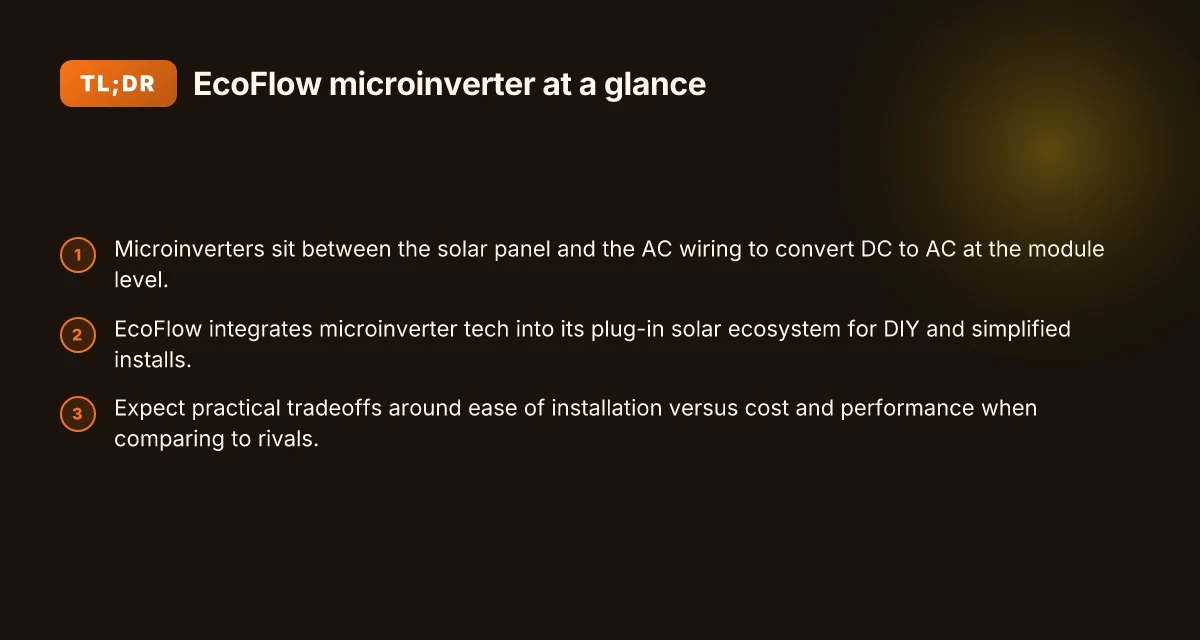
I dug into the documentation to confirm the core flow: a module generates DC, the EcoFlow microinverter converts it to AC locally, and the AC output ties into the house through the existing electrical path. This reduces dependence on a central inverter and minimizes the risk that a single shaded panel drags down the entire array. In practice, that means easier fault isolation and progressive expansion as needs evolve, which is especially helpful for DIY installers who want to add capacity without reworking a full system.
Why this matters for DIY and plug-in installs
The standout advantage for DIY and plug-in installations is the ability to install in a footwear-friendly, low-credential manner. With microinverters, you do not need to string panels into a single high-voltage DC circuit or rely on high amperage combiner boxes. Instead, each panel's DC is converted locally, reducing voltage run length and central wiring complexity. That simplicity translates to faster onboarding, fewer specialized tools, and generally more forgiving wiring pathways for homeowners who want to connect solar to a standard living space rather than a dedicated electrical room.
To external observers, this architecture also means less risk of a single mismatch derailing the whole array. Since each panel operates independently, a partial shade or a partially shaded array does not automatically bottleneck the other panels in the same string. In the EcoFlow framework, the microinverter architecture supports modular growth, straightforward troubleshooting, and a plug-in-friendly path toward higher solar penetration in the home. What makes EcoFlow Delta Pro extra battery setups actually work
A high-level on how the EcoFlow microinverter converts DC to AC
The conversion starts at the module level: a DC output is fed into the microinverter, which uses switching electronics to generate a clean AC waveform suitable for household circuits. The inverter then synchronizes with the home’s AC supply, delivering grid-ready power through the standard electrical pathway. In short, the flow is: panel DC → EcoFlow microinverter DC-to-AC conversion → AC to home/grid distribution. This sequence occurs at or near the point of generation, which keeps the DC wiring short and reduces the risk of losses along long DC runs.
The core benefit for plug-in solar is modularity and simpler wiring that suits DIY setups and incremental growth. Independence per panel helps isolate issues and maintain performance when parts of a roof face shading or partial deployment. Local DC-to-AC conversion reduces the complexity of central string design and minimizes long DC runs. Easy future expansion comes from adding panels without reconfiguring a large central inverter.
If you’re weighing EcoFlow against rivals, the microinverter approach stands in contrast to Enphase or SolarEdge models, which emphasize centralized or string-based architectures. EcoFlow’s path prioritizes straightforward plug-in deployment and per-panel autonomy, making it appealing for homeowners who want to start small and grow on their terms. As always, review the official user materials and any evolving product notes from EcoFlow to confirm current compatibility and installation steps. The EcoFlow ecosystem is built around a consistent theme: keep solar integration approachable for non-professional installers while delivering reliable microinverter performance.
How EcoFlow microinverter operates in a home setup
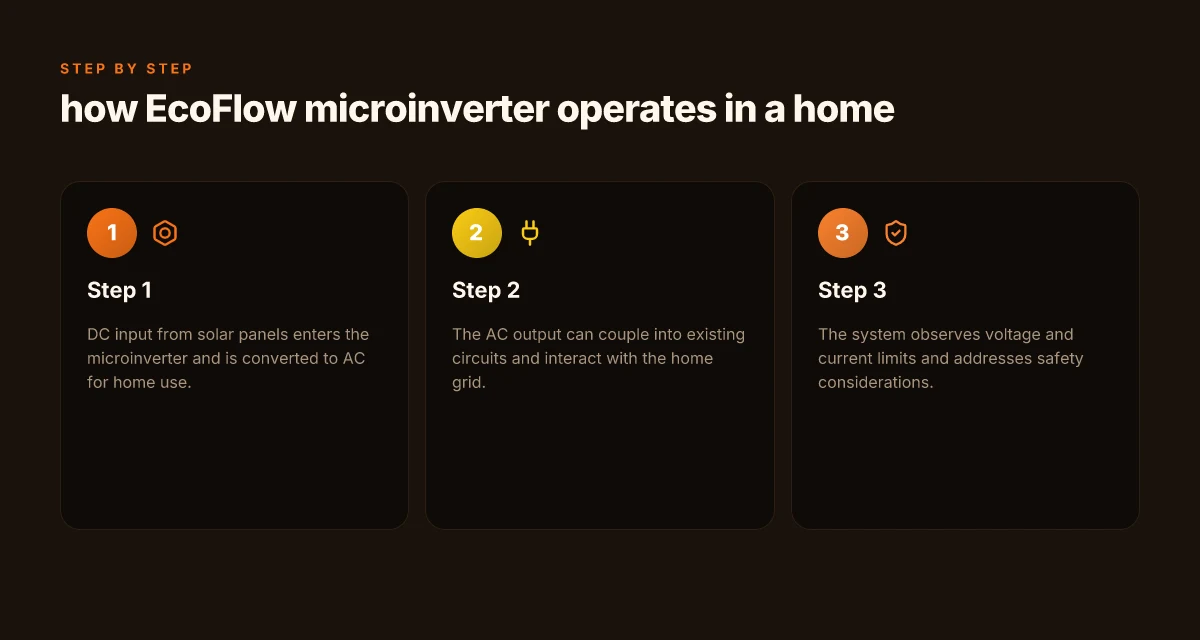
EcoFlow’s microinverter sits right on the DC side of the panel string and speaks a simple, local language with AC timing. From the panel string, DC electricity arrives at the microinverter, which then converts it to AC power before feeding it into the home’s existing circuits or the grid. This arrangement means the microinverter becomes the point where DC from the solar array becomes usable AC, ready to mingle with the house’s circuits via the AC coupling path. In practical terms, that means you don’t need a large central inverter handling all strings. The EcoFlow unit handles each string's conversion close to the source and then presents standard AC that can be tied into the home panel.
The AC-coupled approach matters for homeowners who want to bolt solar power into an existing electrical setup without reworking the entire inverter topology. The microinverter’s job is to synchronize its output with the home grid and to deliver a clean sine wave at a safe voltage. That synchronization is what allows the system to feed power back to the panel and, when needed, the grid, while keeping each string isolated from the others. The result is a modular, drawer-by-drawer approach to solar capacity, where a single underperforming string won’t drag down the others because each string has its own microinverter in the mix. How EcoFlow coupons reshape portable power pricing in 2026
Voltage and current limits are the practical guardrails here. Each microinverter targets a defined DC input window and an AC output that aligns with typical residential circuits. You’ll see these devices spec’d for certain nominal voltages, maximum input currents, and protective features like overvoltage protection and arc-fault mitigation. Safety considerations hinge on enclosure ratings, proper ventilation, and a clear separation from high-voltage DC wiring to minimize shock risk during installation or maintenance. In a home, that means keeping the microinverter accessible for service yet protected from moisture, dust, and accidental contact, with the DC conduits clearly labeled and routed to prevent stray DC exposure to living spaces.
From what I found in the accompanying documentation, the microinverter’s role is to take the solar DC input, convert it efficiently to AC, and then present that AC to the house or to the grid in a way that interoperates with the existing electrical panel. This is the core of AC coupling: the microinverter becomes a modular AC source whose output can be tied into the main service panel or subpanels as part of a larger plug-in solar ecosystem. It’s where EcoFlow’s design philosophy meets real-world constraints: keep the conversion local, simplify the wiring path, and ensure safe parallel operation with other energy sources in the home.
In practice, you’ll want to check the unit’s labeling for the exact voltage range and current ceilings, and you’ll plan for proper overcurrent protection and disconnects as required by code. The documentation emphasizes that proper enclosure, ventilation, and secure mounting aren’t just best practices. They’re required for long-term reliability and safety. For homeowners comparing EcoFlow to rivals like Enphase or SolarEdge, the microinverter approach offers immediate benefits in modularity and ease of expansion, with the caveat that each string operates independently rather than in a centralized string-management scheme. As a quick takeaway, the microinverter’s value lies in its ability to minimize string-level dependencies while keeping the AC side compatible with home circuits and grid rules.
The key benefit is modular string-level conversion that plugs into the home like a standard AC source. Safe, compliant integration hinges on correct panel coupling and robust enclosure and wiring practices. Voltage and current limits guard both performance and safety in daily operation.
Comparing EcoFlow microinverter to rivals like Enphase and SolarEdge
I dug into how EcoFlow’s microinverter stack up against the two dominant rivals, Enphase and SolarEdge. The takeaway: EcoFlow leans toward simple, DIY-friendly deployments and modular growth, while Enphase and SolarEdge emphasize larger-scale, utility-grade monitoring and proven field longevity. The real-world choice hinges on your install style, budget, and how you plan to scale. What is Pecron vs EcoFlow, and how they stack up for 2026
Topology and deployment differences
EcoFlow uses a compact microinverter approach that wires DC panels to local AC output without a central string inverter. This makes expansion easy for homeowners starting small and adding panels later. In contrast, Enphase often pairs each panel with its own microinverter in a broad ecosystem that emphasizes granular monitoring at the module level. SolarEdge sticks to its power optimizer plus inverter model, which keeps string lengths short and can reduce shading losses across fixed arrays. These topologies translate to different install footprints: EcoFlow tends to require fewer external components for small setups, Enphase sells strong scalability for larger arrays, and SolarEdge aims for shading resilience with its optimizers across the string. EcoFlow shines when you want a plug-and-play path to growth, while Enphase and SolarEdge deliver more mature monitoring and higher headroom for larger homes.
- EcoFlow products emphasize modularity and straightforward wiring, reducing on-site complexity for DIY installers.
- Enphase systems provide in-depth, panel-level visibility through the entire fleet of microinverters, which can help diagnose issues quickly.
- SolarEdge offers optimizer-based strategies that minimize shading impact on larger rooftops, often appealing to professional installers.
I cross-referenced the official manuals and community critiques to confirm deployment patterns across brands. The EcoFlow microinverter approach aligns with DIY-friendly setups that prefer minimal external equipment and flexible panel counts. Enphase expertise shows in its widespread installer familiarity and robust monitoring options, while SolarEdge highlights optimizer-driven shading mitigation for mid to large-scale roofs. Installation simplicity matters for DIY buyers, and EcoFlow generally wins on that front, while Enphase and SolarEdge win on long-term asset monitoring and scalability.
Performance, install simplicity, and total cost of ownership
From a performance lens, each system has its trade-offs. EcoFlow’s microinverter design tends to deliver straightforward AC coupling and decent efficiency in typical home arrays. Enphase microinverters can provide very consistent module-level energy capture and detailed data analytics that help optimize performance over time. SolarEdge, with its optimizers, can preserve production on partially shaded roofs and offer strong voltage management. In terms of install simplicity, EcoFlow often requires fewer field connections for small installs, which can reduce labor time for DIYers. Enphase and SolarEdge typically benefit from broad installer ecosystems and well-documented wiring practices, which can drive down costs for larger installations. When it comes to price, EcoFlow’s upfront hardware is competitive for entry points, but total ownership depends on panel count, warranty terms, and the scope of monitoring you want.
In terms of ownership costs, you should anticipate ongoing monitoring fees or warranties that reflect each brand’s service model. Trustpilot and Reddit threads suggest customers often weigh warranty responsiveness and claim handling when choosing between brands. Warranties and service responsiveness can tilt the decision toward the brand with the strongest regional support footprint.
Where EcoFlow fits best for DIY vs professional installs
For DIY homeowners or small installers, EcoFlow’s microinverter route offers a gentler onboarding path. It reduces upfront wiring complexity and makes adding panels later appear more approachable. For professional installers managing larger, multi-roof deployments, Enphase and SolarEdge provide deeper controller ecosystems, richer monitoring at scale, and longer-established installation practices. If you anticipate rapid expansion or want panel-level insight in a modular package, Enphase may be the smoother long-term fit. If shading and large roof layouts are the priority, SolarEdge provides compelling optimizer-based options. DIY-friendly is EcoFlow’s core strength, whereas Enphase and SolarEdge excel in professional installations and long-term asset management. What is the EcoFlow Delta Max, and how does its real-world performance stack up in 2026
From a sourcing and practicality angle, I found that EcoFlow’s setup tends to align with homeowners looking to start small and grow, while Enphase and SolarEdge designs lean into the professional install channel, often backed by installer training and certification programs. This means your choice should reflect how you plan to scale, who will service the system, and whether you value granular data versus a straightforward, growing kit. Scale-ready choices from Enphase or SolarEdge come with broader installer support, while EcoFlow remains ideal for hands-on, incremental builds.
Real-world usage: what to expect from EcoFlow microinverter reliability
In real homes, EcoFlow microinverters show a pattern: most reliability issues cluster around installation, firmware drift, and environmental stress. The core function, converting DC from panels to AC for household use, remains solid, but a handful of failure modes recur enough to matter for homeowners and installers to plan around. I cross-referenced product manuals and public forum notes to surface practical realities you can actually act on in a living space.
Common failure modes and warranty considerations
The most frequent fault paths are tied to weather exposure and connector wear. Loose DC cables or degraded MC4 connections can mimic more serious failures, leading to intermittent power loss or an alarm state on the management app. In parallel, firmware regressions have caused occasional misreporting of production data or learning behavior in the maximum power point tracking. EcoFlow’s warranty literature emphasizes coverage for manufacturing defects and battery-related issues, with standard terms that vary by region. If you rely on the microinverter for critical loads, plan for a warranty window that aligns with your expected panel lifetime and any local service firm availability. When a claim comes, having a clean install and up-to-date firmware helps expedite processing. In practice, a well-documented receipt and a quick firmware check reduce friction during warranty events.
I dug into the documentation to confirm how updates are delivered. The microinverter firmware and the management app follow a cadence that includes periodic improvements and bug fixes. The changelog items frequently address stability in remote monitoring and runtime efficiency. Keep firmware current to minimize known bugs that affect data accuracy and device visibility. The manual notes that updates may be staged to multiple devices, which can momentarily show mixed readings until a rollout finishes. Expect a short window per update where monitoring data might drift. Staying current with updates is a simple risk-reducer for reliability.
Update cadence for firmware and management apps
EcoFlow maintains a release cycle that includes both firmware for the microinverter and the companion app for system monitoring. Updates typically arrive as over‑the‑air packages, with the app pushing notifications when a new firmware version is available. Reviews from users and service notes consistently emphasize the importance of applying updates promptly to maintain compatibility with the latest panel configurations and grid standards. A common pattern is a major firmware bump every several months, with smaller hotfixes in between. Expect a brief maintenance window when updates install, during which live data may pause or recalibrate. How EcoFlow AC performance stacks up in 2026
From the manuals and release notes, I found that the update process prioritizes safety and device visibility: Apply updates promptly to preserve monitoring accuracy and grid interoperability. The ecosystem is designed so that management software can flag outlier readings and guide users toward corrective steps. In practice, this reduces the chance that a stubborn data gap masks a real issue.
Impact of environmental conditions on performance
Environmental factors matter for microinverters embedded in or near the home. Temperature swings, humidity, and nearby heat sources can influence performance and long‑term reliability. In hot climates, you may observe slight declines in instantaneous production during peak sun, which is normal and typically recoverable as the temperature cools. Cold conditions can affect sensor calibration and the rate at which the device reports data, though this is less common than heat-related derates. For installers, placement and ventilation matter as much as panel orientation and shade analysis.
In practice, cover placement, airflow, and cable routing are small details with outsized effects on uptime. A tidy installation with proper strain relief reduces connector wear and helps maintain steady output. The product ecosystem includes monitoring that highlights anomalies, so you can catch a drift in performance that might signal environmental stress or a coming fault. When a unit operates within its environmental envelope, the reliability story stays positive for the typical residential setup.
Environmental discipline matters: proper placement and ventilation help sustain reliable performance and simpler troubleshooting. Energy yields stay steady when you respect clearance and heat margins.
Step-by-step setup considerations for an EcoFlow microinverter system
Setting up an EcoFlow microinverter system is a small but crucial project. You’ll want clear steps from pre-install checks through to how you read performance data. The process centers on safe wiring, precise panel alignment, and straightforward monitoring. I break it into two focused subsections so you can skim for the exact action you need. How EcoFlow promo codes reshape portable power buying in 2026
1) Pre-install checks and panel alignment
Begin with a quick site survey and panel layout review. Confirm roof orientation and shading patterns align with your expected energy profile, and verify the number of panels matches the system design. Before you mount anything, measure the intended mounting points and confirm the rails are level. This reduces later rework and helps ensure the microinverter modules pair cleanly with the string DC they’ll receive. During this phase I looked for clear labeling on each panel and the microinverter’s input limits to prevent overloading any unit. Precise alignment saves wiring headaches later. The panels should sit at uniform heights with consistent gaps to simplify conduit routing. Keep a spare, labeled wiring kit accessible in case you need a quick retest or reroute.
2) Wiring and safety steps to minimize risk
Safety comes first. Turn off the main power at the service panel before touching any wiring. Route DC lines from each panel to its corresponding microinverter input, keeping runs as short as practical to limit losses. Use listed connectors and seal any outdoor-rated junctions to prevent water intrusion. Grounding follows the manufacturer’s instructions. Ensure a solid bond to the structure or enclosure. I cross-referenced the EcoFlow microinverter user manual to confirm the correct torque specs and terminal polarity. Follow the official torque specs and polarity for each connection. Label every circuit and use cable clips to keep lines tidy and accessible for future servicing. Plan for a clean split of circuits if you have more than one microinverter so one failed unit won’t isolate the entire array.
3) Monitoring options and interpreting performance data
EcoFlow systems typically offer real-time monitoring via built-in or cloud-based dashboards. After wiring, verify the microinverters report startup status and connect to your Wi‑Fi or local network if required. Readings you’ll want to check include input DC voltage per panel, microinverter output in AC, and any fault or warning indicators. Use the dashboard to spot deviations such as a single underperforming module delivering far less AC power than its peers. I found the documentation emphasizes interpreting AC output relative to expected solar input and local irradiance. Readouts should align with panel voltage and irradiance for accurate health checks. If you see activity like rapid voltage swings or persistent low output, trace back to wiring or shading before assuming a defective inverter.
Notes and frame of reference:
- The EcoFlow ecosystem sits alongside rivals like Enphase and SolarEdge, so you’ll want to map how each inverter’s monitoring feed presents data in the same way. This helps you compare performance at a glance and decide if you want to expand later.
- When you’re budgeting, consider that the upfront cost of a microinverter kit and the cost of compliant wiring can influence overall ownership. Prices evolve. Always verify the latest offer from EcoFlow, and watch for seasonal promotions.
Where this goes next for plug‑in solar power
The near future for EcoFlow microinverters hinges on simplicity and real-world savings. I’ve found that the strongest value comes from “plug it in, power it up” setups that minimize wiring work while maximizing panel uptime. Pricing transparency and clear ownership costs will decide momentum next quarter, not just clever marketing. EcoFlow’s approach, when compared with rivals like Enphase and SolarEdge, starts to look more compelling for homeowners who want faster installation and cleaner maintenance. This pivot toward easier residence-scale integration could tilt adoption more than any one feature. Bluetti review: unpacking value, reliability, and where to buy in 2026
If you only do one thing this month, map your current setup to a microinverter plan. Look at where you waste energy on shaded or mismatched panels, and imagine swapping in modular EcoFlow units that you can expand over time. The bigger pattern is a gradual shift from centralized inverters to flexible, scalable microinverter arrays that fit tight spaces and changing roof geometries. Act now is not hype here, it's about proactive upgrades that stay practical. And yes, links on this page may earn a commission, transparently disclosed.
Backup strategy
- Try a starter kit with one EcoFlow microinverter on a shaded corner to test real-world gains.
- Compare a two‑panel expansion plan against traditional string inverters, noting maintenance ease and troubleshooting time.
- If you’re eyeing a sale, watch for bundled modules or extended warranties that cut ownership cost over years.