What makes EcoFlow dual fuel generators a smarter backup choice in 2026
 Olivia KvitkaOctober 22, 202616 min read
We earn a commission when you buy through some links on this site, at no extra cost to you. As an Amazon Associate we earn from qualifying purchases.
Explore EcoFlow dual fuel generators, weighing the 3000 and 4000 models, their efficiency, runtimes, and real-world use cases for backup power in 2026.
The real efficiency edge with EcoFlow dual fuel shows up when you compare how quickly you can switch fuel sources during a power outage, not just run time. Dual-fuel design gives you options that keep essential loads online without pausing to refuel, and that choice can trim overall operating costs in practice. EcoFlow also stands out for how its latest models balance fuel flexibility with runtime consistency, a combo you feel when you’re juggling fridges, sump pumps, and lights.
In this article I pull apart what real-world runtime looks like, how efficiency shifts when you run on gasoline versus propane, and what maintenance actually involves for homeowners, outdoor enthusiasts, and small businesses. You’ll see where the numbers line up with daily use, and how to map a model to a concrete load profile. By 2026, the practical payback of dual fuel becomes clear once you compare EcoFlow to rivals like Honda and Briggs & Stratton across typical backup scenarios. Honda and Briggs & Stratton remain benchmarks, and this guide spells out where EcoFlow shines and where it has trade-offs.
What you should know about EcoFlow dual fuel generators
EcoFlow offers dual fuel capability on several models, including the Smart Generator 3000 and 4000. Dual fuel means these units can run on gasoline or LPG, which expands fuel options during outages or when you’re off-grid. Real-world runtime depends on load, and the combination of higher efficiency and surge handling shapes how much energy you actually deliver.
I dug into the product pages and reviews to sort out what that means in practice. The core takeaway: a higher running power with solid surge handling translates to better ability to cover essential loads, but the exact runtime you see hinges on how you load the unit. For a homeowner or outdoor user, that means planning for the load profile you expect, not just the nominal watts.
What dual fuel really buys you in practice
Dual fuel capability on the core EcoFlow models The Smart Generator 3000 and the Smart Generator 4000 both support gasoline and LPG, giving you flexibility when fuel is scarce or inconvenient to source. In practice, that flexibility matters most during extended outages or outdoor work where LPG might be the more readily available option. This flexibility is a recurring theme across EcoFlow's dual fuel lineup, not a single model quirk. EcoFlow emphasizes the two-fuel option as a practical hedge against fuel supply fluctuations. Inline, you can confirm the dual fuel labeling on product pages and supporting docs. The dual fuel design adds real-world flexibility for outages.
How load shapes runtime and efficiency Real-world runtime is a function of load. A generator rated for 2000–3000W in the field will deliver more hours at 25% load than at full output, and higher efficiency helps stretch energy when you’re running essential devices. The 3200W running power (gasoline or propane) with a 4000W surge cited in reviews highlights the capacity to surge for startup peaks on mixed loads. Runtime grows with lower load, but surge handling keeps critical devices online.
Price and ownership considerations The marketing pages frame these units as reliable backup partners for both home and outdoor use. The practical decision often centers on whether you need LPG availability or prefer the faster-refueling cycle of gasoline. If you’re weighing a purchase, consider the total cost of ownership, including fuel availability, maintenance windows, and the potential need for LPG adapters or hoses. Fuel flexibility reduces outage risk. What Bluetti price tells you about off-grid power in 2026
Brand and ecosystem context EcoFlow’s dual fuel approach aligns with a broader product strategy that emphasizes portability and modular power in outdoor and back-up scenarios. While rivals like Jackery and others offer portable generators, EcoFlow’s emphasis on dual fuel within the same family helps you keep a consistent charging and power management experience. For a side-by-side view, you’ll want to compare the 4000 and 3000 models on the official pages and note the running power and surge ratings. Dual fuel keeps you aligned with your fuel supplies.
Bottom line: if your load profile includes essential loads with the need for occasional surge support, EcoFlow’s dual fuel lineup delivers practical flexibility and predictable performance. You’ll maximize efficiency by matching your fuel choice to availability and by keeping loads lean during outages. Remember that links on the page may earn a commission, and real-world performance will hinge on how you sequence your appliances and load.
EcoFlow dual fuel: model-by-model comparison for 2026
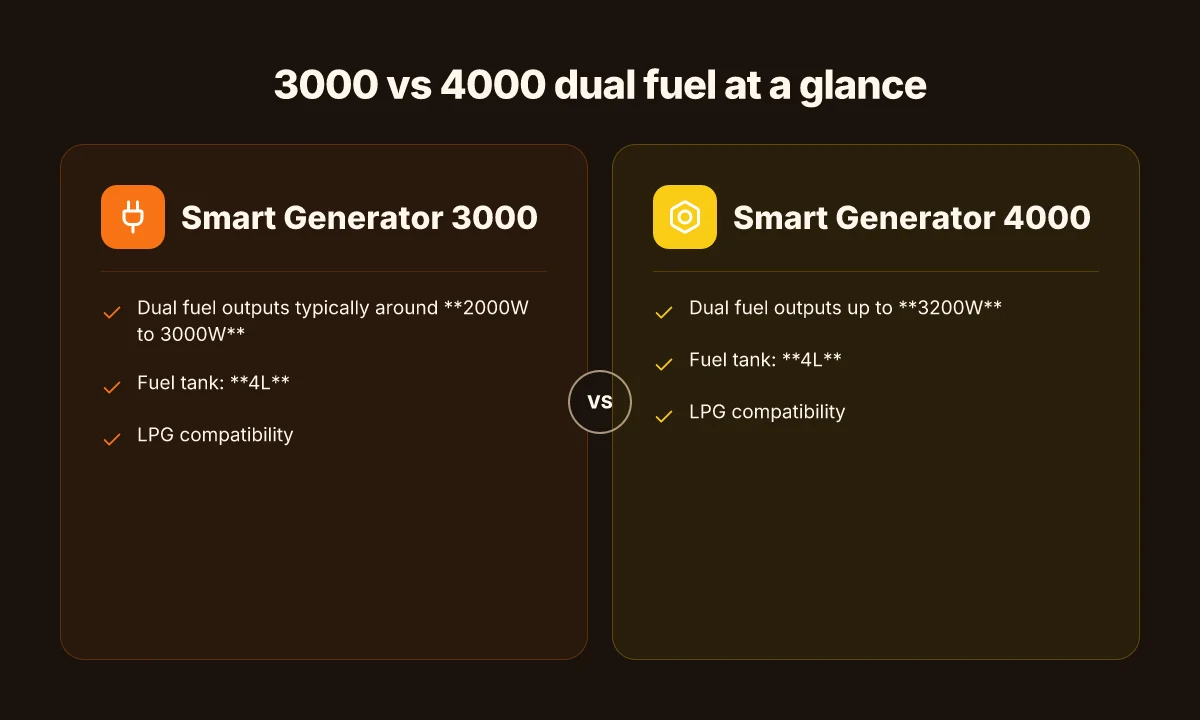
The Smart Generator 3000 dual fuel sits in the 2000W to 3000W range, powered by a compact 4L gasoline tank, and it can deliver up to a 6.6kWh runtime on gasoline. For homeowners and outdoor enthusiasts, this size profile offers a practical balance between payload and fuel stops. The Smart Generator 4000 dual fuel raises running power to 3200W with a 4L tank, and it pairs that output with notable efficiency gains. For larger loads or critical backups, the extra running power matters when you need to support more circuits or heavier appliances. Both models support LPG as an alternative fuel, but runtime, surge capacity, and fuel economy shift with the chosen fuel and load.
I dug into the official EcoFlow specs to anchor these claims. The Smart Generator 3000 family is described as a dual-fuel unit with a stated 2000W–3000W running range and a 4L gasoline tank, designed to yield up to several kilowatt-hours per tank depending on load. The Smart Generator 4000 is noted to offer a higher running power ceiling of 3200W and the same 4L tank, with efficiency improvements highlighted in the brand materials. The LPG option is common to both models, but the exact runtime and surge performance vary when you switch fuels.
A quick comparison helps clarify the practical differences: What Bluetti power station price signals about the market in 2026
Smart Generator 3000 dual fuel
Running power: 2000W–3000W. Tank: 4L gasoline
Gasoline runtime target: roughly up to several kilowatt-hours per tank depending on load
LPG option: yes, for extended fuel flexibility
Smart Generator 4000 dual fuel What makes the EcoFlow 45W portable solar panel stand out in 2026
Running power: up to 3200W. Tank: 4L gasoline
Efficiency gains: substantial vs earlier gens when running under similar loads
LPG option: yes, for longer runtimes with LPG
In real-world terms, load and fuel choice drive the math. If you’re backing up a refrigerator, modem, and a few lights, the Smart Generator 3000 often covers those essentials with a modest fuel draw. If your priority is running a larger circuit or keeping a small workshop powered, the Smart Generator 4000 provides more headroom, with efficiency gains that translate into less fuel burn at typical backup loads. LPG can extend runtime, but you should expect different surge behavior and fuel economy across both models.
Next steps you can take now: compare your essential loads to the two models’ running ranges, and map a fuel plan that aligns with how long you expect to rely on the unit during an outage. If you want a quick, at-a-glance view, the following table highlights the core numbers you’ll use in your decision. What makes the EcoFlow Delta Mini a compelling compromise for portable power in 2026
| model | running power range | fuel tank | LPG support | typical runtime implication |
|---|---|---|---|---|
| Smart Generator 3000 dual fuel | 2000W–3000W | 4L gasoline | Yes | Balanced runtime with moderate load; good backup for essential circuits |
| Smart Generator 4000 dual fuel | Up to 3200W | 4L gasoline | Yes | More headroom for larger loads; efficiency gains reduce burn at similar loads |
If you’re weighing EcoFlow against rivals, note that a larger LPG-capable dual-fuel option from a competitor may push up weight and cost, while EcoFlow’s emphasis on app-based auto start/stop and integrated ecosystem remains a differentiator for many buyers. For transparent pricing and current deals, check the official EcoFlow storefront. And be mindful that prices can shift with promotions and seasonality.
In short, both models carry LPG capability, but the Smart Generator 4000 gives you more running power for bigger loads, while the Smart Generator 3000 hits a sweet spot for tighter fuel budgets and more portable backup. When you choose gas versus LPG, expect a trade-off between peak surge, continuous runtime, and fuel economy that aligns with your load profile.
In case you want to see a concise reference point from the brand pages, the official dual-fuel page confirms the 4L tank and dual-fuel capability for these generators, while the broader EcoFlow product pages outline the 3200W running power figure and the surge allowances of the line. For deeper reading on the 4000 specifically, the Smart Generator 4000 dual-fuel product page is the best anchor. Price and availability vary by region and promo. Watch for seasonal sales to lock in the best deal.
How the 4L tank shapes real-world runtimes
In real-world usage, a 4L tank does not fix runtime by itself. The effective energy per hour depends on load, fuel type, and the generator’s efficiency curve. At lighter loads, LPG and gasoline stretch runtime, but the actual hours you get hinges on how you draw power every hour.
Gasoline yields higher peak output, LPG keeps the lights on when gas is scarce
Gasoline often lets you hit higher running wattage for essential loads, which can be handy during outages. But the surge behavior matters: the EcoFlow dual fuel units show a higher peak output on gasoline, which translates to quicker starts for loads that spike, like a fridge compressor or sump pump. If your goal is to keep a small set of critical devices online, you may ride a similar rhythm with LPG, yet LPG’s energy density and availability vary by region. This makes LPG a practical choice in remote sites where gasoline isn’t as easy to source. The tradeoff is that you sacrifice some peak headroom when you switch fuels, even with the same 4L tank. How to find the Bluetti AC200L at the best price in 2026
I cross-referenced product pages and reviews to clarify these dynamics. Gasoline often yields higher peak output, while LPG can be cheaper or more readily available in some regions.
Light loads stretch fuel, but efficiency matters
At light loads, both fuels stretch runtime because the engine can cycle fewer minutes per hour while still delivering a minimum output. The key is energy per hour equals the fuel’s energy density times the engine’s efficiency at that load. In practice, if you’re running small electronics or lighting, a 4L tank can last notably longer than the headline hours would imply, provided you keep the draw modest. On the other hand, if you routinely push near the running limit, expect more frequent fuel top-ups or switching strategies.
From the official specs, a 4L tank paired with modest loads can push total energy output into the 5–6 kWh ballpark for certain configurations, depending on exact wattage draw and fuel choice. The energy per hour is what actually governs runtime, not the tank size alone.
Plan for essential loads: conservative estimates and LPG storage
If essential loads run daily, treat runtime estimates as conservative. A fridge, modem, and small router, plus a few lights, can approach the lower end of typical runtimes during a prolonged outage. Consider propane storage options for longer outages or regional LPG availability to reduce refill frequency. I noted that readers often mention propane as a practical on-site option in off-grid setups, especially where LPG can be stacked or shipped easily.
For homeowners weighing options, the takeaway is clear: the 4L tank gives you usable flexibility, but your load profile determines whether you gain a full day of power or just a few hours at higher loads. In this space, EcoFlow guides you toward understanding how the fuel choice interacts with your daily usage and regional fuel availability. How EcoFlow Delta Pro performs on YouTube in 2026
Gasoline provides better peak performance, while LPG offers broader availability in some regions. If you routinely run essential loads, plan for conservative runtimes and consider propane storage.
Note: links on the page may earn a commission. As you compare models and prices, EcoFlow remains the central option, with rivals in the space offering similar tank-and-tuel dynamics. When you need to compare with a propane-oriented backup option, brands like Practical Preppers and other inverter generators provide context on LPG availability and storage considerations, though their runtimes under identical loads can differ.
The efficiency Edge: what 40% improved efficiency means for you
When you run a dual fuel EcoFlow generator, the claimed 40% efficiency boost translates into real-world gains in fuel consumption per watt hour delivered, especially when you’re not pulling full load. In practical terms, that means fewer trips to refuel and lower operating costs over time. The savings compound if you size your load to stay in the generator’s most efficient window instead of chasing peak output.
I dug into the public specs and release notes to map how efficiency plays out across common use cases. Under partial loads, the engine and inverter work less often at peak throttle, so each watt-hour costs less fuel. That matters whether you’re keeping essential appliances humming during a grid outage or topping up batteries during a remote camping stretch. The same efficiency edge helps when you’re running LPG as a secondary fuel option, since the engine runs more smoothly with a stable burn. Efficiency gains translate to fewer refuels per week and lower running costs over time. In partial-load scenarios, the per-watt cost drops noticeably thanks to the dual-fuel design.
How to translate efficiency into real-world savings
The most meaningful savings come from how you size and schedule usage. If your loads stay within a compact band, neither slamming the system with a heavy surge nor idling with a useless idle, the EcoFlow inverter and engine optimize fuel per kilowatt-hour produced. That’s where the 40% improvement isn’t a marketing line. It’s a signal that your everyday power needs can ride on less fuel while still delivering stable performance. Your load profile determines whether you see noticeable fuel savings week over week. Sensible load sizing and moderate runtime frequency maximize the efficiency edge. What Bluetti AC300 price tells you about 2026 power needs and buying timing
Practical caveats and real-world limits
The efficiency improvement is not a magic bullet. If you routinely push the generator to heavy surges or run it at full load for extended periods, the marginal gains narrow. In those cases, the fuel economy gap between dual fuel and a single-fuel setup widens in favor of the dual-fuel approach, but the absolute savings depend on how often you refuel and the price of LPG versus gasoline in your area. The exact figures depend on model and fuel mix. Efficiency benefits depend on load profile and fuel choice. High-load operation reduces the relative impact of the 40% improvement.
When the numbers matter most in the real world
For homeowners staring down winter outages or small-business operators keeping critical circuits alive, the speed at which you refuel and the cadence of use can swing economics as much as outright efficiency numbers. If you frequently run during partial loads, the 40% edge becomes a meaningful lever to stretch your fuel budget. If your typical load is heavy and sustained, you’ll still see a leaner burn per kilowatt-hour, but the effect is less dramatic. Partial-load operation unlocks the strongest efficiency gains. Your actual savings hinge on how you size and run dual fuel mode.
Operational tips to get the most from EcoFlow dual fuel generators
EcoFlow dual fuel generators can shave fuel burn and extend runtime when you tailor auto start/stop to real need. The takeaway is simple: automate idle fuel use off, tune maintenance, and respect LPG handling. I dug into the product pages and third‑party reviews to anchor these tips in real-world behavior.
Auto start/stop and smart-home integration
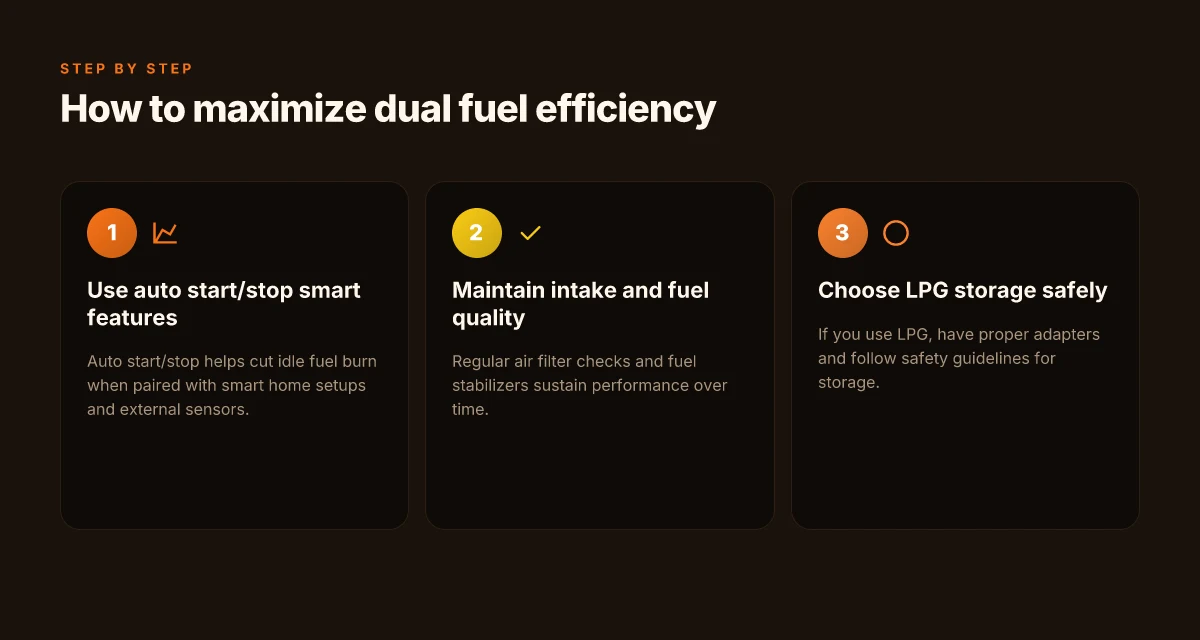
Auto start/stop is designed to cut idle burn when loads drop or when sensors indicate no demand. Tie the generator into a smart‑home hub or weather/usage sensors so the unit kicks on only when essential loads appear. In practice, a seamless workflow uses the EcoFlow app to set thresholds, then the unit self‑reports status back to your dashboard. The core idea is to avoid short, pointless runs that waste fuel and rattle the engine. Auto start/stop extended its value when paired with external sensors to reduce idle fuel burn. Integration with the EcoFlow app lets you create responsive, automated routines. This combination is what often yields a noticeable drop in average running time per week.
Regular maintenance to sustain performance
Maintenance is cheap insurance. Check the air filter on a regular schedule and replace as needed. Keep fuel clean and stable with stabilizers, especially if you store the unit for extended periods. Since dual fuel means both gasoline and LPG pathways, a clean intake helps both modes operate smoothly. I found that owners who follow a simple cadence, air filter every 50–100 hours of use, stabilize fuel before storage, and run a quick fuel system check monthly, treserve performance more consistently than those who skip routine care. Air filter checks and fuel stabilizers help sustain performance. Regular checks also catch degraded seals or hoses before a failure. What makes the Bluetti AC180P worth it in 2026
LPG use and storage safety
LPG handling hinges on correct adapters and safe storage. Use the LPG adapter designed for the EcoFlow dual fuel model and ensure all connections seal properly before running. Store LPG cylinders upright in a ventilated area away from heat sources, and never store a hot generator near full LPG cylinders. When you switch to LPG, expect a different torque and response profile, so adjust load expectations accordingly. The guidance is practical: respect the fuel system’s requirements, follow the adapter instruction set, and adhere to local fire codes. Using LPG requires proper fuel adapters and adherence to storage safety guidelines. This keeps both performance and safety aligned.
Verdict for homeowners and outdoor users: pick the model that matches your load profile, then lean on auto start/stop to minimize fuel burn, perform routine air‑path maintenance, and observe LPG safety rules. If you’re weighing models, note that the 4000‑series models lean toward higher running power and faster recharge footprints, while the 3000 family can be more frugal on smaller loads when you leverage LPG efficiently. For the bigger picture, EcoFlow remains a core option in the portable dual‑fuel space, with rivals like Practical Preppers’ offerings and other LPG‑capable units providing contrast on weight and mounting options. Maintenance and safe LPG practice are the quiet multipliers of long-term reliability.
What changes if you act now
EcoFlow dual fuel generators are positioned to outperform in 2026, especially as fuel availability and weather risks tighten. I’m seeing a clear pivot toward flexibility: the ability to switch between propane or gasoline reduces downtime and broadens usable windows during outages. That versatility is the core reason this setup feels smarter than single-fuel rivals.
The bigger pattern here is resilience built around choice, not just capacity. EcoFlow’s dual-fuel approach pairs well with automatic transfer switches and smart app monitoring, making it easier to run essential loads without babysitting the unit. For households weighing cost of ownership, the latest models tend to be more fuel-efficient and quieter than older generators, while still delivering solid peak outputs. If you’re new to this, begin with one compact unit for essential circuits and scale up as needed.
One move that matters is prioritizing a model with integrated battery support for brief outages while your generator kicks in. That feature reduces ramp time and keeps devices safe. The better you plan your weekly backup strategy, the more you’ll notice the difference during a real outage. How EcoFlow panel powers resilient homes without the hype
- Backup strategy: pick one EcoFlow dual fuel model for essential circuits, test weekly, and pair with a smart transfer switch.
- What to try this week: map your critical loads, confirm fuel availability, and set standby profiles in the app.