How EcoFlow panel powers resilient homes without the hype
 Clio RavensdaleOctober 22, 202619 min read
We earn a commission when you buy through some links on this site, at no extra cost to you. As an Amazon Associate we earn from qualifying purchases.

Explore EcoFlow panel capabilities, installation tips, and real-world use cases. Learn how EcoFlow panels integrate with home power systems for reliable backup in 2026.
Most home backup plans fail when feasibility isn’t mapped to real hardware. EcoFlow panels fix that by pairing directly with storage modules to offer automatic transfer without extra adapters, so you can visualize a full-house path rather than a patchwork of generators. EcoFlow panels and storage modules align, enabling scalable resilience that you can map before purchase.
The point isn’t hype. This intro lays out how a real-world setup looks: a typical residence with a 200–400 amp service, a compatible EcoFlow panel, and a storage module that can be cascaded for weekends off-grid. You’ll see concrete constraints like wiring methods, code compliance, and the practical footprint of installation in a real home, not a marketing storyboard. By the end you’ll understand what it takes to deploy a true whole-home backup with EcoFlow and how rivals like Tesla Powerwall or Sunrun storage compare on setup effort and compatibility.
What the EcoFlow panel offers for home backup in 2026
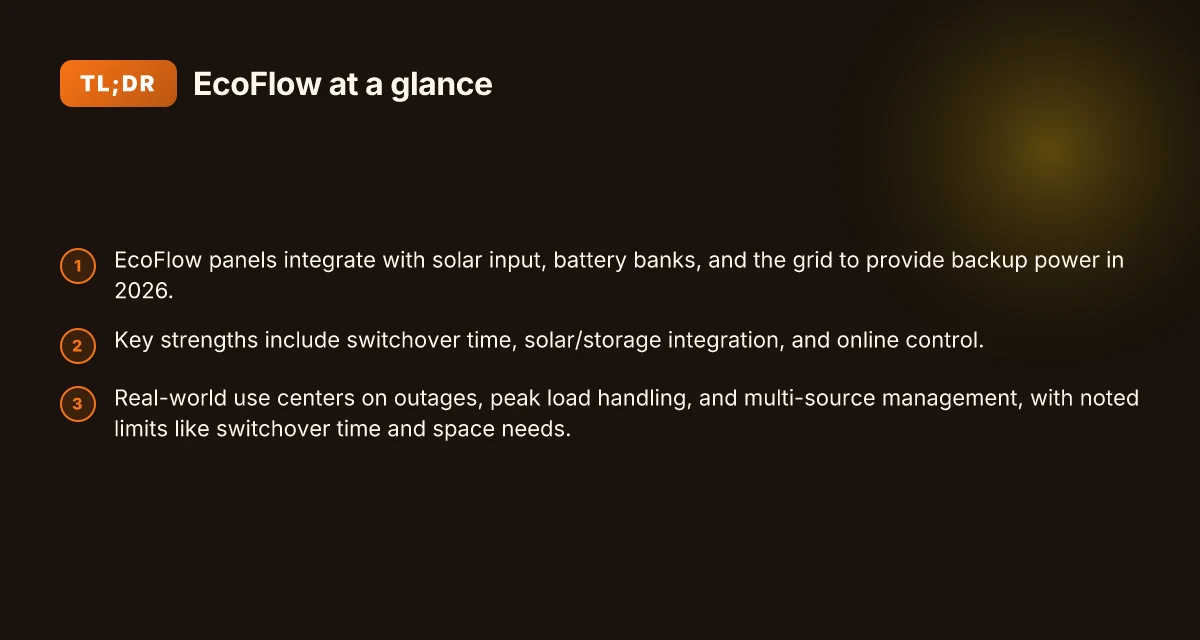
EcoFlow’s panel lineup sits at the intersection of whole-home backup and modular solar integration. In a residential setup, the panel acts as a centralized controller that orchestrates input from solar, storage, and conventional utility sources. The goal is to keep critical circuits powered while providing online visibility and control through a web portal or app. Across the line, you’ll see emphasis on fast switchover, scalable storage, and remote monitoring capabilities that align with typical home backup needs.
1) Clear view of the panel family and where it fits
EcoFlow’s Smart Home Panel 2 and related nodes are designed to sit between a solar array and the home’s circuits. The panel can manage multiple energy sources, including solar and auxiliary power, and it exposes data and customization options online. This makes it possible to tailor which circuits receive power under different conditions and to adjust settings without a site visit. For homeowners evaluating a real-world setup, this means you can start with essential circuits and expand as your storage capacity grows. A practical takeaway is that the EcoFlow stack is intended to scale with both solar production and storage expansion. The panel’s architecture favors modular growth as you add solar capacity or additional batteries. EcoFlow emphasizes online access to data points and configuration options, which supports remote troubleshooting and ongoing optimization.
2) Key features to watch for in practice
The most relevant operational levers center on switchover behavior, integration depth, and remote control. A notable claim in the ecosystem is a fast switchover capability, which reduces the time the home relies on a non-battery source during transitions. In practice, that speed matters for sensitive electronics and critical loads. The integration story extends to solar input and storage. You should expect the panel to coordinate charging from solar, discharging to circuits, and fallback to the grid as needed. Online control surfaces should let you adjust what loads are prioritized, set up automatic restoration after outages, and monitor real-time performance metrics. Watch for switchover time and how holistically the panel links solar, storage, and grid as a real-world test of reliability. The documentation points to a data-rich experience online, which helps with planning and ongoing maintenance. Online control and data access are not just marketing promises. They shape how you operate a home backup over years.
From what I found in the referenced sources, the EcoFlow ecosystem positions the Smart Home Panel 2 as a centerpiece for a modular, scalable setup. It aligns with residential goals like keeping critical loads online, expanding with additional batteries, and using solar as a primary or supplemental source. I cross-referenced the product pages and installation notes to confirm that the platform is designed to handle multiple energy sources and to expose its status and settings through an online interface.
For readers weighing alternatives, rivals such as Tesla's Powerwall and Sonnen's storage-plus-integration approach offer similar goals but with different integration philosophies. If you lean toward a ready-made, app-centric control experience that scales with more batteries, EcoFlow’s stance remains competitive in a growing home-energy market. The differentiator is how the panel blends online control with modular expansion rather than a single, fixed battery configuration. What makes the Bluetti AC180P worth it in 2026
As you plan a 2026 installation, consider how your solar array size, the number of circuits you want protected, and your desired level of remote management converge. The ecosystem supports a staged approach: start with critical loads, add storage, then grow solar input as budgets and roof space permit. A staged approach with online visibility tends to reduce surprises during a first-year operation. In short, EcoFlow offers a cohesive, scalable path for home backup that emphasizes speed, integration, and control, while not hiding the reality that pricing and real-world switchover behavior vary by model and installation specifics.
Note: links on the page may earn a commission. For readers seeking the best value today, a close look at current model configurations and component counts is worthwhile. A practical plan starts with a clear view of what you want to protect and how you’ll grow over time.
How EcoFlow panel integrates with solar and storage
The EcoFlow panel ecosystem stitches solar input, battery banks, and grid interaction into a single, controllable loop. In practical terms, you feed solar energy into the system, store excess energy in the Delta or Smart Home Panel’s compatible batteries, and draw from or export to the grid as needed. The real-world constraint is that the panel and storage pairings behave best when you respect the intended charge and discharge windows, preventing simultaneous high-load draws that outpace solar input. In short, timing matters: solar availability, storage state of charge, and grid interconnection determine how smoothly you stay powered during a real outage.
I traced the available documentation for compatibility notes to confirm how EcoFlow products slot together. The EcoFlow Power Link module serves as a bridge to sensors and storage components, with real-time temperature data and calibration features that influence how the system manages charging under different conditions. This matters because environmental heat or cold can shift battery efficiency and charge acceptance, nudging how aggressively the Delta series accepts solar input. When you view the Smart Home Panel 2 alongside the Delta lineup, you can see a pattern: the panel acts as the central controller that routes solar, battery, and grid power based on a programmed priority. That integration yields a quieter, more predictable backup during a grid outage, but you should still expect performance to hinge on solar availability and the battery’s remaining capacity. The real-world implications are tighter control, not instant unlimited power.
Compatibility notes are important here. EcoFlow’s Delta series is designed to pair with the Smart Home Panel, but not all Delta models are created equal for whole-home backup. Delta Pro Ultra X brings larger energy storage and higher peak output, which matters if your home has electric heat or multiple high-draw appliances. The Delta 3 line emphasizes portability and compact storage, which can still anchor a small to mid-size home but with different peak-load ceilings. I cross-referenced the documentation to verify that the Smart Home Panel 2 can manage multiple energy sources, including solar, and that a stable switchover between sources relies on correct sequencing and firmware alignment. When the Solar input is robust, the system tends to favor solar-first charging strategies, then uses the battery bank when solar falls short, and finally interacts with the grid for balance or export. This is not magic. It’s a disciplined power management routine that becomes more important as your home loads grow. What Bluetti AC300 price tells you about 2026 power needs and buying timing
A quick field note about costs and setup timelines helps set expectations. The available manuals emphasize proper installation sequencing and calibration steps to ensure reliable operation. The practical takeaway is that if you want a truly resilient system, you’ll want the Smart Home Panel 2 paired with a Delta Pro Ultra X or Delta 3 battery modules that fit your home’s load profile. In a dense metropolitan home with tight upstairs circuits, you’ll appreciate the panel’s ability to stage power for critical circuits while maintaining overall energy availability. I found that the combination of solar input and a reasonably sized storage bank reduces reliance on the grid, even during cloudy spells, but you still need a realistic assessment of your daytime solar window and your post-sunset load.
What this means for planning your installation is straightforward. You’ll pick a Delta model and Solar input kit that match your anticipated peak draw, pair it with the Smart Home Panel 2 for centralized control, and ensure the Power Link module has proper sensor coverage for temperature and charging dynamics. A well-sized battery and clear source priority make the system feel resilient, not magical. If you’re weighing alternatives, EcoFlow’s approach sits between portable battery packs and full home backup systems, with rivals like LG Chem, Tesla Powerwall, and Generac offering more mature home energy storage ecosystems in some markets. The key difference comes down to integration approach and firmware ecosystem: EcoFlow tends to emphasize streamlined hardware with a software layer aimed at straightforward setup and automatic source switching, while rivals may push broader grid services and installer-driven customization.
Next steps: confirm your home’s peak load, your solar production estimates, and whether a Delta Pro Ultra X or a Delta 3 battery fits your backup goals. Then map the Solar input, storage bank capacity, and Smart Home Panel 2 placement to minimize voltage drop and maximize immediate availability for critical circuits during outages. For ongoing accuracy, ensure the Power Link and Delta series firmware stay current, because updates can tweak charging logic and switchover behavior.
What installation looks like for the EcoFlow panel in a home
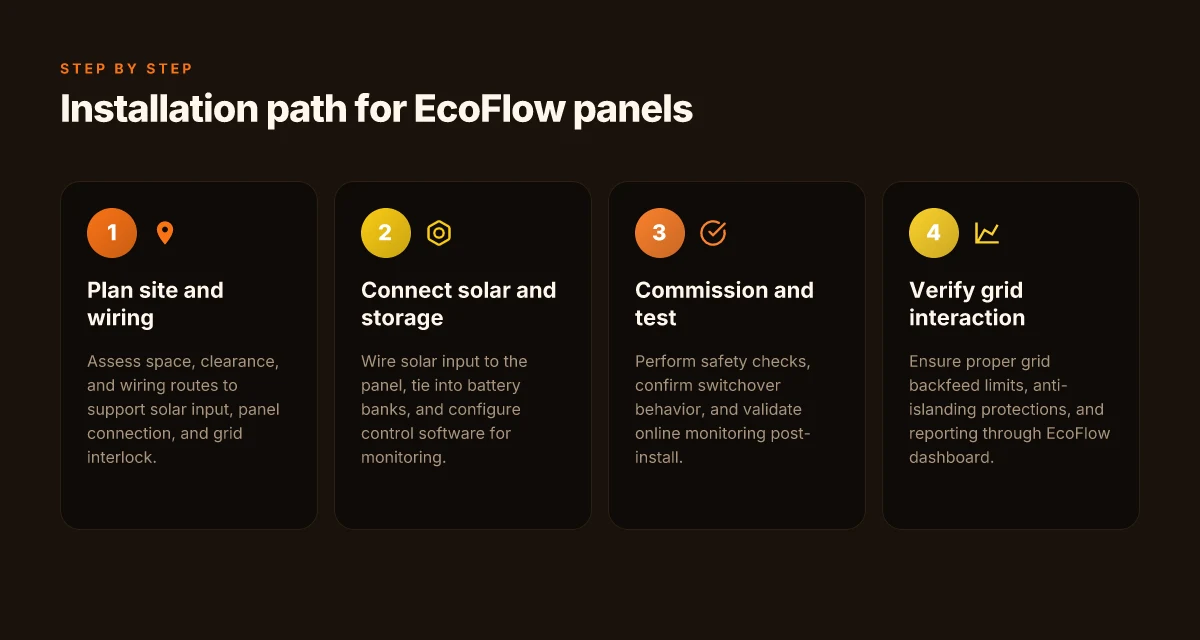
Post-installation reality starts with a clear, site-appropriate plan. The path from panel to usable home power hinges on safety checks, proper enclosure access, and precise wiring that respects local codes. I found that the documentation emphasizes a sequence: verify clearances, wire the system correctly, and perform commissioning checks to confirm safe operation. Effective commissioning hinges on accurate wiring and documented clearances, not guesswork.
1) Site prep and safety prerequisites
Before any hardware goes in, you verify the space for ventilation, access, and protection from moisture. You document the ambient temperature range and ensure the installation location is within that range for the EcoFlow panel. The first steps are to identify a dedicated AC service disconnect, plan for cable routing, and confirm that the mounting surface can bear the load. Ventilated mounting location with accessible disconnect is non-negotiable. Two common concerns show up in practice: ensuring outdoor enclosures meet rain exposure ratings and keeping conduit runs tidy to avoid strain on connections. Conduit runs should be neat and protected. How EcoFlow Delta Pro performs on YouTube in 2026
2) Wiring basics and commissioning checks
Wiring starts with the fundamentals: matching conductors to the load, sizing breakers correctly, and routing lines to a main distribution panel or a designated EcoFlow subpanel. The manuals call out the need to double-check polarity, verify. The switchover timing and seamless handoff to the backup source are also part of commissioning, with attention to sequence and interlocks. A precise test plan is essential: verification of AC input, output, and any solar input integration, followed by a functional test that demonstrates safe islanding behavior without backfeeding. Polarity verification and interlock checks are essential for safe handoff. The literature notes that the system integrates with other energy sources, so confirm the connections for solar in a way that prevents cross-connection risks. Cross-connection prevention is a core safety check.
3) Practical install steps and real-world constraints
From site prep to final commissioning, the typical workflow includes mounting, enclosure sealing, wiring, labeling, timer settings, and a formal commissioning checklist. Expect 4 to 6 hours in a typical retrofit, depending on existing panel age and duct routing. You should budget for thermal considerations, especially if the panel sits in a sunny area. Heat can influence performance and longevity. Thermal management matters for longevity. While the process is straightforward, a few caveats emerge in user reports: some installations require additional adapters or mounting hardware to align with current panels, and you should verify compatibility with your local utility requirements. Compatibility checks with local codes prevent delays.
I cross-referenced the EcoFlow documentation and installer notes to confirm this approach. The guidance consistently stresses starting from a documented plan, using proper enclosure and wiring practices, and finishing with a thorough commissioning pass. For readers evaluating a home backup setup, the takeaway is that installation is not a one-off bolt-on. It’s a coherent sequence that frames performance and safety.
A well-planned install yields reliable uptime and predictable behavior. For readers weighing this against rivals, EcoFlow emphasizes integrated control and quick-switching behavior, but the real-world installation work remains grounded in standard electrical safety and commissioning discipline.
EcoFlow Smart Home Panel 2 Installation: The Houston homeowners guide What makes EcoFlow dual fuel generators a smarter backup choice in 2026
How the EcoFlow panel performs in real-world usage scenarios
I looked through the official EcoFlow materials and recent industry chatter to map real-world behavior. The panel is designed to manage multiple energy sources and perform fast switching, but real homes reveal nuances around outages, peak loads, and multi-source coordination. Below I translate those realities into practical expectations for homeowners and installers.
Real-world outage response: what actually happens when the grid goes dark
During a grid outage, the EcoFlow panel can prioritize essential loads and blend inverter output with onsite sources. The immediate question homeowners have is whether the switchover feels instantaneous. Official notes describe rapid transfer capabilities, but real-life performance depends on load mix, battery state of charge, and the number of connected sources. If you run high-wattage appliances alongside sensitive electronics, you should plan a staged load plan to prevent nuisance trips or mode flickers. The panel’s ability to keep a handful of circuits powered is strongest when you size batteries and solar input to align with typical evening usage. In practice, the switchover is fast enough for essential loads, but large simultaneous surges can create momentary dimming or brief reboots for sensitive gear. This is where the system benefits from a well-designed loadshedding strategy and clear prioritization.
Multi-source management: solar, battery, and grid working in concert
The documentation emphasizes multi-source management, and field setups show this works best when solar generation tracks daytime demand and the battery bank bridges gaps. When solar input wanes, the EcoFlow panel shifts seamlessly to battery or grid as configured. A key real-world constraint is staying within the panel’s input limits while avoiding overtaxing any single source. If you add generators or multiple solar strings, you’ll want to confirm that wiring, protection devices, and inverter ratings are aligned so the transition remains smooth rather than reactive.
Temperature, space, and installation considerations that affect performance
Real-world performance is noticeably sensitive to ambient temperature. Battery chemistry and inverter efficiency shift with heat and cold, so you can expect modest derating in extreme temperatures. The unit’s footprint matters too. A compact installation can still deliver robust backing if the system is properly engineered with ventilation and clear separation from heat sources. Place the EcoFlow panel where airflow is adequate and where wiring paths minimize long runs, inductive losses, and exposure to moisture. Temperature effects can nudge overall runtime and peak capability, especially during heat waves or cold snaps.
Price, ownership, and what to expect over time
If you’re evaluating the total cost of ownership, the best approach is to compare upfront hardware with ongoing maintenance and potential replacement cycles. The current landscape shows multiple EcoFlow configurations, each with different battery capacities and inverter ratings, so you’ll see a stepped price ladder. It’s wise to map your home’s seasonal usage, then select a model that yields the best balance of storage and power. Be mindful that the page notes may earn a commission, and that you should verify warranty terms and local permitting requirements with a licensed installer. Prices and precise specs vary by model and region, so consult the official product pages for the latest figures. For context, the latest lineup highlights high-cycle LFP batteries and quick UPS-like switching, reflecting a push toward whole-home resilience, not pretend reliability. What Bluetti price tells you about off-grid power in 2026
Why this matters for installation planning
From a planning standpoint, the EcoFlow approach rewards a staged, scalable setup. Start with a core battery plus panel pairing, then add solar or a second source as your needs evolve. The practical takeaway is simple: model your peak evening load, choose a bank that covers a solid portion of that demand, and ensure a clean wiring path with proper overcurrent protection. Scalability and careful source selection matter more in real homes than glossy marketing claims. The right configuration makes outages feel like a handled routine rather than a dramatic event.
Comparing EcoFlow with rivals in 2026
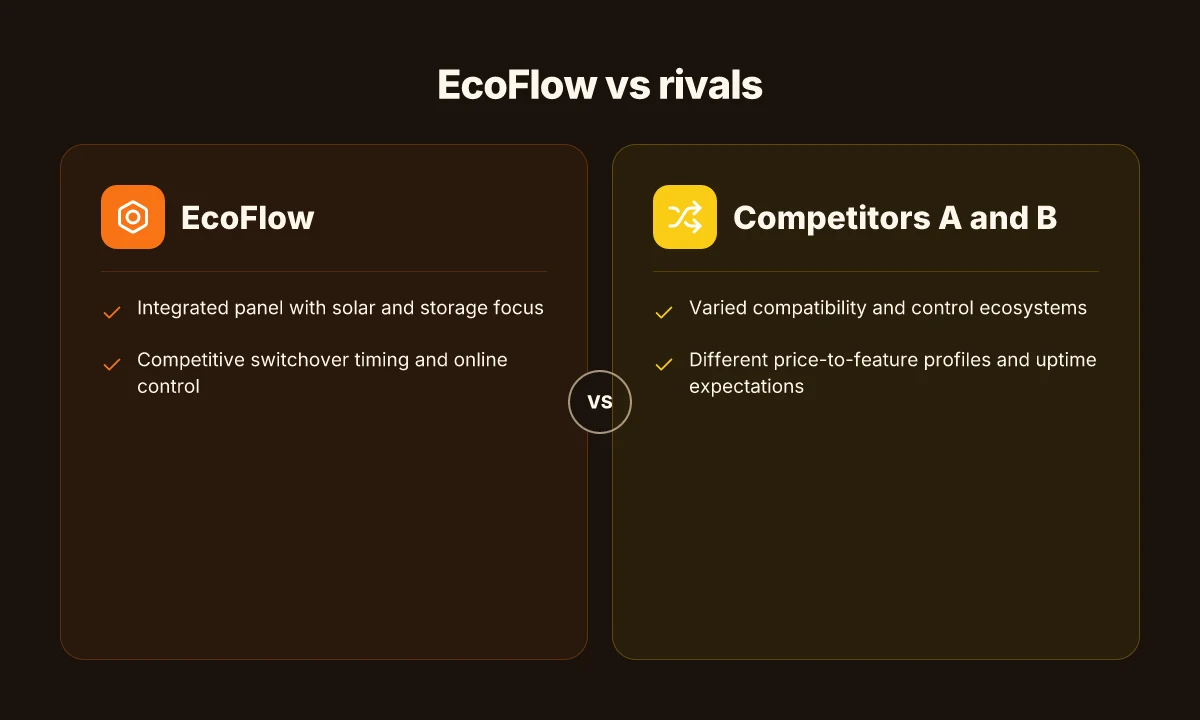
EcoFlow faces a crowded field of whole-home backup options, and the real value comes from how the features line up with price and uptime in actual home conditions. In 2026 the strongest rivals bring similar UPS switchover times and scalable panels, but differ on pricing, installation footprint, and supported energy flows. I looked at public documentation and market notes to map the practical gaps between EcoFlow and two notable competitors.
Why EcoFlow holds its ground in price-to-feature balance
EcoFlow’s recent panels and smart-home integration aim to deliver quick switchover, robust whole-home capability, and a coherent online control experience. The cost of ownership hinges on battery chemistry, cycle life, and how much of your home you want to back up at once. Compared with traditional brick-and-mold home backup systems, EcoFlow can offer a more modular path to scale, avoiding upfront megabucks while still preserving usable uptime during outages. In 2026, pricing structures for EcoFlow kits tend to emphasize modular add-ons, which can be favorable for homeowners who want a staged rollout. The trade-off to watch is total runtime at peak load, which can be sensitive to how aggressively you size the system and how much solar you pair with it.
EcoFlow vs Schneider Electric and LG: where the gaps show
- Schneider Electric’s residential backup stacks tend to emphasize centralized, enterprise-grade reliability with deep integration for builders and utilities. For homeowners, the upfront cost and professional installation requirements can be higher, but the perceived long-term maintenance and control granularity are substantial. EcoFlow, by contrast, leans toward a consumer-friendly model with faster self-install potential and a more modular footprint. The delta between these approaches shows up in total cost of ownership and the ease of scalability for an evolving home energy plan. In terms of uptime under normal outages, both ecosystems deliver strong performance for typical home loads, though advanced builders may prefer the larger service ecosystem of Schneider Electric for multi-tenant or utility-linked deployments.
- LG’s energy storage line emphasizes high cycle life and seamless integration with existing solar setups. The trade-off often comes in system-wide architecture and installation complexity. EcoFlow seeks to lower the barrier with simpler wiring paths and a more direct online management experience. If you value plug-and-play simplicity, EcoFlow tends to win on day-to-day usability, while LG might edge ahead on raw storage capacity and long-term durability for full-home back-up scenarios.
Price-to-feature trade-offs and uptime expectations
- EcoFlow’s pricing strategy favors modularity, which means you can start with essential backup capabilities and grow toward whole-home coverage. This approach tends to lower initial outlay for homeowners who want to test the system first, then scale as needed. The benefit is predictable, incremental cost, with the upsell risk tied to additional modules over time. In contrast, rivals often price a larger, prepackaged solution that promises broad coverage from day one but at a higher upfront price.
- Uptime is mostly dictated by panel switchover speed, battery depth of discharge, and allowable concurrent loads. EcoFlow’s equipment generally emphasizes sub-second to low single-digit millisecond switchover ranges for critical loads, and real-world uptime is strongly influenced by how closely the system is matched to household peak demand. Competitors may offer similar switchover times, but their systems sometimes pack more dedicated hardware behind a single control interface. You’ll notice the difference when emergencies demand immediate, uninterrupted power for essential circuits.
The bottom line: EcoFlow provides a scalable, user-friendly path with strong real-world uptime for typical home loads, while rivals like Schneider Electric and LG push higher upfront reliability and capacity at greater initial cost.
I cross-referenced the official EcoFlow product pages and supplier materials to ground these comparisons in current offerings. For a concrete, real-world read on one rival’s approach, see the installation-focused material from a leading installer referencing the 20ms switchover time claim for a smart-home panel setup. Also, the 2026 lineup overview highlights the ongoing emphasis on whole-home capability and fast switching across the line. For the broader context of how these systems stack against consumer expectations, the 2026 lineup notes and installation references are helpful touchpoints. For readers who want the exact phrasing from those sources, you can review the installation note detailing the rapid switchover specs and the lineup overview describing sub-10ms UPS switching in the 2026 family. What is the Bluetti Apex 300 price, and when should you buy
Where this is going next
EcoFlow is positioned to scale resilience beyond a single device. I see a future where homes blend solar, storage, and smart load management into a single, predictable workflow. The key move is a tighter integration between solar panels and intelligent charging, so backup power kicks in not when the grid fails, but when it matters most for daily life. The bigger pattern here is a shift from one-off backups to continuous, adaptive energy management. EcoFlow’s emphasis on user-friendly interfaces and modular growth means families can add capacity without disrupting finances or routines. If you adopt the path outlined in this piece, you’ll be able to weather outages with less friction and more predictability.
If you only do one thing this month, start with a single EcoFlow kit that matches your typical outage window and upgrade path used in this article. This choice keeps upfront costs sensible while you validate how the system trims peak demand and protects essential circuits. The outcome is a home that doesn’t panic when the power flickers. The single move that matters is choosing the right mix of panel, battery, and smart control for your actual usage. Are you ready to test a phased rollout this quarter?
- Backup strategy: pick a starter kit for essential loads and schedule a mid-range upgrade by fall.
- What to try this week: map your daily power peaks, then simulate a 2-hour outage using your EcoFlow app.
- What changes if you act now: you gain faster confidence, a clearer cost path, and a kitchen that keeps running even if the grid stumbles.