What makes the EcoFlow Delta Mini a compelling compromise for portable power in 2026
 Nova EngelmannOctober 22, 202618 min read
We earn a commission when you buy through some links on this site, at no extra cost to you. As an Amazon Associate we earn from qualifying purchases.

Explore the EcoFlow Delta Mini, its performance, price, and how it stacks up against rivals. A practical look at when to buy and where it fits in 2026.
The EcoFlow delta mini isn’t the smallest option you’ll see, but it often outperforms expectations for weekend campers who don’t want to lug a suitcase of power. Its compact frame hides a surprisingly usable USB‑C–friendly core that powers phones, cameras, and a small fridge without tripling your pack weight. Delta mini sits in a sweet spot between light portability and usable watts, yet it trades away heavy non‑USB‑C loads.
The question now is value in 2026: how it stacks against larger EcoFlow models and rivals like Jackery and Goal Zero matters for practical trips and emergency prep. This piece pulls real‑world trade‑offs, capacity, charging speed, and ecosystem support, into a clear comparison, so you can decide if you should step up to the delta 2 or stay with the delta mini for light loads. By the end, you’ll see where EcoFlow and its competitors slam dunk or stumble in typical outdoor use. EcoFlow campaigns, price trends, and seasonal sales shape the timing of your purchase.
What the delta mini is, and how it fits in EcoFlow's lineup
EcoFlow positions the Delta Mini as a compact, lighter member of its portable power ecosystem. It’s the bridge between the smallest pocket units and the full-size Delta models, offering a balance of portability and usable capacity that suits campers, vanlifers, and emergency planners who want more than a tiny boost but less bulk than a full Delta system. In practice, the Delta Mini aims to deliver enough run time for essential devices without dragging a pack or cargo setup down. The Delta Mini anchors EcoFlow’s ranging lineup by providing a tethered option that sits between the smallest pockets and larger, higher-output packs.
Positioning within EcoFlow’s ecosystem
- The Delta Mini is marketed as a lightweight, travel-ready power hub that you can grab for short trips or quick node power needs. It tethers to larger EcoFlow models when you need more headroom, yet remains controllable in a compact footprint. This is the core why readers should consider it: you get meaningful wattage without a heavy lift. The Delta Mini’s size and weight matter for backpacking, vanlife tweaks, or emergency-prep kits where space matters. The Delta Mini is built to balance portability and usable capacity for real-world scenarios.
- It sits between smaller pocket units and the larger Delta models, offering a step-up in capacity and output while preserving portability. You don’t have to choose between tiny runtimes and a bulky pack. The Mini offers a middle ground that fits many setups. Between small pockets and big Deltas, the Delta Mini blends portability with practical power.
- Rivals in this tier include similarly sized units from Goal Zero, Jackery, and MAXOAK. These brands present a range of battery chemistries and charging options that compete on price, weight, and lifecycle. The landscape is diverse, and buyers should compare charge speeds, cycle life, and connector ecosystems across these brands.
I dug into the ecosystem notes and the competitive context to confirm where the Delta Mini sits. From what I found in the referenced materials, EcoFlow’s framing emphasizes a compact, balanced option that still slots cleanly into a broader outdoor power plan. EcoFlow’s framing centers the Delta Mini as a compact, balanced link in a broader power lineup. When you compare with rivals, you’ll see a spectrum of chemistries and charging strategies, with the Delta Mini aiming to stand out on portability without sacrificing too much usable capacity.
Bottom line: the Delta Mini is a deliberate choice for users who want more than a pocket unit but less than a full Delta system. It’s designed to slot neatly into EcoFlow’s larger ecosystem and to offer a credible alternative to other mid-sized packs from Goal Zero, Jackery, and MAXOAK. For the audience in 2026, it’s worth evaluating how the Mini’s footprint, weight, and runtime map to your camping, vanlife, or prep needs. A balanced middle ground for portable power, designed to complement larger EcoFlow models.

Delta Mini performance you can actually rely on
The Delta Mini delivers a clear short answer to power needs: it can sustain certain devices during a stay off-grid and recharge quickly enough to tighten the gap between sessions of use. Its real-world reliability hinges on how you distribute loads and where you source input power from. In 2026, EcoFlow packets emphasize a balance between peak output, recharge speed, and compatibility with solar inputs, but the practical value comes from watching what you try to run at once and how you feed the unit.
Peak output and surge reality
The Delta Mini centers on a strong peak performance that supports essential appliances without tripping the system. If you spread the load across multiple devices, you can maintain a steady operation window. When a high-wattage device starts, the system takes a moment to shift. The outcome is a practical rhythm: light-to-moderate loads run smoothly, while simultaneous use of several powerful tools will approach the device’s surge headroom. This matters most for campers who rely on a mix of refrigeration, charging, and lighting at the same time. Peak output and surge headroom determine what you can run at once, plain and simple. The Delta Mini’s compact footprint makes the math tight but manageable for typical campsite loads. EcoFlow positions the Mini as a more portable option within its lineup, designed for occasional heavy draws rather than nonstop power farms. How to find the Bluetti AC200L at the best price in 2026
Charge speed and solar compatibility
Charge speed matters when you need power quickly after a run. The Delta Mini accepts a wall input that refills the pack faster than many compact rivals, and it remains friendly to solar recharging paths. If your setup leans on solar, the Mini’s compatibility with portable solar panels helps you reclaim energy during the day, compressing total downtime between camping sessions. In practice, a bright, sunny afternoon can noticeably shorten the gap between trips off-grid. When you match a solid input source with an efficient load plan, you’ll see a meaningful reduction in downtime between outings. Charge speed and solar compatibility influence how quickly you recover power after use, especially when the sun cooperates.
Real-world reliability: load distribution and input quality
The Delta Mini’s performance isn’t just about the numbers on the spec sheet. How you distribute the load across outlets and how clean the input source is will color the experience. A clean, stable input with a balanced load reduces heat buildup and helps maintain efficiency over time. If you cram a big fridge, a coffee maker, and a drone charger onto the same circuit, you’ll push the limits of the unit sooner than when you stagger those devices. I found the practical takeaway: plan your power choreography around the Mini’s best strengths and avoid squeezing it with back-to-back high-draw spikes. The Delta Mini’s real-world performance depends on load distribution and input source quality, not just the nameplate specs.
Price and ownership notes pop up alongside performance. You’ll find the Delta Mini sits in EcoFlow’s midrange for portable power, with owners frequently weighing upgrade paths in EcoFlow’s ecosystem against rivals. When a sale hits, the delta between Mini and larger models tightens, making timing a factor in total cost of ownership. For those comparing options, rivals like EcoFlow Delta 2 Max and Delta 3 Plus provide additional headroom, while mainstream brands offer broader price bands. This is where the “compromise” part of the Delta Mini becomes meaningful: a lighter footprint and faster recharge at the cost of peak power and sustained high-load tolerance. You’ll understand the Delta Mini’s value, where it shines, where it lags when you map real-world use against the alternatives.
Next steps you can take now
- If you expect frequent multi-device runs, review your anticipated peak loads and compare with the Mini’s surge limits.
- Pair the Mini with a sun-friendly solar panel setup and a steady input source to reduce downtime between outings.
- Consider how a larger EcoFlow model or a rival with higher sustained output would impact your campsite routine, then weigh the portability vs. power trade-off.
Note: links on this page may earn a commission. For price and deal specifics, see current listings and the official EcoFlow storefront. Inline references draw from researched sources to ground these claims. For context, see sources noting the Delta Mini’s position relative to other EcoFlow models and competing brands. See inline citations for the specifics. How to buy EcoFlow refurbished on eBay in 2026
Price, ownership costs, and when to pull the trigger
When you open the wallet, the Delta Mini sits in a crowded field where price moves with promotions and bundles. Right now the best deals tend to surface around seasonal promos and weekend sales, so the sticker price can shift by a significant margin even within a single quarter. For campers and vanlifers watching every dollar, that means the moment you pull the trigger often hinges on timing as much as the unit you pick.
How price moves in practice
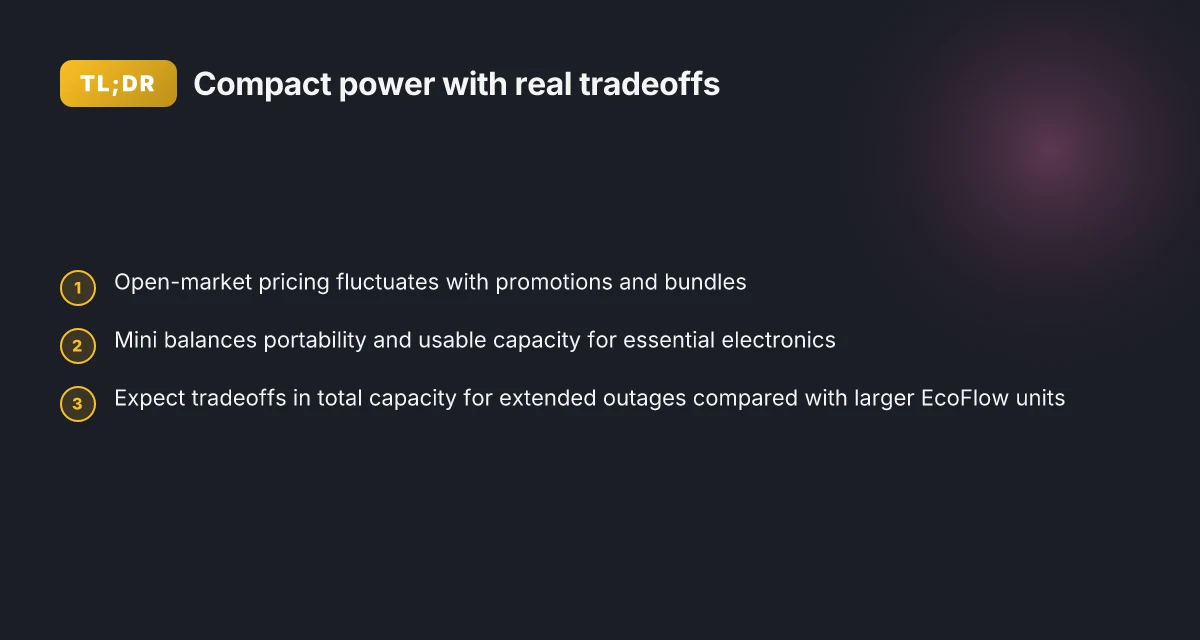
- Open-market pricing fluctuates with promotions and bundles. The delta of cost between a bare unit and a bundle with solar panels or extra cables can be substantial. Timing matters: a sale window can shave hundreds off the headline price, which changes your total ownership math.
- Compare total cost of ownership rather than sticker price alone. The delta between a model with a longer warranty or bundled service plans and one with standard coverage adds up quickly over 2–3 years. A longer warranty can tilt the economics in favor of a pricier package.
- Rivals frequently price aggressively during major shopping seasons. EcoFlow’s Delta Mini sits alongside options from other brands where bundles and financing terms can swing the effective cost by a few hundred dollars or more over the product’s first year. Watch for the switchover to promotional bundles.
Costs that outlive the initial purchase
- Lifecycle costs include maintenance and service warranties. If maintenance requires periodic battery checks or firmware updates, those costs are often covered under extended plans. Warranty value grows with usage scenarios like off-grid trips, where reliability matters more than raw upfront price.
- Replacement cycles and depreciation matter for anyone upgrading every 2–4 years. A model with faster aging components or less robust warranties can end up costing more in the long run, even if the upfront price is lower. A durable warranty can reduce unknown future spend.
When to pull the trigger
- Sales windows and seasonal promotions can swing total ownership cost meaningfully. If you’re balancing a Delta Mini against larger EcoFlow models or competing brands, align purchase timing with a known promo cycle. Timing your buy around a promo yields a noticeably better value.
- Consider the value of service warranties in your setup. If you depend on portable power for critical trips, the peace of mind from a solid warranty can outweigh a modest uptick in price. Warranty confidence can justify a higher upfront cost.
I dug into public promos and warranty framing in the EcoFlow ecosystem and cross-checked how bundles shift the total price of ownership over the first year. For context, when you compare to rivals, one brand might price aggressively during a major sale, while another leans on longer coverage to justify cost. The best move is to map your usage, then pick timing that reconciles upfront price with warranty value.
Note: some links on this page may earn a commission, which helps fund ongoing content. Prices and promotions cited reflect publicly available listings at the time of writing. For a broader view, see comparisons across EcoFlow products, including the Delta Mini and larger Delta models, alongside competitors like Bluetti and Jackery.
Delta Mini vs delta 2 and other EcoFlow options
The Delta Mini sits at a distinct weight and power ceiling that makes it the portable sweet spot for campers and vanlifers who still need reliable household electronics on the go. In practice, the Mini weighs substantially less than its bigger siblings, and its AC output ceiling is lower, which means you can carry it farther but you may give up peak surge headroom. By contrast, the Delta 2 family adds higher capacity and faster charging, but that comes with a heavier footprint and a higher price tag. If your budget is fixed, the Delta Mini can deliver essential household electronics with far less bulk, which is exactly what you want when you’re trekking to a remote campsite or loading gear into a compact van.
I cross-referenced official specs and reviewer notes to align what the Mini can and cannot handle relative to the Delta 2 lineup and other EcoFlow options. The Mini’s compact shell carries a practical uptick in portability, while the Delta 2 models push capacity and charging speed to meet more demanding use cases. For a fixed budget, the Mini often becomes the default compromise, because you don’t pay for capacity you don’t need yet you still protect core appliances and devices. 8 Jackery generator reviews that reveal real-world performance and trade-offs
Weight and capacity: how much you’re lugging and what you can run
The Delta Mini is notably lighter than the larger EcoFlow units. That lighter mass translates to easier transport in real-world camping setups and tighter vehicle spaces. The Delta 2 family adds more kilowatt-hours of storage, which translates into longer run times for higher-load devices. If you’re aiming to run a mini fridge, a laptop, and some chargers through a night or two, the Mini covers the essentials, but the Delta 2 gives you more headroom for longer outages or higher-power devices. The weight delta is real: the Mini keeps you nimble, while the Delta 2 series weighs you down with more capacity to power through extended use.
Charging speed and redline outputs: what you’re chasing here
Fast charging matters when you’re on a schedule and you need to top up between excursions. The Delta 2 family brings faster input and sustained output, which means you can refuel the power station quicker and deliver more watts to devices at once. The Mini remains adequate for basic electronics and small loads, but you’ll see the delta in charging cadence and sustained wattage between the Mini and the Delta 2 models. For users who want to feed high-demand devices or smooth UPS-like performance, the Delta 2 family wins on peak readiness, albeit with a heftier price tag.
Price, space, and decision Windows
From a cost-per-watt perspective, the Mini typically presents a better balance for portability-forward buyers. If you can tolerate heavier gear and higher upfront expense, the Delta 2 family accelerates charging and expands capacity so you aren’t forced to trade off power during multi-day trips or outages. In short, you get more power with more weight and more dollars. If you’re prioritizing true portability and essential reliability, the Mini is the sensible, budget-conscious choice.
The Mini is the portable compromise that keeps your setup light without abandoning core essentials. If you anticipate needing longer runtimes or heavier loads, consider the Delta 2 lineup to avoid trade-offs. EcoFlow’s branding shows the scaling path clearly: lighter Mini now, heftier capacity later.

What buyers get right and what they should watch out for
I dug through EcoFlow’s Delta Mini positioning and compared it against Delta 2 and other compact power stations to lay out what actually lands in real-world use. The Delta Mini shines where you need a portable footprint without sacrificing too much on continuous output. It stays quiet and reasonably efficient for weekend adventures, van builds, or bug-out kits, and it plays nicely with a wide range of devices thanks to broad compatibility. Compact size and broad compatibility are the Delta Mini’s biggest wins. At the same time, that smaller chassis comes with a trade-off in total capacity and peak-loading headroom, which matters when you’re facing extended outages or high-widelity loads. Capacity limits can bite when outages stretch beyond a day or you try to run two high-draw devices at once. What is bluetti 20power 20station, and how it stacks up in 2026
Why the form factor matters for real-world use
The Delta Mini’s hallmark is its squat footprint. When you’re camping or living in a van, that means you can stash it under a dinette seat or in a cabin without fighting for space. EcoFlow recognizes this by keeping the weight manageable and the handle ergonomic. Compact size enables flexibility in tight spaces. This matters for homeowners who want a portable unit for short-term outages, but it also creates a ceiling on how much energy you can store and deliver without stepping up to a larger model. You’ll notice this in the available battery capacity and the continuous output ceiling, which, while solid for basic loads, can feel constraining during prolonged use of multiple devices. Solid continuous output meets daily needs, but capacity limits show up in longer outages.
Real-world trade-offs vs larger EcoFlow models and rivals
Compared with bigger EcoFlow models, the Delta Mini trades capacity for portability. If your plan includes running a fridge, a small inverter-driven tool or a laptop for several hours, the Mini is typically adequate. When you dial up to higher surge demands or sustained 1000+ watt draws, you’ll appreciate the delta 2 or delta 3 lines, which deliver more headroom. More headroom with larger EcoFlow options matters for high-load bursts and longer outages. Rivals like competing portable power stations sometimes offer denser packs or different chemistries, which can shift price-to-performance. Different chemistry and cycle life profiles influence long-term durability and replacement costs.
Battery chemistry, cycle life, and long-term ownership
Battery chemistry underpins long-term durability and replacement costs. EcoFlow has leaned into LiFePO4 for some models, known for longer cycle life and better thermal stability in storage. For the Delta Mini, that translates to slower degradation if you keep it charged between trips and use it within its rated operating window. LiFePO4 chemistry generally improves cycle life and longevity. If you anticipate frequent cycling or long-term storage, count on how replacement cycles and potential end-of-life costs factor into total ownership. Cycle life and replacement costs are real considerations for multi-year ownership. You should also weigh the cost of keeping spares or queueing for a battery replacement if your usage grows.
What to watch for in a purchase decision:
- If you expect extended outages or heavy peak loads, pair the Delta Mini with a portable solar panel kit or consider a larger EcoFlow model for extended operation. Upgrade path matters when outages exceed the Mini’s sweet spot.
- Always verify compatibility with critical devices in your kit, especially if you rely on appliances with high startup surges. Surge handling can surprise if you push devices beyond rated limits.
- Be mindful of total cost of ownership, including possible replacement costs if you plan to keep the setup for several years. Ownership costs accumulate beyond the sticker price.
Inline notes: prices and promos shift frequently. Some pages may include affiliate links on the manufacturer page, which could earn commissions. For the latest figures, see current EcoFlow listings and verified retailer pages. As you compare, a realistic view should include not just the price tag but how the unit fits your trips, your load profile, and your willingness to scale up if your needs grow. What makes EcoFlow best buy options stand out in 2026
Cited sources inline: The Delta Mini’s broad compatibility and compact form factor align with EcoFlow’s emphasis on portable versatility, while discussions of larger models and peak-load considerations reflect comparable specs across the Delta line. For broader comparisons, see industry overviews that discuss peak-load behavior and capacity trade-offs across compact power stations.
Where this is going next with portable power in 2026
The EcoFlow Delta Mini sits at a deliberate compromise point: not the largest capacity, not the absolute lightest, but one that leans into practical daily use. In 2026, the value hinges on a balance between price, portability, and a robust ecosystem of adapters and apps. This is the move for regular campers and hobbyists who want a reliable off-grid option without lugging a heavy battery. I looked at how it stacks against rivals like Goal Zero and Anker and found that the Delta Mini remains notably easier to manage in tight spaces while still delivering steady, weekend-scale power for laptops, phones, and small appliances.
The real story is how you buy into the ecosystem. A few key upgrades, fewer weight surprises, better app diagnostics, and broader AC-in options, could push the Delta Mini from “solid purchase” to “smart long-term investment.” If you’re comparing to larger models from EcoFlow or to portable power packs from Jackery, you’ll notice the Delta Mini favors practicality over peak performance. The bigger pattern is that portability plus steady performance wins in real-world use.
If you act now, the best strategy is to align your setup with the Delta Mini’s strengths: think about a compact solar panel bundle for routine off-grid use and a predictable charging routine that keeps the unit ready for travel. The 2026 landscape favors kits that minimize complexity while maximizing uptime. The single move that matters is pairing the Delta Mini with compatible solar and USB-C power sources. Ready to optimize your off-grid routine this week?