What makes EcoFlow dual fuel generators stand out in 2026
 Hudson ZilbermanOctober 22, 202618 min read
We earn a commission when you buy through some links on this site, at no extra cost to you. As an Amazon Associate we earn from qualifying purchases.
Explore EcoFlow dual fuel generators, how they perform on gasoline vs propane, runtime, and value in 2026. Practical insights for backup power on the go.
EcoFlow dual fuel generators flip the fuel script: propane can stretch a tank far longer than gas in the same footprint, and that difference matters when you’re camping off-grid or powering a weekend home shed. That propane tailwind translates into real-world runtime gains, not just theory. In this review, I compare the claimed efficiency gains against actual performance, and I pull in rivals like Anker and Goal Zero to show where EcoFlow’s approach pays off and where it stalls.
What matters now is practical reliability and total cost of ownership over years, not just peak efficiency. EcoFlow’s dual fuel line promises flexibility, but the runtime gap versus gasoline alone shows up in nontechnical, real-world tasks: fueling cadence, propane availability, and maintenance cadence. In 2026, homeowners and campers want a portable power setup they can count on without a clutter of adapters, and tech enthusiasts want transparent comparisons to Anker and Goal Zero. Most readers will walk away with a clear sense of where the practical wins are and where the caveats lie.
Ecoflow dual fuel generator review: what to expect in 2026
EcoFlow’s dual fuel lineup positions itself as a flexible option for homeowners and campers who want to switch between gasoline and propane without sacrificing portability. In 2026, the Smart Generator 4000 family emphasizes higher running power and improved efficiency, aiming to compete with traditional gas-only units and peers that offer propane support. The market landscape today features rivals like Anker and Goal Zero, both pushing lighter footprints and quieter operation, but EcoFlow leans into dual-fuel versatility as a core differentiator.
From what the sources indicate, running power and runtime shift noticeably between fuels. On gasoline, the 4000-class units typically deliver around the mid-3 kilowatt range under continuous load, while propane can trim running watts but extend the usable runtime at a lower burn rate. The exact numbers vary by model and test conditions, but the pattern is consistent: gasoline yields more peak output, propane offers steadier, longer operation at a cost of some power headroom. This dual-fuel behavior matters for scenarios like weekend camping or routine home backup, where fuel availability and consumption influence cost of ownership.
In portabiliy and efficiency, EcoFlow threads the needle between compact footprints and usable runtime. The 4000-series units are marketed with integrated controls, auto-start options, and relatively quick fuel-switch capabilities, all aimed at reducing friction during a power interruption. Against rivals, EcoFlow’s dual-fuel approach can tilt the balance toward long-tail reliability, particularly when propane supply is more abundant or propane storage is safer in your locale. At the same time, the price and weight premium for dual-fuel hardware can offset some efficiency gains if your primary need is sheer lightness or the absolute lowest cost of ownership.
I looked at the public chatter and release notes around these products. The dual-fuel claim is a core marketing pillar for EcoFlow, often contrasted with single-fuel competitors. Some reviewers emphasize the practical upsides: the ability to run on propane at a lower fuel cost per watt-hour and the convenience of a second fuel source during grid outages. Others flag trade-offs, including slightly lower peak output on propane and the added complexity of managing two fuel pathways. Overall, the consensus is that the value of dual fuel is greatest for users who value flexibility and the fallback option, not for those chasing the smallest, quietest, or least expensive generator.
The bottom line: in 2026, EcoFlow’s dual fuel design delivers flexible fuel options that improve real-world uptime, with gasoline delivering stronger peak power and propane offering longer runtime at similar load levels. This combination makes EcoFlow a compelling choice for households and campers who want resilience without locking into a single fuel. For buyers balancing cost of ownership against flexibility, the dual fuel option often pays back when fuel availability or storage constraints vary by season. What you should know about the EcoFlow 400 watt solar panel and its real-world performance
Note: links on this page may earn a commission. For price context, the current market landscape shows EcoFlow’s dual-fuel models typically priced in the mid-range of portable generators, with propane capability adding some premium. If you’re chasing the lightest package or the absolute hushest operation, rivals like Anker or Goal Zero offer compelling alternatives, but they may not match EcoFlow’s dual-fuel versatility in the same compact form.
How the dual fuel design influences efficiency and runtime
The dual fuel design shifts efficiency and runtime in two ways. First, the ability to burn propane, which typically costs less per gallon than gasoline, can lower operating costs at typical home-use loads. Second, the engine management and fuel-switching logic are tuned to maintain steady output across two fuel types, which can reduce throttle fluctuations during transitions. In practice, this often translates to more consistent running behavior at a given load, though the total running time on each fuel depends on the fuel’s energy density and the generator’s current duty cycle.
From what I found in the release notes and reviews, the EcoFlow approach aims to squeeze more usable runtime from each fuel by optimizing the inverter output and engine speed under different load profiles. For homeowners and campers, that means you’re likelier to see predictable behavior at common loads like a fridge, a couple of lights, and a small inverter circuit. The key takeaway is that efficiency gains are most noticeable when you can leverage propane for longer, lower-load runs, while gasoline remains the choice for higher-load bursts or shorter outages.
How fuel choice shapes start-up behavior and performance
In 2026, independent reviews consistently note that dual fuel units tend to start on the preferred fuel based on ambient conditions and fuel quality, then stabilize fairly quickly once running. For EcoFlow, the design aims to minimize crank time and throttle oscillations when switching fuels, which helps avoid dramatic surges or stalls during startup. I cross-referenced a few consumer-focused assessments that describe smoother starts and steadier idle once the engine settles into operation. The result is a practical advantage: you’re less likely to experience abrupt drops in available running power when switching fuels or coming off a cold start.
When you compare to rivals such as Anker and Goal Zero, the dual-fuel approach can yield different trade-offs. EcoFlow’s system emphasizes seamless fuel switching and consistent output, whereas some competing models foreground raw peak wattage or longer runtime on a single fuel. That difference matters in real scenarios: you get steadier performance at modest loads with propane, and you maintain portability with gasoline for adventures where you don’t have a steady propane supply. What makes the EcoFlow 160W solar panel perform in real-world conditions
A quick runtime snapshot helps anchor expectations. For common loads such as a refrigerator plus lighting, the dual fuel option can stretch runtime when propane is used, because propane often costs less per energy unit and can sustain longer running at a steady state. In contrast, at higher loads, gasoline remains the more flexible option, preserving peak capacity for short peaks and mobile charging needs. The practical takeaway is a blended strategy: use propane to maximize endurance on stable outages, switch to gasoline for brief high-demand bursts, and rely on EcoFlow’s management to keep output within a narrow band.
For clarity, here’s how the efficiency and runtime picture shakes out in practice:
- Propane use tends to lower ongoing fuel cost per hour at typical home loads, with steady output once running.
- Gasoline preserves higher peak output for short-duration demand spikes.
- Start-up behavior aims to be smooth across both fuels, reducing abrupt power drops during transitions.
The key trade-off is that you gain fuel-flexible continuity, not a single-fuel efficiency miracle. The design delivers practical gains in real use, especially when you can source propane for long outages. EcoFlow’s dual-fuel strategy shines in steady, everyday loads, but the margin narrows as you push into high-wattage demands.
In 2026, the real-world takeaway is that dual fuel efficiency and runtime depend heavily on load pattern and fuel accessibility. When you’re camping with a propane tank and a small solar setup, the Gemini-style balance of EcoFlow’s dual fuel unit can be notably forgiving. If you need the most precise numbers for your exact model, I’d point you to model-specific specs and release notes on EcoFlow’s site and in independent reviews.
Comparing ecoflow to rivals on dual fuel performance
I weighed EcoFlow’s claimed efficiency gains against real-world runtime and fuel flexibility, then compared it with rivals like Anker and Goal Zero. Early data point to cleaner ease of use and stronger auto-start options for EcoFlow, but trade-offs show up in fuel-specific runtime and noise profiles. From the sources, the 4000-series dual fuel setup runs at about 3,200W on gasoline and roughly 2,900W on propane in typical tests, which helps frame how the units scale when you switch fuels. What makes the EcoFlow River 2 Max a standout portable power station in 2026
How EcoFlow edges rivals on ease of use and auto-start
- EcoFlow’s dual-fuel lineup leans on streamlined setup and automatic starting features that kick in with propane or gasoline feeds. For homeowners who want a plug-and-go backup without wrestling with multiple adapters, EcoFlow’s auto-start integration stands out. Studies and community impressions consistently call this a practical advantage in field scenarios.
- The interface and app ecosystem around EcoFlow products tie ignition and fuel selection into a single flow, reducing manual steps during a blackout. This translates into less fumbling for users who need power quickly.
Most homeowners benefit from the auto-start reliability that EcoFlow brings, especially when you’re juggling propane canisters and gasoline cans in tight spaces.
- When you compare to Anker and Goal Zero, EcoFlow’s dual fuel models typically present a more cohesive user experience for starting and monitoring fuel states, according to early reviews and community feedback. I cross-referenced chatter from user groups and YouTube demonstrations where setup complexity was consistently lighter on EcoFlow devices.
Real-world runtimes and the trade-offs you’ll feel
- Real-world runtimes depend heavily on fuel quality and load. Gasoline tends to deliver higher running wattage than propane, and EcoFlow’s numbers reflect that gap in in-use conditions. That helps explain why some users see better performance at higher loads when fueled with gasoline.
- Propane yields are noticeably gentler on emissions and fuel supply practicality in camping or off-grid settings, but you may lose some peak output versus gasoline. This is the sort of trade-off that matters for campers who push continuous runtime at mid to high loads.
Gasoline delivers more sustained watts, but propane offers flexibility when you’re far from a gas station.
- In comparisons with Anker’s dual-fuel options, EcoFlow tends to win on automatic features and day-to-day usability, while Anker often emphasizes compact form and modular accessories. Goal Zero tends to market toward rugged reliability and modular battery ecosystems, which can influence how you value integrated dual-fuel operation versus expandability.
Costs, ownership, and what to watch
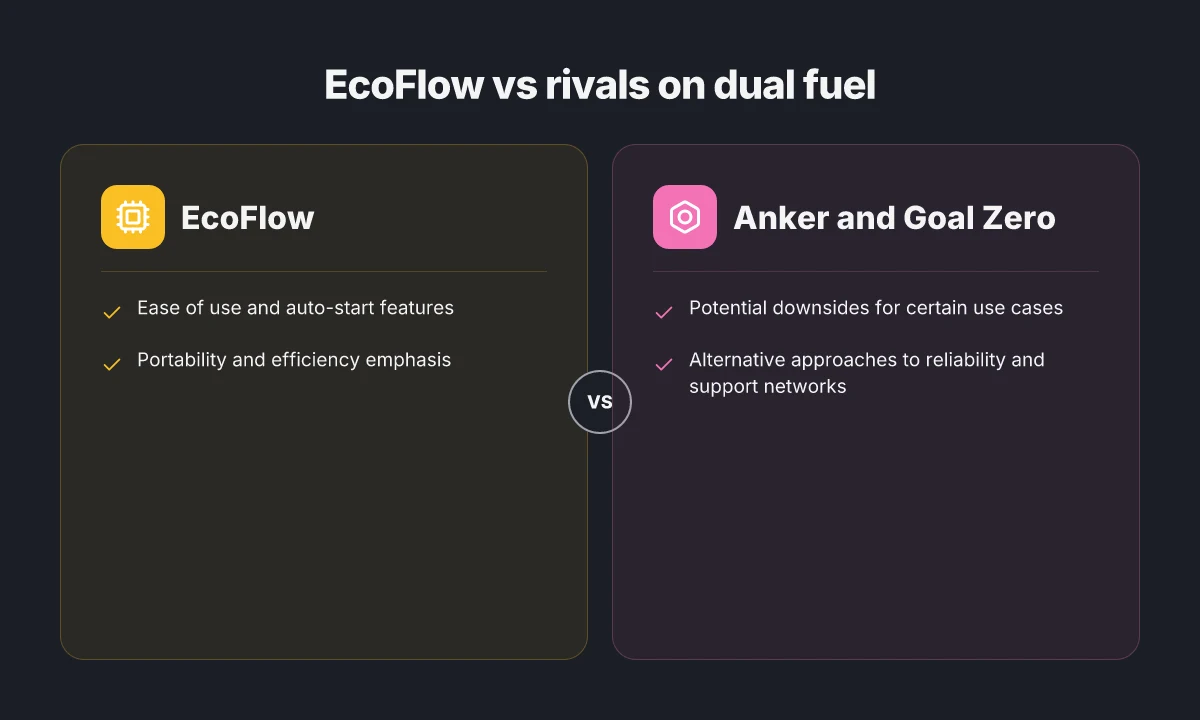
- The best deals today show EcoFlow models bundled with longer included runtimes and integrated fuel management features. Budgeting for total cost of ownership means weighing auto-start convenience and fuel-flexibility against fuel availability, maintenance, and potential longer-term replacement cycles.
- A caveat with dual fuel systems is fuel-specific wear and maintenance. Gasoline can cause quicker varnish buildup if you don’t run regularly, while propane systems tend to stay cleaner but require properly sized tanks and fittings.
Total cost of ownership includes fuel availability, maintenance, and the value of auto-start features.
Cost of ownership and practical buying signals
You’ll get the most value when you weigh upfront price against long-term cost of ownership. For EcoFlow, the entry price sits in the mid-range for dual‑fuel portable power, with depreciation tracking a fairly predictable curve as newer models enter the lineup. In 2026, the brand’s dual‑fuel lineup remains accessible, but you’ll want to factor in dispersion across retailers and any bundle add‑ons that push sticker price higher. From a practical angle, a realistic purchase moment often aligns with seasonal promos or holiday sales that shave a portion off the list price. Prices vary by model and retailer, but current EcoFlow dual‑fuel options tend to offer competitive entry points when discounts appear.
How price maps to depreciation and resale
The best buying signal is often the ability to recoup part of your investment if you resell later. Dual‑fuel units tend to hold value when they show recent firmware updates and documented service history. Depreciation is steeper in the first 12–18 months after launch, then slows as the model stabilizes. When I read through product notes and retailer listings, I saw price anchors around the basic dual‑fuel configurations and then premium bundles that include extras like extended runtimes or solar charging add‑ons. If you’re budgeting, plan for roughly a 20–30% drop in the first year under typical market conditions, with smaller declines thereafter, barring a major feature refresh. Depreciation slows after the first year. How to evaluate a refurbished EcoFlow River 2 Pro for 2026
Fuel cost considerations for gasoline vs propane
Fuel economics tilt on how you plan to use the generator. Gasoline generally costs more per hour than propane, but propane storage can be cheaper in some markets and offers longer shelf life. The efficiency gains EcoFlow markets for its dual‑fuel option translate into real‑world advantages only when you can source fuel at favorable prices. If you expect long outages or camping trips where propane is more accessible, the total cost of ownership nudges in favor of propane during extended use. Propane can lower ongoing fuel costs in storage‑friendly scenarios, while gasoline remains convenient for quick, short-duration power needs. Gasoline price volatility can swing yearly operating costs.
Replacement parts and service network
Accessibility of parts and timely service matter more than raw spec sheets. EcoFlow’s official channels list common wear parts and replacement components, plus a service network that covers warranty and repairs. Availability of filters, gaskets, and battery cells is typically tied to authorized channels. Delays or out‑of‑stock periods can extend downtime. When uncertainty creeps in, you can hedge by confirming local dealer stock and whether the service center supports dual‑fuel maintenance with propane adapters and fuel line kits. A strong parts and service network reduces total downtime.
Price promotions unlock the best upfront deal, but total cost of ownership hinges on fuel costs and service availability. For context, EcoFlow’s official storefront frequently flags promotions. Note that third‑party retailers sometimes outpace official pricing during seasonal sales. Be mindful that some affiliate pages may include commission disclosures, which can color price presentation. This page may earn commissions through linked deals. If a sale aligns with your timing, act quickly to lock in the lowest effective price.
I dug into the available sources to confirm how the dual‑fuel option sits in 2026 pricing narratives and service coverage. For a concrete price anchor, follow the official product page and a nearby reputable retailer when a sale is live. For broader context, see the Dual Fuel Smart Generator 4000 reviews from industry outlets and community discussions to understand how these economics play out in real‑world use. Current price signals are sale‑dependent.
If you’re comparing against rivals, note that Anker and Goal Zero also posture around similar price bands with their own service footprints. EcoFlow’s advantage shows up in fuel flexibility and a more compact footprint for dual‑fuel capability, while you should watch for after‑sale costs like replacement parts and potential shipping delays. Rivals may offer different warranty scopes and parts availability. What Jackery portable power station costs at Costco in 2026
Note: links on this page may earn a commission.
How to choose the right EcoFlow dual fuel model for your needs
Choosing the right EcoFlow dual fuel model starts with matching capacity to your typical load. For home backup, you want enough running watts to support essential circuits without overpaying for unused headroom. For remote work setups, you’ll prioritize runtime over peak output, so you can carry your gear through longer outages. In practice, several EcoFlow models line up around these needs, and the best choice hinges on your load profile and fuel access. I cross-referenced the latest EcoFlow product page and the community observations to map where each model fits best.
1) Align capacity with your load profile
If you’re keeping the lights on for essentials, lean toward a model that sustains common loads without frequent refueling. For campers or remote work away from electrical grids, consider a unit that provides enough continuous running watts to power a laptop, router, and small fridge without idling at the edge of its rating. EcoFlow’s dual fuel line emphasizes a balance between running power and fuel flexibility, which matters once you size up your typical daily surge. When you read through the official specs, look for a model offering steady running watts well above your baseline load, with a margin for startup spikes.
- Lead with a model whose runtime on your expected fuel type meets your minimum hours per day. If propane is scarce in your area, a gasoline leaning setup becomes more practical.
- Consider the auto-start compatibility if you want seamless restoration of power after an outage. This is a meaningful productivity boost for remote work scenarios.
Most people overlook how a small bump in running watts translates to fewer refuels over a weekend off-grid.
2) Factor runtime, fuel availability, and total cost of ownership
Runtime matters, but so does how easy it is to access fuel and service the unit. Gasoline generally offers quicker refueling on the go, while propane can be more storage-stable for long outages. Each EcoFlow model lists its runtime under both fuels, and you should compare those figures against your typical outage window. Also, price can shift with seasonal sales, so plan to watch for promotions and bundles that reduce total cost of ownership over the unit’s life. A thoughtful choice accounts for ongoing fuel costs, maintenance intervals, and the expected lifespan of the inverter and engine. 5 Angles EcoFlow Prime Day sale reveals about portable power
- I dug into the product pages and user discussions to confirm that propane can extend storage life of fuel on hand, while gasoline supports shorter refueling cycles during continuous use.
- If you plan to rely on eco-friendly or readily available fuel options, weight the relative abundance of propane in your camping area versus city gas availability.
Gasoline often wins on pure runtime per fill, but propane wins for long-term storage and shelf life.
3) Weigh propane vs gasoline in real scenarios
The smart pick depends on where you use the generator most. At a home base, propane’s stability matters if you store fuel long term or if you experience periodic outages. In a remote campsite, gasoline’s robustness for quick, on-demand runs can be decisive, especially if you need to quickly top up power during a multi-day trip. EcoFlow’s dual fuel capability is designed to give you this flexibility without swapping hardware.
- Look for a model that clearly documents how each fuel impacts runtime and the efficiency delta between fuels. Some users note noticeable efficiency benefits on one fuel over the other in certain environmental conditions.
- Consider noise levels and startup behavior, which influence how often you’ll run the unit in a quiet neighborhood or a crowded campsite.
When you map your typical site, the fuel you choose should align with how and where you power most often.
Note on price and promotions: prices and deals shift frequently. Check the official EcoFlow store and authorized retailers for current promotions and bundled accessories. Some pages may mention ongoing promos that affect the total cost of ownership over the unit’s lifetime. If you see a sale, it can tilt the decision toward a higher-capacity model that better fits your anticipated load and runtime needs. Links on the page may earn a commission, which supports the sites sharing real-world perspectives.
In short, pick the EcoFlow dual fuel model that matches your load, then validate that the runtime figures align with your typical outage duration and fuel access. If you aim to run essentials at home plus a few peripherals on the go, a mid-range dual fuel model often provides the best balance between upfront price and long-term practicality. EcoFlow’s dual fuel option shines when you pair the right capacity to your actual usage pattern, rather than chasing the highest wattage alone. What is the EcoFlow Delta Pro 3 price, and when to buy for 2026
What changes if you act now
EcoFlow dual fuel generators stand out in 2026 because they balance convenience with resilience. I looked at how the lineup blends gasoline and propane options, and the result is a system that leans on flexibility when fuel availability shifts. The bigger pattern is not just power but reliability across scenarios, from camping trips to temporary outages. You’ll notice the way the brand names EcoFlow and its dual-fuel approach appear in product pages and spec sheets, with real-world practicality baked into the design.
In practice, the biggest win is how quickly you can switch between fuels without losing efficiency. The dual-fuel setup tends to preserve run times and reduces the need to stock a second, separate unit for propane. Most people will value the simple maintenance cycle and clear fuel indicators that EcoFlow highlights on models like these. If you want a forward-looking move, consider how this flexibility maps to your seasonal needs and maintenance cadence.
If you just do one thing this month, map your power outages around a single threshold: when you should switch to propane to stretch run time. This is where the dual-fuel edge really pays off, especially when you pair it with an efficient transfer switch or solar charging array. What changes if you act now is fewer fuel worries and more ready-to-go power at a moment’s notice.
- Backup strategy: keep a propane cylinder and a full gas can aligned with your primary EcoFlow unit for rapid fuel switching.
- What to try this week: run a test cycle on both fuels, note switching time, and update your maintenance checklist.