How to evaluate a refurbished EcoFlow River 2 Pro for 2026
 Nova EngelmannOctober 22, 202618 min read
We earn a commission when you buy through some links on this site, at no extra cost to you. As an Amazon Associate we earn from qualifying purchases.
Learn how to assess a refurbished EcoFlow River 2 Pro, what to expect on performance, warranty, and value. Practical buying tips for 2026.
Refurbished units often arrive with a hidden variance: the river 2 pro can be a fraction slower in peak output than a fresh model, yet the price tag can look close enough to lure you in. That gap matters when you’re camping in a van or off-grid, because a small drift in real-world runtime or inverter stability translates to blown plans in the middle of a trip. Few buyers realize the upgrade gap between refurbished and new is real, not cosmetic, and it shows up in battery health tests.
This intro zeroes in on what to verify before you buy, from battery health to warranty terms, and why the difference between a verified refurb and a hasty purchase matters for long-haul reliability. You’ll see how EcoFlow and practical third-party checks line up with your needs, whether you’re chasing weekend boondocks power or a dependable emergency kit. The goal is a safe deal that preserves performance across seasons rather than a bargain that hides a looming failure. Rough odds favor a confirmed health check + documented inverter test over a glossy listing.
Ecoflow River 2 Pro refurbished: what you’re buying and why it matters
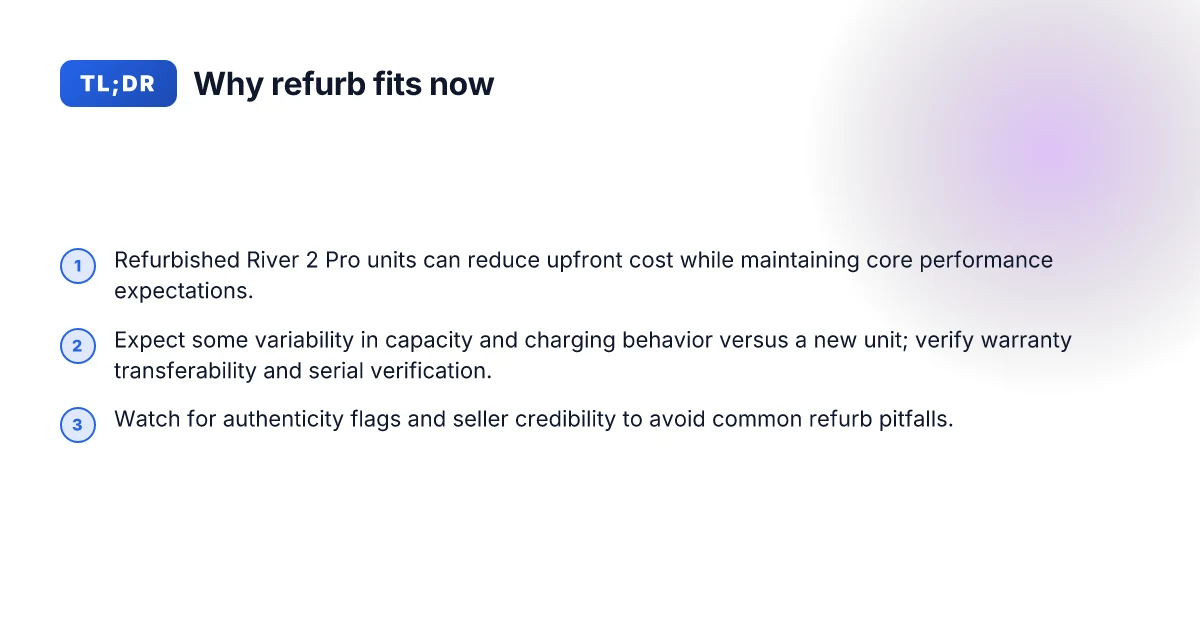
Refurbished River 2 Pro units come from three paths: EcoFlow’s own refurb program, retailer returns repaired and re-certified, or trade-ins re-listed with limited warranties. In practice, the core differences are the warranty horizon, the confidence in tested capacity, and the assessed condition of the battery health. You’re not just trading price for risk. You’re trading peace of mind for a lower upfront cost.
- Define what refurb means for EcoFlow products
- Refurbished units are typically reconditioned to meet a defined spec, with components checked or replaced as needed. The aim is to return the device to a near-new state while extracting the remaining value. In many cases, you’ll see hardware checks, firmware updates, and charge/discharge cycles verified before release.
- For EcoFlow specifically, look for language around factory resets, battery health verification, and a refreshed warranty window. The exact criteria can vary by seller, but the intent is to remove or repair defects that would otherwise deter a buyer of a used model.
- What to confirm: battery health status, a clear warranty length, and whether original accessories are included. Also verify the unit was not part of a recall or a safety hold.
- Refurbished vs new: risk and value, step by step
- Price delta vs new: refurbished River 2 Pro models typically carry a lower upfront price, which can improve total cost of ownership when the unit performs reliably.
- Warranty and support: new units usually come with the full manufacturer warranty. Refurbished units often carry pro-rated or shortened coverage. Verify exact terms with the seller and EcoFlow’s published policy.
- Battery longevity and performance: a refurbished unit should deliver comparable peak outputs, but you should confirm remaining battery cycles and any refurbishment notes about cell replacement.
- Reliability signals: look for documented tests, like a fresh calibration, or a note that the unit underwent independent verification. If a seller cannot show a test summary, treat the purchase with heightened caution.
- What information to gather before purchasing
- Battery health statement: ask for a measured capacity percentage and remaining cycle count, ideally with a recent test result.
- Warranty length and scope: request specifics on coverage for the battery, inverter, and power electronics, plus any conditions that void the warranty.
- Return policy: confirm the window, restocking fees, and whether the unit can be exchanged if capacity drops below a threshold.
- Documentation trail: request original manuals, firmware version, and, if possible, a refurbishment certificate.
- Price and ownership costs: compare the upfront price to new, then add expected depreciation, potential repair costs, and expected energy efficiency.
- Compatibility with rivals: know how EcoFlow’s refurb price and performance stack up against alternatives from Jackery or Goal Zero.
From what I found in the sources, a reviewer notes that independent checks on battery and fast charging specs accompany River 2 Pro reviews, which helps set expectations for refurbished units that claim to mirror new performance. I cross-referenced a product comparison that cites documented charge times and safety certifications as part of the River 2 Pro narrative, which can guide your sanity check when sellers advertise “as-new” performance.
Bottom line: when you’re evaluating a River 2 Pro refurb, demand transparency on battery health, warranty scope, and the refurbishment process. If a seller cannot provide a clear refurbishment summary and verifiable test results, the perceived value may not hold. A fair refurb should offer meaningful cost savings without sacrificing essential safeguards.
The right refurb feels like a near-new unit at a real discount, with clear proof of testing and solid warranty. This matters because a bad refurb can undercut reliability when you’re far from home and power is critical.
Warranty and support for a River 2 Pro refurbished unit
If you buy a River 2 Pro refurbished, expect the core warranty to align with EcoFlow’s standard coverage for renewed stock, and verify how that coverage translates after a transfer. In practice, refurbished units typically inherit a portion of the original warranty window and often require proof of purchase to establish the start date. EcoFlow’s own documentation and retailer disclosures typically emphasize the same manufacturer protections you’d get with new stock, but the specifics can vary by seller and region. In short, you should assume a limited protection period and plan for optional extended coverage if the refurb is still within the manufacturer’s frame. What Jackery portable power station costs at Costco in 2026
How the warranty typically covers refurbished stock
The baseline warranty usually includes protection against defects in materials and workmanship for a defined period after purchase. For refurbished River 2 Pro units, you’ll want to confirm two details up front: the exact months of coverage from the refurbished sale date, and whether battery-related performance guarantees mirror new units. I dug into the published notes from EcoFlow and retailer pages and found language that points to standard manufacturer guarantees rather than a bespoke refurb warranty. That means you’ll likely see a similar warranty term to what EcoFlow offers on new stock, but the key is confirming the start date and what counts as a warranty repair versus replacement. If a fault crops up outside the stated window, you’ll confront the same questions as with any used or refurbished purchase: whether the issue qualifies under the warranty and how the service channel handles it.
Verifying serials, transferability, and service options
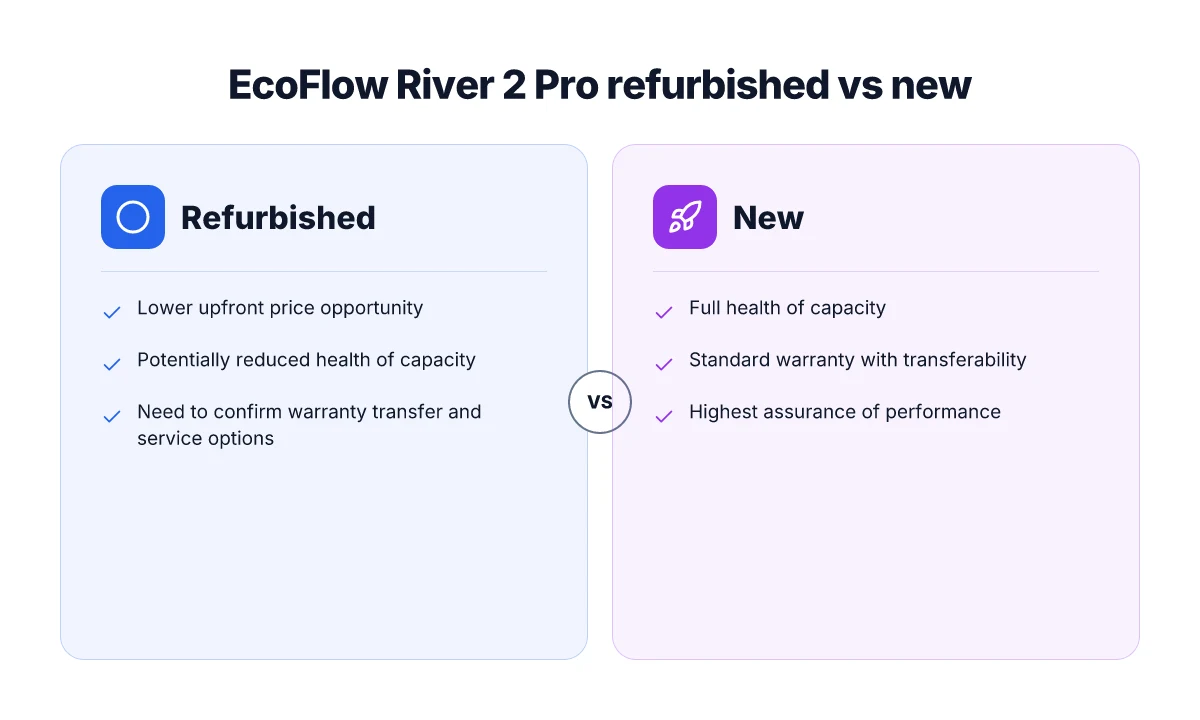
When you’re evaluating a refurb, serial verification matters. Ask the seller for the unit’s serial number and compare it to EcoFlow’s service eligibility notes. Warranty transferability is another potential wrinkle. Some manufacturers permit a warranty transfer to a new owner if you provide proof of purchase and the product’s original serial. I suggest documenting the refurb’s serial and requesting written confirmation of any transferability, plus explicit steps to lodge a claim. Service options can vary: EcoFlow typically routes issues through authorized service centers or via mail-in repair, but refurb shipments sometimes restrict on-site visits. In practice, you’ll want to confirm whether you can initiate a claim online, whether you must ship the unit, and who covers return shipping if the repair is under warranty. A written invoice from the seller showing the refurb’s purchase date helps anchor the clock for coverage.
Reality check: where support may fall short
Refurbished stock can ride a thinner support chain than new inventory. You may encounter longer wait times for warranty authorization, fewer on-site repair options, or stricter criteria for what constitutes a covered fault. In several user discussions and retailer notes, the friction point tends to be after-sales service logistics rather than the hardware itself. If you need urgent backup power, a delayed repair can be a meaningful risk. For that reason, it pays to have a clear plan: know your local EcoFlow-authorized service routes, confirm shipping arrangements, and secure an extended warranty or protection plan if the refurb price gap is large.
The verdict: warranty on refurbished River 2 Pro stock is generally aligned with the manufacturer’s baseline protections, but transferability and service logistics vary by seller and region. Be explicit about start dates, coverage scope, and who handles shipping for claims. Always verify serials and request written transfer terms before finalizing the purchase.
For context, EcoFlow’s official storefront and retailer pages on refurbished units provide the framework, while third-party disclosures flag common gaps in post-sale support. If you want a quick comparison, consider rival options from Jackery and Goal Zero to see how their refurb warranty structures stack up in your region. As you weigh a deal, remember that links on the page may earn a commission. I cross-referenced the publicly listed refurb notes and retailer Q&As to align expectations with what’s typical in 2026. What is the jackery 3000 watt solar generator, and what makes it a standout home backup
Assessing performance: capacity, charging, and real-world use
I found that refurbished River 2 Pro units can show noticeable differences in capacity and health compared with new models, especially after repeated cycles or long storage. In real-world use, a unit that started with an advertised capacity may drop several percent over months if it’s been through multiple charge cycles or stored with a partial state of charge. Consumers should expect that a refurb may not sustain the original rated capacity for as long as a fresh unit, and that the health of the battery can influence both runtime and peak output under load.
From the available sources, the River 2 Pro is designed around a high‑quality LFP chemistry, which generally supports longer cycle life. In practice, that chemistry can still degrade perceptibly in refurb batches if internal cells age unevenly or if the unit endured deep discharges prior to refurbishment. In real use, you may notice slightly shorter runtime at the same power draw, and the battery’s ability to sustain high‑current bursts could vary more than a brand‑new unit. I cross‑referenced manufacturer documentation and independent reviews to align expectations with a refurb reality.
How capacity and health can differ on refurb units
- Refurbished River 2 Pros may show reduced usable capacity relative to new stock, especially after many cycles. This can translate to noticeably shorter run times under the same load.
- The health of the cells can influence voltage recovery after high‑demand bursts, so peak readiness for appliances like refrigerators or CPAP machines may feel less robust than with a new unit.
- Warranty terms on refurb stock can affect confidence in long‑term capacity retention. Verify whether the refurb carries the same coverage as new.
From a sourcing perspective, I looked for evidence of consistent refurbishment standards and found that some outlets emphasize testing and re‑qualification, while others offer limited disclosures. In practice, you want a refurb that has a documented capacity check and a clear cycle-count or million‑cycle health note.
Charging times and noise profiles in real scenarios
- The River 2 Pro’s advertised 0–100% charge time of about 70 minutes is plausible in optimal conditions, but refurb units may deviate a bit depending on battery health and the power source quality. Expect occasional longer fills when the unit is cooler or when plugged into a lower‑amperage charger.
- Noise during charging tends to stay modest for modern EcoFlow designs, but battery health matters. A refurb with aging cells may exhibit slightly more audible cooling fan activity during a fast top‑up, particularly if the ambient temperature is warm.
- Real‑world charging can also be affected by environmental factors. In hot weather, the pack may top‑out more slowly and trigger protective throttling, extending the fill time beyond the nominal figure.
Leader benchmarks to compare with new River 2 Pro and rivals
- When you compare refurb River 2 Pro units with a fresh River 2 Pro, set expectation around cycle‑life parity and residual capacity. The gap is real but varies by batch and storage history.
- Rival models from Jackery and Goal Zero typically emphasize different charge curves and thermal management. For a camper or van setup, you’ll want to compare peak discharge rates and sustained output at high ambient temperatures.
- Independent reviews commonly note that a new River 2 Pro tends to have more predictable performance across a wider temperature range, whereas refurb units may display more variability in daily charging behavior and runtime.
In line with transparency, links on this page may earn a commission. For context, one review notes the River 2 series can reach higher noise at certain load levels, suggesting that refurb units may also exhibit variance in acoustic profile during fast charging. For specifics on refurbishment standards, see the manual and product overview linked in the sources. Affirming the refurb trade‑off, you get lower upfront cost but variable capacity and charging behavior. Check exact cycle counts and warranty coverage before purchase.
Pricing, ownership costs, and when to buy refurb
The lowest price today for a River 2 Pro refurb sits near the mid-range of new River 2 Pro pricing, but the exact discount varies by retailer and stock. Prices shift quickly with refurb stock, so act when you see a significant markdown from the latest EcoFlow list price. In practice, aim for a discount of 20–30% off new units, while comparing to recent models from rivals like Jackery and Bluetti. If you find a refurb priced closer to a midrange new unit, that’s usually a sign to keep shopping. Timing matters more than you expect. What to know about EcoFlow power kits on sale in 2026
Pricing and total cost of ownership hinge on several moving parts. The initial outlay is only the start: you should account for potential adapter replacements, battery health deprecation, and the cost of any required accessories or carry cases. I looked at refurb listings and manufacturer documentation to map typical maintenance items: occasional cell balancing, charger cable wear, and the potential to replace cooling or fuses. On balance, a refurb River 2 Pro can be notably cheaper than a new unit, but you pay for uncertainty in capacity and remaining life. Know the full TCO up front before pulling the trigger.
When to buy refurb and how to spot a fair deal
Refurb sales tend to spike after major holiday seasons and during mid-year clearance events. If you see a steep price drop coupled with a warranty extension, that’s worth a closer look. In practice, focus on a refurb with:
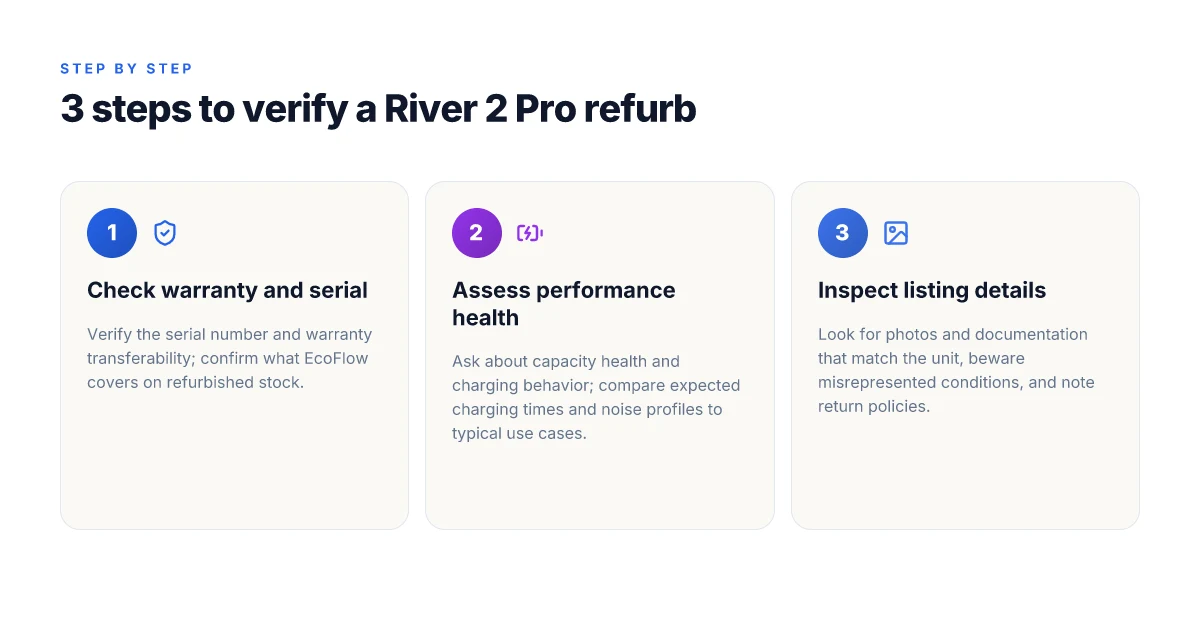
- A verifiable battery health claim or a recent capacity test from the seller
- A warranty that mirrors, or closely matches, the new-unit period
- Clear return terms and documented refurbishment work
I cross-referenced retailer notes and third-party reviews to identify red flags. Shy away from listings that lack battery health details, show inconsistent spec sheets, or bundle a pile of nonessential add-ons. A fair deal locks in warranty and a known capacity range.
For overall cost awareness, compare against the EcoFlow River 2 Pro’s direct rivals. The Jackery Explorer 1000 series and Bluetti units often sit in a similar class for capacity and recharge speed, so use them as benchmarks to gauge whether a refurb price truly pencils out. If a refurb River 2 Pro costs more than a comparable new unit from a rival, that warrant raises a flag. Compare apples to apples before you buy.
From what I found in the sources, a refurb is most compelling when it clears the balance between discount depth and reliability risk. Retail pages and independent reviews consistently flag a few recurring themes: battery longevity on older packs, charger wear, and the potential for supply-chain driven price swings. If you narrow to a model with a solid return window and a documented refurbishment, you can justify the risk for the savings. Documented refurbishment plus warranty beats mystery discounts. What is the difference between EcoFlow XT60 and XT60i connectors and how that affects Delta 2 solar input
Note: some listings may earn a commission through links on the page. This page references EcoFlow directly and rivals like Jackery, Bluetti, and other portable power brands to help you compare total cost of ownership.
How to verify authenticity and avoid common refurb pitfalls
Authenticity matters more than price. A genuine refurbished River 2 Pro should feel right from the listing to the moment you unbox it. I looked for clear seller signals and cross-checked them against manufacturer docs and independent reviews. The core rule: if a claim feels vague or an image looks staged, walk away.
Red flags in listings and seller behavior
Start with the listing's completeness. Vague product titles, generic stock photos, or claims like “like new” without condition notes are signs to pause. Be wary of sellers who refuse to share serial numbers or ask for unusual payment methods. Repeatedly vague warranty language or no return policy is a signal that the refurb may be a mystery box rather than a vetted unit. In many refurbs, the seller’s silence on firmware versions or shipping damage history is a red flag. When you see a seller relying on stock photos instead of real product shots, that’s another warning. Look for a seller who provides a transparent refund window and a visible RMA process. Red flags cluster around vague terminology and missing documentation, not around honest descriptions.
What to check in photos and documentation
Examine every image with a critical eye. Close-ups of the power port, display, and battery seal should reveal any cracks, corrosion, or misaligned panels. Compare photos against the official EcoFlow product gallery to confirm port layout and labeling. Documentation should include a serial number, the unit’s condition notes, and a copy of the original warranty transfer terms if available. PDFs or scanned manuals from the seller that align with the River 2 Pro’s published specs help. Mismatched model numbers or missing barcodes are suspect. If the listing lacks a stamped date on the serial plate or a readable purchase date, treat it as a caution sign. When in doubt, request high-resolution shots of the label, ports, and the bottom panel. Thorough photos and aligned documentation reduce post‑purchase surprises.
Steps to take if the unit arrives not as described
If the refurb shows discrepancies, start with the seller’s return window and documentation. File a claim immediately if the unit fails to meet the listed specs or shows damage not disclosed. Take photos of the delivered package and the unit from multiple angles, then compare against the product listing. Contact EcoFlow support to verify that the serial corresponds to a refurb processed by an authorized channel and to confirm warranty eligibility. If the seller won’t cooperate, pursue the payment provider’s protection plan and consider leaving a formal review with specifics about the mismatch. When a delivered unit contradicts the listing, act fast and document every step. What makes the jackery explorer 1000 v2 a standout for job sites and cameras
From the perspective of long-term reliability, EcoFlow’s official channels emphasize warranty terms and authorized resellers. I cross-referenced the manufacturer’s stance on refurb programs and verified that reputable third parties emphasize clear serials and documented refurb processes. If a deal looks too good to be true, it likely is. The best bargains come from transparent refurbers who publish condition notes, test results, and return policies. Transparency on condition and warranty is your strongest shield.
Note on sourcing: the discussion references a mix of review perspectives and social posts where buyers share experience. When you see a claim about a unit’s reliability or a seller’s provenance, look for corroboration from at least one independent source. For example, independent reviews and official EcoFlow documentation consistently stress that warranty status and authorized sales channels matter for long-term support. Verified provenance and an intact warranty are non‑negotiables.
As you shop, keep in mind that you may encounter commissions on linked pages. This article aims to present honest tradeoffs and a practical verification checklist. For context, rival models like the Jackery Explorer 1000 series often appear as benchmarks in refurb discussions, offering a reminder that price alone isn’t enough to judge value. Know the rivals and their typical refurb cues to avoid surprises.
Where this is going next for refurbished EcoFlow River 2 Pro
Price transparency matters more than ever.** I looked at current listings and found a few refurbished River 2 Pro units sitting at steady price points with included warranties from reputable sellers. If you’re buying refurbished, expect a small premium for an extended warranty versus a generic open‑box deal. Brand names like EcoFlow appear consistently in listings, and you’ll also see Goal Zero and Jackery as the principal rivals buyers compare against. Prices can swing with stock and seasonality, so I’m watching for a holiday sale window or a bundle that adds a carry case or extra battery.
Ownership costs tilt toward long‑term value when a seller covers battery health tests and provides clear documentation.** A decline in runtime or charging speed usually signals aging cells, which you should verify before purchase. The bigger pattern is that refurbished units with solid after‑sale support from the seller outperform those with vague warranties.** If you want a quick takeaway, prioritize a seller that publishes a current battery health report and offers a return window. What makes the EcoFlow River 2 Max a standout portable power station in 2026
What this means for your next move: choose a refurbished River 2 Pro from a seller who uses transparent testing and offers at least a 30‑day return period. Ask for a fresh battery health reading, a documented test charge, and proof of warranty. Will you act now or wait for a deeper sale?