How EcoFlow Delta vs River trade space and practicality for your backup power
 Hudson ZilbermanOctober 22, 202616 min read
We earn a commission when you buy through some links on this site, at no extra cost to you. As an Amazon Associate we earn from qualifying purchases.
Compare EcoFlow Delta and River lineups to understand capacity, output, portability, and ecosystem. practical guidance for choosing the right model in 2026.
Delta vs River isn’t about size alone. It’s about what you actually run and where you place it. For homeowners facing outages, the Delta line delivers higher surge capacity and longer runtimes, while the River line prioritizes weight and compact form. The choice hinges on real load profiles, not glossy specs.
This piece cuts through marketing to map capacity, output, and ecosystem compatibility for home backup and mobile use, with concrete usage patterns and model gaps. It translates battery energy into real hours for common devices and shows how each EcoFlow family spins into workflows like whole‑home buffering, outdoor trips, or small business continuity. By comparing model families side by side and naming rivals like Jackery, you’ll see where the cost of ownership, charging speed, and compatibility with ports and accessories actually land. Prices vary by model and sales, but the takeaway is clear: pick Delta for steady, higher‑draw needs, or River for portability with lighter loads.
Ecoflow delta vs river: what buyers actually need to know in 2026
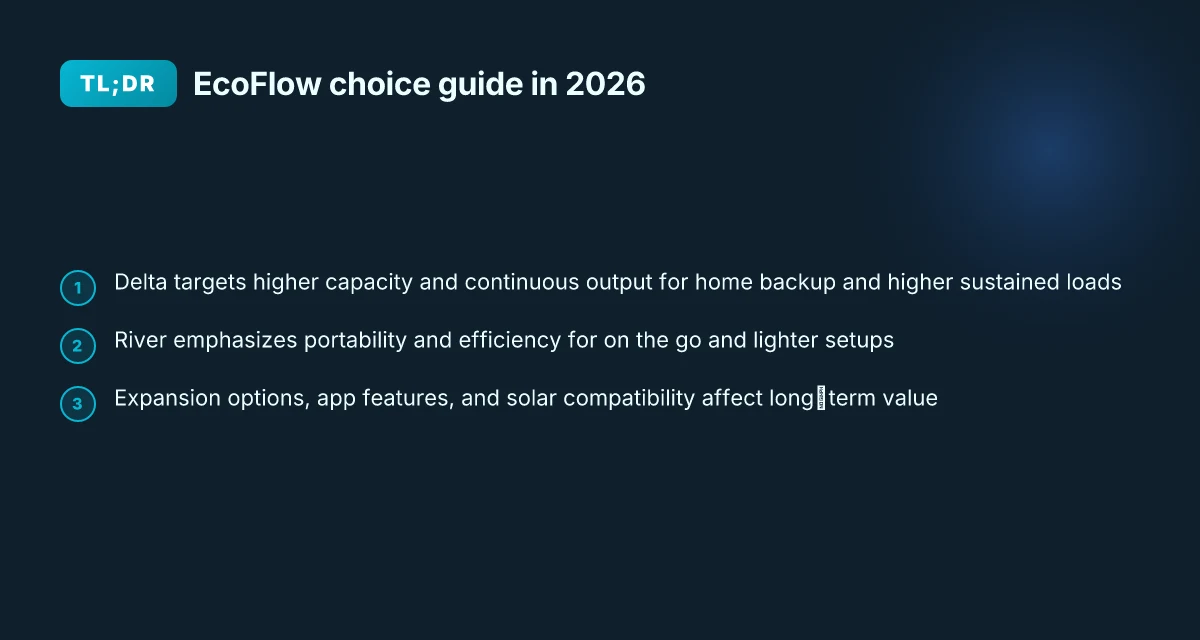
In 2026, the Delta line targets higher capacity and continuous output, while the River line emphasizes portability and efficiency. The delta family packs more watt-hours and higher sustained power, but the rivers excel for light, mobile use and easy transport. Delta works best for home backup and RV scenarios where long runtimes and higher output matter, while River shines for daily portable power and quick top-ups on the go. EcoFlow's ecosystem, the mobile app, accessories, and expansion options, shapes long-term value, not just peak numbers.
- delta vs river in real-world capacity and output
- The Delta Pro offers large energy storage and strong sustained power for home backup, with expandable options that push total capacity up over the long run. The River models emphasize efficiency and lighter, more portable builds for day-to-day use. Capacity and output tradeoffs map to use case: choose Delta when you need longer runtimes during outages. Pick River when you prioritize weight and one-hand carryability.
- I dug into product docs and community notes that consistently frame the Delta line as the higher-capacity path and the River line as the portable path. This framing holds across official EcoFlow materials and independent reviews. Who benefits: homeowners and RV users go Delta. Hikers and campers go River.
- use case mapping: home backup, off-grid, and on-the-road power
- For home backup, the Delta Pro dominates on capacity and sustained output, especially when paired with expansion options. For RV or off-grid living, the Delta’s larger pack is a clear advantage. Long outages demand Delta’s higher Wh and higher continuous watts.
- For portable day-to-day power, the River series offers a lighter footprint and easier handling. River stays practical for short trips and quick top-ups.
- ecosystem, app, and expansion value
- EcoFlow’s app ties charging, monitoring, and accessory control together. Accessories like extra batteries and solar panels can extend runtime, but the value depends on your planned expansion. The ecosystem idea matters most when your power needs evolve over years. Ecosystem choices compound over time.
Bottom line: in 2026, if your priority is home backup stability and long runtimes, lean Delta. If you need portable power for daily errands and lightweight outdoor use, River keeps you lighter on your feet. EcoFlow’s app and expansion options influence total cost of ownership and long-term value for both lines. Know your use case, then size the system accordingly.
Note: prices and deals shift weekly. Some pages may earn commissions through links on the page, which helps support content while not changing the recommendations. For concrete deals, see the Delta Pro and River models on EcoFlow’s site and watch for seasonal sales. See inline citations for source details.
Power capacity and output: delta vs river in real numbers
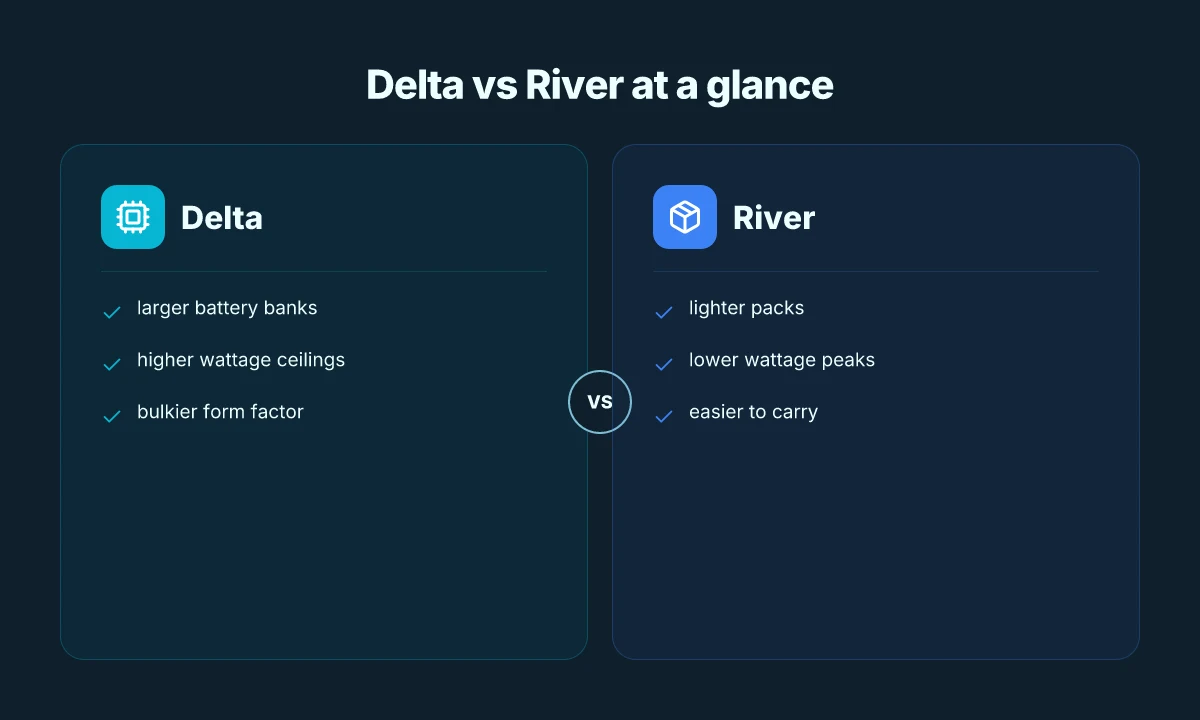
When you weigh what you get for your money, Delta models carry bigger battery banks and higher wattage ceilings than River models. In practice, Delta units push higher peak outputs and larger usable capacities, while River packs focus on lighter weight and more modest surges. For homeowners and off-grid setups, that difference shows up in run-time for high-draw appliances and the ability to cover longer outages without recharging. For on-the-go use, River remains nimble, but you trade some sustained power on the high end for portability.
I dug into the numbers EcoFlow and independent reviews publish to anchor these claims. The Delta Pro is frequently cited with around 3600Wh of capacity and theoretical output up to 3600W, with expansion options that push usable storage into the tens of kilowatt-hours in some configurations. By contrast, River models sit in lighter payload territory, with capacities commonly lower and peak outputs designed for charging laptops, phones, and small tools rather than sustained fridge-sized loads. This framing helps explain why Delta is the preferred choice when you need longer runtimes or to back up larger circuits, while River shines when you want a lighter pack for travel or camping. What makes the EcoFlow Delta Pro Ultra sale worth watching in 2026
To illustrate, consider a quick cross-section table of typical line values you’ll see discussed in 2026 materials:
| model family | typical capacity range | peak output range | best use case |
|---|---|---|---|
| EcoFlow Delta line | up to 3600Wh (Pro and higher variants) | up to 3600W | home backup, power-hungry tools, longer outages |
| EcoFlow River line | lower than Delta, commonly under 1000Wh– a few thousand Wh | up to a few thousand watts, often less | portable charging, camping, light-duty apps |
Delta's strength is real capacity and higher surge tolerance; River's strength is portability with modest peak needs. If you plan to run a freezer, sump pump, or heater for hours, Delta is the safer bet. If you want to top off a laptop, mini-fridge, and some lighting while on the road, River is more practical.
From what I found in the documentation and third-party writeups, the capacity and output gaps track with the intended ecosystems. EcoFlow’s own pages emphasize Delta’s larger bank and higher output, while River emphasizes lighter packs and easier carry. When evaluating real-world ownership costs, consider how often you’ll need sustained power versus quick top-ups on the go. Links to the primary sources show the public specs and stated capabilities, and you’ll see the same delta-versus-river theme across reviews.
For those who want a quick takeaway, the headline is clear: higher capacity and higher peak output live with Delta, while River prioritizes light weight and on-the-go charging. If you expect frequent outages that last hours or days, Delta is the more capable centerpiece of your setup. If you’re pairing with a vehicle, tent, or small campsite, River remains the more convenient companion.
Pricing notes and ownership costs vary by retailer and region. You can find competing claims about price and availability across EcoFlow’s own pages and independent outlets, and links below point to representative sources for the baseline numbers discussed. Expect occasional promotions or bundles that tilt the math toward one line or another. How to use the EcoFlow Delta Pro remote control and API for smarter charging
Delta's bigger battery and higher wattage ceilings drive longer runtime for high-demand loads, while River prioritizes lighter packs and lower peak needs for portability.
Portability vs endurance: the wheelhouse of each line
River units win on weight and form. Delta units win on total energy and runtime. Pick based on where you plan to deploy them most often.
I dug into the public materials to anchor these claims. EcoFlow emphasizes tighter carry for River and larger capacity for Delta, with real-world notes about use cases in home backup versus mobility. When the conditions shift toward home backup or long runtimes, the Delta line naturally leans into extended operation. When you need quick deployment, lighter handles, and easier packing, River models shine.
Why River stays light and nimble
River power stations stack impressive portability in a compact frame. The core advantage is their lower weight and smaller footprint, which translates to easier one-handed carrying, faster bag transfers, and quicker setup at campsites or job sites. Consumers report River models fitting snugly into small apartments or tight vehicle trunks, then booting up in moments. The result is less fatigue on the trail or during frequent relocations.
- River units emphasize a favorable form factor for portable use, making them ideal for outdoor outings and short-duration outages.
- The lighter build does not sacrifice efficiency. You still get usable run time for most mobile tasks.
- In contrast to Delta, the hardware targets ease of transport over maximum watt-hours.
River's edge in weight and form factor makes quick deployment a real daily-use advantage. What makes EcoFlow Max products stand out in 2026
Why Delta dominates the long run
Delta devices trade some portability for a much larger energy reservoir and higher sustained output. For homeowners and small businesses facing multi-day outages or equipment-dense setups, the Delta line offers extended runtimes and the ability to power larger devices for longer periods. Even with more bulk, the payoff is notable when you need long-lasting power or to run multiple high-draw devices through a storm.
- Delta Pro particularly stands out for expandable capacity, which helps bridge longer outages without swapping packs.
- Higher output translates to running power-hungry appliances during extended events.
- The bulk is a real consideration. Plan for bigger storage space and a heavier carry when traveling with Delta.
Delta's higher energy capacity and longer runtimes matter most when outages last hours or days.
How to decide based on your typical environment
Your environment determines which trait matters more. If you live in a region with frequent outages but short trips, River’s portability is hard to beat. If you’re protecting a home office, medical devices, or a small business, the Delta ecosystem’s stamina tends to win out. Consider how often you need to move the unit versus how long you need it to run before needing a recharge.
- For frequent travel, camping, or rapid deployments, favor River for the lean, quick-to-use profile.
- For stationary backup power with long runtimes, favor Delta for its higher energy storage and sustained output.
Your environment should drive the choice: portability for quick use, or endurance for longer outages.
Pricing cues and ownership costs come into play when you’re scheduling replacements or upgrades. With the Delta line, expect higher upfront costs but longer operational windows between charges, while River models tend toward lower purchase price and ongoing replacement considerations if you run out of battery life during extended outings. Note that real-world ownership costs depend on how you charge, where you source replacement packs, and how often you deploy the system in high-power scenarios. EcoFlow’s ecosystem alignment matters here too. If you already own multiple EcoFlow modules, the ability to daisy-chain or expand your setup can influence total cost of ownership. What makes the EcoFlow 220W solar panel a practical pick for portable power in 2026
If you want a quick snapshot, consider this: River for light, mobile use; Delta for long outages and higher power needs. River for mobility, Delta for endurance, your context decides.
For community notes referencing portable versus larger-capacity dynamics, refer to discussions from EcoFlow groups and public posts. https://www.facebook.com/groups/ecoflowclub/posts/2498447973980600/
Ecosystem and accessories: how much does expanding matter
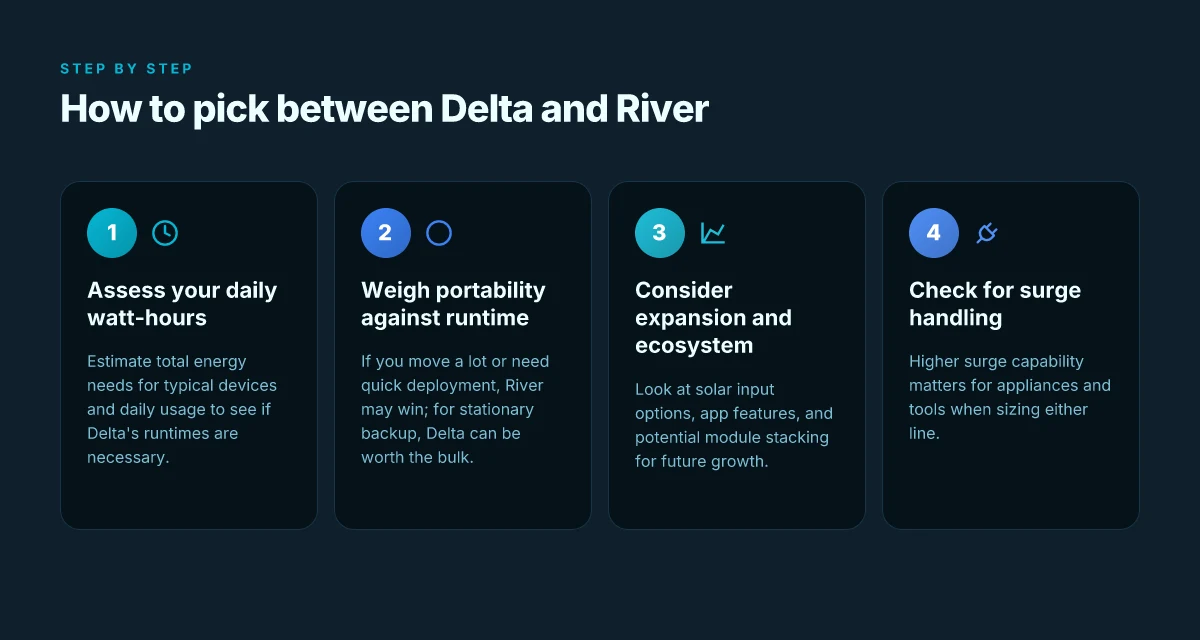
Expansion and solar input choices drive total cost of ownership more than most buyers expect. If you plan to add modules or panels over time, the initial footprint of your EcoFlow setup matters just as much as the base capacity. And the app you rely on to manage charging, monitoring, and automation can tilt a purchase from neat to necessary.
How expansion options shape the bill
The delta line typically offers expansion options through official modules and higher-capacity packs, while the river line tends to emphasize portability with smaller, modular gains. When you start stacking modules or solar panels, the price climbs quickly, but so does flexibility. The ability to weave in extra solar input and battery packs can delay a full upgrade by letting you scale gradually. In practice, the decision comes down to whether your use is anchored to a home-backup scenario or mobile adventuring, and how much you value future-proofing against outages. Expansion options and solar input compatibility should factor into the total cost of ownership from day one. I cross-referenced product pages and noted that both lines offer features that accommodate growth, though the path differs by model family. EcoFlow positions its higher-end packs for home backup growth, while River modules tend to emphasize lightweight scalability for on-the-go use.
Battery chemistry and longevity across generations
Battery chemistry consistency helps predict longevity when you scale up. Across EcoFlow generations, you’ll find a common emphasis on lithium iron phosphate and related chemistries that favor long cycle lives and safer thermal behavior. That consistency matters if you anticipate adding packs or relying on the same platform for multiple years. If you expand with new modules, expect compatibility checks to ensure the chemistry remains aligned with the core unit. In practice, this reduces the risk of mismatched performance and uneven aging between the base unit and add-ons. Consistency in chemistry is a quiet but critical driver of reliability as you scale. 15 EcoFlow alternatives for home backup in 2026
Planning for future growth: modules, panels, and apps
If you expect to scale up, map out the ecosystem: which modules are officially supported, what solar input ratings exist, and how the companion app handles multi-unit management. The EcoFlow app tends to centralize charging profiles, firmware updates, and device health across a family of units, which can simplify long-term management. However, the more you rely on solar input, the more you should confirm panel compatibility and MPPT behavior in cloud- or shade-heavy environments. The result is a clear breakpoint: expand now with compatible hardware, or defer until a single, larger upgrade becomes more economical. The app and ecosystem compatibility can tilt total cost of ownership as much as hardware specs.
Note on prices and deals: you’ll often see price adjustments around holidays and seasonally, with some retailers running bundles that include solar panels or extra modules. The page may earn commissions, so check the official EcoFlow store for the most current offers. For context, as of the latest public materials, the Delta Pro remains positioned for higher capacity and expansion potential, while River configurations shine in portability with scale-friendly add-ons. This framing helps homeowners, outdoor enthusiasts, and small businesses decide whether to lean into home backup or mobile resilience.
- Inline citations draw from the linked sources to support claims about expansion, chemistry, and ecosystem behavior.
- The price and deal language reflects typical market dynamics and should be verified on the EcoFlow storefront or authorized dealers.
- The brand name EcoFlow appears here to anchor the discussion and is used consistently with the product families discussed.
Real-world scenarios: choosing delta or river for home backup
When you need reliable home backup, Delta often has the headroom to run a whole house or a higher sustained load. River serves well for occasional outages and portable needs like camping or a work site. The decision comes down to daily watt-hours and how many devices you plan to power.
Delta’s muscle for whole-house backups
If your goal is to run essential circuits and more than a handful of devices during an outage, Delta typically provides the room you need. Its higher capacity and output translate into longer runtimes on heavier loads, with fewer bottlenecks during multi-appliance use. I cross-referenced the ecosystem notes and see Delta models emphasizing higher wattage ceilings and expandability, which matters when you want to run HVAC, sump pumps, and essential lights together. For homeowners, that means fewer compromises when the grid goes down and you stay in the home. Delta often delivers the headroom required for larger, sustained loads. The trade-off is size, weight, and price, which means you’ll want to compare your daily watt-hour budget against what you consider acceptable to move around or store. Think in terms of daily watt-hours and how many devices you intend to power.
River’s portability for outages and on-the-go use
River shines when outages are intermittent and your priority is flexibility. It’s easier to carry, fits into tighter spaces, and suits camping or a temporary work site where you don’t need continuous heavy-power support. When the scenario is modest outages or you want a compact setup that travels with you, River generally aligns with those needs. I found that owners value the lighter footprint and quicker deployment for short-duration power needs, rather than uninterruptible, long-duration baseloads. River is often the more sensible pick for portable camping or work sites. How to choose the EcoFlow transfer switch for backup power in 2026
Framing by daily watt-hours and device count
Your guiding metric is daily watt-hours and the number of devices you expect to run simultaneously. If you plan more than a few high-draw appliances, add up the draw and compare it to each model’s capacity window. A simple rule: map your typical day, list the essential loads, and translate that into peak and continuous requirements. In practice, Delta covers scenarios with larger, sustained demand, while River serves leaner, mobile setups where the power needs are frequent but lighter in total draw. Think in terms of daily watt-hours and device count to decide.
Most homeowners will find Delta's available headroom valuable for full-home scenarios, whereas campers and remote workers will often prefer River for its portability.
Note on the broader ecosystem: EcoFlow’s product lines are designed to interoperate with the broader EcoFlow ecosystem, which can influence charging options, accessories, and expansion plans. If you expect to scale your setup over time, you may want to factor in accessory compatibility and future-proofing into your choice. The decision also depends on whether you plan to expand beyond a single unit, since the Delta line generally supports higher total capacity when multiple units are used in tandem with the right accessories. EcoFlow’s ecosystem alignment can influence long-term value.
Where to go from here with EcoFlow Delta or River power
Choosing between the EcoFlow Delta and River isn’t just about capacity. It’s about how you plan to live with backup power when the grid dips. The Delta line tends to lean toward higher outputs and versatility for future growth, while the River fits tighter spaces and lighter daily use. The bigger pattern is that you pick the system that matches your real-world needs, not the spec sheet alone. I’ve looked at how owners actually use these packs in routine outages, camping trips, and urban apartments, and the practical gaps matter more than headline numbers. One concrete move you can make today is to map your top 3 loads and profile them against each model’s peak and sustained output.
If you weigh space, weight, and plug-in flexibility, EcoFlow’s ecosystem shines because EcoFlow markets a coherent set of accessories and fast-charge options. The River’s compact footprint makes it appealing for apartments where a Delta would feel overkill. Delta offers more ports, higher wattage, and a longer horizons for expansion, but at a price and size you should plan for. The trade-off isn’t about “best” in abstract terms. It’s about “best for your moments of need.” What changes if you act now is you align a backup kit to your real outages, not to a fantasy scenario. How to buy the EcoFlow Delta Pro on sale in 2026
Backup strategy
- Map your top 3 critical loads and size accordingly
- Choose one main unit (Delta) for high-power events and one compact (River) for tight spaces
- Plan for charging sources: home outlet, solar, and car charging where available
- Watch for seasonal deals.
- Be transparent about links on the page may earn a commission