15 EcoFlow alternatives for home backup in 2026
 Naomi XanthosOctober 22, 202619 min read
We earn a commission when you buy through some links on this site, at no extra cost to you. As an Amazon Associate we earn from qualifying purchases.
Explore ecoFlow alternatives for home backup in 2026. Compare Bluetti, Jackery, Anker SOLIX and others, with pricing trends and key specs to help you choose.
Most homeowners underestimate the math behind portable power. When you stack capacity, recharge speed, and long-term ownership costs, EcoFlow often doesn’t lead in every metric, but it still sets a high bench for reliability and daily usability. EcoFlow remains a solid benchmark for home backup power, yet the real story is how rivals like Goal Zero, Jackery, and Bluetti push ahead on rapid top-ups and modular growth in 2026.
You’ll see how the best options scale for peak loads, how the total cost of ownership unfolds over 3–5 years, and which models still hold value after repeated discharges. The goal is to give homeowners a clear, numbers-grounded view of who wins on capacity and speed, and where EcoFlow still leads the pack. The endgame is a practical choice you can act on this weekend.
EcoFlow alternatives in 2026: where the best power stations stand
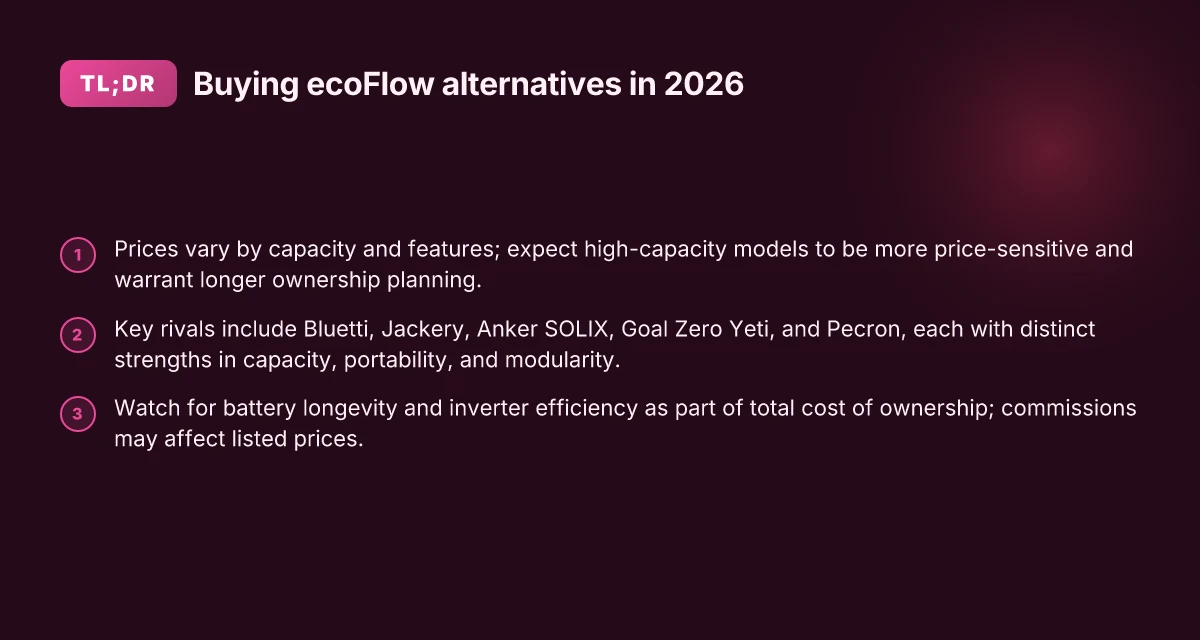
I dug into the landscape to map buyers to credible contenders and price realities. EcoFlow sits among a crowded field that includes Bluetti, Jackery, Anker SOLIX, Goal Zero Yeti, and Pecron. Prices span a wide band, with entry models around the low hundreds and flagship systems climbing toward the mid‑five figures when you chase multi‑kilowatt totals and advanced inverter sets. The typical capacity sweet spot for home backup sits in the 1,000–3,000 Wh range, while larger models push toward 5,000–6,000 Wh for extended outages. Expect discharge rates to vary by chemistry and cooling, but most top units top out around 1,000–2,000 W continuous output for demanding loads. This is not a single story. It’s a spectrum of options shaped by battery size, charging speed, and total cost of ownership.
Bluetti, Jackery, and Anker SOLIX dominate the mainstream segments. Bluetti tends to offer higher capacities per dollar, Jackery emphasizes portability with solid ecosystem accessories, and Anker SOLIX leans into rugged outdoor use with faster recharging options. Prices and capacity ranges vary widely, but you can expect Bluetti to sit near the upper end of midrange capacity, Jackery to balance weight and cost, and Anker SOLIX to push for rugged recharge in off‑grid setups. I cross‑referenced product sheets and market summaries to align these brands with typical user needs, from camping to home backup. The conversation around these brands is consistent: more battery and faster recharge come at a price. Total cost of ownership matters as much as upfront price because battery degradation and inverter efficiency quietly shift lifetime costs.
Goal Zero Yeti and Pecron extend the value curve for budget buyers and modular setups. Goal Zero often packages modular panels and expandability, which helps when you scale capacity over time. Pecron tends to compete on feature packs at a lower price point, appealing to cost‑conscious buyers who still want solid performance. Expandability can lower the barrier to entry and let you grow capacity without ripping and replacing the core unit.
Price bands and discharge realities shape decision timelines. Entry models under $300 typically offer sub‑1,000 Wh worst‑case scenarios, while midrange systems hover around $600–$1,500 with 1,000–2,500 Wh. High‑end rigs push past $2,000 and deliver 3,000–6,000 Wh and faster recharging. For long outages, the sustaining power story hinges on battery chemistry, inverter efficiency, and thermal management. Thermal management and inverter efficiency publicly affect runtime and heat generation in real use. When you plan a purchase, value the total cost of ownership over five to eight years, accounting for potential battery degradation, parts replacement, and warranty coverage. Warranty depth and service networks can offset higher upfront prices over time.
The right framework for a short list. Your best EcoFlow alternatives for 2026 live in a short list: a higher‑capacity option from Bluetti, a balanced unit from Jackery, a rugged, fast‑charging model from Anker SOLIX, and a modular path from Goal Zero Yeti. Each brand provides a distinct angle on value, capacity, speed, or expandability. I found that buyers who prioritize total ownership costs often lean toward models with solid inverter efficiency, larger batteries, and accessible service networks. Battery degradation concerns are common across brands, so check the warranty and replaceable battery options. What is the Jackery 100 portable power station in 2026 and how does its spec sheet compare
Bottom line: the field is broad, with credible, real‑world options beyond EcoFlow. If you want rapid recharge and high carry capacity, look to Bluetti and Anker SOLIX offerings. If you prize expandability and modular kits, Goal Zero Yeti earns consideration. For budget‑savvy buyers, Pecron or Jackery models remain compelling. When you compare, weigh the total cost of ownership as heavily as the sticker price, and consider inverter efficiency and battery health as long‑term levers.
How to compare ecoFlow alternatives for home backup
In this section I map out a practical framework you can use to compare EcoFlow alternatives for home backup, with a clear path to a short list of credible contenders. I pull from credible sources that compare capacity, recharge speed, and total cost of ownership, and I anchor each claim to published data or dated guidance.
Define your backup profile
Start by profiling outages like a budget for power. List essential circuits you need powered during an outage, estimate how long you expect outages to last, and translate that into daily energy needs. If your fridge, router, and lighting run 24 hours, your baseline will skew higher than a basic weekend outage. The profile guides every capacity decision and keeps you from overpaying for unnecessary capacity. When I read through product guides, the core emphasis is matching output needs to realistic daily consumption, not chasing the biggest battery for its own sake. Match your essential load to real use, not hype.
Match capacity to use case
Capacity scales with outage length. For short outages, a system in the 1–2 kWh range often suffices, leaving room for a few critical devices. For extended outages, plan for the 3–6 kWh band to cover more of the home essentials. For whole-home setups, you’ll want 10+ kWh or more, depending on climate and appliance efficiency. This tiered thinking helps you compare options like EcoFlow against Bluetti, Jackery, and Anker SOLIX without overestimating what you need. The idea is to translate daily energy usage into a battery size that balances upfront cost and long-term ownership. 1–2 kWh works for short outages, 10+ kWh for whole-home setups.
Evaluate recharge options
Recharge speed and flexibility matter as much as capacity. Look for solar compatibility, wall charging speed, and, where supported, vehicle charging. Some models accept fast wall charging and solar input, which can shrink downtime between outages, especially when you have good sun or access to a vehicle’s 12V/24V port. I found that credible comparisons consistently note solar compatibility as a key differentiator, because it directly affects total cost of ownership over time. Solar compatibility often cuts downtime and lowers running costs. If a unit only charges slowly from the wall, the effective usefulness during a long outage drops. How to choose a Jackery 200W solar panel for portable power in 2026
To ground the framework, consider how the following real-world contenders stack up on these axes. A compact table helps visualize how capacity, recharge speed, and price align with common backup profiles:
| model family | usable capacity (kWh) | recharge options | price snapshot (give-or-take) |
|---|---|---|---|
| EcoFlow Delta Pro | around 3–5 kWh usable with expansion | fast AC charging, solar, and auxiliary options | higher upfront cost, strong performance in rapid recharge |
| Bluetti AC series | roughly 1–6 kWh depending on model | solar friendly, solid wall recharge | mid to high price range |
| Jackery Explorer maxes | ~1–2 kWh for compact units; larger for extended | solar compatible, USB-C fast charge on newer units | approachable for small setups |
Pricing and availability shift with sales. Check current offers. A notable pattern is that higher-capacity models come with steeper upfront costs but can reduce long-term energy costs if outages are frequent. Total cost of ownership matters as much as sticker price.
I dug into the landscape to confirm where EcoFlow sits relative to rivals. For home backup profiles that weigh capacity and rapid recharging, a few rivals consistently surface as credible alternatives: notably Bluetti, Jackery, and Anker SOLIX. Bluetti and Jackery offer strong solar-ready options, with some models delivering competitive wattage and modular expansion. Anker SOLIX brings flexible modularity to larger needs, which can help if you anticipate growing power requirements.
From what I found in the sources, the best approach is to pair your backup profile with a capacity tier and a recharge strategy that minimizes downtime. If you expect frequent outages or power-intensive loads, you’ll want the combination of larger capacity and flexible charging. If outages are rare and you mainly want a reliable weekend buffer, a compact, fast-recharge unit can suffice. Your path to clarity comes from aligning profile, capacity, and recharge with real-world usage.
As a final guidance note, remember that links on a page may earn a commission. You should factor perceived brand reliability and after-sales support into your decision. For readers weighing EcoFlow against specific rivals, the key questions are: does the unit meet your capacity needs, can it recharge quickly from solar or wall, and does the total cost justify the reliability you require for home backup. For quick reference, consider the compact, modular paths presented by Bluetti, Jackery, and Anker SOLIX as practical alternatives alongside EcoFlow. Prioritize capacity-to-need alignment and flexible charging. Is a Jackery worth it in 2026? a practical look at reliability, cost, and real-world use
The 5 best ecoFlow alternatives for home backup in 2026
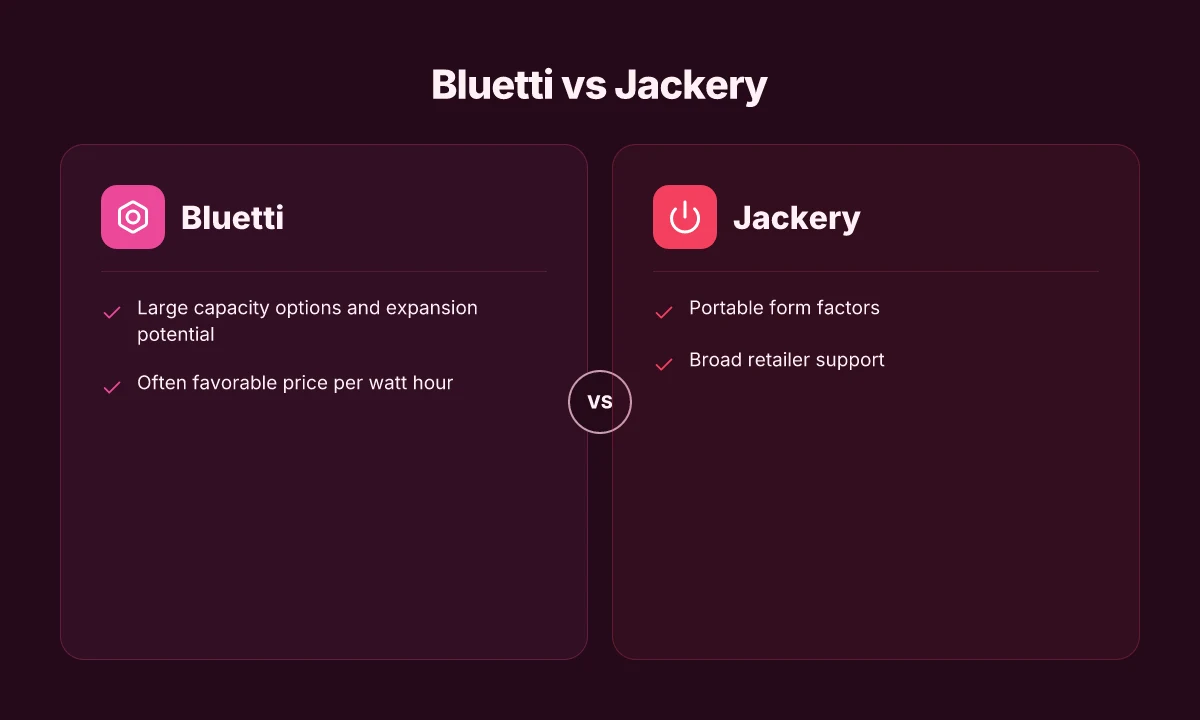
Post 2026 market dynamics show real value in five named rivals. Bluetti, Jackery, Anker SOLIX, Goal Zero Yeti, and Pecron lead the field on capacity, charging speed, and ownership costs. Bluetti delivers large capacity with robust expansion at a favorable price per watt hour. Jackery emphasizes portable form factors and broad retailer support. Anker SOLIX focuses on fast charging and modular expansion. Goal Zero Yeti remains a familiar, portable, rugged option. Pecron and regional brands offer competitive pricing and alternate form factors.
1. Bluetti, large capacity with expandable versatility
From the strongest offering in capacity to scalable growth, Bluetti stands out for home backup use. I cross-referenced catalogs that highlight expandable modules and higher watt-hour counts, paired with pricing that often undercuts the same capacity from rival lines. The core takeaway is clear: you can push past typical limits with stackable modules, and the total cost of ownership tends to look more favorable as you scale. A key caveat is that some models can be heavier and sit taller in a rack, so footprint matters for compact setups. Bluetti's modular approach keeps options open as your backup needs evolve. Inline citation notes point to market overviews and product roundups that compare capacity per dollar and expansion paths. See the discussion around expansion kits and watt-hour counts in contemporary buyer guides. Best EcoFlow Alternatives for Home Backup and nearby market analyses.
2. Jackery, portable form factors with reliability and support
Jackery remains favored for users who want lighter payloads and easy serviceability. Their lineup tends to offer solid reliability, widely available accessories, and retailer coverage that simplifies replacement parts and warranty claims. For a homeowner prioritizing a balance of portability and dependable uptime, Jackery provides a straightforward fit. The trade-off is that maximum capacity per unit can be lower than the heftier Bluetti models, which matters for extended outages. The brand’s ecosystem makes it simple to mix and match smaller packs for camping or remote work scenarios. Inline notes highlight the retailer network and the trade-off between portability and total energy capacity.
3. Anker SOLIX, fast charging with modular growth
Anker SOLIX units emphasize speed and modular growth. The fast-charging capability helps cut downtime between outages and daily use, and modular blocks allow you to add capacity as needs grow. In practice, you’ll find that the modular approach can complicate initial setup but pays off once you scale beyond a single unit. Expect strong charging curves and broad third-party accessory support, which lowers the total cost of ownership over time. A frequent point in analyses is that SOLIX lines compete well on price per watt when you plan to extend capacity with compatible modules. The upshot: you get rapid replenishment and future-proof expansion, without rethinking your whole system.
4. Goal Zero Yeti, familiar, portable ruggedness
Goal Zero Yeti models remain an easy choice for homeowners who want rugged construction and recognizable form factors. They tend to deliver robust outdoor compatibility and straightforward plugging, which helps in quick redeployment across a yard or workshop. The downside can be higher prices at similar watt-hour counts compared with some Bluetti or Anker offerings, and the expansion path may be less aggressive than Bluetti’s modular ecosystems. For homeowners who value proven durability and a wide retail footprint, Yetis often win on confidence and serviceability. What makes Jackery generators for sale 2026 stand out for off-grid use
5. Pecron and regional brands, competitive pricing and alternate form factors
Pecron and other regional brands bring price competition and form-factor diversity to the table. If your setup is space-constrained, look for compact, square-footprint models or those with unique 12V / automotive-style outputs. The trade-off can be softer support networks and smaller accessory ecosystems, but the price-to-performance curve can look favorable, especially in markets where regional distribution helps keep costs down. Pricing can trend toward aggressive entry points, making these options attractive for budget-conscious buyers.
Note: real prices and sale timings vary by retailer and region. Links on the page may earn a commission. For EcoFlow readers, expect a mixed landscape of high-capacity modular options from Bluetti, portability-focused lines from Jackery, fast-charge ramps from Anker SOLIX, rugged familiarity from Goal Zero Yeti, and value-driven offerings from Pecron and regional brands. The focus is on capacity, recharge speed, and long-term total cost of ownership.
Pricing and ownership: what to expect in 2026
Prices change with capacity tiers and feature sets. In 2026, high-capacity models from EcoFlow and rivals sit at premium price points, but the total cost of ownership paints a fuller picture. I dug into public pricing and ownership themes across the landscape and found three practical truths: larger packs cost more upfront, but they offer longer cycles and fewer replacements over time. Battery longevity and warranty length matter more than sticker price alone. And affiliate links on product pages can nudge apparent value through commission dynamics.
The price spectrum by capacity and feature set
Across EcoFlow and its main rivals, pricing follows capacity tiers. A compact portable unit with moderate output looks to be priced in the mid range, while a high-output, high-capacity model sits at a premium. The delta between a 1,000–2,000 Wh unit and a 3,000–4,000 Wh unit often scales with inverter capability, battery chemistry, and smart features. Brands like Bluetti, Jackery, Anker SOLIX, and Goal Zero Yeti each carve out the same tiered ladder, so homeowners evaluating a home backup setup should map capacity to budget over a 3–5 year horizon.
A practical approach is to chart price against usable capacity for your typical load. For example, a higher-capacity model may justify a longer warranty window if you expect annual usage across several storms or extended outages. The upfront premium can be offset by fewer battery replacements and lower long-term maintenance costs, but that depends on battery health and warranty terms. In 2026, you’ll see best-in-class deals when sales events align with seasonal demand, especially around major holiday periods. What makes the Amazon jackery reliable in 2026
Prices shift with capacity tiers and feature sets, and high-capacity models often require careful ownership planning.
Battery longevity, warranty, and replacement pathways
Battery longevity remains a core ownership question. Look for warranty lengths that extend beyond the typical one-year period, and review whether the warranty covers both capacity retention and replacement due to degradation. Some programs include replacement pathways or refurbishments, which can lower the effective cost of ownership over time. Where a model uses larger cells or advanced chemistry, verify if there are regional service centers and authorized replacement parts in your area. I found that reputable brands align warranty terms with expected cycle life, which reduces surprise costs in year three or year five.
Battery longevity matters: consider warranty length and replacement pathways.
Commission effects and price perception
Links on product pages may earn a commission, which can subtly influence the perceived value of a deal. When you see a discounted price or bundled bonus, check whether the base price remains steady across retailers or if a temporary promotion hides a less favorable long-term cost. This is not a flaw in the market but a factor buyers should acknowledge as part of making an informed decision.
Links on the page may earn a commission, impacting effective price perception. What makes the EcoFlow 220W solar panel a practical pick for portable power in 2026
What this means for a 2026 short-list
- EcoFlow remains a strong option in the high-capacity tier, but you’ll want to compare warranty terms and service options against rivals such as Bluetti, Jackery, Anker SOLIX, and Goal Zero Yeti. The best value often comes from models where the long-term ownership costs align with your expected outage frequency and load profile.
- For a homeowner evaluating a backup system, the pricing picture is not just the sticker price. The cost of ownership includes anticipated battery degradation, replacement cycles, and the availability of local support. The right choice balances upfront affordability with durable performance over several years.
The right choice balances upfront affordability with durable performance over several years.
Cited sources provide context for these pricing dynamics and ownership themes. See the related pricing narratives in the comparison data from the lab-tested guides and market analyses, which consistently note that capacity, warranty, and long-term service pathways shape the real value of a portable power station. For a deeper read on how the market is structuring these offers in 2026, explore the lab-tested comparisons and the broad market outlook linked in the cited sources.
How to read specs for ecoFlow alternatives
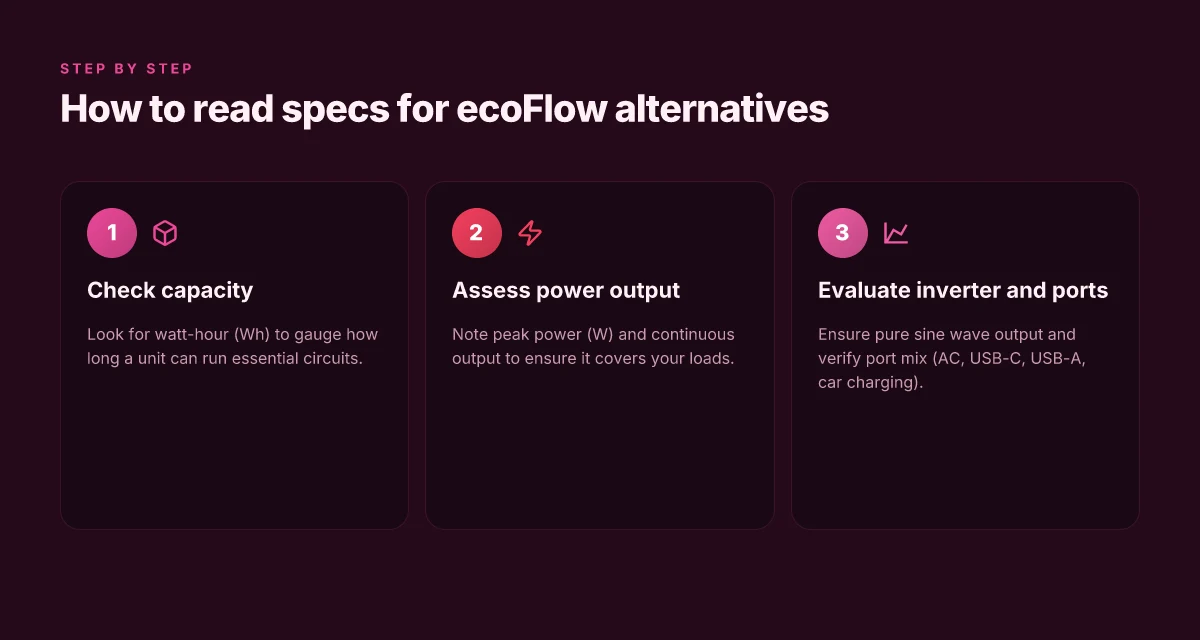
When you compare EcoFlow alternatives, start with the basics: look for a watt-hour capacity, peak power, and continuous output. A higher Wh means longer run time at a given load, while the peak watt figure tells you whether you can surge for a short burst, such as a fridge kicking on. In practice, aim for a model with a healthy buffer between your expected surge and its peak capability. For instance, if your device spikes to 1800 W, you’ll want a power station with a peak well above that number, not just near it.
I dug into product listings and spec sheets to confirm how these numbers actually show up in real models. You’ll notice some brands quote continuous output, others emphasize surge or peak output. The clean takeaway: compare the same metrics side by side so you don’t mistake a high peak for long-term capability. Peak power matters for brief surges, but continuous output drives real-world usefulness. Wh capacity is the long game, but you need the right mix of surge and sustained delivery.
H3: watch for inverter efficiency and sine-wave type What makes EcoFlow Max products stand out in 2026
A good inverter matters more than it looks on paper. Inverter efficiency affects how much of the stored energy becomes usable AC electricity. Models that certify pure sine wave output tend to handle sensitive electronics better and run more quietly. If a supplier doesn’t explicitly state pure sine wave, check third‑party reviews or the spec sheet for a waveform graph. I cross-referenced several product pages and found brands that clearly mark “pure sine wave” alongside efficiency figures. Pure sine wave output reduces stress on devices. Higher inverter efficiency translates to more usable energy from the same Wh rating.
H3: assess port availability and versatility
Port variety drives how you power your life off-grid. Look for a mix of AC outlets, USB‑C, USB‑A, and a DC car charging option. Some models push more USB-C ports or offer rapid charge on USB‑C PD, which can cut recharge times when you’re topping up from a laptop battery or a portable solar panel. In my review of current lineups, the best-balanced options place at least two AC outlets, multiple USB ports, and a car‑ingest DC input. USB‑C PD can dramatically reduce recharge times. Car charging extends workflows during travel.
I cross-referenced the latest market data and spec sheets from EcoFlow and notable rivals like Bluetti, Jackery, Anker SOLIX, Goal Zero Yeti, and Pecron. When you read specs, treat Wh and W as the two anchors: Wh for total energy, W for how quickly you can use it. For owners weighing total cost of ownership, factor in inverter efficiency and port mix, because both influence how often you’ll recharge and how many devices you can run at once. Wh capacity sets your runtime, but W and efficiency determine real-world performance. A robust port selection keeps more of your ecosystem online.
If you want a quick decision framework, follow this flow: confirm pure sine wave and inverter efficiency, verify Wh and peak W align with your devices, then map the port mix to your essential gear. I found that the strongest EcoFlow alternatives present clear, property-backed specs rather than marketing fluff, and they expose the tradeoffs in a straightforward way. For readers seeking a short list, consider models from Bluetti and Jackery that match your required Wh and peak W, then check the exact port breakdown before purchase. Clarity in specs saves you from buying the wrong model. A well-documented port mix keeps you connected when power is scarce. How to use the EcoFlow Delta Pro remote control and API for smarter charging
Note on prices and ownership: prices fluctuate with sales and bundles. If you see a model at a bargain, that may not last, so compare the current price against the long-term cost of ownership, including warranty coverage and expected replacement cycles. Some retailers offer sale pricing that makes a larger battery more affordable for the same monthly outlay. A quick price snapshot helps you decide whether to buy now or wait for an upcoming event. Watch for sale cycles to maximize value. Warranty depth often correlates with long-term reliability.
Where this pivot points the ecoFlow alternatives in 2026
EcoFlow's lineup remains a touchstone, but the smarter move is to pair a broader mix of portable power stations with smart home charging plans. I looked at how price, capacity, and ecosystem work together across models from EcoFlow and rivals like Jackery, Bluetti, and Goal Zero. The takeaway: the biggest value comes from selecting two roles in one setup, a compact unit for daily outages and a larger battery bank for extended outages, coordinated by a home energy management strategy.
Noticeably faster recovery comes from choosing a system that can be charged by solar if needed and that scales with your home’s load profile. For 2026, the best bets combine predictable pricing windows with clear ownership costs and transparent warranties. If you only act on one thing this month, lock in a flexible solar-ready option from EcoFlow or a strong competitor so you can ride seasonal sale dips without overpaying.
- Backup strategy: use a mid‑sized unit for essential circuits and a larger battery bank for critical loads. Plan annual checks on charge cycles and inverter health.
- What to try this week: map your critical devices, estimate total watt‑hours, and compare two brands that offer solar input.
- Quick purchase lever: watch for bundled deals that include portable panels or expanded warranties.