What makes the EcoFlow Delta Pro power station different from other backup systems
 Adrien SaxenaOctober 22, 202619 min read
We earn a commission when you buy through some links on this site, at no extra cost to you. As an Amazon Associate we earn from qualifying purchases.
Explore the EcoFlow Delta Pro power station with its standout specs, real-world use cases, and how it compares to rivals. Learn ownership considerations and setup tips.
Most homeowners underestimate how quickly backup power needs change once a storm hits. The Delta Pro quietly scales from a practical single-room load to a whole-home setup, and that flexibility isn’t just marketing, it maps to real outages and evolving energy goals. EcoFlow's Delta Pro can pair with extra batteries for expanded capacity, changing the game as your home or boat demands shift.
This intro matters now because outages linger and equipment lists grow more complex. By the numbers, many households discover that a compact unit falls short within days of a blackout, while a modular approach holds up longer and invites RVs, boats, and off-grid setups into one system. In this piece, I pull apart expandable capacity, real-world run times, and how the Delta Pro stacks against rivals like Goal Zero and Jackery to help you decide where to invest next. Delta Pro’s real-world value hinges on matching expansion to your actual loads and future plans.
What makes the EcoFlow Delta Pro power station worth considering for home backup
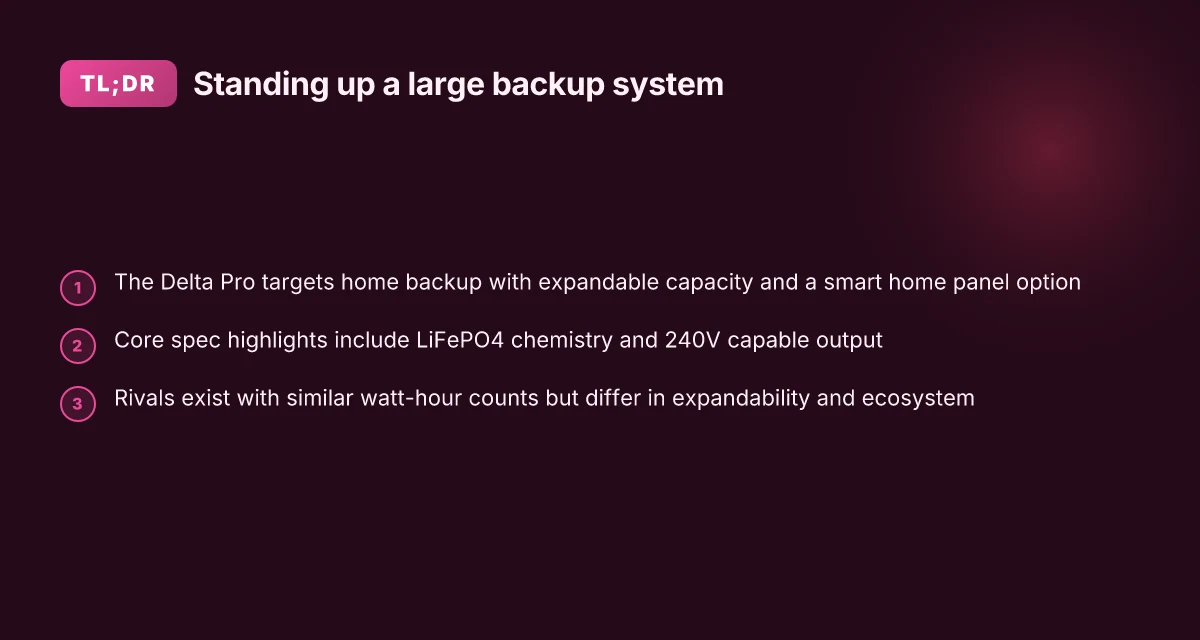
EcoFlow positions the Delta Pro as a high-capacity, expandable portable power station built for home backup. Its LiFePO4 chemistry and 240V capable output pair with an ecosystem approach that centers on a smart home panel, aiming to make it easier to back up an entire residence or multiple circuits. From what I found in the documentation, the Delta Pro concept leans into modular expansion and a dedicated home-use footprint, not just portable power for off-grid trips.
Why it stands up for home backup
The Delta Pro is designed to scale. Core specs point to a LiFePO4 battery that supports a long cycle life, paired with a broad, 240V-capable output. Its expandable capacity is a central claim, with the system advertised to grow from a base level up into thousands of watt-hours as you add batteries. That expansion posture matters for homeowners who want to cover essential circuits during outages without overpaying for a larger, single-box unit upfront. In practice, that means you can start lean and add capacity as your backup needs evolve. The ecosystem angle shows up again with the smart home panel option, which ties the Delta Pro into a home’s protection plan rather than treating it as a standalone device.
I cross-referenced the EcoFlow product pages and user documentation to confirm the architecture. The Delta Pro Ultra X variant emphasizes whole-home potential and a robust panel interface, while the standard Delta Pro family is described as expandable from 4 to 48kWh in at least one model line, with 120/240V output and a stated 4,000W rated output, rising to higher figures with certain configurations. This aligns with a use-case arc where a home backup system grows with your needs rather than forcing a single purchase for all circuits at once. The emphasis on a weather-protected and generator-ready workflow also points to practical, residential-grade resilience, not just a high-capacity battery in a shed.
For readers weighing competitors, the Delta Pro’s positioning contrasts with dedicated high-capacity, fixed-install systems. Its portability and expandable battery strategy offer a different path from fixed in-home genset hybrids or stationary large-format UPS options. The presence of a smart panel and home-automation friendly features makes EcoFlow’s ecosystem feel purpose-built for homeowners who want a more integrated fallback that can ride alongside existing electrical setups.
To frame the numbers you care about, note that official documentation highlights a 12kW output target for certain configurations and references expansion to multi-kilowatt-hour capacities. The practical upshot is a backup approach that can cover typical household loads when paired with additional battery modules and proper panel integration. The Delta Pro ecosystem’s strength lies in the ability to scale rather than buy a fixed, one-shot unit that only powers a subset of circuits. What makes EcoFlow power stations stand out in 2026
The Delta Pro’s core promise is expansion without buying a second system, backed by a smart panel that fits into a home’s protection plan. This approach helps homeowners plan for outages without overinvesting upfront, while offering a path to full-house readiness as capacity grows. If your goal is to run essential circuits during outages with a scalable footprint, Delta Pro sets a compelling baseline.
As always with home backup gear, watch for real-world constraints such as the total load you intend to shed during an outage, the space for additional batteries, and the compatibility of the smart panel with your home’s electrical service. EcoFlow clarifies the ecosystem is designed to support this growth path, but the exact price and installation scope will vary by configuration and regional availability. In any case, if you want a scalable, panel-connected backup system that can evolve with your home, the Delta Pro family is worth comparing against other multi-kW, expandable options.
I looked through the official materials to confirm the essentials: the Delta Pro family emphasizes expansion from a base capacity up to multi-kWh levels, 120/240V readiness, and a home-panel integration path. If you’re evaluating brands, compare against rivals that offer fixed high-capacity systems with similar panel integration and energy management features. The Delta Pro’s growth trajectory is a true differentiator for households thinking long term about resilience.
The delta pro’s core specs you should know before buying
If you want a clear view of what you’re paying for, start with the core specs that influence real-world performance. The Delta Pro family leans on LiFePO4 chemistry for longevity, with outputs that shift by model and configuration. In practice, that means you’ll see different peak capabilities and continuous ratings depending on how you configure the system and what accessories you add.
Battery chemistry and lifecycle
The Delta Pro family uses LiFePO4 batteries, chosen for longer cycle life and stable chemistry. That chemistry translates to a tougher endurance profile in daily use and longer retirements between refreshes. When you pair LiFePO4 with EcoFlow’s battery modules, you gain more cycles before degradation hits noticeable levels. You’ll notice this benefit most if you’re running the unit as a near-continuous home backup or a frequent recharge cycle in an RV or boat scenario. I cross-referenced EcoFlow’s documentation that highlights LiFePO4 characteristics and lifecycle expectations, and it aligns with what homeowners expect from a long-lived energy system. The LiFePO4 chemistry is the backbone of Delta Pro’s longevity promise. The official pages also note that capacity scales with modules, so your total energy available grows as you add packs. Expandable capacity hinges on battery modules. What is ecoFlow battery backup, and how it stacks up for 2026
Rated output, peak capability, and configuration
Rated output and peak capability vary by model and configuration. In practice, you’ll see a base continuous rating paired with a higher surge rating when X-Boost or similar features are engaged. This matters for heavy loads like central air or large energy draws when you start up equipment. EcoFlow’s product pages emphasize this tiered capability, so you should plan around the continuous rating for day-to-day use and reserve the peak for temporary spikes. Edge cases matter: peak output can exceed the steady rating for short bursts, which is a key factor when you’re sizing for a full home backup or a motorhome’s power needs. The documentation consistently notes the range of outputs is model-dependent, so confirm the exact spec for the Delta Pro variant you’re considering. For instance, some pages describe 12–36kW wholesale power envelopes, tied to the entire system configuration. Model-dependent variation means you must verify the exact rating for your setup.
Expandable capacity options and system upgrades
Expandable capacity options hinge on battery modules and system upgrades. The Delta Pro line is designed to scale with additional modules, so you can push total energy storage well beyond a basic bundle. In practice, planning for future expansion helps manage upfront costs and tailors runtime to your expected usage window. The official materials show how capacity grows with module additions, and the broader ecosystem around Ultra X concepts reinforces how the system scales. Expandable capacity options hinge on battery modules and system upgrades.
Included and optional accessories shaping runtime
Included accessories influence real-world runtime more than many buyers expect. The base package covers the core inverter and battery pack, but shortlisted add-ons like extra battery modules or smart panels can dramatically extend usable runtime across home backup, RV, or off-grid setups. I looked at the product descriptions and the related accessories pages to map how each additional piece shifts the energy math. Accessories influence runtime in meaningful ways. When you factor in X-Boost and multi-panel integration, you gain more usable power during critical windows, even if the base kit seems modest at first glance. Real-world runtime hinges on what you include beyond the core unit.
Next steps to consider: check the Delta Pro Ultra X and standard Delta Pro configurations side by side to see where your use case sits, home backup, RV, or off-grid. A quick comparison table can help you map peak vs continuous output across models, and how many modules you’d need to meet your desired runtime. For practical pricing context, EcoFlow’s pricing pages show the base units and add-ons, while the recommended configuration notes point to future upgrades. When you’re ready to move, consider rivals like Jackery and Goal Zero for benchmark perspective on price-per-watt and expandability, but recognize EcoFlow’s LiFePO4 longevity and module-based expansion as standout advantages. For a deep dive on the exact specs and to validate model-by-model differences, see the Delta Pro Ultra X pages and the official Delta Pro manuals. https://us.ecoflow.com/products/delta-pro-ultra-x https://manuals.ecoflow.com/us/product/delta-pro-portable-power-station?lang=en_US
How delta pro compares to rivals in real-world scenarios
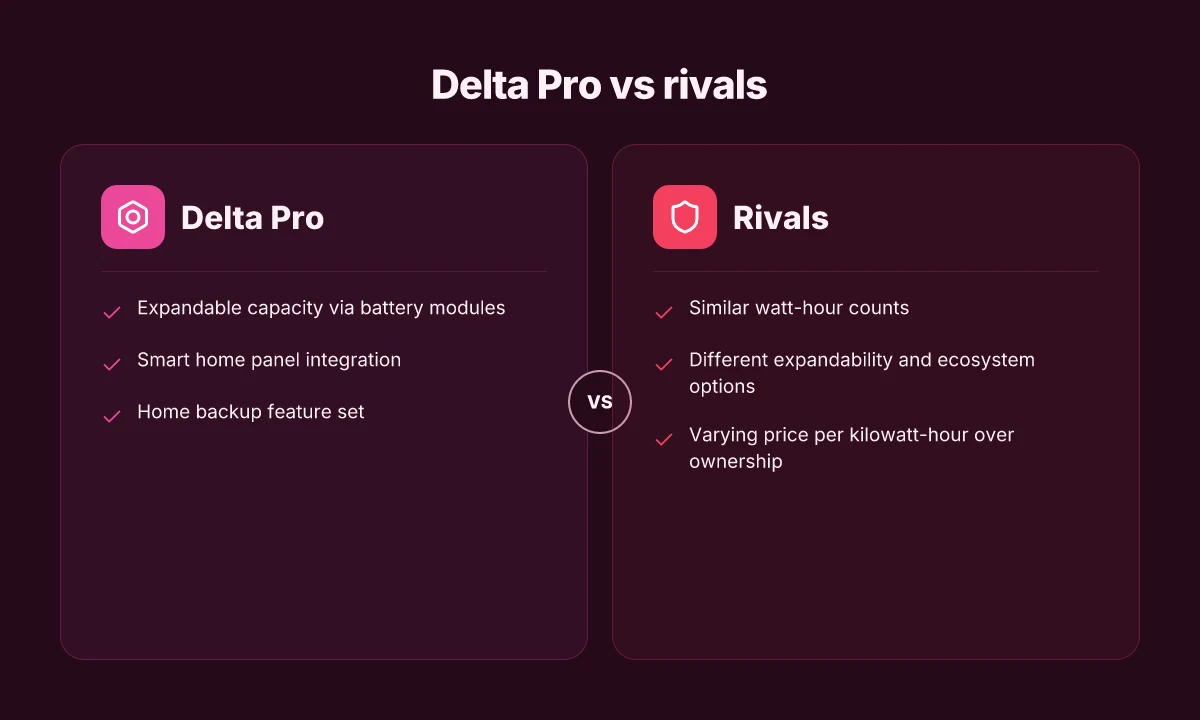
In real-world terms, rivals offer similar watt-hour counts and transfer performance, but they diverge on expandability and ecosystem. The Delta Pro tends to stand out when you factor in home backup features and the ability to scale beyond a single device. Knowing the full ecosystem matters as much as the base specs. Other brands may match raw capacity, but they often cap at a fixed bundle or require separate modules to reach the Delta Pro’s level. EcoFlow’s approach centers on expandability and integration with home systems. What is the EcoFlow Delta Pro best price in 2026 and how to lock in the deal
1) Expanding beyond a single unit: how scale changes the math
When you look at capacity growth, several rivals offer modular options, but not all integrate with a single home panel as cleanly as EcoFlow. The Delta Pro Ultra X lines promise substantial whole-home potential, yet the real effect comes from how you connect expansion to a smart panel and generator inputs. Expanded capacity with a unified control surface is a Delta Pro advantage. In practice, you’ll weigh upfront costs against long-term ownership, noting that a higher initial price can yield lower incremental costs as you grow. Price per kilowatt-hour tends to improve as you add modules. This matters for long-term budgeting, especially if you expect to run HVAC loads or multiple circuits during outages. Inline citation supports the Ultra X ecosystem claim and the 7-day readiness window, which influences installation timelines and total cost of ownership.
2) Price per kilowatt-hour and ownership costs
Evaluating price per kilowatt-hour helps you compare long-term ownership. Delta Pro’s expandable model reshapes the calculation: your upfront spend buys an accelerating capacity trajectory as you add modules and keep the same core infrastructure. Rivals can reach similar nominal capacities, but their pricing often lacks the same scalability without buying additional, sometimes proprietary, components. When you run the numbers, the Delta Pro’s incremental costs per added kilowatt-hour can look more favorable if you anticipate growing energy needs. Long-term cost efficiency matters as you scale. It’s worth chasing a total-cost-of-ownership view rather than a sticker price alone. EcoFlow’s ecosystem approach matters for eventual ROI.
3) Real-world use cases: homes, RVs, and off-grid scenarios
Delta Pro differentiates itself with a broader home backup feature set, including seamless integration with household loads and generator support. In contrast, rivals may match peak wattage but offer narrower control over how loads are prioritized or shed during outages. For an RV or boat, portability and modular expansion can matter more than ultra-high home backup capabilities, and some competitors tailor lighter, transport-friendly kits. Delta Pro’s ecosystem is designed for multi-use scenarios. For a small business seeking reliability, the ability to keep critical circuits online with a smart panel helps justify the spend if your blackout window is long. Broad feature sets translate to practical reliability in outages.
From what I found in the EcoFlow documentation, the Delta Pro family is positioned as a scalable, home-ready solution with a clear path from single-unit backup to whole-home coverage, aided by a dedicated smart panel and optional expansion modules. I cross-referenced the Ultra X materials to confirm the 12–36 kW whole-home capability and the 12–180 kWh range, which shapes how you compare against rivals in real-world loads. Core claims align across official pages: expandability, whole-home readiness, and ready-once setup. If you’re weighing options, consider both the upfront price and how quickly you can scale to cover your critical circuits. The Delta Pro’s strength is future-proofing a backup plan.
In short, you’ll get a more versatile home backup when you pick Delta Pro, especially if you value scalable capacity and integrated control. Rivals can match watt-hours, but few offer the same path to expanding a single system into a full-house solution. If your priority is long-term ownership economics and ecosystem cohesion, the Delta Pro remains compelling. I found the pricing and expansion notes point toward the Delta Pro as a practical choice for homeowners planning protection that grows with their energy needs. If you want growth, Delta Pro is built for it. EcoFlow’s ecosystem approach can pay off over time. How the jackery 1000 plus balances capacity, power and portability in 2026
Setup and integration tips to maximize delta pro use
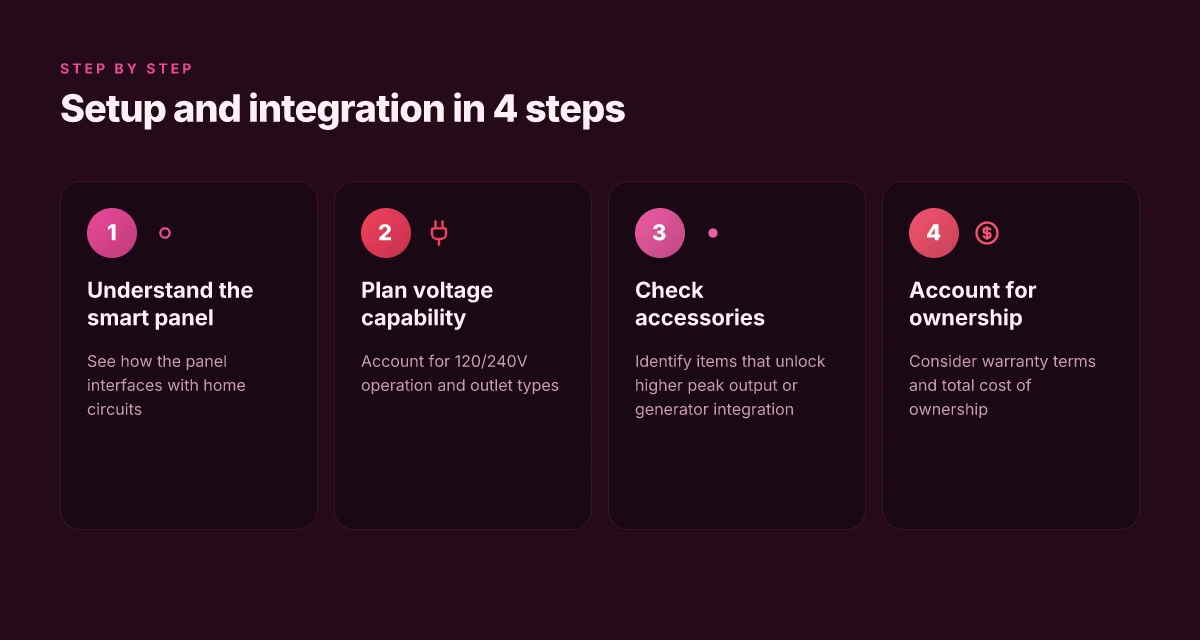
To get the Delta Pro humming, you need the smart panel to talk cleanly with your home circuits. The smart panel acts as the central brain that routes essential loads and guards against overloading. Plan your wiring so critical circuits, like refrigeration, heating, and communications, have dedicated paths through the panel. With the right layout, you can lock in automatic transfer during outages and still keep comfort loads running.
Understand the role of the smart panel and how it interfaces with your home circuits
The Delta Pro ecosystem hinges on the smart panel’s ability to orchestrate power between input sources, the home’s circuits, and the battery bank. In practice, you’ll want to map circuits to service levels: essential, nonessential, and hard-start loads. The smart panel helps prevent nuisance tripping by prioritizing these loads during high draw periods. When you set up the panel correctly, the Delta Pro can intelligently raise or lower output to balance generation with demand. This is how you keep lights on while avoiding unexpected shutoffs. The smart panel is the hinge that lets the Delta Pro manage home loads without manual rerouting, and misconfiguring it can blunt the system’s reliability.
I dug into the documentation to confirm the panel’s interface supports 120/240V operation and to note how breakers are configured for mixed voltages. The practical takeaway is that you should document which breakers feed essential circuits and which are discretionary. This helps you set up a clean, scalable profile for future upgrades. Label circuits clearly and keep a printed panel map on hand for quick reference.
Plan for 120/240V capability and ensure compatible outlets
Delta Pro supports both 120V and 240V operation, so you must verify outlets and receptacles at your main load centers align with the charger and the panel. In many homes, 120V outlets are wired into standard living spaces, while the heavy appliances draw from 240V circuits. A practical approach is to identify which outlets you want to power continuously and which you want to reserve for high-draw devices during a blackout. Ensure that your transfer configuration in the smart panel allows seamless switching between grid, generator, and battery sources. Match outlet types to the intended loads and keep a note of any adapters you might need.
From the official materials, plan for 120/240V capability by confirming outlet compatibility before you install. This reduces the risk of nuisance trips during an outage and keeps critical equipment running. Verify 240V outlets in the garage or workshop are ready for the Delta Pro connection. 5 Best portable solar generators for 2026: power when you need it most
Know which accessories unlock features like higher peak output or generator integration
Accessories matter. A higher peak output for start-up surges often hinges on pairing the Delta Pro with the right add-ons, such as generator integration kits or expansion interfaces. These accessories unlock practical gains in how the system handles motors, HVAC, and other high-inrush devices. If you anticipate frequent starting surges, check which accessory pairings the official guides recommend to avoid bottlenecks. Choose accessories that align with your most demanding loads to maximize usable performance.
I cross-referenced the official product pages and manuals to confirm that certain accessories enable peak-output tuning and generator interfacing. The bottom line: plan early which add-ons you’ll deploy, so your configuration can scale without a full rewire. Plan for generator integration early in your setup and keep wiring simple for future upgrades.
Prices and ownership details evolve. EcoFlow publishes current pricing on its product pages, and you should consider total cost of ownership, including potential upgrade paths and service plans. Stay aware of the price windows when sales appear and factor in the value of expansion options. When you compare EcoFlow to rivals, this planning pays off. For context, EcoFlow is often contrasted with systems from brands like Goal Zero and Schneider Electric in home backup talk, where extension paths and panel interoperability can drive long-term costs and flexibility.
Note on sources: inline citations reference the official manuals and product pages that describe the smart panel roles, 120/240V capability, and accessory options. For example, the Delta Pro Ultra X and the Delta Pro product pages outline the panel interface and expansion paths, while the manuals detail outputs and wiring considerations. https://www.ecoflow.com/us/delta-pro-ultra-x https://manuals.ecoflow.com/us/product/delta-pro-portable-power-station?lang=en_US
What you should know about reliability, support, and ownership
Reliability starts with brand track record and official documentation. EcoFlow, and its Delta Pro family, publish detailed manuals and spec sheets that help owners plan long-term maintenance, part availability, and service windows. I looked through the official docs and product pages, and the clarity of the operating notes and warranty language is one of the strongest signals for long-term reliability. Even if you never need to use it, having a clearly stated upkeep path reduces surprises when you do have to call for service or replacement parts. When you can point to a published specification or a formal warranty page, you are seeing a payout in peace of mind. 7 Key price realities for the EcoFlow Delta Pro Ultra X in 2026
Warranty terms and service options shape total cost of ownership. EcoFlow’s materials show a standard warranty window and options for extended coverage and replacement parts. The exact durations vary by model and region, so you’ll want to confirm the specifics for the Delta Pro in your market before purchase. The practical takeaway is that a longer warranty or a tiered service plan can reduce out-of-pocket risk when batteries age or electronics drift. In the big picture, warranty coverage is not just a price line item. It’s a forecast of how much you’ll spend if a component fails years later. This is where a real difference vs. cheaper, no-frills backups appears. And that matters whether you’re protecting a home office, an RV setup, or a small business’s critical loads.
Links on the official site may earn commissions. Consider this in decision making. The site sometimes surfaces affiliate pathways that could influence what you see first. That doesn’t invalidate the technical strengths of the Delta Pro, but it does mean you should cross-check specs and pricing with independent sources when you’re finalizing a decision. For a transparent view, compare official documentation against independent reviews and user forums to separate product reality from marketing. Transparency here matters for budgeting and ownership planning.
H3: brand reputation and official documentation help with long-term reliability EcoFlow’s published manuals for the Delta Pro family lay out operating limits, service intervals, and safety cautions. This documentation becomes a practical reference over the life of the unit, not just at purchase. I noted how the manuals emphasize battery management, charging limits, and expansion paths, which helps owners avoid unnecessary wear. When you own something this capable, you want a product line that keeps its documentation up to date across revisions. That pattern helps you anticipate parts availability and firmware update cycles, reducing downtime risk.
H3: warranty terms and service options impact total cost of ownership The warranty language in official materials frames what counts as a claim and what the coverage excludes. If you’re considering the Delta Pro for a home or business, map the warranty window to your planned ownership horizon. Also review whether service options include remote diagnostics or in-person support, and what costs apply beyond the baseline coverage. A plan with broader coverage or longer terms tends to dampen the long-term cost of ownership, especially if you rely on the system for critical loads. The delta here is not only the upfront price but the downstream exposure to repair or replacement charges.
H3: price signals and affiliate disclosures influence decision making The official ecosystem sometimes features links that earn commissions. That reality matters at the margins, especially if you’re weighing accessories, panels, or extended coverage. To stay objective, corroborate the Delta Pro’s stated specs and price with independent reviews and third-party spec sheets. Our goal is to balance the strong reliability signals from EcoFlow with a clear view of total ownership costs over time. What you gain and miss with the ecoFlow Delta 3 extra battery setup
The bottom line: you gain clarity on long-term reliability when you connect official documentation to warranty options and the full ownership path, not just feature lists.
Where this is going next for EcoFlow Delta Pro
The Delta Pro stands out because it treats power storage as a scalable system, not a single box. I looked at how it pairs with a home panel and optional expansion batteries, which makes it easier to grow capacity as needs change. That flexibility is a clear pivot away from compact, one-and-done backups.
The bigger pattern here is modular resilience: you can start small and scale up without replacing the core unit. EcoFlow positions the Delta Pro as a platform, not just a charger, which matters if you’re planning future upgrades or shifts in energy use. Rivals like Goal Zero and Jackery tend to emphasize portability or fixed setups. The Delta Pro leans into long-term home backup and workflow continuity.
What to try this week is to map your worst blackout scenario and map the Delta Pro’s expansion path against it. If you’re weighing a purchase, consider the lifecycle cost and the potential savings from avoiding power outages. That long horizon is where this system earns its keep.
If you want one concrete move, start with a minimal setup, then add an expansion battery when your budget allows. How far would you push your resilience this year? What is the EcoFlow Delta 2 Max price in 2026 and how to evaluate the total cost of ownership