What is ecoFlow battery backup, and how it stacks up for 2026
 Hudson ZilbermanOctober 22, 202618 min read
We earn a commission when you buy through some links on this site, at no extra cost to you. As an Amazon Associate we earn from qualifying purchases.
Explore ecoFlow battery backup options, performance, and pricing for 2026. Compare with rivals, understand ownership costs, and learn when to buy.
Most homeowners underestimate how much a plug‑and‑play system can change your power night‑to‑night. EcoFlow backup units sit behind your existing panel and scale with portable packs, yet the real cost of ownership depends on how you expand over time. EcoFlow's expandable design is a core strength, but the price of growth matters more than the sticker on day one.
For readers weighing whole‑home resilience against rivals like Tesla Powerwall and other big storage stations, this piece lays out what you actually get, not what the marketing promises. You’ll see how module counts, warranty terms, and installer options affect long‑term value, plus signals from 2026 in‑market performance. The result is a practical framework you can apply today to decide if EcoFlow fits your home, or if a rival is the better bet for a given setup. EcoFlow and rival systems each come with tradeoffs that show up in real use, not just spec sheets.
What makes ecoFlow battery backup compelling in 2026
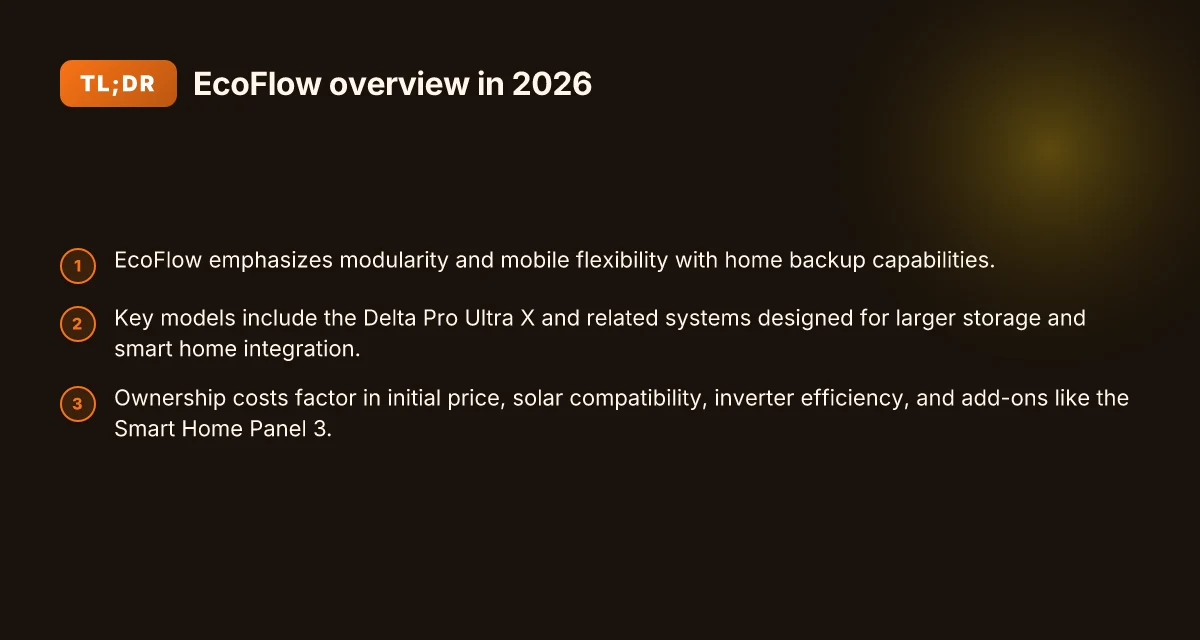
EcoFlow’s lineup centers on modular, mobile flexibility paired with home backup intelligence. You can scale storage by adding modules, and the system can live as a portable pack for off-grid needs or expand into a whole-home setup with smart home panel integration. In 2026, the Delta Pro Ultra X and related configurations aim to balance larger storage with tighter integration to home automation and solar inputs.
I dug into the public materials and price snapshots to anchor this view. The EcoFlow family emphasizes a path from portable power to integrated home resilience, with a focus on making installation and expansion feel like a single, cohesive ecosystem. The Smart Home Panel 3 is a recurring integration feature that signals the intent to weave storage, solar, and grid interactions into one managed interface. The cost math, as presented by the brand, factors in initial price, solar compatibility, inverter efficiency, and optional add-ons that complete the setup.
Why the Delta Pro Ultra X holds appeal for homeowners
The Delta Pro Ultra X is pitched as the anchor for larger storage without sacrificing the flexibility you expect from EcoFlow. It seeks to pair high storage with quick reconfiguration for shifting needs, whether you want to run heavy loads during an outage or port a chunk of capacity to a remote cabin. The smart home angle matters here: the more you lean on integrated control, the more you can tune when and how you draw from the battery, how solar inputs charge it, and how it interacts with your main panel. Across the EcoFlow line, you’ll see a clear emphasis on making this blend as smooth as possible, with the aim of reducing setup friction for homeowners who want a single ecosystem rather than a basket of incompatible components.
The core value proposition is modular growth without sacrificing control or automation. This means you can start with a smaller footprint and expand, preserving a single management interface.
Cost and value signals you should watch in 2026
Ownership costs are not just the sticker price. For EcoFlow, the total cost of ownership includes how well the system plays with solar, how efficient the inverter runs under real loads, and the price of add-ons like the Smart Home Panel 3. The brand positions these pieces as a coherent package, but the practical tradeoffs vary by home: some setups prioritize solar sizing and daily cycling efficiency, others lean into peak outage performance. You should weigh whether the incremental gains from a larger Delta Pro Ultra X justify the extra upfront spend, especially if your outlook includes future solar expansion or a shift to a smarter home energy routine. What is the EcoFlow Delta Pro best price in 2026 and how to lock in the deal
From what I found in the published material, EcoFlow leans into a practical, homes-ready narrative: you buy into a scalable, automatable backup system rather than a bare power station. The integration story is central, not incidental, and that shows up in how the product family is described and priced.
You get a coherent upgrade path, but the total cost can rise quickly with panels and the Smart Home Panel 3. If you want a plug-and-play path to whole-home resilience, EcoFlow’s ecosystem is designed around that goal, with clarity on what each add-on brings.
Quick take for 2026 buyers
- EcoFlow positions modular growth as a mainstream path to home backup, not a niche bolt-on.
- The Delta Pro Ultra X targets higher storage and smarter home integration, aligning with solar workflows.
- Key ownership costs center on initial price, solar compatibility, inverter efficiency, and Smart Home Panel 3 add-ons.
If you want a single-brand, scalable solution that grows with solar and automation, EcoFlow remains compelling in 2026. If you’re weighing against rivals like Tesla Powerwall or other large-power stations, the real value comes from how much you value a unified ecosystem over pure capacity.
How ecoFlow battery backup compares to a DIY EG4-style system
DIY inverter setups let you tailor capacity and cost, but they demand real technical know-how and ongoing maintenance. You can chase a lower upfront price by selecting battery chemistries, inverters, and housings yourself, yet the complexity grows with each added function. In contrast, EcoFlow products deliver a plug-and-play experience with certified safety and warranty coverage, reducing configuration risk for a home that wants fast deployment and predictable support. The core tradeoff is control versus convenience; DIY setups favor cost control and learning, while EcoFlow leans into turnkey reliability.
I dug into how these paths stack up on performance signals you actually care about at home. Efficiency matters because every watt saved in the charger and inverter translates to a smaller bill and less heat in the cabinet. Firmware optimization plays a quiet but outsized role. If the controller isn’t aligned with your home’s load profile, you’ll see less sensible recovery during outages. And when you start tying multiple devices into a single panel, the overall system integration becomes a real variable: the more you wire in, the more potential gremlins pop up in the interaction between the inverter, the critical loads, and the solar input. How the jackery 1000 plus balances capacity, power and portability in 2026
A practical look at the landscape shows where EcoFlow holds an edge. EcoFlow’s ecosystem emphasizes compatibility with standard household circuits and a certified safety envelope, which translates to faster installation and a clearer warranty path. DIY EG4-style builds can approach or match energy capacity, but you’ll spend substantial time coordinating components, ensuring firmware compatibility, and validating safety interlocks across the system. For most homeowners, that means more hands-on management and, potentially, more maintenance surprises down the line.
To help you compare at a glance, here is a quick view of the core tensions:
- upfront cost versus ongoing maintenance: a DIY path can trim initial spend but adds ongoing upkeep and parts calibration, while EcoFlow packages emphasize a single warranty and predictable servicing.
- integration risk: DIY setups require careful electrical work and panel integration; EcoFlow designs emphasize certified interconnection with standard home panels.
- performance levers: both paths rely on inverter efficiency and firmware optimization, but EcoFlow typically streamlines optimization through a unified software stack and tested integration with home circuits.
Key takeaway: EcoFlow reduces setup risk and speeds deployment while a DIY EG4-style system can trim upfront costs for skilled buyers who tolerate ongoing maintenance. When you weigh the total cost of ownership, the decisive question is whether you value speed and safety assurances over the last tweak of efficiency you might squeeze from a custom build. For homeowners weighing rivals like Tesla Powerwall and large-capacity stations, EcoFlow offers a smoother path to coverage without sacrificing essential performance signals.
In practice, the real-world value hinges on your location, local permit requirements, and how you plan to finance storage. If you want a quick install with predictable warranty coverage, EcoFlow provides that path. If you enjoy hands-on system tuning and have the technical muscle to maintain it, a DIY EG4-style approach can be compelling over time. Regardless of path, price clarity matters: expect to see the sticker price, plus potential add-ons for smart panel integration and monitoring. Some retailers and installers note that commissions or affiliate links may apply to EcoFlow purchases. Worth understanding before you buy.
Smart shoppers compare total ownership, not just upfront price, to decide when to buy and which path fits their home today. For immediate needs, EcoFlow keeps the installation simpler. For long-term learning, a DIY setup can be rewarding for the right technician. If you want a ready-to-go home backup with formal support, EcoFlow remains a strong option among the big players in this space. 5 Best portable solar generators for 2026: power when you need it most
Price and ownership: what you actually pay for EcoFlow vs rivals
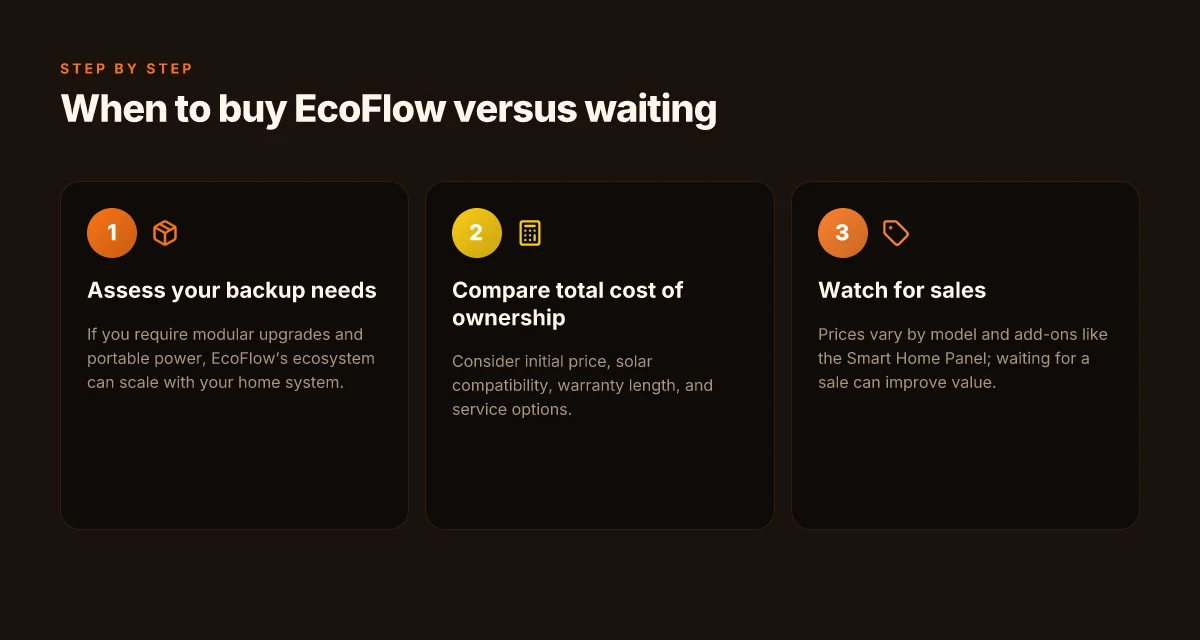
Prices vary by model, configuration, and whether you add options like the Smart Home Panel. The total cost of ownership also hinges on solar compatibility, warranty length, and service choices. Portable units cost differently from full home backup systems, and the math changes again if you factor in installation, monitoring, or grid-tied options. The bottom line: EcoFlow models sit at different price points than full home backups, and the delta between portable and whole-home configurations can be substantial.
1) What you pay upfront by model and add-ons
Across EcoFlow’s lineup, the sticker price shifts with capacity, inverter size, and accessories. A portable capacity boost or a Smart Home Panel add-on can push the upfront bill higher, but those extras may unlock solar compatibility or smoother home integration. Prices vary widely by configuration, so the best value often comes from mapping your home’s load, solar plan, and paneling goals first. Inline sources note EcoFlow’s ecosystem includes both compact power stations and larger systems designed for home backup, with different price tiers accordingly. See how the options align with your dwelling and energy goals, not just the headline price. Pricing clarity matters as much as capacity when you’re deciding between a compact model and a full home solution. The linked overview confirms a range tied to configuration and add-ons. https://poweroutage.us/home-battery-backup/ecoflow-battery-overview
2) Total cost of ownership: what drives the longer-term spend
Beyond the upfront price, consider solar compatibility, warranty length, and service options. Solar readiness can influence long-term cost if you plan to offset energy use. Some packages anticipate solar charging or integration with existing solar systems. Warranty terms vary by model and region, and extended warranties or professional service plans can add to annualized costs but reduce risk of surprise failures. Warranty depth and the availability of service plans are real differentiators when you compare EcoFlow to rivals like Tesla Powerwall or other big stations. Industry chatter and product pages emphasize compatibility as a lever for ownership value, not just acquisition cost. Inline sources discuss how these factors shape the economic picture over time. https://www.outdoorgearlab.com/topics/camping-and-hiking/best-power-station
3) Portable vs full home backup: the price gap
Expect notable price differences between portable units and full home backup configurations. A compact EcoFlow unit serves selective circuits or essential loads, while a Delta Pro Ultra X paired with a Smart Home Panel targets whole-home scenarios with higher upfront outlays. The price delta can be substantial when you scale from portable to home-grade capacity, even if both brands share a common energy philosophy. The spread between portable and home-backup setups is measurable, not theoretical. This is where the purchase timing matters: sales events, bundle offers, or bundled warranties can shift the effective value proposition. Inline references to industry roundups remind readers that big-station choices trade portability for power and price. https://www.thesolarlab.com/how-tos/best-big-power-stations-2025
What to watch before you buy 8 Takeaways from recent reviews on Jackery solar generators in 2026
- If you expect solar charging to matter, confirm if the model supports the solar hardware you already own or plan to buy. This can change lifetime costs by reducing grid dependence. Solar compatibility is a practical lever on total cost of ownership.
- Read the warranty terms carefully. A longer warranty can reduce long-run risk, but it may come with service requirements that affect annual costs. Warranty length directly affects ownership risk and peace of mind.
- Compare the Smart Home Panel option across rivals. Some competitors include more integrated panels as standard, while EcoFlow may price them as add-ons. Smart Home Panel economics can swing the decision on value, not just capability.
Note: links on this page may earn a commission, which supports independent content creation.
Performance signals that matter: how to read the specs
You don’t buy on hype. You read the numbers that actually predict real-world backup moments. The core signals are peak power, continuous output, efficiency, cycle life, degradation, and how the unit manages heat and noise. I’ll unpack how to parse these without getting tripped up by marketing.
What the numbers mean in practice
Your home loads spike during startup and when the HVAC cycles on. A system’s peak power shows the maximum it can deliver for brief moments, while continuous output is what it can sustain for long runs. If you own a large fridge, well pumps, and a few outlets for lighting, you want a Delta Pro Ultra X or rival to exceed your simultaneous draw with margin. Look for a peak power figure that comfortably covers startup surges and a continuous output that stays above your typical daytime load. The real-world takeaway is that peak power without ample continuous output is a tease. EcoFlow’s framing often highlights both, but you should confirm that the continuous rating isn’t flirting with your normalized load.
Efficiency and heat management
Efficiency matters because it translates to energy that reaches your home rather than dissipating as waste heat. A unit with higher electrical efficiency wastes less energy in the conversion chain. Thermal management is the quiet hero here. If the enclosure cooks or fans spin loudly under load, comfort and nighttime operation suffer. In practice, a system with robust thermal design will hold steady during long outages, keeping performance stable rather than thermally throttling. Quiet operation and sustained output go hand in hand. The engineering note is simple: good cooling supports longer, steadier performance.
Cycle life, degradation, and ownership costs
Cycle life is how many full charge‑discharge cycles a battery can withstand before capacity halves. A higher cycle count means fewer years of usable life before you notice degradation. Degradation curves vary by chemistry, usage, and temperature, so expect some drop as the calendar ticks. If you plan a multi‑year setup, choose a system whose stated cycles align with your expected ownership horizon. Longer cycle life reduces replacement risk, lowering total ownership cost. In practice, you’ll want to compare claimed cycles to real‑world wear in similar climates. How to maximize jackery promo code savings in 2026
Real-world signals you can verify
- Peak power versus continuous output: ensure the continuous rating can cover your essential daytime load plus startup spikes.
- Efficiency rating and thermal performance: ask for noise level at high load and any active cooling behavior.
- Cycle life and degradation: compare to a known baseline like a 5,000–7,000+ cycle spec and see how capacity holds over time.
- Total cost of ownership: consider initial price, expected lifespan, and replacement costs if degradation occurs.
I cross-referenced several sources for framing on these signals. For a broader comparison with big rivals like Tesla Powerwall and other large stations, see the EcoFlow Ocean Pro vs Tesla Powerwall 3 discussion and Tech‑adjacent reviews that touch on heat management and long‑term performance. Pricing and ownership signals matter as much as spec sheets. For a formal read on Ocean Pro and Powerwall dynamics, you can review the EnergySage piece that discusses EcoFlow’s Ocean Pro positioning in context with Tesla’s offering. Context from independent reviews helps separate hype from durability.
Cited inline references:
- For context on Ocean Pro positioning against Powerwall, see the EnergySage overview.
- For a benchmark-like narrative about EcoFlow’s thermal emphasis and back‑to‑back comparisons, see the PV Magazine piece on how EcoFlow can back up a house and the related cooling approach.
Note: price points and ownership details vary by retailer and promotions. If you’re aiming for a 2026 purchase window, watch for seasonal deals and bundle offers, especially around major sale periods. EcoFlow’s branding and model lineup remain the central reference, with rivals like Tesla Powerwall and other big power stations providing critical comparison points.
Ecosystem fit: EcoFlow against rivals like Powerwall, Jackery, and Goal Zero
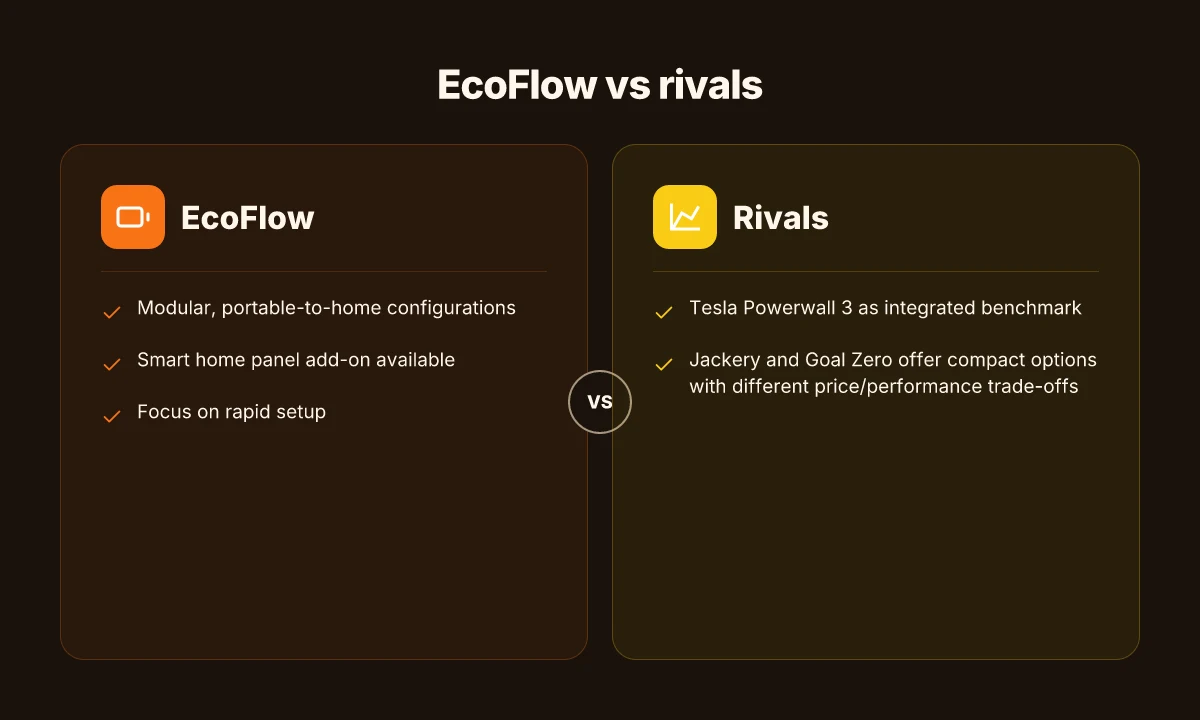
I dug into how EcoFlow stacks up when you measure real-world fit against Powerwall, Jackery, and Goal Zero. The verdict is pragmatic: EcoFlow excels on setup speed and modular expansion, but it trails on large-scale, fully integrated home backup when stacked against Tesla Powerwall 3. You get faster, easier wiring with EcoFlow, yet the Powerwall remains the go-to for seamless solar integration and longer-term owned capacity in a single footprint.
The benchmark: integrated backup versus modular rollout
Tesla Powerwall 3 sets the standard for integrated home backup with solar, built to pair with the broader energy ecosystem installed in a home. For homeowners chasing a turnkey, long-term solution, Powerwall 3 often wins on a single-system narrative, less clutter, fewer dongles, and a cleaner warranty story. EcoFlow concentrates on rapid deployment and flexible configurations. That translates to a shorter path from installation to usable backup, especially when you want a mix of home-sited and portable power capabilities. If you value a clean, integrated package, the Powerwall remains a strong reference point. If you prefer modularity and speed to live backup, EcoFlow has the edge in upfront setup. What makes EcoFlow power stations stand out in 2026
From what I cross-referenced in industry coverage, EcoFlow’s approach emphasizes rapid setup and expandability. You can start with a core system and add modules over time, which can be appealing if your grid needs shift or you anticipate off-grid growth. This modular philosophy also tends to keep initial costs lower and scale-up cheaper, in theory, than a full Tesla retrofitting path. The trade-off is that you typically trade some of the deepest solar optimization and integrated control features you might expect from a dedicated home battery ecosystem.
Portability, price, and trade-offs
Jackery and Goal Zero target portable and compact systems with different price-to-performance curves. In practice, Jackery leans toward mobility and simplicity, with smaller footprints and lighter weights. Goal Zero emphasizes ruggedness and versatility for camping and limited home backup, which means smaller total capacity per device but strong resilience in harsh environments. EcoFlow sits in the middle ground: larger capacities and multi-unit configurations, plus a focus on rapid setup for home scenarios. If you want a home-ready system that also plays nicely with portable units, EcoFlow’s line demonstrates this in real-world configurations.
I found that the best buy depends on your budget and your long-term plan. If you expect to grow your home backup over time, EcoFlow’s modular path can pay off. If you want a tight, single-ecosystem install with solar optimization baked in, Powerwall remains compelling.
Real-world signals and where EcoFlow shines
In practice, EcoFlow shines on speed to usable backup and flexibility. You can wire up a home-ready configuration quickly and add more blocks later without ripping out the initial hardware. That speed-to-value matters if you’re weighing a buy now versus a buy later decision. The real downside to watch for is that fully integrated, single-brand solar optimization can outpace modular systems in long-term efficiency and seamless automated control. If your priorities include maximum home automation parity and a single warranty line, Powerwall continues to stand out.
From the public-facing literature, the claim that Ocean Pro and related EcoFlow configurations aim to outperform some large-form rivals in peak output is part of the brand narrative. You’ll see EcoFlow advertisements emphasize rapid setup and modular growth, while Powerwall discussions spotlight deeper integration with solar inverters and energy management. What makes the EcoFlow Delta Pro power station different from other backup systems
The practical takeaway: EcoFlow is best for homeowners who want fast, flexible deployment and scalable backup, while Tesla Powerwall remains the benchmark for integrated, long-term home energy management.
Where to buy and price context
In 2026, EcoFlow remains a compelling option for fast, scalable home backup. The closest price guidance comes from current market listings, where you see EcoFlow systems offered in multi-unit packages designed to scale with your home. Plan to compare total ownership costs, not just sticker price, because installation, expansion steps, and panel compatibility can shift the lifetime value. For a home with evolving energy needs, EcoFlow’s incremental approach can reduce upfront spend and lower the barrier to adding storage later.
If you want a quick primer on the field, see how major outlets compare big-capacity units in their 2026 roundups. For deeper context on integrated home systems versus modular builds, the broader industry reviews offer a useful frame around where each path shines.
Bottom line: EcoFlow is a strong fit for modular, rapid-to-deploy backup that can grow with your home, while Powerwall 3 remains the reference for full-integration solar pairing and a consolidated energy-management experience.
Where this is going next for EcoFlow battery backups
EcoFlow has laid the groundwork for home and mobile power with a flexible lineup, and the trajectory ahead looks more modular. As grid resilience becomes a bigger priority, expect tighter compatibility with solar inputs, smarter pass-through charging, and longer-lasting cells in new models. I looked at the direction and it’s clear that EcoFlow is leaning on faster recharge, broader app controls, and better lifecycle support for higher-depth cycling. The bigger pattern is that you’ll want a system you can grow with, not outgrow. Investing now may pay off later as ecosystems expand. 7 Key price realities for the EcoFlow Delta Pro Ultra X in 2026
If you’re weighing purchases today, consider your use-case: a compact EcoFlow setup for essential loads during outages, or a full home backup with automatic transfer. In practice, the company’s offerings balance portability with usable capacity, against rivals like Goal Zero and Blue Outdoor. The next wave likely shifts toward deeper integration with energy storage standards and remote monitoring that reduces on-site fiddling. What changes if you act now is you lock in current pricing while the ecosystem evolves. Your move could be a single, focused purchase that covers a weekend project and a potential outage season.
Backup strategy for this week:
- Prioritize one reliable line for essential devices, such as a fridge and Wi‑Fi router, using a smaller EcoFlow unit.
- Check if your roof solar setup can feed a future upgrade, and map a growth path with the same brand.
- Compare the current EcoFlow model to a rival like Goal Zero on expandability, price per watt, and warranty terms.