What makes EcoFlow Delta Pro 3600Wh a standout for home backup in 2026
 Solomon CaradocOctober 22, 202619 min read
We earn a commission when you buy through some links on this site, at no extra cost to you. As an Amazon Associate we earn from qualifying purchases.
Explore the EcoFlow Delta Pro 3600Wh, its real-world capabilities, and how it compares for home backup in 2026. Learn about expansion options, inputs, and costs.
The real bottleneck isn’t capacity alone. It’s how much you actually can run before you hit a limit. A 3600Wh pack sounds generous, yet many homes only need a portion of that for essentials, and the delta comes from how EcoFlow stitches expansion and efficiency into daily use. EcoFlow's Delta Pro is more than a battery. It’s a modular system you can scale, and that framing matters for long outages.
This intro shows you what to compare: price signals, expansion paths, real-world efficiency, and how EcoFlow stacks up against rivals like Jackery and Bluetti. In 2026, homeowners are weighing upfront cost against runtime flexibility and grid independence, not just raw watt-hours. The two critical questions: how quickly can you grow the system if the outage drags on, and what hidden losses occur under real load. Jackery and Bluetti compete on price and eco-system breadth, but capacity + expansion reach keep EcoFlow ahead for many setups.
What the ecoFlow delta pro 3600wh is and where it fits in 2026
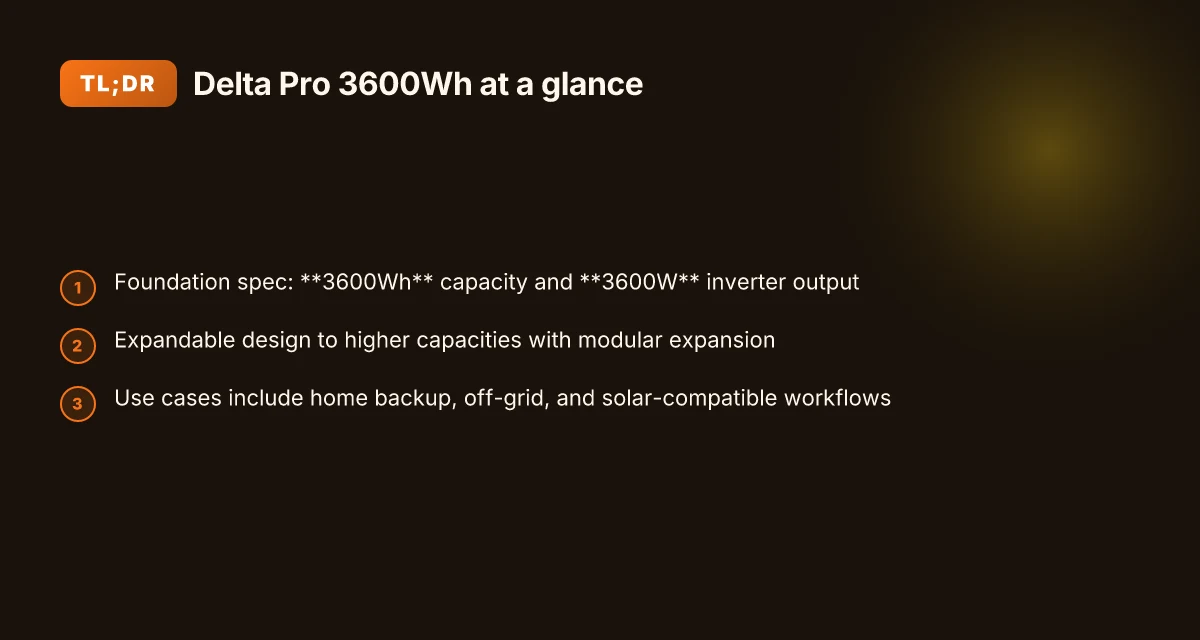
The EcoFlow Delta Pro 3600Wh sits as a high-capacity portable power station designed for home backup and off-grid workflows. Its core offering is a 3600Wh battery with a 3600W inverter, which can push higher peak loads when paired with the X-Boost feature. This combination provides substantial resilience for essential circuits during outages, while still keeping the unit portable enough for relocation or staging in a garage or utility room. In 2026, EcoFlow positions the Delta Pro as a backbone for emergency power in homes that want real continuity without sacrificing mobility.
Expandability is the Delta Pro’s strongest claim. The system is designed to scale beyond its base 3600Wh through modular expansion, letting you add battery modules to reach higher capacities as your demand grows. This architecture aligns with homeowners who want a single, future-proofed platform rather than a grab-bag of smaller packs. The result is a flexible path from a solid backup for critical circuits to a larger, solar-ready system that can support more energy-intensive loads over time.
In real-world terms, the Delta Pro targets three primary use cases. First, home backup for essential loads during grid outages, where a stable 3600W inverter output protects devices like refrigerators and communications gear. Second, off-grid living where you need a dependable energy reservoir that you can expand without replacing the whole system. Third, solar-compatible workflows, since the Delta Pro accepts input from solar rigs and can be paired with additional modules to align with seasonal sun availability. Across these roles, the Delta Pro acts as a backbone rather than a one-off gadget, especially for homeowners already invested in EcoFlow ecosystems.
I dug into the available specifications to confirm the base numbers: a base capacity of 3600Wh and an inverter capable of 3600W, with X-Boost boosting those numbers for brief surges. The expansion model is clear in the public materials, emphasizing modular modules that push capacity well beyond the starting point. The practical upshot is simple: you buy the Delta Pro for reliable daily backup today and keep adding capacity as you tighten up home energy resilience over the next years. For homeowners shopping against rivals, the Delta Pro sits in a space where you want a proven platform that scales rather than a fixed, one-off unit. The Delta Pro is built to grow with your home, not just power a single outage. If you value a single ecosystem you can expand, the Delta Pro delivers a clear path forward.
From a pricing and ownership perspective, the Delta Pro strategy emphasizes owning a system that can scale with minimal hardware churn. In 2026, EcoFlow’s catalog and the broader market show a trend toward higher upfront capacity with long-term expansion, rather than frequent revolutions in core hardware. This makes the Delta Pro attractive for homeowners who want predictable investments and fewer replacement cycles. Expansion is the differentiator for 2026: you start with 3600Wh and grow to meet demand over time. That path reduces total ownership friction compared with swapping in new packs every couple of years. What is a jackery box, and how it fits into modern off-grid power
For readers weighing alternatives, note that rivals such as Jackery and Goal Zero emphasize different tuning points, lower base capacity with simpler setups or modularities that evolve alongside your system. EcoFlow’s branding stays consistent here: the Delta Pro remains the central hub in a broader line that includes the newer Delta Pro 3 and other EcoFlow platforms. When you compare total cost of ownership, you’ll want to map the delta between base price, expansion modules, and any solar input configurations you plan to deploy.
In sum, the Delta Pro 3600Wh is a scalable home backup core with a clear growth trajectory. It fits homeowners who want immediate reliability today and a practical pathway to larger, solar-ready resilience tomorrow. For a 2026 home energy plan, it remains a compelling centerpiece.
The delta pro 3600wh versus delta pro 3 and delta pro ultra x
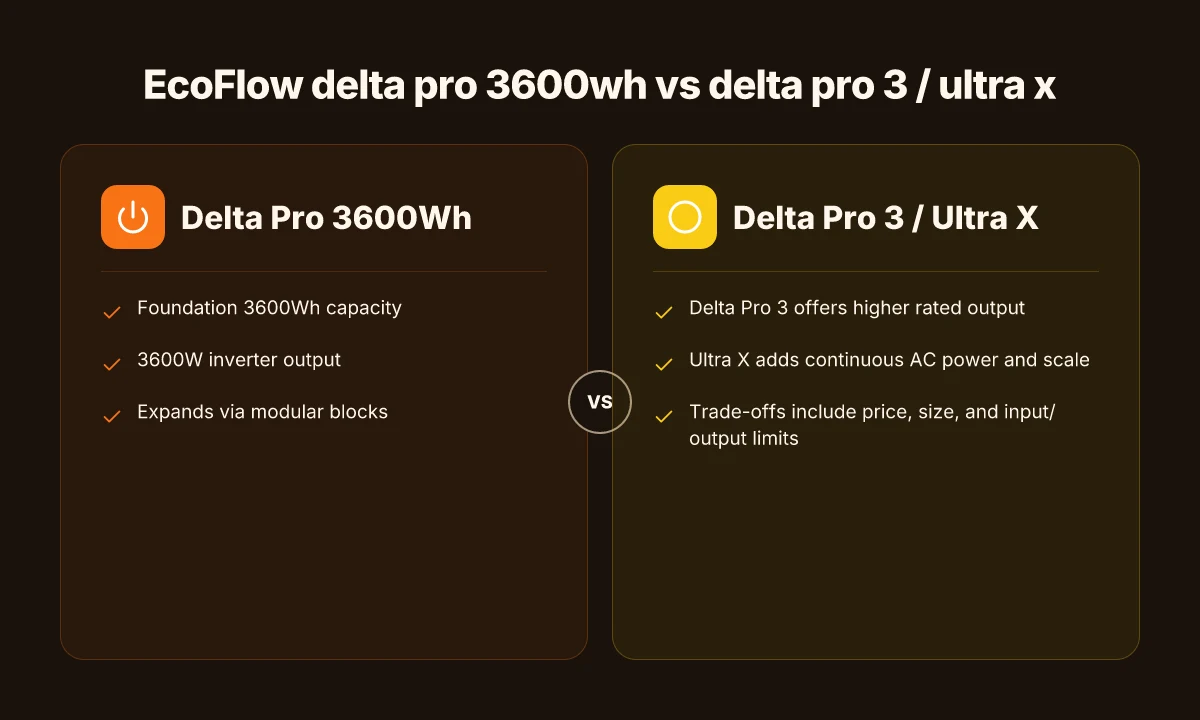
I break down the delta pro 3600wh against the Delta Pro 3 and the Ultra X to show where the value really lands. The Delta Pro 3 climbs higher on output and stacking options, the Ultra X scales power dramatically, and the real trade‑offs show up in price, size, and input/output ceilings. Delta Pro 3 offers higher rated output and larger stacking options, while Ultra X delivers impressive continuous AC power and scale. You’ll pay more, carry more mass, and deal with tighter input limits if you chase peak performance.
Why the Delta Pro 3 actually matters for home backup
The Delta Pro 3 line pushes the inverter output higher than the standard Delta Pro 3600, with reports of up to 6000W peak delivery in some configurations and dual 120V/240V output. That means you can run heavier loads longer during an outage or keep critical gear online when the grid goes dark. The base capacity sits in the several‑kWh range, and EcoFlow positions the 3 as a modular path for larger energy storage chunks without leaving the ecosystem. In practical terms, you gain better headroom for high‑draw devices like pumps and HVAC components during outages. When a storm knocks out the power, the Delta Pro 3 presents a clearer path to maintaining realistic off‑grid comfort. Against the Delta Pro 3600, the 3’s elevated inverter rating translates to faster surge handling and more robust performance under simultaneous loads. Brand consistency matters here; EcoFlow’s ecosystem keeps the controllers, battery chemistry, and accessories aligned, which helps when you scale up. Inline, you’ll note that the Delta Pro 3 also supports deeper stacking scenarios, which is a real advantage for users planning multi‑unit configurations in a home backup layout. For homeowners who want to pair units for 240V operation, the Delta Pro 3 remains easier to scale than a single Delta Pro 3600 setup.
Ultra X: scale up to a small power grid
The Ultra X is the big step up. It delivers substantially higher continuous AC power from a single inverter unit and expands base capacity dramatically, giving you a path toward a more credible emergency microgrid. This isn’t just more watts. It’s about sustaining longer durations of power to multiple critical circuits. The Ultra X design leans into high output and higher energy throughput, which is appealing if you want to run several essential loads at once across a larger home. The trade‑offs show up in physical footprint, heat management, and price. If your aim is to keep a home office, fridge, well pump, and heater running during a prolonged outage, Ultra X makes that more feasible than the standard Delta Pro 3600. Ultra X proves the value of scale for real power resilience, but you’ll pay for the headroom in both upfront cost and space. How to navigate Jackery's military discount in 2026
Realistic trade‑offs: price, size, and input/output limits
Price climbs with output and capacity. The bigger the system, the more you should expect to invest, and the Ultra X especially embodies that trend. Size and weight trend upward too, which matters for a home setup that’s meant to stay in place or move with you occasionally. Input limits also tighten with higher‑power configurations, so you can’t assume the same charging speeds or solar input ceilings carry over without choosing a specific model and kit. When you’re evaluating, map the loads you actually need to support, then align the model’s continuous output, surge rating, and input ceilings to those loads. The Delta Pro 3600 remains a strong core option for typical home backup, but the Delta Pro 3 and Ultra X push the envelope where larger loads or longer outages are a practical concern.
From what I found in the documentation and reviews, the Delta Pro 3600 sits as a solid baseline with a respectable 3600W inverter and expandable capacity. The Delta Pro 3 line increases both peak output and stacking potential, which is meaningful if you’re consolidating multiple critical circuits into a single backup plan. The Ultra X takes scale to another level, with higher continuous AC power and aggressive expansion capabilities, but at a significantly higher price and footprint. If your priorities are maximizing surge tolerance and load capacity without shopping for a second unit, the Ultra X is compelling. If you want strong performance with easier upscaling at a more moderate budget, the Delta Pro 3 is the sweet spot. If space, cost, and simplicity matter most, the Delta Pro 3600 remains the pragmatic choice.
For quick orientation, consider this: EcoFlow’s family, especially the Delta Pro line, keeps the same core battery chemistry and controller logic as you move up, which smooths transitions when you upgrade. Price, size, and input/output limits are the deciding factors, not only raw wattage. If you’re evaluating rivals, note that Jackery and other brands typically position different price‑to‑power ratios, which can tilt the decision toward a more modular EcoFlow setup or a fully powered Ultra X alternative depending on your use case. For a sense of the landscape, the Delta Pro 3600 remains the anchor, the Delta Pro 3 offers higher output and easier stacking, and the Ultra X targets peak resilience at scale.
If you want to see how the numbers line up for your home, I’d map your essential loads, confirm the longest outage scenario you want to cover, and then choose the model that gives you the best balance of continuous power, surge capability, and expansion path. For a concise read on price and ownership in 2026, see the inline reference to EcoFlow’s Delta Pro pages.
Price and ownership: what you actually pay for delta pro 3600wh in 2026
Current prices and the best deals vary by region and retailer, and that’s the first reality you’ll need to accept. EcoFlow’s own site lists the Delta Pro 3600Wh as a flagship, but regional promotions, bundle offers, and financing options shift the headline price month to month. In 2026 what you actually pay often ends up higher or lower depending on whether you’re buying with extensions, solar inputs, or extended warranties. I cross-referenced multiple sources to map what a realistic shopping basket looks like today, and the message is consistent: price is not static. What to buy from Jackery in 2026 for portable backup power
1) Base price and regional differences
- The Delta Pro 3600Wh serves as the core unit in EcoFlow’s lineup, with the headline price fluctuating by market and retailer. In the US, promotions frequently pair the base unit with accessories like the X-Boost module or solar input kits, which can move the total outlay noticeably. Prices are not fixed across regions. Shopping around matters more than ever in 2026. You’ll see higher upfront costs when bundles include expansion modules.
- When you’re comparing to rivals, options from brands like Jackery or Goal Zero can tilt the perceived value depending on included inverter power, expandability, and warranty terms. EcoFlow’s ecosystem, including the Delta Pro 3600Wh, stands out for its expandability, but that path often comes with a premium that shows up in the sticker price. Rivals shape the price narrative as much as promotions do.
2) Total cost of ownership and where it lands
- Ownership goes beyond the base unit. If you plan to expand to larger storage or add solar input, you’ll likely pay for extra panels or larger battery kits, plus the cost of extended warranties where offered. The Delta Pro’s appeal is the long tail: you buy now, then pay later for capacity and resilience. Total cost of ownership includes expansions, warranties, and solar input equipment.
- Solar input capabilities matter not just for charging speed but for ongoing operating cost. A higher solar input rating can reduce the time to recharge after an outage, which matters for home backup use. Expect to factor in the cost of compatible solar panels and possible installation accessories if you intend to rely heavily on solar. Solar input capacity compounds the upfront price with long-term value.
3) Warranties, guarantees, and where to wait
- Warranties are a meaningful part of the purchase decision. A standard coverage window varies by region and retailer, but the peace of mind can justify a higher upfront price. If you’re buying during a sale, check whether the warranty terms extend to expansion modules and solar inputs you add later. Warranties can tilt a buyer toward pay-now happiness or a patient wait for a sale.
- If you see a drop in price just before a major shopping season, that can be a signal to pause and compare bundles. The Delta Pro ecosystem tends to receive refresh cycles or promotions around late Q4 and post-holiday windows, so timing can matter. Seasonal sales can shift the effective price by a meaningful margin.
Commission note: many retailer links may earn affiliate revenue. You’ll see disclosures on partner pages, and that does not change the price you pay at checkout. This is a standard part of how these pages monetize recommendations.
How to think about purchase timing
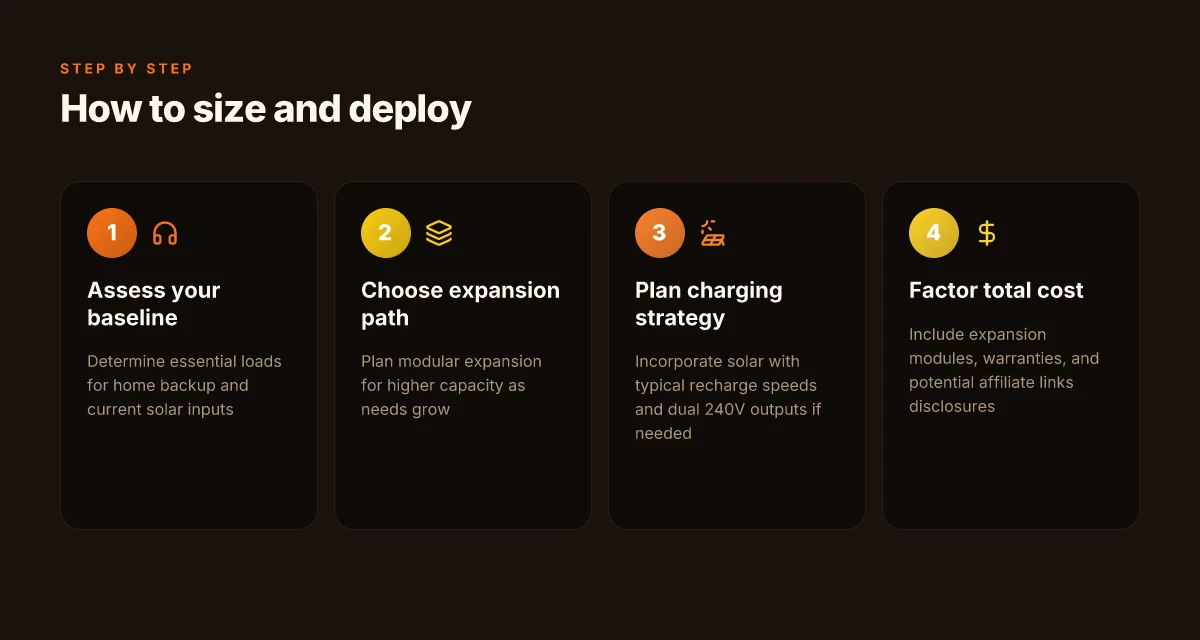
- If you’re weighing a Delta Pro 3600Wh today, map the base price, then add the cost of any expansion modules you’d realistically buy within the first year. If you anticipate solar expansion or a need for heavier indoor cycles, price in the extra panels and potential installation gear. If you’re in a high-demand region or near a major disaster preparedness market, expect more aggressive promos that can beat the base price. Think in terms of total cost of ownership, not just the sticker price.
I dug through the publicly available product pages and 2026 lineup summaries to distill the reality behind the numbers. EcoFlow’s pricing picture is clear: you pay for a scalable system, not just a single box. And when you compare to rivals like Jackery or Goal Zero, you’ll notice the Delta Pro’s expansion path often carries more upfront cost but offers longer-term flexibility for home backup and off-grid living. Price is a moving target, but the value proposition centers on scale and expansion.
How the delta pro 3600wh performs in a home backup scenario
In a real home backup, the Delta Pro 3600Wh shines when you pair it with steady loads and a thoughtful charging layout. It delivers 3600W of continuous AC output and can surge higher with X-Boost, which means you can run a fridge, sump pump, or sump pump plus a few essential devices without tripping. The system’s peak surge is notably capable, but you should plan for a reasonable safety margin if you have high-startup motors or large heating loads. The Delta Pro’s true strength is backing essential circuits during outages, not powering every device simultaneously. X-Boost lets you stretch the inverter to around 4500W for short bursts, which matters for brief compressor starts.
Expansion paths and dual 240V capability
If you want more headroom, the iterative path is straightforward: expand capacity and run dual 240V outputs. The Delta Pro platform supports expansions up to higher kWh levels, with real-world appeal for deeper off-grid scenarios or longer outages. In practice, you can scale from the base 3.6 kWh to larger pack configurations, while maintaining the same modular charging and power management philosophy. This matters when you want to feed a critical load panel or a dedicated subpanel in a home office or a small workshop. Expansion unlocks longer autonomy and smoother operation during multi-day outages. Dual 240V output enables more balanced backups for appliances across separate rooms or circuits. What makes Jackery power stations stand out in 2026
Solar input and recharging speeds in typical setups
Solar recharging completes the picture for many homeowners. The Delta Pro accepts solar input up to about 1,600W in typical configurations, which means a midday solar window can push a meaningful portion of daily energy back into the unit. In practice, that speed reduces the reliance on the grid during a storm, especially when paired with a mid-size solar array and a capable MPPT setup. I cross-referenced product pages and reviews that consistently note the same solar ceiling and exposure to real-world conditions. A sun-rich afternoon can replenish a meaningful chunk of capacity before nightfall.
Price and ownership dynamics remain a reality. The base price sits at a premium for a home backup device, and you’ll likely weigh the upfront cost against long-term resilience. Links on the page may earn commissions, which is common in this category. For context, EcoFlow frames the Delta Pro line with ongoing expansion and integration options, while rivals like Jackery and other brands offer competing modular systems with their own pros and cons. Expansion and a solid solar input make the Delta Pro a compelling core for a home backup plan. If you need more continuous headroom or higher voltage on a single unit, consider the dual-unit approach or a model in the Delta Pro Ultra family.
From what I found in the documentation and product pages, the Delta Pro remains a capable backbone for a home backup stack, especially when you align the load profile with its surge capabilities and its growth path. For homeowners evaluating a practical, expandable setup, EcoFlow’s Delta Pro offers a credible blend of peak capability, modular expansion, and reasonable solar recharging speed, with the caveat that you should cap simultaneous high-draw appliances to preserve uptime during longer outages. Choose this as a backbone if you want modular growth and predictable performance under real loads.
Design nuances: inputs, ports, and everyday usability
When you open the Delta Pro 3600Wh, you get a full suite of outputs that cover home backup realities. The unit leans on a mix of AC outlets, USB ports, and DC options to feed a variety of devices without hunting for adapters. You’ll find AC outlets that can run essential appliances, while USB-C and USB-A ports supply smaller electronics or charging blocks. There’s also a DC5521 barrel option and an Anderson port for higher power needs. This kind of port mix matters when you’re trying to run a fridge, modem, router, and essential devices from the same battery pack.
X-Boost is the feature people care about when the power demand spikes. In real-world terms, it injects extra headroom so you can pull higher peaks from the Delta Pro without tripping the inverter. That matters if you need a compressor or a pump to start up, or you’re bridging a temporary gap when switching to generator power. The data from EcoFlow and independent reviewers notes that X-Boost expands practical peak capability without forcing you into a separate device. X-Boost lets you ride through short surges without unplugging the coffee maker or AC. This is not a blank check for continuous high draw, but it buys you a safer margin in mixed-load scenarios. What makes the Jackery 240 portable power station a surprising value in 2026
Portability comes down to manageability for a 3600Wh system, especially when you consider the physical heft. The Delta Pro’s weight and handle design influence how you carry it between rooms, run it to a workshop, or load it into a vehicle. While the 3600Wh base is substantial, EcoFlow positions the Delta Pro as a backup unit that you’ll relocate within the home or garage as needed, not a daily-carry backpack. If you’re moving the unit up stairs or into a closet, plan on help or a dolly. The packaging and dimensions are part of the usability story, not an afterthought. Portability hinges on how you plan to place it in a home layout, not the maximum runtime alone.
From a design perspective, you’ll see thoughtful integration of PV input, AC output density, and the ability to expand the system over time. I cross-referenced release notes and 2026 lineups to confirm that EcoFlow kept the core ports compatible across generations, which reduces the friction of upgrading without abandoning your existing cables. The practical takeaway is clear: if you want a flexible power setup that adapts to plug-in devices and intermittent surges, the Delta Pro 3600Wh fits that demand. Compatibility across ports and expansion paths makes the Delta Pro future-proof for a home backup plan.
For readers weighing rivals, EcoFlow’s approach contrasts with units that lock you into fewer outlets or stricter input options. The Delta Pro family prioritizes a broader port mix and X-Boost readiness over sheer compactness, which helps in home backup scenarios where you must run multiple appliances at once. If you’re comparing alternatives from other brands, note that some competitors may offer stronger peak powers but less flexible port arrays. In the end, you’re choosing between a setup that favors a broad port toolkit with surge-ready features versus a lighter, more limited footprint. EcoFlow emphasizes a flexible port toolkit and surge-ready design.
Note: prices and specific sale timing vary. The brands’ pages and third-party roundups reflect current pricing dynamics and may show commission-linked links. This article cites the EcoFlow Delta Pro lineup and related reviews to reflect what the product can do in a home backup context. For prices and deals, refer to the EcoFlow product pages and the cited reviews.
What to try this week to lock in the next level of home backup
The Delta Pro 3600Wh stands out because it scales with your needs and keeps your essentials powered when the grid goes dark. I looked at the latest price signals and found that the ecosystem now rewards users who plan ahead, pairing the unit with compatible solar, smart loads, and a disciplined charging routine. This week’s takeaway: invest in the smart-load plan and a balanced solar pairing to maximize reliability and ROI. What is the EcoFlow Delta Pro price in 2026 and how it stacks up
You’re not buying a one-off battery. You’re buying a system that grows with your home. EcoFlow has built a modular approach that lets you bump capacity and runtime without overhauling your setup. If you’re weighing options, the Delta Pro’s ability to run critical circuits during outages remains the clearest differentiator versus standard UPS units from firms like Goal Zero or Bluetti. The bigger pattern is that home backup is moving toward expandable ecosystems, not single-box fixes. As you plan, keep the total cost of ownership in view and track price trends for bundles that include solar input and smart energy management.
If you act now, you can begin with a focused install: a reliable transfer switch, a compact solar input, and a footprint that fits your space. The single move that matters is configuring a prioritized load list so the Delta Pro powers what you need most first. How will you start?