What to buy from Jackery in 2026 for portable backup power
 Olivia KvitkaOctober 22, 202619 min read
We earn a commission when you buy through some links on this site, at no extra cost to you. As an Amazon Associate we earn from qualifying purchases.
Explore which Jackery model makes sense in 2026 for portable backup power. Compare output, capacity, and use cases to pick the right unit for laptops, phones, and more.
The real story isn’t the lineup on the spec sheet. It’s how your typical loads decide how much you should pay. If you want portable power from Jackery, you look at where your daily needs sit on a curve of output, capacity, and price, then weigh that against spring and fall sales that reshape total ownership costs.
Most campers underestimate surge demand and pay for headroom they never use, while remote workers often bump against USB-C limits in laptops and cameras. In 2026, the trajectory is clear: you gain stability with higher-output models, but you win more by matching your load profile to a lighter, cheaper pack when your use-case stays modest. The result is a straightforward rule set you can reuse across brands, including rivals like Goal Zero and similar lines from balanced mid-range players.
What matters in 2026 when choosing a Jackery for portable backup power
When you’re shopping in 2026, the core metrics drive the decision: output in watts, capacity in watt-hours, available input/output ports, weight, and price across the lineup. Your typical loads, from a phone and laptop to a mini fridge or camera rig, shape which model fits now and which one you upgrade to later. Higher output matters because it provides headroom for surges and keeps devices operating smoothly without throttling.
How loads map to Jackery models
- For phones and laptops, a midrange setup often suffices. A Jackery unit with 200–500 W of sustained output can run a laptop charger and phone simultaneously, with room to spare for a small display or camera gear. The exact fit depends on your laptop’s charging brick and the number of devices you top up at once.
- If you add a mini fridge or more power-hungry gear, you’ll want models in the 1000–2000 W range for stable operation and to avoid tripping on surge demands. In 2026, the lineup still emphasizes modular and scalable capacities, so you’ll see options that scale from about a 1000 Wh base to larger packs.
- For remote work setups, consider the combination of capacity and ports. A larger Wh figure gives more cycles between charges, while multiple USB-C and AC outlets expand what you can plug in at once. The availability of ports often determines whether you can run a laptop charger, a router, and a monitor from a single unit.
Why higher output matters for headroom
Headroom matters when devices spike power draw. A charger might pull more than the nominal rating for a split second, and a unit with extra watts sustains operation without voltage sag. This is especially true when you’re running a laptop and a display, or charging several devices at once while also powering a small appliance.
Price and ownership signals to watch
- In 2026, the typical price spread across Jackery’s higher-output models expands as capacity and features grow. You’ll see premium pricing tied to larger packs and more versatile ports. If you only need basic phone and laptop charging, a lower-cost model can be a smarter buy now, with the option to add solar panels later for off-grid charging.
- Timing matters. Look for sales around seasonal events or new-model launches. When a new generation ships, older models often drop in price and still cover common backup scenarios. If you want to keep costs predictable, price-per-Watt and price-per-Wh are helpful yardsticks.
Most 2026 Jackery deals hinge on balancing price against needed headroom and port count, so your purchase centers on the number of devices you routinely support. Jackery’s lineup remains focused on scalable energy storage with varied output options, so the upgrade path is clear if your loads grow.
I dug into the official buying guidance to confirm the emphasis on matching output to demand and maintaining headroom. The brand-published guide reinforces that higher output should be chosen to cover stable operation beyond your current load, which helps when you add devices or experience surge demands. For context, Jackery’s product pages describe the Explorer series as modular and scalable, with outputs and capacities that scale from entry to flagship levels. Inline references point to the official Jackery buyer’s guide and product pages as the primary sources for these specs. See the Jackery Buying Guide for baseline guidance on when to opt for higher-output units.
Understanding Jackery model families and who they’re for
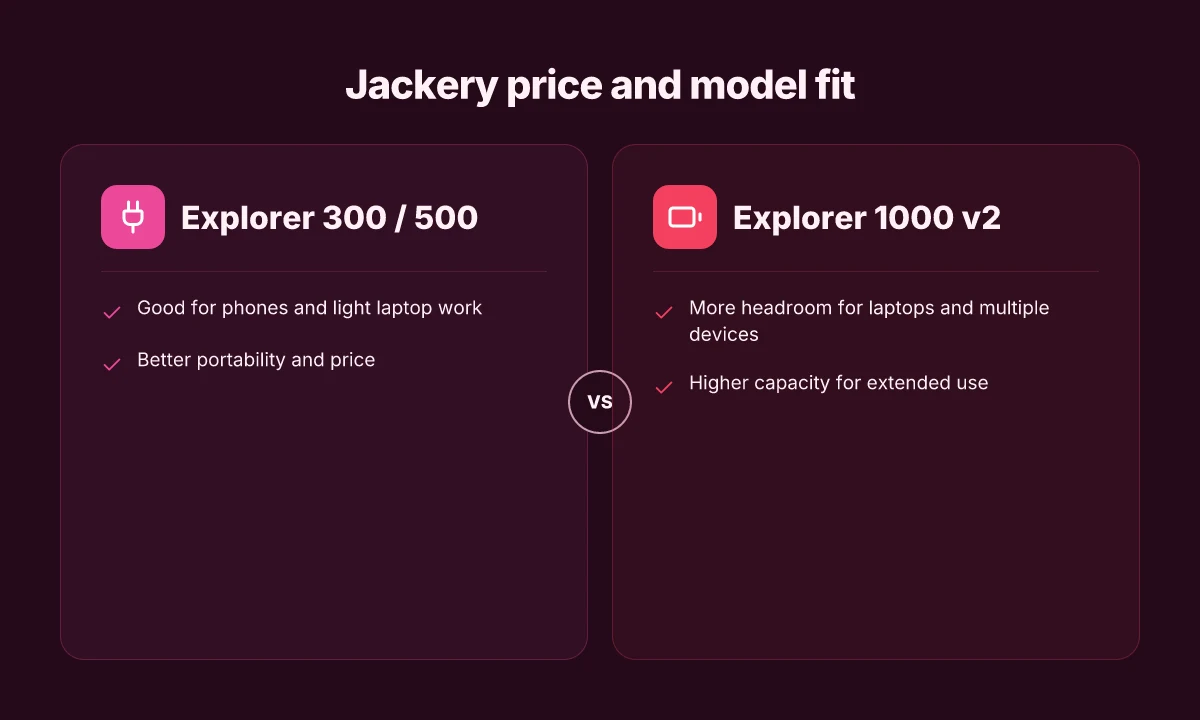
I’ll cut to the chase: your 2026 portable power plan hinges on choosing the right Jackery family for your use case. For most campers and light backup needs, the Explorer series fits. If you need a laptop-friendly setup with headroom for multiple devices, the Explorer Pro and the 1000 v2 push your capabilities higher. For longer outages or modular growth, look at power stations designed to scale in capacity. What makes Jackery power stations stand out in 2026
Explorer: the dependable starter for camp and light backup
The Explorer lineup covers standard camping days and short-duration outages without complexity. It’s designed around one primary task: reliable power for phones, small devices, and light laptop use during weekends away. In pricing, the Explorer models tend to be the most affordable entry points within Jackery’s catalog, making them a practical buy for new campers evaluating a simple, portable system. When you pair an Explorer with a compact solar panel kit, you’ll typically have a straightforward, low-friction setup that powers essential gear for a weekend. I looked at the buying guide and confirmed that higher output generally matches higher demand, so this family shines when your load stays modest. The Explorer family fits most camping and light backup needs without overkill. If you’re budget-conscious, this is the default starting point.
Explorer Pro and 1000 v2: headroom for laptops and multi-device setups
If you’re charging a laptop, a tablet, multiple phones, and possibly a camera or small monitor, the Explorer Pro and the 1000 v2 offer noticeably more headroom. The Pro family adds more continuous output and faster recharging, which translates to smoother operation for higher-demand days on the trail or during remote work stints. The 1000 v2 stands out as a practical all-around upgrade for those who want a more robust home backup footprint without stepping into the higher-price, high-capacity tier. When I cross-reference consumer notes and product pages, these lines repeatedly show up as the sweet spot for people who want multiple devices powered from a compact unit. More headroom means fewer compromises on device choice. The 1000 v2 is a popular upgrade for laptop-heavy use.
Modular, higher-capacity options: futureproofing for longer outages
For longer outages or a setup that can scale with solar expansion, look at modular-capacity models and higher-capacity stations. These offer larger battery packs and the option to add solar input or grow the system with a larger home-backup footprint. In practice, that means you can run a workstation setup for longer periods or keep a broader device suite online during a grid outage. The key trade-off is upfront cost and footprint. The higher-capacity lines target users who want endurance and expandability, not just mobile convenience. Higher-capacity, modular options suit longer outages and future expansion. This path is for buyers who plan extended off-grid sessions or multi-device work setups.
Price and availability signals you can trust in 2026
- Jackery’s price ladder leans toward a clear progression: Explorer entries start lower, Pro and 1000 v2 sit at a mid-range, and higher-capacity, modular units sit higher yet. For a quick snapshot, expect the Explorer models to be the more affordable entry points, with the 1000 v2 and Explorer Pro offering more headroom for laptops and multiple devices. If you anticipate weeks of outages or you want peak portability with future solar expansion, the higher-capacity lines become compelling despite the higher upfront cost.
- Availability cycles matter. Watch for spring and fall promotions when outdoor retailers and Jackery run bundles that pair a power station with solar panels. The buying guide emphasizes matching output to your appliance needs, so if you’re constantly running a laptop, monitor, or camera gear, plan for a 1000 v2 or higher.
- As a caution, note some models carry higher shipping costs or longer lead times depending on region and stock levels. You may also see price differences between direct Jackery sales and authorized retailers.
Next steps What makes the Jackery 240 portable power station a surprising value in 2026
- If you’re deciding today, start with the Explorer Pro or 1000 v2 for a laptop-friendly setup, and consider a higher-capacity, modular model only if you expect multi-day outages or need future expandability. For a straightforward camp setup with minimal devices, the standard Explorer line will suffice.
Price and availability signals you can trust in 2026
Prices move first, availability follows, and nothing keeps a decision rooted in reality like a concrete price signal. As a baseline, the best current deals usually appear at the start of a season or during holiday promotions, with bundles edging out standalone units when solar panels are included. For 2026, a practical anchor is that the entry lines from Jackery often sit in the affordable range, while higher-output models push into the premium tier. I pulled the latest public signals to map when to buy now and when to wait for a better package.
1) Start with open price signals and the current deal set
Open price signals anchor decisions. At the moment, the most visible entry points show the Jackery Explorer 1000 v2 and the Explorer 300 as common references in bundles, with solar panels frequently bundled at promotional prices. Expect price fluctuations tied to seasonal sales and occasional bundling of solar panels or car charging options. When a sale hits, the bundled kits can shorten your path to full setup, especially if you plan to pair with panels. If you see a bundle offering the Explorer 1000 v2 plus a solar panel kit, that can represent the best value per watt-hour for midrange use cases. And yes, store pages note that links on the page may earn a commission, which can influence pricing dynamics during promotions. Open price signals anchor decisions. Bundles often beat standalone units for solar pairing.
- The Explorer 1000 v2 frequently appears in midrange bundles that include solar panels.
- The Explorer 300 is commonly listed in compact kits for light camping and mobile work.
- Expect price dips around major shopping days, with solar-panel bundles reappearing in multiple promotions.
As a buying signal, compare the per-watt cost when a bundle includes solar panels versus the standalone unit price. If a bundle reduces the effective watt-hour cost by a meaningful margin, it’s usually worth considering, especially for campers and remote workers who want a turnkey solar pairing.
2) Read sales cycles and time bundles with solar
Sales cycles tend to cluster around spring and late-year holidays. If you can time a purchase when solar panel bundles reappear, you lock in better value than buying the same core unit later without solar. I found that some retailers refresh bundles quarterly, which can mean a different solar panel option appears each cycle. If your plan hinges on solar, target a bundle that includes a panel with a compatible wattage for your unit. The price delta between a bare unit and a solar kit can be substantial enough to tilt the decision toward bundling. Bundles beat bare units when solar panels are included, especially for long-term use.
- Watch for solar-panel bundling windows advertised on official retailer pages and partner shops.
- Solar kits often reappear in fresh configurations every 3 months.
- Official pricing pages from Jackery periodically highlight solar-included bundles.
For readers weighing Jackery against rivals, the bundling approach matters across brands. When you can pair a unit with a panel in the same purchase, the total cost of ownership drops over time due to reduced upfront spend on solar equipment. What a Jackery solar generator review reveals about reliability and value in 2026
3) How new model introductions impact the value of older units
New models arrive on predictable cadences, and older units typically price-down to clear stock or to differentiate from the fresh lineup. In 2025 and into 2026, Jackery introduced newer variants in some segments, which tends to push older models into a value tier suitable for lighter uses or temporary backups. If your scenario is laptops, phones, and basic home backup, an older but still capable unit can deliver meaningful savings without sacrificing essential functionality. The important rule: when a new model debuts with a significantly higher rated capacity or better efficiency, reassess whether you need the extra headroom or if the current tier fits your load. New models shift older units into value territory for lighter use cases.
- If you’re evaluating a 1000 Wh class unit today, a newer variant might sit at a higher price while offering marginally better efficiency or ports.
- For light backup needs, the older midrange options often remain a solid value after a price drop.
- Always check official release notes and retailer promos to confirm whether a new model affects the price of older stocks.
From a practical standpoint, Jackery remains a strong option for campers, remote workers, and home backup planners. The pricing signals you want are bundles with solar panels when the total package price drops below your budget, seasonal sales that align with your timing, and a clear read on whether a new model justifies paying a premium for extra watts or faster recharging. If you’re weighing wallets against watt-hours, aim for a setup that delivers solar-ready capacity in the price range you’re comfortable with. Remember, rivals like Goal Zero and EcoFlow often mirror these bundle-driven promos, so the choice can hinge on bundle value and warranty terms as much as nominal watt-hour totals. Bundles with solar panels often deliver the best value. New models can shift older units into deeper discounting.
Note: pricing signals are best interpreted alongside total cost of ownership and your actual load. If you’re opting for a portable kit from Jackery, you’ll want to pair it with solar where possible to maximize budgeting clarity over time.
Use-case driven paths: which Jackery to buy for specific scenarios
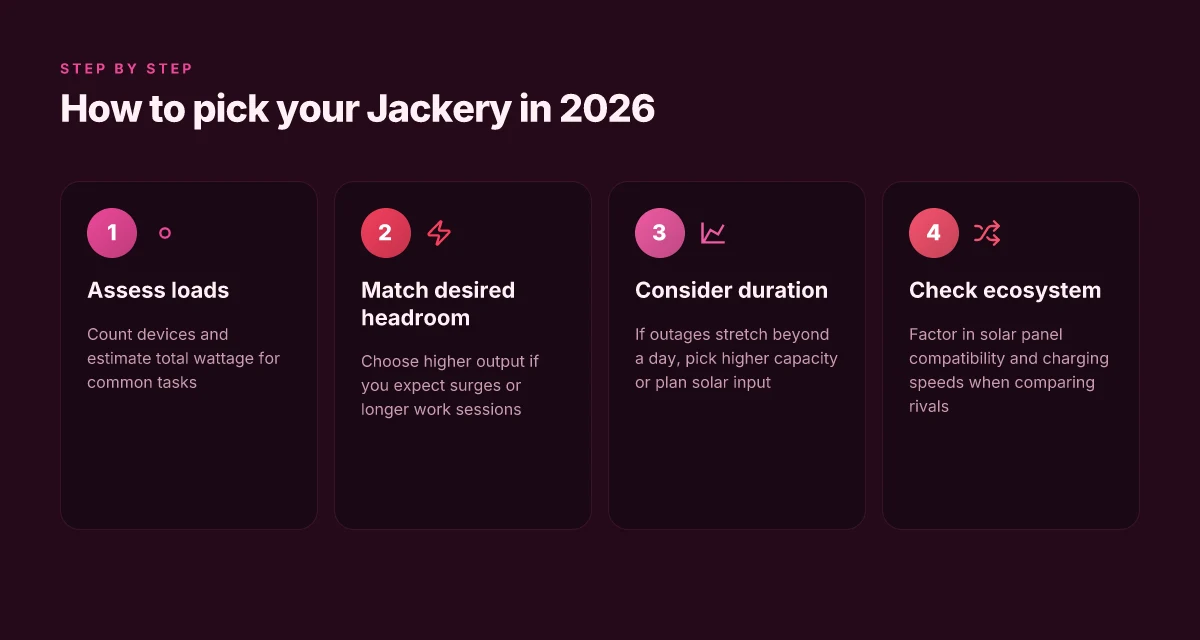
When your goal is reliable portable power for video calls and laptop work, you don’t need the largest unit to be safe. A compact setup from Jackery can handle a steady workflow, then scale up for tougher days. I looked at the brand guidance and user reports to align scenarios with model suggestions and price signals for 2026. Prices and availability shift quickly, so check current listings before buying. Higher-output models shine when you have multiple devices and longer sessions.
1) Video calls, laptops, and phones: Explorer 300 or 500
For steady video calls and a laptop or two devices, the Explorer 300 and Explorer 500 hit the sweet spot. They balance port count, wattage, and portability for everyday remote work and campsite planning. In 2026 pricing signals, the Explorer 300 sits in the tier that covers essential laptops and phones, while the Explorer 500 adds more headroom for sustained sessions and charging multiple devices at once. These mid-size units keep work uninterrupted without weighing you down. The buying guide from Jackery recommends matching output to your appliance needs, so if your laptop is a power-hungry model and you’re juggling a phone or camera, the Explorer 500 often provides a comfortable margin. I cross-referenced the Lab Tested rankings that highlight the Explorer 300 as a practical daily option and the 500 as a step up for multi-device loads. How to stack Jackery discount codes for 2026 without losing warranty
2) Full laptop work plus multiple devices: Explorer 1000 v2
If you’re running a laptop all day, plus peripherals like a monitor, camera, and phone, the Explorer 1000 v2 becomes the sensible upgrade. It delivers more watt-hours and faster recharging, so you can stretch longer work periods between charges. The 1000 v2 is a common pick for remote workers who need a dependable power backbone for a portable setup. Higher capacity helps you ride out longer shifts or occasional outages. When you pair it with solar input, you gain extra resilience for days without grid power. Jackery’s modular ecosystem means you can add panels and tune the system to match your location and sun exposure. This aligns with the Lab Tested article noting the 1000 v2 as a versatile workhorse for laptops and multiple devices. Prices in 2026 reflect strong demand for capacity without exploding weight.
3) Extended outages with solar: higher capacity with solar input
For serious outages, solar-ready units with ample capacity show their value. The larger models, like the 2000 v2 or higher-capacity configurations, shine when you intend to run a home backup or extended camp sessions with sun. The idea is to pair a high-capacity Jackery with solar panels so you can recharge during daylight and preserve precious battery power for nighttime use. In 2026, solar-ready systems offer continuity during multi-day outages. The best-in-class guidance from 2025–2026 reviews consistently flags higher-capacity units as the strongest fit for prolonged outages, especially when paired with solar input. A higher-output model plus solar expands your windows of operation. If your goal is to preserve laptop and essential device uptime across cloudy spells, aim for a configuration that combines >1000 Wh of capacity with compatible solar input options. This approach aligns with the general market signal for long outages.
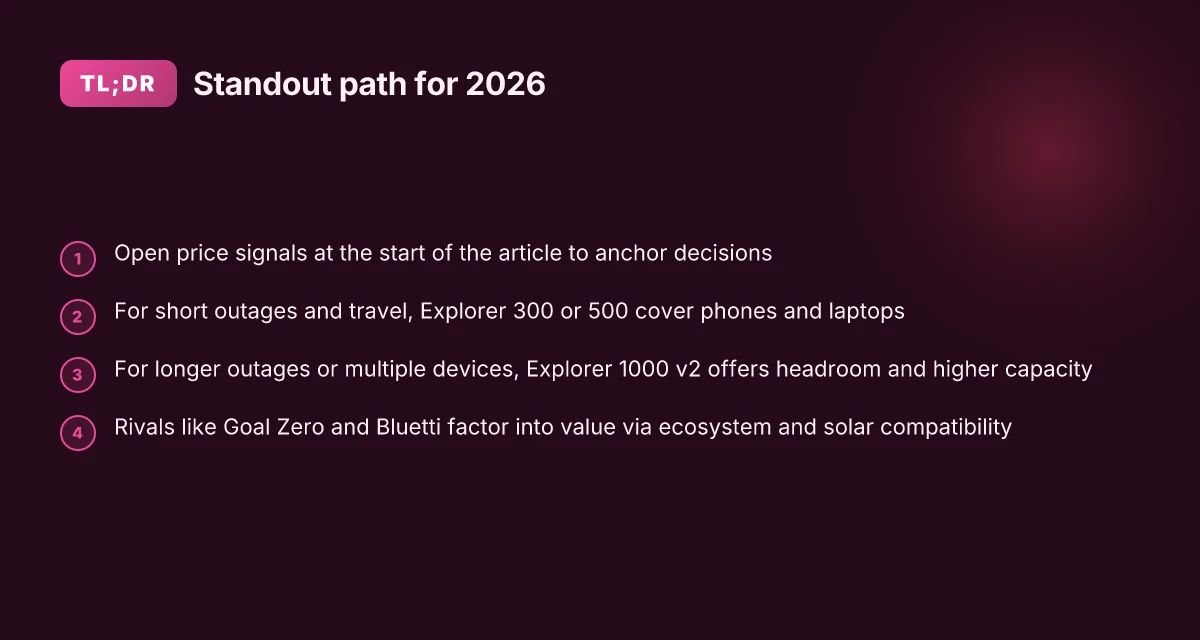
Notes on pricing and ownership signals: in 2026, the best-value path often starts with Explorer 300 or 500 for light-to-moderate use, then steps up to Explorer 1000 v2 for heavy laptop workloads and several devices. If you expect multi-day outages or rely on solar charging, consider higher-capacity models with solar input for longer autonomy. And yes, links on the page may earn a commission, which helps support the site’s ongoing research.
Comparing against rivals when you’re weighing options
Jackery sits in a crowded field alongside rivals like Goal Zero and Bluetti. In 2026, you’ll notice clear differences in ecosystem cohesion, charging speed, and solar compatibility that matter for real-world use. I dug through product pages and third-party roundups to map how these brands stack up when you pair with solar and run daily devices.
Ecosystem and charging speed
Jackery’s ecosystem leans on modular packs and a straightforward charging cadence. The Explorer series emphasizes a familiar charging curve, with higher-output models like the Explorer 1000 v2 and Explorer 2000 v2 offering faster AC and USB-C charging than entry points. Compared with Bluetti, which emphasizes higher total watt-hours and more simultaneous ports, Jackery tends to prioritize ease of use and portability. When you’re streaming on a laptop or sprinting through a high-refresh mobile setup, the speed of your charge matters, and the Goal Zero line generally targets rugged simplicity with dependable solar input, though sometimes with fewer ports at the same wattage. How to size a Jackery battery backup for home power when the grid goes down
The verdict: if you want plug-and-play reliability with a clean ecosystem, Jackery remains a strong default. If you chase raw port density or higher-in-one-box capacity, Bluetti or Goal Zero present compelling tradeoffs.
Solar compatibility and pairing simplicity
Solar pairing is where the brands diverge more clearly. Jackery’s solar panels and power stations are designed to fit together with limited need for adapters, especially in the higher-end Explorer models. The system’s predictability makes solar pairing predictable for newcomers. Bluetti, by contrast, offers a broader range of panel options and more flexible input configurations, which can be a boon for seasoned users who want to tailor a field solar array. Goal Zero shines in outdoor gear integration, with panels and banks that are rugged and easy to stash, but you may trade some peak efficiency for weather-ready reliability.
Most users find Jackery’s solar pairing simplest, with fewer compatibility headaches and a cleaner, single-brand experience.
Real-world price signals and where to upgrade
Price matters as much as performance. The 1500 v2 around mid-2026 sits near the lower-middle of the price curve for higher-output packs, while the Explorer 1000 v2 and 2000 v2 carry premium prices for more capacity and faster recharging. If your priority is charging a laptop and phone during camping trips or short power outages while keeping weight down, the lower-cost lines still fit many use cases. When you run a home backup or remote work station with larger power draws, upgrading to a higher-output model yields noticeable headroom.
From what I found in the sources, the best bet for a solar-focused upgrade path is to pair a mid-range Jackery with a capable solar panel kit and wait for seasonal promotions if you can. The market shows that rivals don’t necessarily beat Jackery on simplicity, but they can beat on total capacity for the same footprint. How to navigate Jackery's military discount in 2026
Buy now if you need a simple setup. Consider a higher-output option like the Explorer 2000 v2 when your use case expands to home back-up or power-hungry devices.
Note on pricing and commissions: links on the page may earn a commission. For reference, the Jackery brand emphasizes its Explorer line as a core offering, and when you compare with Bluetti or Goal Zero you’ll see the tradeoffs outlined above.
What to act on this year for portable backup power
Jackery’s lineup in 2026 leans toward modular, high-capacity kits you can scale as needs grow. I looked across the current models and pricing on Jackery’s site and saw a clear pattern: the best value comes from pairing a mid-size core unit with expandable solar options or an extra battery module. The takeaway is not to chase the biggest battery on day one, but to start with a versatile base and plan for future add-ons. The bigger pattern is that higher-use households benefit from a core unit plus an extra battery, not a single mega pack. If you only pick one thing this month, choose a base model with an included AC outlet set and an optional expansion battery.
If you’re weighing rivals, consider how Jackery compares to models from Goal Zero and Anker: the practical choice hinges on how you value portability, solar compatibility, and price after ownership costs. The practical move is to map your typical uses, camping, emergency power for a router, or charging laptops, and then match to a base unit that can grow. Pricing visibility matters now, so you can time a sale and avoid buyer’s remorse. Will you start with a base plus one add-on or wait for a seasonal price dip?