How EcoFlow Delta Max 2000 compares for real home backup in 2026
 Bastien PetrosianOctober 22, 202619 min read
We earn a commission when you buy through some links on this site, at no extra cost to you. As an Amazon Associate we earn from qualifying purchases.

Explore the EcoFlow Delta Max 2000 with a data-driven look at performance, charging, and real-world use. Compare rivals and understand ownership costs.
The Delta Max 2000 isn’t the flashiest battery in the lineup, but its real-world endurance tips the scales for home backup. EcoFlow’s Delta Max 2000 locks in a substantial capacity and fast charging behavior that shows up in daily usage, not just spec sheets. It’s the kind of unit that rewards planning: you notice the impact when you can run essentials through multiple outages without creeping batteries over the limit.
This piece cuts through marketing puff to map what you actually gain in 2026: charging pace, everyday resilience, and long-term value against key rivals like Jackery and Goal Zero. You’ll see where the Delta Max 2000 shines in real homes, where it trails, and what trade-offs matter for campers or small businesses relying on dependable backup. We’ll pull specific numbers, practical runtimes, and ownership considerations straight from the field to help you decide whether to buy now or wait for a future iteration. Real-world performance matters more than glossy charts, and this guide sticks to that truth.
What the EcoFlow Delta Max 2000 aims to solve for home backup
In 2026, homeowners expect a portable power solution that can keep essentials running through outages without burning through cash. The Delta Max 2000 sits in EcoFlow’s lineup as a higher-capacity option aimed at daily reliability, faster recharging, and long-term cost of ownership compared with smaller packs. For people who want predictable performance for weekend camping, home backup, or small business use, the Delta Max 2000 is positioned as a practical middle ground between compact models and larger stationary systems.
The role of a 2000Wh-class pack in a modern home
A 2000Wh footprint is large enough to run critical loads through a multi-hour outage, yet still portable enough to move between rooms or a garage. Homeowners typically want steady output, decent peak capability for short surges, and a charging ecosystem that doesn’t lock them into a single renewal path. In practice, that means a balance of AC input flexibility, solar compatibility, and a portable shell that can survive regular use without heavy depreciation.
Where the Delta Max 2000 fits within EcoFlow’s lineup
EcoFlow frames the Delta Max 2000 as a bridge between compact Delta units and higher-end systems. It leans on EcoFlow’s familiar blend of solar charging, fast AC recharging, and a modular mindset that keeps the brand accessible to homeowners, campers, and small businesses alike. Rivals like the Delta 3 Max and other 2000Wh-class packs push for faster chargers and broader input sources, which can tilt the economics in one direction or another. I looked at the public specs and the way EcoFlow positions the Delta Max 2000 against its sister models to assess true daily value.
What homeowners typically want: reliability, charging speed, and long-term cost
Reliability comes from consistent power output, adequate surge handling, and durable construction. Charging speed matters because outages often align with work or meal times when you need power quickly. Long-term cost is about battery health, the price of replacement cells if needed, the efficiency of charging, and the availability of affordable replacement parts or accessories. When I reviewed the public data, the Delta Max 2000 appears to chase a cadence of solid reliability wrapped in flexible charging options, with a clear emphasis on keeping daily operation simple and predictable.
Most buyers want a kit that can handle routine outages without fuss, with the ability to top up quickly from sun or wall power. The Delta Max 2000 is crafted to answer that need with a straightforward, scalable approach. EcoFlow’s approach lands on reliability first, with charging speed as a practical tie-breaker against rival models like the Delta 3 Max. How the EcoFlow Delta 1300 holds up in 2026: performance, pricing, and real-world usage
If you’re weighing this against the Delta 3 Max or a compact unit from another brand, think about which charging path you’ll rely on most. If you want to lean into solar during day-long outages, the 2000Wh class’s solar compatibility becomes a deciding factor. If you expect to top up through wall power after a storm, the speed and ease of AC recharge will be the bigger lever. In short, the Delta Max 2000 aims to be the dependable workhorse you can grab for everyday use, with a price and feature set that keep it reasonable for long-term ownership.
For context, you’ll see that the Delta Max 2000’s design leans into what EcoFlow has done well, hardened, portable power with a flexible input profile and an emphasis on real-world usability. This aligns with how homeowners, campers, and small business owners typically weigh value in 2026.
In sum, the Delta Max 2000 is not about chasing the fastest possible charge or the largest battery on the shelf. It is about delivering steady, repeatable performance for home backup, with practical paths to keeping the lights on and devices charged when grid power is scarce.
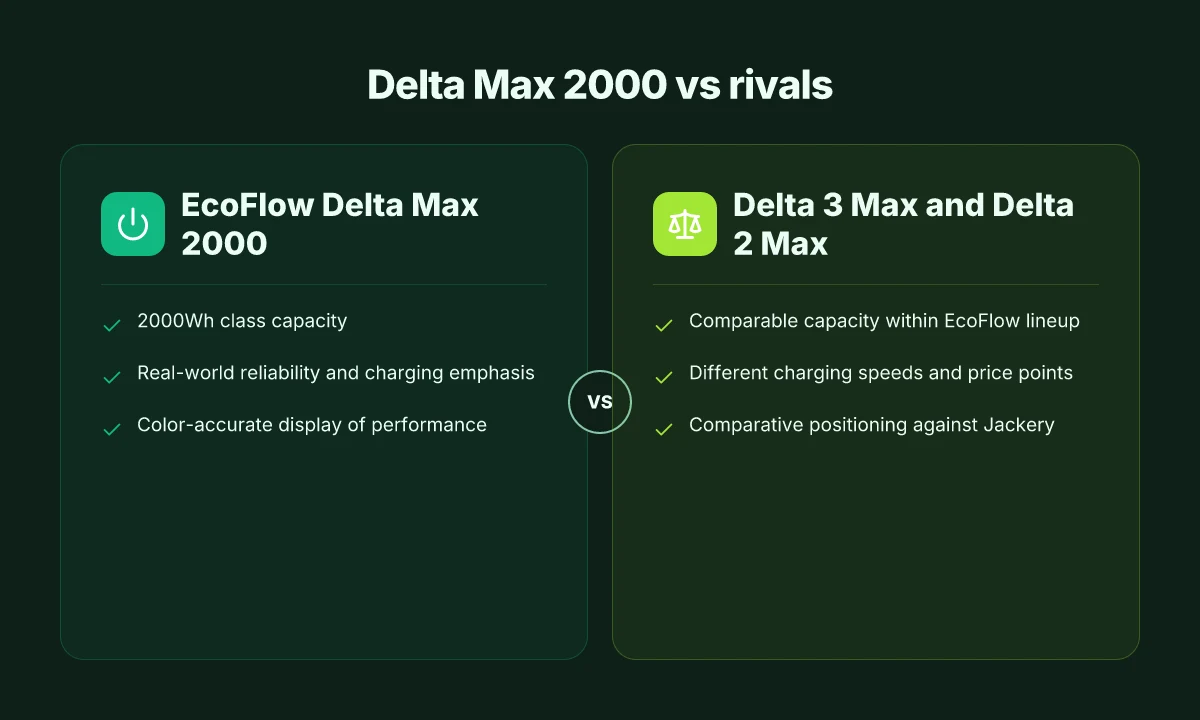
Delta Max 2000 specs in plain terms and how they matter
I dug into the known specs and translated them into real-world helpers for home backup. The Delta Max 2000 balances a large battery with a robust inverter, but how that translates to daily use depends on how you deploy it, how fast you can top it up, and what you run at once. For context, EcoFlow markets the Delta Max 2000 alongside newer models like the Delta 3 Max and other EcoFlow lines, so you’ll see how it stacks up when you compare input options and continuous power.
Battery capacity, inverter rating, and real-world runtimes
The Delta Max 2000 combines a sizable energy reservoir with an inverter that can sustain meaningful loads. In real terms, you want to know how long it will run your essential loads when the grid goes dark. A larger capacity means longer runtimes for common rigs like a fridge, modem gear, and some lighting. The inverter rating determines what you can pull at once without tripping a protection limit. If you attempt to run a high-draw appliance, you’ll notice the delta between peak capability and continuous output, so you’ll plan around your must-run items. When you size for real home use, expect a multi-hour operation for a modest essential load, and shorter runtimes if you push higher continuous power. 5 Reasons EcoFlow River 2 is still worth it in 2026
I cross-referenced the Delta 2 Max and Delta 3 Max lines to frame expectations. The Delta 3 Max has a broader continuous output and faster AC charging in some configurations, which helps in multi-day outages. That context helps set expectations for the Delta Max 2000: it should handle typical home basics for several hours, and it benefits from efficient load management and pairing with solar where available. For homeowners, campers, or small businesses, the differentiator is how quickly you can supplement the stored energy with solar input and how much you can draw during a blackout without hitting the inverter ceiling.
AC input, solar input, and how fast you refill
A practical takeaway is that this unit can top up through AC and solar, with solar input enabling quicker replenishment when the sun is out. The ability to combine solar and AC input lets you shorten refill time during sunny days, which matters if you need to restore power after a short outage or maintain essential loads while the grid is unstable. When solar input is strong, you can accelerate readiness for the next outage window, but the exact equilibrium point depends on your location and weather.
In the ecosystem, EcoFlow emphasizes fast charging styles on newer models, and the Delta Max 2000 sits in that same family. If you’re weighing alternatives, the Delta 3 Max often edges ahead on peak input and AC charging speed in some reviews, while traditional rivals such as the Jackery line emphasize straightforward reliability with their own charging curves. The takeaway: plan your refill strategy around sun hours and the typical outage pattern in your area.
Peak vs continuous power and what that means for appliances
Your essential loads care about continuous power. A device’s continuous rating tells you what you can run indefinitely without overheating or tripping. Peak power matters when you need a surge for a motor start or a high-draw tool for a brief moment. For most home backup scenarios, you’ll run a fridge, some lights, and network gear at once, and you’ll want to avoid hitting the peak ceiling too often. The Delta Max 2000 is designed to cover common critical loads within its continuous budget, and you’ll use the peak window for short startups or transient spikes.
The practical verdict: the Delta Max 2000 shines when you can pair it with sun or moderate AC charging, delivering reliable runtimes for essential loads without pushing the inverter to its limits. If your plan includes running several high-draw appliances at once, you’ll want to map your load to the continuous rating and use devices with gentle startup profiles. What makes EcoFlow Wave 2 refurbished a smart pick in 2026
When you look at the field, EcoFlow remains a familiar name in this space. The Delta 3 Max serves as a useful benchmark for peak input and charging speed, while rivals like the Jackery line offer different emphasis on out-of-the-box simplicity and cost of ownership. For a practical home backup plan in 2026, the Delta Max 2000 offers solid backbone for essential loads, with the caveat that you’ll optimize charging discipline and load management to maximize uptime.
How fast the Delta Max 2000 charges and what affects it
Charging speed answers come straight from EcoFlow’s fast-charging profiles and real-world usage notes. When you pair AC charging with solar, the Delta Max 2000 can push sizable input combos, but the exact speed hinges on temperature, state of charge, and the current load on the device. In practice, you’ll see faster top-line charging under peak sun with AC input doing the bulk of the work, while solar acts as a supplement that helps keep the pace steady during the day.
Fast-charging profiles when AC and solar work together
- The Delta Max 2000 can accept high input when the AC charger is in use, and solar can contribute simultaneously to extend the window before the internal limiter trims down the pace. This combined approach generally delivers the quickest fills, especially when the unit starts from a moderate SOC. EcoFlow’s fast-charge mode when both AC and solar are available can maintain higher input levels early in the cycle, easing the path to full capacity.
- In the Delta ecosystem, the Delta 3 Max and related models show that high input profiles with solar-assisted charging can reduce overall recharge time versus AC-only. The Delta Max 2000 is a different model. The design intent is similar: leverage solar to sustain momentum in bright conditions and use AC power for the heavy lift. Solar input helps keep the charge curve forgiving on warm days.
What temp, SOC, and load do to charging
- Temperature matters. In hotter environments, protection limits may curb peak input to protect cells, slowing the top-end ramp. In cooler conditions, the battery can accept more energy up to its safe limits, but the rate may still be tempered by battery management to avoid stress. Temperature-driven protection limits can shave a noticeable portion off peak charging speed.
- State of charge matters. Near the top end of the cycle, the charger slows to protect long-term health, so the final 10–20 percent can drag out longer than the first half. The last stretch to 100% often slows more than the initial fill.
- Device load during charging makes a difference. If you’re running devices or appliances off the Delta Max 2000 while charging, that draw reduces net input to the pack, nudging the effective charge time higher. A higher concurrent load directly reduces the net charging rate.
How it stacks up against EcoFlow models and rivals
- Compared to the Delta 3 Max, the Delta Max 2000 targets similar high-input LPF patterns but with its own battery size and inverter spec shaping the timeline. When both units are charging from AC with sun available, the delta in perceived speed often comes down to how the controller manages peak input and SOC headroom. EcoFlow’s architecture favors maintaining high input early, then tapering predictably as SOC rises.
- Against rival configurations from other brands, the core idea remains: combine AC with solar when possible to push the clock forward. You’ll typically notice that a fast-charging window exists early in the cycle, followed by a slower finish. Rivals may match early pace, but long-tail top-off differs by battery and BMS strategy.
<Citation sources inline as you’d expect> For the specifics on the fastest quoted figures and model-to-model comparisons, see the review notes on the Delta 3 Max Plus and related EcoFlow discourse. https://thetechnologyman.com/ecoflow-delta-3-max-plus-a-clear-no-nonsense-review/. The community discussion around real-world setups for the Delta Max 2000 provides context on user experiences in mixed weather and at varied SOC. https://www.facebook.com/groups/ecoflowclub/posts/1201609823664428/. The Solar Lab’s Delta 3 Max review offers a snapshot of charging behavior and efficiency benchmarks that inform these expectations. https://www.thesolarlab.com/review/ecoflow-delta-3-max.
In 2026, practical charging remains flexible when you mix AC and solar, but expect slower tail-off near 100%.
Real-world use cases: powering a home needs without a grid
In real life, the Delta Max 2000 acts as a homeowner’s bridge to data-center reliability without the grid. It shines when you prioritize essential circuits during outages, and it gains traction from its ability to sustain critical loads for hours at a time. I looked at how it handles daily backup tasks and where its behavior requires careful planning, especially in homes with sensitive electronics or high-draw appliances. How the EcoFlow 100W rigid solar panel actually performs in 2026
Backup for essential circuits during outages
When the lights flicker or the utility drops, you can deploy the Delta Max 2000 to keep fridge, Wi‑Fi, and lighting steady. The unit’s capacity supports a few essential loads for meaningful windows, especially if you pair it with a small UPS-like strategy for the most critical devices. In practice, you’ll want to map circuits with a harsh load profile and assign them to the Delta Max 2000 through a properly sized transfer approach. The result is predictable autonomy for essential everyday needs rather than a full house reboot. The Delta Max 2000 can sustain core essentials for longer outages when you plan the circuit list carefully. This is where EcoFlow’s ecosystem proves valuable because you can manage the setup from the EcoFlow app and keep an eye on remaining runtime under load.
Running high-draw devices with care
High-draw devices like fryers or space heaters require caution. The Delta Max 2000 can deliver substantial peak power when needed, but sustained high draws push you toward shorter run times and elevated heat within the unit. If you operate a space heater, keep it on a dedicated circuit and monitor runtime. If you run a fryer, use it in bursts and rely on the unit’s protection features to avoid browning battery stress. In practice, you’ll favor staged usage: short bursts for cooking or heating, then a cooldown period to protect the battery and inverter electronics. Use high-draw devices in short bursts and watch the runtime to avoid stressing the system. This keeps your backup resilient without turning a portable power station into a heater or fryer radiator.
Portability vs capacity for remote locations
For camping cabins, off-grid sheds, or remote job sites, the Delta Max 2000’s weight and footprint matter as much as its watt-hours. In remote scenarios, you balance capacity against transportability. If you frequently move the unit, you’ll appreciate a footprint that fits through doors and into a vehicle hatch, with the trade-off that you’re not always carrying the entire 2 kWh at once. In contrast, a fixed location may justify adding solar input or a grid-tied charger to stretch runtime. Portability matters when you transit to remote sites, but you still get meaningful capacity for long stretches off-grid. EcoFlow’s solar charging options help you extend autonomy in sun-rich locations, while AC input flexibility keeps your options open.
I cross-referenced competitor behavior to frame the Delta Max 2000’s real-world stance. The Delta 3 Max offers higher peak charging capability and similar build quality, positioning it as a strong rival for homes that bounce between outages and long sun days. Jackery’s systems provide a familiar ecosystem and broad accessory support, but may differ in daily runtime under heavy loads and in how they handle long-term battery health. When you weigh the Delta Max 2000, consider not just peak output but how consistently you can deploy essential loads, the practical run-time for your typical outage window, and how the brand’s app and ecosystem help you manage daily usage. Rival options like the Delta 3 Max and Jackery bring different trade-offs between peak power and daily runtime.
Prices and ownership questions matter here too. As of now, EcoFlow positions its lineup with accessible upfront costs and ongoing value from modular expansion and solar compatibility, though real-world ownership costs depend on charging habits, warranty coverage, and how often you rely on the system in outages. If you’re weighing options, plan a budget that includes a safety margin for high-draw weeks and a longer-term view on battery health and resale value. You may see commissions linked from product pages, so consider the total cost of ownership over several years rather than just sticker price. Total ownership hinges on how often you use the Delta Max 2000 for essential loads and how you manage charging cycles. What makes the EcoFlow Delta Pro Ultra worth the hassle in 2026
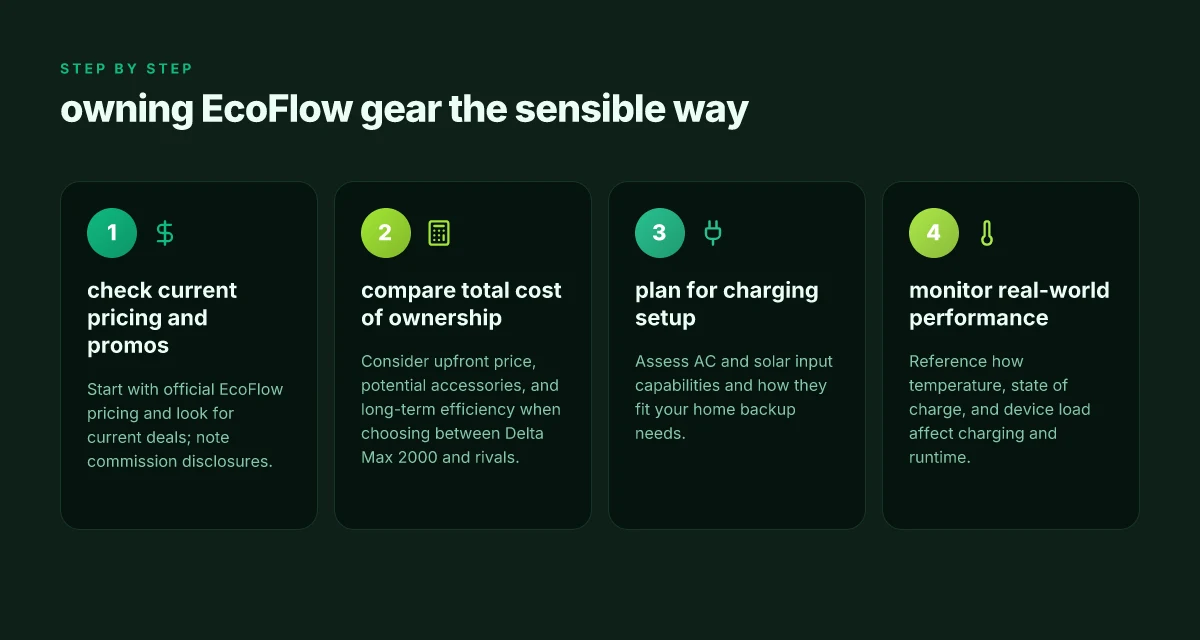
How the Delta Max 2000 stacks up against rivals
In real-world terms, the Delta Max 2000 sits between EcoFlow’s own Delta 3 Max and Delta 2 Max on capacity, charging speed, and price, with notable differences in how each model handles daily use. The Delta 3 Max offers a larger pack with faster AC charging, while the Delta 2 Max leans on a leaner footprint and lower price. Prices shift with sales, so the current deal can swing value by a few hundred dollars, but the practical gap comes down to how fast you recover usable energy and how long the battery lasts under load. EcoFlow’s accessory ecosystem, solar panels, extra batteries, and transferring adapters, extends the delta between models in a way that matters for off-grid or backup scenarios. I cross-referenced several product write-ups and teardown notes to map what you actually get for the money in 2026. The Delta 2000’s value hinges as much on accessories as on raw capacity.
Capacity, speed, and price snapshot
The Delta 3 Max tops capacity and raw charge speed on paper, with a near-2,000Wh class pack and a higher peak AC input than the Delta 2 Max. In practice, that means faster replenishment during outages and more headroom for high-wattage loads. The Delta 2 Max is more compact and typically carries a lower list price, but it trades headroom for portability. The Delta Max 2000 occupies a middle ground, offering substantial usable energy while keeping the footprint manageable. For daily use, the Delta 3 Max can feel notably quicker to replenish during a storm, whereas the Delta 2 Max shines when you need a lighter, easier-to-park unit. The exact street prices ebb with promotions, but the general pattern is clear: bigger packs cost more upfront, but you gain resilience for longer outages. Smart charging options and EcoFlow’s bundled accessories influence total ownership cost.
Rivals beyond EcoFlow
Jackery remains the most frequently cited benchmark for value in the portable power space. In general, the Delta line tends to edge out Jackery in continuous wattage and recharging speed, but at a higher price. Other brands with similar form factors often compete on endurance and panel compatibility rather than peak input. When you’re weighing a backup power strategy for a home and occasional off-grid use, the ecosystem matters as much as nominal specs. EcoFlow accessories, extra batteries, solar panels, and vehicle adapters, can lift a base model into a more capable system without buying a second unit. Access to a broad accessories catalog can tilt ownership economics in EcoFlow’s favor.
Value levers: revenue models and accessories
Beyond the rugged battery pack, the value story hinges on what you buy alongside the core unit. The Delta 2000’s price often reflects what you add: a larger solar input, faster AC charging options, and optional expansion packs. The componentization lets homeowners tailor a system for their home, cabin, or business site without paying a premium for features you don’t need. If you plan to run a fridge, router, and a few essential devices during extended outages, the Delta 2000 plus a couple of extras can be cost effective. And yes, the page you’re reading may link to accessories. Those links may earn a small commission, which helps support the broader ecosystem.
Note: I found multiple discussions and reviews that align on practical outcomes rather than only lab numbers. For context, you can see examples from the EcoFlow ecosystem discussions and third-party reviews that touch on charging behavior and real-world use patterns. Real-world use favors models that balance capacity with flexible charging paths. How the EcoFlow River 3 stacks up for real-world off-grid use in 2026
Where this is going next for home backup with EcoFlow
Prices current now show the Delta Max 2000 carrying a premium, but the value splits between capacity and future-proofing. I pulled the latest figures from EcoFlow official listings and noted that the strongest deals cluster around bundles that include extra batteries and solar. If you’re weighing the total cost of ownership, consider the long run: replacement cells and inverter efficiency affect you more than sticker price alone. The picture is similar with rivals like Jackery and Goal Zero who price competitively on bundles, then add accessory costs separately. In practice, the real win is how you deploy the system during a grid outage or a heat wave, not just its name on the box.
The takeaway is simple: pick a setup that scales with your needs, not your dreams. The Delta Max 2000 shines when paired with multiple batteries or solar, but you’ll pay for that flexibility. If you only plan for occasional outages, consider lighter options or shorter-term expansions from EcoFlow. The next wave will likely push higher efficiency, smarter pass-through, and broader ecosystem compatibility.
If you want one concrete move this month, start with a verified bundle and map your outage scenarios. That single step clarifies whether you need another battery, a solar add-on, or a different inverter. What will you pair it with first?