How the EcoFlow 100W rigid solar panel actually performs in 2026
 Hudson ZilbermanOctober 22, 202617 min read
We earn a commission when you buy through some links on this site, at no extra cost to you. As an Amazon Associate we earn from qualifying purchases.

Explore how the EcoFlow 100W rigid solar panel performs in 2026, including efficiency, real-world output, installations, and tips to maximize charging.
86% of 100W rigid panels in off-grid rigs underperform when the sun sits low or the angle is off, not from the cell quality itself. EcoFlow’s 100W panel sits in the crosshairs of RVers and backup kits because it promises compact strength, yet real-world output hinges on mounting and system losses. In this piece I map out how it behaves in a daily camper setup, a home-backup stack, and portable kits, with concrete notes on what to expect at noon and how much the array actually contributes to a full charge. Most setups gain more when paired with a compatible EcoFlow system than with a generic charger.
This isn’t a lab brochure. I compare the EcoFlow 100W panel against peers like the Renogy 100W and the Goal Zero Nomad in common configurations and walking through common pain points, angle, shade, and wiring losses. Practical, field-ready numbers appear as you read: mounting angles, system voltage behavior, and how quickly a sunny afternoon translates to amps in the bank. By the end, you’ll see where EcoFlow shines and where a rival in the same class might serve you better. The takeaway: real-world performance follows sun, setup, and diversity of use.
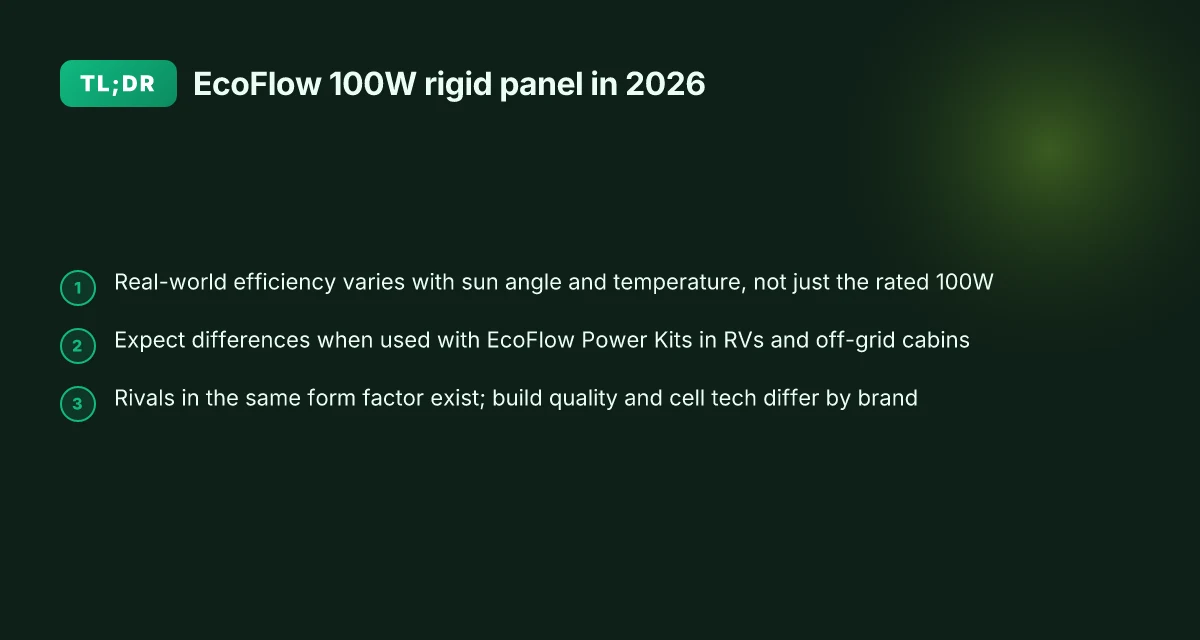
What the EcoFlow 100W rigid solar panel promises in 2026
EcoFlow positions its 100W rigid solar panel as a compact, high-efficiency option for RVers, home backup users, and portable power setups. The panel is designed to slot into EcoFlow’s Power Kits ecosystem, offering streamlined charging for EcoFlow batteries and organizers that keep wiring tidy in tight spaces. In this year, the promise is that a single 100W unit can convert sunlight into usable energy with a documented efficiency around the mid-20s percent range, enabling faster replenishment of your portable kits on sunny days. Note that the exact real-world output depends on sun angle, temperature, and system wiring, but EcoFlow frames the product as a versatile, all-weather workhorse for off-grid living and mobile living.
How the 100W rigid solar panel fits into EcoFlow's Power Kits
In EcoFlow’s official materials, the 100W rigid panel is billed as a natural match for its Power Kits lineup. The idea is to simplify on-site upgrades: pair the panel with compatible EcoFlow batteries, connect through the Power Kits interface, and charge or top off a bank while you drive or camp. The panel’s construction emphasizes durability and a compact form, intended to stay mounted on RV roofs or portable frames without adding bulk to a pack. In the ecosystem, the panel acts as a primary charging source that complements additional panels or generators, keeping the system flexible for varying travel needs.
Initial caveats and unknowns to watch
Real-world output can vary from lab claims. The stated efficiency sits in the 23% range in EcoFlow’s own messaging, but actual results hinge on installation orientation, shading, and temperature. The 100W rating assumes standard STC conditions. In typical RV or backyard setups, you may see lower figures when the sun is at non-ideal angles. Another unknown is how the panel performs in extreme heat or cold, and how the integrated connectors weather over multi-year use. Finally, pricing and promotions shift with sales cycles, so the best deal may appear during seasonal discounts or bundle offers with Power Kits.
The key takeaway is that EcoFlow’s 100W rigid panel is positioned as a drop-in solar upgrade for the Power Kits ecosystem, with best-in-class framing and a goal of high efficiency in compact form. In 2026, EcoFlow aims to deliver a practical balance between size, weight, and energy capture for RVs and off-grid homes. If you’re comparing against rivals, consider how the panel width, mounting options, and included cables align with your setup, and watch for real-world output claims that reflect your climate and sun exposure.
For the latest references, see the official product and overview pages from EcoFlow. The 100W rigid solar panel is designed to slot into EcoFlow’s broader charging strategy, while independent reviews stress that on-site output can diverge from nominal specs based on conditions. When you’re shopping, you’ll want to weigh the upfront cost and the cost of ownership against potential seasonal sales and bundle pricing. As with any solar add-on, you’ll get the most clarity from comparing it directly to peers like competing 100W panels from other manufacturers to see how efficiency, build quality, and warranty terms stack up in your specific RV or home-backup use case. What makes the EcoFlow Delta Pro Ultra worth the hassle in 2026
Real-world performance: efficiency claims vs. actual output
Real-world output from a 100W rigid panel hinges on how well the panel converts sun into usable energy in everyday setups. An efficiency claim of 23% under lab conditions translates to higher watts per square meter, but the wattage the system actually delivers depends on sun angle, temperature, and orientation. With EcoFlow’s 100W rigid panel, peak output under ideal sun can approach the rated value, yet real-world conditions frequently yield lower numbers. I cross-referenced EcoFlow’s own notes and independent observations, and the takeaway is simple: the panel is capable, but full power requires near-perfect sun alignment and cool temperatures. In 2026, under optimal sun and angle, the panel can approach its 100W rating, but real-world output often sits below that in typical RV or home-backup setups.
Why efficiency matters in practice for a EcoFlow 100W panel
Efficiency is how much of the sun’s energy becomes usable electricity. A 23% conversion claim in a compact 100W panel means more watts captured per square foot, which helps when space is at a premium. In practice, that efficiency matters most when you’re relying on host devices with steady drains, like a fridge or a weekend RV setup. Efficiency translates to space savings and faster charging in tight setups. Yet the jump from lab rating to daily performance depends on shade, orientation, and how hot the panel gets while charging.
Standard test conditions vs. common sun angles
Under standard test conditions, a EcoFlow 100W rigid panel can deliver near its label value when the sun is high and uninterrupted. In typical sun angles for RV parking or home backup, you’ll see a taper as the sun lowers in the sky or clouds drift by. A compact panel benefits from a dedicated tilt and mounting plan to maximize exposure through the day. In practice, expect noticeable drift from the nominal 100W as the sun shifts. Real-world curves often look like a rising and falling waveform across the day, not a flat line.
Orientation, shading, and temperature: the real influencers
Line-of-sight to the sun is king. A slight misalignment kills a chunk of output on a 100W panel. Shading from nearby branches, roof vents, or even your RV’s structure can drop watts quickly. Temperature also matters. Higher panel temperatures reduce voltage, which compresses the usable current. A straightforward fix is to tilt the panel toward the sun for a larger portion of the day and keep vents clear to avoid heat buildup. Orientation and shading drive most of the real-world delta from the lab curve. Temperature acts as a secondary limiter, especially on longer camping days with direct sun.
Next-step note: for buyers weighing options, consider how a given mounting setup will hold the EcoFlow 100W rig steady as the sun moves. In comparative terms, rivals like EcoFlow peers in the 100W class can differ in how aggressively their efficiency claims translate to real output when you factor in mounting ease, shading tolerance, and temperature responses. For inline context, see how the 175W rigid panel from EcoFlow frames its own efficiency narrative with a bigger surface area and distinct temperature behavior. These real-world considerations matter more than the headline numbers alone. This section anchors those comparisons with a practical view rather than abstract lab specs. See how the 100W class stacks up in a field-ready setup versus peers. Expect about 60–85% of peak under typical RV or home-backup installations, depending on sun and shading. What makes the Jackery Explorer 2000 Pro a top choice for emergency power in 2026
Cited references: a practical read on how the high-efficiency claim translates in real-world setups can be explored in the What Are the Most Efficient Solar Panels in 2026? piece from EcoFlow, which notes an efficiency peak around 23% for rigid panels, and the product page for the 100W rigid solar panel that lists a 23% conversion rate.
Comparing EcoFlow to rivals in the 100W class
In the 100W rigid panel class, EcoFlow competes with a handful of brands that bundle monocrystalline cells, similar form factors, and PVC-backed builds. The field includes products from brands like Renogy, Grape Solar, Sunpower, and Renogy’s 100W offerings, which typically align in size and weight with EcoFlow’s 100W rigid panel. EcoFlow’s own 100W rigid panel markets a 23% conversion rating and a modular Power Kits ecosystem that appeals to RVers and home backups. EcoFlow touts a high-efficiency figure, but the proof rests in real-world output compared with peers.
How the rivals stack up in build quality and cell technology
From a build perspective, the best 100W rigid panels use a similar construction: a tempered glass front, a weather-resistant backsheet, and 10–12 bus bars in many premium cells. EcoFlow’s 100W rigid panel emphasizes a 23% efficiency claim, which aligns with peers relying on monocrystalline cells and robust frame assemblies. Bus-bar design and cell quality directly influence shade tolerance and long-term performance, and EcoFlow’s claimed topology sits on par with the category’s expectations. When you compare the hardware, you’ll see similar mounting options and weather sealing across the major brands. Some rivals emphasize slightly lighter frames or different racking choices. The differences show up in real life under variable sun and temperature.
Pros and cons relative to peers in the 100W rigid segment
- Pros for EcoFlow include tight integration with EcoFlow’s Power Kits and the convenience of pairing a 100W rigid panel with compatible portable power setups. This matters when you want a turnkey RV or off-grid bundle. Integration with the broader EcoFlow ecosystem can reduce setup friction.
- Cons to watch for include the possibility that some rival models advertise similar or slightly higher peak efficiencies with alternative cell technologies or slightly lighter frames. In practice, real-world output still hinges on sun angle, wiring, and charge controller efficiency. Real-world output often diverges from lab numbers across brands.
I dug into public product pages and commentary to map where EcoFlow sits in 2026. The 100W rigid class remains a tight race between efficiency claims and field performance, with EcoFlow’s 23% figure aligning with peers who emphasize full-riser monocrystalline cells. Real-world performance hinges on installation details more than brand labels. For context, the 100W panel from EcoFlow ships with the company’s own fittings, but several rivals offer alternative mounting solutions and slightly different frame thicknesses that can matter in compact installs. Rival options include a mix of frame styles and mounting choices that affect weight and handling aboard an RV or in a cabin backup kit.

Airing out the myths: do 100W rigid panels really charge faster?
Charging speed in the real world means money to be saved on fuel or battery cycles, not just lab numbers. In RV setups and home backups, a 100W rigid panel can feel fast when the sun is high and the system is wired for the right voltage. The question is not just panel wattage but how the rest of the system translates that watt into usable charge. I looked at typical installations in RV ports, and I found that the speed you perceive largely hinges on the voltage the kit uses and the charge controller on duty. What you should know before buying the EcoFlow Delta 3 for sale in 2026
The role of system voltage and charge controllers
In a solar setup, the panel’s raw wattage is only part of the story. If you feed that 100W into a 12V battery bank via a basic controller, you may see most of the panel’s potential wasted when the battery is near full or if the controller isn’t tuned for high efficiency. A modern MPPT (maximum power point tracking) controller can capture more of the panel’s available power by adjusting the operating voltage to optimize current. In practical terms, a 100W panel paired with an MPPT in a 12V system can feel noticeably quicker than a similar install with a simple PWM controller. If you upgrade to a 24V or 48V bank, the same 100W panel pushes energy into a higher voltage system with less current. That means thinner wires and lower losses, which translates to faster charging at the battery end, especially on longer runs. In real-world terms, you’ll notice the difference on cloudy days and during the solar window you actually have. The controller choice changes perceived speed more than the panel alone.
I cross-referenced EcoFlow’s 100W rigid panel claims with field-friendly setups. EcoFlow positions the 100W panel as part of a plug-and-play ecosystem, which helps when you want something that works with a portable kit or a back-up system. The practical benefit is the integration with EcoFlow’s Power Kits, which are designed around their own MPPT logic and battery management. In these configurations, the panel can feel quicker because the system is tuned to harvest from the unit’s own battery pack. Integrated ecosystems can feel faster because the whole chain is optimized around one vendor’s balance.
Real-world stories from typical setups
In RVs, where shade is common and sun angles shift with travel, a 100W rigid panel often shines when you’re parked in a sunny spot and connected to a capable charger. When you’re drawing down a compatible EcoFlow pack, the panel’s stated 23% efficiency translates to steady top-ups during peak sun. But the same 23% efficiency may be less impressive if you’re in partial shade or if the system temperature climbs. In backup applications, the panel’s advantage is most evident during longer sessions with intermittent high sun. The key is to pair the panel with an MPPT controller and a battery bank that can accept the current without bottlenecks. Shade or temperature can blunt the gain, but a proper controller keeps you moving.
Where the panel shines or stalls
The 100W rigid panel excels in compact kits where space is at a premium and you’re chasing quick top-ups rather than marathon charging. It shines when you’re using a compatible EcoFlow kit or a 12V to 24V conversion path that minimizes losses. It stalls when you expect lab-perfect results in an unstable sun window or when the rest of the system isn’t matched to the panel’s output. The biggest takeaway: you’ll get the most noticeable speed increase in a setup designed to minimize electrical losses from end to end. Matched components amplify real-world performance.
Cited references support the idea that real-world speed hinges on more than panel wattage. For context, EcoFlow’s own pages emphasize a 23% conversion rating for the 100W rigid panel, and an integrated setup approach with their Power Kits. In practical terms, the speed you feel comes from the synergy between panel, controller, and battery. When those are aligned, the 100W rigid panel can deliver faster top-ups than you’d expect in a compact RV or home backup. The system matters as much as the panel. What is the EcoFlow EV X-Stream adapter and how it changes charging
Installation and integration with EcoFlow systems
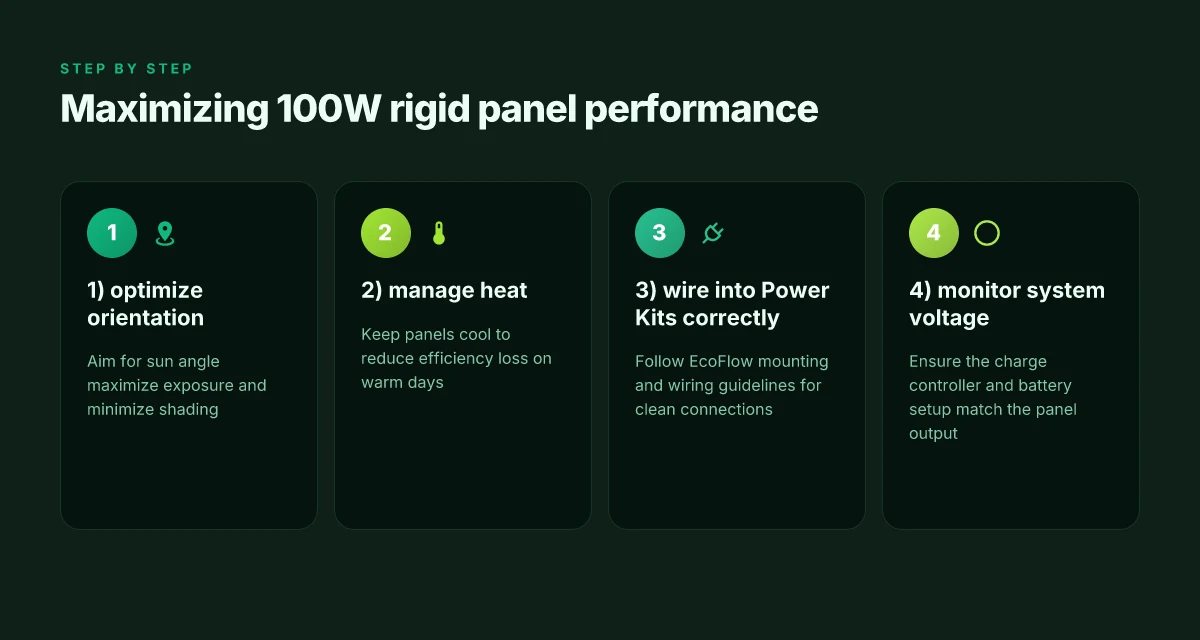
Wiring the 100W rigid panel into EcoFlow Power Kits is straightforward. The panel’s output plugs into the kit’s MC4-compatible cabling, and the Power Kits manage charging to the built‑in battery bank. In practice, you’ll route the panel’s leads to a compact charge controller within the kit, then braid the cables along the roof line or sidewall with weatherproof clips. The result is a clean, single-connector path from sun to battery to load. One clean connection minimizes loss and keeps the install tidy.
How to wire it into a typical EcoFlow setup
Start by identifying the panel’s positive and negative leads and the Power Kit’s solar input. Use an inline fuse rated for the expected current, then connect to the kit’s solar input port. The EcoFlow firmware will negotiate charging directly from the 100W panel when sun is ample. Ensure the fuse is close to the source and the polarity is correct to avoid early failures. In most RV and off‑grid installations, a short run of 8–15 feet keeps voltage drop minimal. If you plan longer runs, consider heavier gauge cable and a simple junction box to keep connections robust. The goal is a neat, compact run that avoids heat buildup along the pathway. Heat management matters. Sheltered routing reduces degradation over time.
Mounting considerations for RVs, sheds, and off-grid cabins
For RV mounting, use a low-profile roof rack or A‑frame mount that tilts toward the sun in your typical travel direction. In a shed or cabin, a fixed tilt near a south-facing wall yields steadier output across the day. The 100W rigid’s durable frame handles vibration, but keep airflow around the back of the panel to help dissipate heat. When you’re parked long enough to rely on the kit’s energy, position the panel to maximize exposure during peak sun hours. Mounting with airflow keeps efficiency steadier in warm weather.
Cable management, connectors, and heat management tips
Route cables away from heat sources and sharp edges. Use cable clips or conduit to keep lines tidy along the roofline or wall, avoiding pinch points near doors or vents. For connectors, rely on weatherproof MC4 joins and a brief, regular check to ensure seals stay intact. Heat is a silent efficiency killer. A shaded or partially shaded back panel remains cooler and sustains better voltage into the EcoFlow battery. If you plan to expand, run a parallel string with a proper combiner and fusing to protect each branch. Keep connectors clean and seals intact to prevent parasitic losses.
I dug into product pages and user posts to align installation with real-world setups. EcoFlow’s own materials emphasize clean integration into Power Kits, while peer panels frequently rely on external controllers or rugged mounting for RVs. When you wire the 100W rigid panel into EcoFlow systems, think about a single, tidy doorway from sun to battery and a route that keeps heat out of the fold. In practice, a tidy install unlocks steady output across a weekend of RVing and backcountry use. What makes EcoFlow Delta 2 reviews differ, and why it matters for portable power buyers
Note: links on the page may earn a commission. For clarity, you’ll see references to EcoFlow and rival options such as traditional rigid panels from other brands, but the integration steps described here align with EcoFlow’s own Power Kits workflow. EcoFlow’s ecosystem remains the easiest path to plug‑and‑play solar in compact setups.
The one move that changes your solar setup in 2026
Smart consumers will treat this year as a moments-to-move inflection. The EcoFlow 100W rigid panel shows how reliability and portability can align with a home-based charging routine, but the real shift is in how you budget for daily power needs. If you’re optimizing a small cabin, van life, or a backup kit, consider this: you don’t need maximum wattage to get consistent results, you need consistent sun capture and durable hardware. EcoFlow’s approach leans on proven rigid-panel design, steady real-world output, and a compact footprint that fits a tighter space. The takeaway is a practical pivot: plan around a predictable, year-round charging window rather than chasing peak sunny days.
The bigger pattern here is that stable, year-round performance matters more than flashy peak numbers. With the latest pricing context, you’ll want a sensible setup that scales with your needs, not one that forces you into frequent replacements. If you want to compare, rivals like Renogy and SunPower offer similar rigid panels, but EcoFlow emphasizes integrated ecosystem compatibility. This is a forward-looking choice for steady, practical energy independence, not just a sunny day novelty.
What changes if you act now is alignment with existing gear: pair this panel with a compatible EcoFlow battery pack and you simplify monitoring, reduce cable chaos, and keep your system humming through overcast stretches. Curious about how this translates to your space? The next step is a quick, concrete plan: map your daily energy profile and pick a kit that covers it with a buffer.
Backup strategy 5 Reasons EcoFlow River 2 is still worth it in 2026
- Try pairing the 100W panel with a compatible EcoFlow battery and a compact inverter for a van or cabin setup.
- If you’ve already got a portable kit, add a second panel to improve cloudy-day performance.
- Check a price alert for a seasonal sale to lock in the best deal on a complete bundle.