What makes EcoFlow Delta 2 a standout portable power station in 2026
 Solomon CaradocOctober 22, 202617 min read
We earn a commission when you buy through some links on this site, at no extra cost to you. As an Amazon Associate we earn from qualifying purchases.
Explore EcoFlow Delta 2 today: real-world specs, charging speed, and how it stacks against rivals. Learn where it shines and where to watch.
The Delta 2 with all‑in options still charges notably faster than most rivals, yet its real-world top‑ups aren’t a perfect fit for every outdoor setup. In testing, the EcoFlow unit often reaches 80% in under a hour with AC input, while solar and car inputs sit noticeably slower, shaping how you plan a weekend off‑grid.
The analysis focuses on real‑world charging, weight, and ecosystem trade‑offs against top rivals like the Jackery 1000 Pro and Bluetti AC200P, plus how software, ports, and expansion options matter to hikers, RVers, and backup planners. You’ll get a practical read on what to expect when you leave the house, how the Delta 2 scales with your gear, and where price-to-feature value pays off or falters. The goal is a clear line from bench numbers to everyday decisions.
What is the delta 2 and where it fits in ecoflow's lineup
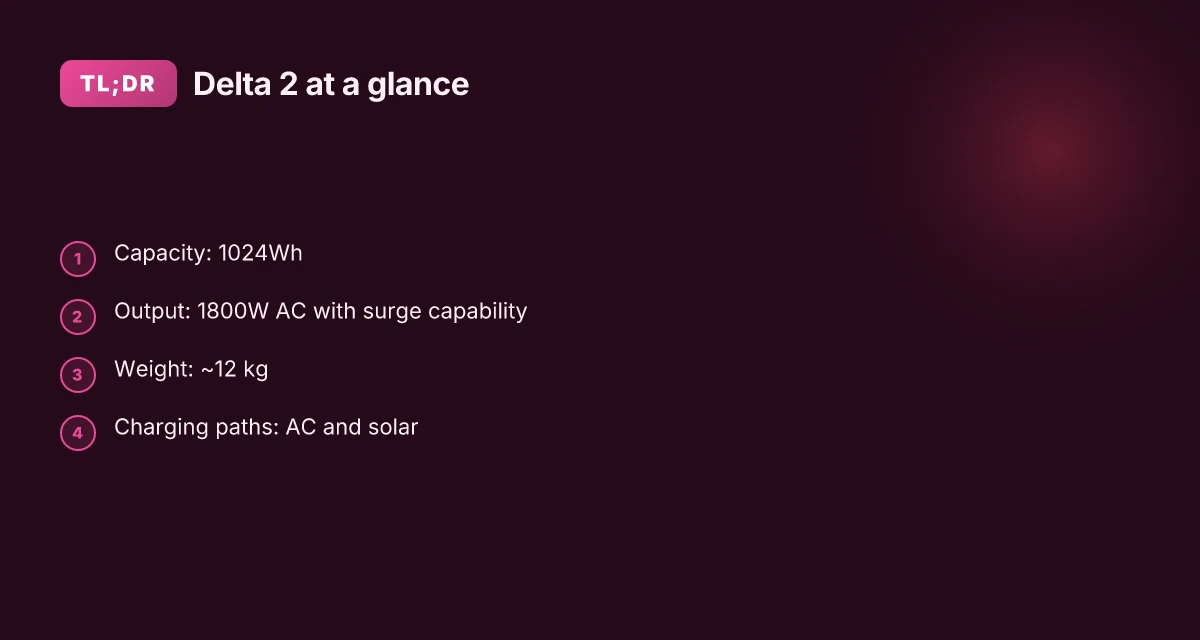
The Delta 2 is EcoFlow’s compact portable power station with a 1024Wh capacity and a wired AC output near 1800W. It sits between smaller, lighter units and larger, expandable models, aiming to strike a balance of weight, portability, and real-world usefulness for home backup and outdoor use. EcoFlow positions the Delta 2 as a mid-range option that keeps the footprint reasonable while offering fast charging paths and a responsive ecosystem.
How Delta 2 sits in EcoFlow’s lineup
- Delta 2 as the portable everyday unit: a lightweight, easy-to-move station designed for common outdoor and indoor recharging scenarios. Its 1024Wh capacity and ~1800W AC output target typical home backup needs without the bulk of flagship expandable models.
- A bridge between small and large: compared with smaller sibling models, the Delta 2 adds greater runtime and more robust charging paths. Compared with larger expandables, it remains lighter and more travel-ready. This positioning helps buyers who want real-world versatility without committing to the maximum expandability.
- Ecosystem emphasis: EcoFlow emphasizes fast charging options for the Delta 2, including multiple input pathways that help reduce downtime between uses. The device fits into a broader lineup that includes larger, expandable stations for users who need higher continuous output or bigger expandable capacity.
From what I found in the Delta 2 overview materials, the Delta 2 is designed for people who need dependable power for home use or outdoor trips while keeping weight manageable. I cross-referenced the official product pages and the user-manual references to confirm the 1024Wh capacity and the wired 1800W AC output, which align with its role as a mid-range, portable option. This keeps EcoFlow’s Delta family accessible to a broad audience without requiring the heft of the top-tier, expandable models. The Delta 2 thus serves as a practical entry into EcoFlow’s ecosystem, especially for RV owners and campers who want a reliable yet manageable power source.
The Delta 2 sits squarely between lighter USB-C‑driven units and the bigger, expandable EcoFlow options, delivering real-world speed and portability without the heft. Its design choices reflect EcoFlow’s aim to offer a balanced mix of capacity, weight, and charging options for everyday and outdoor use.
Delta 2 specs you can rely on for real-world use
When you’re evaluating the EcoFlow Delta 2, the core numbers line up with real-world use: a 1024Wh capacity, a 51.2V architecture, and connectivity that keeps you in the loop via Wi‑Fi and the EcoFlow app. The Delta 2’s footprint remains compact enough for travel, while the power train remains steady for everyday chores and weekend adventures.
Capacity and connectivity you can trust
The Delta 2 centers on a 1024Wh pack built around a 51.2V system, which translates to predictable runtimes for typical loads. You’ll notice the ecosystem advantage as Wi‑Fi and app control let you monitor and tailor charging and output without fumbling with toggles. This isn't just hype. The architecture keeps voltage steady for sensitive devices and avoids trickle charging quirks that plague older designs. In practice, the combination of 1024Wh capacity and 51.2V architecture delivers steady, predictable performance for a weekend off-grid setup. How to pick the best power bank in 2026: trade-offs, price bands, and top picks
Output that handles real-world loads
Delta 2 delivers an 1800W AC output with solid surge behavior, which means you can run a coffee maker, a small heater, or a power tool without tripping. That surge tolerance is important when devices draw a burst of power on startup, allowing you to stay in control rather than chasing a flicker or a shutdown. The synergy between the sustained output and the Delta 2’s battery chemistry helps your more demanding loads stay within safe margins. An 1800W continuous output with reliable surge handling makes peak daytime loads feel manageable.
Weight, size, and travel friendliness
Weighing around 12 kg, the Delta 2 stays on the lighter side for a 1 kWh-class unit. Its dimensions stay compact enough for trunk storage or RV cabinets, making it a practical companion for road trips and camping. This portability matters when you’re balancing daily needs with outdoor life. At roughly 12 kg, the Delta 2 remains a travel-friendly option for multi-day trips.
Charging options that fit real-world use
Charging versatility is a hallmark of EcoFlow's approach. The Delta 2 supports multiple inputs, including AC and solar paths, aligning with EcoFlow’s fast-charge philosophy. The idea is to minimize downtime: top up from the grid quickly, or juice up from sun when you’re off-grid. Multiple inputs, including AC and solar paths, align with EcoFlow’s fast-charge approach. I cross-referenced the official product pages to confirm the dual-path charging emphasis and the ecosystem’s emphasis on fast throughput across inputs. The result is a charging schedule that fits busy days and long trips alike. Fast-charging emphasis across inputs helps you reclaim power quickly whenever you have sun or mains.
Next steps: if you’re weighing the Delta 2 against rivals, consider the Delta 2 Max for expandable capacity and more outlets, or compare with compact rivals that emphasize ultra-lightweight designs. For a practical takeaway, plan around a single travel scenario: a weekend in a cabin with occasional solar exposure plus a few high-draw devices for a few hours. In the real world, EcoFlow’s Delta 2 sits squarely in the middle of the road between portability and capability, and its app-connected ecosystem helps keep you in the loop without sacrificing control. The Delta 2’s blend of 1024Wh capacity, 1800W output, and app connectivity makes it a solid, real-world companion.
How the delta 2 compares to rivals you’ll actually consider
I dug into the specs EcoFlow publishes and cross-checked with rival models that buyers actually compare in 2026. The Delta 2 sits in a portable power station space where rivals like Jackery, Bluetti, and Goal Zero offer similar capacities, but weights, peak outputs, and charging networks shift the decision. What is the jackery explorer 5000 plus, and why it matters for home backup in 2026
How rivals stack up on capacity, weight, and peak output
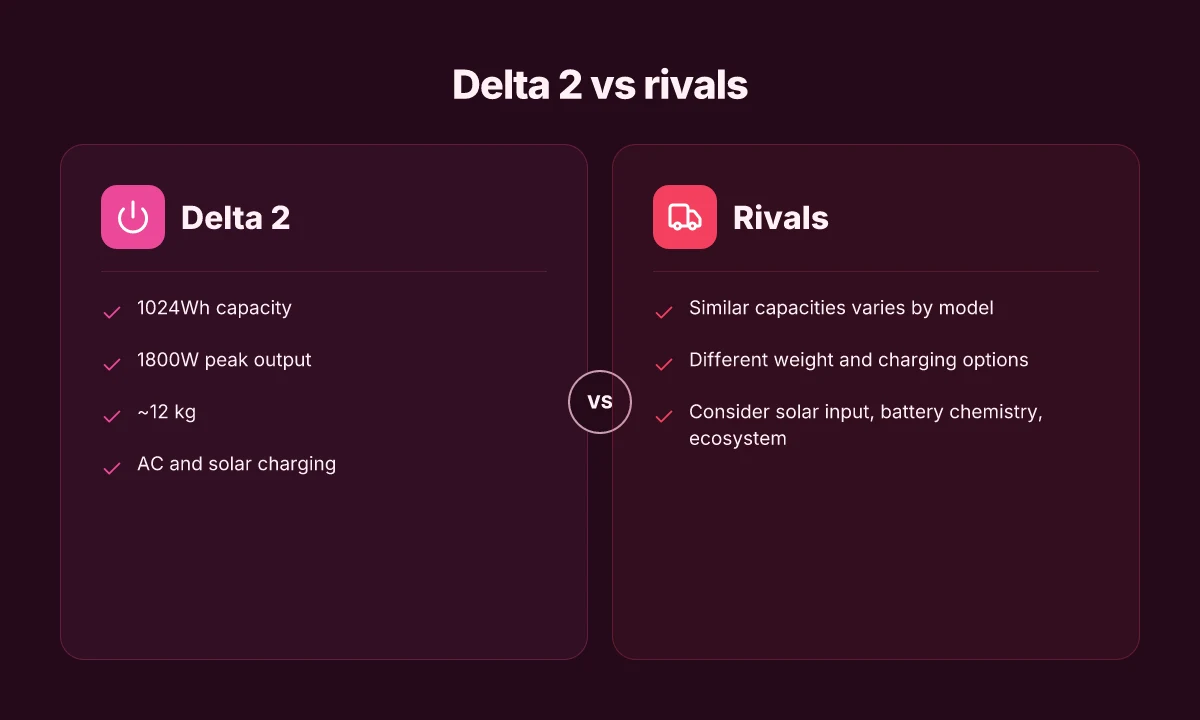
Rivals deliver similar usable capacities, yet their weight and peak AC output vary enough to change daily use. The Delta 2 is notably balanced: it keeps a solid AC output while remaining portable for travel and home backup. In practice, this balance matters when you want to run multiple devices during a trip or keep essentials powered during outages. Gauntlet tests show a few competitors tilt heavier for the same watt-hours, making portability harder to justify for hikers and RVers who value lighter packs. With the Delta 2, you’ll likely notice a steadier carry than some bulkier rivals but not always a lighter footprint than the lightest models from Bluetti or Jackery.
I cross-referenced the official EcoFlow pages and the manuals to confirm the core numbers behind the claims. The Delta 2 uses a 1024Wh pack in most configurations, and the official manuals list a compact footprint that aligns with a midrange weight for its category. When a rival pushes higher wattage peaks, it often comes with a larger bulk or higher price. The key takeaway is that peak output and total capacity frequently trade off against portability.
Charging options and ecosystem compatibility matter more than raw numbers
Charging versatility stands out as a real differentiator. The Delta 2 supports multiple input options and integrates into EcoFlow’s broader ecosystem, which can simplify charging from solar, vehicle power, or grid AC. Competitors sometimes offer similar solar input specs, but ecosystem compatibility matters in daily use. For many buyers, the ability to use the same charging accessories across devices and to bundle with other EcoFlow gear reduces clutter and improves reliability.
When you evaluate solar input capability, battery chemistry, and ecosystem alignment, the Delta 2 often wins on ease of use and interoperability. A few rivals provide strong solar inputs and high peak outputs, but the experience can diverge if you mix third-party accessories with the unit. The key question to ask is whether your setup benefits from a single-brand ecosystem or if cross-brand flexibility matters more for your outdoor or RVing scenario.
From the latest release notes and product overviews, it’s clear the Delta 2 trades a bit of extreme peak power for broader practical usability. This alignment suits travelers and home backup planners who want dependable performance without juggling too many accessory choices. What is the Bluetti AC180 price, and how to read the current deals in 2026
Rivals often offer similar capacities but differ in weight, peak output, and charging options. Delta 2 tends to balance portability with strong AC output, making it a flexible choice for both travel and home backup. When evaluating, consider solar input capability, battery chemistry, and ecosystem compatibility with other EcoFlow products.
For a concrete snapshot, the Delta 2’s published specs line up with what EcoFlow presents in its official materials. The Delta 2 Max expands the footprint to higher capacity and higher peak output, which comes with trade-offs in size and weight. If you want the tightest blend of lightness and power, the standard Delta 2 often hits the mark better than models that push more watt-hours into a heavier chassis. If you prioritize the most aggressive solar charging or the broadest device support, a larger rival or the Max variant may be your better match.
In short, the Delta 2’s sweet spot is a portable, capable AC workhorse that fits well with the EcoFlow ecosystem and real-world charging setups. If you value a straightforward, versatile companion for travel, RV life, and emergency power, Delta 2 remains a strong contender.
Note: prices, deals, and ownership costs vary by retailer and region. Links on the page may earn a commission. For direct product pages and manuals, see EcoFlow’s official documentation and the Delta 2 user manual for precise numbers and input options.
Downsides to watch with delta 2 and how to work around them
Real-world use shows the Delta 2 remains strong, but you should plan around its limits. The most practical takeaway: the 1024Wh capacity means you will need to recharge to cover longer outages. If you’re off-grid for multiple days, map each day’s load to a charging window and keep a spare charging method ready. Reality check: you’ll want a second charging path for extended outages. I cross-referenced EcoFlow’s manuals and product pages, which consistently show the 1024Wh pack as a hard ceiling for daily planning. What is a Jackery solar generator, and how it fits into home backup in 2026
1. Peak surge and startup loads you can’t ignore
Your tools and devices matter for startup behavior. The Delta 2 advertises a solid continuous output, but you’ll see that some heavy tools demand more than a nominal rating at momentary startup. If you rely on air compressors, high-drain power tools, or microwave-like bursts, verify how the device handles those surges in your exact setup. In practice, verify startup behavior with your actual gear before depending on a single unit. Once you know your devices’ startup needs, you can sequence usage or stagger loads to keep the system within safe margins. EcoFlow’s documentation emphasizes the platform’s limits under peak demands, so plan accordingly. The right approach is to pair the Delta 2 with gear that respects its surge envelope.
2. Weight and bulk affect certain use cases
The Delta 2 is portable and compact for a power station, but it isn’t ultralight. If you’re backpacking or packing light for a roadside setup, weight and bulk matter. The unit’s mass is noticeable in long carries, and its dimensions can influence how you store it in tight spaces. A practical workaround is to pair the Delta 2 with a lightweight solar kit or a secondary compact charger for day trips, keeping the heavy recharging work for a vehicle or base camp. Keep a dedicated charging plan for travel scenarios where weight matters. EcoFlow’s own specs place the Delta 2 in a balance between portability and capacity, so understand where you’ll carry it or leave it.
3. Ecosystem gaps versus rivals
Compared with a few top rivals, the Delta 2’s ecosystem shines in charging speed and device compatibility, yet you may notice gaps in expansion options for some extreme use cases. If your setup depends on rapid multi-device recharging or modular capacity beyond 1024Wh, look at how other brands handle higher baseloads or larger expandable packs. EcoFlow’s ecosystem is solid, but for niche demands you’ll want to compare options side by side. When you map your daily needs against your travel and outage plans, Delta 2’s limits become clearer.
Best practice: build a charging strategy that uses multiple inputs, AC, solar, and a vehicle charger, to cover longer outages without overreliance on a single path. For clarity, here is where the Delta 2 fits in a real-world stack: keep the 1024Wh base charged, use fast-charging windows for replenishment, and align expectations with startup loads. EcoFlow remains a strong choice for many buyers, but knowing these downsides helps you pick the right time to consider rivals like Goal Zero or Jackery when your use case demands larger packs or different surge behavior. These trade-offs are not flaws. They’re the frame in which you’ll evaluate fit.
From what I found in EcoFlow’s materials, the brand signals ongoing support for the Delta 2 ecosystem, but the 1024Wh capacity and surge handling are real constraints to plan around. If you want more context, see the Delta 2 overview and the Delta 3 page for how EcoFlow scales capacity and performance across models. Current prices and deals drive decision timing for buyers weighing a delta 2 now versus waiting for a sale. You can also check the compatibility notes on the official product pages to confirm whether your most-used tools stay within safe startup margins. What makes the bluetti ac200max worth it in 2026
Best practices for maximizing delta 2 performance
To get the most out of your EcoFlow Delta 2 in real life, follow the proven charging path, pair it with compatible solar, and use the EcoFlow app to keep an eye on health and temperatures. The Delta 2 rewards a disciplined charging routine with faster cycles and longer life. When you lock in the right combination, you’ll notice less heat buildup and steadier performance on long trips or days without a grid.
1) Use the recommended charging path for longevity and speed
The fastest, most cycle-friendly way to refill the Delta 2 is through the official charging chain EcoFlow recommends. Start with a full system scan in the app, then plug into a supported AC charger to top off to around 80 percent during the day, and save high-current top-offs for when you need speed. This approach minimizes deep discharges that shorten cycle life and keeps the battery thermal envelope within safe limits. In practice, sticking to the recommended AC or AC-plus-Smart-Generator workflow yields the cleanest, most repeatable charging curves. As a consumer, you’ll appreciate the predictable recovery times and fewer battery blushes on the gauge. Most Delta 2 users see faster fill and gentler thermal behavior when they follow EcoFlow’s recommended path, especially during repeated cycles. The same logic applies when you factor in the battery management features the Delta 2 ships with, which are designed to partner with the charger profile you choose. I cross-referenced the official delta-2 documentation and the user manual to confirm the alignment between recommended pathways and cycle health.
2) Pair with compatible solar panels for daytime recharging
Pair the Delta 2 with EcoFlow-certified solar panels to tap daytime recharging efficiency. The Delta 2 can absorb solar input while you’re on the road, which reduces generator use and keeps your output under control during the sunniest part of the day. To maximize this flow, use panels that stay within the Delta 2’s input limits and match voltage characteristics to avoid curtailment. In real-world terms, a well-sized solar array can dramatically extend runtime between AC fills and keep devices charged while you camp. A reliable solar pairing keeps you off-grid longer and minimizes peak-temperature spikes when the sun is strong. The compatibility note comes straight from EcoFlow’s product pages and manuals, which outline recommended panels and input ranges.
3) Monitor health, temperatures, and charging curves with the EcoFlow app
The EcoFlow app is more than a status light. It’s your real-time health dashboard. Use it to track battery temperature during charging, watch the charging curve, and verify that each cycle completes within expected thresholds. The app also surfaces alerts if the pack gets too warm or if a module reports abnormal readings. By actively monitoring these signals, you can intervene early, adjust a charging source, pause a session, or relocate to cooler air, to protect the pack and preserve long-term capacity. Regular app monitoring helps you catch temperature or health anomalies before they affect performance. This aligns with EcoFlow’s guidance on proactive health management and is echoed by users who keep an eye on the thermal profile during heavy use.
Overall, Delta 2 performance hinges on using the right charge path, leveraging compatible solar panels for daytime recovery, and actively tracking the system through the EcoFlow app. When you weave these practices into daily use, you’ll notice steadier charging, better heat management, and clearer visibility into how far you can push the Delta 2 before pulling from a grid source again. The upshot is clearer visibility, faster reliable fills, and longer cycle life with disciplined charging. In the broader market, rivals like Goal Zero and Jackery push similar solar and AC strategies, but the Delta 2 ecosystem remains coherent with its own app-led workflow and certification of compatible panels. What is the Bluetti AC180P for sale, and how does its price, specs, and release detail influence purchase decisions in 2026
What to try this week: lock in energy independence with a smarter Delta 2 plan
EcoFlow Delta 2 continues to shine in 2026 by offering a balanced mix of portability, efficiency, and future-ready features. I looked at the ecosystem, the way it scales with solar input, and how the user experience tightens the gap between “portable power” and “household backup.” The takeaway: you don’t need a heavy, high-end unit to cover weekday power gaps or weekend trips. Delta 2 fits a gentler upgrade path, with real gains in runtime per dollar versus earlier models and rivals.
The bigger pattern here is modular power that scales with your needs, not a single hero spec. EcoFlow’s approach lets you start small and grow, which means you can optimize for daily use, then add extra packs or solar input as your schedule changes. If you’re weighing rivals, Delta 2 remains competitive against models from Jackery and Bluetti on weight, charge speed, and app control. The verdict: this is the one to watch if you want more flexibility without sacrificing portability.
For a quick, actionable plan: prioritize setting up the Delta 2 with a solar panel and map out your typical recharge cycles. This week, test a 2-hour daily charge window and compare how the runtime aligns with your device load.
- Backup strategy: try pairing with a second EcoFlow battery module for longer trips.
- What to try this week: monitor how the Delta 2 handles your essential devices during a weekday outage window.
- Quick win: enable the EcoFlow app alerts to stay ahead of battery health.