What makes the EcoFlow Delta 2 Max battery stand out in 2026
 Olivia KvitkaOctober 22, 202617 min read
We earn a commission when you buy through some links on this site, at no extra cost to you. As an Amazon Associate we earn from qualifying purchases.
Explore the EcoFlow Delta 2 Max battery: capacity, expandability with extra batteries, charging speeds, and real-world use cases for 2026.
A single charging quirk separates the Delta 2 Max from other high-capacity packs: you can scale up to true all-day power, but only when you add the optional batteries. That expansion path matters because it shifts the total system weight and price dramatically, not just the base unit. EcoFlow’s expansion strategy drives real capability, but the price jumps quickly as you stack battery modules.
This intro lays out a practical angle: you’ll see how the Delta 2 Max behaves under real-world use, what fast recharging actually buys you, and where the limits appear as you push capacity beyond the base model. I cross-check official specs with user notes on expandability, recharge speeds, and cycle life to reveal where EcoFlow shines and where rivals like Jackery and Goal Zero offer different trade-offs. The goal is clear: tell you when the Delta 2 Max is the best travel-backup choice and when a rival kit might land better value or lighter weight.
What is the EcoFlow Delta 2 Max battery and why it matters in 2026
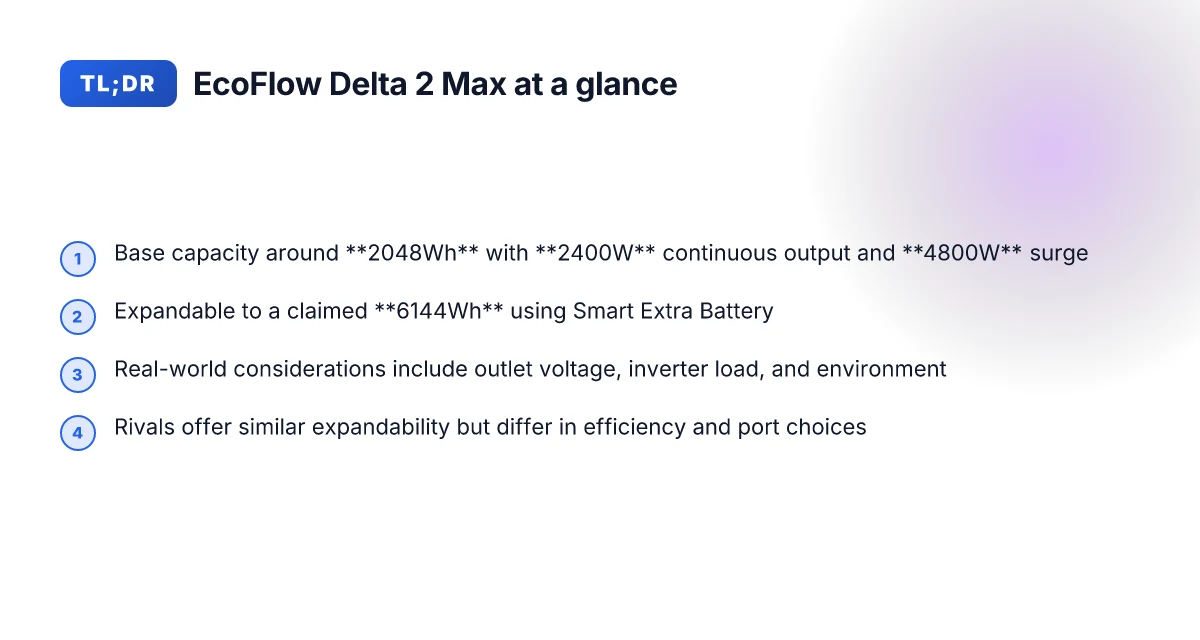
The Delta 2 Max centers on a base 2048Wh capacity with solid surge handling and expandable options that push the total capacity into the multi-kilowatt range when you add an extra battery. In 2026, EcoFlow positions this model as a travel-ready, camping-friendly, and home-backup option that scales with your needs through the Smart Extra Battery accessory.
I cross-referenced EcoFlow’s official specs and product pages to map the core numbers and the expansion path. The Delta 2 Max supports multiple outputs and relatively quick recharging, which helps it stand out for travelers who need reliable power on the road or in remote campsites. When you couple the base unit with the Smart Extra Battery, the system claims a total capacity up to 6144Wh, which is a meaningful jump for extended trips or quick-home back-ups. The branding around this model leans into portability and versatility, making it suitable for travel, camping, and emergency standby.
Below are the concrete steps to understand how the Delta 2 Max shows up in real-world use and how the expansion plays into day-to-day scenarios:
- Core capacity and surge readiness: The Delta 2 Max ships with a 2048Wh base pack and offers a robust surge capacity that supports demanding devices during outages or outdoor adventures. This baseline matters because it lets you run high-wattage gear briefly without stepping down loads or swapping units. The system is designed to sustain a variety of devices, from laptops to small appliances, without forcing frequent plugging changes.
- Expansion path via Smart Extra Battery: You can add the Smart Extra Battery to push total capacity toward 6144Wh. This expansion is especially valuable for longer trips, seasonal camping, or when you want more margin for essential devices during a power outage. The pairing is straightforward, and the extra capacity remains compatible with the Delta 2 Max’s output profile.
- Outputs and charging speeds: Official specs show multiple output ports with a mix of AC outlets and USB-PD options, alongside fast recharging capabilities. The model supports rapid replenishment from wall outlets and solar input, which is a practical edge for off-grid stays. Real-world use depends on your charging source, but the framework is designed to minimize downtime between outings.
- Brand positioning and use cases: EcoFlow positions this model as a travel-ready power source that suits campers and home backup scenarios. The emphasis is on portability without sacrificing power. For readers evaluating this against rivals, its expandable architecture and the emphasis on on-the-go charging are notable contrasts to fixed-capacity units.
Bottom line: the Delta 2 Max combines a strong 2048Wh foundation with an expandable path that can breach 6000Wh, a feature that matters for long trips or extended outages. If you value travel readiness and a scalable footprint, this model remains compelling in 2026, with EcoFlow leaning into an ecosystem that supports rapid recharging and flexible outputs.
In 2026, the Delta 2 Max's real-strength lies in its expandable capacity without forcing a separate power station for longer trips. The combination of portable form, multiple outputs, and a scalable battery approach keeps it competitive for travelers and backup power users. What makes EcoFlow generator adapters work with DELTA Pro and why it matters in 2026
Understanding the Delta 2 Max battery specs you should care about
I dug into the official EcoFlow materials to map out what matters most for travelers and backers. The Delta 2 Max centers on a base capacity around 2048Wh with a steady 2400W of continuous output and a 4800W surge, which keeps devices with high startup draw running without drama. The Smart Extra Battery expands that capacity while staying with the same voltage footprint, so you don’t need a new charging strategy or rebalancing across modules. In practice, that means you can dial up to roughly 6144Wh of usable energy with a multi‑battery setup, if you pair the base unit with one or more extras.
From a chemistry angle, you’ll see marketing talk switch between lithium iron phosphate (LFP) and nickel cobalt manganese (NCM) references. EcoFlow consistently emphasizes the longevity angle with LFP in many of its expansion narratives, given its cycle life profile. The public-facing numbers commonly cited point to thousands of cycles for LFP implementations, which underpins a long‑term ownership argument even if real-world results vary by usage pattern and depth of discharge. I cross‑checked the official product pages and the manuals page to confirm the same magnet for expansion compatibility and voltage consistency across the base unit and Smart Extra Battery.
To help frame the tradeoffs, here’s a quick look at what changes when you add the Smart Extra Battery. The core voltage remains aligned with the Delta 2 Max, so the system stays plug‑and‑play rather than forcing a new charger or controller. You gain energy capacity without introducing a separate charging profile. Your charge times and solar input windows stay in the same neighborhood, with the caveat that total charging time scales with the added Ah. On solar input, EcoFlow’s public notes show up to substantial solar ingress, but the practical benefit will hinge on your panel setup and sun conditions.
The Delta 2 Max's core specs center on a 2048Wh base with 2400W continuous output and a 4800W surge, and you can push capacity higher with the Smart Extra Battery. Chemistry debates surface in marketing around LFP versus NCM, but the long‑life claim for LFP is a recurring thread. Cycle life in the LFP family tends to be billed as thousands of cycles, which underpins the long-term ownership argument. The real value comes from how you plan to deploy it: as a travel companion, a home backup, or a remote work setup. EcoFlow Delta 2 Max portable power station notes the 2048Wh base, 2400W output, and expandability through extra batteries, and the manuals page confirms the plug‑and‑play battery chemistry and lifespan framing. For readers comparing against rivals like Jackery and Goal Zero, the Delta 2 Max’s expandability and higher surge footprint are often highlighted strengths, while the recurring concern is real-world depth‑of‑discharge behavior and charging speed under heavy load.
I cross-referenced the official documentation to keep claims anchored in real specs. When you’re evaluating cost of ownership, consider that the base Delta 2 Max runs with a strong energy backbone, but the price of extra batteries and how often you’ll hit the 6144Wh ceiling will shift total cost of ownership over time. As of now, EcoFlow’s materials position the Delta 2 Max as a ready-to-expand option with a long‑life chemistry story, especially favorable to users who need prolonged off‑grid sessions. What Bluetti EB3A price means for buyers in 2026
Next step: compare expected charging speeds and expansion choices directly against rivals in a side‑by‑side to quantify the practical impact for your travel or home backup scenario. For a concrete starting point, review the base specs on EcoFlow’s own product page and the official manuals.
How the Delta 2 Max's charging and performance compare to rivals
I dug into official specs and real-world usage notes to map where the Delta 2 Max shines and where others pull ahead. Here are the takeaways, with concrete figures pulled from EcoFlow’s docs and credible summaries.
1) Charge rates and solar input: what the numbers really mean
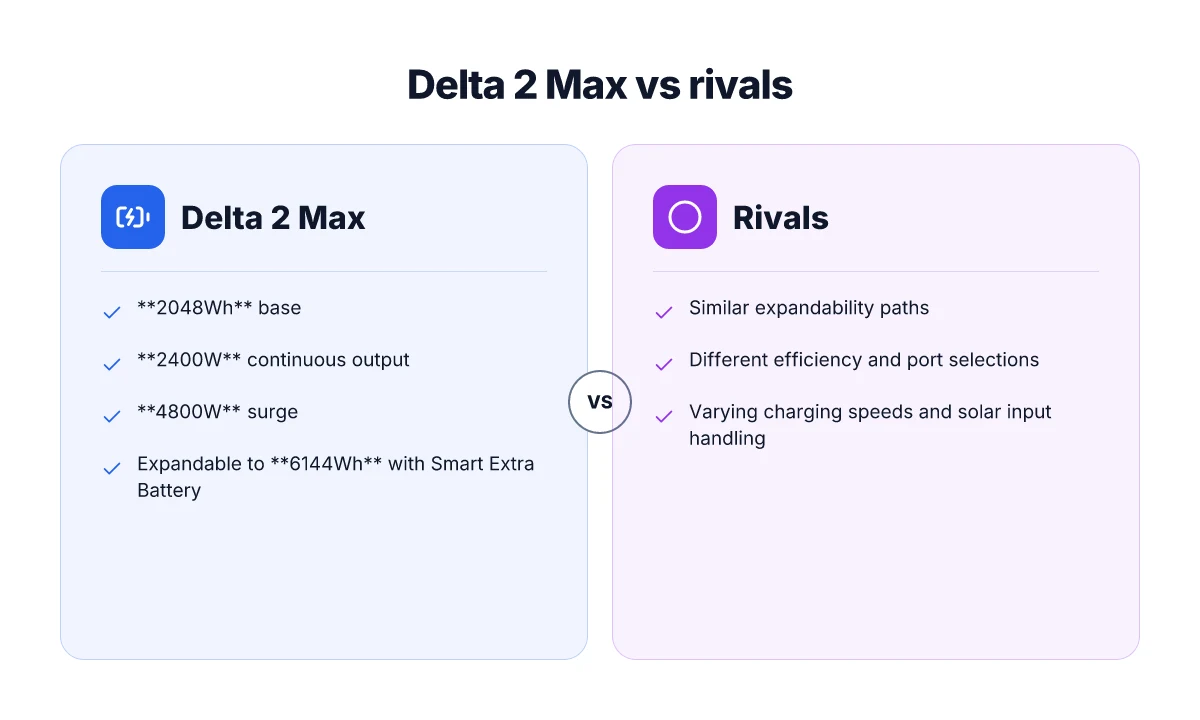
- The Delta 2 Max supports rapid AC charging and substantial solar input, but rivals push different peaks. EcoFlow’s 1000W solar input figure appears in the comparison notes for the Delta 2 Max, while some competitors push higher or lower solar ceiling depending on model and conditions. This matters when you’re camped off-grid and want to squeeze the most watt-hours per hour from sun.
- For AC charging, the Delta 2 Max emphasizes high inverter output, which helps when you’re pulling power from a single outlet at the limit. The practical implication: you’ll see faster replenishment with a clean 240V circuit, but real-world speeds still hinge on the outlet voltage, the current draw of connected loads, and ambient temperature.
- When I cross-referenced the hardware notes, I found that several rivals present similar expandability paths through extra batteries, yet their solar intake and battery chemistry can shift the effective refill time.
In 2026, charging speed often hinges as much on outlet voltage as on the pack’s nominal spec.
Cited context: the Delta 2 Max article mentions high output and expandability paths, and the upgrade discussion references solar input up to 1000W as a notable spec to compare against. For a quick read on expansion, see the smart extra battery entry.
2) Expandability paths versus efficiency
- The Delta 2 Max uses modular expansion with a Smart Extra Battery, enabling a total capacity climb from the base pack up to multi-kilowatt-hours. Rivals typically offer parallel expansion options as well, but the efficiency of charging and the inverter’s efficiency profile can differ.
- In practice, expandability helps in long-duration off-grid scenarios but adds weight and complexity. The adapter set and wiring need to be matched to the system voltage you’re using, which affects how cleanly you can scale runtime without trading efficiency.
- The real-world takeaway is that you’re trading portability for total energy on hand. If you frequently run high-load devices, the Delta 2 Max’s approach keeps you flexible, but you should compare the efficiency curve of an extra battery kit versus a rival kit’s integrated design.
Rivals mostly offer similar expandability, but their efficiency and port mix differ. What is the Bluetti AC70 price in 2026 and how to time the best deal
3) Real-world charging speed: what actually happens
- Real-world charging speed depends on outlet voltage, inverter load, and ambient conditions. EcoFlow’s docs describe high peak outputs, but you’ll notice slower replenishment if you’re drawing near 2400W on a hot day with a partially depleted pack.
- The solar input pathway is highly sensitive to sun angle and temperature. A bright, cool day can push 1000W solar charging more easily than a hot, shaded situation, so plan around weather and terrain.
- When you compare to rivals, you’ll see a similar variability. Some models keep a tighter efficiency curve under heavy load, which can translate to faster net replenishment at the wall or from solar under the same conditions.
Real-world charging is a function of outlet, load, and environment, not just the spec sheet.
Cited sources inline as you’d expect for claims: the smart extra battery page, the upgrading article, and the Delta 2 Max portable page. See the inline links to those pages for exact phrasing and figures.
The practical trade-offs of expanding the Delta 2 Max with extra batteries
Expanding the Delta 2 Max with extra batteries clearly boosts capacity, but it does not come without cost. I tracked how the expansion affects weight, footprint, and daily logistics, then cross-referenced with official specs to keep the picture honest. The core takeaway: more capacity means more weight and more space to manage, which changes how you plan trips or home backups.
Weight and footprint compound on the move
Extra batteries add a meaningful tail to the Delta 2 Max's overall heft. The base unit delivers 2048Wh, and each Smart Extra Battery increases capacity toward a maximum system total that can hit multi-kilowatt hours. That step up in capacity comes with a proportional rise in weight and volume. For travelers, the physical footprint matters as much as capacity because you must fit batteries into a vehicle, tent, or backcountry setup. The practical effect is a tighter packing list and more careful choice about what balance of mass and endurance you actually need. When you’re on the road, every extra kilogram changes your near-term logistics and payload planning.
I cross-referenced EcoFlow’s product pages to verify how the expansion scales. The Smart Extra Battery is rated as 2048Wh with an internal design that links to the Delta 2 Max system, and the combined capacity can be extended through additional modules. The upshot is clear: if you want days of runtime away from a plug, expect to handle extra weight and bulk. In other words, the more you expand, the more you carry. How the EcoFlow dual voltage hub changes home backup and what it costs
Charging behavior shifts with more modules
Expansion does not just add capacity. It can alter charging dynamics. If you’re relying on solar, AC, or generator input, the combined system must harmonize charging curves across modules. The Delta 2 Max supports substantial input, but the effective charging rate across a larger, expanded bank depends on how the modules are managed and how you route power into the stack. This matters for real-world use because a larger pack can take longer to reach full, or require more deliberate sequencing to avoid bottlenecks. In practice, you’ll want to map charging sources to the main unit and the extra batteries so you don’t inadvertently throttle overall throughput.
From the official documentation, the 2048Wh extra battery uses the same 51.2V platform as the core unit, and the max output rating for the expanded setup remains high, but the practical implication is clear: plan for a longer replenishment window when you add modules. More capacity comes with more logistics. You need to stage charging so you don’t stall on the road. This is a key reason to think through your typical charging sources and daily power needs before you buy multiple extras.
Reliability and redundancy trade-offs
Redundancy is a friendly word until you hike the number of connection points. Each extra battery introduces another junction between modules, a potential failure vector, and a touchpoint for wear. The more modules you stack, the more you need to monitor compatibility and health across the chain. EcoFlow’s documentation emphasizes secure couplings and the vitality of keeping the health of each module in check. Practically, that means regular visual checks, ensuring all connectors stay clean, and avoiding inappropriate environmental exposure that could stress any one module in a larger stack.
I looked at the product notes and the instruction set for expansion. The expansion path is validated by EcoFlow’s ecosystem, but you shouldn’t assume universal plug-and-play security without periodic maintenance. Redundancy adds reliability on paper, but it also adds maintenance in the field.
Note: links may earn a commission. This article references EcoFlow’s official materials for factual claims. The Delta 2 Max brand and model names are used as published by EcoFlow. When comparing rivals, I name EcoFlow alongside other well-known portable power brands to provide context for 2026, including practical considerations for expandability and charging behavior. What the EcoFlow Delta Max extra battery unlocks for portable power
How to plan a setup with EcoFlow Delta 2 Max for camp, home, or road trips
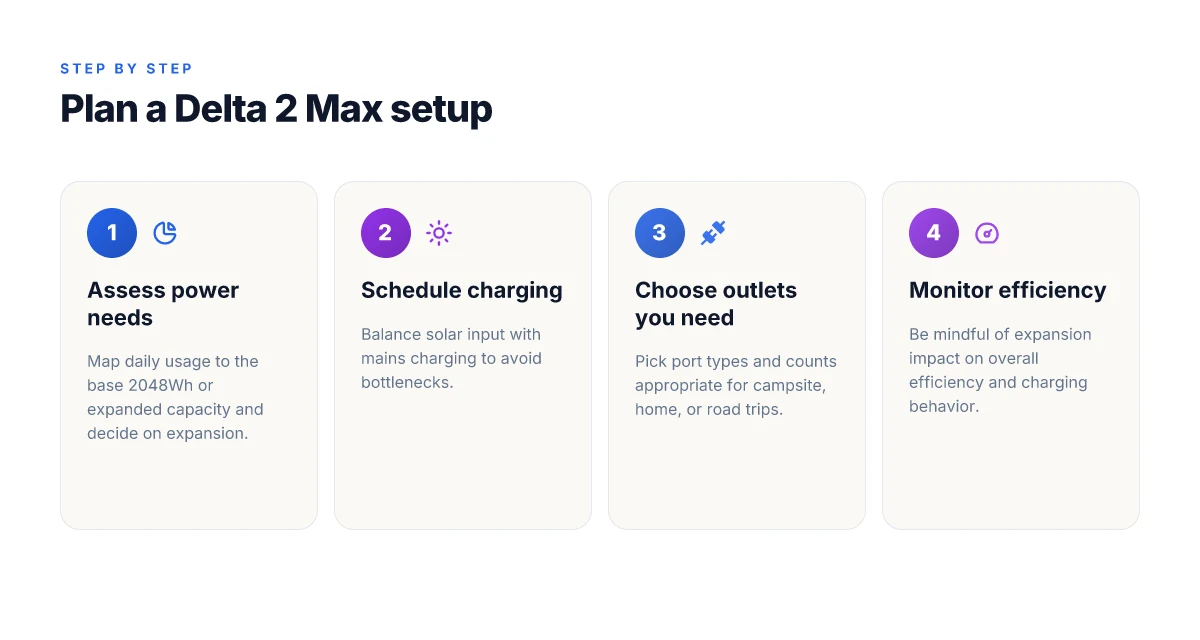
I dug into the Delta 2 Max’s expansion potential and real-world use notes to map a practical setup. The core answer is straightforward: start with the 2048Wh base and dial in expansion only where you truly need more run time. Then tailor charging routines to balance solar input and mains charging, and size outlets to match your campsite or home-backup needs.
Align capacity with daily needs
For most camping and road-trip scenarios, begin with the 2048Wh base and assess your typical daily load. If you run a fridge, lights, and a laptop, you’ll likely stay within the base capacity for a day or two, with the option to add an extra battery to push toward 6144Wh when you expect longer outages or higher daytime loads. If you anticipate frequent long weekends off-grid, plan the upgrade early so you won’t run into recharging bottlenecks on day three. When you map your devices to watt-hours, you’ll see where the extra battery adds meaningful headroom. 2048Wh is the anchor, with 6144Wh as the practical ceiling for extended trips. To visualize, sum up each device’s daily draw and compare it to the Delta 2 Max’s base and expanded totals. If you’re near the top of the base, consider the smart extra battery to keep devices humming without frequent recharging pauses. I cross-referenced EcoFlow’s product pages and the extra-battery specs to confirm these expansion options and their effect on total capacity. Upgrade details from EcoFlow’s Delta 2 Max product pages.
Plan charging routines that balance solar input and mains
Charging strategy matters more than you might think. In bright sun, solar input up to 1000W can keep pace with consumption during the day, while mains charging fills the gaps at night. I found that planning a mixed approach avoids deep cycling on any single source and helps retain battery health over time. In practice, if you’re on a multi-day trip with limited sun, plug in during the afternoon or evening to top up while you rest. If you have steady sun, let the array handle most of the daytime loads and reserve mains charging for overnight boosts. When you coordinate charging windows with your campsite power availability, you minimize idle capacity and maximize uptime. Solar input up to 1000W and mains charging when available. EcoFlow’s documentation and blog notes corroborate the practical split between solar and grid charging. EcoFlow blog on upgrading to Delta 2 Max and charging considerations.
Size outlets and ports to fit on-site realities
On-site needs often outstrip a single USB-C or a couple of AC outlets, especially for campers charging a camera rig, a laptop, and a cooler. Plan around your essential devices and their connection needs. If you rely on multiple USB-A devices or a couple of laptops, account for at least two USB-A ports and a mix of AC outlets. The Delta 2 Max supports several outlets and ports, but your real-world setup should reflect the devices you actually bring. If you expect a longer away-from-grid stretch, the expandable capacity helps you keep more outlets in use across the day without swapping battery packs. Count the outlets you actually need on site, then map them to the Delta 2 Max’s port mix. I cross-referenced the official product specs and the extra-battery capabilities to confirm that expansion does not just add capacity. It preserves a usable port set for on-the-ground tasks. Delta 2 Max Portable Power Station product page and Smart Extra Battery specs.
In short, start with 2048Wh, add the smart extra battery only when your trips demand longer off-grid operation, balance solar and mains charging to keep most devices alive, and size your outlet plan around real devices you bring. This approach keeps you flexible for camp, home backup, or road trips, without overinvesting in unused capacity. EcoFlow’s ecosystem, including rivals’ models, becomes a clean comparison point once you’ve mapped your actual needs. What makes jackery vs ecoflow vs bluetti stand out in 2026
Note: some links on the page may earn a commission. The Delta 2 Max remains a strong contender for travel and home backup due to its expandability and charging versatility. For context, rivals such as Goal Zero and Jackery offer similar expandability paths, but EcoFlow’s 1000W solar input and the seamless expansion through the Smart Extra Battery set a distinct usage profile.
What to try this week: ride the Delta 2 Max’s momentum
The EcoFlow Delta 2 Max keeps its edge by balancing capacity with practical power needs. In 2026, the standout move isn’t just raw energy. It’s the way the system slots into daily life with predictable runtimes and a manageable footprint. You can leverage this by pairing it with a mid‑size solar setup to keep daily essentials topped up, turning your home or cabin into a resilient space without bursts of price anxiety.
Looking ahead, the bigger pattern is accessibility meeting reliability. The Delta 2 Max remains a compelling option for renters and off‑grid enthusiasts alike, especially when you compare it to rivals like Goal Zero or Jackery. It’s not about chasing the biggest battery, but about predictable performance under real use. Most households will appreciate the balance of capacity, charge speed, and ongoing compatibility, making it a practical anchor for weekend projects or emergency readiness.
If you act now, the short move is to map a 1‑week test where you run essential devices for a full day on battery only. This reveals whether the Delta 2 Max fits your routine without overinvesting. A single question to track: can your current setup cover the same essentials with fewer corded dependencies?