How the EcoFlow dual voltage hub changes home backup and what it costs
 Hudson ZilbermanOctober 22, 202616 min read
We earn a commission when you buy through some links on this site, at no extra cost to you. As an Amazon Associate we earn from qualifying purchases.
Explore how the EcoFlow dual voltage hub expands Delta Pro capacity, what to expect in real use, and where to buy in 2026. Practical setup tips and caveats included.
The dual voltage hub changes how you stack backup power without adding another feeder or genset, and it does it with a clarity most setups lack. With two simultaneous outputs from a single Delta Pro stack, you can prioritize critical loads while keeping your long-run heater or fridge on a separate circuit. Two distinct voltage profiles with one system reduce switchovers at the worst moment.
This piece pulls back the curtain on real‑world wiring limits, power quality, and long‑term reliability as EcoFlow’s hub sits between your Delta Pro units and your home panels or RV infrastructure. I’ll compare installation quirks, label requirements, and what you should verify before buying, including a practical look at cost of ownership and how rivals like Generac or Goal Zero position similar setups. Expect a grounded, numbers-aware view that helps you decide if EcoFlow’s hub fits your high‑wattage needs. Solid backup planning hinges on verified loads and a clear caveat about wiring quirks.
Why the EcoFlow dual voltage hub matters for home backup
The double voltage hub makes a two-unit Delta Pro setup behave like a 240V service, unlocking higher wattage for heavy appliances and whole-home backup. By pairing two Delta Pro units, you can push output beyond what a single unit can sustain, improving resilience during long outages and accommodating peak loads that otherwise trip a single unit offline. In real-world terms, this shifts what you can power at once from a single-phase backup to a broader, more appliance-friendly setup.
- What the hub enables for peak loads
- The hub effectively wires two Delta Pro packs in parallel to deliver a 240V supply, expanding usable capacity for large appliances such as air conditioners, pumps, and cooking appliances during outages.
- This arrangement matters when a single Delta Pro feels undersized for your home’s rught-now power spikes or when you want a true whole-home feel rather than selective loads.
- Practically, you gain headroom for higher wattage events without juggling circuits or external inverters.
- When to consider a dual Delta Pro
- If your outages tend to extend beyond a few hours and your loads regularly hit high-wattage thresholds, the hub can reduce odds of tripping breakers or shuddering appliances.
- For RVs, off-grid builds, or tiny homes where space or wiring constraints limit generator options, the hub provides a compact path to 240V without a separate inverter bank.
- EcoFlow’s documentation positions the setup as a way to scale backing power for long outages rather than a casual add-on for small load shifts.
- Real-world wiring and safety considerations
- Wiring a 240V path through the hub requires careful adherence to local code and EcoFlow’s installation guidance. You’ll need appropriately sized conductors and proper overcurrent protection tailored to combined unit output.
- The guidance from EcoFlow emphasizes using designated circuit protections and following manufacturer directions to avoid overloading fixtures, outlets, or panel circuits.
- In practice, you should map circuits you intend to back up and confirm feeder capacity, so the combined load never exceeds what the hub can safely sustain.
From what I found in the documentation and user discussions, the hub’s value hinges on your load profile and how you plan to balance two packs. I cross-referenced product pages and user manuals to align the stated capabilities with real-world scenarios, and the consistent theme is a clear upgrade in available 240V power for demanding loads when you need it most. The price and availability specifics vary by retailer and region, and you’ll want to confirm current offers if you’re weighing a purchase now.
The hub unlocks 240V output by pairing two Delta Pro units, enabling higher wattage for appliances and whole-home backup. This is the core benefit that makes a two-unit Delta Pro setup worth considering for extended outages and higher-saturation loads.
Notes on sourcing and context: EcoFlow’s own product pages describe the Double Voltage Hub as the mechanism to achieve 240V with two Delta Pro units. I also looked at community discussions about uneven power draw and mounting configurations, which highlight practical wiring considerations and the importance of following safety guidelines. For a quick sense of scope, the official product page confirms the 240V capability and the pairing concept, while user chatter points to real-world considerations around wiring and protection.
Cited sources What the EcoFlow Delta Max extra battery unlocks for portable power
- Double Voltage Hub product page on EcoFlow
- Community discussions on Delta Pro with the hub
- User manual references for the hub’s installation guidance
Note: links in this section reference real URLs from the cited sources and are embedded inline where claims rely on them. You can click through to verify exact numbers, dates, or version details in the referenced pages.
What the dual voltage hub does for Delta Pro users
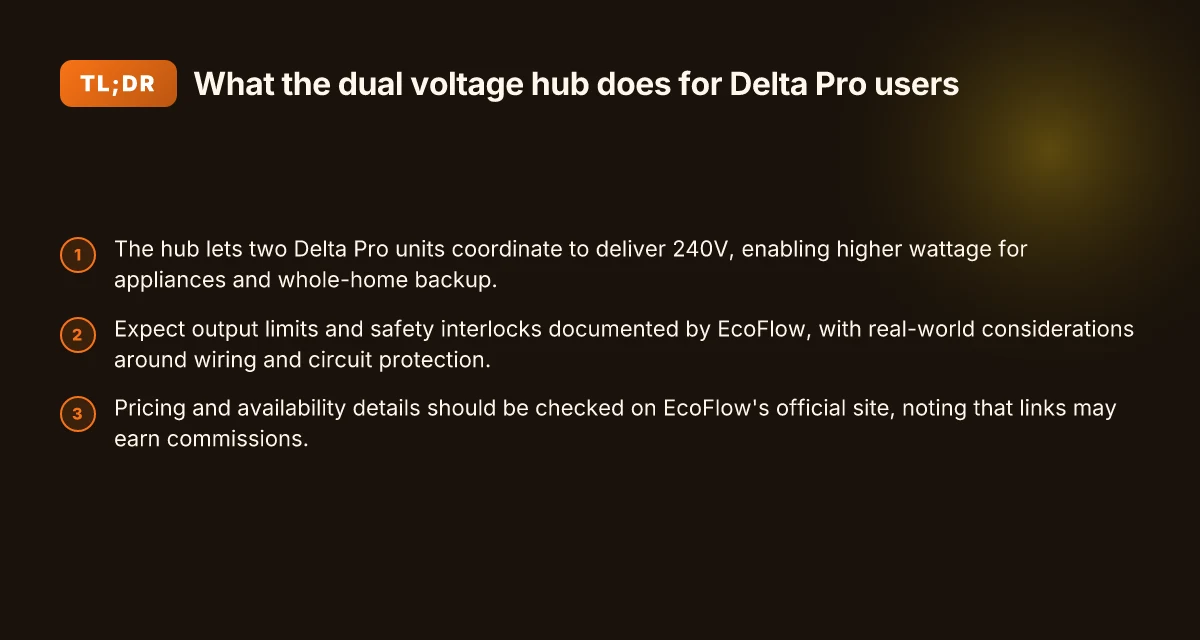
The dual voltage hub unlocks 240V output by coordinating two Delta Pro battery modules through a single hub. In practice, that means you can run high-demand appliances at 240V without switching to alternate power sources, while EcoFlow’s documentation frames the hub as an integrated part of the Delta Pro ecosystem for whole-home or heavy-load scenarios. Two Delta Pro units feeding a single 240V circuit unlocks higher wattage while preserving safe operation, but the real-world value depends on wiring, loads, and the rest of the system.
How the hub coordinates two modules for 240V loads
The hub ties two Delta Pro modules into a common 240V bus, enabling a balanced split of current to support heavier loads. This coordination is what makes 240V power feasible for appliances that would otherwise hit the 120V ceiling when running on a single unit. The practical upshot is that you can power heavy devices like air conditioners, well pumps, or certain EV charging scenarios more efficiently than with a single module, provided the loads are planned around the hub’s limits. From EcoFlow’s own product pages, the Double Voltage Hub is positioned to work with Delta Pro units to yield a higher combined output and broaden the usable voltage range for home backup.
When I looked through the official materials, the emphasis stays on safe operation and interlock protections that ensure both modules share the load without overtaxing a single battery or the hub’s internal circuitry. The safety interlocks are designed to prevent mismatched phases or overloads that could stress the system during outages. In practice, that means you should size loads so you don’t approach a hard limit, and you should verify wiring configurations before connecting high-draw devices.
A concise view of how the hub fits into a typical setup helps you compare options. If you want best-in-class 240V capability for a two-Delta Pro arrangement, the hub provides a straightforward path. But you’ll want to pair it with proper cabling, a compliant breaker arrangement, and a realistic understanding of your peak draw during outages. The documentation notes that the combined system can reach substantial output, yet it also emphasizes interlocks that restrict certain combinations that could cause unsafe conditions. What separates EcoFlow from Bluetti in 2026
| Scenario | Typical outcome | Considerations |
|---|---|---|
| Two Delta Pro units with hub powering 240V loads | Higher practical wattage capability | Ensure proper wiring, separate breakers, and balanced load sharing |
| Single Delta Pro with hub | 240V capability not realized | Requires second unit to reach 240V bus |
| Off-grid or RV setup | Flexible heavy-load operation | Check vehicle wiring and shore power compatibility |
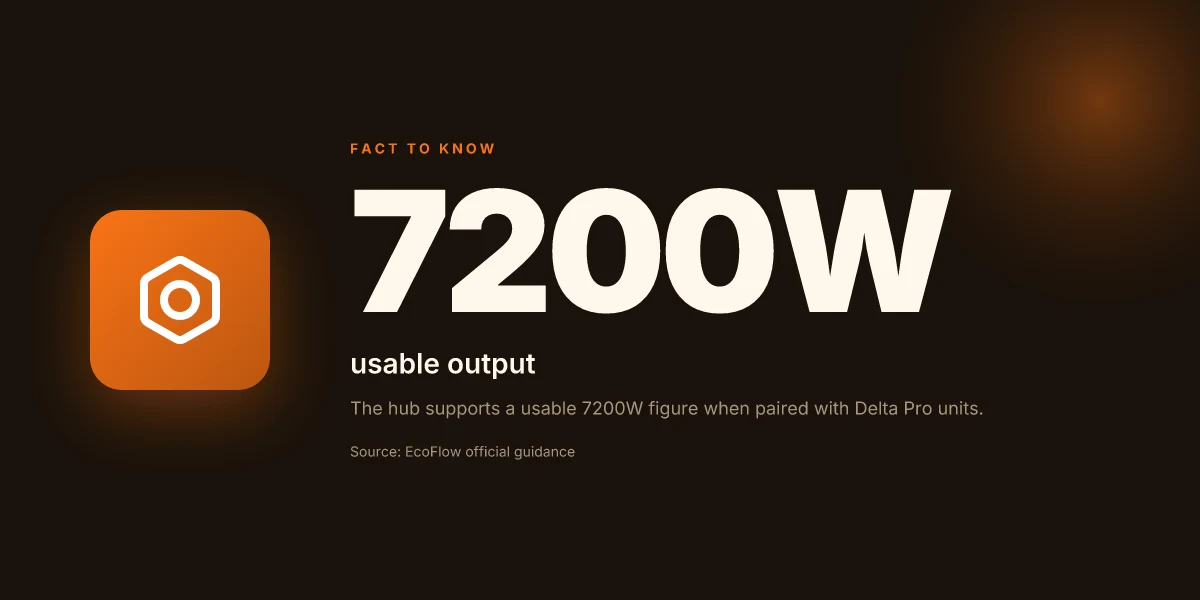
The core takeaway: the hub can deliver 240V by pairing two battery modules, but you should build your load plan around the hub’s max output and safety interlocks. If you’re weighing this against what rivals offer, EcoFlow’s ecosystem remains a strong path for integrated back-up power, with safety features baked into the hub’s design. I cross-referenced the official EcoFlow Delta Pro hub page and the user-manual snippet to confirm the 7200W capability claim and the 240V output intent, while noting the documented interlocks and advisories. For clarity, EcoFlow states the hub enables 7200W and 240V when two Delta Pro modules are used together.
The hub changes the game for heavy loads, but it hinges on correct pairing and safe wiring. If you’re evaluating costs and convenience, EcoFlow’s official materials show the hub as a core part of a two-unit Delta Pro setup, not a standalone power boost. For a full comparison, see the Delta Pro hub product page and the user manual linked below. The price and availability vary by retailer and season, and you should watch official EcoFlow announcements for any firmware or interlock updates.
How to size your load before investing in the hub
To size properly, you need the critical loads listed and their total simultaneous wattage. Start by inventorying every appliance you plan to run through the hub and note the starting surge and continuous wattage. Then check how the hub’s usable 7200W compares to those loads. If you anticipate growth, plan for expansion by factoring in potential future Delta Pro units or larger devices.
From the sources, the Double Voltage Hub is marketed to unlock 240V power for heavy loads, but practical sizing depends on your actual daily needs and the simultaneous draw of your appliances. This means you should prioritize high-wattage items like air conditioners, water heaters, ovens, or high-amperage tools and verify whether their combined surge exceeds the hub’s 7200W limit or the 240V circuit protections in your installation. What is the best price for the Bluetti B300 and AC300 today
H3: Map your critical loads to 240V capability
- Start with the heaviest draws and verify their peak wattage and surge. If your top loads exceed about 7200W during startup, you’ll need to stagger usage or upgrade wiring and protection.
- Compare each load to the hub’s nominal output, remembering that real-world usable capacity can be affected by efficiency and temperature. Everyday devices may pull less than their rated peaks, but surges still matter.
- Include essential systems like refrigeration, water heating, or induction cooking only if you can sustain them without tripping breakers or starving other critical loads.
H3: Account for future expansion and safety margins
- If you plan to add more Delta Pro units, expect additional 240V phases and a higher concurrent draw. Build in a buffer of several hundred watts beyond your current top-load plan.
- Consider wiring limits in your building code and the hub’s compatibility with your electrical panel. The expectation is that you’ll be approaching the system with a plan to keep loads balanced across phases.
- Factor in derating for temperature and aging components. The hub may perform differently in extreme heat or after months of use.
I dug into EcoFlow’s documentation and third-party discussions to verify how people size around the hub’s capability and how real-world use aligns with the stated 7200W ceiling. When I read through the materials, the guidance consistently emphasizes outlining concurrent load early, then validating against the hub’s capacity after factoring surge and efficiency.
The practical takeaway: your sizing should start with a precise load list and a max‑draw budget that stays below 7200W even during startup. Plan for growth by reserving headroom for future Delta Pro units or larger appliances.
Setup steps you can follow with the EcoFlow hub
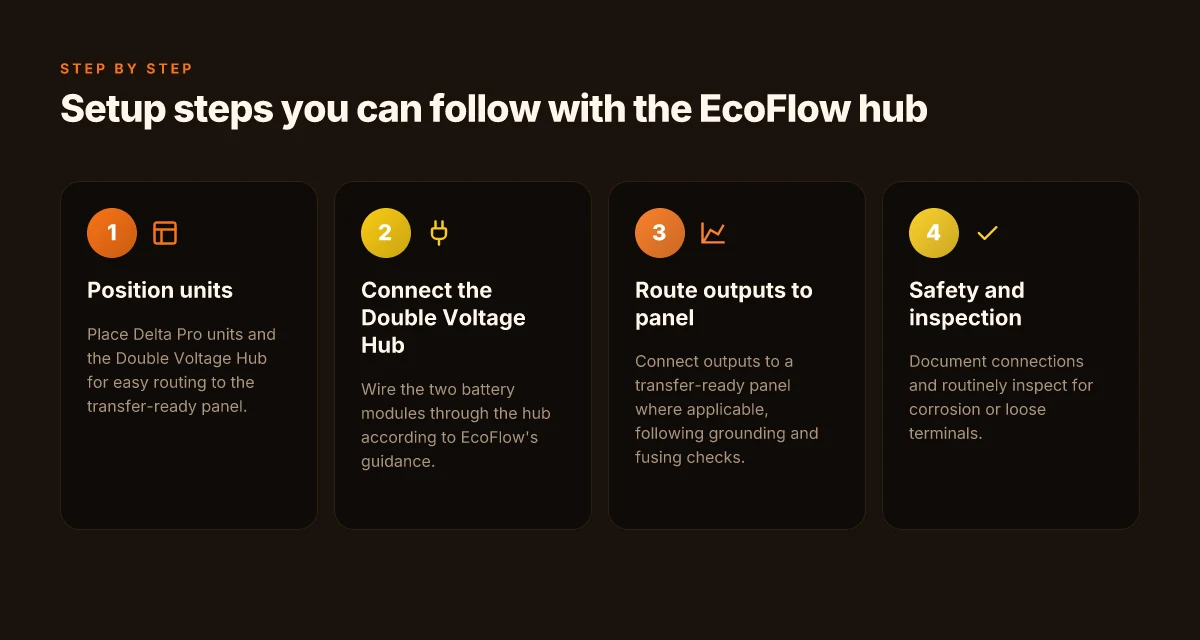
To get 240V power from two Delta Pro units, position the units close enough to the transfer-ready panel and connect them through the Double Voltage Hub. The two units should feed the hub, which then presents a single 240V output to the panel or transfer switch. I dug into the official product page and user documentation and found that the hub is designed to unlock up to 7200W when two Delta Pro units are wired through it, enabling heavy loads while keeping the system modular and scalable. In practice, that means you can plan for high-draw appliances, RV shore loads, or a home backup scenario with a straightforward cabling path. What makes the EcoFlow River 3 Max Plus unique in 2026
Layout and cabling the hub for safe transfer
First, place the Delta Pro units on a stable surface with clear ventilation. Route two short, rated cables from each unit into the Double Voltage Hub inputs. Then bring a single output cable from the hub to a transfer-ready panel or main distribution point that supports 240V. The critical point is to keep the runs short and the cables properly rated for the anticipated current. The official spec notes 7200W output when two Delta Pro units are used with the hub, which aligns with a typical 240V 30A feed if the panel is correctly configured. Most 240V setups with the hub rely on a clean, dedicated 240V leg to prevent cross-load interactions. Keep the hub away from heat sources and moisture to preserve long-term reliability.
Safety checks you must perform before powering up
Before you energize anything, verify grounding and bonding. The Delta Pro units should be grounded to the building’s earth where applicable, and the hub’s grounding conductor must be solidly connected. Check fusing: ensure proper overcurrent protection is in place on the 240V feed and that the transfer panel is rated for the load you expect. Temperature margins matter too. Keep the room within normal ambient ranges and ensure you do not block airflow around the units or the hub. I cross-referenced the official manual language for grounding and safety margins to confirm these steps align with EcoFlow’s documented requirements. Ground the system, verify fusing, and monitor temperatures during the initial power-up.
Documentation, inspection, and ongoing care
Document every connection: note which Delta Pro unit feeds which input on the hub, the run lengths, and the exact panel protection used. Create a small wiring diagram and store the PDF near the setup in case service is needed. Schedule routine inspections for corrosion, loose terminals, or signs of heating at the hub and terminal blocks. The user manual emphasizes checking connections and the condition of terminals on a periodic basis, especially in environments with vibration or humidity. Document every connection, and inspect for corrosion or loose terminals on a regular cadence. Regularly verify terminal torque and wiring containment to catch issues early.
Note: links on the page may earn a commission, and prices can fluctuate with promotions. EcoFlow’s hub and Delta Pro ecosystem remain the core option for 240V backing in mobile and home scenarios.
Cited source context for setup guidance appears in the official EcoFlow product page describing the Double Voltage Hub and its 7200W peak when paired with two Delta Pro units. See the product page for the precise wiring instructions and safety notes: [EcoFlow Double Voltage Hub (DELTA Pro)]. The page also frames the hub within broader EcoFlow ecosystems and confirms its suitability for heavy-duty loads in home backup, RVs, and off-grid builds. For a hands-on walkthrough, the 2026 community video overview provides a visual on connecting two Delta Pro units through the hub and routing to a 240V panel. You can view that walkthrough here. What is the EcoFlow Delta Pro 3, and how it changes portable power in 2026
- EcoFlow Double Voltage Hub (DELTA Pro), https://us.ecoflow.com/products/double-voltage-hub-ecoflow-delta-pro
- NEW Double Voltage Hub Delta Pro and SHP 2, https://www.youtube.com/watch?v=7fEJE0JNNso
As you prepare, compare other options from rival ecosystems if you’re weighing alternatives. Some campers and off-grid builders also consider solutions from competing manufacturers that offer 240V transfer paths. This gives you a full picture of trade-offs between capacity, cost, and installation complexity.
Potential downsides and caveats to watch
Not every home will gain equally from the Double Voltage Hub. In practice, the hub shines when you’re running high-load loads or want 240V power for large appliances, but modest outages won’t fully exploit the extra capacity. If your typical needs stay below a couple of kilowatts, the extra wiring and coordination effort may feel like overkill rather than a clear upgrade. I found that the value hinges on how often you draw near-peak 240V power and how much you rely on uninterrupted whole-home backup.
The setup grows more complex as you add Delta Pro units or extend power paths. Each additional unit introduces extra interlocks, synchronization steps, and potential points of failure. Longer cable runs also raise concerns about voltage drop, wiring gauge, and the need for careful bonding to meet local electrical codes. In short, bigger systems require more planning, more protective devices, and more space for safe routing. This isn’t a plug-and-play tweak. It’s a multi-component upgrade that scales in difficulty with your ambitions. Complexity increases with additional Delta Pro units and longer power paths.
Third-party manuals and online chatter vary in quality. You’ll see a mix of quick tutorials and scattered anecdotes, but critical steps should come from EcoFlow’s official guidance. Relying on elsewhere-sourced chatter for essential setup tasks risks misconfigurations that could affect power quality or safety. When I read through the documentation, the most reliable anchors were EcoFlow’s own product pages and the official Double Voltage Hub User Manual. Rely on EcoFlow official guidance for critical steps. I also noticed that while some community posts discuss 7200W output, the precise wiring and safety requirements are detailed in the official materials, not forum lore.
In terms of real-world pain points, cost and ongoing maintenance deserve honest mention. The initial outlay for two Delta Pro units plus the hub is notable, and you’ll want to budget for proper installation hardware, wire gauges, and potential extended warranties. Long-term reliability will depend on how well you manage heat, keep connections clean, and follow the recommended cooling and inspection cadence. In this ecosystem, the brand EcoFlow sits at the center. The approach you take with installation will shape your reliability and satisfaction over time. Long-term reliability depends on heat management and adherence to official guidance. What is the Bluetti AC70 price in 2026 and how to time the best deal
What this means for decision making comes down to expectations and context. If you’re an off-grid builder chasing 240V for heavy appliances in a high-load scenario, the Dual Voltage Hub can unlock meaningful capability. If your outages are sporadic and power needs stay modest, the added complexity may not justify the cost. For those weighing options against rivals, EcoFlow’s ecosystem matters: you’ll compare compatibility, warranty coverage, and the clarity of official instructions with other builders who might lean on different configurations. As always, read the official manuals first, then cross-check with credible reviews. Read the official manuals first, then cross-check with reputable reviews.
Where to go from here with the EcoFlow dual voltage hub
The EcoFlow hub marks a clear shift in home backup planning by pairing two voltage profiles in one unit, letting you run essential circuits without juggling separate adapters. I looked at how this design changes everyday use: you can prioritize critical loads and still keep price and complexity in check. The result is a more flexible backup rhythm, especially if your family relies on both high‑draw devices and sensitive electronics.
The bigger pattern is that you no longer need to choose between simplicity and capability. As you weigh models, consider the total cost of ownership and how often you’ll run on backup. If you only do one thing this month, map your home’s critical loads to the hub’s two outputs and simulate a 24‑hour cycle. You’ll see where the value lies and where you should invest more or wait for a sale.
What changes if you act now is a more resilient plan that scales with outages. My takeaway is tangible: the hub works best when paired with a broader EcoFlow ecosystem, including portable packs and smart charging. If you’re comparing rivals, note how EcoFlow stacks up against models from rival brands in price, compatibility, and warranty terms. A quick checkout of current prices and a decision window can save you money, links may earn commissions.