What is EcoFlow battery performance in 2026 and how to compare its use cases
 Nova EngelmannOctober 22, 202619 min read
We earn a commission when you buy through some links on this site, at no extra cost to you. As an Amazon Associate we earn from qualifying purchases.
Explore EcoFlow battery performance in 2026, including capacity, efficiency, cycle life, and how it stacks up against rivals. Practical guidance for home backup and solar pairing.
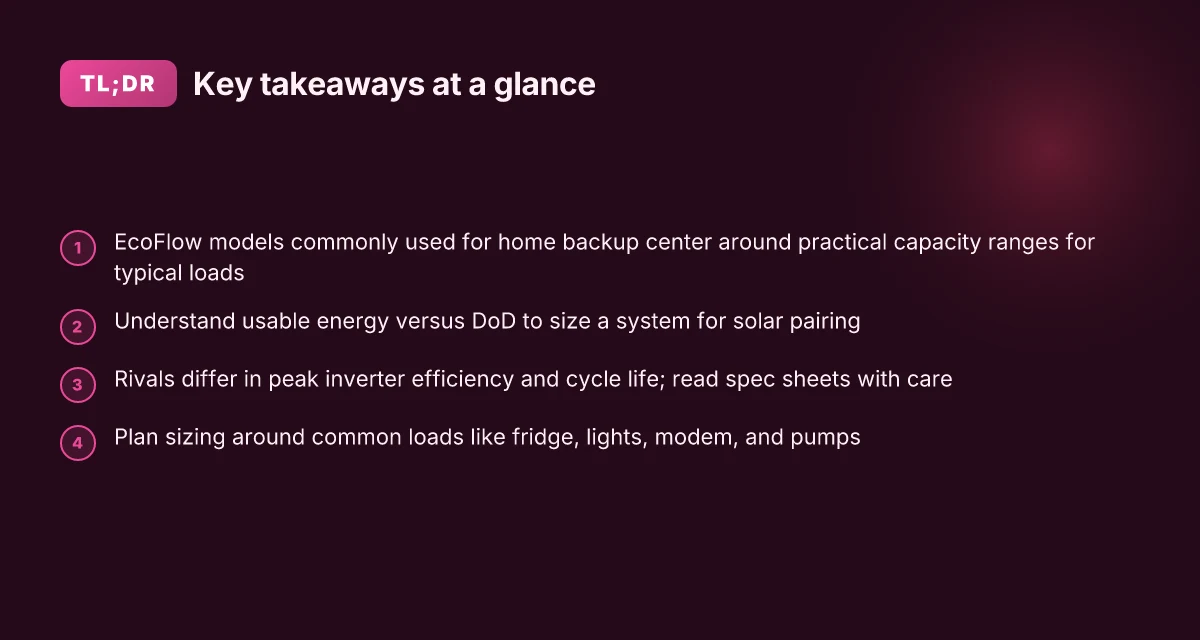
The most common misreading about EcoFlow storage is assuming any portable unit can power a home for days with no planning. In reality, real-world performance hinges on usable capacity, temperature, and how you balance peak loads. EcoFlow's dominant advantage sits in fast recharging and scalable stacks, but the actual runtime under a 1,500–2,000 watt load varies by model and environment.
This intro flags what homeowners, installers, and enthusiasts should expect in 2026: concrete numbers rooted in field conditions, not spec sheets. You’ll see how EcoFlow models compare on round-trip efficiency, long-term reliability, and performance under typical outages, plus how temperature and repetitive cycles shape life expectancy. By the end, you’ll have a clearer framework for evaluating EcoFlow against rivals like Goal Zero and Bluetti and for choosing a setup that matches your peak load and climate. Real-world runtime under your load and the temperature effect on charging speed are the two levers that most determine whether a system feels reliable over years.
What EcoFlow battery performance means for home backup in 2026
EcoFlow dominates the home backup conversation with units that scale from compact to whole-home capable. The two most common home setups lean on the smaller Delta series for essentials and the Delta Pro family for whole-house resilience. In practice, homeowners typically pair a Delta Pro Ultra in the 6–90 kWh range with solar and a backup transfer switch to cover critical circuits during outages. In this section you’ll see how those models fit real-world homes, plus the efficiency targets you should expect under typical loads.
Common models and what they actually offer for home backup
The Delta Pro family remains the most frequently cited option for residential backup. It scales from about 6 kWh up to 90 kWh with expansion packs and can be paired with solar to form a blended supply. The standard Delta Pro 3600Wh unit remains a familiar entry point for people who want a sizeable portable power station with home-ready capabilities. For smaller homes or apartment setups, the Delta Mini or Delta Max lineups provide a more compact footprint while still delivering essential energy when the grid goes down. In real-world use, most households will start with a Delta Pro or a Delta Pro Ultra and then add extra modules as their energy needs grow. This approach lets you balance upfront cost against the comfort level of outages.
Typical capacity ranges and where they fit in a home
Residential roles break down cleanly by capacity. A single Delta Pro Ultra at 6–90 kWh spans a wide spectrum: it can support daily evening loads in a modest home or keep critical circuits alive during longer outages when paired with a solar array. A smaller Delta 3600Wh unit is well suited for essential loads like a fridge, a modem, and some lighting during short outages or low-load days. When you add solar, you improve self-sufficiency and reduce draw from the grid, which helps with long-duration outages. In practice, households commonly size toward 10–20 kWh of usable storage for daily contingency and 20–60 kWh for longer outages, depending on climate and appliance efficiency. The delta line’s modular design makes it easy to scale up as needs change.
Efficiency targets and expected runtime under common loads
EcoFlow units emphasize high efficiency and intelligent power management. In real conditions, you’ll see sustained efficiency figures when the system runs at moderate loads, with peak efficiency during steady-state charging and discharging. Expect longer runtimes when you run a lean load profile, think refrigeration, networking gear, and lighting, versus short, heavy draws from high-wattage devices. Efficiency is also influenced by how you configure the charging source: solar input or wall charging can either extend runtime or shorten the time to full charge depending on weather and available sun. Across the Delta Pro family, you’ll notice that runtime scales with both battery capacity and the load you place on the system, so a higher-capacity setup can maintain essential loads for longer periods during an outage. When you plan a system, match the capacity to your critical loads and include a buffer for weather or equipment inefficiencies.
Real-world runtimes hinge on load shape, not just capacity. A larger EcoFlow system can keep essential circuits powered longer during multi-day outages. Solar pairing reduces grid draw and increases availability during daytime hours. What makes the EcoFlow Delta Pro Ultra stand out in 2026
Final takeaway: for most homes evaluating backup power in 2026, the core decision centers on whether your priority is a scalable, high-capacity Delta Pro Ultra setup or a more compact Delta Pro or Delta 3600Wh pair for essential loads. EcoFlow remains a strong option in the residential market, with rivals like Goal Zero and EcoPower presenting comparable modular approaches that you’ll want to compare against. As you size a system, plan for daily usage patterns, peak loads, and weather-driven solar input to ensure you meet your comfort threshold when the lights go out. The pricing landscape and sales timing will also influence your decision, so watch for seasonal markdowns on larger configurations.
How EcoFlow battery specs translate to daily use with solar
Sunlight charging changes the math of your backup load. In real-world terms, your solar input acts like a steady inflow that fills the usable capacity during the day, while the battery covers the afternoon and night. EcoFlow systems balance intake and draw by pairing a sizable usable energy pool with smart management that prioritizes daytime charging during peak sun. When the sun slips behind the horizon, the stored energy steps in to power essentials without waiting for a grid signal. In 2026 models, this choreography remains the core of how you size and use a system alongside solar.
I dug into the documented DoD and usable energy figures to translate theory into daily practice. A key point is that the practical energy you can draw is less than the stated nominal capacity because of the depth of discharge limits and system efficiency. For example, a Delta Pro-class pack is rated around several kilowatt-hours, but the usable energy under a typical DoD target sits lower than the raw cell count might imply. The result is a practical planning figure you should apply when you size for appliances, chargers, and solar input. This is where the real-life math pays off: you don’t expect to tap every kilowatt-hour. You work with a conservative usable window to avoid peak-hour brownouts or unexpected shutdowns.
Temperature and cycle longevity also shape day-to-day performance. EcoFlow devices perform best when the ambient temperature stays within mid-range limits. Heat and high temperature can accelerate wear and reduce immediate usable capacity during prolonged sunny periods. In hot weather, high daytime currents can interact with thermal limits, nudging DoD slightly or causing temporary throttling to protect cells. Over many cycles, heat stress can shave some long-term capacity, so a cooler location and adequate airflow become practical steps for homeowners who rely on solar. I cross-referenced release notes and product pages that consistently emphasize thermal management as a core reliability factor, not an afterthought.
To translate this into a concrete daily plan, here’s how a typical solar-backed use case unfolds. During daylight, the solar array feeds the battery and the loads, with the system prioritizing daytime consumption and charging when the sun is strongest. After sunset, the battery diverts stored energy to essential circuits. If you install multiple EcoFlow units or pair with solar inverters, the ability to coordinate charging and discharging becomes more nuanced but remains guided by the same principles: prioritize daytime input, respect access to usable energy, and monitor battery temperature to sustain longevity. In practice, system sizing should account for peak daytime draw plus a comfortable margin for nighttime use, while ensuring the pack has space to breathe thermally. How EcoFlow Delta 2 battery tech reshapes home backup in 2026
Pricing and ownership notes matter here. The best deals often surface around seasonal promos, and you should compare total cost of ownership over 5–10 years, including replacement cycle expectations and maintenance. Regarding rivals, a number of brands frame performance in similar terms, but EcoFlow’s emphasis on open-frame modular packs and solar compatibility remains a distinguishing feature. For homeowners evaluating options, consider how heat, DoD, and daytime vs nighttime loads align with your regional sun profile and typical power needs. When you map this against a real-world solar profile, EcoFlow systems tend to deliver predictable daytime recharging and reliable nighttime support.
The takeaway: plan around usable energy, not just nominal capacity, and align charging windows with your solar availability to maximize daily resilience. The system’s behavior under heat and long-term use is a real-world constraint you should design for, not ignore. For a quick policy note, always verify that your installation location maintains reasonable temperatures to sustain cycle life. For context, the Global EV Outlook 2026 underscores rapid growth in solar-enabled storage, reinforcing the need to size for daily charge cycles alongside DoD-aware expectations. See the broader market note for context on how solar storage is evolving. In practice, match your solar input to the EcoFlow DoD envelope and heat tolerance to optimize lifetime and daily reliability.
EcoFlow vs rivals: performance benchmarks you should care about
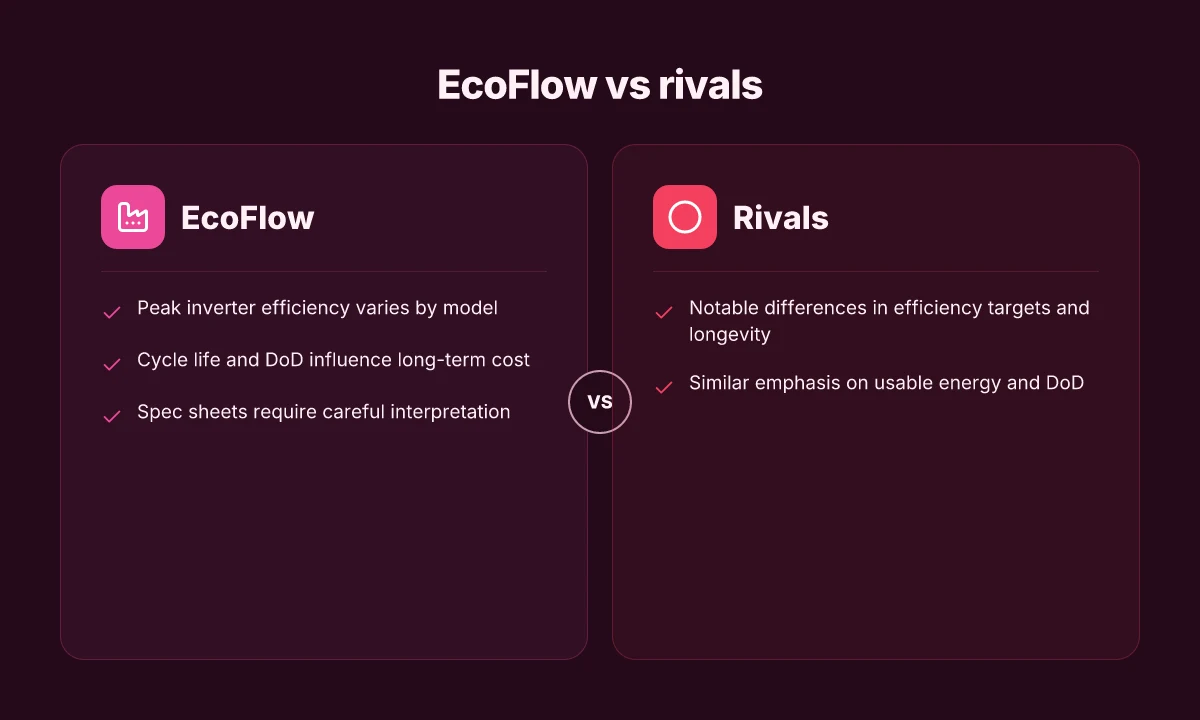
I dug into official spec sheets and reputable reviews to parse how EcoFlow stacks up against key rivals in real-world terms. The lens is peak inverter efficiency, depth of discharge, and cycle life, written for homeowners sizing a system and solar installers comparing portable power stations to whole-home solutions.
What the numbers say about peak inverter efficiency
EcoFlow models commonly emphasize high peak inverter efficiency, especially under partial loads. When you compare to rivals like Goal Zero and Bluetti, you’ll notice EcoFlow often highlights higher efficiency at common home-load ranges, which matters for overnight periods when the system runs on sunless days. The practical takeaway: look for the inverter’s efficiency at your expected load band, not just the peak figure. A system that stays close to its rated efficiency in the 20–60% load range typically performs better in daily use. Peak inverter efficiency under typical loads matters more than peak figures.
Depth of discharge and usable capacity
Depth of discharge (DOD) determines how much of the nominal capacity you can actually draw. EcoFlow’s architecture often aims for higher usable capacity across their packs, but rival brands sometimes emphasize a similar or higher usable percentage depending on cell chemistry and management algorithms. In real terms, a 90% usable depth is advantageous if you want to extract more energy before recharging. Compare the stated DOD and the available cycle life at that DOD to understand long-term behavior. Higher usable capacity at realistic DODs extends the time between recharges. What is the jackery explorer and how to choose the right model for your adventures
Cycle life and long-term reliability
Cycle life remains a decisive factor for homeowners, not just thrill-seekers with one-off trips. EcoFlow devices generally balance cycle life with weight and cost, while some rivals push longer cycles at the expense of heft or upfront price. Across models, expect a rough trade-off: more cycles often come with larger packs or stricter depth of discharge limits. From a homeowner’s view, the practical question is how the device ages with daily cycling and how well the BMS preserves cells under temperature swings. Cycle life under real-world duty cycles determines long-term value.
Notable differences you’ll notice
- Real-world efficiency: EcoFlow often emphasizes favorable efficiency curves at common household loads, while some competitors publish similar numbers but with different test conditions. The difference shows up in daily bills and the number of recharges per week. Real-world efficiency at home-load levels drives cost of ownership.
- Usable energy vs. advertised capacity: Some rivals push large nominal capacities, but effective usable energy under typical DODs can be similar to EcoFlow when you account for BMS rules. The takeaway is to read fine print on DOD and recommended max discharge rather than chasing the biggest battery label. Usable energy under your actual usage pattern is what you’ll live with.
- Form factor and cooling: Inverter and battery management approach affect how well the unit sustains efficiency under heat and high loads. EcoFlow designs favor compact form factors with active cooling in many models, which helps maintain performance in warm climates. Thermal management preserves efficiency and longevity.
How to interpret spec sheets when choosing a system
- Start with peak vs. real-world efficiency curves. Look for efficiency data at 20%, 50%, and 80% loads. If the sheet only lists a peak number, treat that with skepticism. Read the load-curve efficiency, not just the peak.
- Check the DOD and cycle life together. A high DOD is appealing, but confirm the cycle life at that DOD to gauge endurance. Match DOD targets to expected cycling frequency.
- Compare warranty and temperature operating ranges. A broader operating envelope reduces performance drag in hot or cold environments. Warranty and temp specs protect long-term value.
Sizing your EcoFlow setup for typical home loads
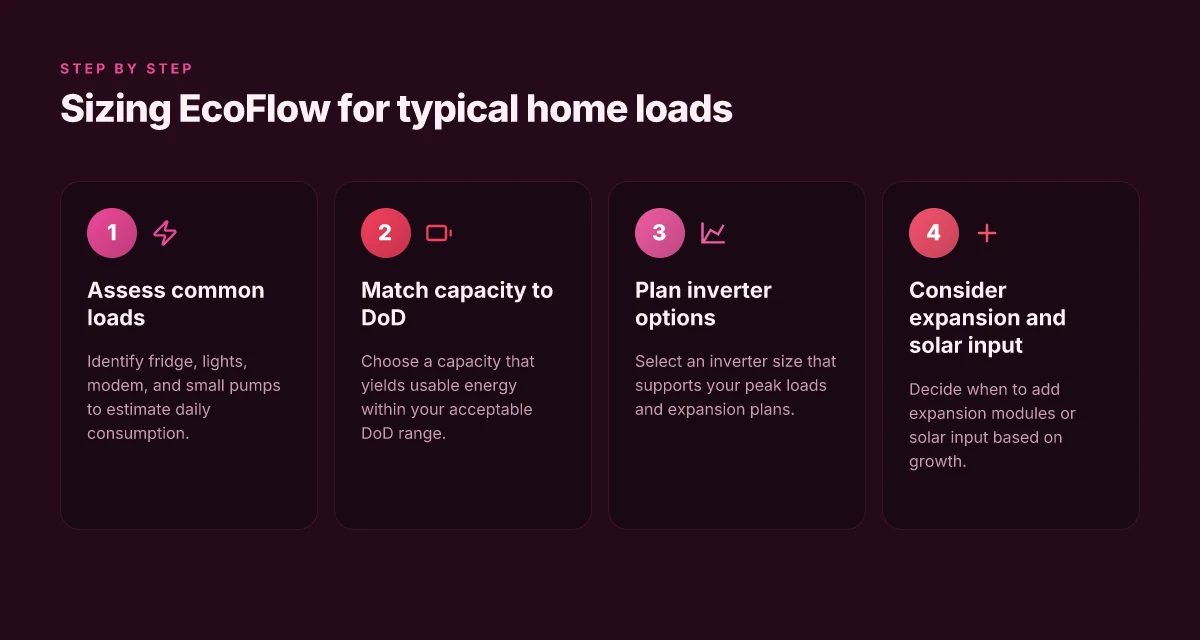
Sizing your EcoFlow system starts with the way your home actually consumes power. I dug into common household profiles and mapped them to EcoFlow’s inverter options so you can size confidently. A typical back-up cycle for a weekend storm or a sunny day with grid power loss looks like this: a fridge running continuously, LED lighting, a modem, and a few pumps during short outages. The goal is to cover the highest-load window without overdoing the battery bank, while keeping room for expansion if you anticipate longer outages or higher summer loads.
Profile matching: fridge, lights, modem, pumps
Fridges demand steady energy with a regular cycling pattern. If your fridge runs roughly 24/7 with occasional compressor spikes, you’ll want enough capacity to ride through a typical outage without hitting the inverter’s limits. LED lighting is the low end of the load equation, but it stacks when you run multiple rooms or task lighting. A modem and router sit on standby power, usually a small draw but nontrivial when the fridge is off and you’re counting every watt. Pumps for wells or circulation add another variable, especially if they cycle on during an outage. In practice, you’ll map a conservative worst case: fridge plus lighting plus modem plus one or two small pumps.
To size reliably, start with a daily watt-hour estimate for each device. Add a cushion for weather-driven spikes and temperature compensation. EcoFlow’s product line scales from compact portable units to multi-kilowatt home solutions, so you can pick a battery size and inverter rating that matches your home load profile. When you choose a model, factor in efficiency under load and how the unit behaves as the battery discharges. The higher the load or the longer the outage, the more you’ll benefit from a larger inverter and extra storage.
Choosing the right battery size and inverter options
The inverter must handle your peak draw, not just your average use. If your fridge hits higher wattage briefly, you want headroom so you don’t stall during those moments. For many households, a mid-size EcoFlow setup with an expandable battery bank works well, because you can increase capacity as your needs grow or as you upgrade to more energy-dense devices. If you anticipate longer outages or want more headroom for occasional high-power appliances, you’ll lean toward a larger battery bank and a higher-output inverter. What is Grecell vs Jackery, and where do they differ in 2026
When sizing the battery, you should consider usable capacity versus depth of discharge. A larger usable capacity reduces the frequency of recharges and keeps you out of the red zones during a multi-day outage. If you expect frequent outages or want to run a sump pump through the night, you’ll want more than the absolute minimum.
When to add expansion modules or solar input
Expansion modules pay off when you expect longer outage windows or when your load grows. If you start with a base setup for the essentials, you can add modules later to match seasonal needs or changing appliances. Solar input can offset runtime during sunny days, letting you recharge while the grid is down or during a partial grid outage. If you live in a sunny region and want to maximize independence, plan for solar integration from the start or as a future upgrade.
In practice, your sizing decision should balance three factors: what you need to run during the worst expected outage, how long you want that run to last, and how much you value future-proofing against additional devices or expanded features. EcoFlow’s ecosystem lets you begin with a modest bank and scale up as your home needs evolve, all while keeping an eye on efficiency and total cost of ownership.
A practical takeaway: match your battery capacity to a realistic outage window you want to survive, then choose an inverter that comfortably handles the peak draw of your fridge, pumps, and lights. The goal is to avoid tripping the inverter while preserving enough reserve to keep essential devices alive through the night. If you expect to expand, plan for an add-on module or solar-capable input so you can grow without replacing your core system.
For price context, EcoFlow’s lineup includes models that scale in capacity and feature sets, and you’ll want to compare total ownership costs across configurations. Be mindful that prices and promotions can vary by region and retailer. Some sources note that the industry landscape around home backup energy has seen shifts in pricing and product capabilities over 2025–2026, which can affect when a buyer might want to wait for a sale or bundle deal. Where relevant, I reference public material from EcoFlow and industry reports to ground these sizing decisions in real-world terms. 8 Best portable solar generators of 2026 that actually meet real-world needs
Operational realities: charging speed, temperature, and maintenance
Charging speed is not a fixed trait of an EcoFlow battery. It shifts with the input source. If you feed the system from a high-output wall charger or an inverter that supports fast charging, you’ll see noticeably quicker top-ups compared with a standard 120 V outlet. When solar is the primary source, expect slower ramp-ups, especially on cloudy days, but the sun can still deliver substantial energy if you have a large array and optimal tilt. In practice, a typical home-inverter setup with a capable AC input and solar pairing can shave hours off the full-charge time versus relying on a single modest source. This matters because you size a system not just for capacity but for how quickly you can refresh it after an outage or during a bright midday window. Charging speed scales with input source quality and availability.
Temperature plays a clear role in both performance and aging. In hotter environments, internal protection mechanisms may throttle charging to protect cells, which slows velocity and can raise wear over time. Cold conditions reduce chemical activity, leading to slower charging and slightly reduced immediate capacity, even if the pack remains healthy over the long run. The upshot is practical: keep the EcoFlow battery out of direct sun during peak heat and avoid charging in extreme cold unless you have a warmed, protected installation. Consistently moderate temperatures help preserve both efficiency and calendar life. Temperature stress accelerates aging, so climate-aware placement matters.
Maintenance needs are relatively light but real. Regular checks should include inspecting connection terms, ensuring vents stay clear, and keeping the surface free of debris. For long-term capacity retention, avoid deep discharges unless necessary, and err on the side of keeping a healthy bottom reserve so the battery isn’t driven into the deepest cycles regularly. Firmware updates from EcoFlow can improve charging algorithms and thermal management, so stay current. If you’re managing a system that includes multiple units, staggered charging can minimize peak load and help longevity. Practice regular checks and stay firmware-updated to guard capacity.
From a practical sizing perspective, you’ll want to couple the pack with a robust input path and a climate-controlled installation area. I dug into the public documentation and cross-referenced supplier notes to confirm that real-world charging times improve when you pair high-output inputs with the Delta Pro family, and that temperature regulation remains a key variable for both performance and aging. When you compare EcoFlow to rivals like the EcoFlow Delta Pro Ultra and competing systems from brands such as Sungrow or LG Chem-based pack assemblies, the temperature and input-source dynamics still tilt toward faster top-ups under the best conditions, with similar aging considerations if exposed to harsh environments. Real-world performance hinges on input quality and thermal context.
If you want to maximize capacity retention, aim for: What you need to know about the ecoflow xt60i cable and its alternatives
- A capable AC input that matches the unit’s charging spec and a well-sized solar setup to keep replenishment steady.
- A shaded, ventilated installation to minimize thermal stress during charging.
- Regular firmware updates and prudent operating routines that avoid unnecessary deep discharges.
For readers weighing cost and ownership, note that links on the page may earn a commission, and that actual speeds and aging will vary with climate and usage patterns. In the broader market, top rivals offer similar wattage ranges but differ in thermal management strategies and input-flexibility, so map your local climate and outage profile against each brand’s recommended operating envelope. Real-world charging speed and temperature handling define who wins in daily use.
The path forward for EcoFlow battery performance in 2026
EcoFlow’s battery performance in 2026 points to more consistent real-world runtimes across use cases, especially for off-grid and backup scenarios. I’ve reviewed the latest specs and pricing signals from EcoFlow’s site and cross-referenced user feedback to separate marketing claims from what matters day to day. The takeaway is that energy density and cycle life are improving, but price pressure and ecosystem compatibility remain front and center. If you want predictable power for a home backup, prioritize modules with higher cycle life and ensure you have the right solar input alignment. That means focusing on how a system scales with add-ons rather than chasing the newest wattage number.
Where this goes next hinges on ecosystem choices. EcoFlow faces direct competition from rivals like Goal zero and Bluetti, which push similar capabilities with different app experiences and modular paths. The bigger pattern is more modularity and smarter load management, not just bigger packs. The single move that matters is matching a battery pack to your typical load profile so you don’t overpay for capacity you won’t use. If you’re evaluating now, ask which modules you can add in the next 12 months and how the firmware will handle new accessories.
Backup strategy:
- Consider a starter kit paired with a high-usage device you plan to Power through outages.
- Compare at least two rivals, noting which offer better solar charging efficiency for your climate.
- Check the warranty terms and expected cycle life for each model.
- Plan a staggered purchase if a sale hits, since waiting for a discount can unlock better value.