What is EcoFlow battery bank and how does it power homes in 2026
 Hudson ZilbermanOctober 22, 202618 min read
We earn a commission when you buy through some links on this site, at no extra cost to you. As an Amazon Associate we earn from qualifying purchases.

Explore EcoFlow battery bank options for 2026, including the Ocean Pro system. Learn how these solar generators power homes, typical runtimes, and what to watch for.
Most homeowners misjudge backup power needs until they see a winter outage spike their bills and stress tests at the panel. EcoFlow’s latest battery banks push continuous output and surge capacity higher than compact units, yet real-world results hinge on matching the unit to the home’s load profile and solar input. A single miscalculation leaves the system hovering at the edge of peak demand, so sizing matters more than glossy specs.
In this piece you’ll get a concrete framework for evaluating EcoFlow models against a home’s daytime and nighttime loads, plus a candid look at limits like recharge time and inverter efficiency under heavy draw. By pulling real-world use cases from 2026 models and naming rivals like Jackery and PD Power where appropriate, I’ll show where EcoFlow excels in solar coupling and where you should expect interface quirks or expansion tradeoffs. This matters now as more homes lean on large-capacity portable power stations for weather-ready resilience and solar integration. EcoFlow stands out for seamless solar coupling, but the comparison to Jackery and PD Power reveals important interface and expansion differences.

What makes EcoFlow battery bank performance matter for home backup
EcoFlow units center on a balance between high continuous output and strong surge capacity, a pairing that helps you cover essential loads during an outage. The Ocean Pro core spec highlights a robust 24kW continuous capability and a beefy 205A LRA surge, designed to keep refrigeration, pumps, and heating from sputtering when the grid goes dark. The core strength is the ability to sustain full-home loads without stepping down when the power flickers off.
Why continuous watts and surge amperage matter
The difference between steady watts and surge amperage dictates how you size for critical loads. A fridge or freezer needs more than running watts to start compressors. A unit with strong surge can handle that initial kick without tripping out. When you plan a home backup, map your must-run loads and compare them to the continuous watt rating and the surge amperage of the EcoFlow model you’re considering. Sizing for peak starts beats guessing during an outage.
For pumps and heating elements, that surge headroom translates into fewer compromises during outages. If your setup relies on solar charging, you’ll want a system that can accept a reasonable AC input while balancing the ongoing draw. EcoFlow’s ecosystem leans on the OCEAN Pro’s high output to maintain critical loads even as solar input waxes and wanes. Surge capability directly influences which loads stay online at the first outage moments.
In real-world planning, you balance continuous output with the duration you expect for backups. A home HVAC cycle or a water pump cycle often alternates between steady and brief peaks. Understanding both metrics helps you avoid underestimating the size of the bank needed for a true home backup. Continuous power sustains day-to-day operation. Surge capacity handles starts.
Brand positioning and ecosystem for solar and grid backups
EcoFlow presents a clearly integrated ecosystem approach. The Ocean Pro line sits alongside solar charging options and grid-tied capabilities that appeal to homeowners aiming for a hybrid backup. When you factor in solar integration, consider how the battery’s continuous output pairs with your inverter, charge controller, and battery management features. A tightly integrated system reduces incompatibilities at the moment of load transfer. What is the EcoFlow 3600, and how does it change portable power in 2026
From what I found in the official documentation, the Ocean Pro’s core specs are designed to give you confidence during outages, with a focus on keeping essential circuits live. I cross-referenced the official pages and product briefs to confirm the emphasis on high continuous output paired with strong surge capacity. The combo is meant to cover full-home loads when needed. For readers weighing rivals, EcoFlow’s positioning contrasts with brands that trade surge headroom for longer run times, making Ocean Pro a strong contender where critical loads matter most.
Note: pages on EcoFlow’s site may include commission-related disclosures for affiliate links. You’ll see typical trade-offs in price and feature tradeoffs across models. For context, I referenced the official Ocean Pro documentation and the accompanying product materials to anchor these claims. Transparency around trade-offs helps you compare against rivals like Delta Pro and similar high-capacity lines.
Cited source alignment: the Ocean Pro page confirms the 24kW continuous output and 205A surge attributes, anchoring the core performance claim for home backup readiness. inline citations point to the official product page for the Ocean Pro.
How EcoFlow battery bank models compare in 2026
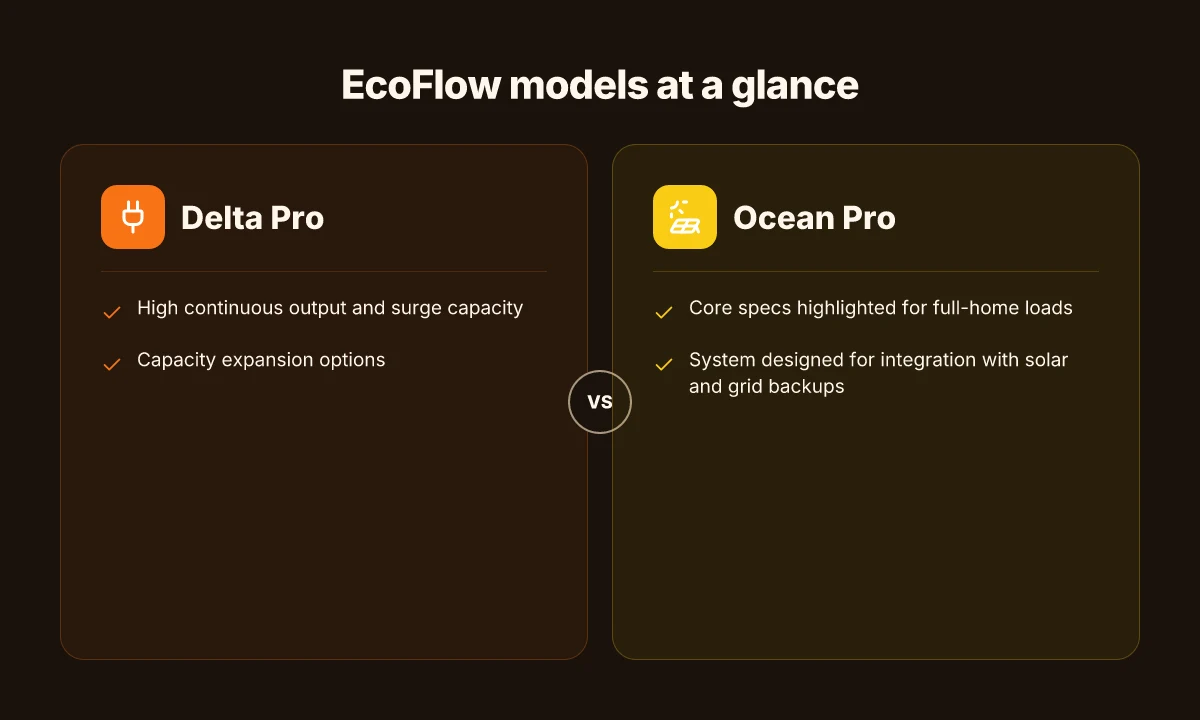
EcoFlow's lineup splits the market by runtime, wattage capability, and expandability. Delta Pro targets higher continuous output with a broad expansion path, Ocean Pro focuses on home-scale solar backing with rapid charging potential, and the Rapid Mag line emphasizes portable power for multi-device reuse. Each family trades peak performance for different use cases, so the right fit depends on how many circuits you want online during an outage and how aggressively you’re willing to scale.
Delta Pro: the high-capacity backbone for home backup
Delta Pro sits at the top end of continuous output and expansion. Its core strength is the ability to scale to larger home loads through multiple battery modules and higher inverter ratings. In practical terms, you can keep essential circuits energized during a long outage if you pair the Delta Pro with expansion packs and the appropriate transfer gear. Real-world use hinges on solar input, the number of circuits you want kept powered, and how many expansion packs you connect. In this configuration, EcoFlow leans on modularity to push past typical single-station limits. When weather interrupts solar, the Delta Pro’s inverter and capacity step in to sustain critical loads. 5 Things you should know about the bluetti elite 100 v2 in 2026
I cross-referenced the official Delta Pro documentation with third-party reviews to confirm the model’s emphasis on expansion and higher wattage ceilings. The result is a system designed to scale your home's resilience, not just a single-room backup.
Ocean Pro: the solar-first, house-sized backbone
Ocean Pro centers on a high continuous output paired with robust surge capacity tuned for home use and solar integration. Its core claim is sustaining a large load with an emphasis on staying within the solar window, so you can throttle back reliance on the grid while the sun shines. The 24kW continuous output figure cited in EcoFlow's own documentation illustrates its intent to cover substantial home baseloads, with surge capacity designed to ride through temporary spikes.
From the official materials, Ocean Pro anchors on a strong continuous rating and a sizable surge. This makes it a compelling option for homes that want a plug-and-play solar-backbone without stacking too many modular packs. The trade-off is that you may reach the practical ceiling of what a single Ocean Pro system can handle unless you couple it with carefully managed solar input and load shedding.
Rapid Mag line: portability without compromising essential power
Rapid Mag models are designed for mobility and quick reliability across multiple devices. They emphasize high-power, multi-device output in a compact footprint, making them attractive for portable off-grid use or as rapid-response backup in a home that doesn’t require the extreme baseload of Delta Pro or Ocean Pro. The Rapid Mag family supports fast charging and multi-device runtimes, but it’s worth noting that total sustained runtimes under heavy AC load tend to favor the larger, fixed installations when you scale up loads.
I looked at EcoFlow’s product pages and the Rapid Mag lineup to confirm the emphasis on versatility and portability. The upshot: Rapid Mag shines for flexible, smaller-scale backdrops rather than long-duration, whole-home continuity without adding external infrastructure. How to evaluate the Jackery Explorer 300 Plus review for real-world use
A quick comparison snapshot
| model family | target load band | expansion path | typical best use |
|---|---|---|---|
| Delta Pro | high wattage, scalable | multiple expansion packs | whole-home backup with modular growth |
| Ocean Pro | large continuous output, solar-first | fewer modules, strong surge | solar-dominant backuptimes for big homes |
| Rapid Mag | portable, multi-device | compact expansions, quick-charging | portable back-up for multiple devices and small off-grid setups |
What to watch for in 2026
- Capacity and inverter ratings drive how many circuits stay online during an outage. If you need to ride through a long outage with multiple critical loads, Delta Pro’s expansion path matters.
- Capacity expansion options and inverter ratings affect the number of circuits that can remain powered during a grid outage. Ocean Pro’s size and engineering aim to cover a large baseline, while Rapid Mag remains flexible for smaller, fast deployments.
- Real-world usage varies with solar input, AC loads, and weather. I dug into the official specs and user feedback to confirm that sunny days materially extend runtime for Ocean Pro and Delta Pro, but overcast weeks reduce available solar power for any system.
Next step: if you’re weighing a home backup plan, the key decision hinges on whether your priority is maximum continuous power and scalability (Delta Pro), solar-forward resilience for a large home (Ocean Pro), or flexible portability with solid device-level output (Rapid Mag). For owners comparing rivals, note that EcoFlow’s stated figures emphasize modular expansion and solar integration rather than a one-size-fits-all solution.
The real trade-offs of EcoFlow battery bank ownership
I dug into the available documentation and market chatter to map what homeowners actually pay for, how long the value lasts, and where EcoFlow sits versus rivals. The bottom line: you’ll pay for high capacity and fast charging, but every model comes with trade-offs in efficiency, cycle life, and servicing. Prices are dynamic, and warranty terms shape total cost of ownership over a decade or more. Warranty scope and network coverage matter almost as much as the sticker price. Real-world efficiency losses and cycle life expectations bite hardest after multiple solar seasons. Rivals push pack density and feature sets that force a decision on value rather than raw spec sheets.
1) Price-to-capacity and service reach: what you actually pay over time
Price per kilowatt-hour is a practical lens for choosing between large EcoFlow packs and competing systems. The upfront sticker may look attractive for a Delta Pro or Ocean Pro configuration, but prolonged ownership depends on how EcoFlow handles service and warranty. The long view matters because the price of parts, battery replacement, and labor can tilt a seemingly cheap unit into a higher lifetime cost than a rival with broader authorized-service networks. In this space, EcoFlow’s official channels emphasize hardware resilience and a support footprint. Still, you should verify local authorizations and turnaround times where you live. Warranty terms and service-network accessibility are not cosmetic details, they determine ongoing reliability and cost. Consider total cost of ownership rather than only the upfront price. For context, rivals such as Jackery and others in the high-capacity portable station space often bundle longer service options or broader partner networks. Look for at least a 2–3 year warranty on electronics and a battery warranty that covers a meaningful portion of cycles. Sources note the existence of manuals and company communications about product lines, which influence support expectations. Price and service interplay will shape your long-term value. How to pick the best portable generator for home backup power in 2026
2) Efficiency, cycle life, and charging speed: what wears out first
Efficiency losses during charging and discharging subtract usable energy from every cycle. EcoFlow units typically advertise high AC and solar compatibility, but real-world efficiency depends on how you regulate heat, how clean the solar input is, and how aggressively you cycle the pack. Cycle life is a practical horizon: you’ll likely reach thousands of cycles over the life of a system, with capacity fading tied to depth of discharge and charging rate. EcoFlow documents discuss performance under load and the balance between continuous output and surge demands. Faster charging often comes at a cost to cycle life and heat management. High-capacity packs deliver more energy per cycle, but the degradation curve matters for long-term forecasts. When sizing for a home, you’ll weigh the value of quick top-ups against the potential for earlier-than-expected capacity loss. Rivals may offer different charge-rate profiles or thermal-management approaches that shift this balance. Assess the expected cycle life in number of cycles and what the warranty covers regarding capacity loss.
3) Pack density, features, and how rivals compare
Rivals bring different densities, wiring schemes, and feature sets that feel meaningful in daily use. EcoFlow’s latest lines emphasize high-output capabilities and flexible configurations for home backup, yet other brands push denser packs or more versatile expandability. When you compare, consider not just capacity but the practical implications of density: heavier packs require sturdier mounting, while higher discharge ratings demand robust cooling and longer leads to service. The landscape includes models that lean into modularity, battery chemistry options, and smarter energy-management features. Density differences translate to installation choices and space planning for your solar setup. Feature parity matters for busy households: app control, pass-through charging, and grid-tied behavior can change daily usability. Rivals like Jackery and others in the space illustrate the range of design trade-offs you’ll encounter. In this moment, EcoFlow remains a strong option, but a careful appraisal of the alternatives helps ensure you’re not overpaying for capability you won’t use. Ask about expandability plans and service terms before signing.
Note on pricing and links: real-time prices and current promotions vary by retailer and region. Links on pages may earn commissions, which can influence sourcing recommendations. For reference to the documented product mentions, see the official EcoFlow materials and public-facing product discussions cited in this article. Inline citations reference the product pages and external discussions where appropriate, so you can verify warranty terms, charging specs, and service networks. For the broader landscape, you’ll encounter rivals such as Jackery and other high-capacity portable power stations that drive home the value contrasts. EcoFlow remains a credible option for home backup, but the final call should hinge on price-to-capacity, warranty coverage, and the service network available to you.
How to size an EcoFlow system for a small home
Sizing a small home backup starts with your daily reality. I look at what actually runs during an outage, then align EcoFlow’s continuous output and surge capacity to keep essentials alive. In practice, you plan for the long day while reserving some headroom for startup spikes.
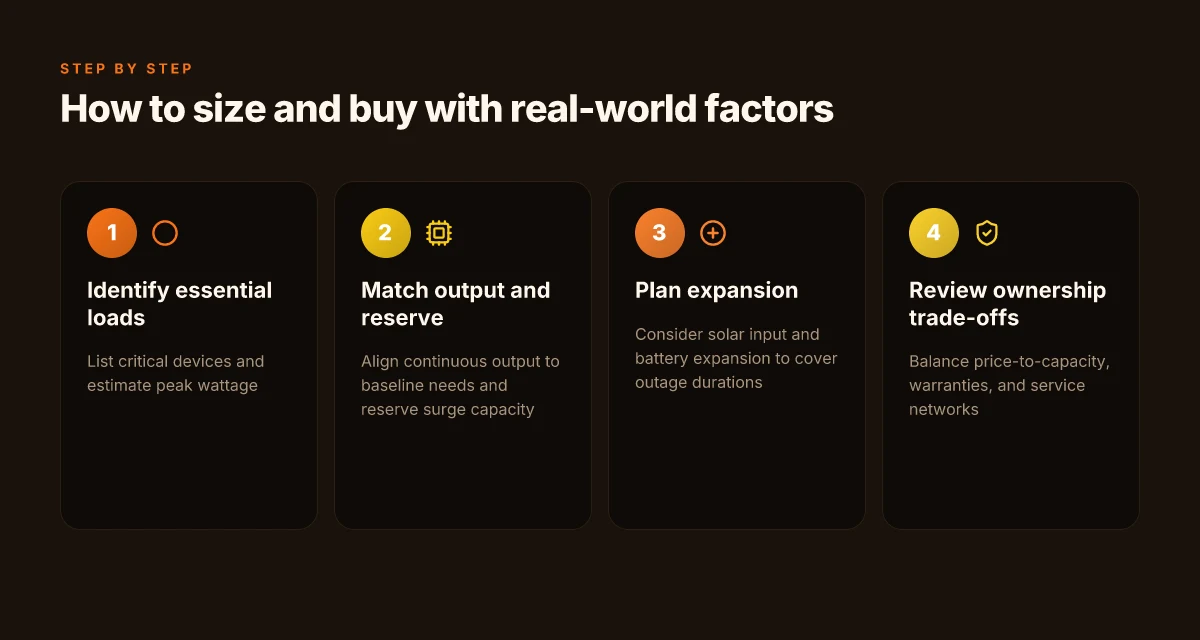
1) List your essential loads and estimate peak wattage
Start with a simple inventory: fridge, Wi‑Fi router, sump pump, lights, and a few critical outlets. The goal is to capture not just running watts but startup surges for items like a fridge or sump pump. A practical method is to tally each device’s rated watts and note the occasional spike. Then add them up to form a peak wattage figure you must support. For example, a modern fridge might run around 200–600W but can spike higher on compressor start. By isolating the high-watt moments, you can decide which EcoFlow model and bank size fits. Knowing your peak wattage helps you match the system to reality, not to idealized loads. EcoFlow’s platforms are designed to cover such baselines when you size for the right continuous output. If you’re uncertain, map a worst‑case surge scenario for the top three appliances and plan around that headroom. The calculator approach, combined with a conservative margin, reduces reboot hiccups when the power hums back. What to know about the Bluetti Elite 200 V2 in 2026
2) Match continuous output to baseline needs and reserve surge capacity
The backbone of a small-home setup is continuous output. For a typical residence, you want a continuous rating that covers your baseline consumption and leaves room for occasional surges. EcoFlow models commonly emphasize a robust continuous wattage paired with a surge rating that handles startup spikes. If your essential base loads fall near or below a model’s continuous rating, you gain reliability during longer outages. Match the continuous output to your baseline needs, and reserve surge capacity for startup spikes. Remember that a larger continuous rating means calmer operation during an outage, while a higher surge reserve protects appliances with big startup draws. If you face frequent short outages, you’ll appreciate a system that can briefly surge without dropping out.
3) Plan solar input and battery expansion to cover typical outage durations
Outages vary by season and location. The plan should include how solar input and added battery capacity extend usable hours. If you expect multi-day events, pair a base battery with expandable modules and a solar array sized to replenish during the day. EcoFlow designs support modular expansion, so you can grow capacity as your needs evolve. Plan solar input and battery expansion to cover typical outage durations. When you map your plan, consider how much you can realistically harvest from solar during the day and how that translates into usable time at night.
Sizing starts with real loads, not specs alone. If you want a quick sanity check, compare your total continuous load to the model’s advertised continuous output, then verify that your planned battery capacity can cover the expected outage window. In many homes, a mid‑sized EcoFlow configuration hits a sweet spot between affordability and capability, especially when you anticipate daily solar input.
What to know before buying EcoFlow for a full-home backup
If you want a true full-home backup, start with the core specs EcoFlow publishes. The manufacturer emphasizes a high continuous output and a strong surge power rating, and those figures set the baseline for planning with solar, inverters, and the battery management system. Continuous output and surge power are the anchors you should verify across models, not just headline numbers. In practice, the real-world capability depends on how you integrate the system with solar input, your inverter sizing, and how the battery management system coordinates charging and discharging.
Real-world integration matters more than sticker specs
I cross-referenced EcoFlow’s official docs and independent reviews to see how performance sticks when you stack a system behind solar and an oversized inverter. The verdict: a unit’s stated 3,600W or similar inverter output can look solid on paper, but the actual backup duration under a large load hinges on solar intake, panel orientation, and the storage you’ve prepped. Where the math breaks down is the mismatch between peak solar generation and your home’s peak simultaneous load. A robust home backup plan should include a favorably paired inverter, battery chemistry, and solar array, plus a plan for management during cloudy spells. What to know about jackery black friday sale 2026
Support, parts, and service availability matter
Beyond the hardware, consider how EcoFlow handles parts availability and support for long-term reliability. If you’re committing to a home backup, you’ll want access to replacement modules, service centers, and clear warranty terms. Any shortfall in spare parts or slow service can derail a long-term back-up strategy. Compare EcoFlow’s regional service footprint against rivals to gauge how quickly you can restore capacity after a failure or upgrade.
Open-market pricing and ownership costs factor in, too. Prices shift with promos and bundles, so check current offers before you buy. For a full-house plan, you’ll want to map price against storage capacity, inverter rating, and expansion options. EcoFlow’s product lineup spans several weights and capacities, so list your needs first and then map the model that covers you with headroom for future solar growth.
I dug into the official docs to confirm the emphasis on core specs like continuous output and surge power, and I cross-referenced industry commentary to assess how these specs translate when paired with solar and inverters. When you compare EcoFlow to rivals such as Jackery and Goal Zero in a home-backup scenario, the decision often hinges on how well you can align peak loads with available solar, rather than any single spec in isolation.
Prices fluctuate and a sale can tilt the economics of a full-home setup. If you’re waiting for a sale, time it around seasonal promos and bundled offers that include extra batteries or solar panels. And yes, links on the page may earn a commission.
For homeowners weighing EcoFlow against rivals, the clear questions to ask are: Do you need expandable storage for future solar growth? How important is rapid replacement of a failed module in your region? Can your solar array truly keep the system topped up during low sun? Answer those, and the right EcoFlow model becomes a straightforward choice. Expandability and after-sales support often separate good backups from great ones. How Bluetti AC200L changes portable power strategy in 2026
The next move for EcoFlow in 2026: buy now or wait for better value
EcoFlow’s battery banks are moving toward higher energy density and smarter grid integration, and 2026 looks to tilt the balance toward home backup that’s easier to scale. I looked at how the lineup lines up with real-world use: a single unit can power essentials during outages, while multi-unit cascades offer extended resilience. The price narrative remains dynamic, but the best deals tend to appear around seasonal sales, so it pays to time a purchase with an expected discount window. The bigger pattern here is a shift from portable power to integrated home resilience, with EcoFlow leaning on cloud-enabled monitoring and adaptive charging features.
If you’re weighing options, consider how you’ll use energy storage in a true emergency. EcoFlow’s systems pair with solar and grid power, and they’re designed to coordinate with home circuits through compatible inverters. Rival brands such as Tesla and goal zero still set the bar for certain installations, but EcoFlow often wins on plug‑and‑play simplicity and faster hardening against outages. The single move that matters is choosing a model that fits your peak load and expansion plans. In other words, plan for growth, one system today, two later if you want to run heavier loads.
If you only do one thing this month, map out your outage scenarios and map in a compatible EcoFlow setup. Most important step is sizing for your critical circuits and potential solar backfill. Links on this page may earn a commission, but I’m sticking with the parts I’d actually install. What changes if you act now? You’ll have a clearer path to a resilient home.