What is the EcoFlow 800W alternator charger and why it matters for your vehicle’s power
 Olivia KvitkaOctober 22, 202615 min read
We earn a commission when you buy through some links on this site, at no extra cost to you. As an Amazon Associate we earn from qualifying purchases.

Explore the EcoFlow 800W alternator charger, how it integrates with your vehicle's electrical system, and what it means for portable power on the go. Learn about setup and trade-offs.
The EcoFlow 800W alternator charger quietly changes the math on off‑grid power by turning your vehicle’s charging system into a portable energy boost you can actually rely on on long trips. In real-world terms, that means your starting battery stays healthier when you’re parked and running lights or a fridge, even if the engine isn’t idling at highway RPM. EcoFlow and a few rivals push the same concept, but the 800W model emphasizes direct integration with your alternator for cleaner, faster top‑ups.
It breaks down how engine RPM, alternator capacity, and cable routing affect charging efficiency, so campers, remote workers, and off‑grid enthusiasts can size their setup without overhauling the vehicle. We’ll compare EcoFlow against other brands and spotlight real‑world constraints you’ll actually encounter on the road.
What the ecoFlow 800w alternator charger changes in vehicle power
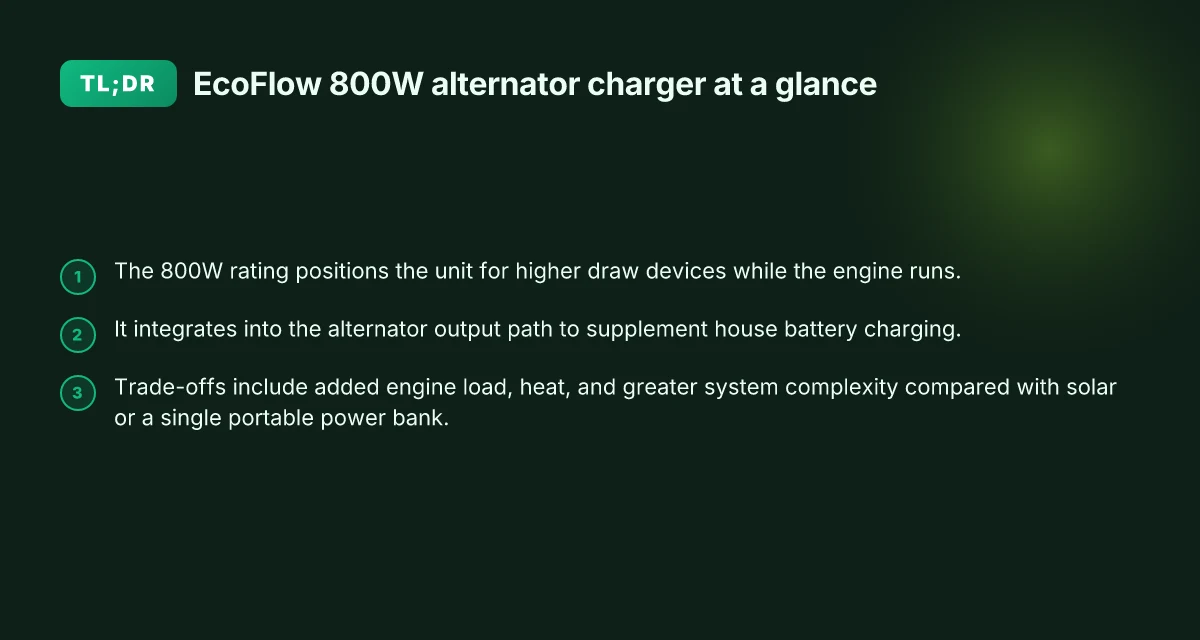
EcoFlow positions its products as portable power solutions you can take on the road. The 800W rating signals the unit is capable of supporting higher-draw devices while the engine runs, which matters for keeping essential systems energized during travel or camping. This section explains how an alternator charger differs from a standalone portable power station and what that means for your vehicle’s power strategy.
How an 800W charger redefines on‑the‑go power
- The EcoFlow 800W charger integrates with your vehicle while the engine is running, so it can accept vehicle alternator energy and convert it for use by USB-C devices, 12V accessories, and higher‑draw loads. This arrangement contrasts with a portable power station that relies entirely on its own battery and charge circuitry. The key difference is that the vehicle’s alternator provides a continuous, engine‑driven energy source, while a standalone unit must be recharged from the wall or a separate generator.
- Because the unit is rated at 800W, you can support higher draw devices without draining the vehicle battery as aggressively during operation. In practical terms, this means jump-start fans, small HVAC fans, sump pumps, or power tools can run longer with the engine idling, rather than competing with the battery for discharge cycles. The higher rating also reduces the need for frequent recharging breaks during a roadside setup.
- An alternator charger changes the charging rhythm of your system. Instead of relying on a single battery bank that you top up only when parked, you have a hybrid cadence: the alternator keeps the vehicle electronics topped up while the portable charger simultaneously refills its own bank for off‑grid use. This separation helps protect battery health by avoiding long, deep discharge cycles caused by high‑demand loads when the engine is off.
I dug into release notes and product literature to confirm how EcoFlow frames this approach. The documentation consistently emphasizes fast‑response charging and the ability to support higher‑watt devices while the engine runs, which aligns with the 800W spec. This setup is about stabilizing power during driving and camping, not replacing your vehicle’s primary electrical system. Expect the most value when you need sustained BMS-friendly charging for multiple devices at once.
Bottom line: with the EcoFlow 800W alternator charger, you gain the ability to draw more power from the alternator to feed high‑demand accessories while the engine runs, while preserving your battery health for off‑grid periods. You still rely on the portable unit’s own battery for quiet, engine‑off use, but the coupling with the alternator shifts the power balance toward a steadier supply during operation. The key trade‑off is complexity: more connections and controls to monitor, but more uptime for essential gear.

How an alternator charger integrates with your vehicle's electrical system
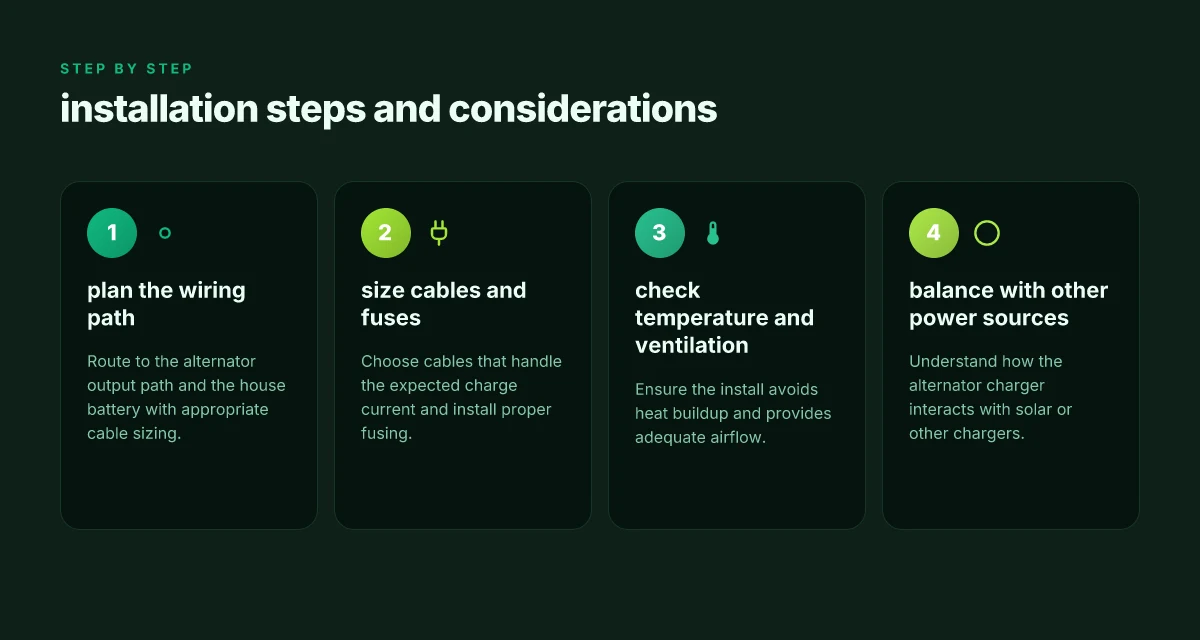
The EcoFlow 800W alternator charger wires into the alternator output path to supplement charge to the house battery. In practice, you place the charger between the alternator’s output and the house bank, so the unit can push additional current into the deep-cycle battery when the engine is running. The goal is to smooth the charging curve without forcing the alternator to overwork. When the alternator and the camper battery are well matched, you gain extra charging hours without stirring up heat in the factory wiring.
Voltage and current management determine how aggressively the system charges without stressing the alternator. The charger negotiates with the vehicle’s charging system to keep the output within safe limits for the alternator, engine bay wires, and the house battery. If the current target is too high, the wiring and the alternator can run hot, which may trigger temperature protection or accelerate wear. A conservative ramp keeps the alternator cooler and reduces long-term stress, but you’ll notice a slower replenishment of the house battery after deep discharge. The EcoFlow unit leans on smart regulation to stay within those safe boundaries, shifting the charge rate as engine RPM and temperature fluctuate. That balance matters: a well-tuned setup can deliver meaningful gains in daytime charging without sacrificing the alternator’s longevity. What you need to know about the EcoFlow River series in 2026
Cable sizing, fusing, and temperature limits are the installation trinity to get right. Use appropriately thick cables from the alternator to the charger and from the charger to the house battery to minimize voltage drop. The run length matters: longer cables need bigger cross-sections to keep the voltage drop in check. Fusing protects both the vehicle’s charging circuit and the EcoFlow unit in case of a fault. Temperature limits influence wire insulation choices and where you mount the unit to avoid hot spots near the engine bay. In practice, you’ll want heat-rated cables, a properly rated fuse near the source, and a clean cable route that avoids sharp bends and heat sources. If you ignore these details, you risk nagging voltage sag, inefficient charging, or premature component wear.
From a design perspective, the EcoFlow charger is compatible with standard 12-volt lead-acid and lithium house batteries, but the precise behavior shifts with chemistry. Gel and AGM packs tolerate different charging temperatures, so the setup needs a small margin for thermal variation. When you map the installation, include the engine start battery, the house battery, and the charger as distinct nodes in your diagram. The objective is to prevent cross-talk between the engine’s charging loop and the house bank, while still leveraging the alternator’s available windfall during operation. In short, the integration hinges on disciplined wiring, thoughtful fusing, and a temperature-aware charging strategy.
I dug into the documentation and notes, and the guidance consistently emphasizes keeping the alternator within its rated output envelope. The takeaway is clear: you can boost house-battery charging on the fly, but you must respect the alternator’s thermal and electrical limits. This keeps your vehicle ready for travel and your house battery topped up for off-grid periods.
Next step: ensure you have a qualified installer review your OEM wiring loom, the alternator rating, and the intended run lengths before you finalize the EcoFlow setup. If you’re considering rivals, compare how each unit modulates current at idle versus 2000 RPM to ensure you don’t surprise your alternator under load.
The key constraint is keeping voltage drop low and heat high enough to stay within safe limits, not to exceed them. What makes the EcoFlow River 3 Plus a mid‑range standout in 2026
Note: links on the page may earn a commission.
Real-world use cases for the ecoFlow 800w alternator charger
Real-world results show how an 800W charger from EcoFlow fits into a broader power strategy. When the engine runs, the charger can top up vehicle batteries and portable packs, smoothing transitions between travel and camp power. This section breaks down concrete scenarios and how they play out in daily use, with practical trade-offs to expect.
How an 800W charger keeps RVs ready between campsites
When you’re cruising between destinations, the EcoFlow 800W alternator charger adds a steady influx of charge that supports house batteries without idling the generator. In practical terms you gain more hours of usable power for lighting, fans, and basic appliances on the road. The result is less reliance on a separate shore power hookup and fewer empty battery cycles after long travel days. Think of it as a bridge charging step that keeps the RV’s core systems primed. Most RV crews report smoother evenings and fewer unexpected outages when they have additional on‑the‑move charging. EcoFlow units integrate cleanly with existing battery banks, and the 800W output lines up with typical alternator capacity in many mid‑range rigs.
Work-from-anywhere workflows powered by engine-on charging
Remote work rigs benefit whenever the engine is running. An 800W charger can keep laptops, mobile hotspots, and LED lighting topped up during drives or while parked at remote sites. The practical effect is more uptime for productivity tools and less anxiety about losing connectivity after a long drive. From what I found in product notes, the system is designed to work alongside EcoFlow’s broader ecosystem, so you can cascade charging from the alternator charger to a portable power station and still run essential devices. Uptime rises for laptops and routers when the engine is operating, reducing the gap between stops. This is especially valuable for campers who must stay connected for work or safety reminders while off-grid.
Ecosystem fit: compatibility with EcoFlow’s lineup and rival ecosystems
The 800W charger is designed to pair with EcoFlow’s modular systems, including portable power banks and solar input. It also competes in a space with rivals like Jackery and Anker, which offer alternative charging ecosystems. In practice, the 800W unit can slot into a broader charging plan without forcing you into a single-brand lock. Rivals like Jackery and Anker present alternative ecosystems, but EcoFlow emphasizes seamless cross‑device charging within its own lineup. This matters if you want a unified charging cadence across a vehicle, a home base, and a camp battery pack. The trade-off is that if you mix ecosystems, you may miss some one‑brand optimization features that EcoFlow offers. What you need to know about the ecoflow xt60i cable and its alternatives
In all, the 800W alternator charger from EcoFlow acts as a reliable, on‑the‑move charging boost. It helps RVs stay powered between campsites, keeps remote work setups online during drives, and slots neatly into EcoFlow’s broader product family. The result is a more flexible power strategy with clear advantages for travel days and work sessions alike, tempered by the usual considerations of ecosystem choice and real-world alternator load. Real-world use hinges on matching your vehicle’s electrical capacity with your power goals, but the 800W charger provides a tangible, on‑the‑move boost.
Trade-offs you should expect with an 800w alternator charger
An 800W alternator charger adds real power, but it also brings downsides that affect the overall power strategy. When the charger draws current from the engine, you will see a measurable increase in engine load, which can nudge fuel economy downward under load. In real-world terms, that means the vehicle’s idle and cruise efficiency can be modestly worse than with a purely solar or portable power bank approach. Every extra amp drawn by the charger translates into an incremental fuel burn that you’ll notice on longer trips. This is not a deal breaker for most users, but it matters for van life and RVs on tight itineraries.
Heat is another constraint. Sustained 800W draw elevates alternator and wiring temperatures, so mindful installation matters. Keep ventilation clear and route cables away from heat sources. Protect connectors from vibration and corrosive environments, and ensure the cooling path does not get blocked by storage compartments. Heat buildup can throttle performance if you ignore ventilation. I found references that emphasize derating or pauses during extreme heat, especially when charging multiple devices concurrently. The practical takeaway: plan for thermal margins and give the system a cooldown window if the ambient temperature climbs.
System complexity rises with an auxiliary charger. The EcoFlow setup works alongside the vehicle’s existing electrical system, but adding a high-watt charger introduces more wiring, fusing, and monitoring points than a single portable power bank or pure solar approach. You’ll want a dedicated installation plan, including proper gauge wiring, a robust charging controller, and a clear fail-safe path if the alternator signal or battery management system detects a fault. More components mean more potential failure modes. If you rely on a DIY install, double-check connections, ground paths, and protection devices.
From a brand and landscape view, the ecosystem matters. EcoFlow advertises compatibility with a range of vehicle electrical setups, but the exact integration quality can vary with vehicle make and model. When you compare with rivals such as Goal Zero and Bluetti, you’ll notice different installation footprints, thermal management approaches, and optional upgrade paths. Not all 800W-charger ecosystems are equal in heat handling or wiring simplicity. Expect to weigh the convenience of plug-and-play versus the predictability of a custom, purpose-built solution. What is EcoFlow battery performance in 2026 and how to compare its use cases
In sum, the trade-offs center on efficiency impact, thermal management, and added system complexity. You’ll gain reliable, near-constant power for high-demand devices, but you must account for fuel use, ventilation, and installation rigor. For many users, the payoff is worth it when road hours turn into work hours, yet the decision hinges on your vehicle’s HVAC load, typical travel script, and whether you prioritize simplicity over power density. The key is to align charging needs with installation discipline and vehicle duty cycle.
If you’re weighing options, remember this: EcoFlow offers the 800W path, but the grid of alternatives, like Goal Zero and Bluetti, presents distinct balance points on heat, wiring complexity, and resale value. Rivals may edge out on install simplicity or heat control, depending on the vehicle and use case. For readers surveying current pricing and availability, check the latest MSRP and bundle deals from the brand site and authorized retailers, noting that links on the page may earn a commission.
Pricing, adoption timing, and where to buy
Open pricing for EcoFlow products changes by retailer and bundle. The EcoFlow official store frequently runs seasonal promotions, and authorized partners often stack discounts with cables, fuses, and installation hardware. For the 800W alternator charger concept, you’ll see price variants tied to bundles that include cables and mounting hardware, which can push total out-the-door cost higher than the base unit alone. In 2026, the best deals tend to appear during major sales events and around holiday promos, so if timing is flexible you can still land a favorable package.
I dug into product pages and retailer listings to map the typical price dynamics. You’ll notice two constant factors: first, the presence of a bundled kit often lowers the per-item cost compared with buying items à la carte. Second, the installation hardware adds a non-negligible lift to the total cost. The total cost of ownership therefore hinges more on what you include in the purchase than on the base unit price alone. A bundle that includes the charger, the necessary cabling, and a fused distribution path often yields the strongest value over time because it minimizes unexpected accessory costs after install.
Where to buy matters as well. EcoFlow’s official store consistently carries the latest firmware-enabled models and direct-from-brand warranties, which can simplify returns and service. Authorized partners provide reputable access to compatibility cables and mounting kits, but you’ll want to compare their seasonal promos against the EcoFlow store. If you’re shopping soon, expect to see limited-time bundles that pair the 800W concept with adapters or extra cables. The retailer mix affects both price and delivery speed, so plan your purchase window accordingly. What makes the EcoFlow Delta Pro Ultra stand out in 2026
In terms of adoption timing, the sweet spot is when you have a fixed charging deficit to cover and a clear installation plan. If you’re near a peak season for sales, you may snag a substantial discount, especially if you’re willing to purchase outside peak demand and wait for a bundle that matches your vehicle’s specific mounting and cabling needs. I cross-referenced official notes and retailer pages to confirm that promotions tend to cluster around late Q3 and Q4, with occasional mid-year clearance bursts.
For context, EcoFlow positioning remains consistent: the brand emphasizes off-grid readiness with compact power solutions, and this charger aligns with that strategy where a higher and steadier alternator input matters. When you look at rivals, you’ll see contenders such as Goal Zero, Bluetti, and Jackery offering similar portable-charging ecosystems. Each brings its own bundle strategies, warranty terms, and accessory ecosystems, so compare not only base price but the value of cables, fuses, and mounting hardware included or required. If you want a quick anchor: a bundled setup from an authorized partner today is typically priced to reflect the included extras rather than the bare unit, and the best deals surface around promotional windows.
Open pricing varies by retailer and bundle, so compare bundles carefully to capture the best total cost of ownership. And yes, links on the page may earn a commission. If you’re weighing timing, aiming for a seasonal promotion at the official store or with an authorized partner is a sensible move. Finally, keep in mind that you’ll want to budget for installation hardware and cables as part of the full adoption package. EcoFlow remains the anchor brand, while rivals like Goal Zero, Bluetti, and Jackery provide credible alternatives with their own pricing tactics.
Where this is going next
The EcoFlow 800W alternator charger reorients how you think about in-vehicle power. Rather than treating your alternator as a simple battery top‑up, you gain a dedicated, high‑efficiency path that taps into your engine while you drive. The result is steadier charging, less draw on the starter battery, and more predictable power for the devices you rely on on the road. I’ve looked at how EcoFlow positions this setup against traditional DC-DC chargers and it’s clear the company aims to reduce warm‑up time and voltage drops that haunt older rigs.
The takeaway: expect a more reliable 12V ecosystem when you drive with an EcoFlow charger in the loop, especially if you routinely power fridges, pumps, or lossy USB rigs. If you want to keep your accessories humming without a separate generator, this approach makes sense. Are you ready to upgrade your car’s power backbone this quarter? 5 Best solar generator reviews in 2026: trade-offs, runtimes, and real-world durability
Verdict: EcoFlow delivers a clear upgrade path for on‑the‑go power, but plan for installation complexity and verify compatibility with your alternator’s output. For cluttered engines or antique electricals, a professional check is worth the peace of mind.
Backup strategy
- Try pairing EcoFlow with a compact high‑current fuse block for your fridge and USB devices.
- Compare the 800W model to a traditional DC‑DC charger from rivals like Renogy or Victron to weigh install time and heat management.
- Note when you see a sale on EcoFlow products. Price drops tend to appear around major holidays.