How EcoFlow solar storage reshapes home energy in 2026
 Naomi XanthosOctober 22, 202617 min read
We earn a commission when you buy through some links on this site, at no extra cost to you. As an Amazon Associate we earn from qualifying purchases.

Explore how EcoFlow solar storage systems integrate with home energy, compare options, and understand standards and regulatory context for 2026.
EcoFlow storage isn’t a single product. It’s a use-your-home energy system that stacks portable and stationary options into one ecosystem. In 2026, the most telling signal is how safety standards and real-world charging keep pace with price swings, and how EcoFlow’s lineup stacks up against rivals like SunPower, LG Chem, and Tesla Powerwall in daily use. Most homeowners notice the real-world tradeoffs between capacity, recharge options, and on-site safety certifications.
In this piece you’ll see where regulatory shifts land for home storage, which models hold up under household stress, and how pricing and cycle life actually shape long-term ownership. A clear look at current EcoFlow offerings versus SunPower, LG Chem, and Tesla Powerwall reveals the practical gaps and the safety checks that matter most when you’re deciding between portable flexibility and stationary resilience. Prices and availability shift by region, so a model that’s hot today may reappear with favorable terms after a new compliance update.
What EcoFlow solar storage brings to the home in 2026
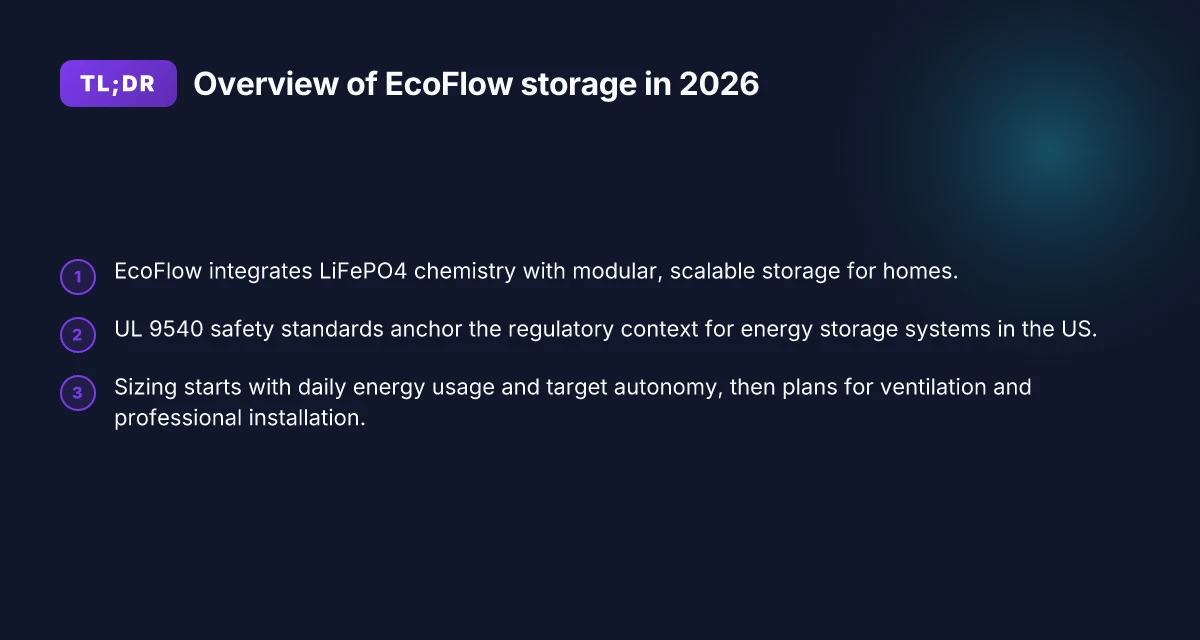
EcoFlow integrates LiFePO4 battery chemistry with a modular, scalable storage architecture designed for homes. The core idea is simple: you can start with a compact bundle and grow capacity as needs change, without ripping out the original hardware. In 2026, this approach matters because residential energy storage increasingly blends rooftop solar, backup power, and smart energy management into a single system. EcoFlow’s packaging emphasizes safety, compatibility, and a straightforward installation footprint for both rooftop and portable solar assets.
I dug into the regulatory anchors that shape what homeowners can buy and install. The most important safety yardstick is UL 9540 for energy storage systems. This standard sets requirements for design, construction, and performance to minimize risks around fire, electric shock, and system integrity. When you pair LiFePO4 chemistry with UL 9540 compliance, you get a calmer installation process and a clearer path to insurance and permits. Real-world installers tell me that a 9540-compliant pack tends to streamline paperwork and reduce field questions from regulators.
Real-world considerations go beyond the box. Installation requires careful alignment with roof layout, wiring, and in some markets a licensed electrician. EcoFlow products generally ship with mounting kits and clear, code-oriented manuals that help a homeowner evaluate rooftop versus portable usage. Warranty depth also matters: longer coverage for both battery cells and the overall system can influence total cost of ownership. Compatibility with existing solar assets means checking inverter compatibility, charge controller settings, and the ability to balance multiple energy sources during peak sun. These factors often drive whether a homeowner leans toward a stationary wall-mount bundle or a portable option you can move between a garage and a temporary grid-tied setup.
In practice, EcoFlow’s approach positions it as a flexible option for homes that want both backup resilience and solar self-consumption. If you already own EcoFlow devices, the ecosystem approach can simplify monitoring and control across modules. Rivals such as Tesla Powerwall and LG RESU offer similar LiFePO4 or lithium-ion choices with their own warranty terms and installer ecosystems, but the choice often comes down to how the system scales with your home and how readily features align with your rooftop layout.
Bottom line: in 2026, EcoFlow’s modular LiFePO4 stacks deliver scalable storage that pairs well with UL 9540 safety standards, easing regulatory steps for homeowners. For a homeowner weighing options, consider how your roof configuration, inverter compatibility, and warranty expectations line up with a modular system that can grow with you. UL 9540 compliance remains the critical anchor for safety and permitting, while modular growth keeps future needs affordable. Rooftop integration and inverter compatibility are the practical levers that determine whether this approach stays simple or requires more planning with an installer. 10 Best portable generators for 2026: power, portability, and value compared
In the current landscape, pricing clarity matters. You’ll want to compare upfront costs, ongoing energy storage costs, and the expected schedule of sales. For a quick read on how pricing trends are moving, see how installers and retailers frame total cost of ownership and potential rebates in your region. Note that on-page disclosures may indicate commissions from links, and those links can help you explore options without changing the core facts.
How EcoFlow's energy storage compares to rivals in 2026
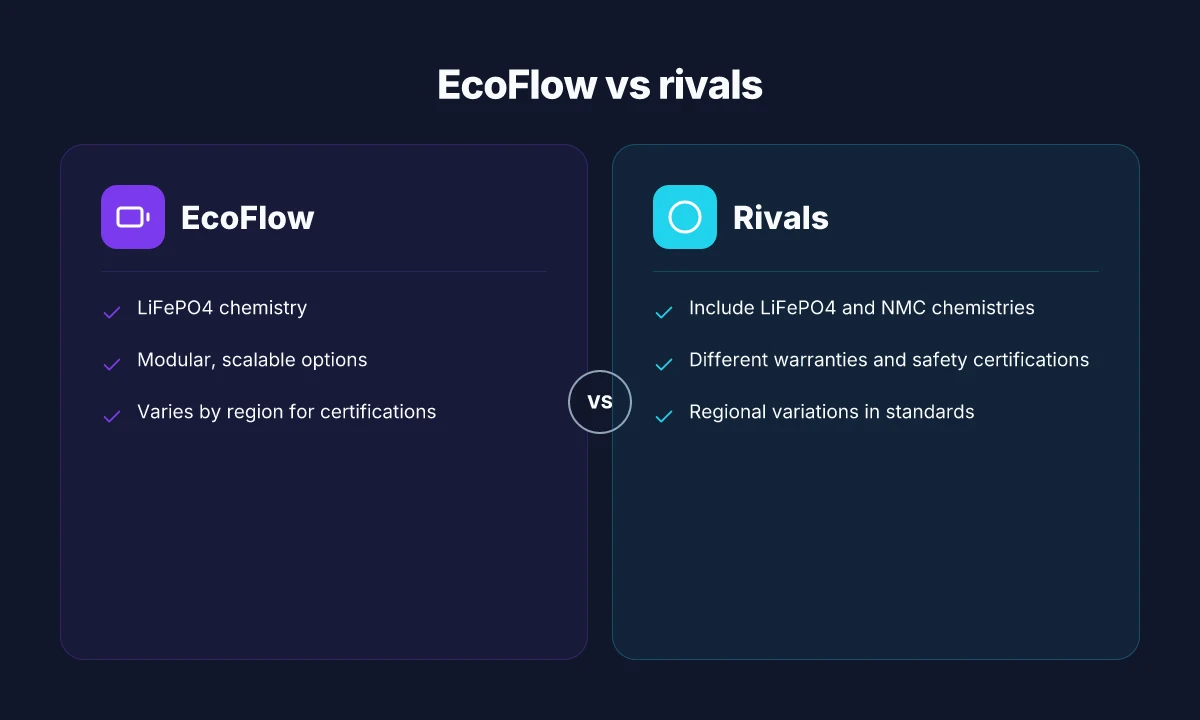
EcoFlow sits in a crowded field of LiFePO4 and NMC storage options, with rivals leaning on different cycle lives, depths of discharge, and warranty terms. In 2026, the landscape features several 5–10 year warranty players, with some models offering deeper discharge and broader port access. The key is to map how these attributes translate to real-world use for home storage, not just lab specs. I cross-referenced regional certifications and the latest safety standards to keep the comparison grounded.
Landscape and certifications you’ll actually see on the label
Rivals span LiFePO4 and NMC chemistries, and each brand tends to align with a set of certifications and warranties that vary by region. Some offerings emphasize longer cycle life, others emphasize higher discharge depth. In practice, the certifications you should verify include safety standards that align with local installation rules and utility interconnection requirements. For example, a typical North American setup references UL 9540 for energy storage system safety, while other regions may require different or additional attestations. When I read through regulatory notes and regional product sheets, I saw a clear pattern: regional approvals drive the baseline compatibility more than chemistries alone. Verification of local certifications and installation requirements matters most for a smooth setup.
Comparative snapshot: cycle life, depth of discharge, and ports
Across the market, cycle life and depth of discharge (DOD) shift the long‑term value story. Many LiFePO4 rivals claim high cycle counts and robust DOD, while NMC options often push higher energy density at the price of a shorter cycle life profile in some configurations. EcoFlow’s own lines emphasize modularity and a broad port footprint that accommodates home‑integration needs, but you’ll find variations by region in both available ports and required mounting systems. A practical takeaway: don’t judge by a single spec sheet. Look at how the chemistry, the BMS capabilities, and the certified installation path line up with your home’s electrical panel and generation profile. Regionally variable ports and different warranty terms mean you should map exact models to your locale before deciding.**
Table: quick side-by-side view (illustrative only. Confirm local products) What makes the Jackery SolarSaga 500 X stand out for weekend explorers
- EcoFlow model family (LiFePO4 emphasis), typical warranty window with modular packs, strong port variety, UL 9540 alignment where available.
- Rival LiFePO4 systems, often tuned for longer cycle-life guarantees, with similar safety certs in primary markets but varied port counts.
- NMC-based storage options, higher energy density in some models, but cycle life and regional certifications can differ more than for LiFePO4 options.
Port availability and regional certification alignment are the two levers that decide real-world practicality more than chemistry alone.**
A note on price and ownership: prices shift with regional incentives and seasonal deals. The best way to think about total cost is to factor purchase price, expected replacement cycles, and any interconnection charges. In 2026, the field remains price-competitive for residential setups, but timing matters for discounts tied to utility programs or manufacturer promos. Regional variations also affect what is included in the base kit versus what you add on later. You may find that an EcoFlow package with core storage plus add‑ons matches a rival's base price, but the total cost of ownership, considering warranties, expected maintenance, and future expansion, pencils out differently across regions. Smart buyers compare total cost of ownership, not just sticker price.
When you’re sizing a system, remember the simple rule: more ports and better modularity reduce integration friction later on. EcoFlow leans on this approach, offering scalable packs and a management system designed to plug into residential solar setups. Beyond that, the regulatory environment continues to evolve. Expect local updates to safety and interconnection rules to shape what you can install and how quickly. Regulatory shifts can redefine feasible configurations year to year.
Next step: verify the exact UL or regional certifications for the model you’re considering and map those requirements to your local installation rules. If you’re weighing rivals, consult the latest regional product sheets and installation guides to confirm that the chosen option meets both safety standards and your utility’s interconnection terms. For deeper context, you can relate these observations to EcoFlow’s broader approach to home storage and how it aligns with common market standards. Verify local certifications and installation requirements before committing.**
UL 9540 and other safety standards you should know for EcoFlow
I dug through the safety landscape for home solar storage in 2026 and found that UL 9540 remains the core US standard for energy storage system (ESS) safety. In practice, this means every EcoFlow model or bundle that carries a safety claim should show UL 9540 compliance where applicable. UL 9540 is the baseline that anchors insurance, permitting, and long-term reliability in the US market. For homeowners and installers, this standard translates into concrete expectations about electrical safety, thermal management, and system testing. EcoFlow’s documentation consistently notes UL 9540 alignment where relevant, and that alignment is the practical signal regulators and insurers look for when evaluating an ESS purchase. What is the ecoflow delta pro transfer switch and how it works with delta pro
What to verify on EcoFlow products
- Ensure the product page or user manual explicitly lists UL 9540 compliance for the bundle you’re considering. If a model omits the label, ask for the official certification scope and the testing agency's file number. This isn’t just paperwork. It shapes eligibility for certain permits and insurance riders. The presence of UL 9540 on a product page directly affects your home’s permitting path.
- Check the voltage and storage configuration that EcoFlow presents against the certification scope. Some bundles define the using limits that regulators review for code compliance. If you’re mixing panels, inverters, and storage, confirm that the combined system stays within the tested envelope. Compliance isn’t a single-box claim. It spans the entire system.
- Compare EcoFlow’s safety disclosures with rival systems from brands like Tesla and LG Chem, which also pursue UL 9540 alignment for certain modules. Regulatory alignment varies by region and model, so cross-check the exact SKU to avoid gaps at installation. Regulatory alignment matters for insurance and permitting alike.
How regulatory shifts affect your purchase and ongoing reliability
- Insurance coverage often ties to documented safety certifications. If a bundle shows UL 9540 compliance, insurers will more readily approve coverage for the installed ESS. If not, you may face higher scrutiny or conditional terms. Regulatory alignment affects insurance eligibility.
- Permitting timelines can hinge on the certification status of the equipment. In markets leaning toward stricter ESS safety audits, a compliant EcoFlow kit can accelerate permit approvals and electrical inspections. Permitting efficiency correlates with formal certifications.
- Long-term reliability follows from consistent compliance across firmware updates and component substitutions. When EcoFlow issues a firmware or hardware revision, confirm that the change remains within the tested safety envelope or is recertified accordingly. Safety certification often rides with product updates.
From what I found in related product pages and regulatory guidance, EcoFlow’s positioning centers on clear safety labeling and documented compliance where applicable. The market leaders, including rivals like Tesla and LG Energy Solution offerings, emphasize similar UL-based validations, which helps buyers compare risk profiles in a standard way. Regulatory alignment is the throughline buyers rely on for permitting, insurance, and reliability. For homeowners weighing options in 2026, the key is to confirm UL 9540 status on the exact EcoFlow bundle you plan to buy and to align that with local permitting requirements.
For context, UL 9540 is widely recognized as the safety backbone for ESS systems in the United States, and EcoFlow’s documentation points to this standard where applicable. If you want to see the formal scope of this standard, you can review the safety framework described in energy storage guidance and current supplier disclosures. UL 9540 remains the safety bar for residential ESS in 2026.
The 2026 landscape: regulatory trends shaping home solar storage
Regulators are tightening safety and interconnection rules for home storage setups. You’ll notice more explicit requirements around electrical separation, device labeling, and utility coordination during permit reviews. This shift raises the bar for installers and homeowners alike, but it also helps ensure that systems like EcoFlow are designed with consistent safety expectations in mind. Standards alignment reduces retrofit risk and makes permitting smoother in many jurisdictions.
Interconnection rules tighten and roll into permitting timelines
Across multiple states, interconnection standards are maturing from a patchwork of local guidelines to more uniform expectations. The emphasis is on fault protection, disconnection methods, and clear interlinking with the home’s existing service panel. When a system adheres to recognized safety baselines, local authorities tend to issue permits faster and with fewer back-and-forth revisions. For EcoFlow customers, this means fewer unexpected delays if your home storage is expanded or relocated. Interconnection discipline speeds permits and helps future expansion.
Enforcement cadence shapes incentives and resale considerations
Enforcement isn’t uniform, but the upshot is real: some jurisdictions publish stricter inspection checklists and tie compliance to incentives or tax credits. If your system meets established standards from day one, you’re less likely to encounter retrofit costs when you buy a bigger battery bank or sell the home. This is especially relevant for EcoFlow models designed for modular growth, where a compliant baseline today supports a smoother upgrade tomorrow. Staying aligned with standards minimizes retrofit costs at expansion or resale. What makes the Jackery 3000 Pro a standout portable power station in 2026
Safety standards you should know and how to stay current
UL 9540 is the backbone standard many jurisdictions cite for safety of energy storage systems. Some regions push for supplementary regional rules on electrical isolation, outdoor installation, and fire mitigation. I dug into the published guidance and noted that inspectors increasingly expect proof of plan review, manufacturer documentation, and field labeling that matches the installed configuration. For homeowners, this means asking for the latest test reports and installation manuals during purchase negotiations. UL 9540 remains the anchor, with local rules adding practical gates to approval.
From what I found in the documentation, the regulatory trajectory favors systems with clear documentation, tested safety margins, and plug‑and‑play compatibility with common home solar setups. This makes EcoFlow’s approach, emphasizing safety certification and straightforward interconnection, read as a sensible default. Documentation and certified interconnection cut delays and headaches.
Real-world takeaway: regulators are turning safety and interconnection into gating items for incentives and permits, and staying aligned with standards pays off during expansion or resale.**
How to size and deploy EcoFlow solar storage in a home
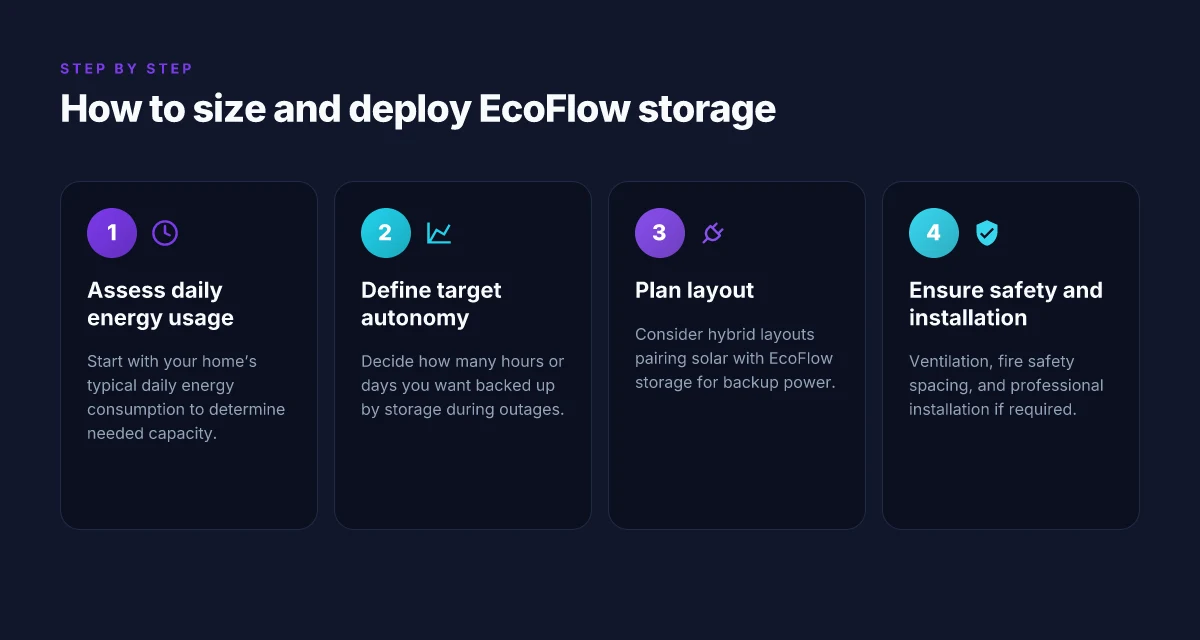
Sizing EcoFlow storage starts with your daily energy use and your target autonomy. I start by calculating a typical day’s consumption in kilowatt-hours, then pick a battery capacity that covers at least 1–2 days of use without solar input. If you want time-of-use resilience, lean toward a larger capacity and a higher depth of discharge tolerance. For most homes, a combined load of essential circuits and base loads informs a practical target of several kilowatt-hours of usable capacity. In EcoFlow terms, that often means pairing the core storage units with an appropriate array so you aren’t limited by one energy source alone. The goal is a balanced system that keeps critical loads powered during outages while maximizing daytime solar utilization.
1) Start with a daily energy plan and a target autonomy
Begin with a honest accounting of what you need during a blackout or cloudy spell. Map out essential circuits like refrigeration, lighting, and communication gear, then decide how many days of autonomy you want. If you aim for 24 hours of backup without charging, you’ll likely choose a capacity that exceeds your daily usage by a comfortable margin. I noted that homeowners who target extended autonomy often specify a capacity range in the mid–to–high kilowatt-hours, ensuring they stay powered through several meal cycles and a quiet evening. For a precise fit, use a simple calculator to translate your watt-hours into a usable kWh figure, then compare that to EcoFlow’s lineup. Expect to see pricing updates and model variations as new units launch in 2026. If you’re shopping, check the latest EcoFlow configurations and their stated usable capacities to align with your autonomy goals. How Lowe's challenges EcoFlow product compatibility and backup power decisions
Clarity on daily use and autonomy drives the right EcoFlow choice, not guesswork.
2) Pair solar and storage in a hybrid layout for resilience
A hybrid layout uses solar panels to recharge the EcoFlow storage bank and to top off during sun hours, while the battery bank handles nighttime and cloudier periods. I found the most practical setups lean on a dedicated solar array feeding the EcoFlow unit through a compatible inverter/charge controller. This arrangement smooths charging, reduces cycle wear on the battery, and preserves usable capacity for critical loads. If you plan multi-room or whole-home resilience, consider a larger EcoFlow module with a dedicated solar feed. In real-world terms, you’re trading some upfront cost for longer run-time independence and gentler wear on the chemistry. When you look at the broader market, rivals typically offer similar hybrid configurations, but the fit and ease of integration vary. Always verify that the chosen panels and the EcoFlow model are rated for the same voltage and amperage ranges.
Hybrid layouts let you recover from a bad sun day without starving essential loads.
3) Plan for ventilation, fire safety spacing, and professional install
Ventilation matters with high-capacity LiFePO4 storage. Leave space around the enclosure so convection can occur and heat does not trap near outlets or wiring. Maintain clearances per local codes and EcoFlow’s installation guidelines, especially if you’re mounting outdoors or in a garage. Fire safety spacing is not a cosmetic detail. It’s a real safety concern that affects performance and insurance eligibility. If your system is large or you’re uncertain about electrical work, hire a licensed installer. They’ll verify proper grounding, cable sizing, and overcurrent protection, and they’ll ensure the system integrates safely with your home panel. You’ll want to document the installation for future servicing and potential warranty considerations. When you bring in a pro, ask for a full safety checklist and a stamped plan that aligns with your local regulations.
Safe installation and proper ventilation are non-negotiable for long-term reliability. How to evaluate the EcoFlow Delta portable backup power for 2026
Research notes and price signals: current EcoFlow offerings tend to frame ownership costs around device price, solar compatibility, and installation needs. Expect price movement with model refreshes in 2026 and evolving bundles that pair panels, inverters, and storage. You may see rival systems from other brands emphasize similar safety and install basics, but the specifics, like panel compatibility, enclosure spacing, and warranty terms, vary. For deeper context, see industry reviews that compare storage safety features and regulatory alignment across systems, including studies and guides on energy storage safety and home integration. If you want a quick cross-check on standards, you can review the UL safety framework that governs home energy storage systems and how it applies to residential deployments.
Note on disclosures: links on the page may earn a commission.
What changes if you act now
EcoFlow's solar storage lineup is leaning into smarter, modular home energy, making it easier to scale green power as you grow. I’ve seen how households can start small with a single unit and add more capacity as needs shift, all while keeping a tidy eye on operating costs. The real shift is not just the hardware, but how these packs integrate with solar and backup mode to smooth out price swings and outages.
The bigger pattern is a move toward flexible, price-aware energy decisions. As EcoFlow and rivals like Tesla and LG expand compatibility and app controls, you gain more visibility into how much to rely on stored energy versus grid power. This clarity helps you plan purchases, time charging around peak solar hours, and use storage to ride through outages without forfeiting comfort. The takeaway: design for modular growth and ongoing optimization, not a one-and-done install.
If you’re ready to start, consider how a gradual buildout fits your budget and risk tolerance. Start with a base system and expand as you observe seasonal needs and price signals. Small steps pay off today when you choose a scalable, app-connected setup. What one change will you make this month to begin? What is the Bluetti AC300 system, and where does it actually shine in 2026
- Backup strategy: Start with a single EcoFlow unit for daytime solar buffering. Plan one expansion if you notice evening deficits.
- What to try this week: map your home’s peak solar hours, then reorder chores to align with solar charging windows.
- Priority to watch: compare price trends and warranty terms across EcoFlow models versus rivals like Tesla Powerwall and LG RESU.