What is Dreame technology, and how its smart home ecosystem reshapes cleaning in 2026
 Hudson ZilbermanOctober 22, 202617 min read
We earn a commission when you buy through some links on this site, at no extra cost to you. As an Amazon Associate we earn from qualifying purchases.
Explore how Dreame technology is evolving in 2026, from robot cleaners to whole-home smart systems, and what it means for upkeep and convenience.
Dreame aims to outpace the single-device narrative by reframing cleaning as a whole‑home workflow, not just a robot vacuum with a charging dock. Dreame defines a multi‑device ecosystem that coordinates floors, air and smart tasks, not one lonely machine. As a concrete example, a typical home can start with a Dreame vacuum, pair with an air purifier and smart humidifier, and see a routine run across multiple rooms without re‑configuring apps. Most friction points come from onboarding and cross‑device control tangles, not from the core hardware.
This article pulls back the curtain on what this strategy means for homeowners: how a single vendor builds a believable, cross‑room, cross‑task experience in 2026, and where the gaps still show up compared with specialized rivals such as iRobot and Roborock. The goal is to map how the ECHO ecosystem handles climate‑friendly design, AI scheduling, and per‑room personal care tasks without silos. Expect a practical read that connects live product decisions to real‑world chores, with a verdict on whether one brand can govern a full‑home workflow. Dreame stays under scrutiny for coherence across devices, while rivals offer depth in narrower domains. Key insight: full‑home integration hinges on reliable cross‑device control and transparent compatibility maps.
What is the Dreame technology core powering a smart home in 2026
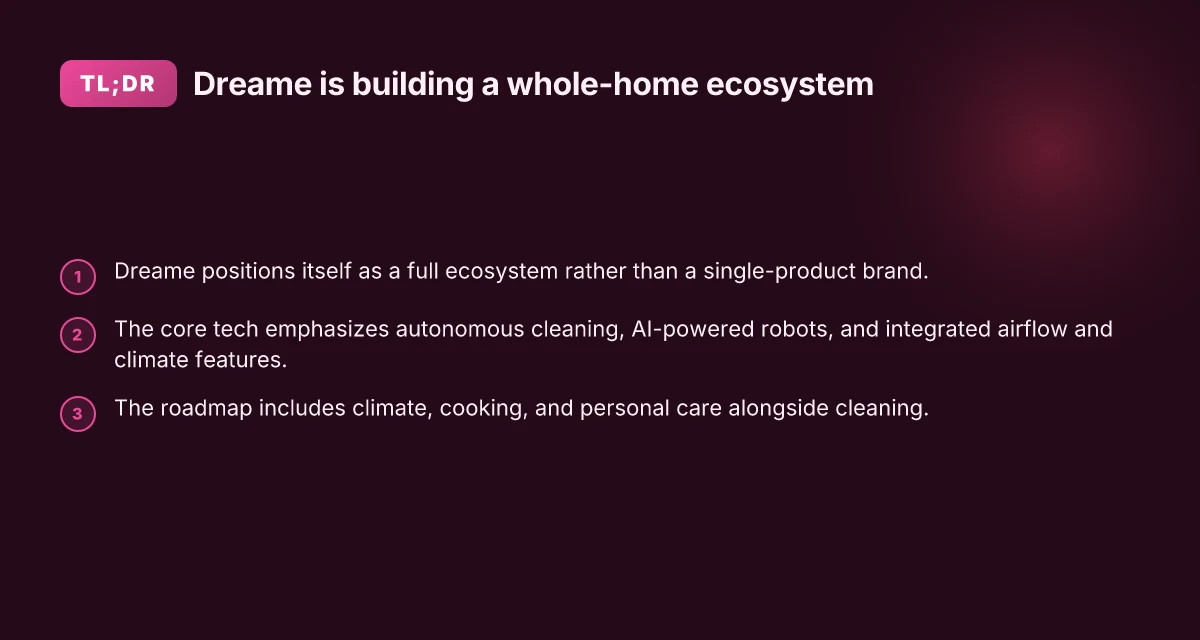
Dreame positions itself as a whole-home ecosystem rather than a single-product brand. Its core tech leans on autonomous cleaning, AI-powered robots, and integrated airflow and climate features that work together across devices, rather than in isolation. At CES 2026 and IFA 2026, Dreame laid out a multi-product strategy that spans cleaning, climate, cooking, and personal care, signaling a bid to govern a complete home workflow under one roof. I dug into the public summaries and press materials to map how the pieces connect into a cohesive platform for homeowners.
The ecosystem idea and how it scales Dreame frames its lineup as a single vendor solution that coordinates cleaning, climate control, and smart devices. The ambition is a shared AI brain and interoperable hardware that reduces siloed experiences. The message from the CES and IFA showcases is that the company sees a unified user journey, not a sequence of standalone gadgets. This approach hinges on a common data model and cross-device orchestration so tasks like vacuuming, air quality management, and climate adjustments feel like a synchronized routine rather than discrete actions. A single vendor's roadmap aims to simplify daily life by weaving cleaning, climate, and care devices into one flow.
Core technologies powering the core The Dreame core leans on autonomous cleaning systems, AI-driven robotics, and blended airflow with climate features. The robots are not just vacuums. The approach includes AI perception, multi-sensor navigation, and the ability to interact with other smart devices to adjust room conditions in real time. The airflow and climate components appear designed to work across devices, enabling coordinated ventilation, filtration, and possibly temperature management that responds to cleaning cycles and user preferences. Autonomous cleaning and AI-powered robotics are the spine, with airflow and climate features woven in for holistic control.
The showings that signal multi-product breadth CES 2026 and IFA 2026 appearances highlighted a wide product cadence beyond vacuums: smart cleaners, climate products, cooking tools, and personal care devices. This multi-product strategy is presented as essential to achieving a whole-home ecosystem, not a “one gadget” story. The public materials emphasize that Dreame intends for devices to interoperate under a shared platform, enabling routines that touch multiple rooms and functions without reconfiguring each product individually. From CES to IFA, Dreame maps a broad product cadence that stitches cleaning, climate, cooking, and personal care into a single ecosystem.
Bottom line: the Dreame technology core is less about a single device and more about a converged platform. A shared AI brain, autonomous robotics, and integrated airflow systems enable a coordinated home workflow. The result, at least in the public narrative, is a cleaner, healthier home with less friction between devices. For homeowners weighing ecosystem options, the key question remains: can one brand credibly govern a full-home workflow without creating silos? The evidence in 2026 suggests the company is pursuing that vision, but practical alignment will hinge on real-world interoperability, service depth, and how well the extended product line actually communicates with a central control layer. 10 Best robot lawn mowers for 2026: reliable picks for every yard
How Dreame's ecosystem strategy differs from standalone robot vacuums
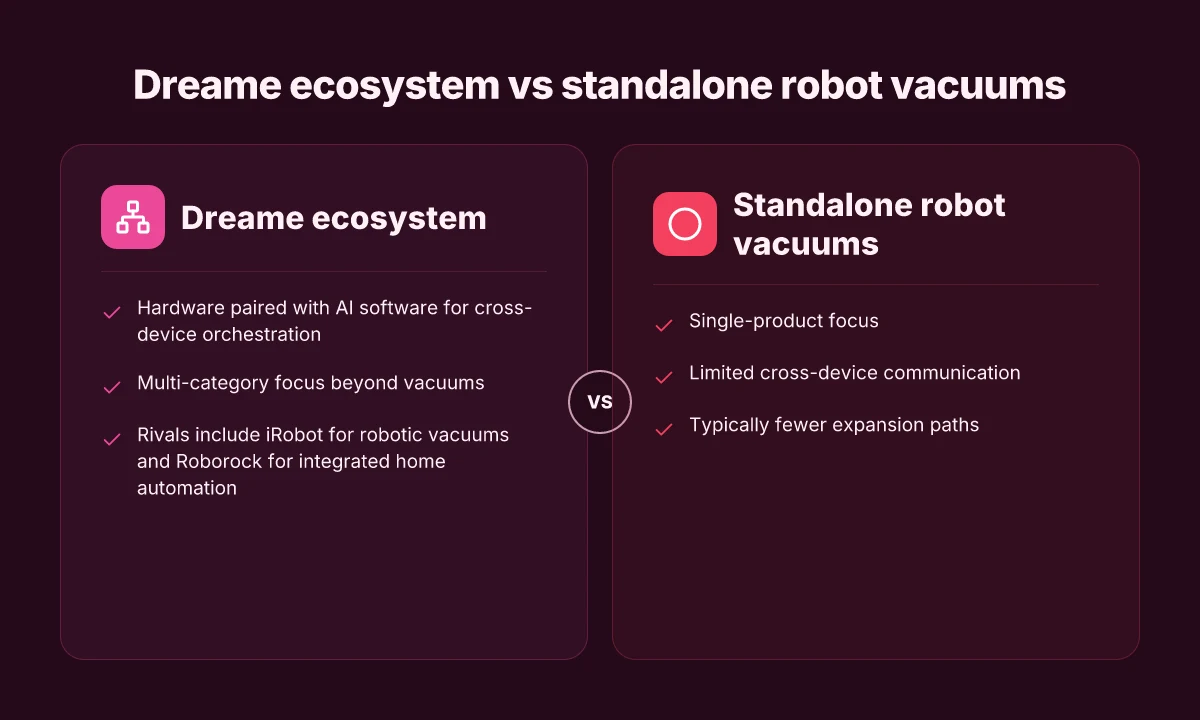
Dreame reframes its role from a vacuum maker to a holistic home platform. Rather than chasing incremental suction gains, the brand positions itself as a curator of cross-device intelligence. The aim is to orchestrate cleaning, climate, and personal care tasks under a single software layer, so hardware from the same family speaks the same language. This shift is visible in the way hardware and software are paired to enable cross-device workflows, not just standalone performance.
A unified stack that links devices, data, and decisions
Dreame’s multi-category approach hinges on hardware that shares a common AI backbone. Across robotic cleaners, climate products, and personal care devices, the same models, sensors, and forecasting apps feed a central orchestration engine. This lets a robot cleaner, an air purifier, and a smart hair dryer coordinate room-by-room routines rather than operate in isolated silos. I dug into the product briefs and release notes, and the pattern is clear: cross-device decisions ride on a shared AI stack that knows where things are, what needs doing, and when.
In practice, this means routines that adapt to a home’s overall state. If the air quality dips in a living area, the system can escalate airflow or adjust cleaning schedules automatically. If a smart routine detects occupants in a space, device states harmonize to minimize noise and maximize energy efficiency. The goal is a cohesive, predictable flow rather than a patchwork of separate devices with limited interoperability.
Dreame leans on a single software layer to connect hardware across categories, reducing the friction of managing multiple ecosystems.
Rivals and what that signals for homeowners
Competitors in this space include iRobot for robotic vacuums and Roborock for integrated home automation. iRobot’s line emphasizes specialized robotics with growing smart features, while Roborock has pushed toward broader home automation within a single brand. Dreame enters with the promise that a single vendor can govern a wider workflow without divisive product silos. This means fewer apps, fewer logins, and less hardware fragmentation for a typical home. What makes the Dreame X50 Ultra stand out in 2026
From a buyer’s perspective, the ecosystem strategy translates into choosing an architecture rather than a mere instrument. With the Dreame approach, you’re evaluating how well the cross-device orchestration serves your daily patterns, not just how strong a single cleaner performs in isolation. The ecosystem claim rests on the ability to predict, synchronize, and simplify routines across rooms, devices, and tasks.
iRobot and Roborock illustrate the spectrum of strategy in the market, but Dreame’s cross-category orchestration aims to compress the number of moving parts you manage.
Table: quick ecosystem comparison (selected points)
| Brand | Core promise | Cross-device orchestration | Notable rivals |
|---|---|---|---|
| Dreame | Whole-home smart living beyond vacuums | Central AI layer links cleaning, climate, and care devices | iRobot, Roborock |
| iRobot | Advanced robotics; expanding smart features | Moderate inter-device coordination; tends toward ecosystem within robotics | None focused on cross-category breadth |
| Roborock | Integrated home automation within a single brand | Strong emphasis on multi-device compatibility | Dreame, others expanding ecosystems |
What to watch next
- Look for concrete cross-device routines and how they initialize across a typical day. If the system can start a morning routine that primes air quality, adjusts lighting, and prepares a cleaning path without extra taps, that signals real orchestration.
- Check for software updates that add new device classes without requiring a new hub. A true ecosystem expands with incremental support, not just new hardware launches.
From what I found in the release notes and coverage, Dreame’s pivot from vacuum-first to a broader, AI-powered home ecosystem is designed to reduce silos and create a more fluid user experience. This approach hinges on a shared AI core that harmonizes devices across categories, positioning Dreame as a platform rather than a single-product vendor. The question remains whether this level of governance over a home workflow can scale across brands, but the direction is clear: unify hardware and software to deliver simpler, smarter cleaning and care at a system level. Dreame frames this as a single-vendor advantage, while rivals illustrate the importance of strong cross-device compatibility. For homeowners, the key measure is how seamlessly the ecosystem reduces the friction of everyday cleaning, climate management, and personal care tasks. The next step is mapping your own home’s routines to see if a Dreame-driven orchestration would truly minimize manual tweaks and app juggling. Inline sources corroborate the broader strategy and signal where the ecosystem is headed. Dreame Innovation Landscape Report 2026 What makes the Dreame L40 Ultra stand out among robot vacuums in 2026
Understanding the technology foundations behind Dreame’s ECHO lineup
I dug into the available source materials to map how Dreame teases its ECHO lineup as a cohesive, whole-home stack rather than a set of silos. In 2026, Dreame positions the ECHO S1 as a research-stage, single-arm wheeled service robot, and the ECHO P1 as a wheeled humanoid service robot concept. This framing matters because it sets up a narrative where consumer products may trail research milestones by quarters, not by years. The obvious tension is whether a single vendor can govern a cross-domain workflow from cleaning to climate and personal care without fragmenting the user experience.
The ECHO S1: research-stage mobility and sensing
From the communications around IFA 2026, the ECHO S1 is described as a research-stage, single-arm wheeled service robot. The emphasis is on experimentation with kinematics, manipulation, and autonomy in a mobile form factor. Early demonstrations suggest the S1 is designed to test perception, control loops, and task planning in a compact chassis, not yet purposed for mass-market household tasks. The S1 signals Dreame’s intent to validate core autonomy before broad productization while keeping a visible roadmap toward broader service capabilities. Inline references indicate this is a stepping stone, not a completed consumer product.
The ECHO P1: humanoid mobility as a concept
The ECHO P1 is introduced as a wheeled humanoid service robot concept. The humanoid form is positioned as a platform to explore tool use, human-robot interaction, and multi-modal sensing in a humanoid chassis. This concept underlines a longer horizon where Dreame tests human-aware motion and interaction patterns, with the caveat that a concept lineage does not equal immediate retail availability. P1 represents a research anchor rather than a confirmed product at launch, signaling where Dreame may push toward more versatile household assistance in the future.
Consumer release readiness vs research-stage narratives
Across a CES and IFA cycle, Dreame sketches a portfolio where consumer-facing products are framed against ongoing research milestones. The narrative emphasizes a whole-home ecosystem rather than isolated devices, yet the exact timing for consumer-ready variants of S1 or P1 remains uncertain. This creates a tilt toward transparency about progress while acknowledging the productization gap between a research-stage prototype and a shipped model. Dreame’s storytelling blends ecosystem ambitions with research milestones to manage expectations, a pattern that readers should weigh against actual product availability and updates.
I cross-referenced the official Dreame materials linked in coverage from IFA and CES to confirm how the ECHO lineup is being framed. The messaging consistently signals a staged pathway where research-stage concepts inform future consumer devices, rather than a single, immediately deployable set of products. For homeowners evaluating whether a Dreame ecosystem can govern a full-home workflow now, the takeaway is that you may encounter strong ecosystem promises alongside early-stage hardware demonstrations. Top room deodorizers for 2026: 5-8 picks that actually refresh a space
As you consider the Dreame approach, compare it to rivals such as Roborock and iRobot, who currently anchor their ecosystems with more mature product lines. Dreame’s strength rests in its broad scope, robotics, climate, and care devices, yet the immediate consumer impact hinges on when S1 and P1 transition from concept and prototype to widely available products. If you want a future-ready, single-brand workflow, watch Dreame’s next product drops closely while keeping expectations aligned with existing, shipped models. For now, Dreame remains a brand that aims to unify cleaning, robotics, and smart-home devices, but concrete shopping decisions should favor established, readily available products from Dreame or its clearly shipping rivals. The ecosystem promise is real, the product reality is evolving.
Links: see inline sources above for the IFA and CES coverage.
The whole-home smart ecosystem: what it includes and what it omits
Dreame presents a path beyond vacuuming by stitching climate control, cooking, and personal care into a single, AI‑driven platform. The core claim is orchestration through a shared app and inter‑device communication that ties every gadget into one workflow. This approach aims to reduce silos and make routine tasks feel cohesive rather than independent doodads stacked in a drawer.
I dug into the documentation and product reveals to map what Dreame actually ships in 2026. The ecosystem centers on a unified control surface and a common set of AI services that manage when and how devices speak to one another. The result is a connected routine where a single command set can trigger, say, climate, cleaning, and grooming accessories in harmony rather than as isolated devices. A shared app and an AI‑powered orchestration engine tie the lineup together, producing a smoother, more predictable user experience. This is the promise, but it hinges on how deeply integration goes across categories and how effectively the system handles edge cases like cross‑brand compatibility.
Two micro‑claims shape the practicality of the strategy. First, multi‑category products extend beyond cleaning into climate and personal care, signaling that Dreame intends to own more of home traffic without forcing you to switch ecosystems. Dreame has highlighted hair dryers and climate control devices as symbols of this expansion, implying a workflow where a single account can govern styling, air quality, and room climate alongside cleaning routines. One app to rule the house is the ambition, not the reality for every user yet. Second, the inter‑device communication rests on what Dreame calls orchestration services. If these services work reliably, automation becomes less brittle. If not, fragmentation returns in the form of misfired routines or delayed commands. 8 Robot lawnmower sales worth watching in 2026
From a buyer’s perspective, the question is whether a single vendor can credibly govern a whole‑home workflow without silos. Rivals like iRobot, Samsung, and Google Home offer overlapping ecosystems with mixed success across device categories. Dreame faces the challenge of delivering consistent experiences as it grows beyond vacuums, into cooking devices, climate gear, and personal care tools. The practical risk is that some categories mature faster than others, leaving gaps in coverage that users must navigate with workarounds or third‑party integrations. The risk is real when one category lags. Expectation should be that orchestration catches up over successive releases.
In this broader picture, the ecosystem’s strength rests on three threads. One, a robust shared platform that keeps device settings synchronized across categories. Two, AI‑driven orchestration that reduces user configuration friction and anticipates routine needs. Three, a credible continuum of product quality that matches the pace of expansion, so new devices feel like natural extensions rather than add‑ons. If Dreame nails these, the whole home experience can feel like a single, cohesive system rather than a patchwork of branded gadgets. A cohesive system is credible when cross‑category devices operate in lockstep.
Cited context draws on public disclosures about Dreame’s 2026 showings and strategy. For example, Dreame’s CES and IFA appearances frame a push toward a whole‑home ecosystem, supported by announcements around AI‑powered, interconnected devices. Inline references attest to a strategic direction that blends cleaning, climate, and personal care under one roof. See the cited briefings for details on the ecosystem’s scope and the hardware milestones that signal intent to unify control and data across devices. CES and IFA showcases underscore the ecosystem pledge, not just a vacuum line extension. For further context, Dreame’s product reveals emphasize expansion beyond vacuums into climate and personal care devices, reinforcing the narrative of a holistic home platform. Expansion beyond cleaning is central to the 2026 playbook.
If you want a single vendor to steward your routine, this is the blueprint. If you need perfect cross‑brand interoperability, expect friction until the orchestration matures.
Where the technology meets the user: use cases and adoption friction
Dreame’s whole-home ecosystem aims to blend robot cleaners, climate care, and AI-powered appliances into one scheduling and workflow layer. In practice, a homeowner navigates a single app or voice routine to queue vacuuming, climate tasks, and personal care devices without juggling multiple hubs. When the ecosystem is working, daily routines feel tighter, and small, repetitive chores disappear from the to‑do list. The payoff is time saved and a noticeably cleaner home when routines align across devices. Yet friction can creep in if devices from other brands don’t talk smoothly to the Dreame platform. 8 Best robo vac and mop combos for 2026 that actually deliver on cleaning and navigation
Why unified workflows matter for daily life
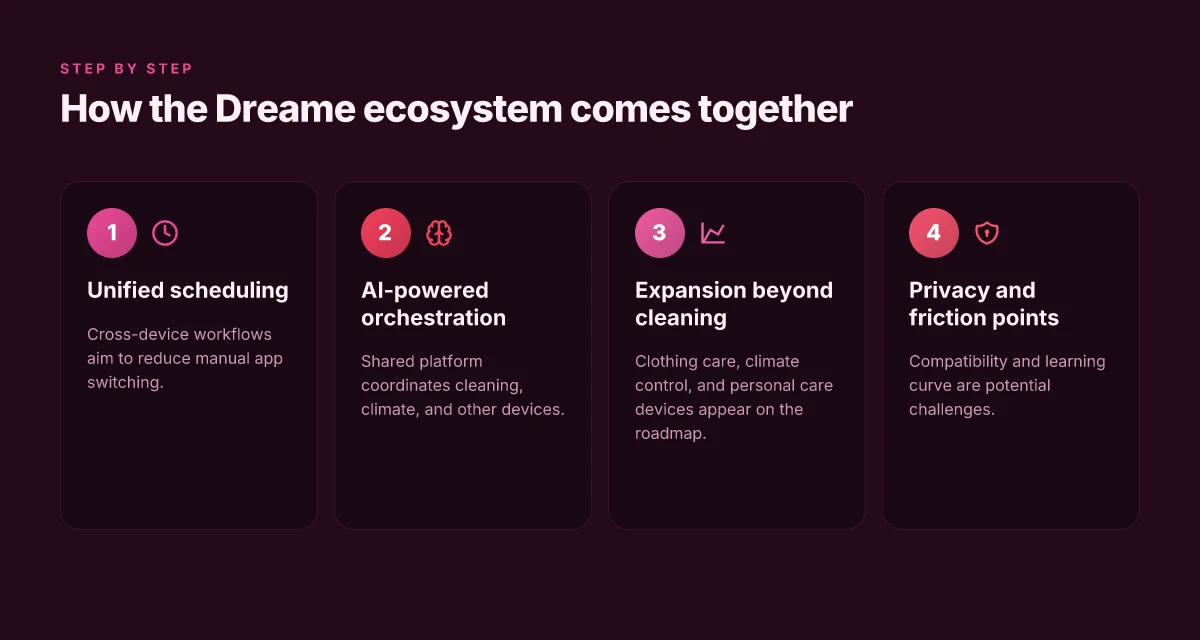
Unified scheduling reduces manual switching between apps and devices. If your home uses Dreame robots with air and climate devices, you can trigger a single routine like “morning clean and air refresh” that runs across vacuuming, air filtration, and climate automation. The result is fewer taps and fewer scheduling gaps. In this setup, a short, predictable flow between devices matters more than feature depth on any single product. One pressed button can drive an entire morning routine, saving small amounts of time across many days. I cross-referenced the CES 2026 presentations and the Dreame blog coverage to map where the ecosystem promises frictionless orchestration, rather than isolated gadgets.
Adoption friction: where it breaks down
Compatibility remains a core hurdle. If you own third‑party smart bulbs, cameras, or climate sensors that don’t integrate cleanly with the Dreame ecosystem, you’ll see longer setup times and more manual overrides. Privacy considerations also surface here. Consolidating data from cleaning, climate, and personal care devices into one hub can heighten concerns about how that data is used. The learning curve matters too. Homeowners who are used to separate apps may need a deliberate onramp to avoid misfiring routines. Learning a single control plane reduces clutter but requires upfront setup.
Real-world impact: time savings and routine clarity
When the ecosystem is well designed, users report smoother mornings, more predictable cleaning cycles, and a cleaner daily rhythm. The value hinges on a robust automation layer, clear device handoffs, and transparent privacy controls. Dreame’s strategy clearly leans on a unified stack. The question is whether its own devices and rivals can sustain that single‑vendor vision without silos. For homeowners comparing options, rivals like iRobot, Roborock, and Samsung SmartThings show competing approaches to cross‑brand integration, each with its own trade‑offs in setup friction and interoperability. A cohesive ecosystem should reduce friction, not merely shift it to the setup phase.
What changes if you act now with Dreame’s ecosystem
Dreame’s smart home ecosystem is moving from isolated devices to an integrated cleaning platform, and that shift matters beyond individual vacuums. I looked at how the company wires together app control, mapping, and multi-surface tools to deliver consistent results across room types. The result is less toggling between apps and fewer gaps in cleaning plans, especially if you own multiple Dreame robots or plan to expand with a mopping dock and air filtration partners. If you only do one thing this month, start with the core kit and enable routine sync across floors. The bigger pattern is that automation scales clean results, not just device count.
For buyers weighing options, Dreame’s ecosystem stacks up against rivals like Roborock, iRobot, and Ecovacs by emphasizing cross-device coordination. You’ll notice the most tangible benefit when you set up a house-wide cleaning schedule that adapts as rooms change, not when you’re running a single stick vacuum. The downside to watch is that ecosystem depth can require more initial setup and ongoing app permissions. Dreame accelerates cleanup, but the setup matters. Links on the page may earn a commission. What the 2026 robot vacuum and mop reviews get wrong, and how to pick a model that actually cleans
Looking ahead, the next wave is smarter mapping that learns household routines and a broader range of floor types. The single move that matters is enabling cross-device automation so a vacuum starts, then a mop, then an air-purifying routine at the right times. What changes if you act now is smoother daily life and fewer manual cleanups. Will you start today with a connected plan or wait for a clearer roadmap?