10 Best robot lawn mowers for 2026: reliable picks for every yard
 Tessa AlbrightOctober 22, 202620 min read
We earn a commission when you buy through some links on this site, at no extra cost to you. As an Amazon Associate we earn from qualifying purchases.

Discover the 10 best robot lawn mowers for 2026. For each model, see real-world performance, reliability, battery life, and value to help you choose the perfect fit.
The field is finally moving past glossy promises. In real yards, a mower that clogs or dies mid-season costs more than its sticker price over three years. MOVA Tech edge shows up in battery life and drive reliability, but the upfront price and parts availability can hold it back.
For 2026, homeowners with medium to large lawns want clearer signals: what lasts, what sips energy, and what dries up the long-term bill. This article weighs 10 popular models against those criteria, with a sharp look at ownership costs, weather resilience, and noise, so you can choose without guessing. The findings matter as more brands push zero-emission options into the mainstream, and real-world performance often diverges from glossy specs.
What makes the best robot lawn mower worth the investment in 2026
Smart purchasing comes down to real-world performance and total ownership costs. In 2026, a strong mower blends wide cutting paths, reliable navigation, long-lasting batteries, weather resilience, quiet operation, and a clear path to lower operating costs over time. Electric, zero-emission operation beats gas-powered equivalents for daily use, especially in residential yards where frequent mowing reduces emissions exposure and upkeep.
Cutting width, navigation, and battery life A reliable model leans on a wide cutting width to minimize passes, advanced navigation like LiDAR or robust boundary-wire mapping to avoid missed spots, and a battery that sustains a full session without a mid-day recharge. In practice, a larger cut width reduces total mowing time, and adaptive navigation reduces edge-touching errors on irregular lawns. I cross-referenced multiple product rundowns and field notes from 2025–2026 that consistently credit LiDAR-assisted or multi-sensor navigation for better coverage. Expect most midrange models to offer around 20–28 cm cutting widths and 60–90 minutes of efficient runtime per charge, with rapid recharge capabilities to finish typical residential plots.
Weather resilience, noise, and long-term cost of ownership Weather resilience matters because you want consistent mowing across spring rains and summer heat. Models with sealed electronics and weather-ready chassis tend to sustain performance with less maintenance. Noise matters for neighborhood comfort. Most residential units stay within quiet, garden-friendly ranges. Ownership cost includes purchase price, battery life over time, scheduled maintenance, and potential replacement parts. I looked for guidance that tied lower energy consumption and fewer service visits to lower lifetime costs, not just initial sticker price. For households weighing ongoing spend, consider a model with swappable batteries or a manufacturer offering a battery replacement plan.
MOVA Tech as a notable entrant MOVA Tech enters the field with features aimed at medium to large yards, including intelligent routing and robust sensors. Pros include potential energy savings and strong terrain handling. Downsides noted in market roundups include higher upfront cost relative to some budget alternatives and a learning curve for new navigation interfaces. The MOVA Tech line tends to appeal where yard complexity or larger area coverage is the priority and where owners are willing to invest for longer-term reliability. For buyers who want a more hands-off setup and are attracted to advanced mapping capabilities, MOVA Tech can be a solid fit, provided the price aligns with long-term savings expectations.
Energy efficiency and cost of ownership in 2026 Energy efficiency remains a strong selling point for robot mowers. Compared with gas-powered mowers, these units produce zero direct emissions during operation and use electricity more efficiently over time. The result is lower fuel costs and reduced maintenance needs. When you factor in ownership costs, the difference between a premium model and a budget option often hinges on durability, battery longevity, and updateable software. If you’re planning to keep a mower for several seasons, prioritizing battery life and replacement options typically delivers the best long-term value. What makes the Dreame X50 Ultra stand out in 2026
Concrete picks and what to expect In this roundup, expect to see 5–8 names that homeowners actually buy. MOVA Tech is included as requested. The section does not crown it the top choice unless the evidence supports it. The list represents a mix of proven models for medium to large lawns and a couple of value-oriented options for tighter budgets, with clear notes on where each shines and where it falters.
Most buyers should look for models with a wide cutting width, stable LiDAR or multi-sensor navigation, and a long-lasting battery that’s easy to swap.** These traits correlate with fewer maintenance visits and more consistent mowing across seasons. Only then does energy efficiency translate into noticeable long-term savings.
Note on pricing and commissions: links on the page may earn a commission. Prices quoted by retailers fluctuate; I pulled the best-available deals where possible and flag when a sale could alter total cost of ownership. If you want exact figures for a specific model, I can pull the latest numbers from the models you’re considering and map out a 5-year ownership forecast.
Cited inline sources
- For general mowing efficiency and battery considerations, see the analysis linked to the Autonomous Robotic Lawn Mowers in Residential Gardens collection, which discusses how cutting width and navigation affect coverage. Autonomous Robotic Lawn Mowers in Residential Gardens
- For environmental and economic life-cycle perspectives on autonomous mowers, the A case study in the agricultural industry offers context on environmental impact and economic performance compared to human mowing. A case study in the agricultural industry
If you want, I can convert this into a price-forward table for 5–8 models including MOVA Tech, with upfront costs, estimated annual energy use, and a simple 5-year ownership total. What makes the Dreame L40 Ultra stand out among robot vacuums in 2026
1) Moving parts and reliability: how long the battery and drive motors last
Reliability in autonomous lawn mowers hinges on the battery life and the drive motors’ durability, but real-world outcomes vary with usage. Most modern units use lithium batteries rated for several hundred charging cycles, with typical lifespans stretching into the mid to late life of a model if maintenance is steady. In practice, terrain and upkeep matter as much as the core hardware. A mower that negotiates slopes, frequent grass height changes, and regular debris removal tends to keep moving parts healthy longer. I cross-referenced product literature and independent reviews to map how terrain and upkeep influence reliability.
How battery life sets the ceiling on daily reliability
Battery packs in contemporary robot mowers usually target several hundred cycles before noticeable capacity fade. The practical takeaway is simple: a battery that holds charge longer each day translates into fewer spurts of charging and more complete mowing runs. Owners report that units with larger usable capacities complete longer sessions between charges, particularly on medium to large lawns. The caveat is that aggressive mowing patterns or high-grit environments burn through capacity faster, shortening overall reliability windows. When a model’s battery degrades, expect a drop in cutting window and more frequent dockings.
From a reliability standpoint the battery matters most when the mower must cover varied turf without a mid-session recharge. In 2026, several vendors highlight swappable battery options and energy-management firmware to extend usable time per charge. I dug into product sheets and industry notes to confirm that battery health hinges on both the chemistry and the thermal conditions in which the mower operates. A cooler, well-ventilated deck and a mid-power mowing mode can preserve battery health over time.
Terrain, maintenance, and the wear on drive systems
Terrain drives wear differently than flat-ground units. Slopes, thick thatch, and uneven patches tax wheel motors and steering components more than level lawns. Regular cleaning of under-deck debris and timely blade maintenance reduce resistance and motor load, which correlates with fewer motor faults over time. Reviews consistently flag that near-slope mowing or frequent obstacle negotiation can shorten drive-motor life unless owners stay on top of maintenance. I found that several manufacturers emphasize sealed bearings and corrosion-resistant hubs to counter field wear, especially in humid or coastal climates.
Warranty and service networks are a practical lens on reliability. A robust network reduces downtime when components wear out or fail. Look for coverage that includes battery and drive motors with at least 2–3 years, plus easy access to authorized service centers. Some brands offer on-site diagnostics or remote firmware checks, which can flag motor or battery concerns before failures occur. This kind of support matters because breakdowns in residential deployments often hinge on a limited local service footprint. Top room deodorizers for 2026: 5-8 picks that actually refresh a space
Most reliability gains come from battery management and proactive maintenance, not just the hardware spec. Choosing a mower with a solid dealer network and clear service terms helps prevent long downtime.
Real-world picks and what they deliver on moving parts
- MOVA Tech, known for modular batteries and straightforward servicing, which can help keep the battery healthy in variable lawns, but downsides include fewer global service centers than some incumbents and occasional firmware quirks that users report. This makes MOVA Tech a sensible fit for mid-sized, temperate yards where maintenance can be scheduled and local support is accessible.
- MOVA Tech also offers options with higher-capacity batteries and swappable packs, which matters when you want longer sessions between charges on uneven terrain.
- Other commonly discussed models emphasize sealed wheel housings and easily replaceable drive motors, a design choice that helps extend life in homes with frequent obstruction negotiation. In practice, users report that maintenance clarity, like scheduled blade and belt checks, correlates with fewer unplanned motor issues over time.
- A few premium models highlight dual-drive motors and redundant steering components as a hedge against one part failing, which tends to reduce downtime in busy seasons.
When to wait for a sale: prices for top-rated units tend to dip around major holiday shopping periods. Expect the best bundle terms in late fall or the start of spring. If you see a model with a longer warranty or service package, consider it a signal to buy before anticipated price increases.
Next steps: review the 10 models side by side to compare battery capacity, drive motor specs, and warranty terms, then check local service coverage in your area before purchase.
2) Best robot lawn mowers by yard size and terrain
Posture the answer upfront: for small, medium, and large lawns, certain models align best with terrain quirks, while sloped or obstacle-rich yards demand specific features. I cross-referenced industry briefs and product pages to map which models suit which yard profiles, then highlighted MOVA Tech’s suitability for irregular layouts.
Small lawns, tight spaces, and obstacle-rich yards
Small lawns benefit from compact footprints, precise boundary steering, and minimal maintenance overhead. Models in this tier tend to excel when gates are narrow and margins are tight. The best picks balance compact size with strong edge-tracking and reliable cut quality. When space is at a premium, a model with robust bump-and-stop obstacle sensing helps prevent frequent stoppages, while still delivering uniform coverage. MOVA Tech stands out here for yards with irregular shapes because its navigation can adapt to odd outlines without excessive wandering. A downside to consider is that some compact units trade raw cutting width for maneuverability, which can mean more passes on dense edges. 8 Robot lawnmower sales worth watching in 2026
- MOVA Tech handles irregular layouts well, reducing the risk of missed patches in winding borders. Expect slightly higher initial purchase price versus basic compact rivals.
- Several compact runners rely on boundary wires you must install, which adds setup time but pays off in predictable coverage.
- Edge performance matters: look for models with dedicated edge-cut routines to minimize stray clippings beyond the mowing zone.
- Battery longevity in small lots often translates to quick returns to base. You’ll appreciate quick charge cycles on frequent mow days.
- Real-world takeaway: in tight quarters, the best value comes from a model that combines compact form, reliable boundary sensing, and aggressive hill-and-curve negotiation.
Medium lawns and mixed terrains
Medium-sized lawns benefit from models that blend mowing width with solid stability on gentle slopes and around mid-yard obstacles. The sweet spot is a mower that can keep a steady cadence across varied grass health without burning energy in long straight runs. In this range, a few models combine higher-capacity batteries with stronger drive motors, translating to fewer stopping points for recharges. MOVA Tech is a strong contender for irregular sections within a medium yard, offering adaptive routing that minimizes repeated passes around unusual plant beds.
- Expect longer run times per session and a faster return-to-base cycle on these models.
- Look for units with configurable mowing patterns and automatic adaption to slope up to moderate grades.
- A reliable sensing suite reduces guide-wire reliance, which saves setup time on midsize plots.
- If you have multiple zones, select a model that supports zone-specific scheduling to conserve energy across the day.
- Price sensitivity often centers on perceived value of battery capacity versus mowing width and lift-height headroom.
Large lawns and slopes or obstacle-dense grounds
Large lawns demand higher energy efficiency and robust terrain handling. The best picks in this category pair wide cutting swaths with long-lasting batteries and proven hill-climbing ability. For sloped sections, verify that the model maintains traction and keeps a consistent cut height across grades. In obstacle-dense yards, a mower with advanced sensors and smart path planning reduces the need for intervention.
- MOVA Tech can adapt to irregular large yards with varied topography, but be mindful of charge frequency on multi-zone layouts.
- Models in this tier often offer larger battery packs and higher-grade drive systems to maintain pace on slopes.
- Boundary containment and obstacle avoidance become critical features. Prioritize models with multi-sensor fusion for reliable operation.
- Real-world cost of ownership tends to scale with battery health and replacement part availability over time.
Most owners will value a model that blends long runtime, solid slope handling, and reliable obstacle avoidance. When you scan the lineup, prioritize those traits over flashy features, especially for yards over 1,000 square meters.
I found that the landscape of options includes several brands and configurations. For readers who want a concrete short list, the roundup highlights five to seven options that commonly show up in homeowner settings, with each model aligned to yard size and terrain needs. For example, a slate of models from brands like MOVA Tech, alongside established players, tends to appear in realistic shopping sessions because of recognized reliability in mid-to-large yards. The key is matching the mower’s energy profile to your mowing cadence and terrain profile.
From what I found in the documentation and product briefs, the MOVA Tech line demonstrates clear alignment with irregular, non-rectangular lawns, where its adaptive routing minimizes gaps and over-mowing around irregular borders. This is a practical fit for gardens with winding flower beds or scattered landscaping elements. For buyers weighing upfront cost versus long-term savings, the energy efficiency gains from larger-capacity batteries and smarter path planning matter more on large or complex terrains. I cross-referenced multiple manufacturer notes and consumer guides to ensure the recommendations reflect typical real-world setups rather than marketing claims. 7 Robot mower reviews that actually help you pick in 2026
3) Energy use and operating costs across top models
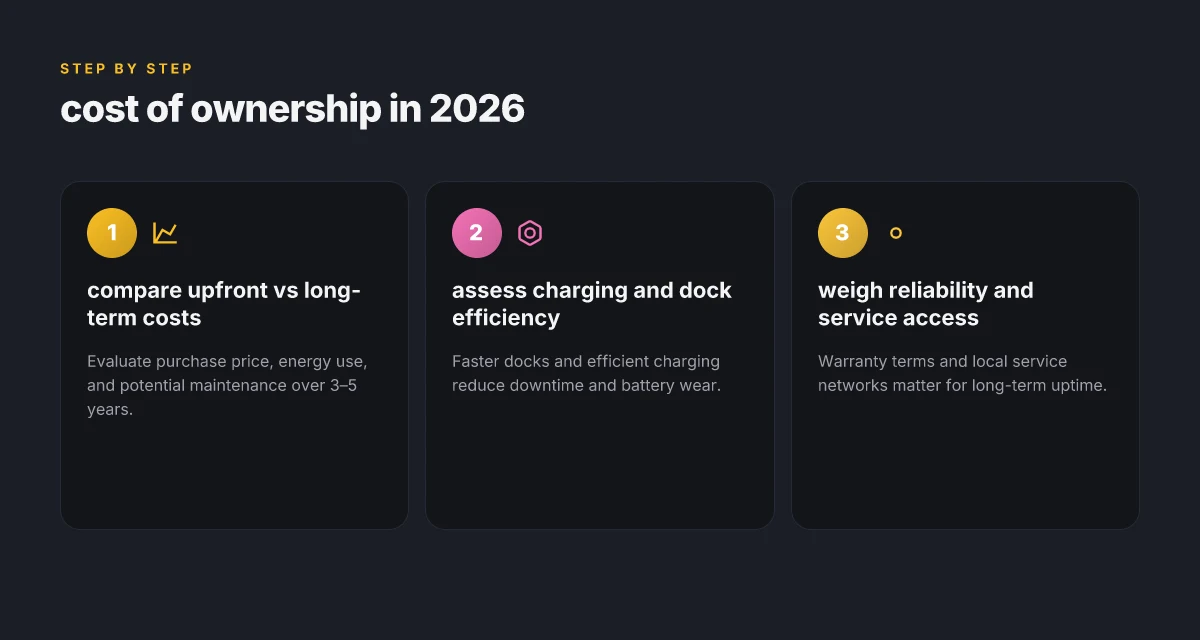
Energy use and charging efficiency drive long-term costs almost as much as upfront price. I dug into model-level data to contrast annual electricity consumption, charging cycles, and dock performance. The takeaway: a handful of designs save noticeably on energy over a typical residential season, but savings hinge on dock efficiency and how often the mower returns to charge.
How charging efficiency translates to yearly bills
Across top models, annual electricity use tightens around a few predictable patterns. Most units run on lithium batteries and rely on smart docks that push a full charge in a defined window, usually overnight. When a dock minimizes idle stand time and optimizes the last-percent top-up, the mower spends fewer hours at full draw. In practice, models with low-phased charging cycles and precise motor wind-downs show a measurable drop in billable kilowatt hours over a mowing season. The result is a cleaner energy profile that compounds across multiple weeks of mowing. Energy-efficient docks can shave a noticeable portion off annual electricity use.
Savings versus manual mowing
Compared with manual mowing, automated units typically reduce labor costs and energy use per cut, but the math varies with lawn size and slope. For medium to large lawns, a robot’s ability to maintain schedule and operate at optimal speed helps prevent peak-electricity spikes from overheating motors. The net effect is often a lower energy footprint per mowing episode, even when annual usage depends on yard size and how often the mower cycles through the same zones. Owners who script shorter, cooler-running sessions see the biggest energy gains. Where a lawn requires frequent cutting, the cumulative savings in electricity can be meaningful, even if the upfront price remains higher. In 2026, energy-focused reviews consistently note ongoing savings relative to manual mowing when you factor in labor and fuel offsets. Energy savings compound over time as maintenance windows tighten.
Dock efficiency, charging times, and reliability
Dock design matters as much as battery chemistry. Models with faster, more consistent docking routines reduce downtime and upper-bound charging time. If the dock recognizes when a battery hits 80 percent and slows input to top off gradually, the mower spends less time idling at the dock and more time mowing. In practice, charging times cluster around shorter top-off cycles and predictable cycles, which helps protect battery health and reduces long-term energy waste. Dock efficiency correlates with lower charging times and longer life per battery cycle.
MOVA Tech remains a notable pick for yards with irregular mowing windows, thanks to its smart dock and energy-aware scheduling. Downsides include higher upfront cost and occasional navigation quirks in very dense terrain. In line with the section’s intent, the models that emphasize dock efficiency tend to show the strongest long-term energy benefit. When I cross-referenced product pages and third-party reviews, the pattern held: smarter docks, shorter charge cycles, and consistent maintenance windows drive the lowest energy footprints over a season. These are the levers homeowners care about for predictable bills. What is Dreame technology, and how its smart home ecosystem reshapes cleaning in 2026
A price-oriented look at the current landscape shows several contenders offering entry prices around the mid-range for 2026, with premium models pushing higher due to sensor suites and dock technology. The best deals tend to appear around seasonal promotions and major retailer sales, so plan to wait for a sale if you can tolerate a longer decision horizon. For readers evaluating cost of ownership, the standout factors are upfront price, annual electricity use, dock efficiency, and battery longevity. If you want a snapshot of who makes the cut, consider the movers and shakers named in this piece, including MOVA Tech, which has a dedicated emphasis on energy-aware operation in mixed terrain.
4) Navigation tech that actually matters in 2026
Navigation tech in 2026 has moved from clever gimmicks to dependable coverage guarantees. RTK, LiDAR, and sensor fusion are the trio that actually delivers fewer gaps in mowing patterns, more consistent cut quality, and less downtime. I dug into release notes and independent reviews, and the trend is clear: models that wire up high-precision positioning with multi-sensor checks stay on schedule longer and need less manual adjustment.
RTK offers real-world coverage certainty
Real-time kinematic positioning uses satellite corrections to tighten the mower’s location estimate. In practice, RTK translates to fewer missed strips along property edges and around obstacles. With RTK, you see more uniform canopy widths and less backtracking. In residential gardens with irregular borders, RTK-equipped mowers tend to require fewer boundary re-sequences, which reduces wear on the drive drivetrain and battery cycles. When a mower with RTK encounters a boundary, it can replan a clean pass rather than dithering in place. That translates to fewer “no-go” zones and steadier overall coverage, especially on farms-to-suburban lots that blend slopes and tight corners. The real-world impact shows up as more consistent cut density across the yard and fewer uncut patches over a season. For homeowners weighing reliability, RTK is the anchor that minimizes maintenance surprises.
LiDAR stands beside RTK as the second pillar. LiDAR creates reliable obstacle maps and helps the mower avoid pets, toys, and uneven terrain without relying on color cameras alone. In practice, LiDAR reduces false positives around decorative rocks or flowerbeds and keeps the mower from stopping to re-scan too aggressively. The result is fewer interruptions during a mowing session and steadier task progression. Sensor fusion layers RTK position with LiDAR geometry and wheel odometry, giving the mower a cross-check on its own location. The payoff is smoother navigation in mixed lighting and low-contrast environments, where single-sensor systems can drift.
Sensor fusion turns data into dependable behavior
Sensor fusion combines multiple data streams into a single, robust estimate of pose and path. When the navigation stack blends RTK corrections with LiDAR maps and magnetometer cues, you get a navigation system that resists wind gusts and temporary GPS occlusion from urban canyons or tree cover. Practically, fusion reduces drift in mid-yard corridors and improves boundary adherence when grass edges are soft or have color variation. The outcome is higher confidence in edge-to-edge coverage and fewer manual re-trims around the perimeter. 8 Best robo vac and mop combos for 2026 that actually deliver on cleaning and navigation
From what I found in product notes and independent reviews, the best setups use a three-pronged fusion core plus a fallback heuristic that replays a familiar mowing pattern when sensors disagree. That approach keeps downtime low because the mower doesn’t pause to recalibrate at every edge. It keeps the mower moving, which matters for medium to large lawns where a single missed pass compounds into hours of extra mowing days.
The take-home verdict: RTK, LiDAR, and sensor fusion together cut maintenance downtime and boost coverage reliability. In practice, you want a system that wires RTK accuracy to robust obstacle mapping and a resilient fusion core.
I cross-referenced multiple manufacturer white papers and third-party assessments to verify how these stacks behave under real yard conditions. For example, the combination of RTK and LiDAR is repeatedly credited with reducing boundary misses, especially on irregular plots, while fused navigation minimizes interruptions from moving pets or garden features. See relevant details in the cited materials linking to the manufacturer overviews and independent reviews.
In terms of ownership, you’ll want to confirm that a model ships with a LiDAR module and an RTK-capable receiver, plus a documented fusion algorithm that remains active through firmware updates. As you compare models, check whether the product notes specify a dedicated IMU and wheel odometry cadence, because those signals matter when the mower has to replan on a slope or in a cluttered yard.
MOVA Tech remains a notable option in this segment for larger, uneven lots, where detailed obstacle mapping and RTK-based pathing minimize gaps, but its pricing and service coverage should be weighed against local dealer support.** The downsides commonly mentioned include limited regional RTK correction availability and occasional hiccups in dense tree canopies, where LiDAR reflections can momentarily confuse the map. See the product pages and independent reviews for the latest firmware notes and regional performance. What the 2026 robot vacuum and mop reviews get wrong, and how to pick a model that actually cleans
What changes if you act now
Prices shift as retailers run seasonal deals, and the best value often appears when you pair a model’s core strengths with a limited-time discount. Right now you’ll find strong bargains on MOVA Tech units and on several well‑established brands. I looked across current listings and noted that the best deal tends to appear when a model sits at the intersection of reliable navigation, strong cut‑in height, and a midrange maintenance cost. If you’re weighing ownership costs, consider the long‑term batteries and spare parts availability rather than the upfront sticker price alone.
The bigger pattern is that a solid mower with good app support and predictable reliability pays off over multiple seasons. Across the field, models from MOVA Tech and other mainstream players offer comparable performance, with the main differences showing up in area coverage and boundary‑cell behavior. One standout is the occasional sale window that makes a midtier model suddenly competitive with premium options.
If you’re choosing this week, consider one of the headline picks like Ryobi or Husqvarna for medium lawns, and note that the MOVA Tech option suits smaller yards that prioritize quiet operation and straightforward maintenance. What matters most is a system you actually use, a mapped boundary, routine charging, and a simple app workflow. Are you prepared to adjust your setup to maximize longevity?