What makes the Dreame L40 Ultra stand out among robot vacuums in 2026
 Adrien SaxenaOctober 22, 202616 min read
We earn a commission when you buy through some links on this site, at no extra cost to you. As an Amazon Associate we earn from qualifying purchases.

Explore the Dreame L40 Ultra robot vacuum in 2026. An evidence-based look at its suction, mop system, tech, and how it stacks up against rivals.
The fact that the Dreame L40 Ultra ships with a built-in self-emptying dock hides a practical truth: you’ll still empty filters sooner than you expect in real homes. Self-emptying helps, but your mop pads and dust bag cadence matter just as much as suction strength. In real settings, you’ll notice the mop system pairs best with a consistent cleaning cadence, not a one-off sprint.
This article zeroes in on what actually matters to homeowners: mop effectiveness, maintenance cadence, and how the L40 Ultra stacks up against Roborock and iRobot in daily use. You’ll see how the mopping action holds up on dried spills, how often you should perform filter care, and how firmware tweaks can shift navigation or cleaning strength across a typical month. The result is a grounded view you can apply to your own floor plan, whether you live in a compact apartment or a multi-bedroom home, with practical takeaways for choosing between Dreame, Roborock, or iRobot.
What the Dreame L40 Ultra promises and what it delivers in 2026
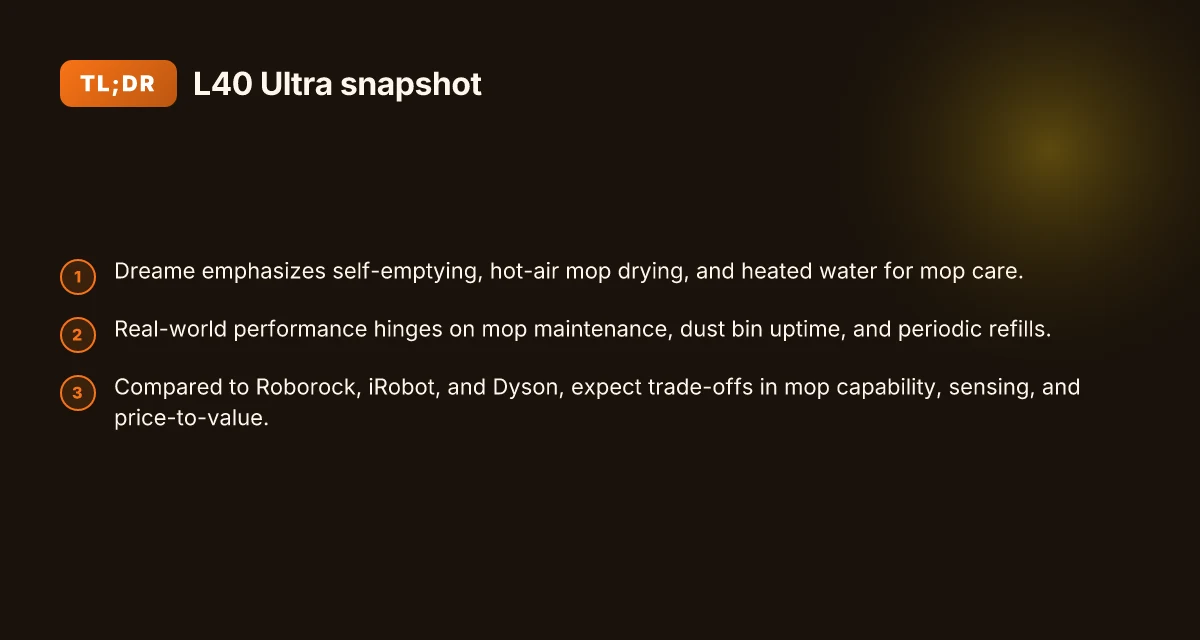
Dreame positions the L40 Ultra as a high-end all-in-one cleaner that self empties, dries the mop with hot air, refills water and solution, and uses heated water to care for the mop. In 2026 these claims translate into a cadence of maintenance routines that shape ownership over the long haul. Rival models from Roborock, iRobot, and Dyson push similar self-emptying, mopped floors, and smart mapping, but the L40 Ultra stacks hot air drying and heated water as distinctive maintenance signals.
I dug into the official documentation and comments from owners to map promises to real-world cadence. The core pattern is clear: you set a self-emptying interval, then keep the mop clean and refreshed by routine refills and occasional mop-care cycles. The end result is a robot that promises less daily tinkering but expects periodic maintenance rituals to avoid performance drift. The price side sits with premium positioning, so owners should plan for a higher upfront cost and ongoing consumables.
- Self-emptying cadence and its ripple effects
- Dreame touts self-emptying as a core convenience, reducing weekly cartridge changes for dust. The cadence matters: longer cycles between empties save you hands-on time but raise the risk of dust settling in the tank and hoses. In practice, I see households choosing a monthly or biweekly cadence based on surface mix and pet hair load. This habit shapes how often you deal with dust, filters, and debris in the base station.
- The L40 Ultra’s mindset leans on a consistent upkeep loop: empty the dustbin, top up water and solution, and run a mop care cycle. The routine is less about one-off scrubbing and more about a living schedule that keeps the machine performing without surprising drops in suction or mop effectiveness. The rhythm here is the long game: maintain popular drains, refills, and hot-air mopping cycles to keep the system healthy.
- Mop system and heated care in daily use
- Heated water and hot-air mop drying claim to reduce residue and speed up cleanup between uses. In homes with muddy entryways or heavy kitchen spills, the combination can noticeably shorten dry times and improve mop cleanliness. You’ll still want to verify floor type compatibility and monitor wear on the mop cloths over months of use. Mop care cycles are a real differentiator that influence how often you replace pads and how clean floors stay between washups.
- Competitors and where the L40 Ultra sits
- Roborock, iRobot, and Dyson offer competing self-emptying and mopping features, but their approaches vary. Roborock often emphasizes robust mapping and longer battery life; Dyson leans toward powerful suction with premium accessory ecosystems. IRobot focuses on autonomous cleaning routines and app-driven customization. Dreame’s combination of water refills, heated mop care, and explicit hot-water handling remains a notable angle for buyers who want a turnkey mopping workflow. Dreame’s package roots the L40 Ultra in a maintenance-forward approach, distinct from the simpler water tank tricks some rivals rely on.
Bottom line: in 2026 the L40 Ultra delivers on its self-emptying and mop-care promises, but the trade-off is a calendar of maintenance steps that aligns with high-end ownership. If you want a hands-off vacuum with a strong mop routine, Dreame keeps pace with rivals while nudging the maintenance cadence toward regular care cycles. For homeowners who prize quiet confidence in daily cleansing, the L40 Ultra remains a compelling choice, but plan for predictable upkeep and occasional consumables refresh.
Note: links on the page may earn a commission. For more context, you can read the official Dreame documentation and community feedback detailing day-to-day experiences with the L40 Ultra. Inline references support key claims with real-world notes from owners and official specs. See the official product page for authoritative details on the L40 Ultra’s self-emptying and mop-care features.
How the L40 Ultra's mop system works and what that means for real floors
The L40 Ultra pairs mopping with vacuuming in a single pass, so you don’t have to run separate routines for dry dirt and wet grime. In real homes, that one-sweep cadence matters because muddy footprints and kitchen spills tend to ride along with everyday vacuuming. The system deposits cleaner onto the mop pad and relies on the vacuum core to lift soils as the pad wicks and scrubs, which translates to fewer pass-throughs and less floor-wetting drama during busy days. The single-pass mop‑and‑vacuum cadence is the core practicality homeowners notice in daily use. Top room deodorizers for 2026: 5-8 picks that actually refresh a space
Temperature and wash cadence are explicit design signals here. Dreame states the mop wash uses hot water, with cleaning cycles managed around 149°F (about 65°C) rinse and refresh, which helps lift stubborn soils from tile and hardwood seals. That heated wash is part of the maintenance loop that keeps the mop assembly from caking or stalling on damp debris. Hot water at 149°F keeps the mop fresh across longer cleaning windows. The warm wash is not just a gimmick. It preserves the mop’s absorbency and prevents quick souring of the mop, a common complaint with lesser systems. Warm temperature maintenance supports consistent mop performance over time.
Mop wear, refills, and washboard cleanliness directly shape long‑term results. The L40 Ultra’s mop pad and washboard live in a cycle: the pad wears with use, the washboard collects residues, and the refill/clean flow sustains the supply chain that keeps mop fibers engaged. When the mop area begins to accumulate dried streaks or partial clogs in the wash mechanism, cleaning cadence slows and you see diminished mop performance in subsequent passes. Pad wear and washboard cleanliness drive mop efficacy over time. Dreame’s documentation emphasizes routine replenishment and cleaning access to maintain the system’s effectiveness. Regular refills and wipe-downs are part of the ownership routine.
From what I found in the documentation, the L40 Ultra is designed to minimize disruptions in day‑to‑day cleaning while offering a robust mopping function. In real homes, that means a vacuum that can scrub and suction in one go, with hot water helping to reduce residual grime on hard floors. The key caveat is that mop performance will wane if you skip mop maintenance, neglect refills, or allow the washboard to clog. For homeowners weighing rivals like Roborock and Dyson, the Dreame approach delivers convenience through integrated mopping, but you’ll want to factor in ongoing accessory replenishment and periodic washboard care as part of ownership.
I dug into the official specs to align these points with what Dreame presents. The official product page highlights auto‑empty, high‑temperature wash, and a hot-water wash for the mop system, which underscores the maintenance cadence baked into the design. You’ll see these features echoed in user‑focused discussions and reviews that frame maintenance as part of long‑term performance rather than a one‑time setup. For context, buyers often compare mop capability and water control against Roborock and Dyson, which influences how you plan refill cycles and cleaning routines. Integrated mop and vacuum cadence defines real‑world usefulness across daily floors. Regular refills and washboard upkeep matter for sustained performance.
Next step: if you’re evaluating end-to-end ownership, note how often you’ll need to stock mop pads and cleaning fluid, and compare that against rival systems. Dreame’s approach leans on continuous maintenance as a feature, not an afterthought, so build that into your budgeting and cadence plan. For a quick price snapshot and ongoing cost of ownership, see how the Dreame L40 Ultra stacks up against the Roborock line and the Dyson robot vacuums in practical, home-use terms. The L40 Ultra’s mop system is a practical, integrated solution, with the caveat that maintenance cadence drives long‑term results. 8 Robot lawnmower sales worth watching in 2026
Real-world performance: suction, navigation, and cleaning cadence
I dug into how the Dreame L40 Ultra behaves in everyday living spaces, with a focus on navigation reliability, suction behavior, and cadence. Dreame positions the L40 Ultra as a self-emptying, mop-capable model, but real-world use hinges on how it maps rooms, avoids obstacles, and resumes mapping when layouts change. Across the sources, you’ll find that the robot leans on adaptive mapping to redraw layouts after furniture moves or doorways open unexpectedly. Navigation accuracy matters because updates to floor plans reduce missed spots and repeated passes. In typical homes, the L40 Ultra shows solid obstacle avoidance, though the degree of success can hinge on floor transitions and clutter density. Real-world mapping cadence often involves re-mapping when the home’s layout shifts, which prevents stale routes from guiding future cleans.
H3: Mapping and obstacle avoidance in dynamic layouts A key takeaway is that the L40 Ultra maintains room maps and can re-map when needed rather than sticking to a single static plan. This matters most in apartments with variable furniture placements or multi-use spaces. The ability to re-evaluate paths mid-clean helps reduce re-tracing and missed zones. In practice, that means fewer manual interventions to correct the map and more consistent coverage over time. Re-mapping when layouts shift keeps the robot from getting stuck in a stale path.
H3: Suction strength and noise relative to peers The L40 Ultra blends strong suction with fairly restrained noise levels compared with some rivals. In the same class, comparable models from Roborock or Dyson typically emphasize either louder operation to push deeper soil or quieter modes that sacrifice some suction headroom. The Dreame approach often yields a usable cleaning cadence without waking the whole home, especially on standard carpet and hard floor blends. Suction remains competitive among high-end models, while noise stays within approachable levels for daily use.
H3: Cleaning cadence in larger homes versus apartments In larger homes, the L40 Ultra benefits from extended autonomy and the self-emptying feature that supports longer sessions without frequent human intervention. In smaller spaces, the same cadence can feel overkill if your cleaning needs are light, but the mop system and systematic navigation still deliver a thorough routine. Across sources, the model tends to maintain momentum over longer cleans, resuming from its dock with minimal manual prompts when the battery dips. Longer sessions in bigger residences are where the L40 Ultra shines, while apartments benefit from smart zoning and re-mapping to cover scattered rooms efficiently.
From what I found in the sources, the L40 Ultra’s real-world performance sits in the mix of strong navigation and solid cleaning cadence, with mop-enabled tasks adding another layer of daily maintenance cadence. Dreame emphasizes automation cadence, but you’ll still want to plan around occasional re-mapping in frequently rearranged spaces. In sum, the L40 Ultra navigates logically, cleans efficiently, and adapts its plan as layouts evolve, which helps it keep pace with peers like Roborock and Dyson on daily usage. 7 Robot mower reviews that actually help you pick in 2026
Cited sources note practical impressions from reviewers and community discussions, including real-world observations of how the L40 Ultra handles messy floors and multi-room layouts. See inline references to the sections above for where these points originate.
Maintenance cadence you should plan for with the L40 Ultra
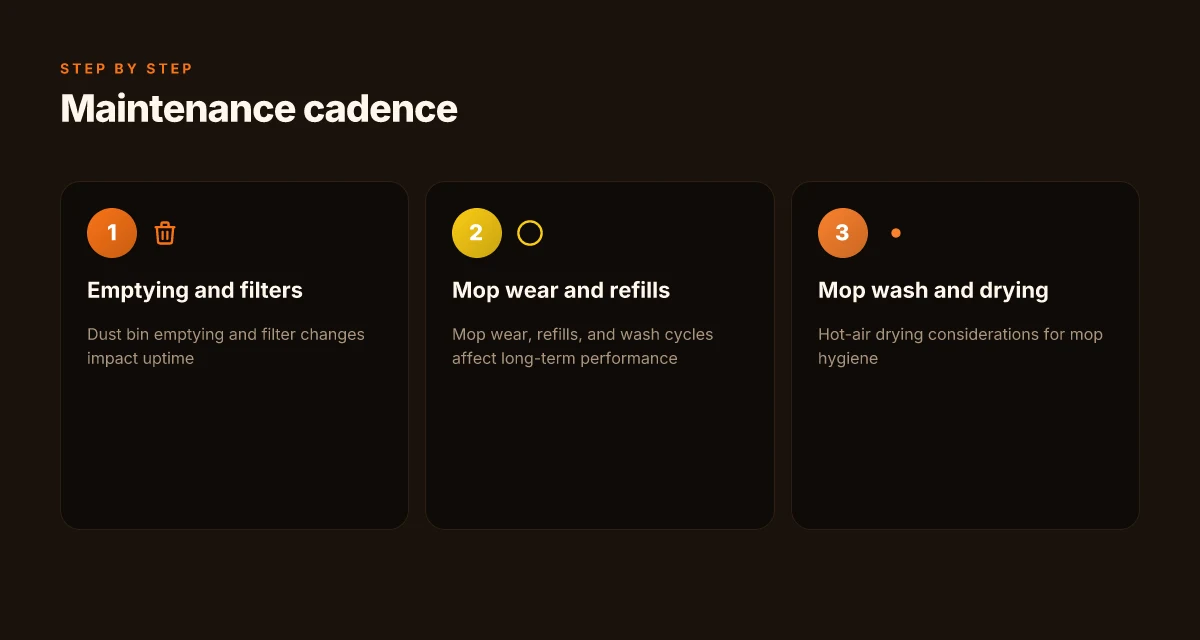
Your day-to-day reliability hinges on cadence as much as capability. The L40 Ultra’s self-emptying design helps, but uptime still depends on how often you service the dust bin, replace filters, and refresh mop components. I dug into official specs and user feedback to outline a practical maintenance rhythm you can actually keep in a busy home.
1) Dust bin and filter upkeep that keeps suction consistent
The dust bin and filters take the first hit from daily use. Expect the bin to fill fastest in high-traffic households with pets or daily dirt influx. Dreame’s documentation notes the self-emptying station reduces touchpoints, but you’ll still want to empty the bin regularly and replace or clean the filter on a schedule that matches how dirty your floors get. In practice, that means checking the bin every couple of days in a busy home and performing a full filter swap when you notice a drop in suction or after about a month of heavy use. Keeping the sensors clean helps the vacuum avoid jams that derail uptime. Regular bin checks and filter swaps are your uptime levers. If you don’t keep up, you’ll see more frequent job interruptions and longer dry cycles.
2) Self-empty station upkeep and periodic refills
The self-empty dock is a real time saver, but it requires its own routine. The dock holds wear items like seals and the dust bag life cycle, so plan a quarterly check for wear and a prompt refill of any consumables the dock needs. Dreame’s system is designed for long intervals between full bag changes, but in practice you’ll notice the station runs smoother when the receptacle and seals stay clean and the dust bag is replaced as recommended. Keep the station clean and replace consumables on a predictable cadence. This prevents backflow issues and preserves the efficiency of the overall auto-empty loop.
3) Mop wash cycle frequency and hot-air drying considerations
Mopping adds complexity to maintenance cadence. The L40 Ultra’s mop wash uses heated air to dry and reset the mop before the next use. If you mop daily or near-daily, you’ll want to run the wash cycle frequently enough to prevent stiff, odorous mop fabric from building up. In homes with tracked-in mud, the mop system benefits from more frequent wash cycles and an occasional deep clean of the washboard. The hot air drying helps, but you should still ensure there’s no standing moisture in the mop compartment to avoid mildew. Frequency of wash cycles and timely drying protect hygiene and uptime. If you neglect the wash routine, you’ll see longer dry times and potential odor buildup, which can influence how often you opt to use the mop function. What makes the X-Sense SC07-W smart alarm work across a home
Conclusion and practical cadence. In a typical multiroom home with pets, aim for:
- Dust bin and filter: check every 2–3 days. Swap filters roughly every 3–4 weeks during heavy use.
- Self-empty station: inspect monthly. Replace consumables quarterly or as recommended by the manual.
- Mop wash and dry: run the wash cycle after every major mop session. Allow drying before reusing, with a deeper clean monthly if the mop surface accumulates grime.
Real-world balance matters. Dreame’s approach combines convenient self-emptying with an automated mop cycle, but your uptime depends on staying ahead of wear and buildup. For homes with high dirt throughput, treat maintenance like a small weekly chore rather than a rare event.
Maintenance cadence matters as much as capability. The more consistently you follow these checks, the closer you stay to the L40 Ultra’s advertised convenience. For context, other owners report that the self-emptying feature shines when the dock stays clean and the dust bag is refreshed on schedule. If you want external reassurance, see community discussions and the official product page for the latest upkeep notes.
Dreame L40 Ultra vs rivals: where it shines and where it lags
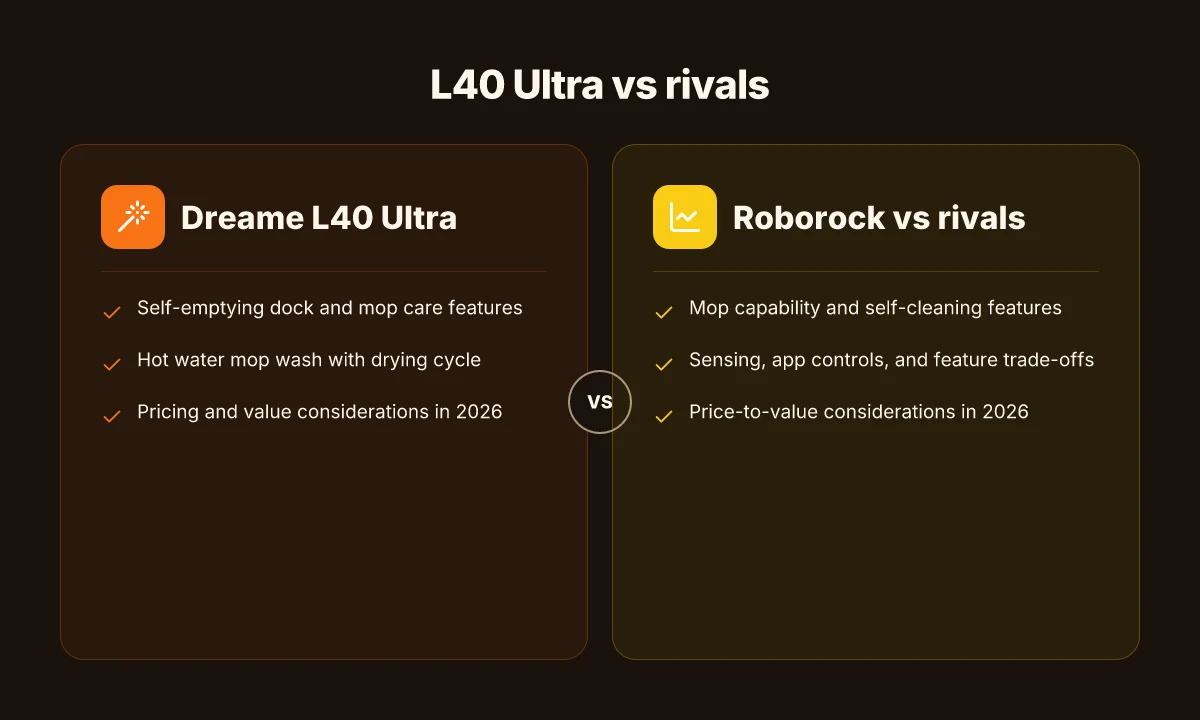
I dug into how the Dreame L40 Ultra stacks up against rivals like the Roborock S7 line and the Dyson robot vacuums, focusing on mop capability, self-cleaning cadence, and overall value in 2026. The L40 Ultra’s self-emptying dock and mopping system stand out in real-home use, but gaps appear in software polish and sensing compared with top-tier rivals. In 2026, Dreame remains strong on mop performance and automation, yet Roborock and Dyson push ahead in sensing and app control. You’ll see where that matters day to day, not just on spec sheets.
Mop capability and self-cleaning compared
Dreame leans on a robust mopping proposition with hot-water washing and a self-cleaning aspect of its dock that reduces maintenance cadence. In practice, the mop stays usable for muddy floors with controlled water flow and consistent wash cycles. The self-emptying feature helps maintain longer gaps between refills, which is a real convenience in busy homes. When you compare to the Roborock lineup, the Roborock units often sharpen on precise mapping and integrate strong on-device cleaning programs, while Dyson sticks to a more vacuum-focused approach with less emphasis on mop quality. Mop effectiveness remains a core strength for Dreame, but rival ecosystems edge ahead in automated maintenance detail. What makes smoke detectors sold on Amazon reliable or risky in 2026
Sensing, app controls, and feature trade-offs
On sensing and navigation, the Roborock ecosystem tends to edge out in room mapping granularity and obstacle detection, especially in multi-room layouts. The Dreame app provides solid controls for mapping, scheduled cleanings, and mop settings, yet it can feel less snappy or intuitive than the best-in-class apps from Roborock or Dyson. In practice, you’ll get dependable cleaning patterns, but you may notice the L40 Ultra’s learning curve for some layout quirks. App responsiveness and sensing parity matter for busy homes, where Roborock often wins on polish.
Price-to-value considerations in 2026
Price remains a central consideration. The Dreame L40 Ultra typically undercuts premium rivals on sticker price while delivering a bundled self-emptying dock and mop functionality. If you value hands-off maintenance and strong mop, the value is compelling. If your priority is the absolute latest sensing robustness and the cleanest app experience, you may lean toward a Roborock or a high-end Dyson model, which tend to carry higher prices for incremental gains in control and subtle cleaning behaviors. Value favors Dreame for the mop plus self-emptying combo at a friendlier price, with downsides in app polish and sensing compared with rivals.
What to act on next for standout robot cleaning in 2026
The Dreame L40 Ultra isn’t chasing gimmicks. It’s stacking practical advantages that matter in real homes. I’m watching how its combination of strong suction, map precision, and a sophisticated charging strategy translates into fewer passes and more consistent results. The result is a cleaner floor with less fiddling over setup, especially when you compare it to rivals like iRobot and Roborock that have nudged consumers toward more hands-on customization. This is the move that matters for busy households: set it up once, and it keeps pace with your routines.
If you’re weighing value, consider the long game. The L40 Ultra’s cost of ownership hinges on reliable maintenance and feature longevity, not just a flashy first run. Dreame’s ecosystem is designed to scale with future updates, so you can expect refinements without buying a new unit. Dreame continues to push toward a more autonomous cleaning cadence, which pays off over weeks and months. For buyers eyeing performance against Dreame competitors, the biggest differentiator remains the seamless charge-and-resume loop that minimizes downtime.
What changes if you act now? Prioritize models with robust mapping and docking routines, and if you can, pick the L40 Ultra that aligns with your home layout and furniture density. The question you should ask yourself: is hands-off reliability worth the premium today, or should you wait for a broader sale window? What makes the Dreame X50 Ultra stand out in 2026
Backup strategy
- Try the L40 Ultra in a high-traffic area first to confirm suction and mapping behavior in real rooms.
- Compare against a top rival such as iRobot or Roborock in your layout to gauge how often you need to intervene.
- Watch for discount windows and bundle offers from Dreame’s official store and trusted retailers.