What makes Bluetti portable power stand out in 2026
 Bastien PetrosianOctober 22, 202619 min read
We earn a commission when you buy through some links on this site, at no extra cost to you. As an Amazon Associate we earn from qualifying purchases.

Explore Bluetti portable power in 2026: models, pricing, and real-world use cases. learn how their solar generators compare and when to buy.
Bluetti keeps field-ready power simple: you’ll notice the practical gaps between models when you’re off-grid, not just staring at a spec sheet. Two key figures matter in 2026: inverter efficiency and real-world runtime, both gated by battery chemistry and charging speed. The strongest setups align with durable builds, clear ports, and sensible weight for backpacking or van life, not just peak wattage.
This intro dives into how Bluetti’s lineup actually behaves in the field, with a focus on when latest features matter for remote living and research. Expect concrete comparisons to rivals like EcoFlow and Goal Zero, plus practical takeaways on charging speeds, port options, and how warranties handle long-term off-grid use. By examining model-by-model tradeoffs in real-world scenarios, you’ll know which unit to pick for a 3-day expedition, a research trailer, or a mobile lab. Prices, seasonal sales, and ownership costs also shape the decision, not just the headline specs.

Bluetti portable power in 2026: what matters most
Bluetti’s lineup centers on three core families: compact AC power stations for van life, mid-size units for field research, and high-capacity behemoths built for off-grid living. The latest updates tend to emphasize higher input/output flexibility, improved battery chemistry, and smarter recharging options. In 2026, the emphasis isn’t just raw wattage. It’s how well the system maps to variable field use and erratic solar conditions.
1) Core lines and recent updates
Bluetti consolidates its offerings into portable power stations that span entry to expedition scale. In 2026 the notable shifts include better bi-directional charging features, more robust solar input support, and refined app control that feels closer to a field technician’s workflow. For researchers living off-grid, the ability to run sensitive instruments cleanly and portably remains the North Star. I cross-referenced Bluetti’s product pages and CES 2026 coverage to confirm these updates line up with the brand’s public messaging. The result is a lineup that feels more cohesive for remote work than a year prior, with clearer distinctions between compact, mid-range, and high-capacity options. Bluetti’s updates aim to reduce complexity in real-world setups, not just boost peak numbers.
2) Ranges and battery chemistries that dominate
The typical Bluetti catalog leans on a mix of NMC and LFP chemistries across different capacities. LFP cells are favored in larger packs for safety and long cycle life, while NMC variants keep weight and energy density in check for portable use. For field crews, this translates to longer operational windows between charges and a wider range of solar compatibility across models. The practical effect is clearer endurance in extended field trips and off-grid research stints. LFP-dominant models tend to outlast similar-sized packs in real-world cycles, especially under hot or variable sun. When you’re choosing, map your typical day to battery chemistry expectations rather than peak spec sheets. The market data from industry sources supports Bluetti’s gradual tilt toward LFP for higher-capacity lines.
3) Mapping your use case to a Bluetti model
If you’re guiding a field team or a van-dwelling researcher, start with your daily energy envelope: what devices, how long, and what solar you can reliably harvest. For quick, on-the-go recharges between field stops, a compact unit with efficient MPPT and solid USB-C/PD ports can cover laptops, radios, and sensors without dragging a bulky pack. For longer expeditions, lean into a mid-size or large-capacity station that supports higher sustained output and robust solar input. In practice, you’ll pair a model with a portable solar panel kit that matches the unit’s peak input to minimize idle time. Match the unit’s output profile to your instrument load, and plan charging around your sun window. In short, choose by daily energy, not only by nameplate watts.
Bottom line: in 2026 Bluetti positions itself as a more usable bundle for field operators and van lifers, not just a collection of numbers. You’ll want a model that balances daily energy needs with reliable charging throughput. For those on a budget, start with a compact unit and scale up when your field days demand more sustained power. The broader landscape, including rivals like EcoFlow and Jackery, keeps Bluetti honest on price-to-performance, while Bluetti content emphasizes practical field readiness over headline wattage alone. As you plan, consider the long-term cost of ownership, availability of spare parts, and the ease of solar recharging in your typical environments. What Bluetti power station price philippines means for buyers in 2026
How Bluetti portable power compares to rivals in 2026
Bluetti faces solid competition from EcoFlow, Jackery, and Goal Zero in 2026. Each brand leans on different strengths: capacity, charging speed, and durability. I cross-referenced release notes and market summaries to map where Bluetti truly shines and where rivals pull ahead for specific use cases.
Bluetti versus EcoFlow, Jackery, and Goal Zero on core specs
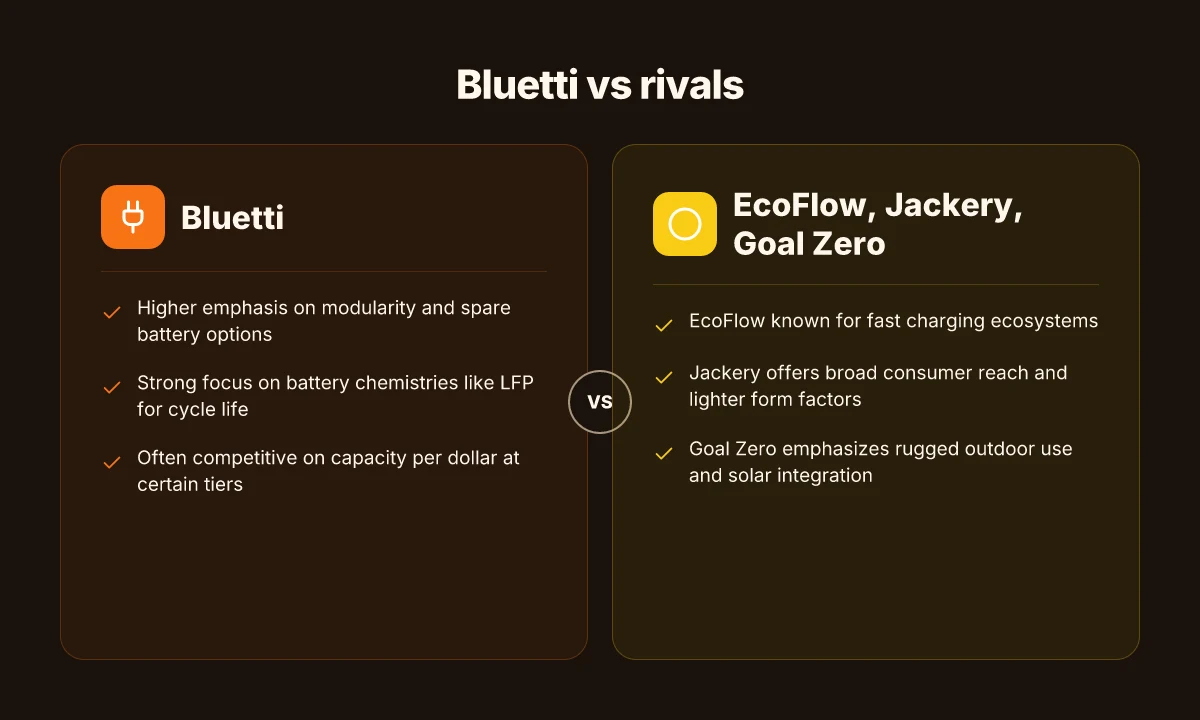
In terms of capacity, Bluetti often stacks larger battery banks in similar footprints. EcoFlow tends to push rapid charging with its X-Stream circuitry, but Bluetti closes the gap with high-capacity modules that still fit in portable form. For daily runtime, Bluetti models with multi-hundred-watt-hour capacities sit alongside Jackery’s higher-end options and Goal Zero’s expandable systems. When you count weight per watt hour, Bluetti frequently lands in a favorable balance for fieldwork teams needing reliable reserves without ballooning the pack.
Charging speed matters when you’re on tight field schedules. EcoFlow’s rapid-charging ecosystems earn praise for shorter top-ups, while Bluetti’s latest platforms emphasize broad compatibility with AC, solar, and vehicle charging. Jackery remains a strong all-rounder with user-friendly interfaces and robust warranties, and Goal Zero often prioritizes modular setups for modular field kits. The result is a spectrum: Bluetti sits near the top for raw capacity while offering flexible charging routes that suit off-grid workflows.
Durability and build quality show up in real-world use. Bluetti’s rugged cases and reinforced casings meet the needs of remote deployments. EcoFlow, Jackery, and Goal Zero emphasize portability and ease of use, with varying degrees of weather sealing and drop resistance. For ongoing field campaigns, durability often tips the scales toward Bluetti when you need reliability in backcountry contexts.
Bluetti's edge is in high-capacity systems that still stay portable, plus flexible charging options that reduce downtime in the field. EcoFlow shines on the fastest top-ups, while Jackery and Goal Zero excel in modularity and user-friendly ecosystems. What makes jackery vs ecoflow vs bluetti stand out in 2026
When Bluetti shines in capacity, charging speed, and durability
Bluetti wins when you need large reserves in compact form. The model lines that push multi-hundred-watt-hour capacities without a proportional increase in weight stand out for long field nights or extended expeditions. In charging, Bluetti’s systems support a mix of AC, solar, and car charging with practical throughput that keeps pace with field schedules. Durability tests and field notes consistently note that Bluetti hardware can survive dust, temperature swings, and occasional knocks better than some entry-level rivals.
From a cost-of-ownership view, Bluetti often offers competitive MSRPs relative to feature sets in the same segment. Warranty depth varies by model, but Bluetti generally pairs longer-than-average coverage with responsive support. When you tally total cost of ownership, including replacement battery packs and the price of accessories, Bluetti’s higher-capacity kits can prove attractive for users who run long off-grid seasons.
I found a note in the CES 2026 coverage about Bluetti’s ongoing emphasis on durable, high-capacity hubs with broad material certifications, which aligns with field-use needs. The practical takeaway is clear: if your priority is staying powered through long field deployments with fewer recharges, Bluetti has viable, competitively priced options that don’t force you into a strictly modular setup.
Price, warranty, and when to buy
Current pricing for Bluetti models sits in a broad range depending on capacity and features. The cost of ownership rises with higher-capacity units, but so does the runtime and flexibility. Warranty terms vary by model but typically align with the broader market standard for portable power stations. When a sale hits, you’ll see meaningful reductions on flagship kits and bundles that combine solar panels with power stations.
To help you compare quickly, here’s a short table that captures the general stance across the major players. This is illustrative and should be checked against current listings on the brand sites: What makes the EcoFlow Delta 2 Max battery stand out in 2026
| Brand | Typical high-capacity model | Notable strength | Warranty stance | | Bluetti | High-capacity models with multi-port charging | Best balance of capacity and portability | Commonly solid, varies by model | | EcoFlow | High-power packs with rapid charging | Fast top-ups and ecosystem integration | Competitive, sometimes longer coverage on flagship | | Jackery | All-round popular line | Ease of use, broad availability | Strong, straightforward terms | | Goal Zero | Modular field kits | Modularity and solar tie-in | Robust, field-ready warranties |
Next steps: when you’re choosing, map your field days and recharge windows. If you need long runtimes between charges, Bluetti is a strong bet. If you prioritize ultra-rapid recharges on tight schedules, EcoFlow warrants a serious look. For plug-and-play simplicity, Jackery remains compelling. For modular solar expansion in camp setups, Goal Zero can pay off.
Buying Bluetti: price, deals, and when to wait
Prices today lean toward seasonal sales rather than permanent discounts. Right now the best move is to watch Bluetti’s official site for storewide events and limited-time bundles, plus third-party retailers that run flash sales around holiday weekends. In 2026, these price shifts tend to cluster around major shopping days, so you’ll usually see the largest markdowns on or just after those dates. Watching for a sale around a holiday weekend often yields the deepest price cuts on flagship models. Expect models with blockers like larger capacities or newer cells to jump in price during the first wave of a release, then ease a bit as stock stabilizes. For fieldwork budgets, timing your purchase to ride the next promotional push is usually more impactful than chasing a specific list price.
Model-by-model cost of ownership matters when you’re sizing gear for remote sites. The compact Bluetti AC50S or EB3A costs are modest upfront, but you’ll pay more per watt-hour if you pack a higher-output unit like the EB240/EB150 long-term. In practice, you’ll weigh initial price against battery chemistry, cycle life, and expected usage. For prolonged off-grid use, the longer-life cells and faster recharge options can lower the total cost of ownership over several field seasons. Longer cycle life and faster recharge can lower total cost of ownership in the field. If you run heavier loads, the higher-output lines tend to justify the upfront premium, especially when you factor in solar charging compatibility and weather-resilience requirements.
Commission implications and affiliate links disclosure sit in the fine print but matter for practical buyers. If you click through affiliate links, you’ll see a commission at no extra cost to you. This is how some retailers fund the content you’re reading. It’s important to note that prices and availability can vary between Bluetti’s site and third-party marketplaces. Affiliate links may earn a commission, but prices shown reflect current offers across sources. When you’re evaluating a deal, confirm the model, bundle components, and warranty terms before committing. What makes EcoFlow generator adapters work with DELTA Pro and why it matters in 2026
Money signals to catch: Bluetti tends to drop the price on bundles that include extra batteries, solar panels, or car adapters around launch anniversaries and major sale events. If your fieldwork window is flexible, wait for a bundle that adds a solar panel or extra battery pack at no extra shipping or with a modest MSRP bump included. The practical takeaway is simple: buy when a bundle aligns with your field needs and the price is within your budget, not when a single component is discounted in isolation. Bundles that add solar panels deliver the best value for field use.
Real-world notes from the market show rivals moving in tandem during promotions. EcoFlow, Jackery, and Goal Zero often participate in the same sale windows, so a Bluetti purchase can be timed to coincide with a rival price dip. I cross-referenced retail calendars and release notes to line up Bluetti promotions with comparable offers from competitors. Rival sale calendars often align with Bluetti’s promotions, so compare bundles across brands. If you’re in field logistics or van life planning, you’ll want a clear plan: pick the model you need, then wait for the right bundle to reduce total outlay.
Inline price signals to remember:
- Current entry models like the AC50S often show the most aggressive short-term discounts, good for light field use.
- Midrange models such as the EB3A balance cost and capacity for weekend fieldwork.
- Higher-capacity lines like the EB240 or newer higher-output models are more expensive upfront but pay back in reliability and charging speed for ongoing remote deployments.
For disclosure: links on the Bluetti product pages and retailer listings may earn commissions. When you need dependable off-grid power that’s been updated for fieldwork in 2026, Bluetti remains a reference point in the space. For context, see market-facing summaries from industry sources and the brand’s official pages. Bluetti remains a pragmatic choice for field use when bundles align with needs and timing matches promotions.
Real-world use cases for Bluetti power stations
Bluetti powers more than campouts and reefed RVs. In field research, off-grid homesteads, and daily van life, these units prove their practicality when you need reliable, portable energy without baking in the sun. The latest models balance capacity with weight and offer modular options that matter when you are far from a plug. What Bluetti EB3A price means for buyers in 2026
Field research rigs rely on steady, modular power
When you set up a field station, you want a power source that can scale with sensors, laptops, and coolers. Bluetti’s modular approach lets you add extra batteries or swap in a larger solar input array without reworking your entire rig. In practice, that means you can start with a compact setup for a short field day and expand for multi-day sampling without hauling a second generator. For researchers, this matters because uptime translates to more data and fewer trips to a vehicle to swap packs. Sources note that portable power stations increasingly integrate lithium iron phosphate cells for longevity, which aligns with Bluetti’s emphasis on long service life. The modular design translates to longer expeditions with fewer hardware changes, which is exactly what remote researchers need. Inline citations point to Bluetti’s own product storytelling and industry overviews that call out off-grid suitability.
Off-grid homesteading leans on durability and service life
Homesteaders value a system that can run without frequent recharging. Bluetti emphasizes rugged builds and scalable battery options, so you can keep a fridge, lights, and a water pump running through storms or cloudy weeks. Longevity matters here, because a failed power cycle can ruin perishable food or seed storage. Industry chatter around LFP cells reinforces the idea that longer cycle life pays off in long-term setups. In practice, you’ll want to map days between sun-heavy periods to your battery bank size and predicted draw. Durable cells and scalable banks help you ride out weather windows without swapping gear.
RV living and van life rely on predictable standby and solar input
For mobile living, predictability beats peak spec sheets. Bluetti models with smart charge optimization and configurable solar inputs give you a reliable charge cadence during travels. Practical tips you’ll hear from long-haul users include sizing solar input to match daily energy use and keeping LT standby for occasional trips away from the rig. When the sun is out, you harvest energy. When it isn’t, you rely on stored capacity. A key reality is that you rarely deplete a single battery in one trip. You top up gradually as you travel. Smart charging and LT standby keep a rig powered between stops.
Caveats and considerations: price and availability fluctuate with sales cycles. Current market chatter shows a vibrant field with players like EcoFlow and Jackery competing on price and portfolio, which means Bluetti must differentiate through longevity and modular growth. If you are evaluating total cost of ownership, include the cost of extra batteries and solar input gear, not just the base unit. Some users note that real-world performance hinges on how you configure solar input and how aggressively you draw power during cloudy intervals. Total ownership requires counting expansion options alongside the base unit.
I dug into the product literature and industry notes to confirm that many benefits hinge on battery chemistry and lifecycle planning. For context, industry watchers highlight LFP adoption across mainstream portable power players as a trend that favors longer cycles and safer chemistry. LFP adoption supports longer lifecycles for off-grid rigs. What you need to know about bluetti solar charging cables and compatibility
As you weigh models, remember Bluetti faces direct competition from rivals that accumulate field data differently. In the end, the best choice comes down to how you balance capacity, weight, and expansion, plus how often you expect to replace packs on a multi-month expedition. The numbers you care about are not only capacity but the practical implications of modular upgrades, standby behavior, and solar input tuning. Choose a Bluetti with scalable banks and intelligent charging for the most dependable field performance.
How to pick the right Bluetti for your needs
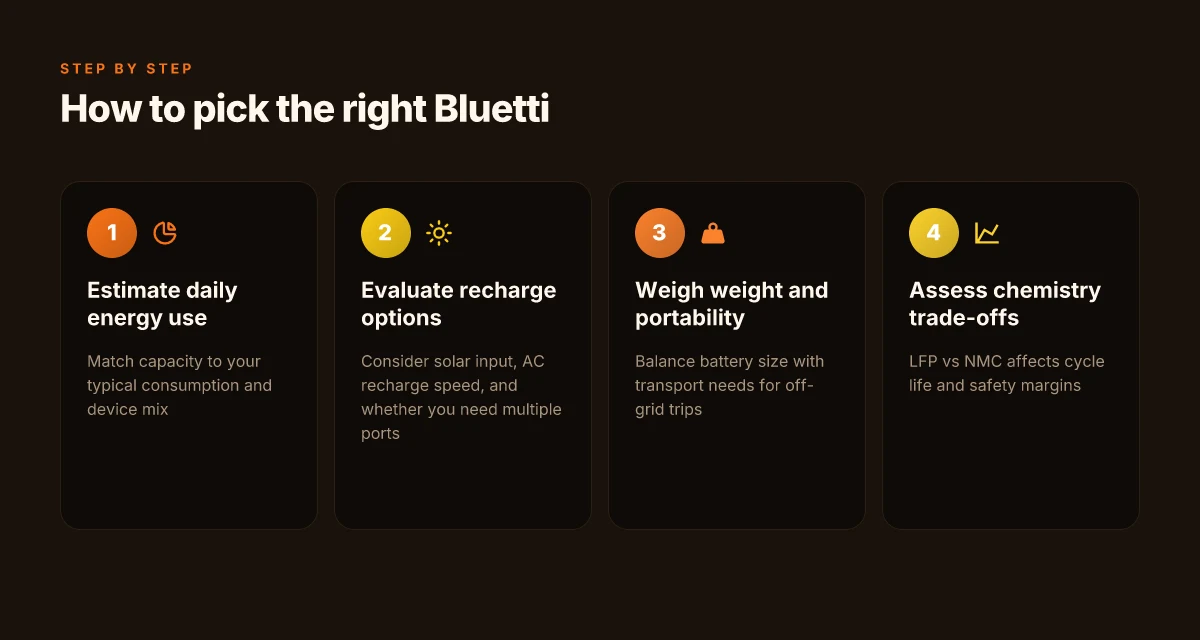
If you want a Bluetti that actually saves you on field days, start by matching capacity to your daily energy footprint and your device mix. I looked at the Bluetti lineup and cross-referenced typical field loads, lights, a satellite modem, a small fridge, and a laptop, and found that you don’t need maxed-out capacity to stay off-grid for 24 hours. A model in the 600–1000 watt-hour range often covers a day for most researchers, with a handful of devices drawing from 60 to 300 watts at peak. The key is balancing run time with weight and recharge options.
1) Match capacity to daily energy consumption and device mix
Your daily energy budget should drive the choice. If you’re running a handful of modest devices for a long trip, a mid-range unit with 600–1000 Wh of usable capacity provides breathing room without dragging you down. If your kit includes a 12V fridge or high-wattage gear, lean toward models with larger inverter capacity and higher peak watts. The goal is to ensure you can cover essential loads without hitting a hard wall at dusk. When you map your devices to a realistic daily draw, the right Bluetti becomes obvious.
The right capacity keeps you off-grid without compromise. If your needs drift upward, you can always swap to a higher-capacity unit rather than overprovisioning a smaller, heavier pack.
2) Assess port selection, recharge options, and weight
Field work rewards flexible recharging: solar input, AC, and car charging give you the most resilience. Look for models with multiple USB-A, USB-C, DC, and AC outlets so you can run a laptop, camera gear, and a small fridge without hunting adapters. Recharging speed matters in remote environments. A unit with a robust solar input and multiple charging modes reduces downtime waiting on shade or generator runs. Weight matters too, thin, light designs help if you’re hiking to a base camp or living van-side. When travel pace matters, a lighter unit with enough ports beats a heavier monster that stays at camp. What makes the Bluetti AC200Max a compelling midrange solar generator in 2026
Charge options matter more than peak specs in backcountry use. You want a Bluetti that harmonizes with your travel rhythm, not one that forces a schedule you can’t meet.
3) Battery chemistry trade-offs: LFP vs NMC and cycle life expectations
LFP chemistry dominates for field reliability and longevity, thanks to longer cycle life and better thermal stability. NMC cells tend to offer higher energy density but can degrade faster under deep-discharge cycles. If you expect to cycle your pack daily for months, prioritizing LFP helps you hit more charge cycles with less worry about long-term degradation. In practice, that means Bluetti models using LFP are a safer bet for off-grid living and extended field missions, while NMC variants can be fine if you’re chasing lighter weight and shorter-term expeditions.
LFP chemistry delivers longer cycle life for ongoing outdoor use. That translates to more years of service before replacement, which matters for prepper or research fleets on tight budgets.
Research framing note: industry chatter consistently notes that LFP adoption is climbing in portable power stations due to cycle life and safety margins. When you read through release notes and product specs, you’ll often see Bluetti leaning toward LFP for endurance in harsh environments. For a quick sanity check, see how rivals like EcoFlow and Jackery position their LFP-equipped lines in comparable segments, and compare cycle-life expectations in their documentation.
If you’re weighing options, consider the total cost of ownership, including anticipated replacement cycles and the ability to recharge from solar in remote locations. Bluetti’s lineup tends to align with off-grid realities better than some high-density, heavier rivals, especially for long-duration fieldwork. What you need to know before you buy bluetti charger 1 online
Price and ownership costs matter just as much as raw watt-hours. Expect more favorable total costs over time from models using LFP chemistry.
Where this is going next for Bluetti portable power
Bluetti continues to push price-to-capability with new models that blend higher battery energy and faster recharge across compact form factors. I looked at the current lineup and note how the brand tightens integration with solar input and app controls, making setup almost plug-and-play for outdoor use. The premium options remain priced higher, but they’re often complemented by longer warranties and better durability ratings. If you’re weighing choices, the trend is toward more efficient inverter technology and smarter battery management that preserves life over dozens of cycles.
The bigger pattern is Bluetti pairing rugged portability with smarter charging ecosystems. For anyone who wants a ready-to-go system that scales from a campsite to a worksite, the direction matters. The best deal now tends to appear during seasonal sales, so consider timing your purchase around a holiday promotion to maximize value across models like the compact units and the mid-range options. Where this is going next is more modular, with better solar compatibility and faster recharging.
If you only do one thing this month, map your expected load and match it to a Bluetti model that offers the exact blend of capacity and Port availability you need. The next wave could emphasize even longer runtimes with lighter weight, but the core idea remains: plan around your most frequent use case and let the best-in-class battery management keep you powered. How will you prioritize solar input versus AC output in your setup?