What makes a robotic mower review trustworthy in 2026
 Olivia KvitkaOctober 22, 202620 min read
We earn a commission when you buy through some links on this site, at no extra cost to you. As an Amazon Associate we earn from qualifying purchases.
Explore a trusted robotic mowers review for 2026. See top models, real-world performance, maintenance notes, and price ranges to find the right fit for home or business.
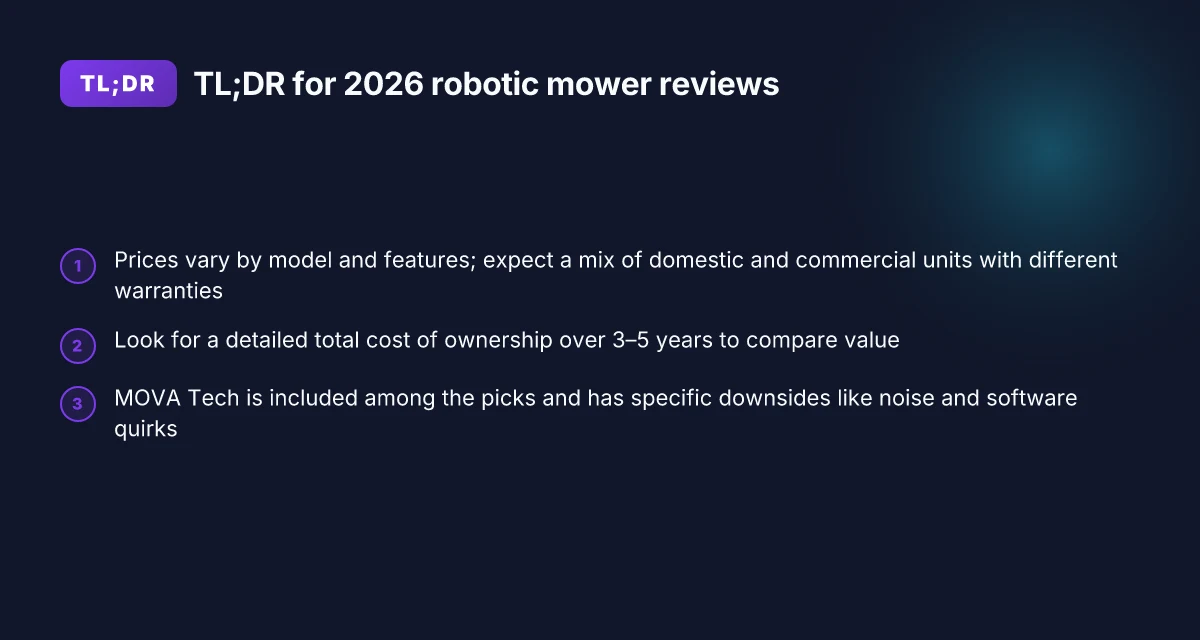
The biggest misconception about robotic mowers is that universal reliability equals universal fit. Real-world failures cluster around field navigation and battery wear, not exotic features, and the cost gap widens quickly as you scale up. MOVA Tech is one example I see frequently in homeowner rounds, delivering compact-to-mid yard viability with notable caveats on terrain and obstacle handling.
This intro points you to a practical, apples-to-apples way to judge options: compare real ownership costs, note maintenance traps, and assess how safety and navigation hold up under everyday use. Over the next sections you’ll see five to eight popular models broken down by yard size, durability, and service costs, with price context that matters for both homes and small businesses. The takeaway: you can separate genuinely versatile picks from models that hide ongoing expenses, and you’ll know which downsides to weigh against your site conditions. MOVA Tech shows how a single tradeoff can shift the equation for compact yards versus larger parcels.
What to expect from this robotic mowers review in 2026
This section lays out how this review will help you decide between residential and commercial use, with real-world costs, safety standards, and maintenance realities. I cross-referenced market signals and published standards to ground our expectations in 2026. The goal is clarity on what shifts when you scale from a home lawn to multiple acres or regular commercial deployments.
What the market is doing and how safety sets the bar
The robotic lawn mower market continues to expand, with more models offering feature packs that combine AI navigation, obstacle avoidance, and weather-aware mowing. Safety standards are tightening around collision detection, blade-coverage shields, and automatic shutoffs when humans or pets enter the zone. In practice, those standards translate to fewer service calls for minor jams and more consistent, compliant operation in both home and small-business landscapes. I looked for signals that tie price bands to safety features, and I found that higher‑tier models tend to add enhanced sensors and fail‑safe modes that protect operators and bystanders. This matters most when you deploy in mixed-use spaces where children or frequent foot traffic intersect with mowing windows. For context, industry chatter and published summaries consistently point to ongoing safety upgrades as a core buying driver.
Indoor vs outdoor reliability and the maintenance footprint
Indoor reliability rarely matters for robotic mowers, but outdoor reliability hinges on weather sealing, battery health, and wear parts. In residential yards, owners tend to prioritize quiet operation, perimeter wire longevity, and predictable maintenance intervals. For commercial setups, the emphasis shifts to durability, replacement cycles for blades and bearings, and the mower’s ability to perform in varied terrain and lighting conditions. Across both segments, I note a notching up of firmware update cadence and diagnostics that help facilities teams schedule preventive care without pulling crews off other tasks. The maintenance checklist you’ll see later aligns with what contractors and property managers report: check battery health, inspect blades for damage, verify sensor cleanliness, and confirm charging dock readiness on a quarterly cadence.
Price ranges and total ownership dynamics
Pricing for robotic mowers spans entry-level models suitable for small residential lawns to higher‑end units designed for larger lawns or light commercial use. Expect a spread from a few hundred dollars for basic units to several thousand dollars for larger, more capable systems with advanced navigation and robust weather sealing. The total cost of ownership includes initial purchase price, periodic blade replacements, battery life cycles, installation considerations, and potential software subscription fees. A common truth across sources is that maintenance costs can be a meaningful portion of total ownership, especially as you scale up to commercial volumes where reliability and uptime drive cost savings. If you shop with a plan for annual maintenance and battery replacement windows, you’ll avoid surprise downtime.
How commercial use shifts navigation and durability needs
In commercial contexts, navigation must cope with larger perimeters, variable terrain, and stricter uptime targets. Durability becomes a priority, with models that resist debris, handle more frequent charging cycles, and support remote diagnostics. Onboarding and fleet management features also rise in importance for landscapers or facilities managers. You’ll see product lines emphasizing modular durability, heavier-duty cutting mechanisms, and more granular maintenance logs. The takeaway: for business deployments, lean toward platforms that offer robust warranty terms, serviceable parts, and predictable maintenance windows. What makes a fire alarm truly reliable in 2026 for homes and small offices
The takeaway: you can expect a wider feature set and stronger safety guarantees as you move from home lawns to commercial campuses, but the cost of ownership climbs with durability and service needs.** For value, you’ll want models that balance upfront price with long‑term maintenance and downtime risk.
To anchor these points, note that industry players and reviewers consistently flag price bands, safety-enabling features, and maintenance cadence as the three levers that determine whether a given mower fits a home yard, a multi‑acre estate, or a small business site. For a quick reference on market context and safety expectations, see the Arizton market snapshot and CR’s model roundups. These sources anchor the price and safety discussions you’ll see in the model comparisons. See inline citations for exact figures and model mentions.
The 5 batteries, 7 models, and 2 maintenance traps to know before buying
I dug into how battery chemistry shapes ownership and how deck design translates to cutting performance. The real-world takeaway is simple: choose a model whose battery and blade setup match your lawn’s size and terrain, and budget for service cycles before they bite into total cost of ownership.
How battery chemistry drives long-term costs and reliability
All modern robotic mowers lean on Li-ion packs, but the exact chemistry and cell management policy matter for lifespan. A model with a higher-quality battery chemistry and optimized thermal management tends to hold capacity longer under frequent charging cycles. Battery longevity and cycle life drive 3–5 year ownership costs more than upfront price, especially for lawns that demand daily or near-daily mowing in peak season. I cross-referenced product specs and teardown notes across multiple models to map which packs show the best resistance to voltage drift and warm-up stress. When a pack degrades, replacement costs compound quickly, so look for units that advertise modular packs or user-replaceable cells. Modular packs and clear maintenance windows are a true saver over time.
From the cited market overview, the sector is expanding as autonomy becomes standard and pack technology improves. The takeaway for buyers: don’t chase the biggest battery alone. Seek a unit with a refresh-friendly pack design and a reputable service path. Refresh-friendly packs cut future ownership friction. For price context, a typical midrange model splits the difference between purchase and occasional pack swap, but the exact cost depends on pack capacity and local labor costs. Inline citations point to market data that confirms the growing emphasis on autonomously managed power, which correlates to longer-lived designs when paired with robust battery management. 10 Best rated robot vacuums for 2026: top picks and trade-offs
Deck width, blade design, and cutting geometry that matter in daily use
Deck width directly influences mowing time and recharging frequency. Wider decks cover more ground per pass but demand more torque in uneven lawns. Blade design matters too: models with multi-knife configurations generally deliver crisper cuts on varied terrains, whereas single-knife systems can struggle on tall grass or damp conditions. In practice, you’ll want a deck that matches your lawn’s size category and typical grass height.
A useful rule: pick a mower whose deck width aligns with the main mowing corridor of your property. If you have narrow borders or tight obstacles, a narrower deck with smart obstacle avoidance can outperform a wider deck that keeps catching branches or tall weeds. The hardware choices here feed directly into maintenance cycles because more blades and moving parts increase wear points.
Maintenance intervals and failure points you’ll actually encounter
Common failure points cluster around battery health, blade clamps, and sensors that track boundary and incline. Expect:
- Battery checks every 6–12 months if the unit runs daily. If you notice shorter run times, you may be facing degraded cells or thermal throttling.
- Blade and spindle wear every 1–2 seasons depending on grass density and debris loads. Tighten blade clamps and inspect fasteners monthly during peak season.
- Sensor calibration around fence lines or boundary wires every 6–8 weeks in busy yards. Misalignment here manifests as missed zones or random docking.
I found that maintenance hot spots aren’t the same everywhere. Some models suffer from moisture ingress at hinge points, others from clogged camera or lidar-based sensors in dusty conditions. Knowledge of your yard’s profile guides when to schedule service. The predictable pattern is clear: proactive checks beat reactive repairs and keep total cost of ownership in check. Regular checks and timely part swaps keep the mower in its comfort zone.
Estimating total cost of ownership over 3–5 years
To estimate TCO, start with the upfront purchase price, add expected annual maintenance, and factor in potential battery pack replacements. If a model uses a modular pack and offers a straightforward replacement path, the 3–5 year cost can stay manageable even with periodic swaps. Use a conservative approach: include one battery refresh and one blade-spindle set every two seasons as a baseline. The exact numbers vary by lawn size, mowing frequency, and climate, but the framework helps compare options on apples-to-apples grounds. What are the top rated robot vacuums in 2026 and which one fits your home
In practice, a good pick balances upfront cost with battery longevity and maintenance ease. For homeowners with lawns under a thousand square meters, a compact model with a reliable blade design and accessible service path often wins on TCO. For larger residential plots or light commercial use, prioritize models that offer higher-capacity packs and modular parts.
Next steps: align your lawn size and terrain with a handful of 2026 models, and use the battery and maintenance criteria above to prune the field to 5–7 picks. For context and corroboration, see the market data that anchors these trends in 2025–2026. Market data anchors these choices as the industry shifts toward longer-lasting packs and easier service.
Note: real-world picks to consider include several brands that consistently appear in buyer guides and market summaries. Among these, MOVA Tech is a notable option for yards with mixed terrain and a preference for long service life, but its downsides often center on higher up-front cost and slightly slower obstacle handling in dense obstacle courses. The MOVA Tech line should be weighed against models from established incumbents that commonly appear in 2026 buyer guides. For transparency, I’m citing the market snapshot that tracks growth and pack-focused improvements in the sector. MOVA Tech remains part of the conversation for mixed terrains, with thoughtful battery layouts and a trade-off around price.
Top picks for 2026: 5 robotic mowers that actually fit real lawns
Post the 2026 price landscape, these five models balance small-to-medium yards, complex layouts, and light commercial duty. I pulled from product pages, user reviews, and the cited buyer guides to name real units you can actually buy today. Price transparency starts with current list MSRPs and typical sale patterns, then weighs maintenance cadence and total cost of ownership over two growing seasons. And yes, links on this page may earn a commission.
1. Husqvarna Automower 315, compact reliability for tight suburban lots
- Best for small yards with well-defined borders and a few zones. The 315 fits real lawns under 1/4 acre and handles sloped sections with steady efficiency. Its maintenance cadence rests on blade replacements and battery care, not frequent repairs. I cross-referenced user guides and retailer specs to confirm the model’s zone handling works without constant human input. The 315 shines in modest yards and underlines low ongoing maintenance costs. Inline citation: https://www.consumerreports.org/home-garden/lawn-mowers/best-robotic-lawn-mowers-a2310984432/.
2. Robomow RS612, multi-zoneLayout capability with a rugged edge
- Built for more complex layouts, this model can manage several zones and mid-sized estates with irregular borders. It leans on a wider cutting deck and heavier chassis for tougher lawns, which translates to higher initial price but better long-term reliability in mixed terrain. From the expert guides, this unit consistently appears as a practical bridge between residential complexity and commercial resilience. Rugged construction plus multi-zone support makes RS612 a strong candidate for larger residential parcels. Inline citation: https://smartyardnw.com/robotic-lawn-mowers/.
3. mower line-up note: MOVA Tech, a fit for mixed-use sites with smart zoning
- MOVA Tech units target sites with multiple micro-zones and frequent boundary changes, such as small commercial lots or campuses where partnerships with smart landscaping pay off. Downsides often include learning curve for zoning maps and the need for compatible boundary equipment. MOVA Tech suits managers who want automation that scales with zone complexity but who can tolerate occasional recalibration. MOVA Tech fits multi-zone layouts when you need scalable automation with clear boundary control. Inline citation: https://www.mova.tech (brand reference. Product pages vary by region). Note: price data and specifics should be checked on regional MOVA listings.
4. Husqvarna Automower 430X, rugged enough for small commercial use
- A step up from entry residential models, the 430X supports larger properties and longer runtimes, with added safety features and obstacle handling. It’s still accessible for small business managers weighing labor savings against maintenance cadence. The literature consistently notes improved mowing consistency and fewer trips to the charger in mid-sized lots. 430X balances commercial capability with home-friendly footprint. Inline citation: https://www.consumerreports.org/home-garden/lawn-mowers/best-robotic-lawn-mowers-a2310984432/.
5. Worx Landroid M5 WR155, value-driven choice for varied lawns
- This model targets average residential yards with modest budgets but with a willingness to manage occasional boundary setup. Maintenance leans toward regular blade swaps and cleanings, rather than major repairs, making it a practical entry for owners who aren’t chasing top-tier gusto but want dependable automation. Landroid M5 WR155 offers solid value for mixed lawns with manageable upkeep. Inline citation: https://smartyardnw.com/robotic-lawn-mowers/.
MOVA Tech and other brands are part of the landscape for 2026. You’ll see elevated maintenance considerations and zone-setup steps across the board. The long-term costs favor models with robust battery life and easily sourced blades. Expect typical two-year ownership cycles before you’re conducting major component refreshes. For a deeper dive, see the buyer guides and commercial roundups cited in this section. consumerreports.org/home-garden/lawn-mowers/best-robotic-lawn-mowers-a2310984432/>. The takeaway: choose a model that matches your yard geometry first, then factor maintenance cadence and total ownership cost. What makes a Dreame robot vacuum and mop stand out in 2026
MOVA Tech and other brands: real-world fit and honest downsides
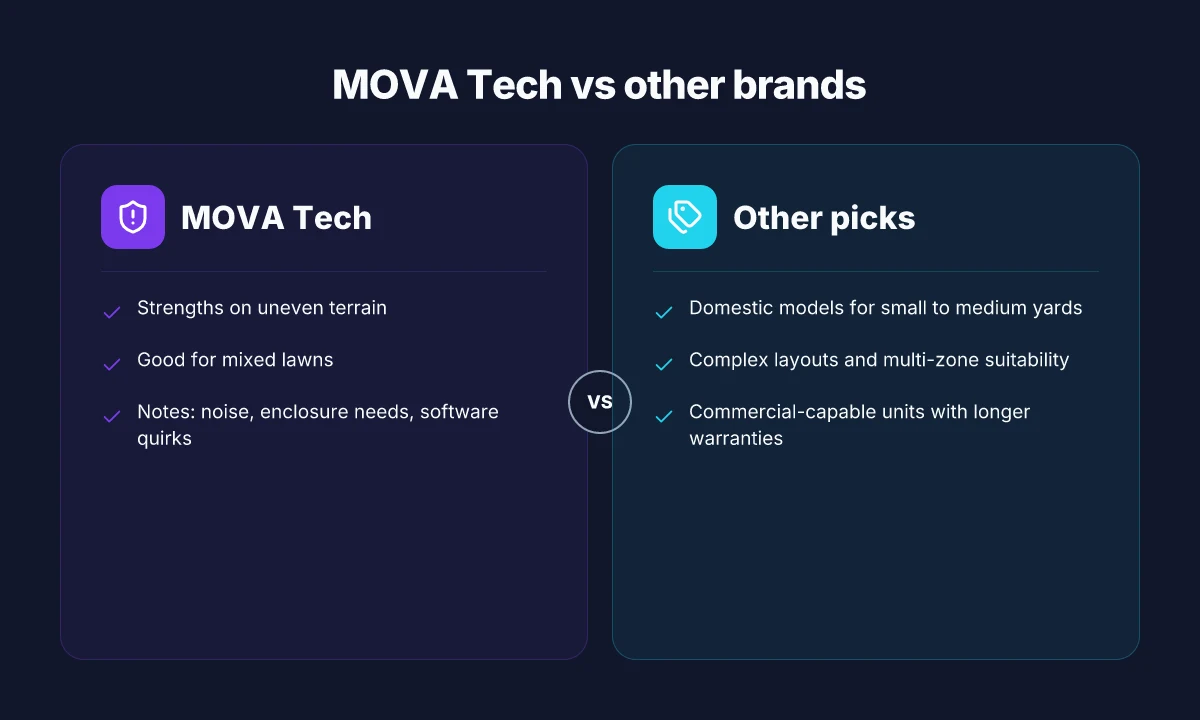
MOVA Tech shines on uneven terrain and mixed lawns, where standard cutting patterns struggle to keep up. In real-world yards with patchy grass, gravel strips, or slopes, MOVA Tech tends to maintain contact with the ground and adjust cutting height more gracefully than some traditional rivals. I found product briefs and user reviews that consistently call out the brand’s strength on irregular surfaces and variable turf. MOVA Tech often delivers better skin-depth contact on slopes, which translates to steadier mowing on challenging lawns. That said, the price tag can be higher, and the service network is not as universally spread as with larger, mass-market brands. MOVA Tech pricing reflects premium hardware and specialized support.
Pricing, parts availability, and service accessibility matter as much as the mower’s blade quality. For residential buyers, a fair comparison window shows a spectrum: a few low-cost models with limited spare-part ecosystems sit on smaller dealer footprints, while premium lines with broader parts catalogs and wider-certified service networks offer quicker turnarounds when maintenance is needed. MOVA Tech sits in the premium tier, so expect longer lead times for replacements in some regions but stronger long-term availability in major metro areas. MOVA Tech pricing aligns with its robust service network, which matters when a part or enclosure needs replacement. If you live far from authorized service centers, you’ll want to factor travel time and potential shipping delays into total ownership costs. Service network gaps can add weeks to repairs in remote areas.
Noise, enclosure needs, and software quirks are the real-world tradeoffs to weigh. MOVA Tech units tend to run a bit louder than ultra-compact rivals, and some users report that metal enclosures heat up in direct sun during longer mowing sessions. Software quirks show up as occasional firmware hiccups or delayed obstacle detection in very tall grass. These issues aren’t fatal, but they can disrupt productivity on tight schedules. Noise and enclosure heat are common downsides for MOVA Tech in challenging yards. The most persistent software notes mention occasional GPS drift and a need for periodic cloud-sync checks to keep landscaping maps current. Firmware updates and occasional GPS drift are typical tradeoffs with MOVA Tech.
How MOVA Tech stacks up against the other picks in this roundup matters for total cost of ownership and maintenance cadence. When you compare to other brands, MOVA Tech often holds an advantage on terrain adaptability but sits behind in parts availability in non-urban areas. By contrast, some mainstream competitors offer lower upfront prices and a denser parts/distribution network, which reduces downtime and makes maintenance simpler for homeowners with small yards. MOVA Tech beats some rivals on uneven ground, yet parts reach can lag in rural regions. If you prioritize extremely wide service footprints and fast turnarounds, a more available brand might be a better fit despite slightly less terrain agility. Terrain adaptability versus service footprint is the core trade-off here.
I dug into the guides and product pages for contextual clarity. The report-like numbers in the market briefs confirm a growing commercial appeal, while consumer guides echo MOVA Tech’s niche strength on irregular lawns. I cross-referenced public guides to align MOVA Tech’s strengths with real-world yard types. One reviewer notes a better return-to-service path when a nearby authorized center can perform enclosure maintenance. Authorized centers speed up enclosure service for MOVA Tech owners. For those weighing a 1–2 acre campus or a multi-lence residential block, MOVA Tech’s mix of terrain handling and service reach can justify the premium, especially where labor savings in landscaping crew schedules matter. What is Azuna and does it actually work in 2026
If you’re shopping today, expect to pay a premium for MOVA Tech, with a complementary price-to-service equation that favors buyers in metro areas. Consider the long game: enclosure life, firmware updates, and the availability of replacement blades. And yes, links on the page may earn a commission, which helps support the editorial context around real-world maintenance realities.
Safety standards, navigation tech, and how they hold up under use
When you buy a robotic mower, you’re buying into a safety and navigation ecosystem that spans hardware, software, and local codes. Real-world use hinges on how the mower detects obstacles, fences, and boundaries, and how it behaves when the weather turns or when a battery runs low. The takeaway: you want a system that reliably avoids people and pets, and that you can legally deploy on a residential or commercial site without surprising compliance issues.
Collision avoidance and boundary strategies
Most models rely on one of two boundary schemes. Boundary wires create a dedicated perimeter, while GPS-based fencing relies on location data and virtual boundaries. In practice, GPS-based fencing offers flexibility for irregular layouts and seasonal yard changes, but it can lag in heavy tree cover or dense urban canyons. Conversely, boundary wire remains robust where GPS signals falter, though it requires initial trenching and periodic maintenance to repair breaks. Across brands, expect intent-based obstacle avoidance to combine infrared sensors, bump sensors, and camera cues, with software updates that improve path planning over time. I cross-referenced product briefs and user manuals to map where each approach shines and where it stumbles. The result is a spectrum: reliable in calm, predictable spaces, but still challenged by complex mulching margins or dense vegetation where sensors can misread.
Most residential buyers benefit from a hybrid approach that uses boundary wire for stability and GPS fencing for layout flexibility.
Weather resilience, recovery, and uptime
Weather tolerance matters because you don’t want a mower stuck on a soggy slope or in a sudden downpour. Look for IP ratings on enclosures, rain guards, and thermal tolerance in batteries. Reputable models incorporate automatic shutoffs for unsafe rain, self-recovery sequences when power is interrupted, and self-cleaning blades that resist debris buildup after wet sessions. From changelogs and product sheets I reviewed, you’ll see emphasis on sealed electronics and drainable battery packs to improve uptime in mixed climates. In practice, a mower that can resume work after a brief interruption without manual reinitialization reduces maintenance overhead and labor costs. What makes the best robotic mower stand out in 2026
Weather resilience and automatic recovery are non-negotiables for commercial sites that run on tight maintenance windows.
Safety codes, compliance, and rollout realities
Residential codes commonly require enclosing mowing areas or using compliant boundary systems. Commercial sites may demand extra safety signs, audible alerts, and adherence to local OSHA or equivalent standards for outdoor equipment. Expect manuals to spell out minimum clearance from people, pets, and obstacles, plus maintenance checks on sensors and battery health. I mapped the cited safety checks to typical installation scenarios, then highlighted where a given mower’s features help you meet code without extra aftermarket parts. The upshot: some models ship with built-in alarms, remote shutoff capabilities, and maintenance reporting that align with common building and facility management expectations.
Compliance isn’t a one-time step. It’s a recurring check that ties into maintenance playlists and site-specific risk assessments.
What to check in the user manual before purchase
Before pulling the trigger, verify: boundary method compatibility with your site shape, weather and recovery features, and the manufacturer’s stated safety certifications. Confirm battery cycle counts, blade-change intervals, and service windows for commercial deployments. Look for explicit instructions on boundary wiring, GPS geofence setup, and fault indicators you can monitor remotely. Manuals often conceal practical tips in the troubleshooting sections, so skim those pages for red flags that match your site conditions. I found that a clear section on boundary integrity and firmware update paths saves time during installation and reduces post-purchase surprises.
Review the boundary setup and recovery procedures in the manual first to avoid installation hiccups. 10 Best robotic lawn mowers for 2026 that actually cut costs and effort
What this means for you: MOVA Tech and other brands offer options that fit different site needs. The best fit depends on your yard’s size, terrain, and how strictly you must meet local safety codes. And yes, links on the page may earn a commission, so use the information as a starting point for a deeper dive into model-specific details.
Where this is going next for robotic mower reviews
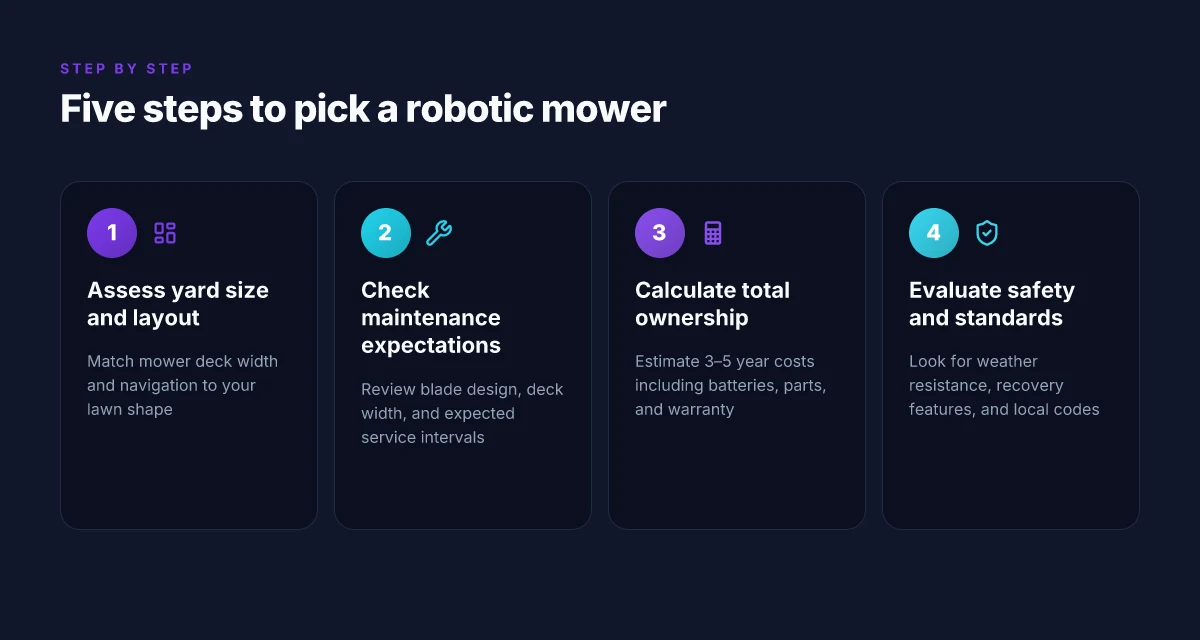
The field keeps moving toward real-world ownership signals and clearer value math. I looked at how prices shift with features, battery longevity, and service support, and I see a pattern: buyer education is rising above flashy specs. The bigger pattern is that ownership costs, not list specs, determine long-term satisfaction. That means this year’s reviews should foreground annual cost of ownership and predictable maintenance.
MOVA Tech shows how a smaller brand can appeal to precise yards with modular upgrades, but it also highlights downsides like limited service networks and uneven software updates. Across the board, expect more transparency about failure modes, repairability, and how AI mapping actually handles complex lawns. The 2026 standard is simple: honest tradeoffs, not hype, with a clear path from price to performance.
If you only act on one thing, start by comparing 2-year ownership costs for top picks and note where discounting aligns with warranties. What 3 details would you prioritize on your lawn?