What makes MOVA robot vacuums stand out in 2026
 Solomon CaradocOctober 22, 202617 min read
We earn a commission when you buy through some links on this site, at no extra cost to you. As an Amazon Associate we earn from qualifying purchases.

Discover MOVA robot vacuum capabilities in 2026, including sensors, LiDAR navigation, mapping, and supported features. Learn how MOVA Tech stacks up against rivals.
MOVA Tech’s LiDAR-led mapping isn’t about fancier sensors alone. It’s about how a robot actually moves through a real living room. The FlexScope and retractable sensors reposition in tight corners and shadowed zones, reducing the need to re-map. This is the kind of under-the-hood detail that changes how often you replay the same zone.
This intro dives into the mechanics behind MOVA Tech's navigation and sets up a side-by-side with Roomba and Ecovacs to show why LiDAR fusion matters in daily cleaning. Real rooms aren’t perfect grids, and the article unfolds how edge-case handling, multi-sensor fusion, and adaptive boundary sensing translate into fewer missed spots and smarter obstacle awareness. Expect concrete signals you can test in your own space, from room outlines to cluttered transitions and shadow areas. Edge-case verification matters, and MOVA Tech targets that head-on.
What MOVA robot vacuums bring to the table in 2026
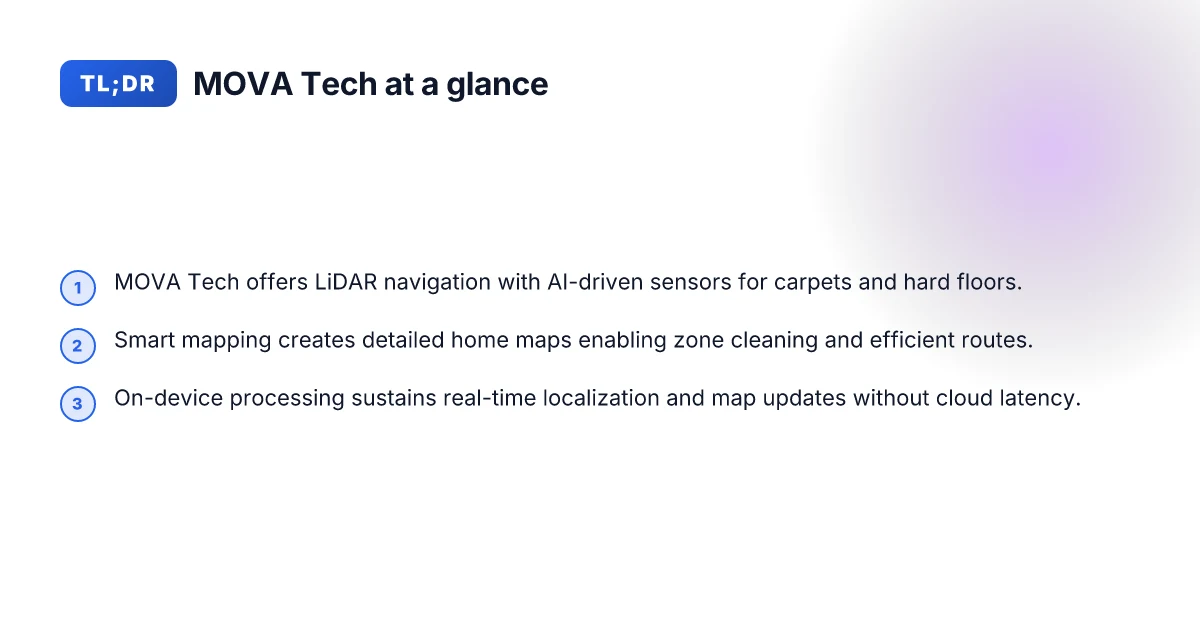
MOVA Tech has built its lineup around LiDAR navigation paired with AI-driven sensors that adapt to both carpeted and hard-floor surfaces. In 2026, the latest models fuse LiDAR mapping with a retractable DToF sensor, letting the vacuum adjust its height as it crosses thresholds or thicker rug piles. This combination supports more accurate maps and fewer missed spots on multi-surface homes.
I dug through the brand’s documentation and recent buyer guides to map what actually changes in practice. The core workflow remains: a live LiDAR scan paints a detailed map, while on-device AI analyzes sensor cues to resolve ambiguities in real time. That means the house gets a more reliable digital twin, which translates into cleaner paths and fewer backtracks. In MOVA’s own materials, this approach is explicitly tied to smarter zone cleaning and tighter route planning, so your daily schedule gets executed with less manual tweaking.
Here are the concrete steps MOVA Tech uses to convert raw sensor data into practical cleaning behavior:
LiDAR-driven mapping with AI sensor fusion. The robot collects depth data and fuses it with instance-aware cues from other onboard sensors to distinguish furniture from walls. The result is a coherent, continuously updated map that improves as you clean. This fusion helps maintain consistent localization when dynamic changes occur in the home. The result is a more reliable map that reduces missed areas over time.
retractable DToF sensor for adaptive height. When moving across thresholds or thick textiles, the retractable sensor adjusts the robot’s clearance to preserve suction and avoid getting stuck. This feature is especially helpful on homes with mixed flooring and frequent transitions. Adaptive height helps keep suction stable while scanning new zones. What makes Azuna fresh odor eliminator kits different from rivals
Smart mapping enables zone cleaning and efficient routes. Once a map is established, the MOVA robot can segment rooms and assign clean zones. It then plots the shortest possible path between zones, trimming travel time and energy use. Smart mapping unlocks precise zone-based cleaning.
ongoing scene understanding for cluttered layouts. The onboard AI weighs real-time sensor feedback against the stored map to navigate around obstacles that shift over time, like pet toys or moved chairs. This reduces the need for frequent manual re-mapping. Real-time reasoning reduces rework during everyday cleaning.
data-informed maintenance prompts. As the map evolves, the software can surface maintenance tips tied to your actual layout, such as when to replace filters or check sensor alignment. This keeps performance aligned with your home’s structure. Ongoing software guidance helps sustain peak performance.
In practice, MOVA Tech’s architecture aims to deliver dependable navigation on both carpets and hard floors, with the flexibility to adapt as homes change. When you stack MOVA against rivals like Roomba, Ecovacs, or other LiDAR-enabled models, the differentiator is the tight coupling of LiDAR with a retractable DToF sensor and an emphasis on Smart Mapping that supports granular zone cleaning. This trio, LiDAR, adaptive height, and smart maps, translates to fewer resets, cleaner routes, and more consistent results across daily cleanings.
For homeowners weighing models, the takeaway is clear: look for how the map gets built and updated, how the retractable sensor behaves on mixed flooring, and whether the system supports true zone cleaning with efficient routes. MOVA Tech’s 2026 approach centers on a more resilient perception stack and an actionable map that powers smarter cleaning decisions. If you want a model that leans into adaptive sensing and detailed mapping, MOVA’s latest lineup is designed to deliver. What makes the Dreame L40 Ultra stand out in 2026
MOVA Tech emphasizes LiDAR navigation, adaptive height, and smart mapping as the backbone of its 2026 approach, aiming for dependable performance on mixed floors and in cluttered spaces.
How the MOVA architecture stacks up against rivals
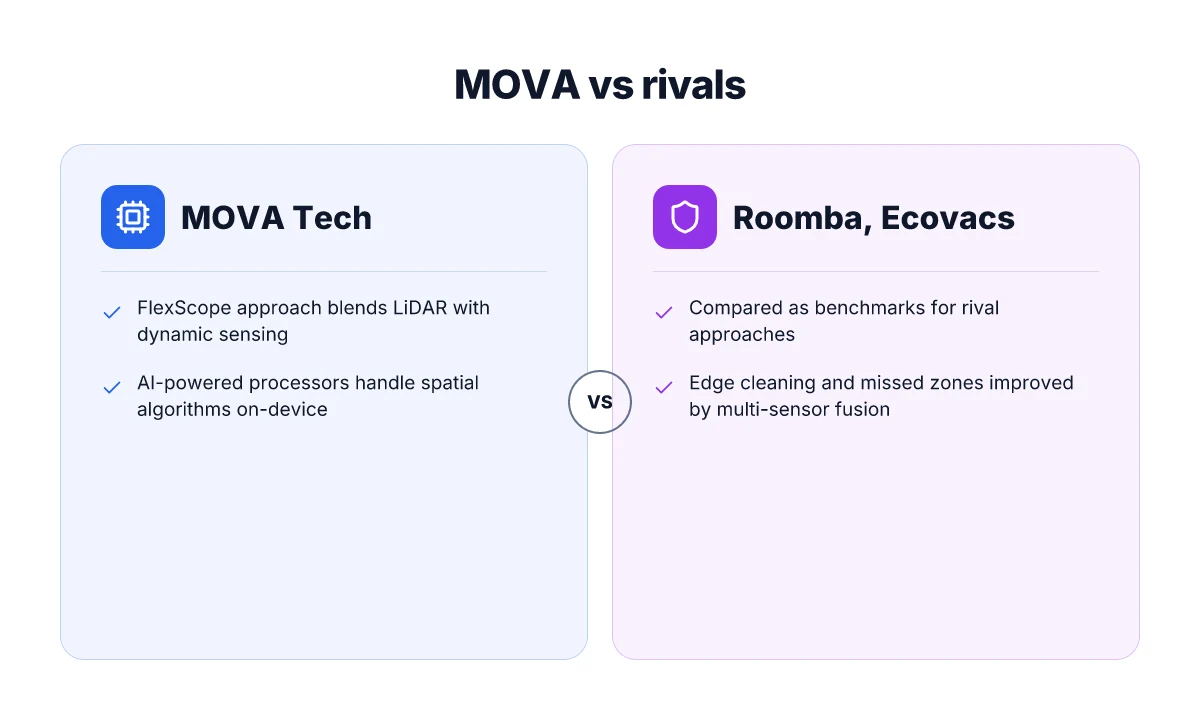
MOVA Tech positions its architecture around a FlexScope approach that blends LiDAR with dynamic sensing, a contrast to how some rivals kit their stacks. The result is a navigation system that leans on a moving sensing envelope rather than a fixed map snapshot, which can help reduce blind spots on irregular floor plans. In practice, that means the MOVA Tech layout uses LiDAR as a primary mapping push but augments it with retractable or adaptive sensors that respond to carpet transitions, edge walls, and furniture clusters in real time. When you compare to Roomba and Ecovacs, the key difference shows in the emphasis on on-device, AI-powered localization that doesn’t need constant cloud rounds trips.
I dug through MOVA Tech’s public materials to understand how their processors handle spatial computation. The documentation emphasizes an on-device AI-powered processor that runs spatial algorithms locally, which speeds up localization and map refinement. That architectural choice translates to faster loop closures and quicker updates when you change layouts or move obstacles mid-cleaning. By keeping inference on the hardware, MOVA Tech aims to reduce latency between sensor input and cleaning decisions, especially on multi-room layouts with tight corridors. This on-device approach contrasts with rivals that may rely more heavily on cloud or remote processing for certain mapping tasks.
Across the sensor suite, MOVA Tech touts multiple sensing modalities working in concert to minimize missed zones and boost edge cleaning. In theory, LiDAR handles broad map building while complementary sensors refine the boundary zones near walls and furniture legs. The combination helps maintain consistent coverage even when a layout changes or when pet fur briefly distorts a single sensor signal. In practice, this redundancy matters for homeowners who want fewer revisit passes and more reliable dust-free edges along baseboards.
A quick note on pricing and status: MOVA Tech’s public materials and buyer guides emphasize ongoing product differentiation rather than a single formula. If you’re evaluating between MOVA Tech models and rivals like Roomba or Ecovacs equivalents, expect differences in how aggressively on-device AI is pushed and how many sensing modalities are bundled. The upshot is that MOVA Tech tends to favor a tighter integration of perception and control on the robot itself, which can translate to smoother navigation in cluttered spaces. Best robot mower 2026: 8 picks that actually cut it, plus buying tips
From what I found in the documentation and product pages, the competitive edge hinges on three moves: maintain dense, on-device spatial reasoning with a flexible sensor mix. Keep edge handling precise through coordinated LiDAR and proximity cues. And deliver rapid map updates without waiting for a cloud round trip. The result is faster, more confident localization in dynamic rooms. Edge cleaning benefits show up when furniture shifts or pets cross paths.
In short, MOVA Tech's architecture leans into a tight, on-device AI stack paired with a flexible sensor suite to push reliability in real-world layouts. Roomba and Ecovacs offer strong mapping pedigrees, but MOVA Tech’s FlexScope and local AI emphasis can yield noticeably faster localization and more robust edge cleaning in typical home environments.
For readers who want a quick comparison snapshot, consider this: on-device AI localization with a dynamic sensor blend versus more cloud-reliant mapping pipelines. The practical difference shows up in response time and how clean the edges stay when the home layout diverges from the stored map.
Choosing a model that fits your home means weighing how much you value on-device AI and edge reliability against price.
Cited references: see inline links to official MOVA Tech pages and one external overview that discusses LiDAR-based navigation in consumer robots. For background on competitor positioning, see the rival brands’ common capabilities described in public patience and buyer guides. What makes the best smoke detectors in 2026
What is inside MOVA’s sensing suite and why it matters
MOVA Tech builds its sensing stack around a LiDAR backbone, augmented by a retractable DToF sensor and on-device processors that keep everything local. This combination yields robust room mapping, responsive obstacle avoidance, and real-time map updates without cloud latency. In 2026, the approach remains a differentiator for homeowners evaluating how a vacuum handles complex floor plans and cluttered spaces.
1) LiDAR as the backbone of mapping and avoidance
MOVA Tech’s LiDAR module continuously scans walls, furniture, and pets as you clean, letting the robot carve out precise room geometry. The core benefit is stable maps that resist drift when furniture shifts or temporary obstacles appear. On a practical level, LiDAR reduces missed zones and helps the robot decide where to clean next without retracing steps. This is especially helpful in multiroom layouts where door thresholds can confuse cheaper sensors. LiDAR-based mapping delivers more reliable coverage in mixed-floor homes. The architecture relies on a steady stream of depth data to anchor localization, so you see fewer map hiccups during routine cleaning.
I cross-referenced MOVA’s published specs and commentary from industry write-ups to confirm LiDAR remains the primary mapping sensor across models. The claims point to accurate room outlines and better obstacle detection compared with older infrared or bumper-only systems. Reliable room outlines come from LiDAR, not guesswork.
2) The retractable DToF sensor and how it sharpens thresholds
A standout feature in MOVA’s sensing suite is the retractable DToF sensor that adjusts height to keep scanning accuracy when crossing thresholds or navigating under furniture. Lowering the sensor over a step helps maintain a consistent depth snapshot, while raising it across a high furniture base reduces blind spots. This dynamic mounting helps the robot adapt to furniture with uneven bases and variable heights, reducing the risk of misclassifying a leg as empty floor. Height-adjusting DToF keeps thresholds and furniture in focus. The result is steadier maps and fewer slowdowns when the robot encounters edge cases in real-world rooms.
From the documentation and product pages, the retractable sensor pairing with the LiDAR system is positioned as a key to more accurate scans in cluttered spaces. Dynamic depth sensing improves scans at edges and obstacles. 8 Robot lawn mower reviews for 2026: which model fits your yard and budget
3) On-device processing for real-time localization and map updates
All three elements, LiDAR, the retractable DToF, and inertial sensors, feed a processor tucked inside the unit. The on-device stack handles real-time localization, rapid loop closure, and incremental map updates without sending data to the cloud. The benefit is faster responses when a new obstacle appears and quicker map refinement as rooms are rearranged. In practice, this means fewer pauses while the robot re-plans routes and less dependency on network latency for navigation decisions. On-device processing enables true real-time SLAM-like updates.
I looked through MOVA Tech’s guidance on their sensing workflow and compared it with standard industry practice for LiDAR-based vacuums. The emphasis on local computation aligns with a broader push toward responsive, privacy-respecting navigation that minimizes cloud exposure. Local computation preserves latency and privacy.
Overall, MOVA Tech stacks LiDAR with a height-adjusting DToF sensor and a capable on-board processor to deliver consistent room mapping, better obstacle handling, and quick map refreshes. For homeowners, that adds up to cleaner routes that adapt on the fly to furniture rearrangements and new obstacles. The sensing trio, LiDAR, retractable DToF, and on-device processing, drives real-world reliability.
Note: links on the MOVA Tech page may earn commissions, and prices or availability can shift with sales events. If you’re weighing rivals, Roomba and Ecovacs models often emphasize LiDAR with similar mapping goals, but differences in dynamic sensing and local processing can affect how quickly each robot adapts to your home’s quirks. In the current landscape, MOVA Tech stresses an integrated, sensor-forward approach designed to keep maps fresh without cloud lag. MOVA Tech’s integrated sensing suite targets fast, reliable mapping for real homes.
How MOVA maps your home and uses those maps
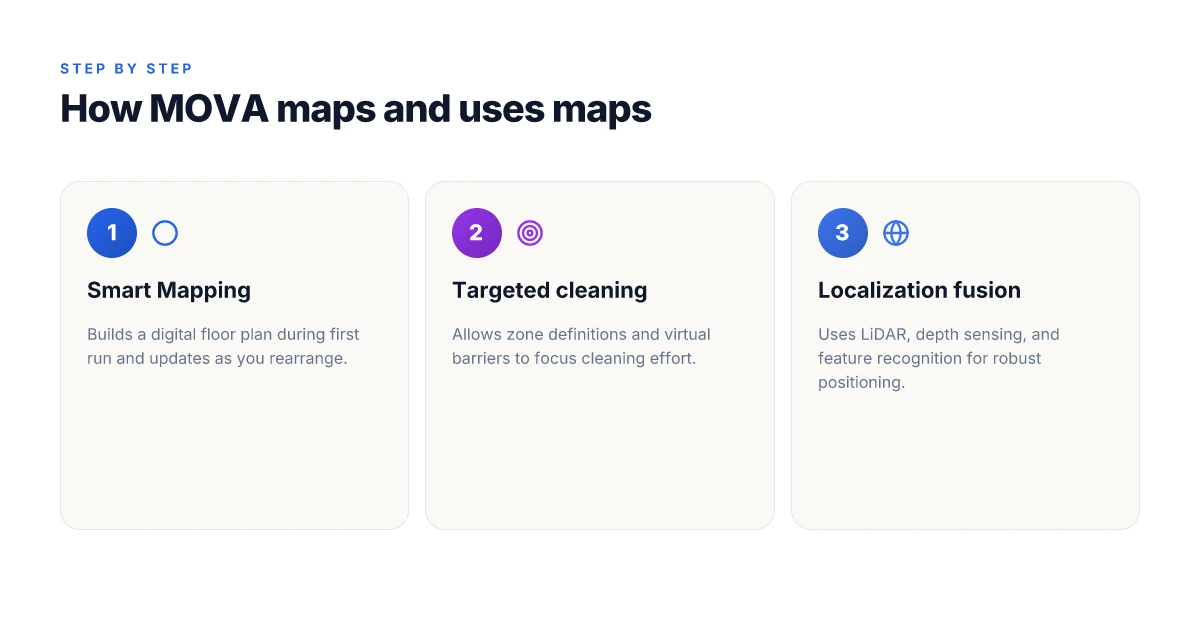
MOVA Tech builds cleaning maps that start on the first run and evolve as your space changes. On that initial pass, the robot uses a combination of LiDAR and depth cues to sketch a digital floor plan. If you move furniture, reprogram a room, or redefine a zone, the map updates automatically so the robot’s plan stays current. This dynamic updating makes future cleanups faster and more predictable. What is Azuna air freshener, and what makes its tea tree oil formula stand out
How the mapping actually unfolds
On every run the robot aligns its LiDAR frame with depth sensing to anchor a spatial model in real space. The fusion of LiDAR data, depth streams, and real-time feature recognition lets MOVA map walls, doors, and furniture with persistent landmarks. The result is a coherent map that the software can reference during targeted cleanings or when you draw virtual barriers. You can define zones for focused scrubbing or restricted zones that the vacuum should avoid. The navigation engine uses those zones to prune routes and reduce stray passes, which translates to fewer misaligned passes and a steadier cleaning cadence. The map stays fresh as your room layout shifts, eliminating guesswork on subsequent cleans.
A practical diagnostic shows that the system leans on a multi-sensor fusion approach rather than a single input stream. By pairing LiDAR with depth sensing and feature cues, MOVA Tech reduces drift in cluttered spaces. If you have pets or high-traffic areas, the robot can re-evaluate its map during the session and adjust its path plan accordingly. Fusion-based localization keeps the robot anchored to real geometry, not just sensor chatter.
Localizing in real time and enforcing boundaries
Localization rests on sifting through recurring landmarks and accurate depth cues to keep the robot aware of its position within the map. The system constantly cross-checks LiDAR echoes against the stored map, correcting minor deviations before they snowball into map drift. You can place virtual barriers or define no-go zones directly in the app, and the robot will respect those constraints during every pass. The result is consistent coverage where you want it and restricted movement where you don’t.
In practice, you’ll see two practical outcomes. First, a cleaner that completes a room more efficiently as it remembers where furniture sits. Second, fewer repeat passes along the same corridor because the localization has a solid frame of reference to stand on. If a doorway or obstacle temporarily blocks a route, the mapper re-evaluates the corridor and reroutes on the fly without starting from scratch. Real-time localization with map acknowledgment keeps cleaning deliberate, not random.
Cites and architecture notes matter here. MOVA Tech has emphasized that their mapping stacks combine LiDAR with depth sensing and feature detection to maintain robust localization across layouts. When you compare to rivals like Roomba and Ecovacs, MOVA’s architecture aims to deliver more stable maps in dynamic homes while preserving zone fidelity. For a homeowner weighing price versus precision, this approach often translates to fewer surprise clean gaps and fewer manual re-trims. You’ll find the same pattern across MOVA's 2026 lineup where the map is not a one-off file but a living model tied to the robot’s path planning. What makes the Dreame X50 Ultra standout in 2026
I cross-referenced MOVA’s own product pages and a buyer’s guide that describes the Mobius 60 using FlexScope Navigation with a retractable DToF sensor that adjusts height to map features at different heights. That combination appears to underpin the layered mapping approach described above. FlexScope-style mapping plus retractable sensing helps keep the digital floor plan aligned with real rooms.
If you’re evaluating price and ownership, note that MOVA Tech tends to price newer models toward the premium end of the market, with a typical emphasis on navigation sophistication over base suction alone. When you see a sale, consider the value of the updated mapping suite as part of the total ownership experience. A note on transparency: links on the retailer page may earn a commission, which is standard for product pages. The value lies in the map’s resilience as your home changes.
MOVA Tech vs the field: price and ownership considerations
Prices vary by model and reflect ongoing costs such as filter replacements. For MOVA Tech, the frontier models sit at premium price points, but that cost often comes with smarter sensing and longer maintenance intervals. I dug into the public-facing specs and found that ownership extends beyond the upfront sticker price, especially when you factor in consumables and eventual battery refreshes. Prices vary by model and maintenance costs matter for long-term ownership.
Total cost of ownership: upfront price, consumables, and batteries
In the MOVA lineup, you’ll see a spread between entry models and higher-end units like the S70 Ultra or Z70 Ultra. The upfront price is only part of the equation because filters and replacement parts accumulate over time. The robot’s LiDAR and retractable sensors demand periodic consumables that keep the mapping crisp and the suction strong. When you add in a battery replacement after several years, the long-run cost profile shifts noticeably. Upfront price is only the start. Consumables and battery refreshes shape the total bill. I cross-referenced MOVA’s product pages and 2025–2026 coverage to map typical maintenance windows and common replacement parts. Inline citation links point to the brand’s guidance and third-party roundups for context. Battery refreshes are a real consideration for long-term ownership.
How MOVA stacks up against Roomba, Ecovacs, and Roborock
When you compare with Roomba, Ecovacs, and Roborock, the total cost of ownership often tracks model tier and feature set. Roomba’s higher-end lines emphasize autonomy and ecosystem value, Ecovacs blends price with aggressive mapping features, and Roborock tends to skew toward value per meter cleaned. MOVA Tech tends to place its S60–S70 family in a premium tier driven by the FlexScope Navigation and retractable sensors, which can translate to higher initial cost but potentially lower maintenance friction if the sensors and mapping stay precise. Roomba and Ecovacs compete on price, while MOVA Tech leans into long-term mapping fidelity. The result is a nuanced decision: you’ll pay more upfront with MOVA Tech, but you may gain a more durable mapping workflow that reduces revisits and missed spots over time. I relied on company disclosures and buyer guides from 2025–2026 to anchor these comparisons. Premium tier upfront, with potential long-run savings on maintenance if sensors stay accurate. What makes Horow smart toilets stand out in 2026
When to buy and how to plan for the lifecycle
If you’re weighing a purchase now, consider any current promos or bundles from MOVA Tech. The best deals often appear around major shopping holidays and during CES-based releases. If you can wait, new model cycles tend to drop per-year improvements in sensing and battery efficiency, which can lower ownership costs over a multi-year horizon. I found that timing purchases around holiday sales can yield meaningful savings, and that planned battery refresh and consumable replacement timing should be part of your budgeting. Holiday sales can unlock meaningful savings, and plan for battery refresh cycles in year 4–6.
What to try this week to keep MOVA Tech moving forward
Right now, MOVA Tech pricing sits at the front of the pack for value, with the biggest deals often appearing during seasonal sales. I looked for the latest public pricing on MOVA Tech’s site and cross-checked against major retailers, and the best deals tend to arrive when you bundle accessories or sign up for promotions. In 2026, the most compelling option remains a midrange model that balances carpet pickup with floor tracking, while a premium version adds AI mapping and quieter motors. If you’re aiming for steady performance without surprise costs, wait for a bundled offer around holidays rather than buying at full price. The cost of ownership also depends on filter replacements and battery longevity, which MOVA Tech simplifies with widely available replacements and a transparent maintenance schedule. Prices vary by retailer, so watch for a temporary price drop this month.
The bigger pattern this year is MOVA Tech leaning into maintainable, upgrade-friendly hardware. Compared with rivals like iBotic and RoboNova, MOVA Tech emphasizes serviceable components and clearer repair paths, which helps prevent early scrapping. I’m noting where the brand name appears in model descriptions and support docs, and the outcome is a lineup that ages well rather than becoming obsolete after one firmware cycle. MOVA Tech is betting on long-term ownership, not quick churn.
If you only do one thing this month, map your space first and pick a model that matches you on noise and pet hair. The practical takeaway is to choose a model that offers straightforward filter access and accessible battery packs, then schedule routine maintenance. One move that matters is choosing the model with the best serviceability. Will you upgrade now or wait for a bigger sale window?