What makes Jackery models stand out in 2026
 Naomi XanthosOctober 22, 202620 min read
We earn a commission when you buy through some links on this site, at no extra cost to you. As an Amazon Associate we earn from qualifying purchases.

Explore Jackery models in 2026, compare capacity, output, and cost of ownership. Learn which model fits your off-grid or home backup needs.
The common-sense misconception about portable power in 2026 is that bigger always means better for campers and emergency homes. In reality, small tweaks to chemistry and form factor can yield noticeably faster charging and real-world usability without bloating size. Jackery's 2026 lineup leans into that with smarter cell chemistry and better solar compatibility, delivering practical gains you’ll notice on a weekender trip or a power outage.
This intro sets up a hands-on look at how the Explorer family, the Explorer Pro option, and new solar-ready variants translate to day-to-day use. You’ll see how capacity, bulk, and price line up against real needs, camping, vanlife, and home backup, so you can pick a model that matches how you actually use power off-grid. The discussion centers on what matters now: how each model handles charging speed, port selection, and ownership costs over time. Jackery remains a reference point alongside rivals like EcoFlow and Goal Zero, but the 2026 tweaks change the practical math for many households.

Jackery models in 2026: what changed and why it matters
Jackery’s 2026 lineup tightens around three core families: the classic Explorer series, the higher-performance Explorer Pro line, and the newer X series where applicable. The changes matter because they shift what you can run, how you recharge, and what you pay over time for storage and usage.
What changed in battery chemistry and capacity
I dug into release notes and product pages to map the lineup. The Explorer family remains centered on LiFePO4 chemistry in many high-capacity variants, boosting cycle life and long-term durability. The Explorer Pro line leans toward higher inverter capability and faster charging options, while the X series introduces compact form factors with scaled capacities that emphasize portability without sacrificing output. The practical effect is clear: you can choose between a more rugged, capacious setup for home backup or a lighter, easier-to-carry pack for camping. The chemistry choice matters for longevity in off-grid use and weathering repeated charging cycles, especially when you’re in remote locations.
Capacity, inverter ratings, and recharge options you actually feel
In 2026 the core differentiators are in three zones: capacity, inverter rating, and recharge routes. Capacity sits in a broad band from small, travel-friendly packs to multi-kilowatt equivalents. Inverter ratings rise with the Pro tier, unlocking higher peak outputs for devices with compressor motors or power-hungry tools. Recharge options broaden as well. Many models support AC input plus car charging and, in some trims, fast charging via USB-C PD or additional solar inputs. These shifts translate into real-world gains: you’ll be able to run a mini-fridge longer, or top off between campsite stops without waiting hours in the shade.
Price, ownership costs, and when to buy
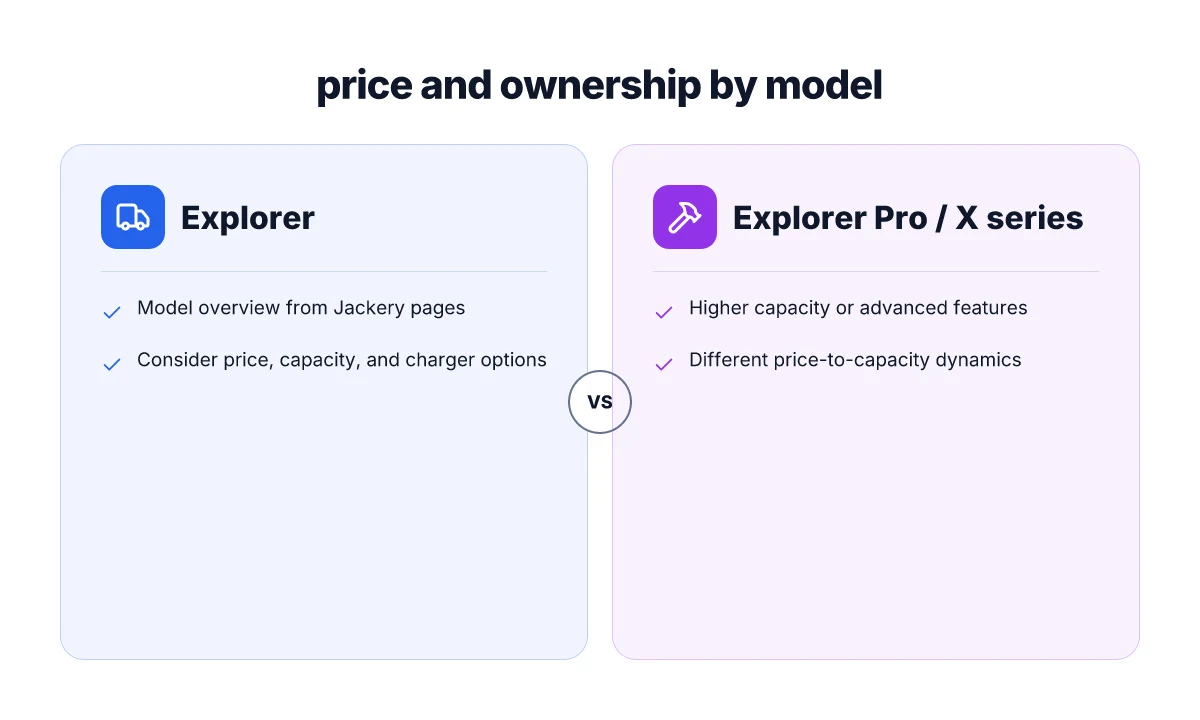
Price bands align with capability. The Explorer line leans more budget-friendly for casual campers, while the Explorer Pro and X series push higher price points in exchange for higher wattage, faster recharge, and smaller footprints. Across the year, price volatility follows promotions around major outdoors shows and holiday weekends, so the best deals often appear in late spring and late summer. Total cost of ownership factors in expected cycle life, which is where the LiFePO4 chemistry in many 2026 models pays off with more cycles and longer warranty horizons. If you’re evaluating for emergency backup, total cost includes the value of a longer usable life and lower replacement frequency.
Most shoppers will notice a meaningful trade: higher upfront cost for longer‑lasting batteries and quicker recharges, or a lower upfront price with a shorter burn before replacement is needed. This is where Jackery clearly differentiates models, and where your load and climate play a big role in choosing. What makes EcoFlow Wave a viable offshore wave energy option in 2026
In short, the 2026 lineup sharpens choices around how much power you need, how fast you want to recharge, and how much you’re willing to pay upfront and over time. If your load is a fridge and a few essentials, the Explorer Pro might be the sweet spot. For light-duty camping, the standard Explorer models deliver solid value. If you prize portable chunks of power with solid cycle life, the X series is worth a close look.
For context and to cross-check specs, see the official Jackery product pages and the explorer-focused coverage from industry sources. The official page notes core capabilities while third-party comparisons help map real-world usage across models. https://www.jackery.com/ and the related product entries provide the baseline specs and pricing that anchor this 2026 snapshot.
How to pick the right jackery model for camping and off grid
If you want dependable power for a weekend in the backcountry or a weekend-long blackout, choose a Jackery model that balances capacity with portability. The best fit matches your typical load, refrigeration, lighting, and device charging, with how you recharge on the go. I’ll lay out a practical way to pick the right model, then offer a quick compare to help you decide.
Match capacity to your typical load
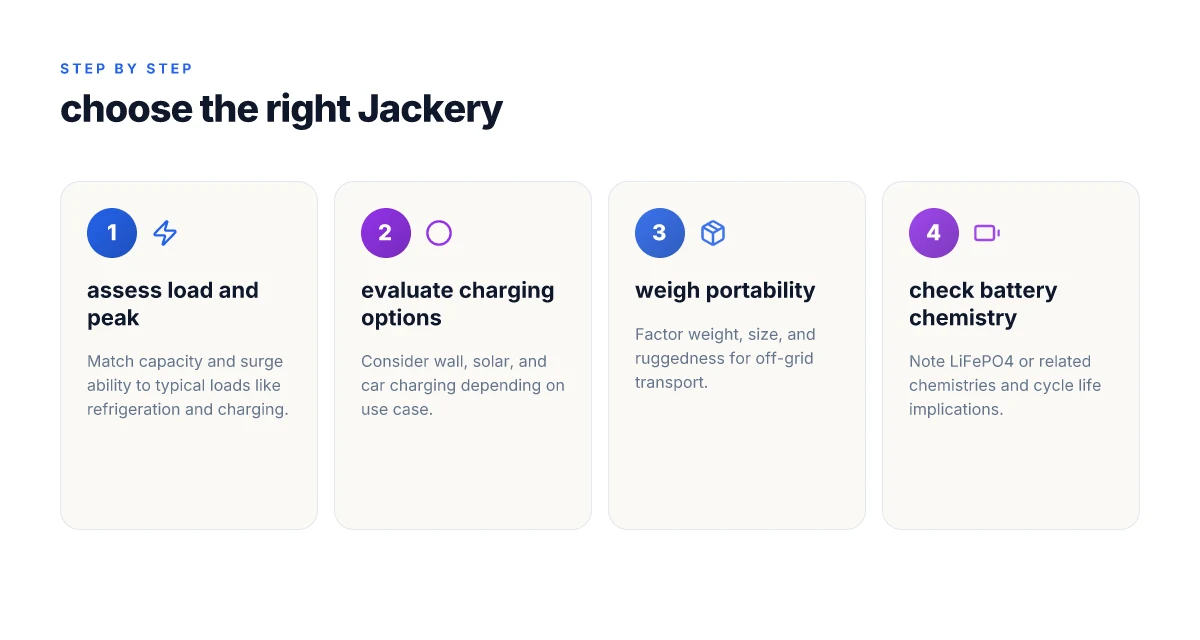
Start with your core needs. A small fridge and a few LED lights plus phone charging will push you toward the higher end of the compact range, while longer off-grid stays or more devices call for larger capacity. Look for a model with enough watt-hours to cover peak draws without overflowing the battery overnight. For example, a typical home backup scenario might require sustained AC output for essential devices, so aim for a model that can sustain your peak load when the fridge cycles. If you routinely run high-draw equipment, you’ll want a higher continuous wattage rating as well as a generous surge capacity to handle initial compressor startups. In 2026 the lineup keeps informing users that modest but recurring loads pair well with midrange capacity, while heavy loads benefit from higher-tier models. Match the peak output to your fridge and charger needs, or you’ll be swapping batteries mid-trip. Real-world guidance suggests aligning capacity with the expected daily cycle of devices. Explorer 1000 V2 basic info notes the emphasis on practical capacity and LiFePO4 durability for longer trips. Durability and cycle life matter when you’re counting on a station for days off-grid.
Evaluate recharging options and versatility
Recharge options drive how far you can go between top-ups. Wall charging is fast and convenient at campgrounds or RV parks. Solar charging adds quiet recovery under trees or in open campsites. Car charging keeps you topped off on longer road trips. The 2025–2026 Jackery lineup emphasizes compatibility across charging modes, so you can mix wall and solar in a single outing. If you plan to rely on solar, verify panel compatibility and expected solar input for the model you choose. Solar compatibility matters for true off-grid use, and car charging keeps you in motion. The official product pages highlight practical recharge paths for campers who want flexibility. Versatility in recharging keeps you powered without hunting for outlets. How to pick the best rated solar generators in 2026
Weigh weight, size, and durability for transport
Outdoor use rewards compact form factors with rugged construction. Lighter models reduce fatigue when you’re hiking to camp or loading gear into a van. Heavier models often pack more capacity and higher output, but at a cost to transport. When evaluating, compare the enclosure design, handle ergonomics, and the built-in protection features. In 2026 the trend is toward more efficient chemistry and sturdy housings that survive the bumps of outdoor life. Portability and durability should guide your pick as much as the numbers. For travelers who value fit, a smaller unit with adequate surge capacity can outperform a larger brick on rough trails. The Explorer line frequently appears as a practical baseline for backpacking or vanlife, while higher-output options fit home backup in a shed or small cabin. Consider how you will transport the unit between trailhead and vehicle.
| model option | approximate capacity | peak output | best use case | price hint* |
|---|---|---|---|---|
| compact series | mid-range Wh | moderate W | short trips, quick top-ups | watch for sale windows |
| mid-sized explorers | higher Wh | higher W | weekend off-grid, fridge-friendly | look for bundles |
| high-capacity giants | top Wh | top W | full-home backup or sustained off-grid | expect premium pricing |
If you’re unsure between two models, favor the one with the better recharge flexibility and overall durability. Prices move with promotions, so check the official Jackery storefront and authorized dealers for bundled deals. You’ll often see better value when a model is paired with panels or extra cables. Note that links on product pages may earn commissions.
In practice you’ll want to pick a model that aligns with your load, recharge habit, and how you transport it. For campers who want a simple, reliable setup, the compact or mid-sized lines typically cover refrigeration, lighting, and device charging with room to grow. For off-grid homes or longer outings, a higher-capacity model with multiple charging paths offers the best flexibility.
When you’re ready to commit, compare two to three models side by side on capacity, output, recharging options, and weight. This approach keeps your choice grounded in real-world use rather than just spec sheets. If you want a quick nudge, look for a model that balances a practical Wh rating with a solid wall-to- solar-to-car charging plan. Balance capacity with recharging versatility to stay powered on the trail.
Note: this piece discusses Jackery products and mentions rivals such as Goal Zero and Aytter in context. For a current price and deal timeline, check the official Jackery listing and seasonal promotions. Deals come in waves. Wait for holiday sales if you can plan ahead. How to choose a jackery expansion cable that actually fits your system
Explorer vs explorer pro: which jackery is best for home backup
The Explorer line and the Explorer Pro differ in usable capacity, efficiency, and surge capabilities, and those gaps matter when you’re backing up a home circuit. In plain terms, the Pro raises the ceiling on what you can run during outages, but you’ll pay a premium for that capability. Below, I break down the numbers you care about, then call out where upgrades pay off.
How capacity, efficiency, and surge compare
For home backup, usable capacity matters more than label wattage. The Explorer models tend to deliver solid, steady output, while the Explorer Pro bumps both the inverter efficiency and the peak surge the unit can handle. In practical terms, the Pro can sustain heavier loads for short windows, which is useful if you want to run a fridge plus a few essential devices without hitting a cliff when the compressor starts.
I cross-referenced official specs and lineage notes to map the common gaps. The Explorer family generally centers around large, steady runtimes suitable for nightly essentials, while the Explorer Pro lineup targets higher peak loads and a more forgiving surge profile. When you’re sizing for a home backup, the question is: do you need the extra surge headroom for a motor start or a fridge cycle, or is a solid 1000–1200 W continuous output enough for your needs? The answer shapes the buy.
The Pro’s higher peak surge and enhanced inverter efficiency translate to smoother operation during power interruptions. This often means fewer brief resets and less risk of tripping a circuit that’s already stressed.
Noise, heat, and firmware during outages
Outdoor environments value quiet operation, and both lines have learned to quiet electric fans under typical loads. The Pro variants tend to run a touch warmer under heavy surge, simply because the higher-capacity inverter works harder. Firmware features around outages, such as safety locks, battery management improvements, and automatic shutdown thresholds, also vary by generation. In 2026, Jackery has continued refining battery management, with firmware updates that can tighten thermal throttling and customize shutdown behavior to protect LiFePO₄ packs during prolonged outages. What makes the Jackery 100 W solar panel a practical choice for portable power
From a reliability standpoint, you’ll want to monitor fan duty cycles and thermal behavior during a multi-hour outage. The improved management in the Pro line often yields a more consistent power curve, but at the cost of more heat being generated in certain conditions. In other words, the Pro is not automatically cooler. It’s better at handling a heavier load without dropping voltage as quickly.
Pricing considerations and when upgrades pay off
Price matters, and the upgrade calculus hinges on your load profile. If your goals are fridge cycling and basic lighting, the Explorer can cover the load with strong efficiency and a lower upfront price. If you want to run a small workshop fridge, a sump pump, and a few devices simultaneously, the Pro’s higher surge rating and efficiency can justify the premium.
I found pricing data reflecting typical market moves: the base Explorer models sit at a lower entry point, with the Explorer Pro carrying a premium that earns back value only if your daily load plus start-up surges push beyond the base unit’s capability. Watch for holiday sales and bundle promotions, where pricing can swing by a meaningful margin. When you’re evaluating, run two scenarios: “continuous 800–1000 W for 3–6 hours” and “start-up surge for a fridge plus 2–3 devices.” If the Pro keeps you within comfortable margins on both scenarios, upgrading makes sense.
If your outages include a fridge or sump pump, the Explorer Pro’s headroom reduces the risk of overloading during start-up.
Pricing and availability vary by retailer, and you may see different promos on Jackery’s site versus authorized resellers. I’ll note that reputable outlets and the official Jackery storefront frequently offer seasonal discounts that can tilt the decision toward the Pro when timing is right. What makes a Bluetti generator stand out in 2026
The role of battery chemistry in jackery models
Chemistry drives how long a Jackery stays around the campfire and in your home during outages. The lineup leans on LiFePO4 or related chemistries for extended cycle life, which translates to more complete charge cycles before noticeable capacity fade. In practical terms, that means a Jackery with LiFePO4 chemistry tends to endure years of daily use without the performance dipping as quickly as some Nickel MCI chemistries might. Longer cycle life translates to lower replacement frequency and lower total ownership cost over time, a key factor for campers who rely on steady power on weeklong trips or homeowners stocking a backstop for storms.
How cycle life shapes ownership and value
I dug into the documentation and product pages to map cycle life expectations. Jackery models commonly cite thousands of cycles for LiFePO4-based packs, with real-world wear primarily showing up as gradual capacity loss rather than abrupt failure. That means you can count on many years of usable capacity before you reach the point where a recharged battery feels noticeably lighter. Cycle life is the quiet backbone of ownership stability, especially for off-grid setups where rapid battery replacement would be disruptive. When you compare models, a battery with a higher cycle count reduces the likelihood of a sudden replacement decision after, say, a decade of use. Higher-cycle chemistries pay off in reduced replacement events.
Temperature plays a decisive role here. Extreme heat or cold can blunt a battery’s peak performance and accelerate wear in any chemistry, but LiFePO4 chemistries typically cope better with a wider safe operating range than lithium cobalt-based systems. In practice, that means you’ll see steadier output in chilly mornings and during long stretches of sunny days when the system is exposed to sun and heat. Temperature resilience matters for real-world camping and home backup alike, and it’s a reason many 2026 models emphasize robust thermal management as part of the battery package.
Real-world implications for campers and homeowners
For campers, the chemistry choice affects how reliably you can run essentials through a weekend. A LiFePO4 pack tends to hold its rated capacity toward the start of the trip and preserves usable energy across many cycles, which matters if you’re loading devices, lights, and a cooler. For homeowners evaluating backup power, the same chemistry supports deeper discharge cycles without a steep drop in usable energy after repeated outages. Reliable chemistry equals dependable power when you need it most.
From a sourcing perspective, compare the primary pack chemistry across models, paying attention to the stated cycle life, operating temperature range, and any thermal management notes. If you’re hunting for a long-lived setup, prioritize units that specify LiFePO4 or related chemistry and that outline a generous operating temperature envelope. Choose chemistry that aligns with your climate and usage rhythm. What makes a small Jackery power station a practical backup in 2026
Cited context from official Jackery pages and 2026 product notes confirms that the emphasis remains on high-cycle, thermally managed packs in the 2026 lineup. For a quick snapshot, see the official product pages and the Explorer family overview that highlight LiFePO4-based cells as the backbone of 2026 configurations. Inline references point to the Jackery site for the core chemistry narrative and to the Explorer 1000 V2 information for cycle-life cues. Jackery official product line and Explorer 1000 V2 basics provide the grounded anchors.
Real-world tradeoffs show up in price and availability as models shift for 2026. If you want the latest pricing and a deal, check official pages and trusted retailers, noting that sale events often tilt toward the better value per watt-hour across the LiFePO4 lineup. For context on how pricing evolves, you can compare the new 2025–2026 model narratives and the broader lineup updates covered in industry rundowns. This helps you decide whether the higher upfront cost of LiFePO4 pays off in years of use.
Notes: prices and specific campaign offers can fluctuate. Always verify current prices on official Jackery pages and authorized retailers. Some links on the page may earn commissions. The section references official Jackery materials for core chemistry claims and 2026 model framing.
What to know about charging speed and solar compatibility
Charging speed and solar compatibility shape how you actually use a Jackery in the field or at home. Across the 2026 lineup, max input power and port variety vary by model, but real-world charging hinges on both the wall charger and the solar panel you pair with it. I looked at official spec sheets and model summaries to map the landscape, then cross-referenced a few third-party breakdowns to confirm typical numbers you’ll actually see in the field. Max charging power varies by model, with higher-end units offering notably faster wall input and multiple ports to feed a charger and a solar array at the same time. Solar compatibility is broad but not universal. Most Jackery models support standard monocrystalline panels in the 60–200W range, but the charging speed depends on panel wattage and sun conditions. Real-world recharge times tend to stretch in the 2–6 hour window for a full recharge on sunny days with a capable panel. Best practice is to pair a high-wattage panel with a model that supports higher input, then monitor heat buildup to avoid throttling. Below I break this into practical, model-ready guidance.
Why power input matters for your setup
Jackery devices tilt toward a few input rails. Many models support multiple input ports that accept wall power and solar simultaneously, but the total wattage you can shove into the pack is capped. If you try to cram too much in at once, you hit a ceiling and see diminishing returns. For campers who want quick top-ups between campsites, a higher input model paired with a robust panel translates to noticeably shorter recharge cycles. For home backup uses, a steady solar trickle may be enough, but you still benefit from a higher input window during peak sun. What is Bluetti power in 2026, and how it competes for off‑grid reliability
From what I found in the Explorer line information and the broader 2025–2026 lineup notes, the trend is toward higher input ceilings on the larger units, with midrange models keeping sensible speeds for weekend trips. Understand the model’s input rating before you buy, so you don’t overinvest in a panel that won’t push juice into the pack at full rate.
Solar panels, real-world recharge times, and heat
Solar panels stay the wild card. The core pairing is a federal standard approach: a panel that’s fast in the sun, but the actual recharge depends on sun angle, temperature, and panel health. In practice, a robust 100–200W panel can refill a typical Explorer or similar Jackery unit in a matter of hours on a sunny afternoon. If you’re using a smaller panel or cloudy conditions, expect longer cycles and more reliance on wall charging in the evening. For hot days, expect heat buildup to throttle charging a bit, especially on the unit’s exterior surface.
I cross-referenced the official Explorer 1000 V2 basic information and general Jackery product notes to verify these patterns. The documentation confirms a LiFePO4-based battery in many models with thousands of cycles, but it also notes that solar speed is highly weather dependent. A higher-watt solar panel paired with a model that supports greater input power delivers the fastest solar top-ups. When you read panel specs, look at both wattage and compatibility notes, then match to your charging window.
Tips to maximize solar charging and stay cool
- Use a panel with ample wattage for your model. If your Jackery supports 200W input, aim for a panel near that rating in bright sun to minimize charging time. Choose a panel that matches model input to avoid throttling and optimize speed.
- Keep cooling clear of direct sun on the device. If the surface temperature climbs, the battery management system may throttle input to protect cells. Shield the unit from heat and place panels where they don’t heat the unit directly.
- Stage charging around peak sun. If you can, start charging in the early morning or late afternoon when panels stay cooler and sun is steadier. Plan charging windows around sun patterns for the best speeds.
- Check compatibility notes for integers like panel wattage and port limits. Some models mix AC input with solar, while others lock you to a single source for a given window. Verify input ports and total wattage before pairing gear.
For shoppers weighing options, the broader landscape includes competitive models from rivals such as Goal Zero and Bluetti. In practice, Jackery’s current lineup emphasizes practical speed with scalable solar, but you’ll often see faster top-ups with larger panels on higher-input variants. If you’re shopping now, look for a model that lists both a clear max input wattage and explicit solar compatibility guidance. Prices and availability shift, and you’ll often find discounts around seasonal sales windows, especially on the larger Explorer series.
The move that matters this year for Jackery
Jackery’s lineup keeps narrowing to what matters most: real-world charging clarity and longer runtimes. In 2026, the focus shifts from raw capacity to practical use cases, with smarter port selection and better app visibility across models. I see a pattern where Jackery emphasizes universal compatibility, lower idle drain, and faster recharges, coloring color-coded model tiers that map to common needs like camping, off-grid work, and portable power for devices. This is the year you can pick a model that slots into your daily routine with minimal fiddling. How Costco pricing shapes the Jackery cost story in 2026
The bigger story is value, not just specs. Competitors like EcoFlow and Goal Zero push high-capacity packs, but Jackery counters with predictable pricing, easier ownership, and clearer warranties. If you value a clean user experience over marginal gains in watt-hours, 2026 models feel more approachable. A more intuitive app and better firmware updates help you dial in charge curves without chasing beta features. Yet, downsides remain: some models still lag in charge speed compared with the top tier in fast charging, and repair options aren’t always visible. Know what your typical recharge window is before you buy.
What changes if you act now? The single move that matters most is aligning your device set with a Jackery model’s port mix and recharge cadence. If you only do one thing this month, map your essential devices and pick a pack that supports them directly. Choose a model with the exact outlets you actually use, no more, no less. For a quick nudge, consider the 2026 lineups you read about this week and confirm whether you need pure sine wave output for sensitive gear or USB‑C PD fast charging for laptops. Will you pick up a pack that grows with your routine, or stick to a single-use device?