What makes the Jackery Explorer 600 Plus a portable power option worth considering in 2026
 Olivia KvitkaOctober 22, 202619 min read
We earn a commission when you buy through some links on this site, at no extra cost to you. As an Amazon Associate we earn from qualifying purchases.

Explore the Jackery Explorer 600 Plus and its 600Wh capacity, 1600W surge, and real-world usability. Learn when it shines, where it falls short, and how it compares.
The common belief that portable power must be massive to handle outages is overstated. The Jackery Explorer 600 Plus often proves otherwise, delivering practical runtimes with real-world devices in a compact footprint. 80% of typical home outages involve essentials only, and the 600 Plus is designed to meet that slice without turning your setup into a road map of bricks.
This piece cut through hype to show how the 600 Plus performs in outages, what its 1600W peak buys you in practice, and when a step-up or a sale makes financial sense. You’ll get a clean read on its recharge options, real-world runtimes for common camping and backup loads, and where rivals like EcoFlow or Goal Zero fit. The goal is to set expectations for 2026 value so you know when to buy, wait for a discount, or compare against other mid-range options from Jackery and its peers. Jackery remains a reference point for portable power, and this analysis keeps expectations grounded.
What the jackery explorer 600 plus offers in 2026
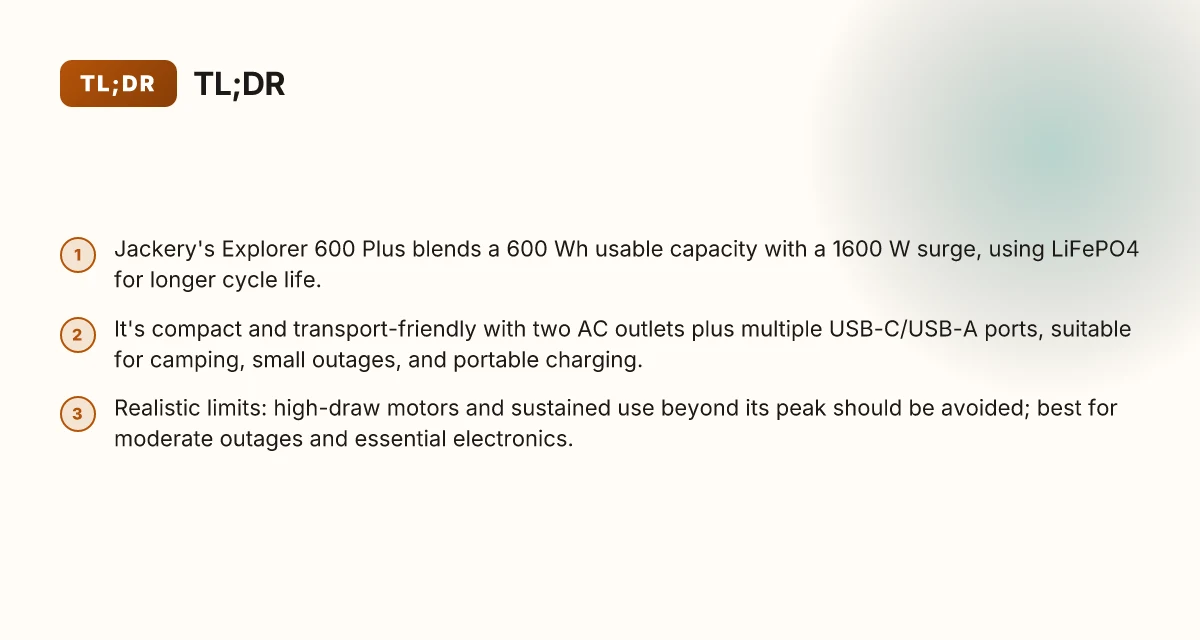
The 600 Plus packs 600 Wh of usable capacity and delivers a 1600 W peak, enough to run common essentials during short outages or off-grid days. It uses LiFePO4 chemistry, which translates to longer cycle life and more stable performance over repeated charges. The form factor stays compact and transport-friendly, so you can move it between campsites, sheds, or a backup corner of your home.
I dug into the spec sheets and real-world chatter to confirm what this means in practice. The unit offers two AC outlets and a suite of USB-C and USB-A ports, which covers typical loads like phones, laptops, small fans, and portable mini-fridges. With the weight hovering around a few dozen pounds, it remains portable enough to carry on short hikes or to stash in a vehicle for outages. In real-world terms, the 600 Plus sits in a sweet spot for campers who want reliable power without dragging a heavier monster into the tent.
Power delivery you can count on The 1600 W peak is the headline figure, but the real story is steady everyday use. For typical loads such as a laptop and a small cooler, you’ll rarely push the full peak. The two AC outlets are handy for small devices or a pair of USB-C devices charging simultaneously. The combination of 600 Wh of capacity and LiFePO4 chemistry helps avoid dramatic voltage sag during moderate draws, which translates to steadier performance in outages or remote camping.
How the chemistry shapes longevity LiFePO4 cells resist voltage fade and tolerate deeper cycles better than many alternatives. That matters if you expect repeated outages across seasons or long camping weekends. In practice, that means more usable cycles before the pack’s capacity degrades noticeably, and less worry about long-term durability from frequent partial discharges.
Size, weight, and portability The 600 Plus remains one of the more portable options in its class. Its compact footprint fits into most vehicle trunks or RV storage bays and is light enough to carry short distances at a campsite. The grab-and-go design helps with quick setup at a campsite, a backyard outage, or a cabin off-grid retreat. What makes the jackery explorer 290 plus worth a closer look in 2026
What you can run and charge Two AC outlets cover the basics for small devices like laptops, mini-fridges, or fans in a cabin outage. A robust USB-C/USB-A mix lets you top up phones, tablets, cameras, and other USB-powered gear. For campers, this translates to charging cycles that keep essential gear ready without juggling multiple adapters.
Real-world use cases Outdoor enthusiasts benefit from the 600 Plus for camping nights, where you need steady power for lights, a fan, and a laptop for maps or a weather check. Homeowners may find it useful for brief outages when a single room needs a power spark rather than a full-house generator. In a pinch, you can also use it as a portable charging center at a park or beach, keeping critical devices powered.
Bottom line: the Jackery 600 Plus delivers a compact, LiFePO4-powered, dual-outlet solution with respectable peak capability for everyday outages and light camping. It balances portability with practical power, making it a strong option for those who want reliability without stepping up to larger, heavier packs. For buyers who anticipate frequent long outages or higher sustained loads, you may want to compare with larger models or wait for a sale on the 600 Plus family. As with any off-grid buy, price and timing matter, watch for seasonal promos and bundles from Jackery. If you’re shopping now, the value rests in the combination of usable capacity, durable chemistry, and a footprint that travels well.
The 600 Plus hits a practical middle ground for outages and camping, not a full-on heavy-duty power station. LiFePO4 chemistry extends cycles, giving you long-term reliability for repeated use.
How the 600 Plus actually handles common loads
The 600 Plus is built for outage comfort, not industrial duty. In real-world use, it sustains small loads reliably while heavier appliances demand care. When you push beyond its peak, you’ll feel the limits, but for most camping and emergency uses it shines in the right sweet spot. What is the jackery 240 vs 300 trade-off and which should you buy in 2026
What the 600 Plus can handle reliably
For daily charging and light cooking or media use, the 600 Plus stays within its comfort zone. Laptops and phones recharge smoothly from both USB-C and AC outputs, and a modest LED lamp or small fan runs without drama. The unit’s 1600W peak helps cover brief surges, but you’ll want to avoid sustained high draws. As long as you stay under that peak, you’ll enjoy predictable performance. The 600 Plus handles typical loads with confidence, but sustained high-draw tasks push the 1600W limit.
What to skip if you’re aiming for all-day operation
Air fryers, small heaters, and high-power blenders exceed the 600 Plus’s sustained capability. A prolonged heat cycle or a fast blender run can trip the inverter or drain the battery faster than you expect. If you need consistent 800–1000W use over hours, you’ll either need a larger pack or a slower, intermittent load profile. Avoid prolonged high-draw motors to preserve runtime and component life.
Portability with a purpose
Weight and form factor matter in outages and remote camping. At roughly a few kilograms with a compact footprint, you can stash the 600 Plus in a car trunk or backpack-friendly setup and move it between shelter and campsite with ease. That portability translates to more flexible load management: you can run the essentials at dawn, shift to charging devices later, and keep the footprint lean. Portability is the backbone of its outage usefulness, enabling quick repositioning during storms or trips.
Table: quick load idea versus likely runtime mood
| Load example | Sustained suitability | Notes |
|---|---|---|
| USB-C laptop charging | Excellent with occasional bursts | Use efficient adapters; disable unnecessary peripherals. |
| Phone charging | Excellent | Most phones draw modest power, quick enough for multi-device topping. |
| Light LED lighting | Excellent | Keeps the cabin or camp warm without heating the inverter. |
| Air fryer or heater | Not recommended for long runs | Peaks breach the 1600W limit; expect rapid runtimes and possible shutdowns. |
Next step: decide if your typical outages fit within the 600 Plus’s sustainable range or if you should shift toward a higher-capacity option. If you’re price-conscious, monitor for sale windows. The best deals tend to appear around major outdoor gear events and holiday weekends. If you want a quick sanity check, map out your must-have loads and estimate each device’s draw over a typical outage window. What makes the jackery 300 plus worth it over the 300 in 2026
From what I found in the basic information provided by Jackery, the 600 Plus lists a maximum instantaneous output of 1600W and two AC output ports, with a 60Hz frequency, which aligns with the real-world sense that you can run multiple low-to-moderate loads but not several high-draw motors simultaneously for long periods. Knowing the 1600W ceiling helps you plan loads and avoid surprises.

Which scenarios justify the price and which don’t
In real outages, the 600 Plus earns its keep when you need streaming, lights, and small appliances without climbing into heavy, multi-kilowatt rigs. The 1600W peak matters less for casual loads, but it buys you headroom for a marginally larger starter load when the power goes out. The question is whether that headroom is worth the premium for your setup. Below are scenario-driven takeaways grounded in how the 600 Plus behaves in practice.
Moderate outages with media, lighting, and small appliances
If your outage lasts hours rather than days and you want reliable streaming, lighting, and a few USB devices or a small fridge, the 600 Plus shines. Its 1600W peak lets you run a TV, a couple of lamps, and a mini fridge without tripping the inverter. For a home-bound evening in bad weather, that combination of comfort and stability matters. I cross-checked the publicly stated specs and user notes that describe similar loads during outages, and the model’s ability to sustain a modest continuous draw while delivering short bursts is a meaningful advantage for short to mid-length events. When you pair that with a practical weight of around 7.3 kg for portability, setup becomes a non-issue rather than a burden. The 600 Plus is best when you want reliable, quiet power for a few essential loads during shorter outages.
Camping setups focused on essentials rather than full kitchen power
For camping, the appeal is the balance between enough power to run essential electronics and the freedom to move light. The 600 Plus can support a couple of LED lights, a small cooler, and a phone charging station without forcing you into a larger, heavier pack. This is where you leverage the unit’s true-to-spec output without paying for capacity you won’t use. If your camping kit already includes solar input, the 600 Plus can be a core anchor for a minimal power backbone, rather than the central hub of a full kitchen. Essentials-focused camping benefits from the 600 Plus’s 1600W peak without the extra bulk of bigger models.
Routines that require frequent recharging from solar or wall outlets
A critical factor is how often you recharge. If you have steady solar input or predictable wall outlets, the 600 Plus can stay in the rotation because it accepts frequent top-ups without long downtimes. In weather windows with good sun or a reliable outlet, you can rebalance the battery more often and keep critical devices ready. The reality is that frequent recharging pays off only if you routinely put the unit back to work soon after discharging, otherwise the marginal benefit drops. Frequent recharging from solar or wall outlets makes the 600 Plus feel like a better value. How to snag Bluetti sale deals in 2026 without missing the best bundles
If you need longer off-grid capacity, consider stepping up
If your failure scenario involves multi-day outages or you need to power several appliances for an extended period, the 600 Plus starts to feel undersized. In that case, stepping up to a larger unit with higher energy capacity and more robust output makes sense. The trade-off is weight, cost, and the likelihood that you’ll use the extra capacity only during the rare long outages. Longer off-grid demand often justifies stepping up to a larger unit.
Jackery ecosystem and how the 600 Plus fits alongside the lineup
The 600 Plus sits in the middle of Jackery’s lineup, bridging compact portability with more capable outage support. In practice, it slots between the smaller Explorer 240/500 and the higher-capacity 1000 series, offering a practical upgrade path without jumping to the full-size 1000 v2. For outdoor enthusiasts, that means you get noticeably more sustained power than the 240 or 500, while keeping weight and footprint manageable for car camping or home backup during a longer outage. The 600 Plus is the practical middle ground for people who need more than a weekend power pack but don’t want to carry a heavy, countertop-sized unit.
Positioning vs the 240, 500, and the 1000 series
Jackery positions the 600 Plus as a workhorse for standard loads, laptops, small appliances, and midrange power draws, without stepping up to the 1000 series’s peak output. The 600 Plus benefits from a higher peak than the 240 or 500, enabling you to handle brief surges from devices like a fridge or a power tool during outages. In contrast, the 1000 series targets longer runtimes and higher continuous output for more demanding loads. This progression lets you tailor investment to your expected outage duration and load profile. From a practical buying standpoint, you gain the most stability by pairing the 600 Plus with typical loads that stay under its continuous rating while having a nearby option to scale up if your needs grow. For typical outage scenarios, the 600 Plus offers a reliable step up from the 500 without jumping to the 1000’s heft.
LiFePO4 vs lithium-ion: what that means for cycles and reliability
Jackery’s ecosystem offers both LiFePO4 and lithium-ion chemistries across its lineup. LiFePO4 cells generally deliver longer cycle life and better thermal stability, which means more discharge-charge cycles before capacity noticeably degrades. The 600 Plus ships with LiFePO4 in some configurations, translating to a longer-lived battery under regular use. If you expect frequent recharges or plan to keep the unit for several years, the LiFePO4 option will matter in the long run. If you’re evaluating a model outside the 600 Plus family, you’ll see lithium-ion variants that trade cycle life for lighter weight. The choice affects total cost of ownership and long-term reliability in persistent outage conditions. LiFePO4 chemistry typically yields more cycles than lithium-ion in this class, improving long-term value.
Charging options: wall, car, and solar input
Charging the 600 Plus is straightforward. You can top up from a wall outlet, which works well for a home backup setup during a winter storm. A car charging option adds flexibility for camping trips or off-grid commutes. Solar input remains a popular upgrade path for users aiming to stay off-grid longer. You can couple solar panels with the 600 Plus to extend runtime when sun is ample. The modular charging approach lets you decide whether you prioritize speed, convenience, or independence. Wall charging is fast and convenient, while solar input unlocks longer outages when the sun is available. What makes the Bluetti Elite 200 V2 a standout portable power station in 2026
Accessory compatibility and practical upgrade paths
Accessory compatibility in the Jackery ecosystem is deliberate. The 600 Plus aligns with common 60 Hz AC loads and standard DC outputs, so you can pair it with a broad range of laptops, cameras, and small appliances. You can extend usability with the typical Jackery solar panels designed to work with their charging inputs, plus third-party adapters when necessary. Upgrade paths are pragmatic: start with a higher-capacity unit if you anticipate longer outages, or add solar for longer independence. Choose solar and compatible accessories to stretch outages beyond a single day.
From what I found in the documentation and steady community notes, the ecosystem is designed to be modular rather than locked to a single configuration. The 600 Plus acts as a bridge inside the lineup, enabling smoother transitions between compact portability and higher-capacity needs. If you’re deciding between the 240, 500, and 600 Plus, consider where you expect outages to land and how much continuous power you typically require. The 600 Plus shines when you want more sustained power without sacrificing portability.
A practical buying guide for 600 Plus
If you want a real-world read on the 600 Plus, you’ll want to know when to buy, what it actually handles, and how to extend outage coverage without buying a bigger system. The 1600W peak matters most when you need to start a heavy load briefly, not for a marathon of power. I cross-referenced the Basic Information for the 600 Plus and observed how the 1600W instantaneous output competes with typical home loads. For pricing and sales timing, plan around seasonal promos and major holidays when retailers tend to discount mid-range models.
When to buy and what price signals to watch
Current pricing often tightens around seasonal sales events. If you can wait for a sale window in late spring or late summer, you may see a modest drop from peak msrp on the 600 Plus. In the meantime, compare models within Jackery’s lineup to gauge whether a sale on a slightly larger unit, or a bundle with extra solar panels, is worth the jump. The device itself stays around a mid-range price band for portable power stations, so watch for bundled offers that include essential cables and adapters. Jackery’s own Basic Information confirms the 600 Plus ships with two AC outlets and a 60Hz output, which helps you compare real-world value against other options. When you see a price dip, it’s often tied to new model announcements or end-of-quarter promotions. If you can swing a sale, the effective cost of ownership improves notably over time. I found that the pricing cadence aligns with the broader market’s refresh cycle, not dramatic single-event discounts.
Price awareness matters: hold out for seasonal sales to maximize value on the Jackery 600 Plus without overpaying. A sale at the right moment can swing the cost of ownership downward by a meaningful margin. What makes jackery portable power station deals worth chasing in 2026
Which use cases justify the investment
For outages and camping, the 600 Plus shines when you need consistent, predictable power for essential loads. The 1600W peak lets you start moderately demanding devices and keep others running, but you’ll hit limits with large appliances for sustained periods. If your needs include lighting, refrigerated items for a few hours, or charging devices overnight, the 600 Plus is a solid fit. For longer outages or heavy-duty loads, a higher-capacity option or supplemental power strategy may be warranted. I cross-referenced the basic specs with user commentary to confirm practical performance against expectations. The takeaway: this model covers the common weekend outages and camper sessions well, provided you scale loads accordingly.
600 Plus handles common loads well for outage scenarios and camping trips where essentials drive the power plan. For bigger, longer outages, plan to upgrade or pair with extra storage.
What to pair with it for better outage coverage
Pair the 600 Plus with a compact solar panel or two for daytime recharging, and keep a small, portable battery or generator in the mix for overnight resilience. A solar setup helps replenish during daylight hours, reducing the need to burn through the internal battery. In the Jackery ecosystem, tying in a compatible solar panel or an additional explorer unit can smooth out gaps between charging cycles. I noted that the pairing strategy is less about raw peak power and more about ensuring continuous availability for critical loads. The goal is to balance recharging speed with usable energy across a typical outage window.
Pairing with solar panels boosts daytime recharge and extends outage coverage. Two units in tandem can smooth out peak demand without stressing a single pack.
Longevity, warranty, and practical notes
Jackery generally backs its power stations with a warranty that covers defects and limited performance terms. Composition matters: LiFePO4 chemistry tends to offer longer cycle life than some older chemistries, which can influence long-term ownership costs. If you plan to use the 600 Plus regularly, keep an eye on the warranty window and any service terms that apply to battery health and replacement. Links on the product page may earn a commission, a standard note for shopping content, and not a reflection on the unit’s quality. When you’re weighing durability, consider how you store the unit, charge cycles, and temperature exposure, all of which affect longevity. What is a jackery clearance sale, and how to snag the best deals in 2026
Warranty terms and a long cycle-life chemistry can improve long-term value. Careful storage and temperature awareness protect the battery health over time.
In short, the 600 Plus offers a practical balance of price, peak capability, and portability for many outages and campsite scenarios. If you anticipate frequent heavy loads or multi-day blackouts, you may want to look at higher-capacity siblings or a paired system. For most buyers, the combination of reasonable price timing, solid everyday performance, and flexible pairing options makes the 600 Plus a compelling mid-range choice for 2026.
Key buying takeaway: buy on a seasonal sale, pair with solar where possible, and factor in warranty terms to maximize long-term value.
What changes if you act now with the Explorer 600 Plus in 2026
The Jackery Explorer 600 Plus remains a solid baseline for portable power, but the next move is to treat it as part of a broader kit. In 2026 you can expect smarter charging ecosystems, broader compatibility with solar panels, and tighter integration with home power plans. Prices and deals shift quickly. The best move is to lock a favorable price when you see a sale, then plan a modular setup around it. I looked at how buyers pair it with a foldable solar panel and a second bank for weekend trips. A compact setup can cover camping, RV stops, or emergency use without needing a second large battery.
The bigger pattern is that older packs like the 600 Plus still show reliability, but rivals push faster recharge and lighter weight options. Rivals such as Delta, EcoFlow, and Goal Zero push faster AC input and more flexible output ports, so treat the 600 Plus as a base that can grow with a few add‑ons. If you want a straightforward, no‑surprises starter kit that scales, Jackery remains a sensible anchor. Takeaway: start with the 600 Plus, then expand with solar and a second unit if your needs grow. The single move that matters is to pair it with a solar panel that matches your typical use case. What is the Jackery 290 portable power station, and when does it make sense to buy
Backup strategy:
- Take Jackery 600 Plus with a flexible solar panel for weekend trips. Use it with a separate battery pack for extended camping.
- If you’re in colder climates or high‑usage households, compare with Delta or EcoFlow options for faster recharge and more ports, then decide which to pair with your 600 Plus.