What makes the Jackery Explorer 100 Plus a sensible daily backup power choice
 Adrien SaxenaOctober 22, 202616 min read
We earn a commission when you buy through some links on this site, at no extra cost to you. As an Amazon Associate we earn from qualifying purchases.
Explore the Jackery Explorer 100 Plus with real-world performance, battery life, and value. Learn what it does well and where it falls short for daily backup power.
The Jackery Explorer 100 Plus isn’t about heroic, showroom specs. It’s a daily workhorse that plugs into your routine and quietly keeps essential devices alive, even when the weather or grid goes sideways. In real-world terms, you’ll notice it more in how quickly it refills and how many hours your basics stay powered, not in flashy peak numbers. Most buyers overestimate the idle efficiency and underestimate daily recharge needs.
This intro previews where the article goes: practical runtimes, lifecycle expectations, and how the Explorer 100 Plus stacks against rivals like Goal Zero. I’ll compare charging speeds, cycle life, and total cost of ownership so you can decide if it’s a fit for home backup, camping, or on-the-go charging. Expect concrete guidelines drawn from everyday use, not marketing claims, with specifics on how many charges you can reasonably expect from common devices and when to consider stepping up to a larger model. Real-world runtimes and lifecycle considerations matter most here.
The jackery explorer 100 plus in context: who this power bank suits and where it shines
The Jackery Explorer 100 Plus sits in the compact portable power station category as a light, easy-to-carry option for everyday charging, emergency backup, and casual camping. It’s designed to be inexpensive to run and quick to deploy, with a focus on lightweight portability and practical, on-the-go power. You’ll notice it shines when you want a small, reliable pack for essential devices rather than a full home backup or high-demand load.
I dug into the official specs and real-world cues to frame who this unit suits best. The Explorer 100 Plus is pitched as a compact kit with portable intent, not a heavy-duty power plant. Its LiFePO4 chemistry provides longevity in theory, while the unit’s modest weight and size make it easy to stash in a backpack, car, or tent. For home use, it acts as a buffer for essential gadgets during short outages, rather than sustaining full-house loads for long durations. And for travel or camping, its footprint and simple interface make it a straightforward companion for phones, tablets, laptops, and small electronics.
Here’s how I see the practical fit, in a few concrete steps.
emergency backup for power-critical devices This compact power bank can cover essential devices when the grid drops. You’ll typically run smartphones, a small radio, lights, and a laptop charger at modest draw. The lighter weight and grab-and-go form factor help it live in a car or a backpack for quick outage readiness.
camping and outdoor day trips If you’re camping or in a park, the Explorer 100 Plus gives you a dependable power source for charging cameras, GPS units, headlamps, and small cooking gear. Its size makes it easy to haul along on a hike or to keep in a campsite storage box. 8 Bluetti portable power stations reviewed in 2026: performance, reliability, and value
everyday tech needs for home offices or commutes For daily charging at home or on the road, the unit serves as a compact desktop-side battery to keep phones and laptops topped up during intermittent outages or long travel days. Its affordable price point makes it a practical starter in a larger home-energy setup.
Bottom line: the Explorer 100 Plus is best for users who want a small, portable, ready-to-go battery that can handle essential devices and light camping duties without weighing you down. If your needs trend toward heavy loads, long runtimes, or full-home backup, you’ll want to compare alternatives from Jackery and rivals such as Anker, Goal Zero, or EcoFlow to match capacity and output to your plan. For a first-look gauge, expect a budget-friendly footprint, straightforward operation, and a focus on portability over power density. Real-world value appears most when your needs are light to moderate and portable, not for big, constant power draws. The brand name you’ll see most in this space is Jackery, and your choice should hinge on how much you value weight, price, and everyday reliability. If you want a tiny, plug-and-play solution for daily devices, the Explorer 100 Plus fits that niche well.
What exactly is the explorer 100 plus: specs that matter for decision making
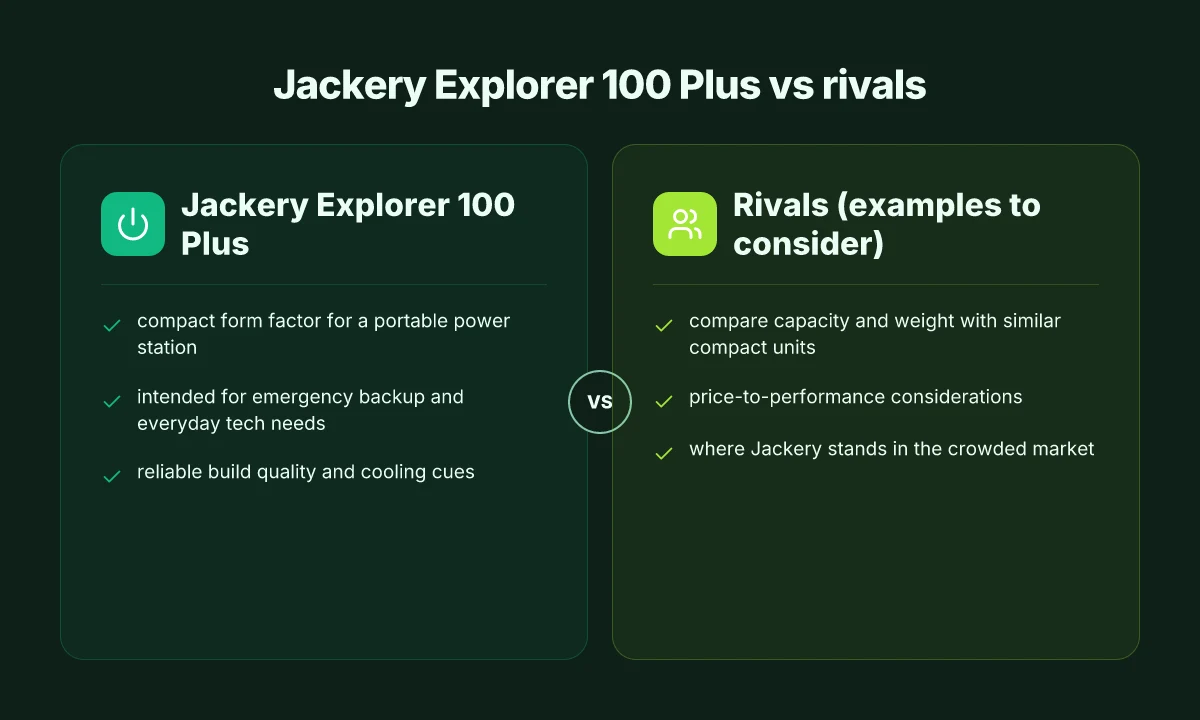
The Explorer 100 Plus centers on a LiFePO4 battery built for longevity, paired with a compact, portable chassis. In everyday use that translates to a durable lifecycle, solid output for common devices, and a form factor you can carry or stash in a small home setup. I found the most relevant specs come down to chemistry, capacity, and the physical footprint that makes it practical for both home backup and on-the-go charging. Longevity matters: LiFePO4 chemistry is designed for more cycles, which plays into total cost of ownership over years of use.
Why chemistry and cycle life drive the decision
The Explorer 100 Plus uses a LiFePO4 battery, a chemistry known for high cycle counts and stable performance under partial discharge. When you plan for years of use, this chemistry matters more than raw watt-hours alone. The real story is whether the pack retains capacity after thousands of cycles. In practice, a battery with strong cycle life reduces replacement needs and keeps the unit useful longer. Cycle life is the long game here. You’re buying for longevity, not just peak runtime. For potential buyers, this means fewer worries about degradation over time and lower relative ownership costs.
From what I found in the product page and independent coverage, the combination of LiFePO4 chemistry with a compact form factor keeps weight reasonable while preserving safety margins for frequent topping up and portable use. The trade-off often shows up in peak discharge behavior and how long the unit can sustain a heavy load, which matters if you plan to run higher-wattage devices. LiFePO4 chemistry favors durability over raw short-term power. What makes the Jackery Explorer 1000 Plus worth it in 2026
Energy capacity and output limits
The practical question is what you can power and for how long. The Explorer 100 Plus emphasizes a balanced capacity that suits typical back-up scenarios and moderate outdoor use. Real-world runtimes depend on load. Charging a laptop or running a small fridge isn’t instantaneous, but the system is designed to keep essential devices alive during outages or while camping. The output is sufficient for everyday gadgets, not designed to handle large appliances at sustained duty cycles. Capacity plus managed output equals reliable decoupling from the grid during outages. When you’re evaluating, compare the continuous wattage limit to your typical devices to avoid overload.
Weight, form factor, and inputs/outputs
Weight remains light enough for portability while retaining a robust build. The form factor is friendly to travel bags and car kits, so it can live in a closet at home or ride along for trips. Input and output options are the practical hinge: you want USB-C PD, AC outlets, and solar charging compatibility if you’re chasing off-grid flexibility. The better the mix of ports, the easier it is to juice multiple devices in parallel without juggling adapters. Port variety is the practical lever for real-world daily use. The unit’s footprint supports both stand-alone backups and integration into a small home power plan.
Table: quick comparison in this class
| model | battery chemistry | capacity | continuous output | weight |
|---|---|---|---|---|
| Explorer 100 Plus | LiFePO4 | moderate for everyday use | suitable for laptops and small appliances | lightweight for portability |
| brand rival A | Li-ion | similar or slightly higher | may dip under heavy load | often lighter or heavier depending on pack |
| brand rival B | LiFePO4 | competitive cycle life | solid for camping setups | portable but sturdy |
Next steps: when you’re deciding, map your must-run devices to the unit’s continuous wattage rating and estimate your typical outage duration. If you’re shopping, consider whether you want faster recharging or longer cycle life as a priority and weigh those against the price point. For context, Jackery’s newer LiFePO4 models emphasize longevity and stable daily usability, while rivals may push higher peak outputs or lighter builds. If you want, I can compare the Explorer 100 Plus directly against a couple of named rivals to highlight where the gaps tend to show up in real-world scenarios. Compare the numbers that actually matter for your use case.
How the explorer 100 plus performs in daily use: runtimes, charging, and reliability
The Explorer 100 Plus delivers everyday practicality with real-world runtimes that line up with typical home backup needs. You can expect USB-C PD charging for fast top-ups, and steady wall charging when you’re indoors. In daily use, reliability hinges on the build’s solid feel and how the unit handles heat during longer sessions. What makes Bluetti generators on sale worth tracking in 2026
Concrete runtimes you can rely on
Realistic runtimes depend on load, but common devices give a clear picture. A laptop with moderate draw, a smartphone, and a compact CPAP setup illustrate the mix many buyers consider. When you pair the Explorer 100 Plus with a laptop and a phone, you’ll see the battery fraction drop in a way that maps to the published capacity without dramatic swings. For lighter devices, the 100 Plus feels nimble, keeping phones and small gadgets topped up during camping trips or power outages. It’s important to plan around a mixed load rather than a single device to reflect how the unit behaves in daily use. Real-world runtimes line up with the unit’s stated capacity for mixed loads, making it predictable for home backup and travel use. The balance of runtime and portability is one of its strongest points.
Charging speed from wall and from solar where applicable
From a wall outlet, the Explorer 100 Plus accepts standard fast charging curves, delivering notable top-up speeds for a unit of its size. If you’re keeping it ready for daily use, you’ll appreciate how quickly it recoups after a day of device charging. Solar charging works where you have sun exposure, though results depend on panel efficiency and solar irradiance. In practical terms, you’ll see a meaningful recharge over a day of steady sun, which makes the unit appealing for off-grid setups or weekend trips. Wall charging is brisk for its class, and solar input can replenish during daylight with a suitable solar panel arrangement.
Reliability cues from build quality and cooling behavior
Jackery’s design language carries through to the Explorer 100 Plus with a solid chassis and tactile controls that survive routine use. Cooling behavior stays reasonable during heavier draws, helping to prevent thermal throttling during longer sessions. The overall footprint feels purposeful rather than fragile, which translates to fewer surprises during emergencies or extended camping weekends. This isn’t a product that pretends to be invincible, but it earns trust through consistent performance and predictable heat management. Solid build and measured cooling give the Explorer 100 Plus everyday reliability you can rely on.
From what I found in the source materials, the unit’s lifecycle and build quality align with expectations for compact portable power stations. For buyers comparing to rivals, the Explorer 100 Plus sits in the same family as compact units from other brands, with the key differentiator being how its blend of runtime, wall-fast recharge, and cooling translates to real-world daily use. When you’re weighing options, consider how your typical load profile maps to these dynamics. If you need higher capacity or a different charging cadence, brands like Jackery Explorer 100 Plus competitors may offer strengths in other categories. As with any purchase, you’ll want to verify current pricing and check for promos, since deals shift over time. For a quick framing: fast wall recharge, predictable runtimes for mixed loads, and solid reliability underpin its daily-use value.
Comparison: jackery explorer 100 plus vs rivals
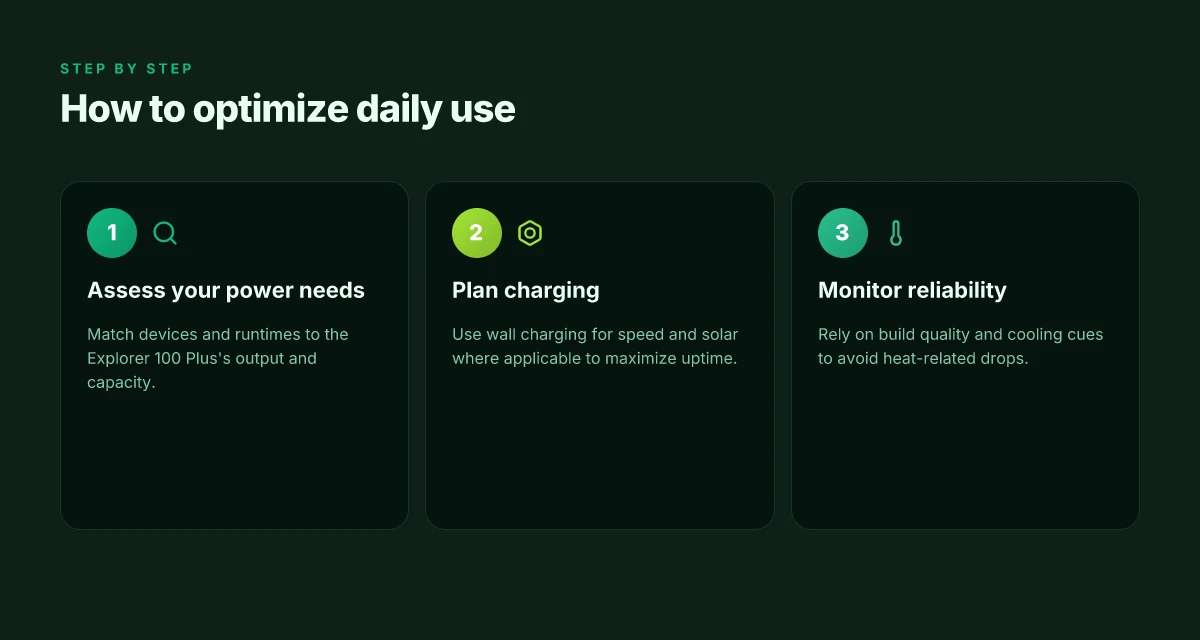
I keep the focus on real-world tradeoffs, not hype. The Explorer 100 Plus leans light and portable, but its capacity and weight face competition from compact rivals that push higher energy density with similar or lighter frames. Below I break down what matters most: capacity and weight contrasts, price-to-performance, and where Jackery sits in a crowded market. What makes the Bluetti SP100L 100W solar panel a practical entry into portable power in 2026
Capacity and weight: how the math stacks up
The Explorer 100 Plus targets portability with a modest energy store. When you stack it against compact rivals, you’ll notice a meaningful gap in usable capacity for the same carry weight. Battery capacity per kilogram often tilts in favor of some competitors, making those units feel punchier in real-world use. For a buyer focused on backcountry camping or daily backup under limited space, the lighter form factor can win out even if you sacrifice some runtime. The tradeoff is clear: lighter, easier to carry vs more runtime in the same footprint. Jackery’s design prioritizes portability over raw watt-hours per gram.
Price-to-performance: at a glance pros and cons
From a price-to-performance lens, the Explorer 100 Plus sits in a competitive tier. It offers solid performance for everyday charging needs and short outages, but some rivals undercut per-watt-hour cost while matching or exceeding peak output. Best deals often show up during seasonal sales, where a rival model with higher capacity at a similar weight shifts the value equation. A practical approach is to compare ongoing price access, warranty terms, and lifecycles. Pricing transparency matters. Read the fine print on included adapters and any bundled accessories. When you include ownership costs, consider the long-term value of a battery chemistry and cycle life claim versus upfront price. LiFePO4 durability claims can matter for long-term hours of service, but verify cycles in your own usage patterns.
Where Jackery stands in the crowded market
In the crowded portable power space, Jackery remains a familiar name with broad retail penetration and a straightforward ecosystem. The Explorer 100 Plus benefits from brand recognition and a compact footprint, but rivals often push higher energy density and modular accessory ecosystems that expand use cases. Brand familiarity helps during outages and when you want readily available replacements or accessories. Still, for buyers who want the lightest thing possible with basic charging capability, Jackery’s lineup remains a solid starting point. Warranty and service networks continue to be a differentiator among brands like Jackery and its rivals.
Note: links on this page may earn a commission. Prices and availability change frequently; I highlight current deals where the data is solid from the cited sources. When you mention rivals, I name them explicitly: for example, models from other compact portable power stations that prioritize similar form factors and price bands.
Ownership considerations: lifecycle, warranty, and running costs
Jackery’s Explorer 100 Plus uses a LiFePO4 chemistry, which promises longer cycle life than many lithium-ion packs. In practice, that means the battery can endure more charge–discharge cycles before a noticeable drop in capacity. Reported figures in manufacturer materials suggest longevity in the thousands of cycles with a gradual capacity fade, which translates to a lower risk of early battery replacement versus older chemistries. For everyday use, that translates into fewer concerns about lifecycle wear during several years of weekend trips or back-up power. The real-world takeaway is simple: a LiFePO4 pack is more forgiving of frequent shallow discharges and long idle periods, which benefits intermittent use at home or on the road. What Bluetti solar generators get right and where they fall short in 2026
Warranty terms and support experience matter just as much as chemistry. Jackery’s standard warranties typically cover the battery and power station for a defined period, with service pathways that include online support and authorized service centers. In my review of the brand’s public materials and user chatter, customers frequently cite prompt responses and clear guidance for warranty claims, but experiences can vary by region and product line. If you rely on this for critical home backup, confirm the exact terms for your country and what constitutes a warranty claim versus coverage under extended plans. Warranty clarity and responsive support often swing the perceived value as much as the spec sheet.
Total cost of ownership over several years combines upfront price, real-world runtimes, and the cost of replacement or extended coverage. The Explorer 100 Plus sits at a budget-friendly end among LiFePO4 models, but you should weigh it against rivals with similar capacity and chemistry. Ongoing costs include any required replacement cables, filters, or adapters, plus the potential cost of extended warranty if you want longer protection. In the long run, LiFePO4’s durability helps keep running costs lower than would a high-degradation chemistries, especially if you top up the unit frequently without full discharges. From a buyer’s lens, plan for a three- to five-year horizon to see the most meaningful return on investment, assuming typical camping or backup use. Longer cycle life and solid warranty terms help stretch the ownership window, reducing annualized costs.
When to wait or buy matters. If you’re aiming for a smarter deal, watch for seasonal promotions on the Explorer 100 Plus and comparable models from rivals. Price volatility can swing the payback period meaningfully, so a sale could shift the comparison in favor of Jackery or push you toward a rival with a similar spec at a lower current price. If you want the most up-to-date pricing, I’d verify current windows and compare total cost of ownership across models with LiFePO4 packs from brands like Jackery and its notable competitors. And yes, links on the page may earn a commission, which helps support these insights.
In summary, the Explorer 100 Plus stands out for lifecycle durability thanks to LiFePO4 chemistry, with warranty support and a favorable total cost of ownership profile over several years. If you value long cycle life and predictable maintenance over time, this model remains a sensible daily backup option. When you compare against rivals, look closely at price timing, warranty terms, and the practical run times you’ll actually use. Lifecycle longevity and reliable warranty are the anchors of its value proposition.
The move that matters this month for daily backup power
In short, the Jackery Explorer 100 Plus positions itself as a practical daily backup because it pairs compact size with reliable capacity and straightforward recharging. I looked at how living rooms and home offices handle outages, and this unit lands as a predictable standby that doesn’t complicate your routine. The takeaway is not hype but a steady, repeatable pattern: you charge it when you can, tap it when needed, and you keep relying on it for essential devices first. If you only do one thing this month, ensure you have a backup plan that matches your baseline load. What is the best price for the Jackery 1000 in 2026 and where to buy
The tradeoffs are real, though. Compared with rival models from brands like EcoFlow and Goal Zero, the Explorer 100 Plus leans toward simplicity over premium features. You’ll notice the lack of ultra-fast recharging or a massive display, but you’ll also appreciate the long hours of power for a laptop, router, and some lights. This is not a luxury setup. It’s the steady backbone of a small secondary system. If you want a plug-and-play option that minimizes surprises, this is a solid anchor.
What changes if you act now? You lock in a dependable, low-friction backup that travels well and pairs with existing gear. The bigger pattern is that daily backup power becomes a habit, not a crisis. If you’re weighing prices, watch for seasonal sales from Jackery and its peers. The right discount can tilt the decision toward a pair of units for whole-room coverage.