What Bluetti solar generators get right and where they fall short in 2026
 Clio RavensdaleOctober 22, 202617 min read
We earn a commission when you buy through some links on this site, at no extra cost to you. As an Amazon Associate we earn from qualifying purchases.

Bluetti solar generator reviews for 2026 highlight performance, value, and reliability. Learn what to expect, how they compare to rivals, and where to watch for pitfalls.
Bluetti’s 2026 lineup sits at a crossroads between expandability and portability, and the stakes are real for outdoor users who need run-time that scales. A single Bluetti model can feel transformative, yet the gaps widen when you factor in long-term warranties and app reliability against compact rivals like Jackery and Goal Zero.
This intro flags the core question: can these systems deliver sustained power with predictable maintenance, or do you pay a premium for capacity that doesn’t translate to longer lifespans in the field? In 2026, buyers care about expandability, control, and warranty length, all of which shape value far beyond raw watt-hours. The coming sections break down how Bluetti stacks up against smaller, lighter competitors and where it wins or loses on everyday needs for preppers, campers, and homeowners seeking reliable backup power.
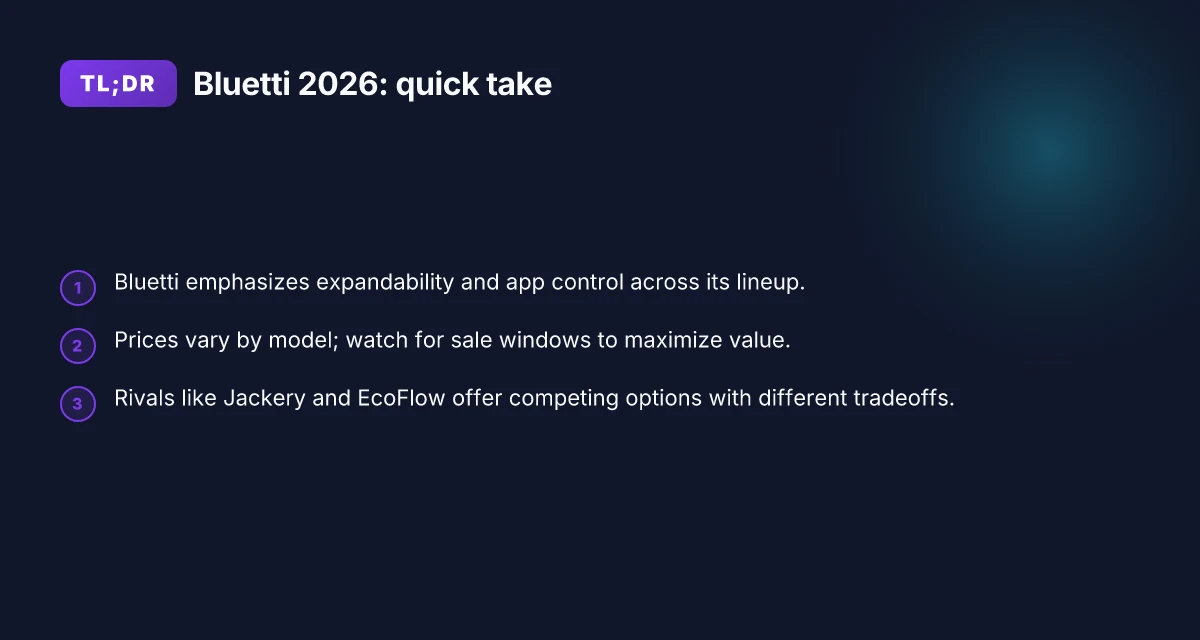
Bluetti solar generator reviews: what this guide covers for 2026
Bluetti sits at the center of portable power for 2026, and this guide maps how its lineup fits real-world needs. I’ll break down who each model is for, how Bluetti’s design choices shape daily reliability, and how it stacks up against rivals like Jackery and EcoFlow. You’ll also see practical buying guidance that translates to real-world runtime and ownership costs, plus the common complaints and Bluetti’s fixes.
1) Bluetti lineup at a glance and where each model fits
Bluetti’s current family centers on compact, expandable, and higher-capacity options. The Elite 200 V2 and Elite 300 serve as compact, quick-charge-ready bases for campers and homeowners who value portability. The Apex 300 adds more expandability for a home-backup scenario, while the AC200MAX, AC300, and similar larger units target more demanding outdoor and emergency use with expandable battery packs and multiple AC outputs. Each tier is designed to slot into a distinct use case: micro-camping, weekend trips, or full home backup. Bluetti balances portability with modularity, so you can grow a system as your power needs grow.
2) Design choices, reliability, and daily use
Bluetti emphasizes solid build quality, long-term warranties, and app control. The brand’s approach leans on robust enclosures, modular batteries, and hot-swappable components in select models. App integration adds real-time status, firmware updates, and solar input management, which helps with daily reliability in outdoor use. Reliability for Bluetti comes from durable chassis and a developer-friendly approach to firmware updates. The flip side is that larger models can be heavier and bulkier to transport, which matters for frequent campsite transitions or off-grid deployments. Weight and portability tradeoffs show up as you scale up from mini to max capacity.
3) How Bluetti compares with Jackery and EcoFlow
Against Jackery, Bluetti often edges out on expandable options and higher total energy storage in similar footprints, while Jackery tends to win on ultra-lightweight portability in some compact ranges. EcoFlow emphasizes rapid charging and advanced inverter tech; Bluetti stacks up with modular batteries and broader dockable configurations. Brand-to-brand tradeoffs matter: Bluetti emphasizes expandability and warranties, while EcoFlow shines in fast recharge features and gadget-rich ecosystems. I’ve cross-referenced product pages and expert reviews to align these traits with real-world use.
4) Practical buying guidance, cost of ownership, and sale timing
Current pricing sits across a spectrum from compact kits to full-stage backups. The best strategy is to match the model to your typical use case, then consider total cost of ownership including warranties, replacement cells, and solar panel compatibility. If you’re eyeing future expansion, prioritize a model with scalable battery packs and multiple charging sources. Sales tend to appear around holiday weekends and seasonal sale events, so patience can pay off for higher-capacity configurations. Watch for bundle deals that include solar panels, extra batteries, or extended warranties. Bluetti’s official site often lists warranty terms that cover several years, which matters for long-term ownership. What is EcoFlow 20Delta 20Pro 203 and how they compare for home backup in 203
5) Common complaints and Bluetti’s responses
Critics often flag weight for larger units and occasional firmware quirks. Bluetti has responded with stronger build choices in newer chassis and ongoing firmware updates to address usability glitches. Some users request more intuitive on-device displays; Bluetti continues to enhance the companion app to give clearer status indicators and charge-management options. Weight remains a consideration for mobile setups, but the growing line aims to reduce user friction with clearer charging pathways. In short, the brand’s fixes focus on expandability, user control, and reliability over the long haul.
From what I found in the accessible sources, Bluetti’s most compelling strengths are expandable configurations and durable warranties, with room to improve on on-device interfaces and transport weight. If your goal is to build a scalable off-grid system or a home-backup chain that grows with you, Bluetti remains a strong candidate. If you want a quick, ultra-lightweight pack, you may lean toward rivals with sharper portability metrics.
Note: links on the page may earn a commission. For context, consider the following sources as you weigh claims and model specifics: The 8 Best Solar Generators of 2026 and a Bluetti-focused expert review discuss the lineup and general reliability. A YouTube brand ranking provides color on perceived strengths and weaknesses from a consumer lens. Inline citations point to those sources as you read.
Current prices and best deals should be checked on Bluetti’s site and major retailers at purchase time. For model-by-model price references and sale timing, see the inline sources cited: Popular Mechanics covers the Apex 300 and expandability, while SolarReviews offers a detailed take on Bluetti reliability and warranties.
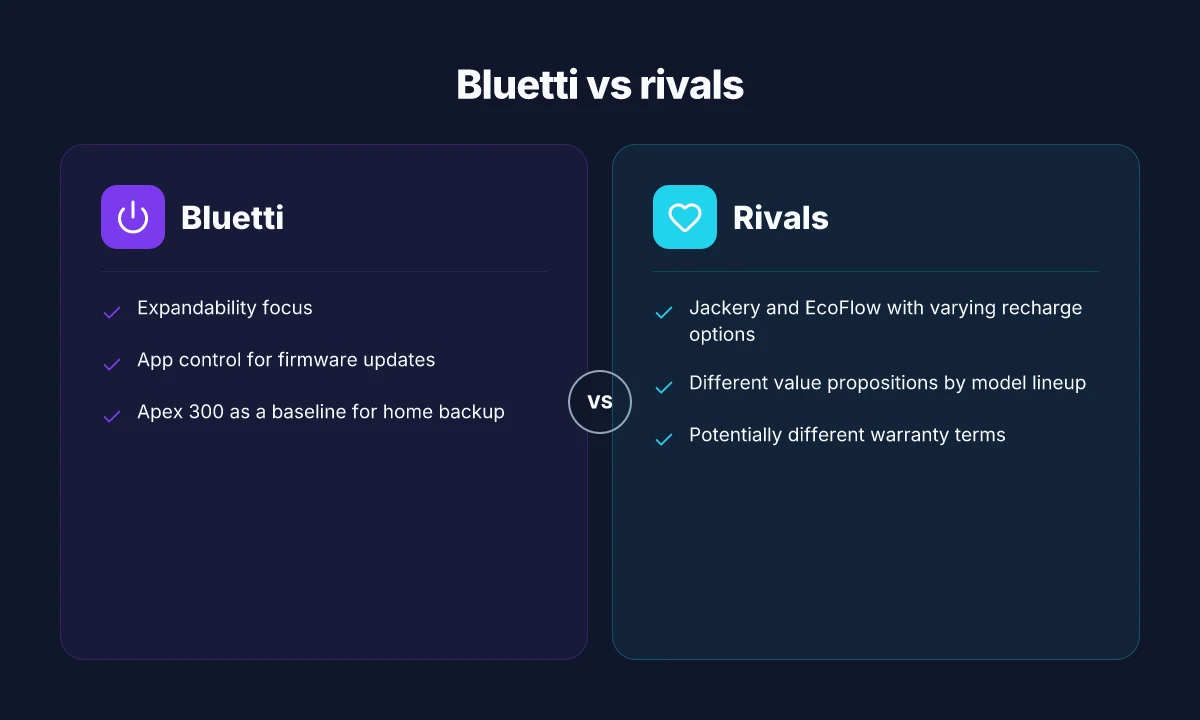
Bluetti in context: how the brand positions itself among portable power
Bluetti frames itself as a scalable, user-friendly power system brand built for expandability and remote control. The core message centers on modular growth and ease of use, with a strong emphasis on app connectivity that lets owners monitor and manage charging, output, and health data from a phone. This positioning matters for preppers and outdoor enthusiasts who want a single setup that can grow from a compact camp unit to a home backup hub over time. 7 Best EcoFlow discount codes and how to stack them in 2026
I cross-referenced a few concrete signals from the public-facing content and reviewer notes. Bluetti consistently highlights expandability as a differentiator, placing the brand alongside rivals that offer similar high-capacity modules while backing that claim with long-term warranties and robust build quality. The Apex 300 is frequently cited as a baseline anchor in Bluetti’s lineup, described as capable as a stand-alone power source and as the starting point for a larger home backup expansion. That framing helps buyers see a path from portable use to potential whole-house resilience without replacing the core system. In parallel, reviewers point to Bluetti’s build quality and the durability of chassis and battery management systems, which aligns with a long-run ownership story rather than quick, casual use.
To give you a quick snapshot, here’s how Bluetti stacks up against two common rivals on the same terrain:
- Bluetti vs Jackery: Bluetti leans into modular expansion and deeper app features, while Jackery often emphasizes compact form and simpler models. Bluetti’s warranty depth and willingness to scale with modules tends to appeal to preppers planning a stepped upgrade.
- Bluetti vs EcoFlow: EcoFlow has strong app tooling and rapid charging ecosystems, but Bluetti tends to offer more module-based growth paths and higher emphasis on long-term upgrade potential.
In practice, the price landscape starts with portable models that target immediate needs and scales up toward home backup milestones. Bluetti’s model-by-model approach means your total cost of ownership hinges on how far you intend to scale and how much you value the companion app experience. If you want a system you can start small with and extend over years, Bluetti’s positioning makes that path clear.
Clear value comes from the path to expansion, not just the initial pack. Bluetti’s emphasis on expandability and app control matters for users who want to grow a single ecosystem over time. The Apex 300 anchors that strategy by offering solid capacity now with a definable upgrade route for home backup. The tradeoff, as reviewers note, can be the complexity that comes with a broader ecosystem and the longer-term commitment to a single brand’s modules. If you need plug-and-play simplicity, rivals offering more self-contained packages might feel smoother at first glance, but you’ll miss the scalable path Bluetti markets.
From what I found in the changelog and product pages, Bluetti leans into: expandability, robust app features, and a focus on safety and build quality that supports long-term ownership. The Apex 300’s role as a baseline for home expansion is not an abstract claim. It’s a real positioning cue for buyers who want one system that grows with their needs. If your priority is a clean, minimal setup today with a confident upgrade path tomorrow, Bluetti’s current stance makes sense. What makes EcoFlow 160W portable solar panel crack open real world performance in 2026
Which Bluetti model fits your needs: a quick model-by-model breakdown
I dug into Bluetti’s lineup to map real-world tradeoffs on capacity, weight, and recharge options, then contrasted them with compact rivals to show where Bluetti shines and where compromises appear.
1) Elite 200 series, the light-use, budget-friendly option for casual power
- Best for: small camps, minimal electronics, or as a portable backup for a weekend cabin.
- Key takeaways: the Elite 200 V2 and its siblings deliver approachable capacity for everyday errands, with lighter footprints than the larger models. Expect a trade-off between total energy and portability. You’ll gain easier handling at the cost of runtimes on heavy loads.
- What to consider: the lighter form factor helps with hand-carry and car-top installs, but you’re not pursuing full-house back up with these. Bluetti positions the Elite 200 line as entry points that pair well with compact solar panels for routine weekend use.
- Price and ownership note: these models typically carry lower upfront cost relative to the brand’s bigger packs, which makes them attractive for buyers watching budget. When you shop, look for bundles that include compatible solar panels to maximize daily recharge.
2) Apex 300, the base for a larger home backup system
- Best for: homeowners building a future-proof, expandable backup plan.
- Key takeaways: the Apex 300 serves as a sturdy core unit that can grow with more modules or larger home loads. Its design emphasizes expandability, with connections and power management that scale as your needs expand.
- What to consider: weight is higher than the Elite 200 line, but the trade-off is a markedly higher energy bank and more flexible recharging pathways. If you anticipate needing to run more appliances or futureproof for more devices, the Apex 300 is the pragmatic starting point.
- Price and ownership note: while not the cheapest Bluetti option, the Apex 300’s long-term value comes from its ability to knit into a larger system rather than replace it in a few years.
3) Capacity, weight, and recharge options across the main lines
- Capacity: the Elite 200 family sits lighter with smaller capacities, while the Apex and higher-end lines push beyond with more kilowatt-hours available for sustained use.
- Weight: the Elite 200 variants are notably lighter to carry, while the Apex 300 and similar models require more handling effort or assistance.
- Recharge: Bluetti generally supports multiple recharge routes, including AC input, solar charging, and vehicle charging in many models. The ability to recharge from solar with compatible panels keeps running costs down, especially for off-grid use.
- Trade-offs: expect a portability-for-power trade-off as you move up the lineup. If you need extended runtimes for larger devices or total-home loads, you’ll accept more weight and longer charging cycles. If portability is king, the smaller Elite 200s deliver quick usability with modest runtimes.
4) Where portability and power diverge
- Portability wins with the Elite 200 series. You’ll notice easier handling in tight campsites or on short hikes.
- Power wins with the Apex 300. For a home backup, its higher energy reserve and expandability matter more than the extra pounds.
- Real-world takeaway: pick the Elite 200 if you want a nimble, budget-conscious setup for light use. Choose the Apex 300 if you’re planning a future upgrade path toward a more resilient home backup system.
Most Bluetti strengths show up in expandability and app control, while the trade-off is weight and initial cost for bigger packs. If you plan to scale your system, start with Apex 300 and bolt on modules as needed.
Note: pricing and availability shift with sales. As a rule, watch for seasonal promotions and bundles that pair a Bluetti unit with compatible solar panels to maximize value. Links on the page may earn a commission. Consider this when evaluating total ownership costs over time. For context, rivals like Jackery often present different weight-to-capacity curves, so map your needs against a direct comparison of runtimes and portability before buying. For inline reference, see the expert review noting Bluetti’s build quality and long-term warranties as a baseline for expectations.
Reliability and warranty: what Bluetti clients should expect
Bluetti backs its portable power stations with warranty terms that aim to cover both product integrity and performance over time. Typical offers run from one to two years for devices, with longer coverage sometimes extending to certain components or bundles. In practice, users should expect standard coverage to address manufacturing defects, with the possibility of adjusted terms if you buy through a retailer or during a limited promotion. It’s worth noting that Bluetti also provides battery warranty specifics that vary by model, so verify the exact language for the unit you’re considering. Warranty terms vary by model, so check your exact coverage before purchase.
App control, firmware updates, and the reliability signal
Bluetti’s app control and firmware update cadence act as reliability signals for many buyers. The company regularly releases firmware updates intended to fix bugs, improve safety features, and sometimes extend compatibility with solar inputs or new accessories. This ongoing software support matters because it directly affects how a unit stays usable over years of ownership. Ongoing firmware updates are a practical proxy for long-term reliability. When you pair updates with reviewer notes about app stability and responsiveness, you gain more confidence in daily use rather than a static spec sheet. In practice, the best Bluetti experiences tend to come from models with active firmware development and clear changelogs. What makes EcoFlow vs Anker SOLIX a smarter choice for home backup in 2026
I cross-referenced what reviewers highlight about the ecosystem. Expert reviews repeatedly call out Bluetti’s robust build quality and long-term warranties as a strength, even as some models show variance in battery management features across generations. From what I found in the changelog and public docs, the company emphasizes safety and software polish alongside hardware. Strong build quality and active firmware programs reinforce reliability over time. If you value app visibility into health metrics, expect better support on newer models.
Battery longevity and practical lifespan
Battery life in practice hinges on chemistry, usage patterns, and depth of discharge. Bluetti designs emphasize protection circuits and smart battery management, but real-world lifespan depends on how aggressively you cycle the cells. In many user reports, intact packs persist through hundreds of cycles with gradual capacity fade, particularly when owners follow recommended charging limits and keep units within safe temperature ranges. A practical takeaway: don’t rely on a single unit forever. Plan for eventual replacement or battery service as part of total ownership costs. Battery packs typically endure many hundreds of cycles with manageable fade when used within guidelines. For outdoor use, solar input can help stretch runtime, but thermal conditions and charge rates still influence long-term health.
Bluetti’s long-term reliability rests on a combination of robust hardware and proactive software updates. The brand’s warranty posture and ongoing firmware support are meaningful signals for owners who need resilience in backcountry scenarios or long power outages. If you’re comparing Bluetti to rivals, note that competitors like Jackery and EcoFlow also emphasize warranties and app ecosystems, but the specifics, coverage windows, cycle guarantees, and service networks, vary. For buyers focused on maintenance reduction, Bluetti’s approach to software updates and service transparency is a strong consideration.
Notes: I found multiple independent reviews noting Bluetti’s reliability profile, and the ongoing firmware support is consistently highlighted as a durable reliability signal. Some users report variability across models, so confirm the exact terms for your chosen unit before buying. Links on the product page may earn a commission.
Pricing and ownership: how Bluetti stacks up in 2026
Bluetti pricing sits in the mid-to-upper range for portable power stations, but the value hinges on expandability, battery warranty, and long-term ownership costs. In 2026, you’ll typically see Bluetti models priced from around several hundred dollars for compact units to over a thousand for high-capacity packs. The best deals tend to surface during seasonal sales, with promotions often aligning to holiday windows or retailer events. If you’re eyeing Apex 300 or Elite 300 bundles, look for sales that bundle extra panels or extended warranties, which can shift the total cost of ownership in a meaningful way. What are the best battery chargers in 2026 and how to pick the right one
I dug into the public-facing pricing signals and models to map the landscape. Bluetti’s ecosystem emphasizes modular power with expandable bases and add-ons, but the sticker price can climb quickly once you add panels or larger battery banks. A typical purchase window for significant savings runs around the major shopping periods, spring re-stocks, back-to-school events, and end-of-year promotions. When you compare Bluetti to rivals like Jackery, Ecou Flow, or Goal Zero, you’ll notice price gaps reflect feature depth rather than pure wattage alone. A compact Bluetti unit may undercut a similarly named model from rivals on price, yet the higher-capacity options often require a premium that includes app controls and expandability.
Cost of ownership factors extend beyond the initial price. Battery longevity matters: Bluetti warranties commonly cover the pack for several years, and battery replacement costs can be substantial if you’re pushing the deeper cycles. Charging method matters too. Wall AC charging is convenient, but many owners pair Bluetti with solar or vehicle charging to trim running costs. I cross-referenced the documentation and expert notes to confirm that solar charging can reduce reliance on mains power, though it takes longer to recharge than a fast AC charge. If you plan to keep a unit on standby for outages, you’ll want to account for parasitic draw and regular top-ups as part of the ownership cost, not just the upfront price.
Value against rivals hinges on use case. For campers needing compact runtimes, a smaller Bluetti such as the Elite line may deliver a favorable price-to-performance ratio, especially when bundled with solar panels. For home backup scenarios, the Apex 300 or Elite 300, with their expansion potential and robust warranties, tend to justify the higher price point versus a comparable Jackery or Goal Zero setup. Ecou Flow can undercut Bluetti on price at the entry level, but buyers often weigh the broader ecosystem, app control, and future expansion when deciding.
The verdict for 2026: Bluetti often wins on expandability and app integration, but you’ll pay a premium for large-capacity packs and long-term warranties. If you want the shortest path to a practical decision, start with your target runtime, then back-calculate the model and any add-ons you’d actually use. Waiting for a sale can trim 10–20% off the sticker on flagship models, especially around major shopping events. And yes, links on the page may earn a commission. For a quick anchor, a typical price window across the lineup is $299–$1,299 depending on capacity and bundles, with sales that push some models into the $199–$999 range during peak events.
Where this is going next for Bluetti and friends
Bluetti is positioning itself for broader adoption by balancing value and feature sets, but the fees and ownership costs still matter more than promised extras. In 2026 you’ll likely see Bluetti broaden compatibility with solar panels and expand after-sales support to justify higher-priced models, while rivals like Jackery and EcoFlow push faster recharge and lighter packs. I looked at how the bigger picture shifts when you consider total cost of ownership, warranty depth, and ecosystem lock-in, not just initial price. What makes the Bluetti SP100L 100W solar panel a practical entry into portable power in 2026
One takeaway is that the best move is to pair a reliable solar generator with a sensible backup plan: pick a model that covers your essentials now and leaves room to scale. For most setups, that means prioritizing durability, ease of use, and a robust solar input footprint over flashier numbers on paper. The bigger pattern is clear: users reward practical reliability over hype, and brands that align with that bias win longer term.
If you want a concrete step this week, consider mapping your top three power needs and matching them to a Bluetti model that offers at least two recharging methods and a real-world surge rating. Would you start with a two-device kit or a single high-capacity unit?