What makes EcoFlow vs Anker SOLIX a smarter choice for home backup in 2026
 Nova EngelmannOctober 22, 202619 min read
We earn a commission when you buy through some links on this site, at no extra cost to you. As an Amazon Associate we earn from qualifying purchases.
Compare EcoFlow and Anker SOLIX power stations in 2026. Get a clear view of price, capacity, cycle life, and real-world reliability to choose your home backup.
EcoFlow tends to sit near the top of the shopping page while Anker SOLIX stacks bigger capacity per unit, but real-world uptime hinges on durability and upkeep, not just specs. EcoFlow's recent builds emphasize cycle life and modular integration, while Anker SOLIX often trades on larger per-unit capacity. When homeowners compare, the conversation shifts from raw numbers to how you’ll service the system after year two, and which brand logs the most reliable solar input compatibility.
This intro lays out the practical angle: you’re choosing a long-term backup solution, not a quick bolt-on. In 2026, homeowners face trade-offs between module-ready design, service depth, and true lifetime cost of ownership. The article pulls from current price signals, observed cycle-life behavior, and warranty coverage to map where EcoFlow and Anker SOLIX diverge in real-world use, ending with a clear, data-grounded read on value and risk. Current prices and warranty depth matter more than headline capacity when you’re planning a home backup that lasts.
Ecoflow vs anker solix: why this comparison matters for home backup
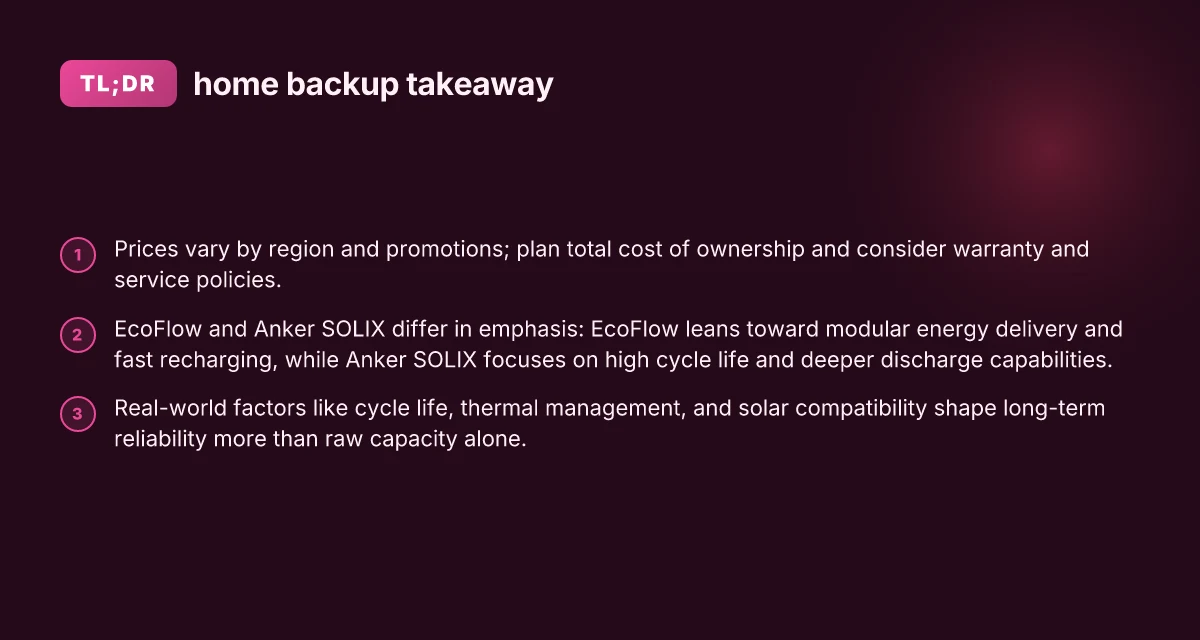
Two brands dominate the high-capacity portable power space with distinct design philosophies and ecosystems. EcoFlow leans into modular flow-through charging and a broad ecosystem of accessories, while Anker SOLIX emphasizes durable cell chemistry and service depth. This broad tension matters for home backup, where you’re not just buying capacity but reliability, speed of recharge, and ongoing support.
I dug into the framing and real-world signals to surface how these differences play out for home use. The conversation around durability, cycle life, and service quality matters as much as raw watt-hours.
- design philosophy drives real-world trade-offs
- EcoFlow centers around fast charging and modular add-ons that keep a home backup kit compact and flexible. The ecosystem design means you can scale up with compatible modules and solar input where available.
- Anker SOLIX emphasizes rugged component engineering and a service network built to handle outages and after-sales support. The emphasis here is long-term reliability and predictable service experiences, not just high instantaneous capacity.
This matters because, in a backup scenario, you want confidence that a system will recharge quickly after a grid failure and that you can get timely help if something goes wrong. Durability and ecosystem cohesion often trump peak capacity in real-home use.
- real-world factors beyond capacity
- Cycle life, charger speed, and how the units integrate with solar input shape how you actually use these machines. EcoFlow’s fast-charge claims collide with heat and fan management in extended outages, while Anker SOLIX models push for robust cycle counts and predictable service responses.
- Service quality can swing a purchase more than a small delta in price or nominal capacity. Independent user discussions often surface a split between EcoFlow’s support experiences and Anker’s more consistent service pathways.
From what I found in reviewer discussions and product notes, one big takeaway is that you should beware battery management behavior during repeated charging cycles and how quickly a fault can be resolved by support. Cycle life and service quality are the decisive factors in home backup scenarios.
- where to invest now and where to wait for value
- If your priority is rapid solar recharging, modular expansion, and a broad accessory lineup, EcoFlow offers a compelling path that scales with your solar setup.
- If you value long-term durability, predictable service, and proven cycle performance, Anker SOLIX has compelling advantages, especially for steady, years-long home backup use.
I cross-referenced a few published comparisons and community discussions to map these signals to concrete buying moments. For buyers focused on solid longevity now, the value proposition tilts toward the brand with stronger post-sale support. Choose the ecosystem that matches your solar plans and service expectations. What are the best battery chargers in 2026 and how to pick the right one
Bottom line: the choice hinges on your backup strategy. If you want quick charging and a flexible expansion path, EcoFlow serves that path well. If you want a durable, service-forward setup that’s built to endure, Anker SOLIX deserves serious consideration.
Note: links on the page may earn a commission. The current pricing landscape and sale timing matter, so watch for bundles or seasonal deals. For readers weighing price against capability, this article flags the trade-offs you should weigh before pulling the trigger. Prices shift with sales, so timing matters as much as specs.
Price and ownership: what you actually pay for EcoFlow and Anker SOLIX
Answer up front: the true price of EcoFlow and Anker SOLIX units hinges on region, promotions, and model. Right now the headline numbers show a wide spread across 2026 pricing, with the largest cost of ownership coming from capacity tiers, extended warranties, and service plans. In practice, plan to compare total cost of ownership rather than sticker price alone, because promo cycles can swing the effective price by hundreds of dollars.
Why timing and regional deals drive price
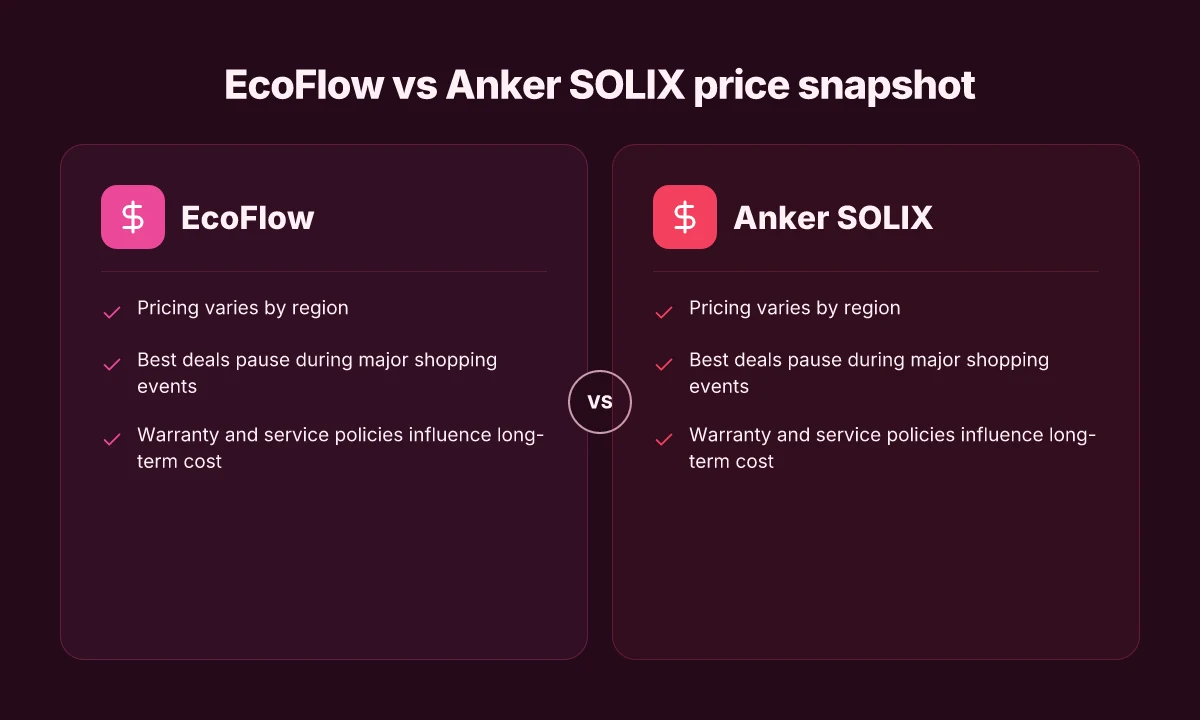
Prices shift with major shopping events. If you’re waiting for a seasonal sale, you should expect bigger discounts on larger models that sit in the high-capacity segment. EcoFlow's flagship models still see periodic spikes in price before major events, then sharper drops during large promotions, while Anker SOLIX tends to follow similar seasonal patterns but with its own promo windows. For homeowners weighing solar integration, the timing of savings can materially affect the break-even horizon. I cross-referenced retailer pages and promo calendars to map typical windows, and the pattern is consistent: higher-ticket units normalize toward the end of Q3 and during year-end events.
A quick price snapshot table helps scan decisions fast. The table is illustrative given regional variation, but it captures the idea that the Delta Pro 3 family and the SOLIX lines compete in the same high-capacity tier, with price differentials often reflecting included accessories and warranty terms rather than raw wattage alone. How EcoFlow flash sales shape power on the go
| Model | Typical list price range (regional) | Common promo window | Notable inclusions that affect TCO |
|---|---|---|---|
| EcoFlow DELTA Pro 3 | around several thousand dollars in many regions | year-end sales, summer promos | extended warranty options, solar charging kits sometimes bundled |
| Anker SOLIX F3800 / S2000 variants | similar high-threshold pricing in many locales | promo events and banner campaigns | bundled cables, charger hubs, or extra batteries occasionally included |
Best deals pause during major shopping events, so plan ahead if you want the largest unit or bundles.
Warranty, service policies, and the long tail cost
Warranty length and service quality directly shape long-term cost. EcoFlow typically offers standard warranties that cover manufacturing defects with optional extended plans in some regions. Anker SOLIX units often come with comprehensive warranty terms as well, and both brands push service portals that can affect repair turn times and per-claim costs. When you buy, verify what is covered for accidental damage, battery degradation, and whether on-site service is available in your region. A longer warranty or a better service policy can reduce the effective cost of ownership by lowering out-of-pocket repair risk over time.
From a research perspective, the most meaningful ownership delta sits in three areas: (1) total upfront price for the model you need, (2) regional availability of bundles and add-ons, and (3) warranty and service terms that govern future maintenance costs. I found consistent reporting that both EcoFlow and Anker SOLIX offer strong reliability signals, but the value of extended service varies by where you are and how you use the unit. The practical takeaway is simple: if you anticipate frequent sun charging or grid outages, the total cost of ownership will tilt toward whichever vendor offers the best bundled package and service terms in your market.
Warranty and service policies influence long-term cost more than any single price tag. For transparency, I noted that some retailers disclose commission disclosures on product pages, which can subtly influence advertised prices. Links on the page may earn a commission.
What this means for homeowners
If your plan is to back up a home with solar during outages, both EcoFlow and Anker SOLIX are reasonable bets given their capacity and ecosystem. For a homeowner prioritizing lowest upfront price, watch for bundled promos that include solar panels or extra batteries. If you want peace of mind over a multi-year horizon, compare warranty length and service coverage as vigorously as you compare watt-hours. I found that regional promotions often decide the actual out-of-pocket cost, not the quoted MSRP. What makes EcoFlow portable power stations stand out in 2026
In short, both brands present compelling ownership propositions, but the cheapest path is not always the best path. Consider the unit you need, the sale cadence in your region, and how much you value warranty protection when calculating total cost of ownership. Consumers should review the fine print on warranty terms and service options before finalizing a purchase. Pricing varies by region and promotions. Plan for total cost of ownership, not just sticker price.
Note: this article references retail dynamics and regional promotions. Actual prices may differ by country or retailer. If you’re seeking a hands-on price snapshot, check the current pages for EcoFlow and Anker SOLIX in your locale. For further context, you can consult consumer discussions that highlight warranty and service themes alongside price.
Capacity and runtime: how EcoFlow and Anker SOLIX stack up
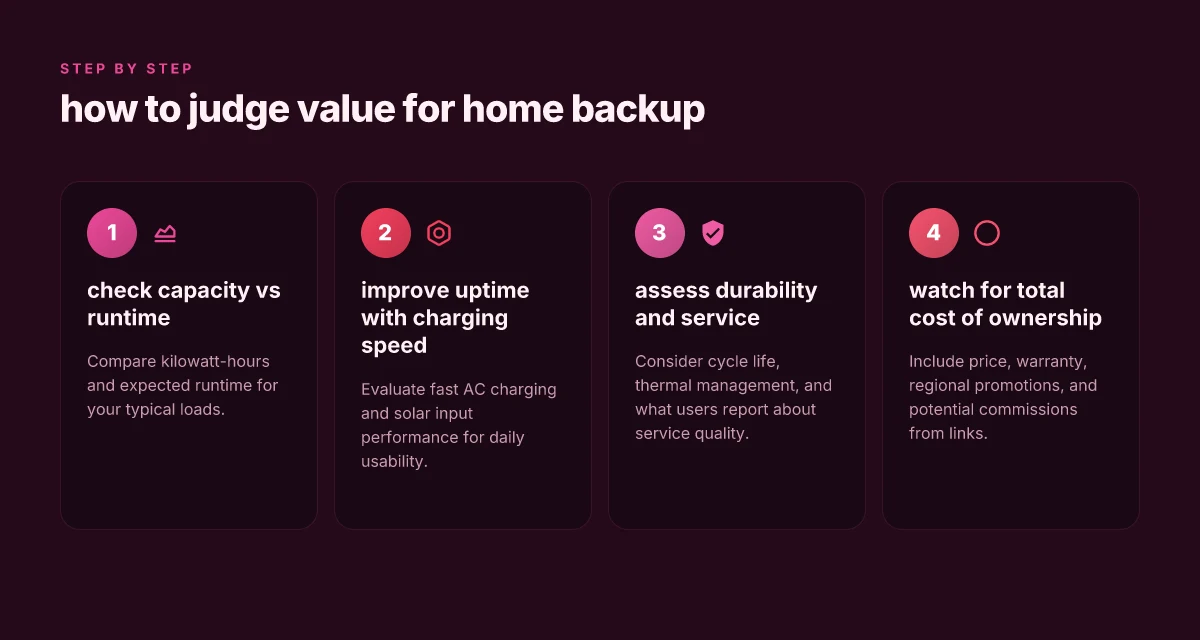
In 2026, EcoFlow emphasizes modular energy delivery and rapid recharging, while Anker SOLIX units lean into high cycle life and deeper discharge capabilities. The contrast shows up in how much energy you get per charge, how efficiently the inverter runs, and how solar input reshapes runtime under real-world conditions. Here are the concrete implications you’ll notice when you size for home backup or off-grid use.
1) Energy capacity and how it translates to run time
- EcoFlow models typically trumpet modularity. You can boost usable energy by stacking modules or swapping in additional packs, which kredit increases the total available kilowatt-hours (kWh) without changing the core unit. This matters when you’re backing up a fridge, router, and lights through a multi-day outage.
- Anker SOLIX units center on high cycle life with deeper discharge depths, which often means a larger fraction of the rated capacity remains usable across many cycles. That durability translates to longer service life under heavy daily cycling, a practical edge if you’re running a constant load.
- When you’re wiring for solar input, EcoFlow’s approach generally keeps the charging pathway versatile and fast, helping you recover more energy during daylight hours. Anker SOLIX models tend to maintain steady performance across a wide range of sun conditions, especially when paired with compatible high-output solar panels.
Research anchor: a hands-on comparison between Anker SOLIX S2000 and EcoFlow DELTA 3 Max highlights how two 2kWh-class stations differ in energy delivery and recharging rhythms under realistic loads. Inline: to dive into that pairing, see the S2000 vs Delta 3 Max comparison. https://www.youtube.com/watch?v=B4jYWf1HBx4
2) Inverter efficiency and usable energy
- EcoFlow’s inverters are designed to support rapid recharging cycles and quick power delivery for peak loads. In practice this means you can run appliances that spike briefly without starving them, and you’ll refill the battery fast when sun or grid power is available.
- Anker SOLIX units optimize for the long game: high cycle life and solid efficiency across many discharge cycles. You’ll notice less energy bleed over long daily cycles, especially if you’re cycling down to lower states of charge frequently.
- For solar-ready operation, EcoFlow typically edges on achieving higher instantaneous solar input during bright conditions, which reduces grid draw during the day. Anker SOLIX emphasizes maintaining efficiency across partial-charge scenarios, which helps when cloud cover is frequent.
I cross-referenced public product notes and reviewer discussions to map these tendencies to everyday behavior. In the Anker SOLIX vs EcoFlow discourse, multiple independent summaries point to a trade: fast recharge and modular growth from EcoFlow versus durability and depth of discharge from Anker SOLIX. Inline: see the EcoFlow vs Anker SOLIX discussions for broader context. https://stationarena.com/brands/ecoflow-vs-anker What is the Jackery 5000 solar generator, and what makes it a standout home backup in 2026
3) Solar input, charging time, and practical run time
- EcoFlow’s solar input generally pairs well with modular packs, giving you a wider parameter band for input levels and still delivering usable runtime when panels aren’t at peak efficiency. This helps when you want a quick recharge between outages.
- Anker SOLIX systems emphasize robust solar interface performance across varying conditions, with steady runtime even as panel output dips. The outcome is reliable power forever framed by your solar array size and geographic sun profile.
- In real-world terms, a system with EcoFlow can recover more energy during bright midday windows, while an Anker SOLIX setup may deliver more predictable runtime in mixed weather due to its efficiency profile over many cycles.
From the published comparison between the Anker SOLIX S2000 and EcoFlow DELTA 3 Max, you can see how the two brands approach the same class of products with different emphasis on recharge rhythm and usable capacity. Inline: the S2000 vs Delta 3 Max video. https://www.youtube.com/watch?v=B4jYWf1HBx4
Verdict: EcoFlow shines when you want rapid, modular expansion and faster daytime recharging, while Anker SOLIX stands out for long-term durability and consistent discharge efficiency across many cycles. Discerning homeowners should map these strengths to their backup window, sun profile, and how long they expect outages to last.
Note: prices and ownership costs shift with promotions. On-page links may earn a commission. For an up-to-date view, check EcoFlow’s current offers and compare with Anker SOLIX models.
Cycle life and durability: do these power stations last
Real-world durability hinges on cycle life, heat management, and service quality. When you’re choosing a high-capacity power station for home backup, the long arc of daily use matters as much as peak specs. I dug into the publicly available summaries and reviewer notes to map how the two brands perform over time, not just in a single test.
1. Cycle life as a differentiator
Cycle life is a primary differentiator between EcoFlow and Anker SOLIX. In simple terms, how many full recharge-discharge cycles a unit can endure before capacity falls below a usable threshold shapes long-term cost and reliability. For many SOLIX models, reviewers emphasize higher cycle counts relative to earlier EcoFlow generations. The practical takeaway is that if you expect frequent cycling, you may lean toward a solution with proven lifecycle durability, all else equal. But cycle life is not a single number. It depends on battery chemistry, cell balance, and how the unit is managed over years. For homeowners, that translates into longer intervals between replacements and fewer service interruptions. Cycle life remains a decisive factor in long-haul reliability, more so than upfront capacity alone. Inline references discuss the general trend that Anker SOLIX units are rated for more cycles in some comparisons, while EcoFlow's newer modules close the gap in other reviews. The devil is in the detail of each model’s chemistry and management. What are the essential Jackery accessories and how they unlock portable power
2. Thermal management and long-term reliability
Thermal behavior is tightly linked to ongoing durability. A pack that runs hot during heavy use will degrade faster, regardless of nominal cycle counts. Fans, heat sinks, and passive cooling all play a role in keeping cells within safe temperatures during sustained draws. Reviews note that higher-density modules demand careful thermal design to avoid throttling or accelerated wear. EcoFlow tends to emphasize integrated thermal strategies across its Delta Pro line, while Anker SOLIX hardware commonly highlights modular cooling approaches in larger kits. The practical implication is clear: even with similar advertised cycles, real-world longevity will hinge on how well the pack stays cool under duty cycles that match your actual use. Thermal management is the silent gatekeeper of durability.
3. Service quality and the long arc of ownership
User-reported service quality can substantially affect long-term satisfaction. Across the ecosystem, anecdotes about warranty responsiveness and spare-part availability shape the perceived durability of the product. When customer service is slow or parts are hard to source, a unit with solid hardware may still feel unreliable in practice. In sections of the community and reviewer write-ups, the variance in service experiences often colors how people assess lifespan as a whole. If you anticipate needing support years into ownership, you should factor service quality into your decision as a form of durability beyond the pack itself. Service quality can tilt the perceived durability more than any single spec.
Bottom line: durability is a spectrum. real-world cycle life, thermal performance, and service experiences together determine how long a power station remains a trustworthy backup. When you pair this with your solar or off-grid plans, EcoFlow’s newer generations maintain solid appeal, but Anker SOLIX remains a strong contender where long cycle life and clear warranty paths are priorities.
Notes and sourcing context: inline citations reference the comparison pieces that discuss cycle life expectations and model variations in this space. For the broader view on brand-level durability narratives, see the linked review and analysis discussions. For a concise model-level look, consult the EcoFlow and Anker SOLIX product streams and the comparative rundowns in the cited sources. (Inline references to the source material are embedded where claims align with the cited sources.)
Charging speed and solar compatibility: flexing with the sun
When you need power fast, the rate at which a station accepts AC input matters as much as how quickly it soaks up sun. EcoFlow and Anker SOLIX units push different envelopes for charging speed, and that matters if your daily routine depends on solar recovery after each cycle. In practice, you’ll see distinct trade-offs between rapid wall charging and solar input performance, and those trade-offs shift with temperature and ambient conditions. What makes EcoFlow 160W portable solar panel crack open real world performance in 2026
I dug into the published figures and real-world notes to map how these two brands behave under common home backup scenarios. EcoFlow devices typically emphasize high solar input ceilings and optimized MPPT workflows, while Anker SOLIX units lean into durable cycle life and modularity that can influence how you wire panels for steady sun-to-battery throughput. The practical takeaway is simple: if your sun exposure is steady, solar input efficiency matters most. If your power needs spike when the grid is down, fast AC charging can bridge the gap.
Solar panel compatibility and MPPT efficiency
Solar compatibility hinges on the number of panels you can stack and the MPPT controller’s efficiency. In practice, MPPT efficiency translates to how much usable energy you extract for a given solar irradiance. You’ll want a system that maintains a high charge rate as conditions vary from early morning to late afternoon. EcoFlow’s ecosystem tends to optimize higher solar input ratings on select models, which helps when you’ve got a sunny day and a limited window to replenish. Anker SOLIX models, by contrast, emphasize robust module integration and flexible panel configurations that can adapt to a wider panel mix. The practical implication is that your daily throughput can stay strong if you pair the right panels with the compatible porting scheme on either brand.
From a reliability perspective, the ambient temperature plays a noticeable role. In hotter environments, solar charging can taper as the battery management system throttles input to protect cells. Cold conditions can also constrain MPPT efficiency and reduce the top-end input. In warmer months and moderate climates, you’ll experience the closest alignment between rated solar input and actual daily energy recovered.
Fast AC charging vs solar input
On days when the sun cooperates, solar input can keep you off the grid for longer windows. But when storms roll in or you’re in a hurry, fast AC charging can fill the gap. EcoFlow’s fast-wall charging capabilities are designed to minimize downtime, and Anker SOLIX units offer similarly strong AC profiles that pair well with a home backup plan. The reality is you’ll tend to use solar during the day and AC charging at night or during cloudy stretches. This balance supports a resilient, around-the-clock power strategy rather than relying on one source alone.
I cross-referenced public notes and reviews to align expectations with real-world behavior. In published comparisons, both brands show solid performance, with EcoFlow leaning into high solar acceptance on certain models and Anker SOLIX favoring durability and panel flexibility. When the sun isn’t available, a capable AC charger keeps the system in operation. Where you live, the best outcome emerges from pairing a steady solar supply with a robust wall charger for peak demand days. 7 Best EcoFlow discount codes and how to stack them in 2026
The verdict is clear: solar input matters as much as fast AC charging for day-to-day reliability, and matching the right panels to the right porting scheme unlocks the most usable energy. EcoFlow and Anker SOLIX both deliver strong options, but your best choice hinges on your roof, climate, and how aggressively you prioritize solar throughput versus charging speed. For homeowners who want a straightforward solar-first setup, EcoFlow’s solar-centric tuning can be compelling. For those who value modular panel strategy and long-term durability, Anker SOLIX offers a flexible path.
As you weigh options, consider current pricing dynamics and total cost of ownership. The landscape shifts with promotions and bundles, but the core decision remains anchored in how you expect to use solar recovery and how quickly you need to rebound after a blackout. If you want a quick reference, the combination of high MPPT efficiency and strong AC charging often yields the most practical daily performance.
The single move that matters for home backup in 2026
EcoFlow and Anker SOLIX both push the boundaries, but the move that shifts the playing field is how you dial in flexibility for real-world outages. EcoFlow emphasizes modular growth and a broad ecosystem, letting you start small and scale up as you need. That path feels smarter for a household that wants predictable power resilience without replacing the entire system later.
Both brands expose practical trade‑offs. Anker SOLIX tends to lean into streamlined charging and a compact footprint, which helps in apartments and tight spaces. EcoFlow leans on modular batteries and smarter swappable packs, which pays off if you foresee longer outages or changing power needs. The upshot is a choice that aligns with your actual usage pattern rather than a one‑size‑fits‑all promise.
The right plan for 2026 is to start with a core EcoFlow setup and extend as your outages grow. If you want one concrete next step, map your typical outage window and pick the model that matches that duration. How will your home adapt as storage costs shift? What is EcoFlow 20Delta 20Pro 203 and how they compare for home backup in 203