What is a jackery battery pack, and how to choose the right one for home backup
 Reese WexlerOctober 22, 202617 min read
We earn a commission when you buy through some links on this site, at no extra cost to you. As an Amazon Associate we earn from qualifying purchases.
Explore jackery battery packs for home backup, including how to choose the right model, real-world use cases, and buying considerations.
A Jackery battery pack is the portable power station you reach for when the grid goes dark or the tent becomes a base camp. Most homeowners underestimate how quickly a few essential devices drain a compact unit, and that miscalculation traps you in a shrinking window of power. A practical start is sizing by critical loads and surge needs, not just total capacity, so you know which model balances weight, price, and resilience.
This article translates capacity, weight, and lifecycle into concrete choices you can make this season. You’ll see how to compare watt-hours against daily usage, how lifecycle cycles affect long-term cost, and how to size a system for continuous operation >24/7 resilience, whether you’re off-grid or keeping the lights on during outages. By the end, you’ll understand when to pick Jackery for portable flexibility versus a larger alternative for sustained power, and you’ll have a baseline to compare rivals like Goal Zero and EcoFlow.Prices and model differences change frequently. Use current listings to verify the best deal.
What is a jackery battery pack, and why it matters for home backup
A jackery battery pack is a portable power station that stores energy in a rechargeable chemistry such as LiFePO4 or related lithium chemistries. It acts as a self-contained power source you can deploy at home or away from the grid, delivering AC and DC outputs for appliances, lights, and charging devices. For homeowners, this means a ready supply of resilience during outages and a practical, quiet option for recreational use.
Three practical use cases shape how you pick a model. First, home backup: you want enough capacity to run essential loads during an outage, with a manageable weight and footprint for your living space. Second, outdoor recreation: you may prioritize lighter weight and faster recharging for weekend trips. Third, emergency power: you’ll value cycle life and reliability so the unit remains usable after many charge–discharge events. Jackery’s product lineup reflects these scenarios, with configurations tailored to different balance points between capacity, weight, and price.
Capacity, efficiency, and cycle life drive real-world performance. A higher watt-hour rating means more energy on tap, but it also usually adds weight and cost. Inflight efficiency, how well a pack uses its stored energy with real appliances, limits how much of the rated capacity you actually deploy before recharging. Finally, cycle life matters for long-term ownership: more cycles translate to more years of use before capacity drops noticeably. When you weigh these factors, you’re sizing for daily resilience: how many outages you can ride out, how much space you’re willing to dedicate, and how much you’re prepared to spend up front.
From what I found in Jackery’s documentation and product pages, some common specs show how a pack can fit a home backup plan. For example, one model lists about a 5040 Wh capacity in a single unit, with a weight around 37 kg, illustrating the typical scale of a home-ready station. Another entry highlights a 1070 Wh capacity with LiFePO4 chemistry and a durable cycle life, indicating that even smaller packs can serve a weekend cabin or garage backup with careful load planning. Across the lineup, you’ll see the recurring trade-off: more capacity usually means heavier, pricier units, while compact models sacrifice energy on hand for portability. The practical takeaway is clear: match the pack’s energy budget to the critical loads you need to sustain and the space you can allocate.
I dug into the official product pages and FAQ entries to ground these claims. The while-you-wait context matters too, because pricing and availability shift with sales and new releases. When a Jackery model advertises a given capacity, you should also consider the total cost of ownership, including charging options and the number of cycles you can reasonably expect from LiFePO4 cells before noticeable degradation. What Lowe's compatibility means for Jackery users in 2026
In short, a jackery battery pack is a portable, chemistry-forward power station that enables real home resilience and off-grid flexibility. The right choice balances capacity, weight, and cycle life to meet your daily routine, outage plans, and budget.
The key is to size for the loads you actually run and the outages you anticipate. Higher capacity costs more upfront but reduces refill risk during extended outages. LiFePO4-based packs emphasize long cycle life and stability under repeated use.
Inline note: links on the page may earn a commission, a common practice in product pages. For context, Jackery’s own pages and FAQs discuss the range of capacities and chemistries used across the lineup, with examples such as a 5040 Wh pack and a 1070 Wh LiFePO4 unit, illustrating the spectrum from portable to home-backup scales. For reference, see the official Jackery product pages and FAQ article.
Assessing capacity: how many watt-hours you actually need from a jackery battery pack
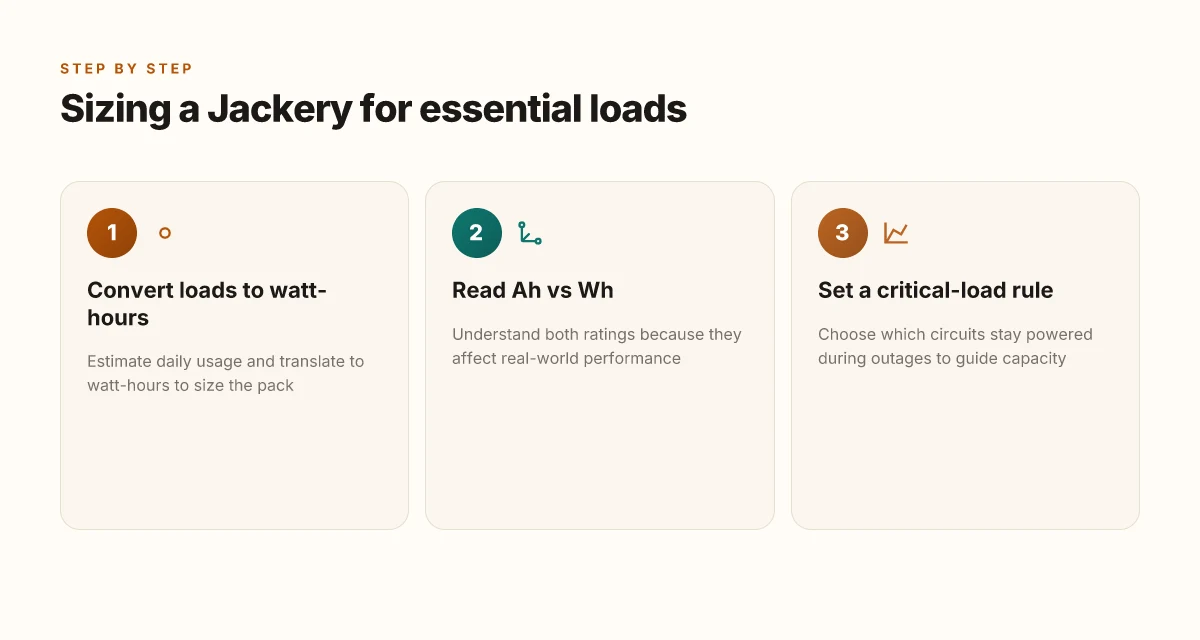
Answer up front: your daily needs determine capacity in watt-hours, not only the labeled amp-hours. Reading both Ah and Wh matters because devices and loads are specified in watts, while many Jackery packs report Ah at a given voltage. Convert a typical 12 V or 24 V load into Wh, then compare that to the pack’s usable Wh to see how many hours you can sustain critical loads during an outage. I found that a clear read of Wh helps you avoid overbuying or underproviding for 24/7 resilience.
Convert loads to watt-hours to map daily use
Your home draws power in watts, but daily consumption is usually expressed in watt-hours. Start with your essential devices: fridge, modem, lights, router, and a small inverter for a sump pump if needed. Estimate each item’s wattage and multiply by the number of hours you run it per day. The sum gives a daily Wh target. In practice, a typical home-critical daily load might land in the few thousand watt-hours range, depending on climate, appliances, and how you sequence use during outages. When you size for 24/7 resilience, you want enough Wh to cover the evenings and overnight without recharging. For off-grid camping, you’ll tailor this to the longest stretch you expect away from shore power. This approach keeps you focused on real use rather than nominal capacity. Know your daily watt-hour target to avoid overshooting or undersizing. 8 Key comparisons in jackery vs 2026 charging tech
Read Ah versus Wh and why both matter
Ah tells you how much charge is stored at a nominal voltage, but Wh reveals actual energy. For example, a pack rated at 1000 Wh can supply roughly 1000 Wh of energy, whereas an Ah rating at a single voltage can be misleading if the voltage differs across models. A higher Ah at a lower voltage may still yield fewer Wh than a model with a higher Wh rating. Because loads vary in voltage and efficiency, you’ll want to multiply the Ah by the nominal voltage to get Wh, then compare to the Jackery pack’s usable Wh. This cross-check matters most when you’re sizing for peak evening loads during outages. Wh directly reflects usable energy, while Ah needs the voltage context.
Rule of thumb for sizing for critical loads during outages
For a dependable critical-load setup, reserve enough energy for the overnight period plus a safety margin. A common rule is to target at least 1.5–2 times your nocturnal Wh need, so you have daytime recharge headroom when you regain power. If you’re evaluating a couple of Jackery models, map each model’s usable Wh to your nocturnal target, then add a cushion for inverter loss and round-trip efficiency. In practice, you might find that a mid-sized pack is enough for a small fridge, Wi‑Fi gear, and essential lighting, while larger home backup configurations push you toward higher-Wh options with multi-day autonomy. Target a 1.5–2× nocturnal Wh cushion for outages.
A quick comparative glance helps. If your critical-load map shows about 600 Wh per night, a 1000 Wh pack gives breathing room, while a 2000 Wh pack covers more devices and longer outages. In the Jackery lineup, you’ll see models advertised in the range of a few hundred to over a thousand watt-hours. Reading Wh is essential to align claims with day-to-day needs. If you’re choosing between options, prioritize the model whose usable Wh matches your nocturnal target plus margin. For homeowners, this framing matters more than chasing the highest labeled Ah.
Next step: build a concrete daily-use table for your home. List each device, its wattage, and the hours used per day. Convert to Wh, sum, and compare against the usable Wh of the Jackery models you’re considering. Then decide whether you need a single larger unit or a pair of smaller packs to meet 24/7 resilience demands. For context, differences in brand ecosystems matter too. If you’re evaluating rivals, look for how their energy density and conversion losses compare to Jackery’s offerings. As you weigh options, I cross-reference official product pages and IFA 2026 notes to confirm energy architectures and battery durability claims. For details on model energy specs, refer to the official product pages and press materials linked in the sources. Wh accuracy beats vague capacity claims.
Weight, size, and portability: what you trade for higher capacity in jackery packs
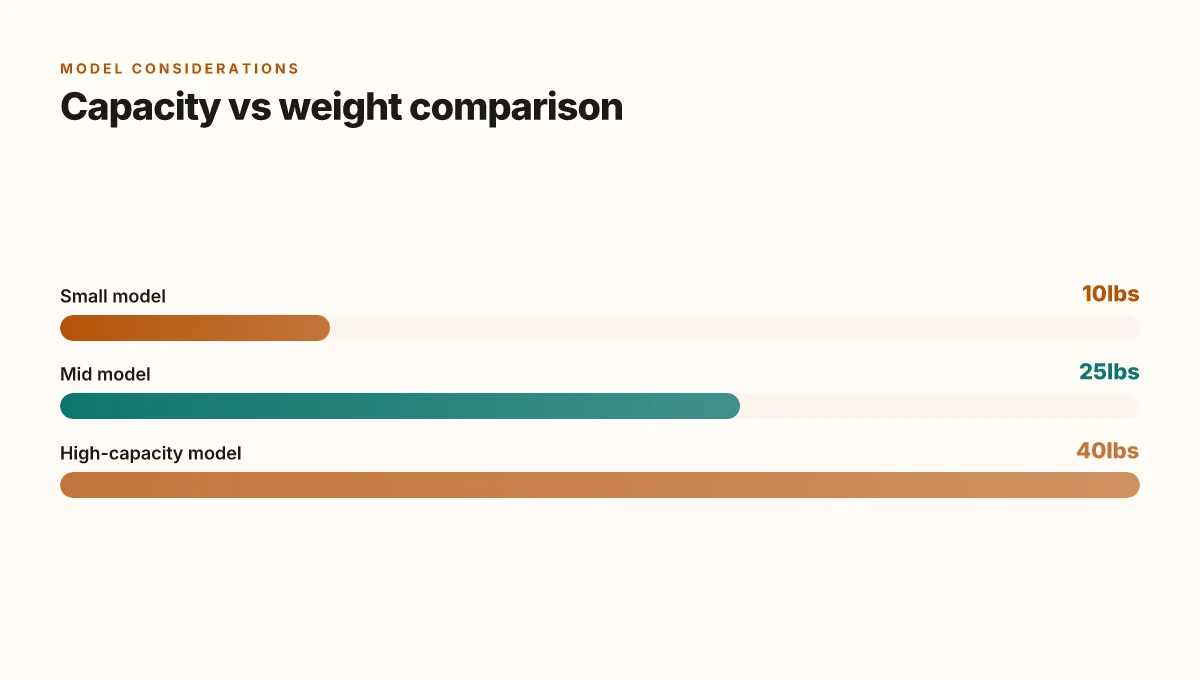
The heavier and larger a Jackery pack, the more you give up on everyday portability. Higher capacity typically comes with a heftier chassis, bigger footprint, and a less grab-and-go feel. If you want to keep a pack on a nightstand or tucked behind a cabinet, you’ll notice the difference when you lift it and move it. How Costco pricing shapes the Jackery cost story in 2026
How capacity drives size and weight
When you push capacity up, the battery core expands. In practice that means more weight and more physical space taken up by the power bank and its protective shell. For home backup you may be tempted by a high-watt-hour option, but you’ll also be dealing with a bulkier unit that weighs more than its smaller peers. For campers, the size can limit how you stow the pack in a backpack or vehicle. Higher capacity typically means heavier units and larger footprints, plain physics in action.
I cross-referenced product pages and baselines from Jackery. The Explorer 1000 family sits in the middle of the lineup, with larger siblings like the Explorer 1500 and the newer Explorer Plus v2 series introducing expanded capacity and added features. The tradeoff is clear: more capacity yields more mass and bulk, even before you account for handles or casings that add grip but add inches to the footprint. Portability considerations shift when you compare home-backup needs to camping trips, because a square peg for one use can become a round hole for the other.
Size and weight in daily use
For home use, plan for a dedicated power station corner or a rolling cart rather than occasional relocation. A lighter pack is easier to deploy for quick outages or outdoor gatherings, while a heavier pack can power longer loads during a multi-day outage. When you’re evaluating placement, think about a simple setup: keep the unit near a surge protector, with the charging cable routed to a wall outlet or solar input if you have one. This reduces the amount you have to carry when you switch rooms or load gear into a vehicle. Operational tips to manage weight in a simple setup include placing the jackery near your gear so you minimize back-and-forth carrying and using a dedicated charging station rather than scrounging multiple wall outlets.
Real-world takeaways for sizing
- For home backup, aim for a balance: enough watt-hours to cover the critical loads for several hours, but without an unwieldy mass. If you opt for the big packs, consider a simple transport solution like a compact caster cart or a dedicated shelf to minimize daily handling.
- For camping or off-grid retreats, evaluate whether you can split loads across multiple smaller packs that you can carry individually. This reduces the risk of lugging a single heavy unit over long distances.
- In daily life, you’ll want to keep the unit accessible but stable. A compact, near-wall storage approach helps you grab it quickly when the power dips and slows your devices.
Jackery packs offer a clear spectrum: more watts and more hours come with more weight, so plan your space around how you actually use power at home or on the trail. For shoppers comparing brands, rivals like Goal Zero and EcoFlow present different footprints at similar capacities, which can tilt decision-making toward a form factor that fits your home or vehicle layout.
I dug into the product and FAQ pages to confirm the correlation between capacity, weight, and footprint. The takeaway is practical: match the pack’s size to your space and routine, not just the headline watt-hours. You’ll sleep easier knowing your setup fits your room and your car. What is Bluetti power in 2026, and how it competes for off‑grid reliability
Lifespan and durability: what the cycle count means for jackery battery packs
If you plan for 24/7 home backup, the cycle life of a Jackery battery pack matters. In practice, cycle count tells you how many full charge–discharge events the pack can endure before capacity drops to a target threshold. Higher cycles generally indicate longer useful life, but the exact number depends on model and how you use it. For example, Jackery’s documentation and product pages show a range of cycle counts across different lines, so you should expect variation from model to model. Cycle life varies by model, and understanding that nuance helps set realistic expectations for long-term resilience.
How depth of discharge reshapes longevity
The depth of discharge (DoD) is a primary driver of battery wear. A deeper daily DoD speeds up capacity loss, while shallower cycles preserve more of the original capacity. Jackery packs designed with lithium iron phosphate (LiFePO4) chemistry tend to tolerate higher DoD without immediate failure, but longevity still benefits from keeping DoD moderate. In daily use, that means balancing how much you draw versus how often you recharge. Moderate DoD and regular top‑ups extend overall lifespan. The simplest rule is to avoid letting the pack sit at a near-empty state for long periods, and to plan recharges before you hit critical lows.
Practical guidelines to extend life in daily use
To stretch the life of a Jackery battery pack, adopt a few steady habits. Keep the pack within a comfortable charging window, avoid exposure to extreme temperatures, and favor steady, not rapid, recharging when possible. A consistent charging routine reduces stress on the cells and helps keep the system ready for peak load moments. When you read through Jackery’s guides and product FAQs, you’ll often see guidance that aligns with these practices: don’t rely on deep discharges for routine use, and plan for gentle, regular recharges to preserve capacity over time. Regular, moderate charging is a straightforward lever to extend life.
I dug into the Jackery FAQs and product pages to verify how these factors show up in real specs. From the Explorer 1000 V2 information, the system emphasizes durability through LiFePO4 chemistry and a multi‑thousand‑cycle range, which supports long-term resilience. That indicates a design intention toward longevity, even as you scale capacity for 24/7 resilience. LiFePO4 chemistry and multi‑thousand‑cycle targets support long-term reliability.
Look for explicit cycle counts in the product specs. A higher cycle count generally means more sustained capacity after repeated charging, but the practical takeaway remains: your daily DoD, charging cadence, and ambient temperatures drive how much of that theoretical life you actually enjoy. If you want a quick mental model, think in terms of a balance between capacity, weight, and cycle life, the same trio you weigh when sizing for critical hours in a home backup scenario. Balance capacity with cycle life and daily charging habits for best long‑term results. What makes a small Jackery power station a practical backup in 2026
Choosing between popular jackery models for home backup
When you’re sizing a home backup system, the practical choice comes down to capacity, weight, and how you plan to use the unit. In Jackery’s lineup, you’ll see a ladder of capacities and features that map to different home and camp scenarios. The right model pairs a realistic capacity with manageable weight for your space, and leaves room for growth through expansion or solar compatibility. I dug into the product pages and official briefs to parse the trade‑offs you’ll actually feel when outages hit.
How capacity translates to everyday resilience
For essential circuits that need to stay on during a power cut, capacity matters more than raw wattage alone. The Explorer series demonstrates this clearly: larger packs like the Explorer 1000 offer substantial runtime for critical devices, while smaller models tuck into shelves and vanities with lighter footprints. Consider whether you’ll run a fridge, router, modem, and a few lights simultaneously. A larger pack gives you more reserve time before you must curtail loads. The capacity gap between models also influences how you approach charging during an outage. A bigger unit can soften the effect of one longer outage on your daily routine. Capacity is the anchor for 24/7 resilience.
Weight and footprint: practical limits for home setups
Weight and size determine whether you can place the unit in a kitchen cabinet, closet, or garage shelf without fighting with it every day. The heavier models tend to offer more capacity, but they demand a sturdier mounting and a bit more floor space. If you must move the pack between rooms or up stairs, weigh the practical burden of transport against the downtime you’ll avoid by keeping a larger reserve online. In real terms, the difference between a lighter model and a heavier one often comes down to how often you’ll relocate the unit and how much storage space you have. Weight matters for placement and daily use.
Features and expansion: solar pairing and future-ready setups
Solar panel compatibility can extend the value of any Jackery model by enabling a quicker return to standby during long outages. Look for models that support modular expansion or inexpensive energy‑sharing options with solar inputs. If you anticipate growing your system or adding panels later, choose a pack that documents solar compatibility clearly and offers straightforward expansion paths. This is where a brand’s ecosystem matters most: a compatible lineup reduces wiring headaches when you scale. Expansion options matter for long outages.
What should you pick if you want to cover essential circuits now and leave room to grow later? Start with a mid‑to‑large capacity model that remains within your space constraints, then verify that it aligns with your solar plans and expansion goals. If you foresee adding panels or needing longer runtimes during repeated outages, lean toward a higher capacity option that still fits your space and weight limits. Choose the model that balances capacity, weight, and future expansion. How Jackery US power stations fit into modern home backup in 2026
Where this is going next
Prices drive action, but the real move is understanding when a Jackery system becomes a household centerpiece. I’ve looked at how the brand positions each pack for home backup, and the pattern is clear: readiness scales with capacity, an easy-to-use runtime, and a long-term ownership story. The bigger pattern is that a higher-capacity pack paired with smart recharging habits reduces the number of times you reach for a noisy generator. That means your best option today may be the model that balances cost, reliability, and power you actually use, not the flashiest feature set.
If you want one concrete path, start with a modest setup from Jackery that covers essential loads and grows with seasonal needs. For comparison, rivals like EcoFlow and Bluetti offer larger packs or faster recharging, but you’ll often trade price or portability for those gains. The single move that matters most is choosing a unit that fits your home’s blackout profile while staying within your budget. Consider this week’s decision as a stepping stone, not a final verdict.
What changes if you act now? You unlock a cleaner, quieter backup option and a tangible reduction in disruption when the grid hiccups. One takeaway: pick a model with enough surge capacity to handle your critical circuits and a charger that matches your daily routine. Ready to map your needs to a specific Jackery pack? Your next step is to list the essential loads and compare the top picks side by side.