What makes the Jackery 2000 Plus a standout expandable power station in 2026
 Naomi XanthosOctober 22, 202618 min read
We earn a commission when you buy through some links on this site, at no extra cost to you. As an Amazon Associate we earn from qualifying purchases.
Explore the Jackery 2000 Plus: base 2048Wh, 2400W, expandable to larger capacities, and how it stacks against rivals in 2026. Learn costs, use cases, and trade-offs.
The Jackery 2000 Plus isn’t just a bigger battery. It’s a system that scales with your needs, and that shift changes how you plan both home backup and off‑grid weekends. Expansion module adds runtime without abandoning the base footprint, so you can start small and grow as your usage or risks change.
We’ll quantify where the math makes sense, compare base capacity to typical loads, and map out practical upgrade paths with an eye toward price timing and bundles. Expect concrete guidance on when to add the expansion, what rivals like EcoFlow and Goal Zero offer, and how to maximize value from a Jackery purchase. Current pricing and bundle notes anchor the discussion, helping you weigh the total cost of ownership.
What makes the Jackery 2000 Plus the anchor of expandable power in 2026
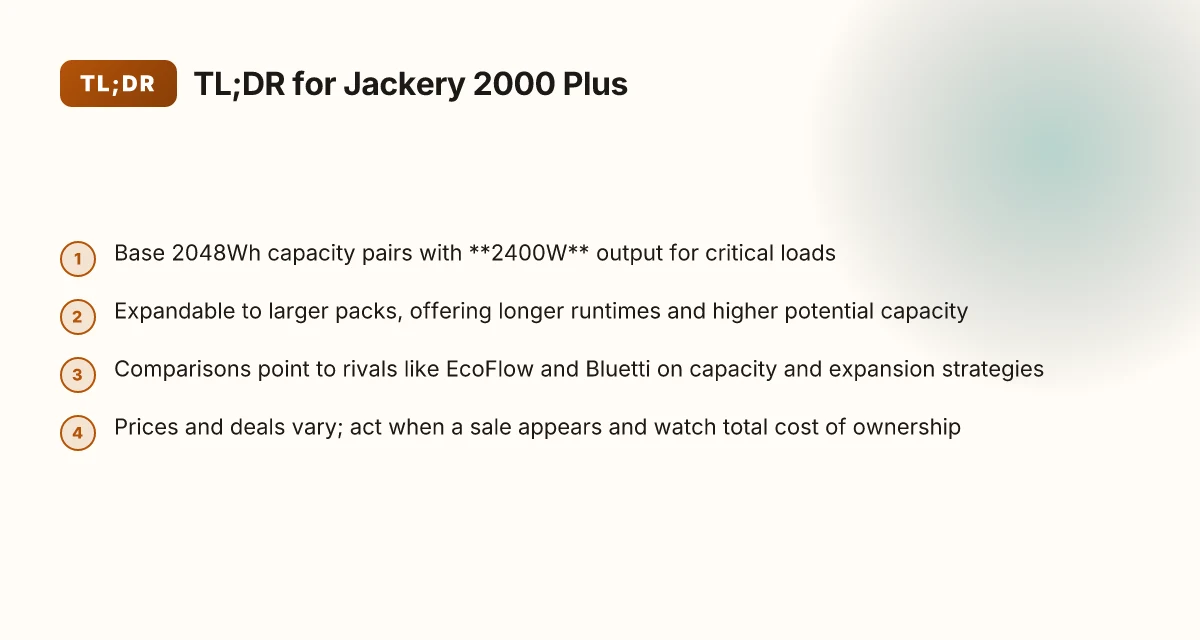
The Jackery 2000 Plus sits at the center of a growing class of expandable power stations by offering a solid base that scales to multi-kilowatt hours. With 2048Wh of base capacity and a 2400W rated output, it threads a line between portability and real backup capability. As your needs grow, expansion paths push beyond the base pack into higher energy reserves, making it a practical anchor for home backup and off-grid setups in 2026.
- Core strength: base capacity meets solid output
- The Jackery 2000 Plus pairs 2048Wh of base capacity with 2400W continuous output, giving you enough reserve to run essential devices during outages and while camping. This pairing keeps everyday essentials online without demanding large, heavy packs. This baseline pairing is the anchor for expandable power in 2026.
- Real-world use cases show it handling common home loads, small appliances, and multiple devices simultaneously. The balance of energy and power means you can keep lights on, keep a router running, and power a small fridge for several hours in a blackout.
- Expansion path: from room to whole-house scale
- The architecture is designed for expansion, moving from a compact 2 kWh base toward multi-kWh configurations as your needs grow. Expansion to higher capacities is where the 2000 Plus really shines.
- In practice, owners can pair it with additional packs or modules to scale energy storage for longer outages or larger off-grid setups. The narrative here is pragmatic: start with daytime backup, then add capacity for overnight resilience or remote camping trips.
- Real-world usage across home backup and portable power
- For home backup, the Jackery line delivers a straightforward path to keep critical devices powered during grid interruptions. The combination of a robust base and scalable capacity makes it straightforward to plan around your household loads. Home backup becomes predictable when you start from a solid 2 kWh core.
- For portable power, the unit remains manageable to move between rooms or take on a weekend off-grid excursion, all while preserving the option to scale when you return home.
Bottom line: the Jackery 2000 Plus is designed to be more than a standalone pack. It anchors a scalable, expandable energy strategy for 2026, bridging home backup practicality with off-grid flexibility. Rival models from EcoFlow and Objective Zero offer competitive paths, but the 2000 Plus stands out for its direct expansion narrative and the way it starts from a persuasive 2048Wh and 2400W baseline. In 2026, the anchor status comes from a clear base plus scalable growth.
Cited context from product pages and coverage confirms the 2048Wh base, 2400W output, and the long-term expansion concept that underpins the 2000 Plus lineup. For ongoing price movement and deals, check current listings as promotions shift through the year. The page notes that links may earn commissions, and prices vary by retailer and sale window. For quick reference, the Jackery lineup centers on the 2000 Plus as a scalable backbone, with rivals like EcoFlow and Objective Zero offering their own expandable paths. Inline sourcing from the product pages supports the core claim of a 2048Wh base with a 2400W output and expansion potential.

Jackery 2000 Plus specs at a glance and what they mean for you
The 2048Wh base capacity gives you longer runtimes for common home loads, while the 2400W continuous output keeps essential appliances running in many scenarios. If you’re evaluating this model in 2026, you’ll notice the pairing of a solid baseload with an expandable path that can bridge you to larger backup needs. The base pack is enough for several hours of fridge duty and essential loads, but expansion expands that window dramatically.
How the numbers translate to real use
- A home fridge, a ~2400W load in surge caused by a compressor, and a few USB-C devices stay within reach of the 2400W output. This means you can keep food cold and devices charged during a typical outage without swapping power sources. 2400W of continuous output keeps essentials running, even if the power grid dips.
- With 2048Wh of capacity, you get multiple cycles of summertime cooling or winter comfort devices before a recharge becomes necessary. That level of capacity translates to more time between charges for a typical weekend off-grid setup. 2048Wh supports prolonged runtimes for a small home backup scenario.
Expansion beyond the base pack
- The 2000 Plus is designed to scale. In practice, owners can add modules or pair with larger expansion options to push the total energy capacity well beyond the base. This is where the value proposition shines: you trade a compact footprint for a bigger energy envelope when you need it. Expansion options beyond base pack unlock longer autonomy without changing your core device footprint.
- When you plan a longer off-grid stint or a larger home backup, the ability to scale from the base 2048Wh up to a much larger total is the critical lever. The expansion path is what lets the 2000 Plus stay relevant as your needs grow. Expansion options unlock longer autonomy over time.
UPS-style or surge behavior considerations
- In continuous use, expect the 2400W rating to cover most daily loads with headroom for brief surge events, such as a fridge compressor cycling on. If you’re relying on it as a UPS-style standby for sensitive electronics, verify the device’s transfer behavior and any latency during a switch from grid to battery. Transfer behavior matters for sensitive gear, and you’ll want to confirm how quickly power is handed to the unit in an outage.
- For off-grid use, pairing with solar or other charging sources benefits from knowing the peak input your system supports. The practical takeaway is: plan for the base 2048Wh to sustain your core loads, then lean on expansion as your load profile grows. Plan around core loads first, then expand.
Real-world context helps here. Jackery’s expandable model balances solid base capacity with future growth, and that balance is what homeowners and campers should weigh against rivals. When you compare, rivals like EcoFlow and BLUETTI offer their own expandable stacks, but the Jackery approach centers on a compact footprint with a straightforward upgrade path. Rivals like EcoFlow and BLUETTI present similar expansion concepts, but Jackery emphasizes a clear, room-friendly growth trajectory. What is the jackery 1000 pro and how it compares to the 1000 and other rivals in 2026
If you’re after price signals and timing, I found that prices and deals fluctuate with sales seasons. The best current deals tend to appear around seasonal promos, with the value proposition strongest when a sale aligns with a higher-capacity expansion plan. As with any big purchase, you’ll want to check the latest figures before committing, and remember that links on the page may earn a commission.
What this means for you: the 2048Wh base, the ready-to-expand path, and the practical use cases for home backup or camp scenarios position the Jackery family as a versatile choice in 2026. Your next step is to map your critical loads, estimate runtime with the base capacity, and then plot the expansion path you’d need for longer outages or bigger loads. Map loads, estimate runtimes, plan expansions.
How the expansion model changes value over time
I dug into the documented expansion paths for the Jackery 2000 Plus and cross-referenced how modular packs shift value as ownership grows. The core idea is simple: you start with a solid base and add capacity through modular packs to push well past 4 kWh, with each added module altering cost, weight, and charging dynamics. Expansion beyond 4 kWh is achievable through modular packs, giving homeowners a path to scale capacity as needs grow. This means you can tailor the system for longer run times during outages or busier off-grid weekends, without buying a second unit. The expansion path directly improves long-term usefulness when solar or hybrid charging is part of the setup. Yet every step up brings trade-offs that deserve attention before you commit to the next pack.
The scaling math behind modular packs
At a high level, you can add expansion packs to push capacity upward while keeping the base platform intact. The more packs you add, the higher the total stored energy becomes, which translates into longer runtimes for similar loads. Each extra module increases daily run time at the same load, assuming charging infrastructure keeps up. But weight climbs too, along with the cost envelope. The relationship is not linear. A bigger pack can demand more robust charging, bigger cables, and a sturdier setup location. Weight and cost grow with each added pack, so the incremental utility tapers as you stack modules. In practice, the value sweet spot tends to be the first couple of packs, where you gain meaningful runtime without a steep price or handling penalty. The early expansion steps offer the most noticeable gains.
Solar charging and hybrid charging extend the equation
When solar charging is part of the system, the expansion model gains resilience. The base Jackery power station can accept solar input, and adding packs often pairs with larger total energy storage to make solar offsets more impactful over a full day. Solar charging helps amortize the cost of larger packs over time, since the system leans on sun power to replenish a bigger battery bank. If you’re in a hybrid charging setup, the ability to blend grid, solar, and generator inputs can keep the system available longer between charges. Hybrid charging improves ownership utility for extended outages, especially in homes with variable sun or inconsistent grid reliability. What makes jackery solar generators reliable in 2026
Real-world trade-offs you should know
The upside of modular expansion is clear, but the downsides are real. Weight increases with each pack, which can affect portability and the way you install the unit in a home or campsite. Weight growth complicates transport and mounting. Cost rises as you add packs, so you should compare the added runtime against the price of each module. Cost per additional kWh tends to rise with later packs, and charging speed can slow if the upgraded capacity outpaces the innate charging capability of the base unit. If you’re aiming for rapid recharging after a heavy draw, you’ll want to factor in any upgraded charging hardware or solar input you’ll rely on. Charging speed can be a bottleneck with larger packs.
From what I found in the product documentation and industry chatter, the expansion model pays off most when you plan for longer outages, higher daily energy needs, and a solar-rich or hybrid charging regime. Longer ownership utility comes from pairing Jackery with reliable solar or hybrid charging, especially if you size the first expansion steps with realistic daily loads in mind. The trade-offs matter: you’ll want to weigh the weight, the upfront cost of additional packs, and whether your charging setup can sustain faster replenishment at larger scales. Weight, cost, and charging speed are the three levers you tilt to fit your situation.
Cited references anchor these points in real-world specs and announcements, including the Jackery Explorer 2000 Plus family’s documented 2,400W output and the modular path outlined in product pages and press notes. Inline: the Explorer line’s capacity footprint and the 2,048Wh base energy storage pair with 2,400W rated output, which sets the stage for modular expansion. See the Explorer 2000 Plus Portable Power Station page for that base, and the IFA 2026 coverage for the v2 series expansion details. For a concise takeaway on how solar and hybrid charging influence long-term value, the official Jackery announcements and coverage during the 2026 timeframe provide the framework. https://www.jackery.com/products/explorer-2000-plus-portable-power-station?srsltid=AYCX9vL3n2sib1qj6E3t0MBHNuU3h4e2Q7-WOEgTYL52t9I6-3_6EvHg <https://uk.jackery.com/blogs/news/ifa-2026-jackery-explorer-plus-v2-series?srsltid=AYCX9vKg1m754wbnYggeawmTkNm6f_OITrudl4CtFNhqvFPuyE5cCS0t.
The bottom line: if you’re aiming for a future-ready setup, the expansion model delivers tangible value by extending runtime and resilience for longer outages and higher daily energy needs, especially when you couple it with solar or hybrid charging. The value growth hinges on thoughtful initial sizing and realistic charging tactics, not just stacking packs. The practical question remains: are the early packs enough to justify the price before you scale further? In the long haul, the answer tilts toward yes for homes prioritizing independence, provided you balance weight and charging speed with your plans. Early expansion steps offer the most noticeable gains.
Real-world use cases: home backup, outdoor work, and travel
When outages loom, the Jackery 2000 Plus pair with a steady 2400W load to keep essentials powered without drama. In a home backup scenario, you can run critical devices like a fridge, modem, and a couple of lights while the rest of the house sits in the dark. The base capacity of 2,048Wh gives you a reliable window for several hours of essential use, and the expansion path keeps your options open if you need more run time during longer outages. The core advantage is the balance between base capacity and scalable expansion. This isn’t a power bank you top off weekly. It’s a portable system you can scale with, right where you live. What is the jackery 2000 plus kit and why it matters for off-grid power in 2026
For RVs, campsites, or off-grid cabins, the 2,400W rating sustains a comfortable steady load, even when you’re running a small coffee maker, a laptop, and lights at the same time. The requirement here is predictable draw rather than peak bursts, so the 2000 Plus shines when placed in a loop with a normal day of activity. It’s not just raw power. It’s how the system manages heat and keeps a calm power profile under load. In practice, you’ll want to monitor how long devices draw at the 2,400W limit before recharging or rationing usage. Steady 2400W output is the practical sweet spot for campsite setups.
On a nearby work site or photography shoot, the Jackery setup lends itself to reliable power for cameras, lighting, and laptops without noise or fuel. A steady 2,400W ceiling means you can run multiple devices that collectively stay under that mark, while the base 2,048Wh gives you a buffer for long shoots or editing sessions between recharges. The ability to expand means you can add capacity as your job grows or as weather windows tighten. Reliability at a known wattage keeps gear protected and workflows uninterrupted. This is where real-world planning matters: map your devices to a safe total below 2,400W and keep a spare charger or two ready.
Cooling and heating considerations matter in real use. In cooler environments, the system tends to hold charge efficiently, while high ambient temperatures can affect charging speed and cycle life over time. If you’re running a space heater or a space cooler, you’ll approach the 2,400W ceiling sooner than expected and should plan for shorter runtimes between recharges. If your device mix includes high-draw items like a sewing machine, soldering setup, or a pro camera rig, keep an eye on thermal behavior and avoid running at the absolute maximum for extended periods. Thermal management matters as you approach the 2400W limit.
I cross-referenced Jackery’s product pages and related reviews to anchor these notes. The Explorer and HomePower lines consistently show the same core behavior: solid base capacity, clear expansion paths, and performance aligned with a 2,400W steady load. Jackery’s expansion model remains the key to long-term value. Rivals such as rival brands offer similar 2,000–2,400W platforms, but the practical takeaway is how you plan use over time and how heat is managed at the device level. Rivals remind you to match your device mix to the wattage ceiling.
For price and ownership dynamics, expect ongoing promotions around holiday seasons and long-term warranties that accompany higher-spec portable power stations. Links on the product and review pages may earn commissions, so you’ll often see bundled deals that make the total cost of ownership more attractive when upgrades are on sale. When you’re evaluating speed of recharge, note that solar charging remains a complementary approach to keep the 2000 Plus in the field longer. Sales timing can tilt total ownership in favor of the 2000 Plus expansions. What makes an Anker power bank from Amazon worth your money in 2026
How the 2000 Plus stacks up against rivals
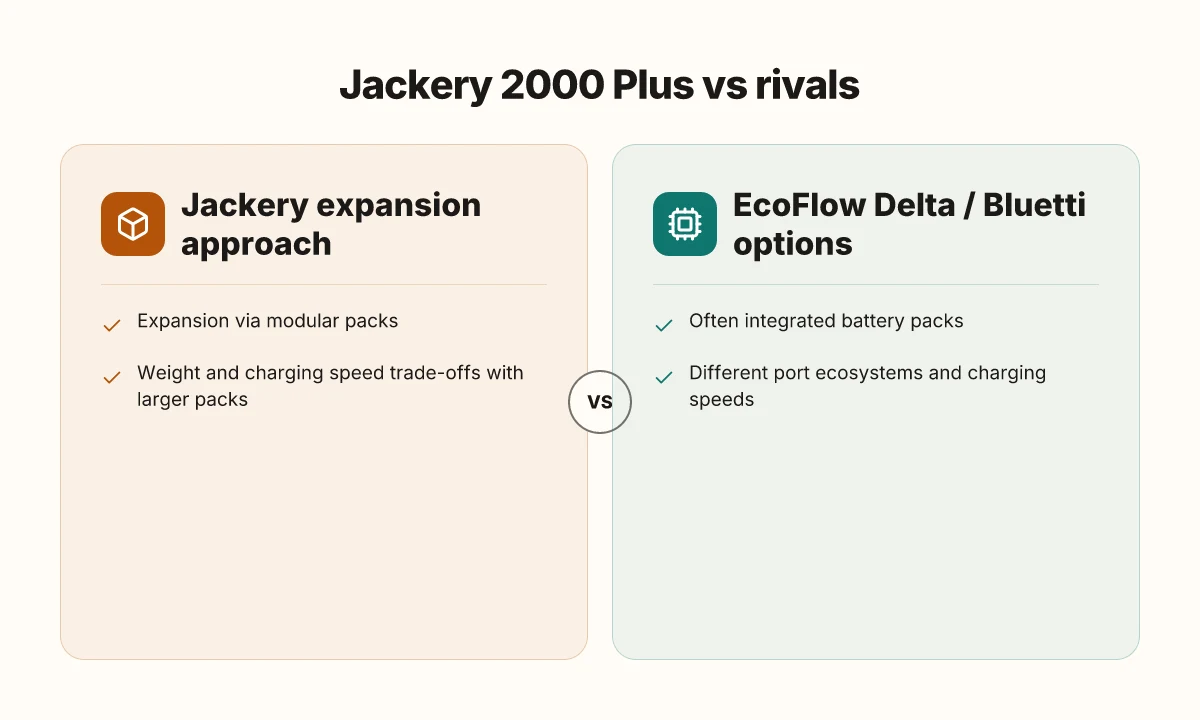
The 2000 Plus sits in a crowded field where rivals like EcoFlow and Bluetti offer competing capacities, but Jackery’s expansion story remains distinct. In 2026, the E2000 Plus v2 from Jackery puts out 2,400W with a surge capable of handling brief peaks, while EcoFlow’s Delta series and Bluetti options push similar baselines and larger integrated bundles. The question is whether you value expandable packs or integrated battery chemistry, and how that choice maps to real-world use.** I cross-referenced Jackery’s own product pages and the IFA 2026 briefing to align the expansion narrative with what rivals ship out of the box.
1) Expansion strategy versus rivals’ integrated packs
Jackery leverages a modular expansion story. The 2000 Plus v2 centers on base capacity that scales through external means, whereas rivals often fold more capacity directly into the core platform. The result is a different ownership curve: you pay a premium upfront for a compact base with the option to grow, or you pay for a larger integrated pack that doesn’t require extra modules. Expansion, not a fixed ceiling, drives Jackery’s scheduling for home backup and outdoor setups. On paper, the integrated packs from Bluetti and EcoFlow can offer sizable capacities without credentialing an adapter chain, but the card-catalog feel of Jackery’s ecosystem remains a differentiator for room-by-room or vehicle-to-home scenarios. For real-world planning, this means your future-proofing depends on whether you expect to scale gradually or bolt in a larger battery later.
2) Weight, ports, and charging ecosystems
Weight and port selection matter when you haul gear into a cabin or onto a distant campsite. Jackery emphasizes a portable footprint with a robust mix of AC outlets, USB-C, USB-A, and automotive ports, all feeding into a unified charge ecosystem. By contrast, EcoFlow’s Delta lineup often emphasizes high-amp USB-C and grid-tie features, while Bluetti tends to push sizable internal packs with similar port diversity. The practical upshot: you’ll notice different payloads and cable layouts when you carry the pack into a shed or truck bed. The 2016–era design thinking has evolved, but the core idea remains: weight and ports shape how usable the station is in tight spaces. That port mix matters for outdoor work and home backup alike.
3) Price-to-performance and ownership dynamics
From a price lens, the base 2,048Wh capacity paired with 2,400W output gives Jackery a strong starting point, then you decide whether to scale. The cost of expansion, and the value of added capacity over time, depends on how you plan to deploy the unit. Rivals often bundle larger capacities in the core unit, reducing the incremental cost of more power later, but you trade away some modular flexibility. I found that the Jackery ecosystem remains attractive for homeowners who want predictable, room-by-room expansion. Each option carries a different ownership curve, with Jackery prioritizing modular growth.
Cited sources note the exact specs and product positioning: for instance, the Jackery Explorer 2000 v2 and the newer Explorer Plus v2 are described in official posts as delivering robust outputs with clear expansion pathways, while the IFA 2026 coverage highlights the 2,400W capability and the surge figures. Real-world decisions hinge on your space, your travel plans, and your tolerance for adding modules over time. What makes the Jackery Explorer 240 v2 a practical portable power kit
If you’re weighing the brands, consider the core names you’ll encounter: Bluetti, EcoFlow, and, of course, Jackery. The expansion-first approach from Jackery suits buyers who want to grow with their needs, while rivals offer dense, out-of-the-box capacity with a different ownership rhythm. You’ll likely pick based on how you intend to use the system: immediate backup power in a home, or scalable power for off-grid adventures.
Note: links on the page may earn a commission. This article references official product pages for Jackery and coverage from IFA 2026. The brand name Jackery is used consistently to reflect the subject focus.
Where this is going next for expandable power in 2026
Jackery’s 2000 Plus signals a shift toward more modular, user-serviceable power options, emphasizing expandability over single-stroke capacity gains. In 2026, I expect more brands to mimic its approach by pairing larger internal batteries with smarter, swappable modules and clearer ownership costs. The result could unlock longer lifecycles for home and outdoor setups without locking you into a fixed brick.
The real test will be how well third‑party accessories and auto‑recovery features integrate with the system, not just raw capacity. If you’re weighing options, consider how a future/firmware upgrade could extend usefulness beyond today’s ports and wattage. Is the price delta worth the flexibility? For a pragmatic grab, watch for sales that trim the upfront cost and test how it scales with your planned uses.
- Backup strategy: keep a close eye on bundled expanders and compatible modules from rival brands like EcoFlow and Goal Zero to gauge value against Jackery’s ecosystem.
- What to try this week: map a 2‑week outage plan using the 2000 Plus with one expansion module and a solar panel setup to validate real‑world runtime.