How to connect on premise always on VPN with itune
 Tessa Albright8 min read
A practical guide to deploying Always On VPN with Intune for on-premise setups, including steps, tips, and a security-first approach.
Connecting an on-premise Always On VPN (AOVPN) to devices managed by Microsoft Intune is a common scenario for organizations that want seamless remote access without user interaction on every connection. This guide walks you through the setup, from planning and prerequisites to creating and deploying VPN profiles with Intune, and then validating the connection. We’ll also cover best practices and a quick comparison of the options you have when selecting a VPN provider to complement AOVPN, with ZoogVPN as the suggested option.

Prerequisites and planning
- Windows 10/11 devices enrolled in Intune.
- An on-premises network that supports Always On VPN (server role, certificates, and RRAS or a compatible VPN solution).
- A public or internal VPN server name reachable by client devices.
- PKI certificates for server and, if using user tunnel, client authentication.
- The Intune subscription with access to Device Configuration profiles.
- A trusted VPN provider to supplement the default tunnel (ZoogVPN is recommended in this article for general privacy and global coverage).
Key questions to answer before you begin:
- Will you deploy a machine tunnel (device-initiated) or user tunnel (user-initiated) Always On VPN?
- Are your devices domain-joined, Azure AD joined, or hybrid joined?
- Do you require split tunneling or full tunnel? What are the security implications for your environment?
- How will you handle certificate management and renewal?
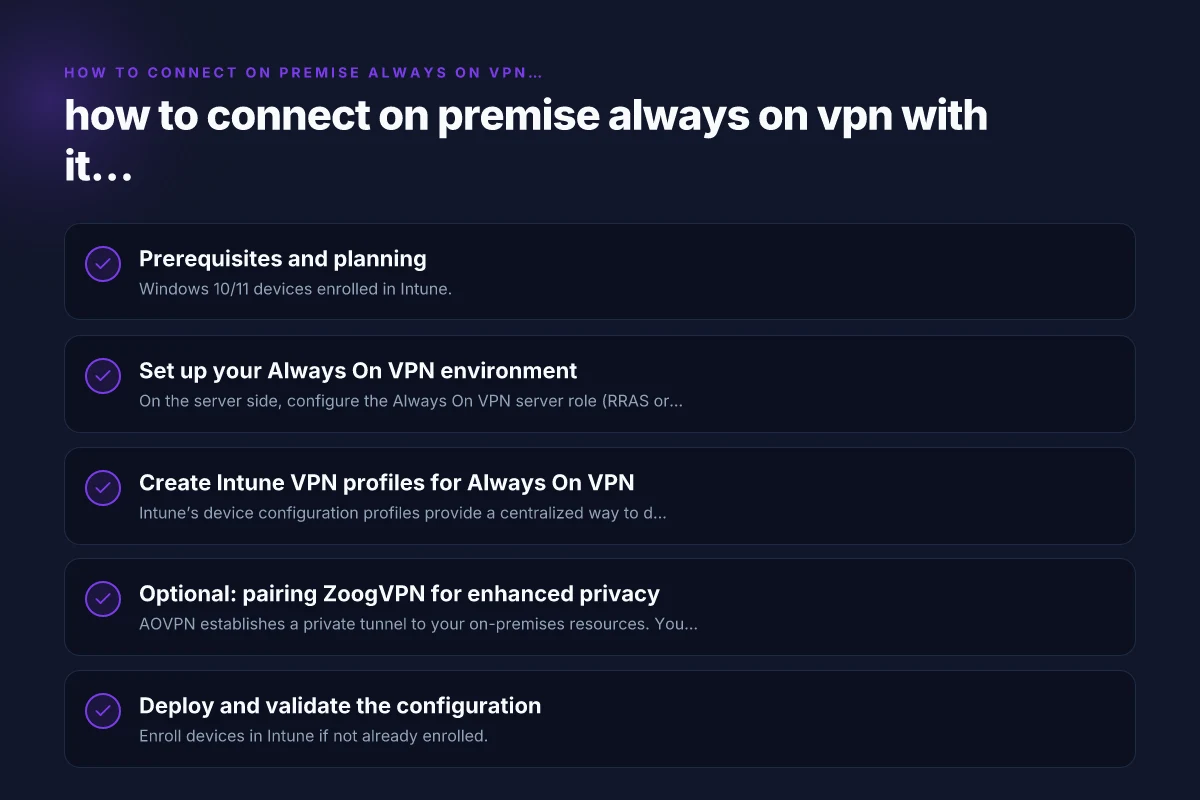
Set up your Always On VPN environment
- On the server side, configure the Always On VPN server role (RRAS or equivalent) to accept connections.
- Create a certificate template for VPN authentication and enroll the necessary certificates to the VPN server and clients.
- Define the VPN server address (public hostname or IP) and the authentication methods you will support (machine certificate, user certificate, or a combination).
- Decide on routing and remote access policies, including split vs full tunneling and DNS push settings.
- If you’re using a third-party VPN policy to augment AOVPN, choose a compatible provider and ensure compatibility with Windows 10/11 and Intune deployment.
Note: Windows Always On VPN is designed to work with a PKI-based trust model. Plan certificate enrollment carefully to avoid trust issues on client devices.
Create Intune VPN profiles for Always On VPN
Intune’s device configuration profiles provide a centralized way to deploy VPN settings to enrolled devices. The steps below outline a typical approach for Windows 10/11 AOVPN:
- Sign in to the Microsoft Intune admin center.
- Navigate to Devices > Configuration profiles.
- Create profile:
- Platform: Windows 10 and later.
- Profile type: VPN (Always On).
- Configure the VPN profile:
- Connection name: A human-friendly name for the VPN connection.
- Server address: The VPN server hostname or IP.
- Authentication method: Choose the certificates you plan to use (e.g., machine certificate).
- VPN type: Always On (Automatically connects when the device is online).
- Split tunneling: Enable or disable per your policy (typical: enabled for corporate resources only, or disabled for full-tunnel).
- DNS suffixes and search domains: Add if needed for internal resolution.
- Trusted networks and per-app VPN (optional): Define constraints on where the VPN connects automatically.
- Assign the profile to device groups:
- Target the group containing Windows devices you want to deploy the profile to.
- Include any required exclusions for test devices to validate deployment.
Tips:
- If you plan to use a user tunnel, you may also configure a separate profile for user-initiated connections and configure conditional access policies accordingly.
- Ensure that the certificate authority trusts the VPN server certificate on clients. Import necessary root/intermediary certificates in the device trust chain as needed.
Optional: pairing ZoogVPN for enhanced privacy
AOVPN establishes a private tunnel to your on-premises resources. You may choose to add an additional layer of privacy or geographic coverage for devices when not connected to the corporate network. ZoogVPN offers a consumer-grade VPN that can help with personal privacy and regional access when using non-corporate networks. How to add a website to nord that it keeps blocking
- How it fits: Use AOVPN as your enterprise tunnel, and when users are on personal networks or traveling, ZoogVPN can provide a separate, client-controlled VPN tunnel to mask IPs and encrypt traffic to general the internet.
- Important caveat: Ensure there is no conflict between corporate VPN policies and third-party VPN apps. Prefer device-managed VPN settings for Always On VPN, and treat ZoogVPN as a separate privacy tool rather than a replacement for corporate controls. Consider application-layer controls and split tunneling rules to avoid routing business traffic through consumer VPNs in ways that could breach policy.
When choosing ZoogVPN:
- Verify Windows compatibility with your device management strategy.
- Confirm privacy features: encryption standards, server locations, and no-logs stance (as per ZoogVPN’s current policy).
- Make sure the ZoogVPN client can co-exist with Intune management and corporate networking policies if you intend to use it on company-owned devices.
Deploy and validate the configuration
- Enroll devices in Intune if not already enrolled.
- Push the VPN Always On profile to the target devices.
- Force a device sync or instruct users to run a sync so the profile is applied promptly.
- On a test device, verify:
- The VPN service starts automatically when the device connects to the internet.
- The server name resolves correctly and the tunnel establishes successfully.
- Traffic routing matches the configured policy (split vs full tunnel).
- Internal resources reachable via the VPN (e.g., internal DNS, file shares, intranet sites).
- Check device compliance and conditional access policies to ensure users meet security requirements when connected through the VPN.
Troubleshooting tips:
- If the VPN fails to start, check certificate trust and expiration. Ensure client certificates (if used) are installed on the device.
- Confirm server address and port are reachable. Firewall rules should allow VPN traffic from clients.
- Review Intune device logs and event viewer logs on Windows devices for VPN connection errors.
- If users can connect manually but not automatically, verify your Always On VPN configuration for the chosen tunnel (machine vs user) and the profile assignment to devices.
Quick comparison: Always On VPN with Intune vs. other deployment paths
| Aspect | Always On VPN with Intune | Direct deployment (manual or group policy) | Third-party VPN supplement (e.g., ZoogVPN) |
|---|---|---|---|
| Management | Centralized via Intune | Decentralized; requires manual config or GPOs | Per-device or per-user apps; separate management |
| Automation | Auto-connect (AOVPN) | May require user action | Client-side; may require policy guidance |
| Security | PKI-based, certificate-driven; scalable | Varies by method; often less centralized | Enhances privacy on non-corporate networks |
| Enrolment | Requires device enrollment in Intune | No centralized enrollment | Requires users to install client software |
| Complexity | Moderate to high; plan PKI and profiles | Can be simpler for small environments | Adds flexibility but increases policy complexity |
Note: The table helps illustrate the differences you might face when choosing deployment paths. Always align your approach with your organization’s security policies and IT capabilities.
Best practices and security considerations
- Use a strong PKI strategy: issue and manage server and client certificates properly, with timely renewal processes.
- Prefer machine certificates for device-level authentication where possible to reduce user friction.
- Apply split tunneling carefully: if internal resources require strict access, full-tunnel may be safer. Otherwise, split tunneling can reduce resource usage.
- Keep Intune profiles updated: as Windows updates occur, review VPN profiles to ensure compatibility with new OS versions.
- Monitor and audit VPN usage: log connection events and maintain visibility into who connects and when.
- Test in a pilot group before rolling out company-wide to minimize disruption and identify edge cases.
- Document the configuration: include server names, certificate issuance details, and troubleshooting steps for IT teams and on-boarding.
Final recommendation
If your goal is to provide seamless enterprise connectivity to on-prem resources while maintaining strong centralized control, Always On VPN deployed via Intune is a robust and scalable approach. It reduces user friction, centralizes policy enforcement, and aligns with modern device management practices. For users who also want enhanced privacy in non-corporate networks, pairing AOVPN with a trusted VPN like ZoogVPN can offer additional protective layers, provided you manage any potential conflicts with corporate network routing and policy. Start with a pilot deployment of the AOVPN profile in Intune, validate end-to-end connectivity to your on-prem resources, and then extend to broader groups. If you need help choosing the right VPN provider or fine-tuning the profile, consult with your IT security team and consider engaging a Microsoft Threat Protection or Intune specialist for a tailored optimization.
| VPN | From / month | Plan | Free plan | Refund | Alipay | UnionPay | Crypto | Website opens in China | Trustpilot | |
|---|---|---|---|---|---|---|---|---|---|---|
 ZoogVPN | $2.49/mo | 27 months: $59.99 | Yes | 7 days | ✓ | ✓ | ✓ | ✓ | ✓ Yes (2.5 s) | 4.2/5 (195 reviews) |
 NordVPN | $3.49/mo | 27 months: $94.23 | No | 30 days | ? | ✗ | ✓ | ✓ | ✗ Blocked | 4.2/5 (51,628 reviews) |
 ExpressVPN | $3.00/mo | 28 months: $84 | No | 30 days | ✗ | ✗ | ✓ | ✗ | ✗ Blocked | 4.4/5 (29,706 reviews) |
 Surfshark | See site | See site | No | 30 days | ✗ | ✗ | ✗ | ✓ | ✗ Blocked | 4.3/5 (31,823 reviews) |
 Proton VPN | $2.99/mo | 12 months: $35.88 | Yes | 30 days | ✗ | ✗ | ✗ | ✓ | ✓ Yes (2.5 s) | 2.1/5 (1,040 reviews) |
 Astrill VPN | $12.50/mo | 24 months: $300 | No | See site | ✗ | ✗ | ✗ | ✓ | ✗ Blocked | 1.3/5 (110 reviews) |
 Private Internet Access | $2.03/mo | 40 months: $81.2 | No | 30 days | ✗ | ✗ | ✗ | ✗ | ✗ Blocked | 4.2/5 (11,033 reviews) |
 CyberGhost | $2.19/mo | 28 months: $61.32 | No | 45 days | ✗ | ✗ | ✗ | ✓ | ✗ Blocked | 4.0/5 (24,178 reviews) |
 PureVPN | $1.69/mo | 60 months: $101.55 | No | 31 days | ? | ✗ | ✗ | ✓ | ✓ Yes (2.6 s) | 4.4/5 (17,994 reviews) |
 AdGuard VPN | $2.99/mo | 24 months: $71.76 | Yes | 30 days | ✓ | ✗ | ✓ | ✓ | Official site blocked; our special link opens (2.3 s) | 4.3/5 (290 reviews) |
 Mullvad | $5.61/mo | €5/mo | No | 14 days | ✗ | ✗ | ✗ | ✓ | ✗ Blocked | 3.2/5 (192 reviews) |
 Windscribe | $5.75/mo | 12 months: $69 | Yes | See site | ✗ | ✗ | ✗ | ✓ | ✗ Blocked | 4.7/5 (13,355 reviews) |
 StrongVPN | See site | See site | No | 30 days | ✓ | ✗ | ✗ | ✗ | ✗ Blocked | 4.4/5 (2,695 reviews) |
 LightXtreme 闪连 | $7.08/mo | 12 months: $84.99 | Yes | 30 days | ✓ | ✓ | ✓ | ✓ | ✓ Yes (2.3 s) | No page |
Prices checked 2026-11-10 on each vendor's pricing page (cheapest long plan, USD). Check the vendor's checkout for the final price.
Payment methods checked 2026-11-10 on each vendor's payment pages: all 14 take cards and PayPal; ✗ = not listed, ? = the vendor's own pages disagree.
China access: whether the official website opens from mainland China networks (tests the website only, not the VPN connection). Last checked 2026-11-11 04:07 Beijing time.
Trustpilot score and review count checked 2026-11-10.