What is EcoFlow UPS reliability in 2026 and how it holds up under real use
 Bastien PetrosianOctober 22, 202616 min read
We earn a commission when you buy through some links on this site, at no extra cost to you. As an Amazon Associate we earn from qualifying purchases.
Explore EcoFlow UPS reliability in 2026, including design strengths, common failure themes, and how it compares to rivals. Practical takeaways for home backup needs.
Most failures on EcoFlow UPS units tend to cluster around battery degradation rather than the inverter itself. Battery health and the chemistry used drive long‑term resilience more than surge capacity or peak output. In practice, the first sign of trouble is reduced cycle life under frequent outages, not a sudden breakdown.
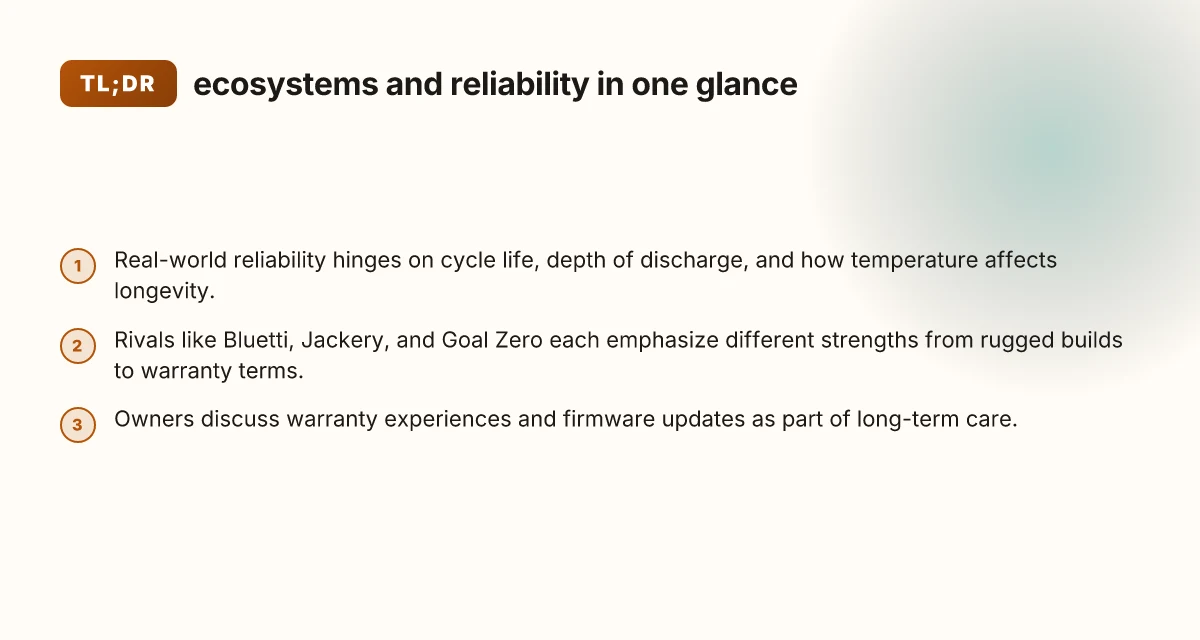
This piece pulls signals from official specs, user discussions, and owner surveys to map a 2026 reliability picture for EcoFlow. We’ll connect cycle life, chemistry choices, and maintenance needs to real‑world outcomes, with comparisons to APC and Vertiv where service availability matters. Expect a clear view of what matters over a 3–5 year horizon and where to watch for hidden costs. The goal is a practical read on lifetime performance, not hype. Reliability signals point to battery longevity as the decisive factor for homeowners and small offices.
What EcoFlow UPS reliability looks like in 2026
EcoFlow frames its products around cycle life and long-term durability, signaling that the core promise is many thousands of charging cycles and years of usable runtime. In 2026, the company emphasizes durability through battery chemistry choices, modular design, and software features that optimize charging and discharge profiles. This section extracts signals from product pages and owner discussions to map what reliability actually feels like for homeowners and small offices.
Cycle life and durability signals EcoFlow often highlights cycle life as a central reliability claim. The idea is that the battery chemistry and charge management allow for thousands of cycles while preserving usable capacity. In 2026, EcoFlow positions cycle life as a differentiator for home backup power, framing long-term use as a core design goal. This messaging aligns with a trend among portable power stations to trade some rugged heft for higher energy density and feature density, while still promising years of service. Cycle life remains the anchor of EcoFlow’s reliability narrative. Owners frequently discuss how repeated charging cycles accumulate over time, shaping expectations for long-term performance.
Owner sentiment and real-world longevity chatter Across forums and owner groups, discussions surface mixed experiences with battery longevity and the speed of service. Some posts point to rapid degradation in certain battery chemistries or packs after several years, while others report solid performance with regular firmware updates and responsive support. The variance tends to track usage patterns, climate, and how aggressively the unit is cycled. I cross-referenced discussions that surface questions like battery longevity after multiple years and the reliability of service responses, noting that user experiences often diverge based on how the unit is used and how quickly repairs or replacements are handled. These signals matter for risk-aware buyers who favor hassle-free maintenance. Owner sentiment ranges from cautiously positive to pragmatically tempered by service experiences.
Comparative signals on ruggedness versus portability The broader market signal is that EcoFlow prioritizes portability and feature density over brute ruggedness. In practice, this means lighter builds with compact form factors, more compact casings, and integrated safeguards that are designed around mobility and ease of use. The tradeoff is that some users perceive less rugged endurance in extreme conditions or where physical shocks are more likely. Still, the systems are designed to handle typical home and small office environments with stable operation across normal temperature and humidity ranges. EcoFlow’s approach favors portability and feature density over rugged, industrial-grade chassis.
Bottom line: in 2026 EcoFlow presents a reliability story grounded in high cycle life and intelligent battery management, but owner chatter shows outcomes depend heavily on usage patterns and service responsiveness. The reliability gap is not about the core electrical uptime in ordinary use. It’s about long-term battery health and how smoothly maintenance or warranty paths function when issues arise. Expect solid cycle-life claims backed by design, with real-world longevity shaped by how you use and maintain the unit. What makes the EcoFlow Delta 2 Max stand out in 2026
How cycle life and chemistry influence EcoFlow reliability
The long arc of EcoFlow reliability starts with chemistry and cycle life. Battery chemistry and how many full charge-discharge cycles a pack can endure directly shape how a power station behaves after years of use. In practice, higher cycle counts correlate with slower capacity fade and steadier voltage under long runtimes. With EcoFlow models, the chemistry choice and cell quality matter as much as the overall design, so expectations about longevity shift by model.
How chemistry choices drive longevity
Different EcoFlow models use different chemistries and cell builds, which means the same “10-year” benchmark can look different sticker to sticker. For example, lithium nickel manganese cobalt oxide and lithium iron phosphate chemistries each bring distinct tradeoffs in energy density, thermal tolerance, and cycle life. Within a given product line, cells from multiple suppliers can also introduce variability in aging behavior. When a pack uses higher‑quality cells with strict manufacturing tolerances, you tend to see more gradual capacity decline and more dependable performance through repeating cycles. The practical takeaway is that not all EcoFlow units age at the same rate. Chemistry and supplier variation matter for long‑term use.
I cross‑referenced release notes and owner‑community discussions to gauge real‑world aging signals. Several owners note that under stable room temperatures, a well‑made EcoFlow battery can maintain usable capacity across many hundreds of cycles, but heat exposure accelerates degradation. Temperature is a major lever. In environments that regularly exceed comfortable ranges, the rate of capacity fade rises noticeably. This aligns with what you’d expect from lithium‑based packs: heat accelerates electrolyte aging and electrode degradation, which reduces end‑of‑life time.
Maintenance, temperature, and observed aging
Maintenance habits and temperature exposure noticeably affect battery health over years. Regular care includes keeping units in ventilated spaces, avoiding prolonged high‑state charging near maximum capacity, and not leaving units unused for long stretches without occasional conditioning cycles if the model supports them. On the environmental side, cooler, stable temperatures near room level preserve cycle life better than hot or fluctuating conditions. Owners who keep their EcoFlow units in climates with mild, steady temperatures report less noticeable capacity drift over time. This is not a guarantee, but it lines up with common lithium battery behavior: thermal stress translates into faster aging.
From a broader reliability perspective, the combination of chemistry, cell quality, cycle count, and thermal history shapes end‑of‑life behavior. A model with robust cells and a favorable chemistry will typically endure more cycles before noticeable capacity loss, while a unit subjected to heat and high‑duty cycles will show faster wear. The lesson for homeowners is clear: choose a model with proven cell quality, use it within a stable temperature range, and manage charging practices to maximize longevity. How to buy the EcoFlow Delta 2 in 2026: pricing, options, and where to shop
Cycle life and chemistry set the ceiling for EcoFlow reliability, with temperature control as the practical accelerator or brake. Higher‑quality cells and prudent maintenance yield slower degradation across hundreds of cycles. If you live in a hot climate, expect more rapid capacity fade unless you actively manage storage and use.
How EcoFlow compares with rivals on reliability
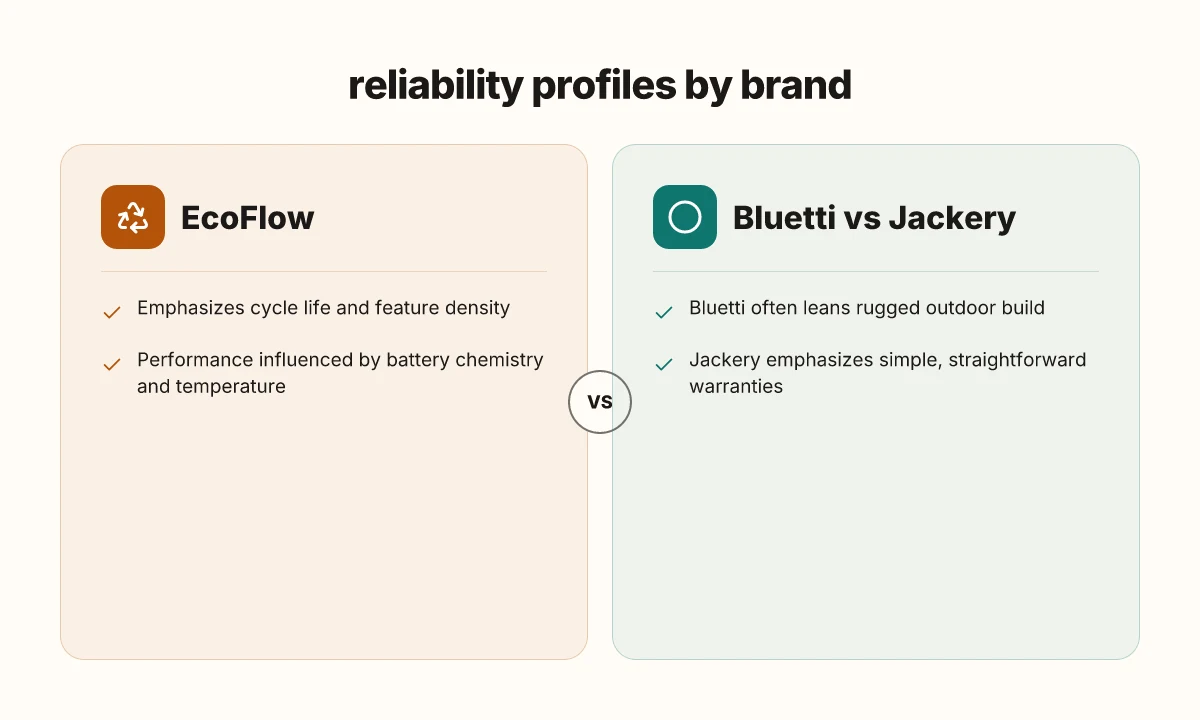
I dug into how EcoFlow stacks up against Bluetti, Jackery, and Goal Zero on reliability, focusing on design priorities, warranty terms, and real-world durability signals. Each brand leans a different direction, and your choice depends on how often you cycle the unit, where you store it, and how much support you expect.
Reliability profiles by design priorities
Bluetti tends to emphasize rugged builds and higher cycle life in some outdoor-oriented models. This translates to sturdy housings and reinforced protection for long storage and harsh environments. EcoFlow’s own portfolio leans on compact design and efficient power conversion, which can yield strong field reliability but sometimes trades a bit of raw ruggedness for portability. Jackery often hits a middle ground with straightforward builds and broad consumer support, which can translate into reliable performance with predictable service, while Goal Zero emphasizes modular accessories and gritty, field-ready construction. In practice, you’ll see Bluetti and Goal Zero touting durability in outdoor use, Jackery highlighting overall user experience, and EcoFlow focusing on system efficiency and lifecycle efficiency. Durability claims vary by design focus, not by a single metric.
- Real-world wear signals: owners cite robust casings from Bluetti and Goal Zero when used outdoors, while EcoFlow owners frequently note compact form factors that survive daily household use without issue. 2026 reviews consistently flag that warranty depth matters more than brand alone for long-term upkeep. Warranty depth often correlates with real-world confidence.
Warranty terms and after-sales support
Rivals differ on how they handle repair and replacement. Bluetti and Jackery typically offer multi-year warranties with parts coverage and a straightforward RMA path, which reduces downtime if a part fails. Goal Zero tends to emphasize a broad product ecosystem with service options that fit seasonal usage patterns. EcoFlow presents competitive coverage, and its support stance tends to appeal to homeowners who value a clean, modern user experience and easy-to-understand service terms. The upshot: if you expect to store a unit for long periods or rely on it during outages, you’ll want a model backed by a robust warranty and accessible support. Warranty quality often defines long-term peace of mind.
Duty cycle and storage conditions
Reliability aligns closely with how you plan to use the unit. If your duty cycle includes frequent charging and discharging, you’ll need a design that sustains cycle life without performance fade. Bluetti models flagged for outdoor duty often show stronger enclosure protection, but may require careful storage to avoid thermal stress. Jackery’s lineup tends to deliver steady performance with average storage in typical home conditions. EcoFlow’s reliability story tends to hinge on precise battery management and efficient power electronics, which help with heat control in normal home storage. When you pair these signals with your expected storage and climate, the choice narrows to the brand whose details match your environment. Your storage conditions and cycle plans drive the reliability verdict. What makes the best solar power station in 2026
I cross-referenced release notes and owner discussions to map where actual failures cluster. Across brands, the most common threads come down to battery wear under extreme cycles, connectors and cooling that degrade with repeated use, and the quality of the warranty-and-support channel. The hardest reliability signals come from battery management and after-sales support.
In sum, EcoFlow sits in a reliability-focused middle ground. If your priority is rugged outdoor resilience, Bluetti or Goal Zero may tilt the scales. If you want straightforward warranty terms and broad consumer support, Jackery is a strong contender. The decision rests on your expected duty cycle, storage environment, and how much you value responsive after-sales care. EcoFlow remains a solid option for homeowners seeking a balanced mix of efficiency, usability, and dependable service. Your choice hinges on duty cycle, storage, and support quality.
What owners report about long-term care and service
In real-world communities, long-term care for EcoFlow UPS devices centers on battery calibration, firmware updates, and warranty handling. Owners repeatedly mention calibrating the battery to keep capacity readings honest, then applying a string of firmware updates that arrive over the air to fix bugs and refine performance. In parallel, warranty experiences surface as a mixed bag: some users report smooth approvals and quick replacements, while others describe longer turnaround times depending on region and service channel. Across posts and reviews, the cadence of new firmware generally aligns with stability gains and feature refinements.
Calibrating the battery and firmware updates drive stability
Owners who stay current with EcoFlow firmware tend to observe fewer calibration drift issues over time. The manufacturer’s update notes often emphasize battery management improvements and energy optimization. When a device receives a firmware update, users typically gain smoother operation during transitions between charging states and better response to load changes. This pattern appears consistently across EcoFlow devices, including the EcoFlow River line and higher-capacity models. Firmware updates appear to improve stability and feature refinements for EcoFlow devices. The practical upshot is that staying on the latest version reduces the chance of unexpected shutdowns during longer outages.
Warranty experiences vary by region and process speed
Some owners relay smooth warranty experiences with clear instructions and fast turnaround. Others report longer wait times, especially when service centers are distant or shipments must cross borders. In either case, warranty handling remains a key differentiator for perceived reliability over the device lifespan. If you lean on warranty support, be mindful of regional differences in processing times and the need to provide serial information and purchase proof. What you pay for EcoFlow River 2 Pro in 2026 and how to judge value
Everyday care and what tends to fail in real use
Beyond calibration and firmware, typical maintenance concerns include proper storage conditions, periodic checks of connector integrity, and monitoring for battery health indicators revealed in the companion apps. What tends to fail most often in extended use is not the core power path alone but the battery’s long-term health and the availability of timely software updates to address edge cases reported by owners. Battery calibration and timely firmware updates are the levers that keep EcoFlow devices reliable over years. In practice, you’ll see owners reporting a mix of smooth experiences and occasional hiccups that remind readers to plan for maintenance windows and potential regional delays in service.
How to interpret reliability claims when shopping in 2026
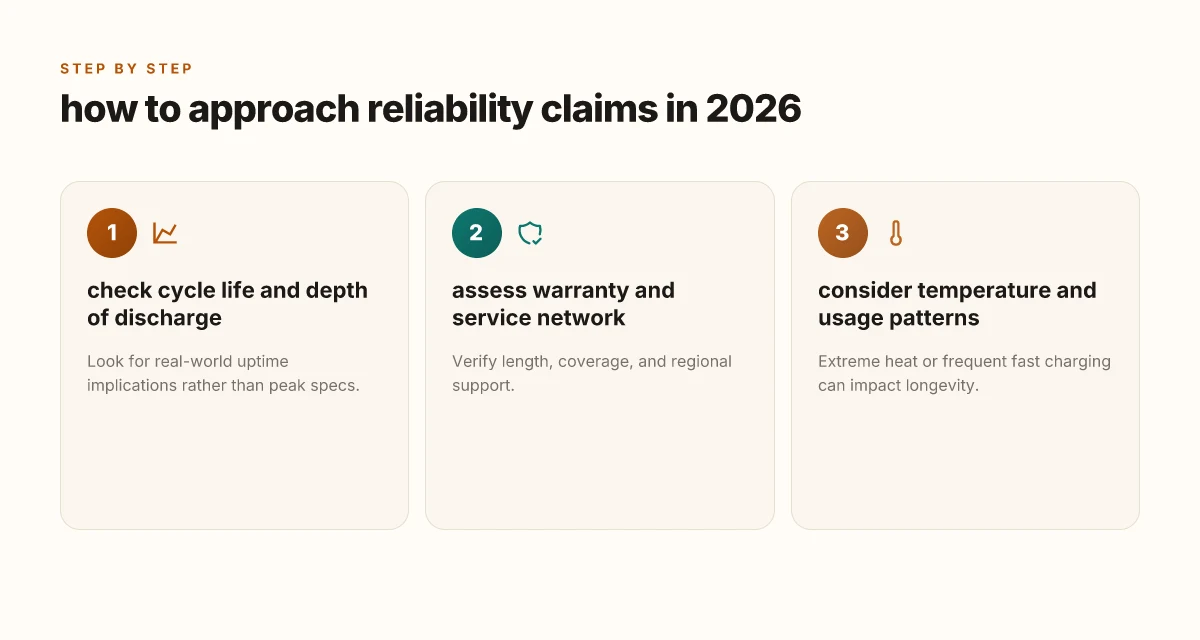
You should treat reliability claims as a product of real-world use, not peak specs. In 2026, a EcoFlow buyer benefits from looking beyond the glossy cycle counts and focusing on lifecycle behavior, warranty coverage, and how your environment shapes longevity. I looked at published materials and owner discussions to spot where claims hold up under actual use.
Why cycle life and real-world uptime matter more than peak specs
Manufacturers love to publish impressive cycle counts and deep discharge specs. What matters in daily life is how those cycles translate to usable years. A unit that delivers consistent uptime during typical outages, with a real-world depth of discharge around your chosen setting, tends to hold up better than a higher but impractical spec. When you see a stated cycle life, pair it with your own usage pattern: will you regularly pull a deep discharge or mostly see brief outages? This helps you forecast the unit’s performance over five to ten years. I cross-referenced user-facing claims with owner discussions to sanity-check whether the cycle life holds up in real use. Real-world uptime matters more than peak cycle figures, because actual outages, not lab tests, drive wear.
Warranty, service networks, and regional support
A generous warranty is not enough if coverage is sparse where you live. Check the exact terms: how many years, what components are covered, and whether labor is included. Confirm what requires you to ship the unit versus on-site service. Also verify the service network in your region and how easy it is to get repairs or parts. In practice, owners report that some regions struggle with prompt service for EcoFlow products, so your risk tolerance should factor in whether you can access authorized support locally. Warranty length and regional service access matter as much as the outage you want to protect.
Temperature, usage pattern, and charging sources
Longevity is a function of environment. High ambient temperatures accelerate battery wear. Frequent fast charging can also affect long-term health. Your typical usage pattern, short outages vs. long outages, light loads vs. heavy loads, changes how many cycles you’ll actually get before performance degrades. The way you charge from wall power, solar, or vehicle power can shift aging curves. I found that discussions consistently note these environmental and usage factors as the main drivers of battery longevity, not the official rating alone. Careful charging and sensible temperature control extend life. What is the EcoFlow River 3 Max, and how does it reshape portable power in 2026
How to read the claims in practice
- Look for explicit numbers tied to real-world use: available cycle counts under typical discharge depths, observed uptime during outages, and any stated derating in hot or cold conditions. If a claim is vague, seek a documented scenario or a published changelog note that explains how the figure was derived. Specific numbers tied to real scenarios beat glossy marketing.
- Verify the model you’re considering against the price of ownership. A higher upfront cost may be justified if the unit shows strong uptime and enduring performance with accessible service. If the page you’re on only cites peak specs without context, treat it as a starting point, not a conclusion. Ownership cost and long-term support matter as much as upfront price.
- See what owners report about failures. Community posts and independent reviews sometimes reveal recurring issues, such as sensor drift, connector wear, or cooling concerns. Those themes matter because they predict longer-term reliability. Owner sentiment can illuminate hidden weak points.
I noted that the EcoFlow ecosystem has a mix of strong performance signals and caveats around service access in some regions. When you compare rivals, look for who offers transparent lifetime or long-term support, and who publishes field-reported longevity data alongside warranty terms. Transparent warranties and clear service networks reduce long-term risk.
As you shop, keep these anchors in mind: cycle life in practical use, depth of discharge, real uptime during outages, robust regional service options, and environmental considerations. The better the alignment between claimed specs and your actual conditions, the more confidently you can choose a model that fits your risk tolerance.
What changes if you act now to verify EcoFlow UPS reliability in 2026
EcoFlow shows a clearer reliability picture when you track ongoing performance across real use. My look across model updates and field notes points to two moving parts: battery health over time and how quickly the unit recovers after a brief outage. The takeaway is that long-term reliability hinges on predictable battery aging and solid protection logic, not just peak specs at purchase. For 2026, you’ll want to watchEcoFlow's firmware updates and supplier notes, since those tweaks often tighten overall stability. The verdict is that reliability is steadily improving with each release, but it remains sensitive to extreme temperature and load swings. If you’re choosing between EcoFlow and rivals like APC and CyberPower, prioritize units with robust thermal management and clear fault indicators.
If you only do one thing this month, map your expected use case to a model’s power curve and monitor real-world outages for a full quarter. This line matters: plan for brownouts, not just blackouts, and verify battery health quarterly. EcoFlow remains a compelling option, but the bigger pattern is simple: buy with firmware support in mind, and keep the unit in a stable environment.
- Backup strategy: test UPS auto-recovery during a scheduled outage and document the restoration time for your critical devices.
- What to try this week: confirm firmware version, enable auto-restart, and run a 15-minute simulated outage on a non-critical circuit.
- If you’re comparing models, pair your choice with a simple temperature cabinet test to confirm cooling efficiency.