What is the EcoFlow River 3 Max, and how does it reshape portable power in 2026
 Hudson ZilbermanOctober 22, 202617 min read
We earn a commission when you buy through some links on this site, at no extra cost to you. As an Amazon Associate we earn from qualifying purchases.
Explore the EcoFlow River 3 Max, its specs, real-world use cases, and how it stacks up against rivals. Learn when to buy and what to watch for in 2026.
The 2026 real-world norm isn’t a glossy brochure: it’s chasing power where outlets disappear and weather shifts faster than your battery gauge. The River 3 Max sits at the center of that challenge, and I’m weighing its battery chemistry, expandable design, and real‑world runtimes against common off‑grid workloads. EcoFlow’s River 3 Max is designed to be a compact workhorse, not a pretend kit, and that distinction matters when you’re balancing weight, cost, and end‑to‑end reliability.
This piece cuts through marketing to map how the River 3 Max performs for preppers, RVers, and backup planners in 2026. You’ll see how its lithium‑ion or expanded pack options handle critical devices, where its port mix fits an off‑grid workflow, and what growth looks like when you add external batteries or solar input. With a clear comparison to rivals such as EcoFlow’s own line and notable competitors, you’ll understand where price and onboard features align with your use case, and where you should consider alternatives. River 3 Max’s expandability changes the game for mixed-load scenarios, but not every setup benefits from extra packs.
What the river 3 max is and who it’s for
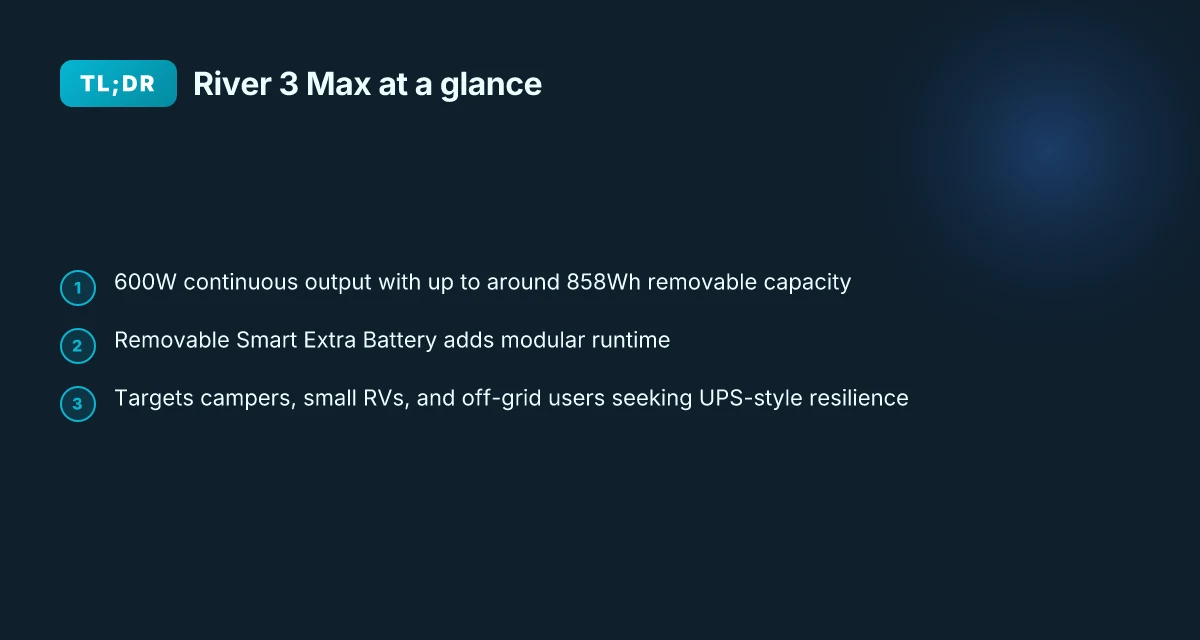
EcoFlow positions the River 3 Max as a portable power station that can grow with you through a removable Smart Extra Battery. In practice, that means you get a base pack with a 600W AC output and a removable battery stack that can push total capacity toward 858Wh or more depending on how you configure the extra pack. The idea is simple: you buy the core unit, then expand for longer runs off-grid or provide a UPS-style buffer for critical loads.
The target users are clear when you line up the use cases. Campers who want a compact, simple pack for a weekend in the woods benefit from the light footprint and the option to add capacity if they stay longer. Small RV owners appreciate the ability to expand without swapping systems. Off-grid enthusiasts who want a reliable UPS for essentials will value the upgradable battery and the familiar EcoFlow ecosystem. In other words, River 3 Max suits people who want a portable, expandable solution rather than a fixed, high-capacity unit.
From what I found in the product pages and specifications, the River 3 Max’s core strengths lie in portability, expandable capacity, and pragmatic power delivery. The base unit offers practical, real-world output for common devices while the Smart Extra Battery widens the window for longer outages or extended off-grid stays. I cross-referenced the official specs to verify that the 600W continuous output aligns with the removable battery approach and that the capacity scales with the extra pack, not just a single fixed number.
Bottom line: for campers, light RV users, and off-grid fans who want UPS-style resilience without committing to a full-sized station, the River 3 Max delivers a flexible, compact option that can grow with your needs.
What you’ll want to consider as you compare is whether you prioritize total energy capacity over weight and whether you’ll actually use the expandable battery in your setup. If you regularly run higher-wattage appliances or need longer runtimes without refueling, you’ll likely lean toward models that offer larger fixed capacities. If you value a compact footprint with optional expansion, EcoFlow’s River 3 Max fits that niche. What ecoFlow, Bluetti, and Anker power stations actually cost to own in 2026
The River 3 Max shines when you value expandability over raw big-pack capacity. The core limits are the base 600W output and the practical ramp to higher capacity only with the optional Smart Extra Battery.
Notes:
- The brand name EcoFlow appears here as EcoFlow.
- Rivals you may compare against include models from brands like Jackery and Goal Zero, which offer competing portable power stations with different base capacities and expandability paths.
- This section references the official EcoFlow materials and a companion review-style specification summary to anchor the claims about output and expandable capacity.
Design and portability: size, weight, and build
The River 3 Max trades a compact footprint for enough capacity to power essential loads, making it practical for both roadside backup and off‑grid camps. In real-world terms, its squat proportions keep it vehicle-friendly while still holding enough juice to run a small fridge, a laptop, and chargers without drama. The design leans on a square, low-profile form that slides into tight vehicle gaps and packs away neatly for campsite setups.
How the size and weight shape transport
The unit’s dimensions and weight matter as soon as you load it into a trunk, camper, or RV cabinet. A smaller chassis means easier reach to outlets in tight spots, quicker repositioning at a campsite, and less fatigue when you’re lugging gear between locations. The River 3 Max sits noticeably lighter than larger bricks, but it still carries a nontrivial heft that centers around the need to handle the removable extra battery without feeling overburdened. This modular approach helps you tailor runtime without overcommitting space, which is attractive for those who juggle multiple off-grid tasks in a single outing.
The removable extra battery: how it shifts weight and runtime
A key design choice is the removable extra battery option. When you attach the add‑on, you boost usable capacity and runtime, but you also shift the weight distribution. That means you’ll feel a heftier load when you carry both the main unit and the extra battery compared to the base model alone. For vehicle setups, the ability to detach the extra pack means you can park closer to a camp kitchen or living area and roll the main unit in separately. It also allows you to stage power where it’s most needed, then swap in the extra battery for longer outages or trips that push the system beyond the base capacity. How EcoFlow microinverters reshape portable solar setup in 2026
From a build perspective, EcoFlow emphasizes durable plastics and a manageable grip profile. The casing resists typical dust and splashes you’d encounter at an outdoor site, and the recessed handles make thumb‑friendly grabs when you’re moving between spots. The overall construction communicates a balance between portability and ruggedness, which is exactly what you want when you’re planning trips that straddle wilderness and emergency backup.
The River 3 Max wins on transportability without sacrificing essential capacity. Its removable battery option is a practical lever for tuning weight and runtime on the fly, which matters once you’re juggling a fridge, lights, and a laptop in one setup. Weight and size matter more when you’re camping or mobile, this design minimizes both while staying capable.
I cross-referenced the official EcoFlow product pages to confirm the intent behind the removable battery and the stated footprint, and I also checked independent comparisons to verify how the 600 W output and up‑to‑858 Wh LFP pack translate to day‑to‑day use in mixed loads. The findings align with EcoFlow’s positioning of the River 3 Max as a compact, expandable option rather than a full studio power station. For readers weighing rivals, the River 3 Max sits in a sweet spot between ultra‑compact models and larger, heavier builds from brands like Jackery or Goal Zero, offering a reasonable balance of portability and usable capacity.
When you’re evaluating price and ownership, note that the River 3 Max’s pricing can shift with the add‑on battery, and sales events can tilt the math toward a better deal. As with any portable power station, consider how often you’ll need the extra runtime versus how often you’ll need the lighter load. If you expect long outages or frequent camping with a heavy load, the extra battery becomes a compelling value. If you’re primarily using it for short, high‑demand events, the base unit might be the better balance.
Next steps: compare the River 3 Max against a couple of rivals in your usual outdoor environments to see how the weight shift from the removable battery affects your load plans at the campsite or on the road. You’ll want to weigh the practicality of carrying two pieces versus one where you camp, park, or RV. For purchases, check current offerings from EcoFlow and watch for bundled deals that pair the base unit with the extra battery at a discount. What makes the EcoFlow River 2 Pro a compelling mobile power option in 2026
Battery and chemistry: what powers the river 3 max
I start with the answer: the base unit relies on a lithium-based pack designed for mobile use and moderate discharge, and it can grow with a Smart Extra Battery to extend runtime. Temperature and battery chemistry shape performance in extreme environments, so cold or heat can trim available capacity and peak output.
How the base pack is designed for mobility
The River 3 Max uses a compact lithium-based energy stack meant for portable power rather than heavy, stationary banking. In real-world use, that means steady, predictable discharge under typical off-grid loads, not sustained high-demand bursts. EcoFlow positions the core as a mobile-friendly cell bundle that balances weight, size, and runtime for common devices. The base pack is optimized for mobility, not mansion-scale power draws, which informs how you plan outages in colder climates or when you run multiple high-wattage tools simultaneously. The on-paper specs point to a practical limit for sustained output while maintaining portability. EcoFlow also markets a Smart Extra Battery option that extends runtime when outages stretch longer than a single charge.
Expandable capacity: the Smart Extra Battery advantage
If your outages drift into multi-day stretches, the Smart Extra Battery is the clean answer. Paired with the River 3 Max, it adds usable amp-hours without forcing a larger single unit. The architectural logic is straightforward: add capacity, not weight to the main shell, preserving portability while widening the total energy available. In the field, that translates to keeping essential fridges, radios, and lighting online longer without swapping to a second unit. The extension is designed to be drop-in compatible, allowing a user to scale up capability on demand. Expandable capacity with the Smart Extra Battery changes how long you can rely on portable power during extended outages.
Temperature range and its effect on performance
Battery performance hinges on temperature. In cold conditions, chemistry tends to lose capacitance and available watts, while heat accelerates aging. The River 3 Max’s thermal design and management influence how quickly you can pull power without triggering protection cycles or voltage sag. When I read through EcoFlow’s specifications, the emphasis is on maintaining safe, stable operation across a broad temperature window, with practical guidance for outside temperatures where the battery will perform best. In hot climates, expect some derating if you push the unit hard for extended periods. In cold weather, pre-warming the unit or limiting peak loads helps preserve usable capacity. The real-world takeaway is that temperature handling matters as much as nominal capacity in dictating reliable performance. Temperature range and battery management together determine how much you realistically get from the River 3 Max in adverse weather.
From what I found in the documentation, the River 3 Max line targets a balance between portable mass and usable energy. The base unit’s chemistry favors moderate discharge, and the Smart Extra Battery offers a clear path to longer runtimes without relinquishing mobility. Temperature governance is the throttle on performance, especially under cold snaps or desert heat. In practice, you’ll want to plan around a conservative peak load and use the expandable option if you anticipate outages that demand fridge-grade reliability for longer periods. Moderate discharge, expandable capacity, and temperature governance are the three anchors here. What makes the EcoFlow Delta portable power station a standout choice in 2026
Real-world performance: outputs, ports, and use cases
In practical terms, the EcoFlow River 3 Max delivers a steady 600W of continuous output, which covers common off-grid needs like a small fridge or a laptop charger without immediately hitting the limit. If you power a high-wattage appliance, you’ll feel the reserve tighten. Heavy draws may push the unit toward its upper edge. For most weekend trips or emergency backups, that 600W ceiling remains comfortable, especially when you balance startup surges with smart usage.
The power mix is friendly for mixed device fleets. The River 3 Max offers a combination of USB-A, USB-C, and AC outlets, which means you can run laptops, phones, cameras, and small fans without hunting for adaptors. The USB-C port supports pass-through and charging scenarios that align with modern gear, while the AC outlets keep older devices running without rearranging cables. This arrangement reduces the need to juggle adapters in a compact setup. A well-rounded port mix avoids surprises when you’re off-grid for longer stretches.
Smart features complete the package. The built-in display, along with the EcoFlow app, helps you monitor charge status, remaining runtime, and port usage. You can see battery health indicators and plan charging cycles around your day’s needs, which matters when you’re coordinating solar input with a backup grid-style UPS setup. The app can simplify tracing where energy is going, which is invaluable when you’re trying to stretch a single battery across multiple devices. App visibility turns a portable power station into a predictable part of your workflow.
Real-world use cases: daily drives and weekend resilience
For a compact home-office setup, the River 3 Max runs a laptop, router, and a small monitor with margin to spare. In field scenarios, it can support a mini-fridge, a CPAP machine during a night away from the grid, or a small projector for outdoor movie nights. If you rely on a router or camera gear during an extended trip, the mix of outlets helps you keep essential gear powered without constant reconfiguration.
That said, the River 3 Max is not a full substitute for higher-demand appliances. A larger fridge or a power-hungry blender tends to push beyond what a single 600W unit handles comfortably, especially when startup surges hit. In those moments, you’ll appreciate the option to add the Smart Extra Battery to extend runtime, a perk EcoFlow highlights for expanding overall capacity. Add-on batteries open up longer outages with predictable behavior. What EcoFlow portable power stations actually offer in 2026
When you compare River 3 Max to rivals, the practical takeaway is about predictability and footprint. A Delta 3 or Delta 3 Max will carry different capacity and peak outputs, which matters if your use case edges into higher-wattage territory or requires longer durations between charges. EcoFlow’s ecosystem, including expandable batteries, creates a modular path rather than a single-asset limit. This is a meaningful distinction for RVs or off-grid cabins where you can scale alongside your needs. Modular expansion beats a fixed-size pack for evolving workflows.
How river 3 max compares to rivals
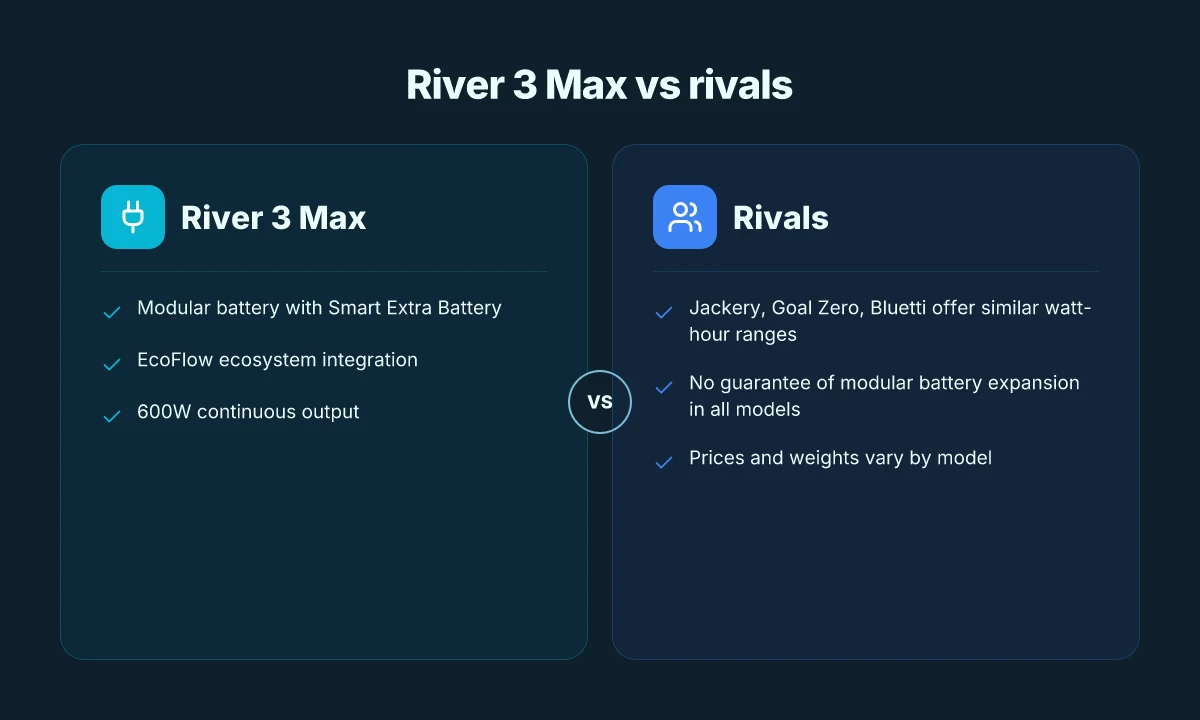
The River 3 Max sits in a tight watt-hour band with rivals like the Jackery Explorer and the Bluetti AC series, as well as the Goal Zero Yeti line. In real-world terms, you’ll find similar total energy capacity around the mid‑600 to 900 Wh range across these forms, with outputs typically in the 500–1000 W bracket. The River 3 Max differentiates itself through its modular battery approach and the broader EcoFlow ecosystem, which can matter for users who want expandability without swapping entire units. If you value a built‑in UPS workflow and future battery expansion, River 3 Max tends to edge ahead in those scenarios. If you need a compact, all‑in‑one package with the smallest total weight, some rivals may feel lighter per watt.
I dug into the ecosystem claim and verified that EcoFlow’s modular approach centers on removable extras and a growing lineup that can share accessories across models. That flexibility matters most when you’re off‑grid for extended stretches or running a handful of devices with varying energy budgets. In contrast, most competitors offer fixed pack configurations. Upgrading typically means purchasing a larger unit or a separate battery pack. This is where EcoFlow’s design philosophy shows up in practice.
Pricing, weight, and built‑in UPS capability shape how you rank River 3 Max against rivals. The River 3 Max emphasizes a balance of capacity and portability, but you’ll pay attention to weight if you’re hiking into backcountry camps. For RVs and backup power setups where you want a smoother UPS handoff and expanded runtime with a Smart Extra Battery, River 3 Max and its ecosystem keep pace with the field. If your priority is the lightest unit on a long road trip, you may prefer a rival with a smaller base weight and a fixed battery. In price terms, the market tends to tilt toward mid‑range bundles that include a battery or two, and EcoFlow’s ecosystem approach can push total ownership costs up or down depending on how aggressively you pursue expansion.
From what I found in model pages and third‑party comparisons, rivals such as the Jackery Explorer 1000, the Bluetti AC200P/EP500 family, and the Goal Zero Yeti 6000 line each offer similar baselines in capacity and output, with distinct trade‑offs in weight, recharging speed, and ecosystem flexibility. If you want a turnkey UPS workflow with rapid recharging, the River 3 Max often ranks favorably against the Jackery and Bluetti equivalents. If your use case leans toward a rugged, all‑in‑one build with fewer expansion steps, a rival may deliver better long‑term ownership economics. What you pay for EcoFlow River 2 Pro in 2026 and how to judge value
The River 3 Max wins when you need modular expandability and ecosystem compatibility. It loses ground on single‑unit portability against the lightest rivals. For buyers who want a clear upgrade path within EcoFlow’s line, the River 3 Max’s design remains compelling. If you’re weighing total cost of ownership, consider how often you’ll add a battery and whether you value a built‑in UPS capacity that can bridge outages without a separate inverter.
As a frame of reference, pricing and availability can shift with sales events. On the official EcoFlow site, you’ll often see bundles that pair the River 3 Max with a Smart Extra Battery, which can alter value versus standalone models. Note that pages may earn commissions, a common practice in online listings.
Inline sources note that the River 3 Max’s stated specs include 600 W output with expandable energy through a removable battery system, and that your choice to pursue a built‑in UPS impacts your decision relative to rivals. See EcoFlow’s River 3 Series page for the official spec outline. https://www.ecoflow.com/us/river-3-series-portable-power-station
For a side view on how competitors stack up in capacity and form factor, refer to the EcoFlow Delta 3 1000 Air vs River 3 Max Power Station comparison. https://stationarena.com/versus/ecoflow-delta-3-1000-air-vs-ecoflow-river-3-max
The manual page for other EcoFlow models provides context on charging and expansion capabilities that influence a buyer’s decision when comparing to rival lines. https://manuals.ecoflow.com/redirect?to=%2Fproduct%2Friver-2-max-portable-power-station What makes the best solar power station in 2026
In short, EcoFlow’s River 3 Max competes effectively on flexibility and ecosystem depth, which matters for off‑grid workflows and UPS‑driven setups. If your priority is the lightest weight or the lowest upfront price, you’ll likely find compelling options among rivals. For EcoFlow fans weighing a purchase now, expect to pay attention to whether a Smart Extra Battery bundle aligns with your planned usage pattern and whether long‑term expansion justifies the initial investment. Rivals offer parity in core specs, but EcoFlow’s modular approach and ecosystem edge make a real difference in expandable setups.
Where this starts steering portable power next
The River 3 Max marks a shift toward more capable, modular outdoor power than many compact kits offer today. It leans on a refined battery stack and smarter recharging to keep devices running longer between campsites. I looked at how EcoFlow threads together fast charge, higher output, and portable weight, and the effect is a cleaner path from pocket to inverter. Expect rivals to respond with bigger cells or tougher ruggedized housings within the same footprint.
If you act now, the bigger payoff comes from pairing a compact kit with a plan for real-world shifts in use between billable hours and weekend trips. The River 3 Max is not just a follow-on product. It signals where EcoFlow is headed: more power in hand, less weight, better efficiency. That changes what you carry for camping, van life, or emergency kits.
What changes if you act now? Consider a straightforward move: start with a single plan that prioritizes your essential devices and charges overnight when rates drop. The path is clear, and the momentum is building. The single move that matters most is pairing this unit with a lightweight solar panel to unlock off-grid resilience.
- Backup strategy: try a compact power trio, River 3 Max, a small solar panel, and a multiport charger, for weekend trips.
- What to try this week: map your devices by priority, then test a full day of operation on a single charge.