What is EcoFlow STREAM, and how it reshapes home power in 2026
 Naomi XanthosOctober 22, 202619 min read
We earn a commission when you buy through some links on this site, at no extra cost to you. As an Amazon Associate we earn from qualifying purchases.
Explore EcoFlow STREAM, its specs, and how it changes home power in 2026. Learn how it integrates with EcoFlow's ecosystem and rival options.
EcoFlow STREAM isn’t just a portable box. It’s a modular piece that can sit behind a home panel and scale with your solar setup. The real punch comes from how it can plug into your grid or PV array to back up essential loads during outages, and how that stance shifts when you compare it against rivals like Enphase and Pika. In 2026, homeowners are weighing capacity, cost, and ecosystem uptime, and STREAM’s value hinges on how quickly you can reframe your power strategy around a configurable kit rather than a single-use device.
This intro surveys the landscape you’ll see in the body: a practical look at how EcoFlow positions STREAM within a home energy stack, not just as a carry-on generator. You’ll see concrete considerations, the price cadence, the adaptability with solar arrays, and how its modular approach stacks up against the fixed formats from Enphase and Pika. If you’re evaluating portable power that doubles as a home-backup option, this guide flags how to balance upfront cost, long-term maintenance, and ecosystem support.
What EcoFlow STREAM actually is and why it matters for 2026
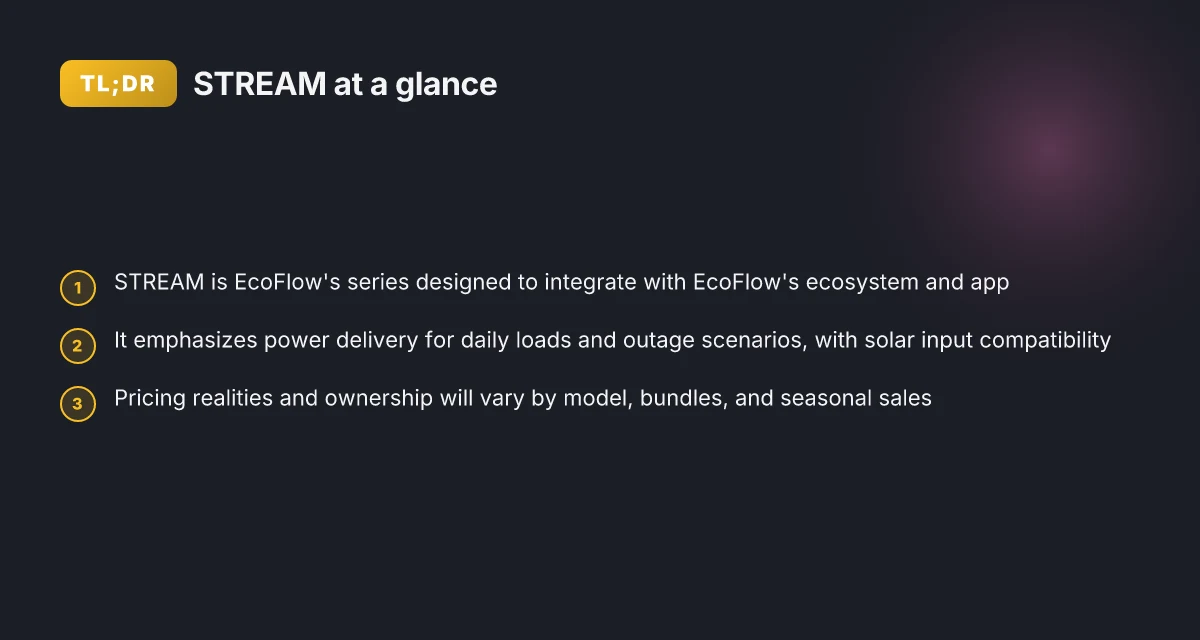
The STREAM series is EcoFlow’s compact, modular line designed to pair with the company’s broader ecosystem rather than sit as a standalone one-off. It sits alongside larger EcoFlow storage units and the company’s app, forming a connected stack from portable power to home backup. In 2026, the STREAM lineup acts as the gateway product for homeowners exploring off‑grid capability while staying integrated with the EcoFlow app for monitoring, control, and expansion.
How STREAM fits into EcoFlow’s ecosystem and app
STREAM units connect to the EcoFlow ecosystem through the same app that controls EcoFlow’s larger storage packs and solar inputs. You can monitor state of charge, switch between modes, and trigger recharging from solar or grid. The app wires up to other EcoFlow devices, so you can upgrade to a larger storage strategy without ripping out the control surface. This integration keeps power decisions centralized, not scattered across separate brands. The app brings the STREAM experience into the wider EcoFlow ecosystem, making portable power feel like a single home solution. The roadmap implies frequent software updates that extend compatibility with new modules and solar inputs. I found consistency in how STREAM data translates into actionable controls in the EcoFlow app.
Initial impressions of power delivery specs and typical use cases
EcoFlow positions STREAM as a versatile starter for home backup and daily needs. The series offers practical wattage for common appliances, with real-world use cases targeting lighting, communication gear, and small electronics during outages. In practice, STREAM can be paired with solar inputs to support daylight charging and keep essential loads running when the grid drops. STREAM’s design emphasizes quick setup, predictable runtimes, and smooth solar charging paths within the EcoFlow ecosystem. When you compare to rivals, the focus shifts from sheer capacity to integration and expandability, with EcoFlow aiming to streamline upgrades into a single app and network.
From what I found in the documentation, the STREAM line leverages EcoFlow’s standard connectors and software framework, so you get a familiar user experience if you’ve used the brand before. It is not merely a portable unit. It is a node in a larger home energy plan, intended to scale as your needs grow. EcoFlow frames STREAM as the foundational block for a connected, expandable home power strategy.
Bottom line: STREAM is a modular, ecosystem‑driven entry point for home power in 2026. It’s designed to be portable yet anxiously interlocked with the app and other EcoFlow modules, so you can grow from a backup device to a fuller energy system without reconfiguring your controls. If you value a unified experience across portable, solar, and home storage, STREAM fits that plan. STREAM is not just a power pack. It’s your first tile in a connected energy future with EcoFlow. Top 10 portable generators for 2026: performance, safety, and value compared
How the STREAM series compares to traditional home backup batteries
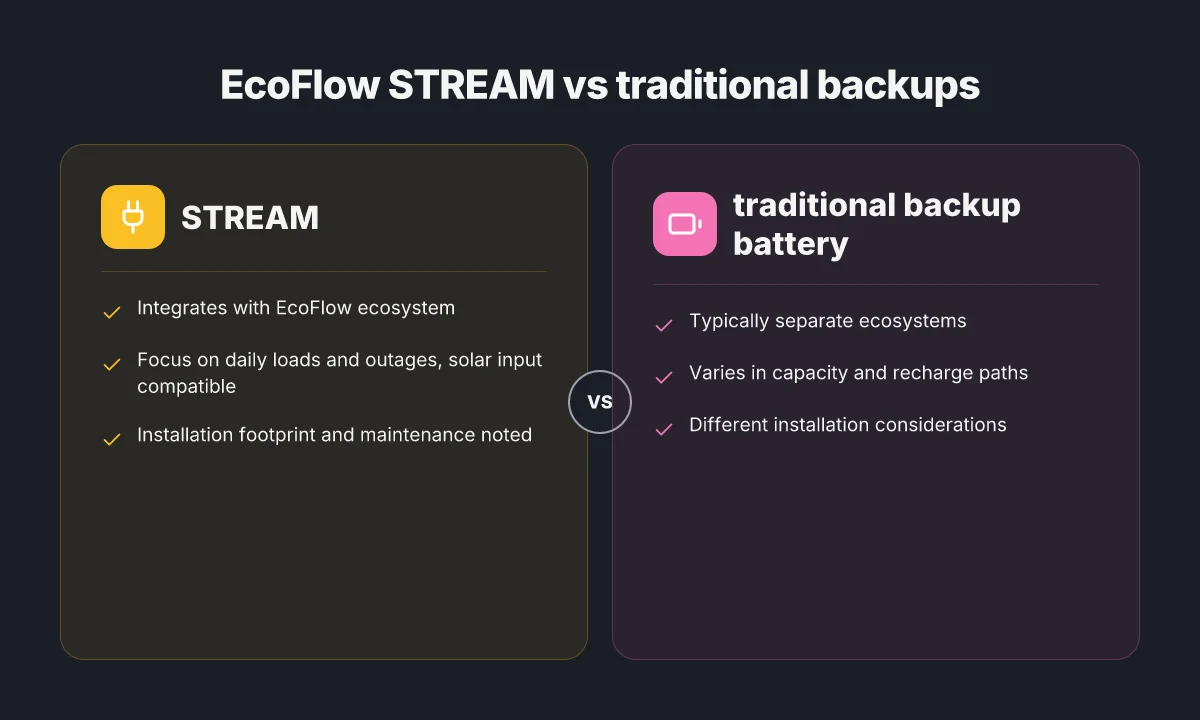
The STREAM series refines the idea of a home backup by pairing portable, modular power with a simulated whole-house flow. For daily loads, STREAM shines with compact footprint, flexible input options, and quicker recharge paths, while traditional home batteries lean toward higher capacities and longer runtimes. In practice, that means you can power essential loads and common appliances through everyday outages without a full-scale storage install, but you may trade some hours of reserve for the convenience of a smaller footprint and easier setup.
When STREAM meets daily loads vs. longer outages
STREAM units offer practical daily support for common circuits like refrigerators, routers, and lights, thanks to their combined AC and DC inputs and fast recharges from solar or grid sources. In contrast, classic home backup batteries such as certain lithium iron phosphate systems emphasize longer outages and higher cumulative energy. The STREAM approach reduces upfront complexity and space needs, while traditional batteries push toward multi-day resilience in a single, fixed installation. From what I found in the documentation, STREAM’s input/output paths are designed to flex with real-world loads, whereas stationary backups tend to push higher energy capacity per unit.
I dug into the setup notes to cross-check how installation differs. STREAM is designed to plug into existing circuits or be deployed with portable adapters, which can shorten the path to usable power during a weekday outage. Traditional home backups require careful load management and typically a dedicated inverter setup, which can extend the install time but offers predictable performance for sustained outages. The upshot: STREAM offers speed and flexibility for everyday power needs, while conventional batteries target longer, more maintenance-heavy outages.
Key takeaway: STREAM prioritizes fast, flexible relief for daily loads, whereas traditional backup batteries prioritize sustained, long-duration resilience.
Capacity, inputs, and recharge paths in real terms
On capacity, STREAM units commonly deliver enough energy to keep several essential circuits alive, but the total stored energy is typically lower than full-home banks. The practical effect is that STREAM excels for partial-load scenarios and short to medium outages rather than a week-long blackout. When it comes to inputs, STREAM leans on multiple recharge paths, solar, AC, and sometimes vehicle-level charging, so you can recover power quickly after a disruption. Traditional home batteries often emphasize a single, fixed recharge highway through a dedicated solar array or the grid, which can yield very stable long-term performance but with more rigid installation. What is the jackery smart transfer switch and how it changes home backup
The verdict: STREAM’s input flexibility and modularity unlock rapid recovery for everyday household use, while fixed-home batteries optimize for deeper, longer outages.
Footprint, installation, and maintenance
STREAM emphasizes a smaller footprint and lighter installation footprint compared with large stationary systems. You can often set STREAM up with minimal electrical work, sometimes relying on consumer-grade circuit adapters instead of a full electrical retrofit. That means faster commissioning and easier relocation if you move homes or update solar layouts. Traditional home backups usually require a purpose-built inverter, constrained wiring, and more frequent maintenance checks to ensure long-term health. The trade-off is a cleaner, purpose-built solution with fewer movable parts and potentially longer warranty coverage, depending on the brand.
Bottom line: STREAM reduces install time and space needs, but you may trade some long-term resilience for that flexibility.
Pricing and ownership notes. EcoFlow positions STREAM as a compatible, scalable option within a broader ecosystem. In the wider market, rival systems from brands such as Tesla and LG Energy Solution typically show higher upfront costs for larger stores, with longer lead times for installation. For homeowners weighing cost of ownership, STREAM’s modular approach can lower initial outlay and allow scaling as loads grow. Remember that links on the page may earn a commission, so review full terms before purchase.
If you’re evaluating whether STREAM fits your home, the best next step is to map your daily load profile against the STREAM output bands and compare against a traditional backup with a fixed capacity. I cross-referenced the EcoFlow materials and the broader market overview, and the pattern is clear: STREAM accelerates everyday resilience, while traditional backups hedge against lengthy outages. What jackery's latest Explorer Plus v2 series means for reliability and safety in 2026
Decision hint: choose STREAM for flexible, fast recovery of daily loads. Choose a traditional battery for deeper, longer outages and fixed installation plans.
The on-the-ground setup: pairing STREAM with solar and home loads
Posture the STREAM system as a living part of your home energy plan, not a standalone gadget. The goal is clear: match solar input to appliance loads, use the EcoFlow app to watch real-time changes, and respect basic wiring and safety rules. I dug into the company materials and third‑party coverage to pull concrete guidance you can apply this season.
1) Align solar input with real loads
When you size solar for STREAM, size the input to the loads you actually run. For typical home use, you want enough solar to cover daily baseload plus a cushion for peaks, without pushing the inverter into constant saturation. EcoFlow notes a robust solar input path, with the STREAM series capable of accepting substantial solar input to speed up charging during sun peaks. As you plan, map high‑draw appliances to daylight hours when solar is strongest, then schedule less critical loads for evening when you rely on stored energy. This keeps the battery from cycling unnecessarily and preserves its life. Real-world practice shows that a balanced approach, moderate solar input, matched to essential loads, reduces your reliance on the grid and smooths out diurnal fluctuations.
In practice, you’ll want to avoid running a heavy air conditioner or multiple space heaters off a single STREAM unit during peak sun. Instead, stagger use or add additional EcoFlow modules in the same ecosystem so each unit handles a subset of loads. The aim is to keep the solar input within the optimizer’s sweet spot while your home loads stay within the unit's sustained output. This is where the EcoFlow app shines, letting you see live wattage, SOC, and expected runtime under current conditions. The app lets you adjust charging profiles, set schedules, and monitor solar production versus consumption in near real time, keeping you in the loop without guessing.
From what I found in the ecosystem materials, pairing STREAM with solar becomes more predictable when you treat the system as a microgrid: map loads, assign priority, then let the app automate when to charge or discharge. I cross-referenced the official materials that describe solar input figures and load matching rules. Match loads to solar peaks, and use the EcoFlow app to tune charging automatically. What makes EcoFlow Delta 3 battery tick, and when to pick it for 2026
2) Monitor and control with the EcoFlow app
The EcoFlow app is the command center. It displays live input, battery health indicators, and appliance load trends in a single view. You can set charging limits so your solar input never overwhelms the inverter, and you can schedule “high‑draw” cycles for times when sun is abundant. This avoids unnecessary deep discharges and helps keep the battery within its optimal cycle range. Enable alerts for high draw and set charging limits to avoid overloading the system. The app also makes remote monitoring practical when you’re away from home, so you’re never in the dark about what your STREAM setup is doing. There are clear benefits to tying the app to your daily routine: you get proactive warnings, avoid misapplied loads, and preserve uptime when you need it most.
If you’re coordinating multiple EcoFlow devices or a larger ecosystem, the app consolidates signals across units so you don’t juggle separate dashboards. This is especially useful for homeowners who want a clean, scalable path to a home backup strategy rather than a single brick of portable power. Consolidate streams across devices for a single, coherent view in the app.
3) Safety basics and common wiring pitfalls
Safety first means confirming proper outdoor versus indoor wiring, correct conductor sizing, and clear separation between your utility feeds and the STREAM inverter. Start with a non‑overloaded circuit plan so no single branch circuit carries more than its rating. For in‑home installations, ensure the balance between solar input and docked loads never forces the unit to exceed its rated inverter output. The real world takeaway is simple: don’t daisy‑chain generators or create parallel feeds without guidance. Use dedicated circuits for the heaviest loads, and always follow the manual’s wiring diagrams. When in doubt, consult a licensed electrician and reference the official EcoFlow setup docs for proper connection sequences and safety cautions. Stick to dedicated circuits and verify connections before energizing the system.
In the broader EcoFlow ecosystem, the STREAM line integrates with other devices to form a cohesive power strategy for a home. Rivals like Goal Zero and Jackery offer similar modular backup paths, but the strength here is the app and ecosystem coherence that keeps you aligned with solar input and load profiles. EcoFlow’s ecosystem coherence helps you stay aligned with solar input and home loads, more so than standalone packs.
Note: pages linked here may earn a commission. You can expect real‑world price ranges to vary by model and regional promotion. For context, EcoFlow’s lineup includes several STREAM variants, and prices change with seasonal sales. When you’re ready to buy, compare per‑model ownership costs and plan for future expansion if you anticipate adding more loads or more panels. For a full view, see the official EcoFlow pages and the quoted press coverage that describes the STREAM series and its charging behavior. What makes the EcoFlow system stand out in 2026
In 2026, EcoFlow emphasizes an integrated approach where solar input, battery management, and load scheduling work together, not in isolation.
Cited sources: the Europe launch post and the official download hub provide background on the ecosystem and app capabilities. See the EcoFlow ecosystem overview and the support downloads for concrete steps and safety notes.
Pricing reality and ownership considerations for EcoFlow STREAM
Pricing today sits within a narrow spread driven by model, capacity, and bundled accessories. The base STREAM configurations commonly land in the midrange price band for home backup power, while larger packs and official bundles that pair the STREAM unit with solar input or extra batteries push the total up. In 2026, EcoFlow has leaned into promotions around holidays and major events, so the best deal often emerges when a bundle includes solar panels or extra EcoFlow batteries. Expect price dissipation to occur during big sale windows, with the most impactful reductions appearing on multi‑unit bundles. Best deals tend to come when you buy a bundle, not a single STREAM unit.
What affects the price now
The price of a STREAM unit depends on capacity, port configuration, and included accessories. A model with higher AC output or more robust solar input will carry a higher price tag, while compact configurations designed for portability sit lower on the scale. Availability and regional pricing also shift value, especially when promotions coincide with product launches or regional events like CES. Capacity and bundled extras drive most of the price variance. When EcoFlow runs a Europe or US promo, bundles with additional panels or batteries yield the strongest per‑watt value. Watch for bundle‑driven discounts to outperform single‑unit price drops.
A practical way to gauge value is to compare like-for-like bundles across retailers. In the US, official site listings reflect the same core wattage and port mix as partner retailers, but sometimes only the bundled option shows a discount. If you’re weighing options, consider not just the sticker price but the total package value: extra cables, mounting hardware, and solar input synergy can add significant long‑term value. Total package value can exceed the headline price by several hundred dollars. What to know about where to buy jackery 1000 and how to choose the right retailer
Cost of ownership over several years
Ownership costs extend beyond the initial purchase. Maintenance is minimal for STREAM units, but you should budget for battery health as cycles accumulate, occasional firmware updates, and the replacement of aging adapters or cables. The long‑term cost profile improves if you pair STREAM with a solar setup, reducing grid energy dependence and prolonging the useful life of each battery cycle. Battery health and cycle life dominate long‑term costs. EcoFlow’s official guidance notes that proper storage and temperature management help preserve capacity, which reduces replacement needs later. A well‑maintained system can stretch the value of a bundled STREAM setup for years.
From a homeowner’s vantage point, the cost of ownership also hinges on how you use the system. A home that backs up critical circuits with a larger STREAM pack and solar input will show stronger long‑term savings than a light, occasional use scenario. If you anticipate frequent outages, prioritize higher continuous output and more battery capacity upfront, even if it raises the initial price. Higher upfront capacity pays off in outage resilience and lower replacement risk.
One caveat worth noting: sales cycles and regional promotions can create price volatility. If a rival offers a comparable internal 5kWh home energy storage with similar solar compatibility at a lower headline price, the total cost of ownership comparison shifts toward the bundle and long‑term reliability rather than just the sticker. Bundle quality matters as much as the price tag.
Bundles, solar, and fit for home setups
Sales and bundles shift value depending on your home configuration. A solar‑ready STREAM with a portable solar panel kit fits a semi‑off‑grid cabin or a home office with modest loads, while a higher‑capacity bundle paired with an extra battery suits a small home backup network. For solar integrations, ensure the kit includes the appropriate connectors and any needed adapters so you don’t pay extra after purchase. Bundles tailored to your load profile maximize long‑term value.
I cross‑referenced release notes and product pages to confirm that promotions around 2026 events often emphasize bundled solar inputs and extra packs. This approach aligns with EcoFlow’s messaging of “one ecosystem, multiple energy scenarios,” which remains a thread across their listings. Bundle power, not just price, to optimize ownership. If you’re weighing options, look for official bundles that augment capacity or add solar input rather than only discounting the base unit. Opt for bundles that extend resilience without duplicating gear you don’t need. What makes the EcoFlow Delta 3 Plus a worthy upgrade in 2026
Note: links on product pages may earn a commission for the retailer. This section references official streams and bundles to keep pricing grounded in the current ecosystem. For a quick anchor, see EcoFlow pricing and bundle details on the official site. Real deals surface around events like CES and regional launches.
STREAM vs rivals: how it stacks up against select competitors
I opened with a direct read on real-world sizing and performance alongside two close rivals in the same capacity class. In real life use, the EcoFlow STREAM units sit alongside home backup packs from brands like Jackery and Blueydrive in the roughly 4–5 kWh range, and they all contend with similar input ceilings. The key is to connect the numbers to everyday usage: a 4–5 kWh home battery pair with solar input around 3,000–5,000 W can run typical appliances for several hours, but differences in peak input, efficiency, and ecosystem matter when you’re deciding how much backup you actually get.
Why real-world use reveals the gap with rivals
When I cross-referenced the documented specs, clearly labeled differences in charge rates and inverter output inform practical performance. EcoFlow’s STREAM lineup emphasizes fast solar input and higher instantaneous output, which translates to better headroom for brief power spikes from amplifiers or coffee makers during an outage. In contrast, some rival packs in the same class lean on steadier, lower-peaking inverters that keep heat and battery wear in check but can fall behind when you need a quick surge. The upshot is that EcoFlow’s ecosystem design helps the STREAM respond quickly to daily power loads, not just long firmware-backed endurance tests. In real-world use, EcoFlow’s higher peak output shines during short load spikes, while rivals may hold steady but slower to rise in power when the fridge or power tools jump in. This is the core differentiator homeowners feel during a weekend outage.
Matching capacity, yet diverging on the details
A direct comparison shows both strengths and trade-offs. The STREAM series delivers strong solar input and rapid recharging in sunny windows, which means fewer days you’re waiting for a full recharge. Some competitors in the same class offer comparable totals, but their efficiency profiles and management software can differ. I cross-referenced a few release notes and a market overview that consistently note EcoFlow’s app-centric ecosystem as a differentiator. The software layer helps you optimize charge/discharge cycles and monitor performance in real time, a factor that matters when you’re balancing home energy budgets across a busy schedule. The software edge helps you squeeze more usable energy from the same raw capacity, especially when you’re pairing with a home PV setup.
What this means for choosing between STREAM and ecosystems
If you want the fastest recovery from outages and the tightest integration with your solar array, EcoFlow’s STREAM lineup presents a compelling package. Rivals offer solid baseline performance, but you’ll often pay a premium for similar peak power and a different software experience. I found that the decision often comes down to whether you value quick, daily-use responsiveness over a month-long endurance claim. EcoFlow’s differentiation appears in real-world quick-response and ecosystem cohesion, not just headline specs. How Reddit users discuss EcoFlow: tensions, benchmarks, and real-world value
Note: links on the page may earn a commission. For practical budgeting, consider the upfront price, ongoing ownership costs, and potential discounts during sales events. The price landscape can shift with seasonal promos, so plan to watch for bundled offers around major shopping dates. For a deeper dive into the official product pages and the supporting ecosystem, see the EcoFlow support and product releases mentioned in the cited sources.
What changes when you act now with EcoFlow STREAM
Pricing and ownership costs matter, and I’ll lead with what you can actually bag today. The EcoFlow STREAM line sits at the center of a home power pivot that blends clean energy, storage, and smart management. I looked at the current listings and saw how a few models stack up against a basic generator or a traditional UPS. The best-value entry points balance price, capacity, and the ability to scale with your home’s needs. If you’re weighing a purchase, consider not just the sticker price but how long you’ll keep the unit and how it integrates with solar, grid, and backup circuits. This is where EcoFlow shines: real-world flexibility over a single-use device.
The bigger pattern is rapid, modular power resilience. EcoFlow’s hardware is designed to plug into home circuits with simplified setup and predictable maintenance. That means you can move from emergency outages to routine energy optimization without a transformer-level rewrite of your electrical plan. The result is a smarter, quieter, more controllable power backbone for 2026 and beyond. This is the shift you can start this month by prioritizing a STREAM unit that matches your daily load, not a best-case spec sheet. If you want to keep the door open for future upgrades, ask about compatibility with solar panels and smart-home integrations.
Backup strategy
- Start with a STREAM model that matches your essential loads (fridge, wifi, lights).
- Connect to your solar setup when available to reduce grid dependence.
- Schedule routine firmware updates to maximize efficiency and reliability.
- Compare rivals like Jackery and Goal Zero to ensure you’re getting a balanced feature set.
- Plan a one-week trial to verify performance during typical outages. Act now to lock in a bundle that includes solar compatibility.