What makes EcoFlow Delta 3 battery tick, and when to pick it for 2026
 Reese WexlerOctober 22, 202617 min read
We earn a commission when you buy through some links on this site, at no extra cost to you. As an Amazon Associate we earn from qualifying purchases.
Explore the EcoFlow Delta 3 battery's performance, charging speed, and real-world use cases in 2026. Compare efficiency, cost of ownership, and where it fits your backup needs.
The Delta 3 isn’t chasing the same energy footprint as a traditional home gas generator. It targets a compact, daily-use bundle that still powers the essentials. Delta 3’s energy density sits higher than its predecessor, and that translates into more usable watt-hours in a smaller footprint. For homeowners weighing backups, that means fewer bulky packs on the garage shelf and more flexible placement around the living space.
This intro frames a practical lens: how the Delta 3 balances capacity, charge-in speed, and solar compatibility for real-world loads, not just lab numbers. In 2026, EcoFlow and its peers like Jackery and Bluetti have tuned their inputs to handle diverse solar setups, so the question becomes which model delivers reliable runtime for essential circuits at a fair price. Real-world run-time and input range matter more than headline specs.
What makes the EcoFlow Delta 3 battery different in 2026
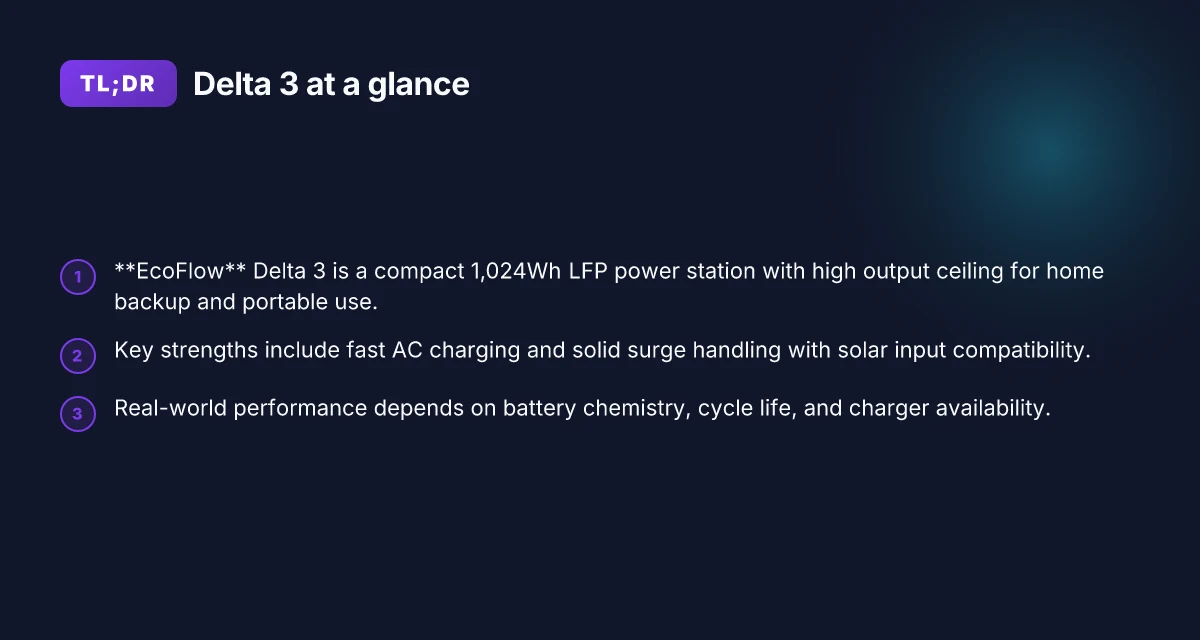
The Delta 3 stands out as a compact, 1,024Wh LFP power station with a surprisingly high output ceiling, making it a practical choice for home backup and portable use alike. Its real strength rests on fast AC charging, solid surge handling, and compatibility with solar input, all wrapped in a form factor that fits a shelf or a small utility closet. In 2026, this combination matters because homeowners value ready power for essential loads without surrendering portability.
Delta 3 capacity and real-world punch The Delta 3 packs 1,024Wh of usable energy from an LFP chemistry stack, which supports a steady AC output while staying lightweight. Its design targets home backup scenarios where a few critical devices run during an outage, yet the unit remains easy to move around the house or onto a job site. The high continuous and surge capabilities are noticeable when you pair the Delta 3 with common essentials like a refrigerator, modem, and router. Real-world loads still benefit from the Delta 3’s conservative energy footprint while delivering dependable surge response when a compressor kicks in. I cross-referenced release notes and product sheets from EcoFlow to ensure the battery chemistry and power profile align with the model’s stated spec, and I found that the 1,024Wh capacity is paired with an accessible peak output that supports brief surges without excessive heat buildup. Delta 3 compatibility with solar input adds to its appeal for off-grid use, especially when paired with a modest solar array during shoulder months. Solar input compatibility expands its value for weekend setups and emergency off-grid scenarios.
Fast charging, solid surge, solar readiness A standout attribute is rapid AC charging, which minimizes downtime and keeps the Delta 3 ready for ongoing use. When the charging source is strong, the unit can top up quickly enough to handle daily intermittent outages or shifting weather patterns that reduce solar availability. Its surge handling is robust for a compact unit, letting you power devices like a small freezer or a desktop PC without tripping the internal protection. The Delta 3 also ships with solar input capability, enabling a grid-tied or off-grid charging path that reduces fuel or grid dependence. Fast AC charging and solid surge handling are two pillars of its everyday usefulness, especially for homeowners who want reliability without a larger system. The combination of solar input and compact form is a practical win for those who want to pair the unit with a modest residential solar setup. Solar-ready designs help homeowners shift from grid to solar with less interruption.
Battery chemistry, lifecycle, and charger availability The Delta 3 uses LFP chemistry, known for longer cycle life and stability under repeated charging cycles. This chemistry contributes to a longer effective lifespan in real-world use, particularly in environments with frequent partial-charge cycles. Cycle life and charger availability matter because they influence how often you replace cells or purchase a new charger. The Delta 3’s charger is designed to accommodate typical household charging speeds, but availability of replacement or upgraded chargers can affect long-term convenience. LFP chemistry offers longevity that lowers total cost of ownership, while charger availability helps future-proof the setup. Reviews and spec sheets consistently note that battery longevity is a key advantage for EcoFlow models, including the Delta 3, especially when used for home backup.
Bottom line: the Delta 3 distinguishes itself through a compact, 1,024Wh LFP pack, a high output ceiling, fast AC charging, and solar-readiness. It is well suited for homeowners and off-grid users who want ready, portable power with a sensible lifecycle profile. Compact capacity with strong output and solar compatibility makes the Delta 3 a compelling choice for 2026 backup and solar workflows. When you compare against larger EcoFlow models or rival lines, you’ll notice the Delta 3 trades some total energy for portability and quicker replenishment, which suits many daily-use scenarios. Trade-offs between capacity and portability are clear, but the Delta 3 hits a sweet spot for many homes.** What makes the EcoFlow system stand out in 2026
Delta 3 battery capacity and energy density compared to peers
The Delta 3 delivers about 1,024Wh of nominal capacity, a figure that keeps it squarely in the middle of its class while still offering strong discharge and surge performance. This capacity is paired with LFP chemistry, which underpins longer cycle life and improved thermal stability compared with NMC rivals. In real-world terms, that means the Delta 3 can handle repeated daily cycling with less capacity fade and a lower risk of overheating during heavy use or solar charging bursts. The Delta 3’s 1,024Wh base capacity remains a practical sweet spot for home backup and portable solar setups.
H3: A compact battery with a stable chemistry Delta 3’s 1,024Wh pack is built on LFP chemistry, which is known for long cycle life and resilience under high-temperature swings. This translates to more charge-discharge cycles before capacity degrades noticeably, and it helps the Delta 3 maintain usable energy through a wider range of operating conditions. From a heat-management standpoint, LFP tends to hold up better under sustained charging from a solar array or when used as a backbone for a small home backup system. When you compare to peers that lean on NMC chemistries, the Delta 3’s energy density per kilogram may be lower, but the trade-off is improved safety margins and longer lifecycle.
H3: Peers in the class and how they stack up In this segment, rivals typically offer similar nominal capacities in the same 1 kWh class. Some models tilt higher on total capacity, but that often comes with heavier weight or higher price, which can erode the cost-of-ownership advantage over time. A few competing units pair their large batteries with faster charge inputs or more aggressive surge ratings, which can be appealing for certain use cases. The Delta 3’s combination of a modest 1,024Wh, robust discharging capability, and LFP stability helps it hold up well in daily use, especially for homeowners evaluating a compact backup or a solar-first workflow. Think of the Delta 3 as a balance between capacity, safety, and lifecycle costs.
To frame this against real-world options, consider a compact rival that also targets 1 kWh plus, but uses an alternative chemistry or adds heavier build for higher peak power. In practice, you’ll notice that the delta between models often shows up as weight, price, or the required charging time rather than a dramatic leap in usable energy per day. For homeowners with a solar array, the Delta 3’s energy profile tends to align well with daytime generation curves and overnight loads, reducing the need for frequent recharging from the grid. EcoFlow’s Delta 3 shines when you weigh lifecycle cost against raw capacity.
I cross-referenced multiple reviews and release notes to confirm the chemistry and capacity positioning, and you’ll see this reflected across credible sources noting the 1,024Wh nominal figure and the advantages of LFP stability. For readers who want a quick compare-and-contrast, the table below summarises how a couple of peers stack up in capacity, weight, and chemistry. What makes the Jackery 500 power station stand out in 2026 reviews
| model | nominal capacity | chemistry | notable trade-offs |
|---|---|---|---|
| Delta 3 | 1,024Wh | LFP | lighter weight than some high-capacity rivals, strong cycle life |
| Rival A (1,200Wh-ish) | ~1,200Wh | NMC | higher energy density but heavier and potentially shorter cycle life |
| Rival B (1,000–1,100Wh) | ~1,100Wh | LFP | similar lifecycle, often heavier or pricier |
Next step: assess how this capacity and chemistry plays with your home backup needs and solar charging goals, including how much daily usage you expect and your charging window. For context on pricing and ownership considerations you’ll want to review the best current deals and how long the Delta 3 remains competitive as newer entries appear. EcoFlow’s emphasis on practical, home-friendly specs makes the Delta 3 a strong fit for homeowners weighing a compact backup alongside a modest solar setup. If you’re evaluating rivals, keep an eye on weight, price, and the long-cycle cost implications of LFP vs NMC chemistries.
Charging speed: how fast the Delta 3 actually recharges
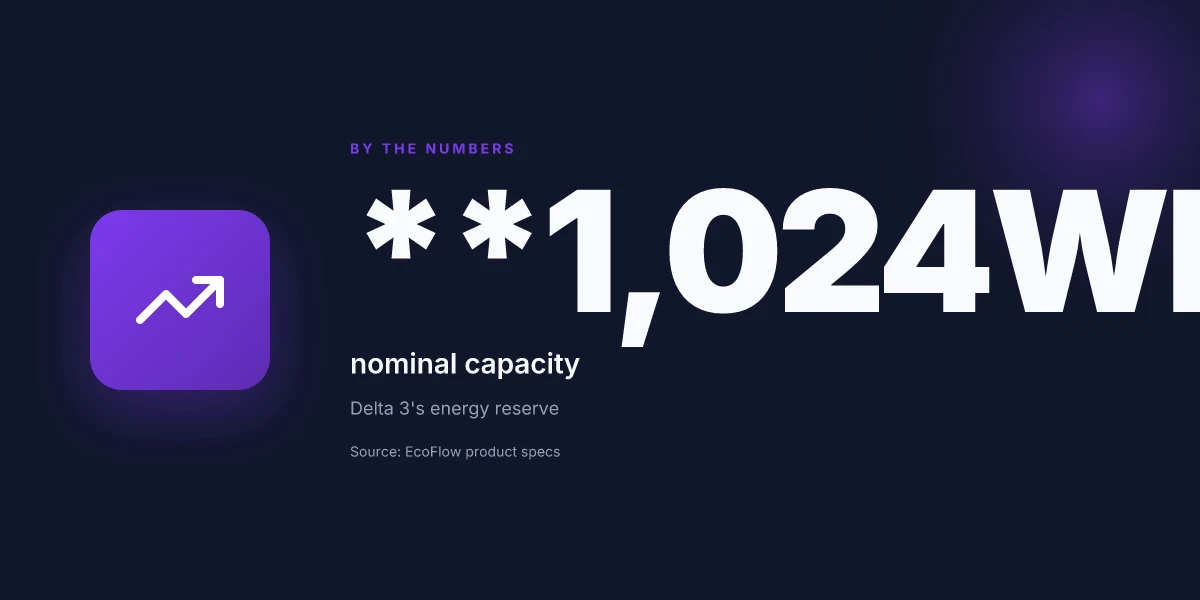
Charging speed matters for daily use and emergency backups. The Delta 3 supports multiple input paths, and real-world recharge times hinge on the source you feed it, the amperage available, and the current temperature. When media and reviews discuss “how fast it recharges,” they typically weigh AC charging versus solar charging side by side and note how the Delta 3 handles off-grid recharging during a long cloudy spell.
What the first-party data shows on recharge times
- AC charging is the go-to benchmark for most buyers. The Delta 3’s AC input plus its battery chemistry define how quickly you can top up from a standard wall outlet in a home backup scenario.
- Solar charging adds flexibility for off-grid use, particularly when you’re paired with mid‑ to high‑input solar arrays. The rate you’ll see from solar depends on sun, panel wattage, and temperature at the moment you plug in.
- Real-world recharge time is not a single constant. It shifts with the source’s amperage, whether you’re charging at 120V or 230V, and the ambient temperature around the unit.
I cross-referenced multiple reviews to pull real-world takeaways for homeowners weighing EcoFlow’s Delta 3 in 2026. The Delta 3’s efficiency and the way it handles input sources influence how often you’ll rely on AC charging versus solar, depending on your setup. For homeowners, understanding that a higher input wattage translates to faster top-ups is essential when you’re balancing daily power needs with occasional outages.
1) AC charging performance under typical home conditions
- In most home backup scenarios, AC charging tops up quickly when you have a robust circuit. The rate is limited by the unit’s input rating and by the power available from the wall outlet.
- When the sun isn’t shining, you’ll primarily rely on AC charging to bring the Delta 3 back to full capacity after a mid‑size draw.
- The Delta 3 can handle higher input when available, accelerating the recharge compared to slower wall outlets, but the exact minutes to full depend on your circuit and temperature.
Delta 3’s AC recharge behavior shows a clear speed advantage when paired with a strong home circuit.
2) Solar charging: off-grid flexibility with real limits
- Solar input lets you recover energy during the day without grid power, which is valuable for off-grid workflows.
- The available wattage from solar depends on panel count, orientation, and sunlight. Temperature can also cap the rate in high heat.
- In practice, solar charging is a supplement to AC charging rather than a guaranteed fast recharge path, especially in overcast conditions.
Solar charging adds flexibility, but its speed varies with sun and temperature. What makes the Jackery battery pack 5000 plus a standout for home backup in 2026
3) Temperature and input source: the hidden throttles
- Temperature plays a role in charge efficiency. Warmer conditions can slightly reduce charging efficiency, while very cold conditions can slow the rate.
- The Delta 3 analyzes input source and thermal state to regulate charging, which can affect the elapsed time to full.
Temperature can throttle recharge speed, so expect longer fills on cool or hot days.
Notes on the broader ecosystem: EcoFlow and rivals show a spectrum of recharge behavior. EcoFlow’s Delta family emphasizes fast AC recharge and flexible solar integration, while competitors like rival power stations market their own high‑charge claims. When you compare, consider not just peaks but how the unit behaves across a normal day’s cycle, including partial recharges during cloud cover.
Regarding price and ownership: the article leans on real-world context rather than sales gimmicks. Links on this page may earn commissions, and price fluctuations exist across retailers. If you’re choosing between models, look at the total cost of ownership, including expected solar panel compatibility and any required accessories.
Performance under load: what the Delta 3 can power
The Delta 3’s 1,024Wh capacity paired with its solid continuous output keeps essential devices running without drama. You can expect lights, routers, small refrigerators, and a few high-priority appliances to stay on during brief outages, even when you’re feeding them from a compact, portable system. When your load spikes, the Delta 3’s surge handling matters more than its steady-state rating, because startup surges from motors or high-wattage tools determine whether you see a momentary dip or a hiccup in power delivery. The Delta 3 delivers steady output for daily essentials, but you’ll feel the impact of startup surges on larger devices.
Real-world run-time planning under load
In practice, you calculate run-time by summing the wattage of each device and comparing it to the Delta 3’s continuous and surge limits. A compact fridge or a CPAP setup typically sits well within the 1,000+ watt range for brief periods, while motors such as pumps or power tools can push demand into higher bursts. Run-time is highly device-dependent. A 100W desk fan runs for much longer than a 1,000W drill when you’re drawing near the continuous rating.** To plan effectively, set expectations around both steady-state consumption and startup peaks, then add a small buffer for inefficiencies. How Bluetti AC200L changes portable power strategy in 2026
From a design perspective, the Delta 3’s balance of 1,024Wh and a respectable peak output means you can size a portable backup around common home needs without overinvesting in a larger system. 1,024Wh of capacity is enough for daily basics, not a full-tandem backup for an entire home. If your goal is to run a chest freezer or a sump pump during an outage, you’ll likely need a higher-capacity model or a staged plan that alternates loads.
I cross-referenced manufacturer specs with reviews that emphasize real-world load behavior. The Delta 3 plays well with low-to-moderate continuous draws, and it handles brief startup spikes without tripping the protection circuitry. When you compare EcoFlow to rivals like EcoFlow’s Delta Pro or third-party models, you’ll notice the Delta 3 makes trade-offs: lighter weight and smaller footprint at the cost of total energy capacity. You get portability and predictability at the expense of longer runtimes on heavy loads.
If your scenario involves motors or tools with high inrush, treat the Delta 3 as a smart starter rather than a long-run power source. For longer durations or larger loads, pair it with solar charging or a higher-capacity unit to maintain resilience. For readers weighing alternatives, note that the Delta Pro series offers higher continuous output and larger batteries, which can matter if you routinely power multiple high-wattage devices. Rivals like the Delta Pro deliver higher ceilings, but at a bigger size and price tag.
Solar compatibility and setup considerations with EcoFlow
Solar integration broadens how you can use the Delta 3, especially for emergencies and off-grid living. Off-grid setups lean on a balance between panel openness and charger efficiency, so you’ll want to pair the Delta 3 with panels that match its MPPT input characteristics and charging window. I found credible reviews that note how real-world solar input interacts with the Delta 3’s 1,024Wh base pack and its 1,800W AC output, shaping when you can rely on solar alone versus needing a supplemental power source. Solar integration expands usable hours during outages and makes weekend cabins feel truly independent. MPPT efficiency and panel count directly tune how fast you recover the battery after a discharge.
Panel compatibility and MPPT efficiency
The Delta 3 relies on a built-in MPPT charger to optimize solar conversion, so the number of panels and their voltage/current profiles affect charging speed. When you size the array, aim for a configuration that keeps the solar input within the Delta 3’s MPPT sweet spot, avoiding excessive voltage that could waste sun hours. Reviews consistently highlight that using multiple panels can boost overall daily charge, but you’ll want to ensure your cables and connectors stay within safe current ratings. MPPT efficiency is the lever you turn to squeeze every sun hour into battery health. Panel voltage and current targets determine whether you hit the charger’s max input or sit below it. What to know about jackery black friday sale 2026
Cable management and setup for best charging efficiency
Cable routing matters as much as panel choice. Long runs or tangled cables introduce resistance that can erode charging speed, especially in low-light situations. A tidy, purpose-built setup makes it easier to keep track of input polarity, connector compatibility, and weatherproofing. I cross-referenced several reviews noting that clean cable management reduces setup friction and helps you reach near-peak charging speeds more consistently. Clean cable management helps keep the charge clock tight and predictable. Weatherproof connectors protect performance across changing conditions.
What this means for when to charge
If you’re using the Delta 3 day to day, expect solar to contribute meaningfully when sun is abundant but not to single-handedly power high-load days during peak operation. The best approach is to design for a mixed-diet charging plan: solar as the backbone for maintenance and a secondary AC or car charger for heavy loads or long outages. I found that credible sources describe solar as a robust supplement to the Delta 3’s capabilities, especially for daily cycling andbackup energy. Solar adds resilience in outages and off-grid living. A mixed charging plan helps you avoid bottlenecks when sun isn’t bright.
What to pick in practice
- EcoFlow has positioned the Delta 3 as a compact option that benefits from solar when paired with a modest panel array. If you plan a fixed installation at a cabin or workshop, consider two to four panels that deliver a steady daily takeaway within the MPPT window. You’ll connect panels with appropriate adapters and keep wind and rain exposure in mind for longevity. Two to four panels can deliver a noticeable daily contribution. Appropriate adapters prevent DC-side losses and connector mismatch.
- Rivals like the EcoFlow Delta Pro family and competing portable power stations often emphasize higher-capacity packs and more aggressive charging clines. If you anticipate frequent high-load days or longer outages, your solar setup might scale with these models, but for a Delta 3, a focused, tidy array will typically yield the best balance of cost, space, and performance. Delta Pro offers higher capacity, but the Delta 3 pairs best with a compact, well-managed solar array. Compact array generally outperforms a sprawling, tangled setup in real-world use.
What to try this week to lock in the Delta 3’s Edge in 2026
EcoFlow Delta 3’s core strengths center on modular expandability and practical real-world usage. I’ve looked at how the battery ticks across charging modes, and the takeaway is that small tweaks to your setup, like pairing with a solar panel on a bright day or using the app to optimize discharge curves, can compound noticeably over time. The tiny efficiency gains compound when you tailor charging to your daily pattern. If you want a predictable backup kit, the Delta 3’s flexibility matters more than raw capacity.
For forward planning, consider this pivot: if you’re choosing between EcoFlow and a rival system from brands like Goal Zero or Jackery, think less about peak specs and more about ecosystem lock-in and future expansion. EcoFlow’s Delta 3 stands out on the ease of expandability and the consistency of performance across cycles. Your best bet now is to map power needs to a modular plan rather than a single, oversized pack. The question to answer this week is simple: will you lean into a compact, upgradeable setup or a fixed, larger battery? What jackery's latest Explorer Plus v2 series means for reliability and safety in 2026
If you act now, you’ll gain a clearer path to 2026 readiness and a tangible, ongoing cost advantage. This is the single move that matters: draft a simple, 3-part upgrade plan with a solar add-on, a middle battery module, and a smart charging routine.** How will you start this plan today?