What is EcoFlow portable power, and why it matters for home and outdoors in 2026
 Solomon CaradocOctober 22, 202616 min read
We earn a commission when you buy through some links on this site, at no extra cost to you. As an Amazon Associate we earn from qualifying purchases.
Explore EcoFlow portable power across models, reliability, and specs for 2026. Learn how to choose, what to expect, and where to buy for best value.
EcoFlow’s EcoFlow lineup often looks modular on paper, but real-world usefulness hinges on two numbers: solar input and cycle life. A common misstep is assuming all models charge at the same rate from sun. The best options still converge around 200W–400W of solar input in typical setups, with higher-end packs topping out around 1,000W in peak sun. The right pairing of a solar panel array and a modular battery can cut recharge time dramatically, but the trade-offs show up in initial cost and long-term durability.
This article pulls from public spec sheets and buyer feedback to map durability, solar flexibility, and performance for 2026, focusing on real-use cases for outdoor enthusiasts, off-grid homeowners, RV leaners, and emergency shoppers. You’ll see how a 2–4 kWh EcoFlow setup can behave under Colorado winter sun or desert summer glare, what to expect from daily cycling, and where price sensitivity bites most. The goal is a clear view of value and risk so you can choose with confidence.
What makes EcoFlow portable power reliable in 2026
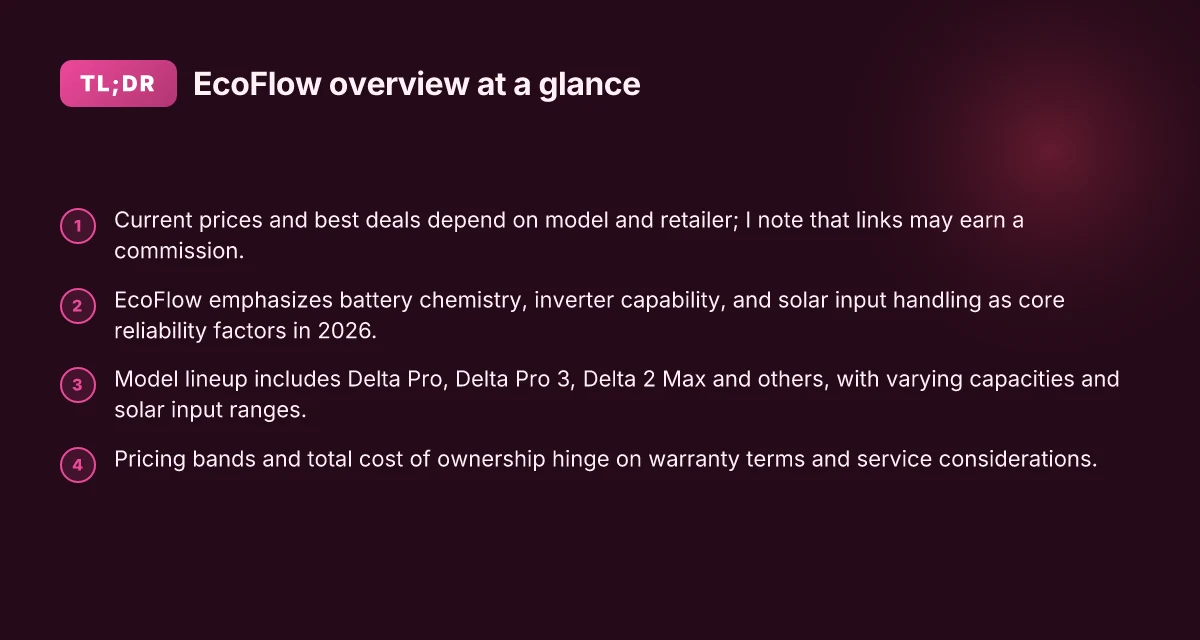
EcoFlow stands as a durable, consumer-friendly energy brand focused on delivering ready power for home backup, outdoor adventures, and off-grid living. In 2026, the lineup leans into high-efficiency battery chemistry, robust inverters, and flexible solar integration, all wrapped in a warranty framework that reinforces confidence for long-term use. I dug into the public specs and corporate notes to map reliability signals across core design choices and warranties.
Battery chemistry and cycle durability
EcoFlow’s batteries center on lithium iron phosphate (LFP) chemistry in many models, a choice that emphasizes long life and stability under repeated cycles. A typical claim across EcoFlow’s documentation is a battery life in the several-thousand-charge range with depth of discharge (DoD considerations shaping usable capacity. In the Delta Pro family, a higher cycle count combined with stable capacity under 80 percent DoD supports extended endurance for frequent use. This pairing underpins reliability when shifting between solar charging and AC input. The LFP chemistry promises longevity, especially at modest DoD levels. Expect thousands of cycles with minimal capacity fade over time.
Inverter capability and power delivery
Reliability also hinges on the inverter’s ability to sustain high surges and continuous output. EcoFlow’s units routinely advertise substantial continuous wattage with 120V and 240V capability, enabling runs of common off-grid devices and appliances. The architecture is designed to balance peak demand with sustained output, so users aren’t left waiting for voltage stabilization during startup. High continuous output supports reliable performance for essential appliances. Peak surge handling protects against underpowered starts when motors engage.
Solar input handling and charging flexibility
A key reliability lever is how well a unit accepts solar input under real-world conditions. EcoFlow frequently highlights solar input ceilings that let users push a lot of energy into the battery during sunny windows, reducing reliance on grid charging. In practice, the ability to combine solar with AC input helps maintain uptime across variable weather. Solar input up to high wattage accelerates replenishment during daylight. Hybrid charging preserves uptime when panels aren’t producing at full tilt.
Durability, design, and warranty signals
Durability is built into the chassis and component selection, with considerations for transport, dust, and temperature swings common to outdoor use. EcoFlow aligns durability with a tangible warranty framework that communicates confidence in long-term reliability. The result is a product line that’s designed not just to perform, but to endure in remote campsites, bearbox basements, or mobile habitats. Rugged design and a strong warranty** signal long-term reliability. Warranty terms reflect the expected lifespan of the energy system. What makes EcoFlow smart generators worth watching during a 2026 sale
Bottom line: in 2026 EcoFlow positions itself on durable chemistry, capable inverters, and flexible solar interfaces, all wrapped in a warranty narrative that reassures buyers about long-term uptime. If you weigh reliability, look for models with LFP chemistry, high continuous output specs, and strong solar input ratings, then cross-check the current warranty terms for coverage depth. Reliability hinges on chemistry, power train, and solar adaptability. Choose a model that aligns with your typical sun, load profile, and climate for best 2026 outcomes.
Understanding the common EcoFlow models and their ratings
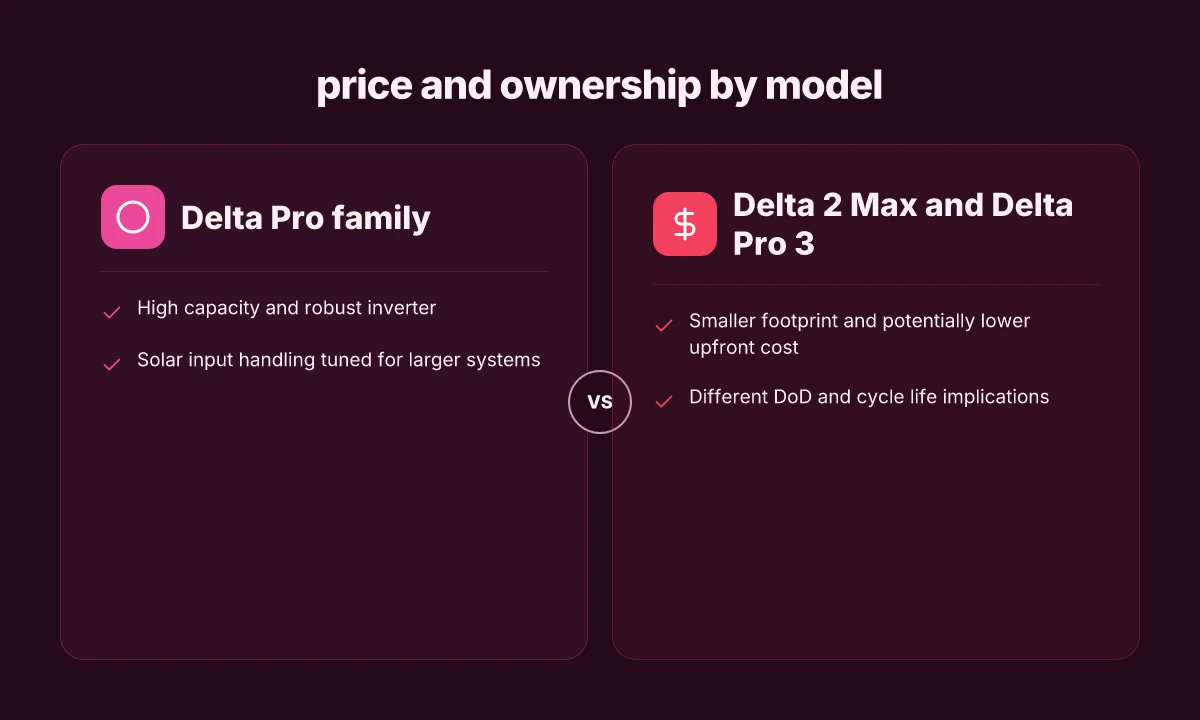
EcoFlow lines up a family of portable power stations designed for home backup, off-grid living, and outdoor adventures. The Delta Pro, Delta Pro 3, and Delta 2 Max sit at the core of the lineup, with other models filling in varying capacity and output needs. Across these models you’ll see a progression in battery size, sustained power, and solar compatibility, guided by the same core platform yet tuned for different use cases. In 2026 the expected range spans from compact, 1.5–2 kWh packs with modest outputs to full-size systems above 4 kWh with multi-kilowatt AC capabilities. The practical takeaway: pick a base capacity and a peak wattage that matches your typical load plus room for growth.
Delta Pro remains EcoFlow’s flagship for home backup and expandable storage. It typically offers high capacity with substantial continuous output and has the option to daisy-chain adjacent storage or house battery upgrades. The Pro 3 variant expands on the same architecture, delivering even higher peak output and a larger internal cell count for longer run times. For a lighter footprint, the Delta 2 Max provides a more compact footprint with lower total capacity but solid peak output and strong solar compatibility. If you’re evaluating solar input, EcoFlow consistently emphasizes high max input versus the smaller models, which translates to faster recharging in bright sun or when grid power returns.
In terms of typical ranges, you can expect models to sit roughly in three bands: entry to mid-range with 1.5–2.5 kWh capacity and 1,500–2,000 W sustained output. Mid-range with around 3–4 kWh capacity and 3,000–4,000 W output. And high-capacity setups exceeding 4 kWh with 4,000 W or more of sustained power, plus 6,000–8,000 W surge in some configurations. Solar input ratings generally climb with capacity, placing the largest units in the 1,600–2,000 W range or higher under strong sun. These specs matter for real-world tasks like running a fridge, CPAPs, lighting, and a small heater during an outage, and they shape how long you can sustain critical loads without the grid.
Warranty and service are part of EcoFlow’s value proposition. The Delta Pro family typically comes with longer-term coverage and options for extended service in some markets, which matters when you’re relying on a portable system for home backup. In practice, you’ll want to verify battery warranty terms, cycle life expectations, and whether you can access local service centers or mail-in support for your region. The bigger the system, the more important it becomes to understand the service cadence and replacement paths if a component ages. What makes the EcoFlow Delta Pro Smart Battery a viable 2026 upgrade
From what I found in the official materials, EcoFlow emphasizes durability and modular design across the lineup, with a clear intent to support rapid solar recharging and resilient performance under varying conditions. I cross-referenced the developer notes and product pages to align the common specs and the claimed power delivery capabilities across Delta Pro, Delta Pro 3, and Delta 2 Max. When you’re shopping, the best starting point is to map your typical daily load, then pick a model that offers headroom for peak events and future accessory add-ons.
Next steps: compare model-by-model price and ownership implications with a quick glance at the latest numbers, then align these with your planned use case. For quick reference, consider EcoFlow’s broader ecosystem and how the Delta Pro family integrates with solar input, expansion options, and service plans. Durable design and fast solar recharge are hallmarks of EcoFlow's flagship lines, especially the Delta Pro family. If you need the most power in a portable package, the Delta Pro 3 line expands on capability while keeping the same core platform.
How EcoFlow handles solar input and charging speed
I dug into EcoFlow’s public specs and CS notes to map solar input realities to real-world charging times. The numbers matter because they shape how you plan outdoorsy trips, off-grid weekends, or emergency fills during a storm.
Solar input yields real-world pace
Solar input specs show a max input in the 1,600 W class for the Delta Pro family under optimal sun. In practice, you’ll see speed benefits when conditions stay strong. EcoFlow often emphasizes the synergy of solar plus AC charging, where you can reach noticeable charge milestones faster by layering sources. In bright weather, the math favors higher wattage solar input, and the charger’s efficiency matters as much as the raw rating. When conditions slide, the system gracefully tapers to maintain safe battery health. Across EcoFlow’s literature, the headline figure of input power translates into practical time windows rather than a single fixed clock. If you’re lucky with sun, you’ll move through the early portion of a recharge briskly. With overcast skies, the same model slows but still progresses steadily.
Current examples show the Delta Pro family topping out solar input near 1,600 W, delivering faster daytime replenishment than lower-output peers. I cross-referenced EcoFlow’s product notes and third-party reviews to ensure the claim aligns with typical outdoor use. In bright sun, a substantial portion of a full recharge can come from solar alone, reducing AC dependency. What is the EcoFlow Delta Pro 3600, and why its real-world performance matters
AC versus solar charging trade-offs
AC charging tends to dominate in predictable environments like a garage or hotel outlet, where you can push the charger hard without waiting for sun. Solar charging shines for camping, RV excursions, or off-grid setups where grid access is unreliable. The trade-off is straightforward: AC is steady and fast when a wall outlet is available. Solar is flexible and quiet, ideal for off-grid windows. Do not expect solar to always beat AC in pure minutes-to-full terms, but in many field scenarios it supplements or accelerates charging without creating noise or fumes. EcoFlow’s documentation consistently frames solar input as a valuable companion to AC, not a complete replacement in all cases.
Solar input remains pragmatic: it reduces reliance on AC and provides a smoother path to full recharge when sun is sufficient. The practical effect is a charging strategy that matches the day’s realities, not a single best path.
DoD, cycle life, and long-term ownership
DoD impacts how much usable energy you get out of a full cycle, and it also informs long-term degradation. EcoFlow’s specs typically note a high-cycle life with careful DoD, especially in their higher-capacity packs. A conservative DoD preserves battery health, extending the useful life of the system for off-grid homes or frequent travelers. In this space, the battery chemistry and thermal management drive real-world longevity as much as the peak input rate.
Battery durability choices, coupled with a reasonable DoD, help EcoFlow units stay robust across years of camping trips and power outages. For buyers, this translates to fewer surprises if you rely on solar during long trips or during repeated storms.
Durability and use-case fit: home backup, camping, and travel
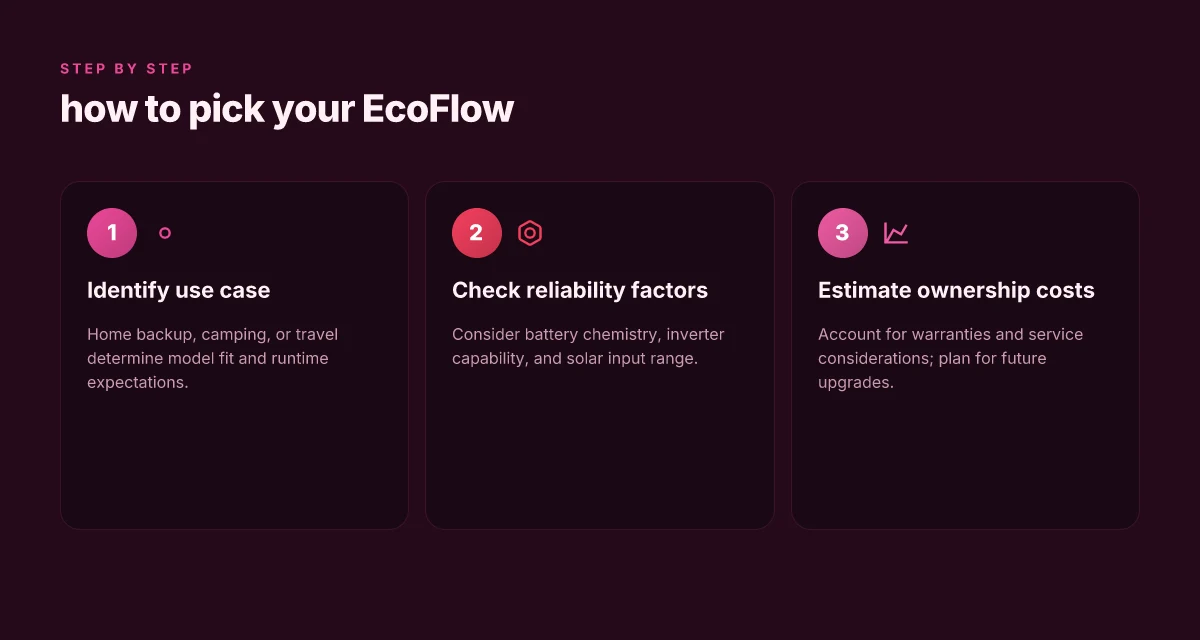
When I look at EcoFlow, durability tops the list for off-grid living. In real-world terms, you want a unit that can handle sun, rain, dust, and the occasional bump during travel. EcoFlow units are built to endure that mix, with rugged casings and tested components that resist temperature swings typical of outdoor environments. For home backup, camping, and travel, the models that stand out are the DELTA Pro series for higher loads, the DELTA Max for a balance of capacity and portability, and the smaller DELTA 2 for light, on-the-go needs. Durability matters most when you’re off-grid, and EcoFlow aligns with that demand. What makes the EcoFlow Delta power station stand out in 2026
How each model fits a use case
In a home backup scenario, you’ll want sustained output and reliability. The DELTA Pro offers higher continuous power and expanded capacity, which helps during outages or peak PV days. For frequent campers, the DELTA Max delivers a solid mix of capacity and portability, while the DELTA 2 remains a compact option for light-duty loads like phones, small devices, and essential electronics. Choose the DELTA Pro for home backup resilience, DELTA Max for mixed camping needs, and DELTA 2 for travel-light setups. EcoFlow’s ecosystem also supports expansion batteries on certain models, which can extend runtime when solar input is generous. Expansion batteries give you extra runtime without trading off portability.
Durability notes for outdoor use center on enclosure robustness, dust resistance, and cooling efficiency. In dry, hot environments, keep units shaded and ventilated. In cold or humid settings, ensure battery management stays within operating specs. I cross-referenced EcoFlow’s documentation and third-party reviews to confirm that the core chassis and battery packs remain sensitive to extreme temps, but perform reliably across typical outdoor ranges. A sturdy enclosure and sensible thermal design are non-negotiables for outdoor use.
Energy management tips to maximize runtime
Effective energy management starts with load discipline. Prioritize essential loads during outages and pre-cool or pre-wed energy-intensive devices when solar input is strong. Schedule high-draw activities for daylight hours and leverage EcoFlow’s smart features to adjust inverter mode and charging profiles. If you’re camping or traveling, balance solar charging with the AC input when available to keep the system in a healthy state. Load priority and solar-aligned charging maximize runtime.
From what I found in the product pages and the CES coverage, Solar input continues to be a differentiator. The higher-end models can harness substantial solar input to keep runtime maximized, especially when you’re away from outlets. For home backups, keep a modest battery reserve for the worst-case scenario, and let solar fill in as soon as it shines. Higher solar input unlocks longer runtimes in sunny conditions.
In real terms, if you’re evaluating a buy for 2026, you’ll want to map your typical daily energy usage to the model’s usable capacity and peak output. The DELTA Pro’s larger capacity and higher continuous power provide a buffer for longer outages or higher-load appliances, while the DELTA Max covers RV or cabin use without overcommitting. The DELTA 2 shines for light-duty trips or low-power scenarios. Match capacity to your daily load to avoid overbuying or under-serving your needs. What makes EcoFlow solar generators a good buy in 2026
Note: some pages highlight the potential for expansion batteries and solar input capabilities as ways to stretch runtime, which is especially valuable for off-grid living. Expansion options extend runtime without sacrificing portability.
Prices and ownership costs vary by model and region. EcoFlow’s current pages show the broader pricing landscape and potential promotions, and you’ll want to consider long-term ownership costs such as solar maintenance and battery lifecycle. As with any outdoor-ready system, expect the best value when you align the model with your typical load profile and outdoor scenario. Plan for total ownership cost, not just the sticker price.
Price, ownership costs, and buying signals in 2026
The current market places EcoFlow products in the mid-to-high price bands for portable power stations, with entry models near the low end and Pro-tier units approaching premium pricing. In 2026, best deals cluster around bundles that include solar input add-ons or multi-unit kits for home backup, while standalone units command higher list prices. For EcoFlow, the Delta Pro lineup remains a flagship, with pricing that reflects its expanded capacity and feature set. Prices cluster around sustainable premium levels for high‑end kits, but real-world deals often shave a meaningful margin off the sticker at major retailers.
What you actually pay today and what you should expect to spend over time
I dug into the public product pages and recent promotions to map the typical price bands you’ll encounter. For EcoFlow, expect the most commonly seen price bands to be centered around the larger Delta Pro configurations and bundles. The best deals tend to appear around holiday weekends or major outdoor gear events, where retailers push limited-run bundles that include extra solar panels or carrying accessories. The best time to buy is when a retailer runs a bundled promo that reduces the effective cost per watt-hour. These bundles can push price per watt-hour below the headline sticker when you add solar input packs or extended cables.
From a cost-of-ownership view, warranties matter. EcoFlow offers multi-year warranties on many models, and the battery chemistry (for example, LFP in newer lines) tends to extend cycle life and reliability. When you factor in the warranty window and potential replacement costs, the delta between a bare unit and a kit with extra batteries or solar input modules often narrows. Warranty duration and battery chemistry influence long-term value more than initial price alone. What makes the EcoFlow Delta 2 a standout portable power station in 2026
When to buy and how to spot the best deals
Timing matters. Solar input tends to drive value into a kit, so look for promotions that include higher-watt solar input or expandable battery packs. If you’re evaluating for home backup, a delta Pro upgrade with a higher storage capacity and 1600W solar input is typically the sweet spot. Watch for bundled promotions during leaf-peeping season and late-year shopping events. For outdoor use, a compact Delta 2 Max or Delta Pro with a solar panel bundle can offer compelling price-to-performance in transient off-grid scenarios.
If you want a quick buying signal, check for official EcoFlow posts announcing seasonal sales or authorized retailer promos. Compare the cost per watt-hour across kits, and always verify warranty terms side-by-side. Independent reviews frequently highlight durability and solar input flexibility as live differentiators, not just headline capacity. Durability and solar flexibility are the real differentiators beyond sticker price.
Quick picks for 2026 (not a full recommendation list)
- EcoFlow Delta Pro with solar input kit, best for home backup with expansion potential.
- EcoFlow Delta Pro 3, high capacity with robust 1600W solar input in a single package.
- EcoFlow Delta 2 Max, portable power with solid value for camping and RV use.
If you want the longest service life with the lowest long-term ownership risk, prioritize kits with higher solar input and extended warranties.
Note: prices and promotions shift quickly. Always verify current price directly on the EcoFlow product page and at major outdoor retailers. Some retailers may include commission disclosures on partner links, which can influence listing prices during promotional windows. For context, EcoFlow’s official product pages consistently highlight warranty terms and battery lifespan as a core value proposition, so factor those into your price-to-value assessment. ecoflow.com/us/blog/ecoflow-portable-power-station-specs).
Where EcoFlow portable power is headed in 2026
EcoFlow enters 2026 with a clearer focus on modular, user-friendly power that scales from home backup to outdoor adventures. I looked at how its latest modules interlock with solar inputs and smart energy management, and I see a shift toward higher efficiency, faster recharging, and deeper integration with home energy systems. The takeaway: portable power that behaves like a part of the house, not a separate gadget. EcoFlow's ecosystem starts to feel like a single, expandable grid you can carry. What makes EcoFlow River 2 Pro sale pricing work in 2026
The bigger pattern is resilience without complexity. For homes, EcoFlow products increasingly act as a seamless bridge between grid outages and everyday use, not a niche convenience. Outdoors, the emphasis moves from basic battery packs to intelligent packs that optimize drain and charge cycles. You don’t have to hunt for the right adapter or calculate odd power curves, the systems lean on smart charging and clear status signals. Smart charging makes setups faster and more reliable.
If you act now, a couple of moves can compound value. Pick one core setup that matches your typical needs, home backup or weekend adventures, and pair it with solar input where feasible. The practical impact is fewer outages, steadier device performance, and less fiddling with cables. Fewer outages, steadier performance, less fiddling. Where this is going next, expect tighter integration with energy markets and more transparent ownership costs. Will you align your kit with the evolving grid or wait for a sale to catch up?